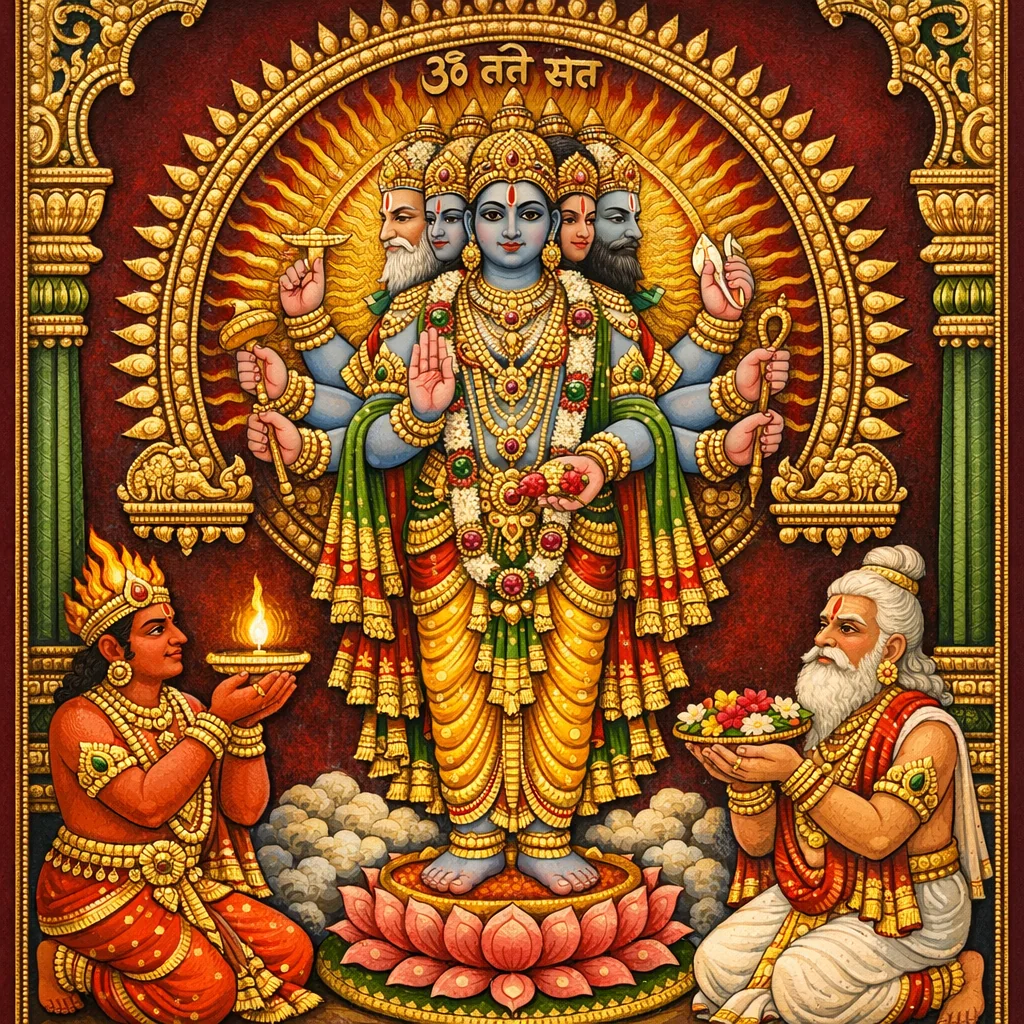
Adhyaya 380
अध्याय ३८० — गीतासारः (The Essence of the Gītā)
This chapter shifts from prior advaita-brahma-vijñāna to a concentrated “Gītā-sāra” taught by Agni: a curated digest of Kṛṣṇa’s counsel to Arjuna, promising both bhukti (worldly fruition) and mukti (liberation). It moves from the metaphysics of the unborn Self that ends grief to the psychology of bondage—sense-contact → attachment → desire → anger → delusion → ruin—prescribing sat-saṅga and desire-renunciation as the pivot to steady wisdom. It establishes karma-yoga: act while offering works into Brahman, abandon attachment, and see the Self in all beings. Devotion and refuge in the Lord are given as the means to cross māyā, with precise definitions of adhyātma, adhibhūta, adhidaivata, and adhiyajña, and the doctrine of final remembrance (smaraṇa) at death with Oṃ. The chapter further explains kṣetra/kṣetrajña and the disciplines of “knowledge” (humility, non-violence, purity, detachment), describes Brahman’s all-pervading nature, and systematizes a guṇa-based taxonomy of knowledge, action, doer, austerity, charity, and food. It concludes by sacralizing svadharma as worship of Viṣṇu, linking practical duty to spiritual perfection in Agni Purāṇa’s encyclopedic synthesis of ethics, yoga, and metaphysics.
Shlokas
Verse 1
इत्य् आग्नेये महापुराणे अद्वैतव्रह्मविज्ञानं नमोनाशीत्यधिकत्रिशततमो ऽध्यायः अथाशीत्यधिकत्रिशततमो ऽध्यायः गीतासारः अग्निर् उवाच गीतासारं प्रवक्ष्यामि सर्वगीतोत्तमोत्तमं कृष्णो ऽर्जुनाय यमाह पुरा वै भुक्तिमुक्तिदं
Thus, in the Agni Mahāpurāṇa, the chapter on the knowledge of non-dual Brahman—namely, the three-hundred-and-seventy-ninth chapter—comes to an end. Now begins the three-hundred-and-eightieth chapter, “The Essence of the Gītā.” Agni said: “I shall expound the essence of the Gītā—supremely excellent among all teachings called ‘gītā’—which Kṛṣṇa formerly spoke to Arjuna, and which bestows both worldly enjoyment and liberation.”
Verse 2
श्रीभगवानुवाच गतासुरगतासुर्वा न शोच्यो देहवानजः आत्माजरो ऽमरो ऽभेद्यस्तस्माच्छोकादिकं त्यजेत्
The Blessed Lord said: “Whether the embodied being has lost the vital breath or has not lost it, he is not fit to be grieved for. The Self (Ātman) is unborn, without old age, deathless, and inviolable; therefore one should abandon grief and the like.”
Verse 3
ज्ञानात् सौवीरभूपतिरिति ख , ञ च पठतां भुक्तिमुक्तिदमिति ख ध्यायतो विषयान् पुंसः सङ्गस्तेषूपजायते सङ्गात् कामस्ततः क्रोधः क्रोधात्सम्मोह एव च
For a man who repeatedly dwells on sense-objects, attachment to them arises; from attachment springs desire, then anger; and from anger alone arises complete delusion.
Verse 4
अम्मोहात् स्मृतिविभ्रंशो बुद्धिनाशात् प्रणश्यति दुःसङ्गहानिः सत्सङ्गान्मोक्षकाभी च कामनुत्
From delusion arises confusion of memory; from the ruin of discernment (buddhi) one is destroyed. The loss that comes from bad company is removed by the company of the good (satsaṅga); and from that good association arises the desire for liberation (moksha).
Verse 5
कामत्यागादात्मनिष्ठः स्थिरप्रज्ञस्तदोच्यते या निशा सर्वभूतानां तस्यां जागर्ति संयमी
Through renunciation of desire, one becomes established in the Self (Ātman); such a one is called steady in wisdom. That which is ‘night’ for all beings—within that state the self-controlled one remains awake.
Verse 6
यस्यां जाग्रति भूतानि सा निशा पश्यतो मुनेः आत्मन्येव च सन्तुष्टस्तस्य कार्यं न विद्यते
That which is ‘wakefulness’ for ordinary beings is night to the seeing sage; and one who is content in the Self alone has no obligatory task to perform.
Verse 7
नैव तस्य कृते नार्थो नाकृते नेह कश् चनः तत्त्ववित्तु महावहो गुणकर्मविभागयोः
For the knower of reality, O mighty-armed one, there is here no purpose served by what is done, nor any loss by what is left undone—for he understands the true distinction between qualities (guṇas) and actions (karma).
Verse 8
गुणा गुनेषु वर्तन्ते इति मत्वा न सज्जते सर्वं ज्ञानप्लवेनैव वृजिनं सन्तरिष्यति
Knowing that the guṇas operate only among the guṇas, one does not become attached; by the raft of knowledge alone, one completely crosses over sin and adversity.
Verse 9
ज्ञानाग्निः सर्वकर्माणि भस्मसात् कुरुते ऽर्जुन ब्रह्मण्याधाय कर्माणि सङ्गन्त्यक्त्वा करोति यः
O Arjuna, the fire of knowledge reduces all actions to ashes; one who performs actions after placing them in Brahman—having abandoned attachment—is thereby purified.
Verse 10
लिप्यते न स पापेन पद्मपत्रमिवाम्भसा सर्वभूतेषु चात्मानं सर्वभूतानि चात्मनि
He is not tainted by sin—just as a lotus leaf is not wetted by water—who sees the Self (Ātman) in all beings, and all beings within the Self.
Verse 11
ईक्षते योगयुक्तात्मा सर्वत्र समदर्शनः शुचीनां श्रीमतां गेहे योगभ्रष्टो ऽभिजायते
The yogin whose self is disciplined in Yoga—seeing with equal vision everywhere—though interrupted from Yoga, is born again in the household of the pure and the prosperous.
Verse 12
न हि कल्याणकृत् कश्चिद्दुर्गतिं तात गच्छति देवी ह्य् एषा गुणमयी मम माया दुरत्यया
Indeed, no one who performs righteous deeds ever goes to a bad destiny, dear one. For this is the Goddess—My Māyā—constituted of the guṇas, and she is difficult to cross over.
Verse 13
मामेव ये प्रपद्यन्ते मायामेतान्तरन्ति ते आर्तो जिज्ञासुरर्थार्थो ज्ञानी च भरतर्षभ
Those who take refuge in Me alone cross over this Māyā. (They are of four kinds:) the distressed, the seeker of knowledge, the seeker of material gain, and the knower—O best of the Bharatas.
Verse 14
चतुर्विधा भजन्ते मां ज्ञानी चैकत्वमास्थितः अक्षरं ब्रह्म परमं स्वभावो ऽध्यात्ममुच्यते
Four kinds of devotees worship Me; and the knower (jñānī) abides in oneness. The Imperishable (Akṣara) is the Supreme Brahman; one’s intrinsic nature is called adhyātma, the inner spiritual principle.
Verse 15
भूतभावोद्भवकरो विसर्गः कर्मसंज्ञितः अधिभूतं क्षरोभावः पुरुषश्चाधिदैवतं
That “emanative projection” (visarga) which brings forth the arising of states and beings is termed karma (action). The perishable condition (kṣara-bhāva) is called the adhibhūta (the domain of elements), and the Puruṣa is called the adhidaivata (the presiding divine principle).
Verse 16
अधियज्ञोहमेवात्र देहे देहभृतां वर अन्तकाले स्मरन्माञ्च मद्भावं यात्यसंशयः
I alone am the Adhiyajña here within the body, O best among embodied beings. And whoever, at the final moment, remembers Me, attains My state—without doubt.
Verse 17
यं यं भावं स्मरन्नन्ते त्यजेद्देहन्तमाप्नुयात् प्राणं न्यस्य भ्रुवोर्मध्ये अन्ते प्राप्नोति मत्परम्
Whatever state of being a person remembers at the final moment, upon leaving the body he attains that very state. And, placing (steadying) the life-breath in the space between the eyebrows at the time of death, he finally reaches the Supreme that is devoted to Me (i.e., attains Me as the highest goal).
Verse 18
ओमित्येकाक्षरं ब्रह्मवदन् देहं त्यजन्तथा ब्रह्मादिस्तम्भपर्यन्ताः सर्वे मम विभूतयः
Uttering the one-syllabled Brahman—“Om”—and thus casting off the body; from Brahmā down to the (lowest) immobile beings, all are My manifestations (vibhūtis).
Verse 19
श्रीमन्तश्चोर्जिताः सर्वे ममांशाः प्राणिनःस्मृताः अहमेको विश्वरूप इति ज्ञात्वा विमुच्यते
All beings are remembered as my portions—prosperous and powerful. Knowing, “I alone am the one, the universe-formed (viśvarūpa),” one is liberated.
Verse 20
क्षेत्रं शरीरं यो वेत्ति क्षेत्रज्ञः स प्रकोर्तितः क्षेत्रक्षेत्रज्ञयोर्ज्ञानं यत्तज्ज्ञानं मतं मम
One who knows the ‘field’ (kṣetra)—the body—is declared to be the Knower of the Field (kṣetrajña). And the knowledge concerning both the Field and the Knower of the Field—this indeed is what I regard as true knowledge.
Verse 21
महाभूतान्यहङ्कारो बुद्धिरव्यक्तमेव च इन्द्रयाणि देशैकञ्च पञ्च चेन्द्रियगोचराः
The great elements (mahābhūta), ego-principle (ahaṅkāra), intellect (buddhi), and also the unmanifest (avyakta—Prakṛti); the sense-faculties, and the single all-pervading space (ākāśa); and the five objects of the senses—these are enumerated.
Verse 22
इच्छा द्वेषः सुखं दुःखं सङ्घातश्चेतना धृतिः एतत्क्षेत्रं समासेन सविकारमुदाहृतं
Desire, aversion, pleasure, pain, the aggregate (of body and senses), consciousness/volition (cetanā), and steadfastness (dhṛti)—this, in brief, is declared to be the kṣetra (the embodied ‘field’), together with its modifications.
Verse 23
अमानित्वमदम्भित्वमहिंसा क्षान्तिरार्जवम् आचार्योपासनं शौचं स्थैर्यमात्मविनिग्रहः
Humility (amānitva), absence of hypocrisy (adambhitva), non-violence (ahiṃsā), forbearance (kṣānti), straightforwardness (ārjava), devoted service to one’s teacher (ācāryopāsana), purity (śauca), steadiness (sthairya), and self-restraint (ātma-vinigraha)—these are the disciplines to be cultivated.
Verse 24
इन्द्रियार्थेषु वैराग्यमनहङ्कार एव च जन्ममृत्युजराव्याधिदुःखदोषानुदर्शनं
Dispassion toward the objects of the senses (vairāgya), and indeed egolessness (anahaṅkāra); and the constant contemplation of the faults inherent in birth, death, old age, disease, and suffering—this is to be practiced.
Verse 25
आसक्तिरनभिष्वङ्गः पुत्रदारगृहादिषु ममाङ्गा इति ख नित्यञ्च समचित्तत्त्वमिष्टानिष्टोपपत्तिषु
Non-attachment and the absence of clinging toward sons, wife, home, and the like; the constant insight that they are not “my very limbs”; and perpetual even-mindedness amid the arising of what is desirable and undesirable.
Verse 26
मयि चानन्ययोगेन भक्तिरव्यभिचारिणी विविक्तदेशसेवित्वमरतिर्जनसंसदि
And unwavering devotion to Me through exclusive yoga; the discipline of resorting to secluded places; and disinclination toward the company and assemblies of people.
Verse 27
अध्यात्मज्ञाननिष्ठत्वन्तत्त्वज्ञानानुदर्शनं एतज्ज्ञानमिति प्रोक्तमज्ञानं यदतो ऽन्यथा
Steadfastness in spiritual (inner) knowledge, and the direct contemplative realization of truth—this is declared to be “knowledge”; whatever is contrary to this is “ignorance”.
Verse 28
ज्ञेयं यत्तत् प्रवक्ष्यामि यं ज्ञात्वामृतमश्नुते अनादि परमं ब्रह्म सत्त्वं नाम तदुच्यते
I shall declare that Reality which is to be known—knowing which one attains immortality. That beginningless, supreme Brahman is said to be called “Sattva.”
Verse 29
सर्वतः पाणिपादान्तं सर्वतो ऽक्षिशिरोमुखम् सर्वतः श्रुतिमल्लोके सर्वमावृत्य तिष्ठति
With hands and feet on every side, with eyes, heads, and faces on every side, and with hearing present everywhere in the world—He stands, pervading and enveloping all.
Verse 30
सर्वेन्द्रियगुणाभासं सर्वेन्द्रियविवर्जितम् असक्तं सर्वभृच्चैव निर्गुणं गुणभोक्तृ च
He manifests as the qualities of all the senses, yet is devoid of all senses; unattached, the sustainer of all; without attributes (nirguṇa), and yet the experiencer of attributes (guṇa).
Verse 31
वहिरन्तश् च भूतानामचरञ्चरमेव च सूक्ष्मत्वात्तदविज्ञेयं दूरस्थञ्चान्तिके ऽपि यत्
It is outside and also within all beings—indeed, both the unmoving and the moving; because of its extreme subtlety it is unknowable to ordinary perception; and it is both far away and yet near.
Verse 32
अविभक्तञ्च भूतेषु विभक्तमिव च स्थितम् भूतभर्तृ च विज्ञेयं ग्रसिष्णु प्रभविष्णु च
It is undivided among beings, yet it stands as though divided. It should be understood as the sustainer of beings—also as the devourer at dissolution and the source at creation.
Verse 33
ज्योतिषामपि तज्ज्योतिस्तमसः परमुच्यते ज्ञानं ज्ञेयं ज्ञानगम्यं हृदि सर्वस्य धिष्ठितं
That Supreme Reality is declared to be the Light even of lights, and the highest beyond darkness; it is Knowledge, the Object of knowledge, and that which is attained through knowledge—abiding in the heart of all.
Verse 34
ध्यानेनात्मनि पश्यन्ति केचिदात्मानमात्मना अन्ये साङ्ख्येन योगेन कर्मयोगेन चापरे
Some perceive the Self within the self by the self through meditation; others through Sāṅkhya and Yoga, and still others through Karma-yoga.
Verse 35
अन्ये त्वेवमजानन्तो श्रुत्वान्येभ्य उपासते तेपि चाशु तरन्त्येव मृत्युं श्रुतिपरायणाः
Others, not knowing it in this very way, worship the Supreme after hearing it from others; they too swiftly cross beyond death, being devoted to the authority of the Śruti (Vedic revelation).
Verse 36
सत्त्वात्सञ्जायते ज्ञानं रजसो लोभ एव च प्रमादमोहौ तमसो भवतो ज्ञानमेव च
From sattva arises knowledge; from rajas arises greed indeed; from tamas arise heedlessness and delusion—and from tamas, ignorance as well.
Verse 37
गुणा वर्तन्त इत्य् एव यो ऽवतिष्ठति नेङ्गते मानावमानमित्रारितुल्यस्त्यागी स निर्गुणः
He who remains established in the understanding, “the qualities (guṇas) alone operate,” and therefore does not waver—who regards honor and dishonor, friend and enemy as equal, and who is a renouncer—he is truly nirguṇa, beyond the guṇas.
Verse 38
ऊर्ध्वमूलमधःशाखमश्वत्थं प्राहुरव्ययं छन्दांसि यस्य पर्णानि यस्तं वेद स वेदवित्
They speak of the imperishable aśvattha as having its root above and its branches below; the Vedic metres (chandas) are its leaves. Whoever truly knows that tree is a knower of the Veda.
Verse 39
द्वौ भूतसर्गौ लोके ऽस्मिन् दैव आसुर एव च अहिंसादिः क्षमा चैव दैवीसम्पत्तितो नृणां
In this world there are two types of beings: the divine and the demoniac. Non-violence (ahiṃsā) and the like, and also forbearance (kṣamā), are the divine endowments of human beings.
Verse 40
न शौचं नापि वाचारो ह्य् आसुरीसम्पदोद्धवः नरकत्वात् क्रोधलोभकामस्तस्मात्त्रयं त्यजेत्
Purity and proper conduct do not arise from demonic (āsuric) dispositions; and since anger, greed, and desire lead to hellish states, therefore one should abandon these three.
Verse 41
यज्ञस्तपस् तथा दानं सत्त्वाद्यैस्त्रिविधं स्मृतम् आयुः सत्त्वं बलारोग्यसुखायान्नन्तु सात्त्विकं
Sacrifice (yajña), austerity (tapas), and gift-giving (dāna) are taught as threefold, according to the three guṇas beginning with sattva. Sāttvic food, however, is that which promotes longevity, clarity of mind, strength, freedom from disease, and happiness.
Verse 42
दुःखशोकामयायान्नं तीक्ष्णरूक्षन्तु राजसं अमेध्योच्छिष्टपूत्यन्नं तामसं नीरसादिकं
Food that gives rise to suffering, grief, and disease is called rājasa, being especially pungent and drying. Food that is impure—such as leftovers and putrid fare—is called tāmasa, being tasteless and the like.
Verse 43
यष्टव्यो विधिना यज्ञो निष्कामाय स सात्त्विकः यज्ञः फलाय दम्भात्मी राजसस्तामसः क्रतुः
A sacrifice should be performed according to prescribed rule; when it is undertaken by one who is free from desire for reward, it is sāttvika. But a sacrifice performed for the sake of results—by one whose nature is ostentatious—is rājasa; and when done in a degraded manner, it becomes a tāmasa rite.
Verse 44
श्रद्धामन्त्रादिविध्युक्तं तपः शारीरमुच्यते देवादिपूजाहिंसादि वाङ्मयं तप उच्यते
Austerity (tapas) performed in accordance with faith (śraddhā), mantras, and prescribed rules is called bodily (śārīra) tapas. Worship of the gods and the like, non-violence (ahiṃsā), and related disciplines are called verbal (vāṅmaya) tapas.
Verse 45
अनुद्वेगकरं वाक्यं सत्यं स्वाध्यायसज्जपः मानसं चित्तसंशुद्धेर्सौनमात्सविनिग्रहः
Speech that does not agitate, truthfulness, and diligent recitation of svādhyāya (self-study); and, for the purification of the mind, inner discipline—together with restraint from bathing for pleasure and from indulgent festivities.
Verse 46
सात्त्विकञ्च तपो ऽकामं फलाद्यर्थन्तु राजसं तामसं परपीडायै सात्त्विकं दानमुच्यते
Austerity (tapas) performed without desire for reward is called sāttvika; that undertaken for the sake of results and advantages is rājasa; and that done to injure others is tāmasa. Charity (dāna), too, is said to be sāttvika when aligned with such purity of intent.
Verse 47
देशादौ चैव दातव्यमुपकाराय राजसं आदेशादाववज्ञातं तामसं दानमीरितं
A gift given with regard to place and the like, in order to gain some return or advantage, is called rājasa. But a gift given in disregard of proper injunctions and with contempt is declared to be tāmasa.
Verse 48
ओंतत्सदिति निर्देशो ब्रह्मणस्त्रिविधः स्मृतः यज्ञदानादिक कर्म बुक्तिमुक्तिप्रदं नृणां
“Om”, “Tat”, and “Sat”—this is remembered as the threefold designation of Brahman. For human beings, acts such as yajña (sacrifice) and dāna (gift-giving), when performed in this spirit, bestow both worldly enjoyment and liberation (mokṣa).
Verse 49
अनिष्टमिष्टं मिश्रञ्च त्रिविधं कर्मणः फलं भवत्यत्यागिनां प्रेत्य न तु सन्न्यासिनां क्वचित्
The fruit of action is threefold—undesired, desired, and mixed—and it accrues after death to those who do not renounce the fruits; but it does not accrue at any time to true renunciants (sannyāsins).
Verse 50
तामसः कर्मसंयोगात् मोहात्क्लेशभयादिकात् राजसः सात्त्विको ऽकामात् पञ्चैते कर्महेतवः
Action has five motivating causes: (1) the tāmasic, arising from blind association with action; (2) that born of delusion (moha); (3) that born of affliction, fear, and the like; (4) the rājasic; and (5) the sāttvic, performed without selfish desire—these are the five causes of action.
Verse 51
अधिष्ठानं तथा कर्ता करणञ्च पृथग्विधम् त्रिविधाश् च पृथक् चेष्टा दैवञ्चैवात्र पञ्चमं
Here, the five factors are: the locus or basis of action, the agent, the various kinds of instruments, the distinct activity (of threefold type), and—fifth—the divine factor (daiva, destiny).
Verse 52
एकं ज्ञानं सात्त्विकं स्यात् पृथग् ज्ञानन्तु राजसं अतत्त्वार्थन्तामसं स्यात् कर्माकामाय सात्त्विकं
Knowledge that apprehends the One (the single reality) is understood as sāttvika; knowledge that sees plurality and separateness is rājasa; and knowledge directed toward what is unreal or not truly the essence is tāmasa. Action performed without desire for reward is sāttvika.
Verse 53
कामाय राजसं कर्म मोहात् कर्म तु तामसं सीध्यसिद्ध्योः समः कर्ता सात्त्विको राजसो ऽत्यपि
Action performed for the sake of desire is rājasa; action performed out of delusion (moha) is tāmasa. The doer who remains the same in success and failure is sāttvika, whereas one driven excessively by passion is rājasa.
Verse 54
शठो ऽलसस्तामसः स्यात् कार्यादिधीश् च सात्त्विकी कार्यार्थं सा राजसी स्याद्विपरीता तु तामसी
A deceitful or indolent person is to be regarded as tāmasika. The understanding that governs and directs proper duties and the like is sāttvika. The understanding that acts for the sake of accomplishing ends is rājasa; but the contrary is tāmasa.
Verse 55
मनोधृतिः सात्त्विकी स्यात् प्रीतिकामेति राजसी तामसी तु प्रशोकादौ मुखं सत्त्वात्तदन्तगं
Mental steadiness (manodhṛti) is sāttvika; what arises from delight and desire is rājasika; but the tāmasika state appears at the onset of intense grief and the like—its sign is a downcast face; and its outcome is governed by one’s prevailing sattva, ending in accordance with that disposition.
Verse 56
सुखं तद्राजसञ्चाग्रे अन्ते दुःखन्तु तामसं अतः प्रवृत्तिर्भूतानां येन सर्वमिदन्ततं
That impulse is rājasa: it is pleasant at the beginning, but in the end it becomes painful and tāmasa. Therefore the activity (pravṛtti) of living beings arises through it—by it this entire world-process is pervaded and extended.
Verse 57
स्वकर्मणा तमभ्यर्च्य विष्णुं सिद्धिञ्च विन्दति कर्मणा मनसा वाचा सर्वावस्थासु सर्वदा
By worshipping Him—Viṣṇu—through one’s own prescribed duty (svakarma), one attains accomplishment (siddhi). By deed, by mind, and by speech—at all times and in every condition—one should worship Him.
Verse 58
भवत्ययोगिनामिति ख ब्रह्मादिस्तम्भपर्यन्तं जगद्विष्णुञ्च वेत्ति यः सिद्धिमाप्नोति भगवद्भक्तो भागवतो ध्रुवं
Indeed, even for those who are not yogins, the devotee of the Blessed Lord—who knows that the entire cosmos, from Brahmā down to a mere blade of grass, is pervaded and governed by Viṣṇu—certainly attains spiritual perfection (siddhi) without fail.
Frequently Asked Questions
It presents Kṛṣṇa’s distilled teaching as bhukti-mukti-prada: it supports righteous worldly life through disciplined action and ethics, and culminates in liberation through knowledge, devotion, and non-attachment.
Bondage arises from repeated dwelling on sense-objects leading to attachment, desire, anger, delusion, memory-confusion, and loss of discernment; the remedy is sat-saṅga, desire-renunciation, steadiness of wisdom, and karma performed without attachment as an offering to Brahman.
It defines adhyātma (intrinsic spiritual principle), adhibhūta (perishable elemental domain), adhidaivata (presiding divine principle as Puruṣa), and adhiyajña (the Lord within the body), alongside kṣetra/kṣetrajña and the guṇa-based classifications of knowledge and action.
It frames one’s own prescribed work as worship of Viṣṇu—performed by body, speech, and mind—so that practical duty becomes a yoga that yields siddhi and supports mokṣa through devotion and non-attachment.