Adhyaya 11
Dhruva Uses the Nārāyaṇāstra; Manu Checks His Wrath and Teaches Dharma
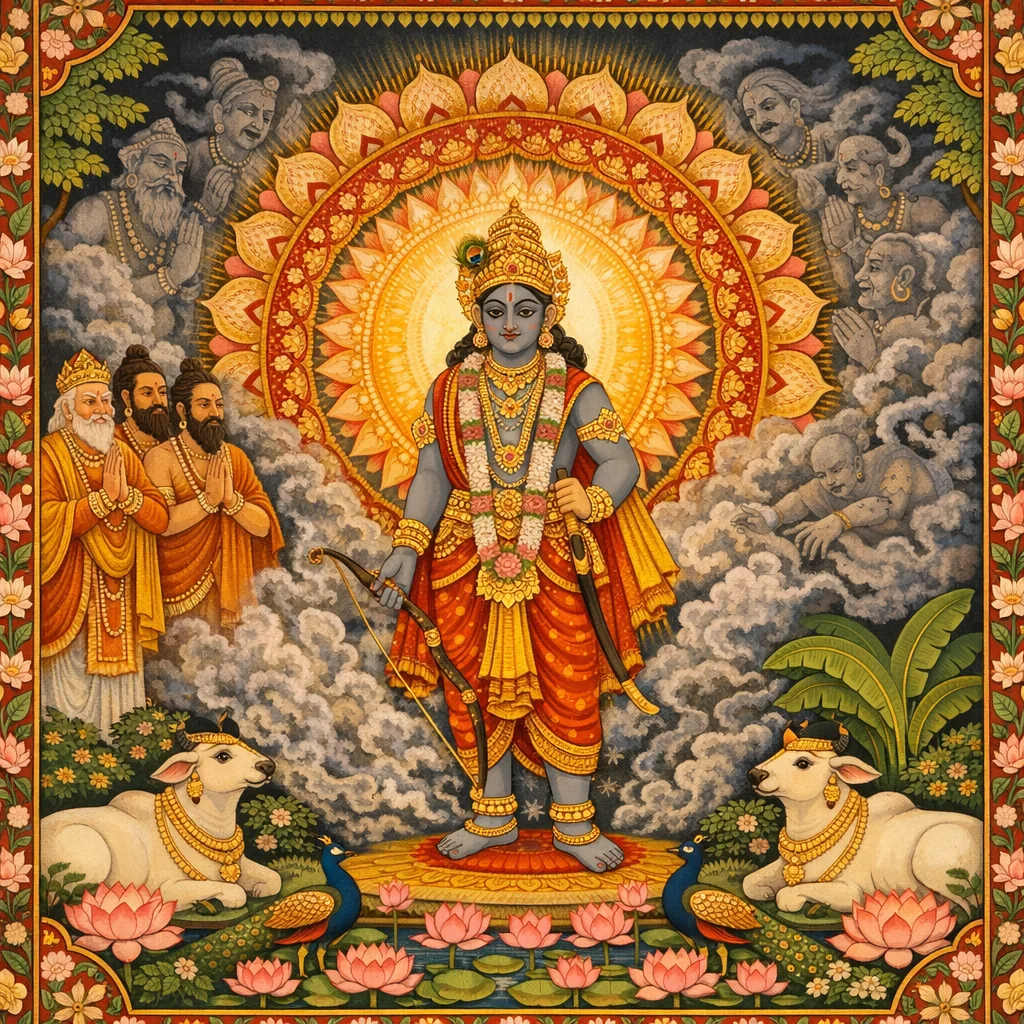
Following Dhruva’s campaign against the Yakṣas after Uttama’s death, this chapter opens with Dhruva, encouraged by sages, performing ācamana and deploying the nārāyaṇāstra, which instantly dispels Yakṣa illusion. Empowered, he releases devastating arrows and slaughters many Yakṣas—extending punishment beyond the actual offenders. Svāyambhuva Manu arrives with sages, intervening compassionately to halt Dhruva’s excessive anger. Manu instructs that uncontrolled wrath leads to hellish consequences, violates righteous family conduct, and contradicts the devotional path that forbids bodily identification and needless killing. He then gives a sustained metaphysical teaching: creation and destruction occur through the Lord’s māyā and the guṇas; the Lord is transcendent yet operates as time, neutrally awarding karmic results. The Yakṣas are not the true cause of Uttama’s fate; ultimate causality rests in the Supreme. Manu urges surrender, restoration of Dhruva’s original spiritual vision, and the practical step of pacifying Kuvera to prevent further offense. The chapter closes with Dhruva offering respects as Manu and the sages depart, setting up Dhruva’s reconciliation and the cooling of conflict in the next narrative movement.
Shlokas
Verse 1
मैत्रेय उवाच निशम्य गदतामेवमृषीणां धनुषि ध्रुव: । सन्दधेऽस्त्रमुपस्पृश्य यन्नारायणनिर्मितम् ॥ १ ॥
Śrī Maitreya said: My dear Vidura, when Dhruva Mahārāja heard the encouraging words of the great sages, he performed the ācamana by touching water and then took up his arrow made by Lord Nārāyaṇa and fixed it upon his bow.
Verse 2
सन्धीयमान एतस्मिन्माया गुह्यकनिर्मिता: । क्षिप्रं विनेशुर्विदुर क्लेशा ज्ञानोदये यथा ॥ २ ॥
As soon as Dhruva Mahārāja joined the nārāyaṇāstra arrow to his bow, the illusion created by the Yakṣas was immediately vanquished, just as all material pains and pleasures are vanquished when one becomes fully cognizant of the self.
Verse 3
तस्यार्षास्त्रं धनुषि प्रयुञ्जत: सुवर्णपुङ्खा: कलहंसवासस: । विनि:सृता आविविशुर्द्विषद्बलं यथा वनं भीमरवा: शिखण्डिन: ॥ ३ ॥
Even as Dhruva Mahārāja fixed the weapon made by Nārāyaṇa Ṛṣi onto his bow, arrows with golden shafts and feathers like the wings of a swan flew out from it. They entered the enemy soldiers with a great hissing sound, just as peacocks enter a forest with tumultuous crowing.
Verse 4
तैस्तिग्मधारै: प्रधने शिलीमुखै- रितस्तत: पुण्यजना उपद्रुता: । तमभ्यधावन् कुपिता उदायुधा: सुपर्णमुन्नद्धफणा इवाहय: ॥ ४ ॥
Those sharp arrows dismayed the enemy soldiers, who became almost unconscious, but various Yakṣas on the battlefield, in a rage against Dhruva Mahārāja, somehow or other collected their weapons and attacked. Just as serpents agitated by Garuḍa rush towards Garuḍa with upraised hoods, all the Yakṣa soldiers prepared to overcome Dhruva Mahārāja with their upraised weapons.
Verse 5
स तान् पृषत्कैरभिधावतो मृधे निकृत्तबाहूरुशिरोधरोदरान् । निनाय लोकं परमर्कमण्डलं व्रजन्ति निर्भिद्य यमूर्ध्वरेतस: ॥ ५ ॥
When Dhruva Mahārāja saw the Yakṣas coming forward, he immediately took his arrows and cut the enemies to pieces. Separating their arms, legs, heads and bellies from their bodies, he delivered the Yakṣas to the planetary system which is situated above the sun globe and which is attainable only by first-class brahmacārīs, who have never discharged their semen.
Verse 6
तान् हन्यमानानभिवीक्ष्य गुह्यका- ननागसश्चित्ररथेन भूरिश: । औत्तानपादिं कृपया पितामहो मनुर्जगादोपगत: सहर्षिभि: ॥ ६ ॥
When Svāyambhuva Manu saw that his grandson Dhruva Mahārāja was killing so many of the Yakṣas who were not actually offenders, out of his great compassion he approached Dhruva with great sages to give him good instruction.
Verse 7
मनुरुवाच अलं वत्सातिरोषेण तमोद्वारेण पाप्मना । येन पुण्यजनानेतानवधीस्त्वमनागस: ॥ ७ ॥
Lord Manu said: My dear son, please stop. It is not good to become unnecessarily angry — it is the path to hellish life. Now you are going beyond the limit by killing Yakṣas who are actually not offenders.
Verse 8
नास्मत्कुलोचितं तात कर्मैतत्सद्विगर्हितम् । वधो यदुपदेवानामारब्धस्तेऽकृतैनसाम् ॥ ८ ॥
My dear son, the killing of the sinless Yakṣas which you have undertaken is not at all approved by authorities, and it does not befit our family, which is supposed to know the laws of religion and irreligion.
Verse 9
नन्वेकस्यापराधेन प्रसङ्गाद् बहवो हता: । भ्रातुर्वधाभितप्तेन त्वयाङ्ग भ्रातृवत्सल ॥ ९ ॥
My dear son, it has been proved that you are very much affectionate towards your brother and are greatly aggrieved at his being killed by the Yakṣas, but just consider: for one Yakṣa’s offense, you have killed many others, who are innocent.
Verse 10
नायं मार्गो हि साधूनां हृषीकेशानुवर्तिनाम् । यदात्मानं पराग्गृह्य पशुवद्भूतवैशसम् ॥ १० ॥
One should not accept the body as the self and thus, like the animals, kill the bodies of others. This is especially forbidden by saintly persons, who follow the path of devotional service to the Supreme Personality of Godhead.
Verse 11
सर्वभूतात्मभावेन भूतावासं हरिं भवान् । आराध्याप दुराराध्यं विष्णोस्तत्परमं पदम् ॥ ११ ॥
It is very difficult to achieve the spiritual abode of Hari, in the Vaikuṇṭha planets, but you are so fortunate that you are already destined to go to that abode by worshiping Him as the supreme abode of all living entities.
Verse 12
स त्वं हरेरनुध्यातस्तत्पुंसामपि सम्मत: । कथं त्ववद्यं कृतवाननुशिक्षन् सतां व्रतम् ॥ १२ ॥
Because you are a pure devotee of the Lord, the Lord is always thinking of you, and you are also recognized by all His confidential devotees. Your life is meant for exemplary behavior. I am therefore surprised — why have you undertaken such an abominable task?
Verse 13
तितिक्षया करुणया मैत्र्या चाखिलजन्तुषु । समत्वेन च सर्वात्मा भगवान् सम्प्रसीदति ॥ १३ ॥
The Lord is very satisfied with His devotee when the devotee greets other people with tolerance, mercy, friendship and equality.
Verse 14
सम्प्रसन्ने भगवति पुरुष: प्राकृतैर्गुणै: । विमुक्तो जीवनिर्मुक्तो ब्रह्म निर्वाणमृच्छति ॥ १४ ॥
One who actually satisfies the Supreme Personality of Godhead during one’s lifetime becomes liberated from the gross and subtle material conditions. Thus being freed from all material modes of nature, he achieves unlimited spiritual bliss.
Verse 15
भूतै: पञ्चभिरारब्धैर्योषित्पुरुष एव हि । तयोर्व्यवायात्सम्भूतिर्योषित्पुरुषयोरिह ॥ १५ ॥
The creation of the material world begins with the five elements, and thus everything, including the body of a man or a woman, is created of these elements. By the sexual life of man and woman, the number of men and women in this material world is further increased.
Verse 16
एवं प्रवर्तते सर्ग: स्थिति: संयम एव च । गुणव्यतिकराद्राजन्मायया परमात्मन: ॥ १६ ॥
Manu continued: My dear King Dhruva, it is simply by the illusory material energy of the Supreme Personality of Godhead and by the interaction of the three modes of material nature that creation, maintenance and annihilation take place.
Verse 17
निमित्तमात्रं तत्रासीन्निर्गुण: पुरुषर्षभ: । व्यक्ताव्यक्तमिदं विश्वं यत्र भ्रमति लोहवत् ॥ १७ ॥
My dear Dhruva, the Supreme Personality of Godhead is uncontaminated by the material modes of nature. He is the remote cause of the creation of this material cosmic manifestation. When He gives the impetus, many other causes and effects are produced, and thus the whole universe moves, just as iron moves by the integrated force of a magnet.
Verse 18
स खल्विदं भगवान् कालशक्त्या गुणप्रवाहेण विभक्तवीर्य: । करोत्यकर्तैव निहन्त्यहन्ता चेष्टा विभूम्न: खलु दुर्विभाव्या ॥ १८ ॥
The Supreme Personality of Godhead, by His inconceivable supreme energy, time, causes the interaction of the three modes of material nature, and thus varieties of energy become manifest. It appears that He is acting, but He is not the actor. He is killing, but He is not the killer. Thus it is understood that only by His inconceivable power is everything happening.
Verse 19
सोऽनन्तोऽन्तकर: कालोऽनादिरादिकृदव्यय: । जनं जनेन जनयन्मारयन्मृत्युनान्तकम् ॥ १९ ॥
My dear Dhruva, the Supreme Personality of Godhead is ever existing, but in the form of time He is the killer of everything. He has no beginning, although He is the beginning of everything, nor is He ever exhaustible, although everything is exhausted in due course of time. The living entities are created through the agency of the father and killed through the agency of death, but He is perpetually free of birth and death.
Verse 20
न वै स्वपक्षोऽस्य विपक्ष एव वा परस्य मृत्योर्विशत: समं प्रजा: । तं धावमानमनुधावन्त्यनीशा यथा रजांस्यनिलं भूतसङ्घा: ॥ २० ॥
The Supreme Personality of Godhead, in His feature of eternal time, is present in the material world and is neutral towards everyone. No one is His ally, and no one is His enemy. Within the jurisdiction of the time element, everyone enjoys or suffers the result of his own karma, or fruitive activities. As, when the wind blows, small particles of dust fly in the air, so, according to one’s particular karma, one suffers or enjoys material life.
Verse 21
आयुषोऽपचयं जन्तोस्तथैवोपचयं विभु: । उभाभ्यां रहित: स्वस्थो दु:स्थस्य विदधात्यसौ ॥ २१ ॥
The Supreme Personality of Godhead, Viṣṇu, is all-powerful, and He awards the results of one’s fruitive activities. Thus, although one living entity’s duration of life is very small whereas that of another is very great, He is always in His transcendental position, and there is no question of lessening or increasing His duration of life.
Verse 22
केचित्कर्म वदन्त्येनं स्वभावमपरे नृप । एके कालं परे दैवं पुंस: काममुतापरे ॥ २२ ॥
The differentiation among varieties of life and their suffering and enjoyment is explained by some to be the result of karma. Others say it is due to nature, others due to time, others due to fate, and still others say that it is due to desire.
Verse 23
अव्यक्तस्याप्रमेयस्य नानाशक्त्युदयस्य च । न वै चिकीर्षितं तात को वेदाथ स्वसम्भवम् ॥ २३ ॥
The Absolute Truth, Transcendence, is never subject to the understanding of imperfect sensory endeavor, nor is He subject to direct experience. He is the master of varieties of energies, like the full material energy, and no one can understand His plans or actions; therefore it should be concluded that although He is the original cause of all causes, no one can know Him by mental speculation.
Verse 24
न चैते पुत्रक भ्रातुर्हन्तारो धनदानुगा: । विसर्गादानयोस्तात पुंसो दैवं हि कारणम् ॥ २४ ॥
My dear son, those Yakṣas, who are descendants of Kuvera, are not actually the killers of your brother; the birth and death of every living entity are caused by the Supreme, who is certainly the cause of all causes.
Verse 25
स एव विश्वं सृजति स एवावति हन्ति च । अथापि ह्यनहङ्कारान्नाज्यते गुणकर्मभि: ॥ २५ ॥
The Supreme Personality of Godhead creates this material world, maintains it, and annihilates it in due course of time, but because He is transcendental to such activities, He is never affected by ego in such action or by the modes of material nature.
Verse 26
एष भूतानि भूतात्मा भूतेशो भूतभावन: । स्वशक्त्या मायया युक्त: सृजत्यत्ति च पाति च ॥ २६ ॥
The Supreme Personality of Godhead is the Supersoul of all living entities. He is the controller and maintainer of everyone; through the agency of His external energy, He creates, maintains and annihilates everyone.
Verse 27
तमेव मृत्युममृतं तात दैवं सर्वात्मनोपेहि जगत्परायणम् । यस्मै बलिं विश्वसृजो हरन्ति गावो यथा वै नसि दामयन्त्रिता: ॥ २७ ॥
My dear boy Dhruva, please surrender unto the Supreme Personality of Godhead, who is the ultimate goal of the progress of the world. Everyone, including the demigods headed by Lord Brahmā, is working under His control, just as a bull, prompted by a rope in its nose, is controlled by its owner.
Verse 28
य: पञ्चवर्षो जननीं त्वं विहाय मातु: सपत्न्या वचसा भिन्नमर्मा । वनं गतस्तपसा प्रत्यगक्ष- माराध्य लेभे मूर्ध्नि पदं त्रिलोक्या: ॥ २८ ॥
My dear Dhruva, at the age of only five years you were very grievously afflicted by the words of your mother’s co-wife, and you very boldly gave up the protection of your mother and went to the forest to engage in the yogic process for realization of the Supreme Personality of Godhead. As a result of this you have already achieved the topmost position in all the three worlds.
Verse 29
तमेनमङ्गात्मनि मुक्तविग्रहे व्यपाश्रितं निर्गुणमेकमक्षरम् । आत्मानमन्विच्छ विमुक्तमात्मदृग् यस्मिन्निदं भेदमसत्प्रतीयते ॥ २९ ॥
Therefore, my dear Dhruva, please turn your attention to the Supreme Person, who is the infallible Brahman. Face the Supreme Personality of Godhead in your original position, and thus, by self-realization, you will find this material differentiation to be merely flickering.
Verse 30
त्वं प्रत्यगात्मनि तदा भगवत्यनन्त आनन्दमात्र उपपन्नसमस्तशक्तौ । भक्तिं विधाय परमां शनकैरविद्या- ग्रन्थिं विभेत्स्यसि ममाहमिति प्ररूढम् ॥ ३० ॥
Thus regaining your natural position and rendering service unto the Supreme Lord, who is the all-powerful reservoir of all pleasure and who lives in all living entities as the Supersoul, you will very soon forget the illusory understanding of “I” and “my.”
Verse 31
संयच्छ रोषं भद्रं ते प्रतीपं श्रेयसां परम् । श्रुतेन भूयसा राजन्नगदेन यथामयम् ॥ ३१ ॥
My dear King, just consider what I have said to you, which will act as medicinal treatment upon disease. Control your anger, for anger is the foremost enemy on the path of spiritual realization. I wish all good fortune for you. Please follow my instructions.
Verse 32
येनोपसृष्टात्पुरुषाल्लोक उद्विजते भृशम् । न बुधस्तद्वशं गच्छेदिच्छन्नभयमात्मन: ॥ ३२ ॥
A person who desires liberation from this material world should not fall under the control of anger because when bewildered by anger one becomes a source of dread for all others.
Verse 33
हेलनं गिरिशभ्रातुर्धनदस्य त्वया कृतम् । यज्जघ्निवान् पुण्यजनान् भ्रातृघ्नानित्यमर्षित: ॥ ३३ ॥
My dear Dhruva, you thought that the Yakṣas killed your brother, and therefore you have killed great numbers of them. But by this action you have agitated the mind of Lord Śiva’s brother Kuvera, who is the treasurer of the demigods. Please note that your actions have been very disrespectful to Kuvera and Lord Śiva.
Verse 34
तं प्रसादय वत्साशु सन्नत्या प्रश्रयोक्तिभि: । न यावन्महतां तेज: कुलं नोऽभिभविष्यति ॥ ३४ ॥
For this reason, my son, you should immediately pacify Kuvera with gentle words and prayers, and thus his wrath may not affect our family.
Verse 35
एवं स्वायम्भुव: पौत्रमनुशास्य मनुर्ध्रुवम् । तेनाभिवन्दित: साकमृषिभि: स्वपुरं ययौ ॥ ३५ ॥
Thus Svāyambhuva Manu, after giving instruction to Dhruva Mahārāja, his grandson, received respectful obeisances from him. Then Lord Manu and the great sages went back to their respective homes.
Frequently Asked Questions
Manu stops Dhruva because devotion must express as dharmic restraint and compassion. Dhruva’s grief-driven anger leads him to punish many non-offenders, which authorities do not approve. The Bhāgavata standard is that a pure devotee becomes pleasing to the Lord through tolerance, mercy, friendship, and equality; unchecked krodha undermines that standard even when the initial cause feels justified.
The chapter acknowledges proximate agents (such as Yakṣas) but teaches that birth and death ultimately occur under the Supreme Lord’s governance as time and Supersoul. Living beings experience the results of their karma within that system, while the Lord remains transcendental and unbiased. Therefore, blaming a whole community as the ‘real cause’ becomes philosophically mistaken and ethically dangerous.
Narratively, the nārāyaṇāstra destroys the Yakṣas’ illusory tactics; philosophically, it parallels self-realization: as the Lord’s power is invoked, māyā-like confusion (material dualities of pain and pleasure) is dispelled. The text uses this as a bridge to Manu’s teaching that true victory is mastery over anger and bodily identification, not merely battlefield dominance.
Kuvera is the treasurer of the devas and the lord of the Yakṣas, also connected to Śiva’s circle. Dhruva’s disproportionate killing agitates Kuvera, creating a risk of further conflict and offense. Manu advises immediate pacification through gentle speech and prayers, modeling the kṣatriya duty to restore social-cosmic balance after excessive force.