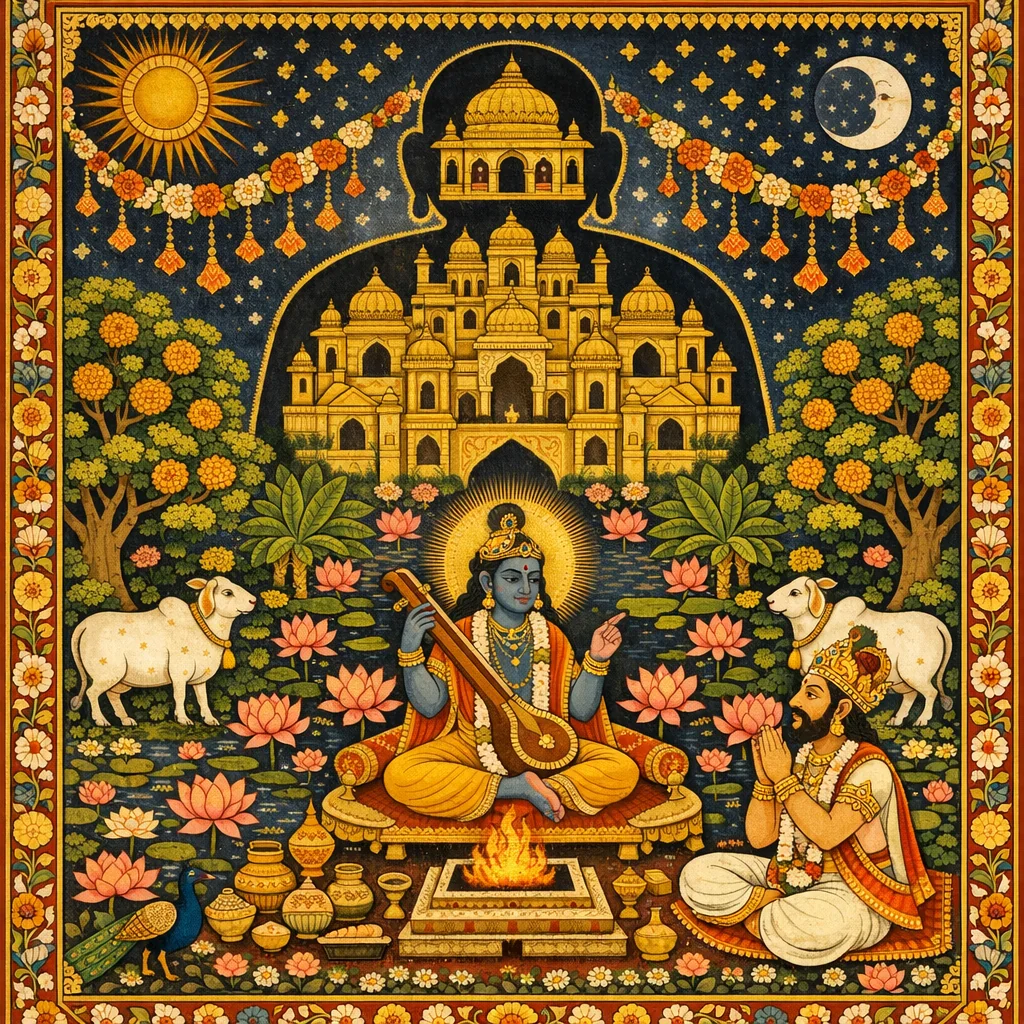
Adhyaya 29
Nārada Explains the Allegory of King Purañjana (Deha–Indriya–Manaḥ Mapping and the Remedy of Bhakti)
Responding to King Prācīnabarhi’s inability to grasp the Purañjana allegory, Nārada systematically decodes the narrative into a map of embodied existence: the jīva as Purañjana, the “unknown friend” as Bhagavān, and the human/deva body as the nine-gated city where the senses, mind, prāṇas, and intelligence cooperate in enjoyment and suffering. He identifies each ‘gate’ and ‘city’ with sensory functions and objects, then expands the allegory into a chariot model of the body driven by intelligence and bound by mind-rope, with time (Caṇḍavega) eroding lifespan through day and night and old age (Kālakanyā/Jarā) allied with death. Nārada critiques karma-kāṇḍa pride and shows that merely reshuffling activities cannot undo karma; only awakening through Kṛṣṇa consciousness—especially hearing and associating with devotees—ends the dream of saṁsāra. Prācīnabarhi accepts the correction, inquires into karmic continuity across bodies, and Nārada explains subtle-body transmigration via mind, impressions, and desire. The chapter closes with the king’s renunciation and liberation, and a phala-śruti promising freedom from bodily identification for attentive hearers—transitioning from allegory to lived transformation.
Shlokas
Verse 1
प्राचीनबर्हिरुवाच भगवंस्ते वचोऽस्माभिर्न सम्यगवगम्यते । कवयस्तद्विजानन्ति न वयं कर्ममोहिता: ॥ १ ॥
King Prācīnabarhi replied: My dear lord, we could not appreciate completely the purport of your allegorical story of King Purañjana. Actually, those who are perfect in spiritual knowledge can understand, but for us, who are overly attached to fruitive activities, to realize the purpose of your story is very difficult.
Verse 2
नारद उवाच पुरुषं पुरञ्जनं विद्याद्यद् व्यनक्त्यात्मन: पुरम् । एकद्वित्रिचतुष्पादं बहुपादमपादकम् ॥ २ ॥
The great sage Nārada Muni continued: You must understand that Purañjana, the living entity, transmigrates according to his own work into different types of bodies, which may be one-legged, two-legged, three-legged, four-legged, many-legged or simply legless. Transmigrating into these various types of bodies, the living entity, as the so-called enjoyer, is known as Purañjana.
Verse 3
योऽविज्ञाताहृतस्तस्य पुरुषस्य सखेश्वर: । यन्न विज्ञायते पुम्भिर्नामभिर्वा क्रियागुणै: ॥ ३ ॥
The person I have described as unknown is the Supreme Personality of Godhead, the master and eternal friend of the living entity. Since the living entities cannot realize the Supreme Personality of Godhead by material names, activities or qualities, He remains everlastingly unknown to the conditioned soul.
Verse 4
यदा जिघृक्षन् पुरुष: कार्त्स्न्येन प्रकृतेर्गुणान् । नवद्वारं द्विहस्ताङ्घ्रि तत्रामनुत साध्विति ॥ ४ ॥
When the living entity wants to enjoy the modes of material nature in their totality, he prefers, out of many bodily forms, to accept that body which has nine gates, two hands and two legs. Thus he prefers to become a human being or a demigod.
Verse 5
बुद्धिं तु प्रमदां विद्यान्ममाहमिति यत्कृतम् । यामधिष्ठाय देहेऽस्मिन् पुमान् भुङ्क्तेऽक्षभिर्गुणान् ॥ ५ ॥
The great sage Nārada continued: The word pramadā mentioned in this regard refers to material intelligence, or ignorance. It is to be understood as such. When one takes shelter of this kind of intelligence, he identifies himself with the material body. Influenced by the material consciousness of “I” and “mine,” he begins to enjoy and suffer through his senses. Thus the living entity is entrapped.
Verse 6
सखाय इन्द्रियगणा ज्ञानं कर्म च यत्कृतम् । सख्यस्तद्वृत्तय: प्राण: पञ्चवृत्तिर्यथोरग: ॥ ६ ॥
The five working senses and the five senses that acquire knowledge are all male friends of Purañjanī. The living entity is assisted by these senses in acquiring knowledge and engaging in activity. The engagements of the senses are known as girlfriends, and the serpent, which was described as having five heads, is the life air acting within the five circulatory processes.
Verse 7
बृहद्बलं मनो विद्यादुभयेन्द्रियनायकम् । पञ्चाला: पञ्च विषया यन्मध्ये नवखं पुरम् ॥ ७ ॥
The eleventh attendant, who is the commander of the others, is known as the mind. He is the leader of the senses both in the acquisition of knowledge and in the performance of work. The Pañcāla kingdom is that atmosphere in which the five sense objects are enjoyed. Within that Pañcāla kingdom is the city of the body, which has nine gates.
Verse 8
अक्षिणी नासिके कर्णौ मुखं शिश्नगुदाविति । द्वे द्वे द्वारौ बहिर्याति यस्तदिन्द्रियसंयुत: ॥ ८ ॥
The eyes, nostrils and ears are pairs of gates situated in one place. The mouth, genitals and rectum are also different gates. Being placed into a body having these nine gates, the living entity acts externally in the material world and enjoys sense objects like form and taste.
Verse 9
अक्षिणी नासिके आस्यमिति पञ्चपुर: कृता: । दक्षिणा दक्षिण: कर्ण उत्तरा चोत्तर: स्मृत: । पश्चिमे इत्यधोद्वारौ गुदं शिश्नमिहोच्यते ॥ ९ ॥
Two eyes, two nostrils and a mouth — all together five — are situated in the front. The right ear is accepted as the southern gate, and the left ear is the northern gate. The two holes, or gates, situated in the west are known as the rectum and genital organ.
Verse 10
खद्योताविर्मुखी चात्र नेत्रे एकत्र निर्मिते । रूपं विभ्राजितं ताभ्यां विचष्टे चक्षुषेश्वर: ॥ १० ॥
The two gates named Khadyotā and Āvirmukhī, which have been spoken of, are the two eyes side by side in one place. The town named Vibhrājita should be understood as form. In this way the two eyes are always engaged in seeing different kinds of forms.
Verse 11
नलिनी नालिनी नासे गन्ध: सौरभ उच्यते । घ्राणोऽवधूतो मुख्यास्यं विपणो वाग्रसविद्रस: ॥ ११ ॥
The two doors named Nalinī and Nālinī should be known as the two nostrils, and the city named Saurabha represents aroma. The companion spoken of as Avadhūta is the sense of smell. The door called Mukhyā is the mouth, and Vipaṇa is the faculty of speech. Rasajña is the sense of taste.
Verse 12
आपणो व्यवहारोऽत्र चित्रमन्धो बहूदनम् । पितृहूर्दक्षिण: कर्ण उत्तरो देवहू: स्मृत: ॥ १२ ॥
The city called Āpaṇa represents engagement of the tongue in speech, and Bahūdana is the variety of foodstuffs. The right ear is called the gate of Pitṛhū, and the left ear is called the gate of Devahū.
Verse 13
प्रवृत्तं च निवृत्तं च शास्त्रं पञ्चालसंज्ञितम् । पितृयानं देवयानं श्रोत्राच्छ्रुतधराद्व्रजेत् ॥ १३ ॥
Nārada Muni continued: The city spoken of as Dakṣiṇa-pañcāla represents the scriptures meant for directing pravṛtti, the process of sense enjoyment in fruitive activities. The other city, named Uttara-pañcāla, represents the scriptures meant for decreasing fruitive activities and increasing knowledge. The living entity receives different kinds of knowledge by means of two ears, and some living entities are promoted to Pitṛloka and some to Devaloka. All this is made possible by the two ears.
Verse 14
आसुरी मेढ्रमर्वाग्द्वार्व्यवायो ग्रामिणां रति: । उपस्थो दुर्मद: प्रोक्तो निऋर्तिर्गुद उच्यते ॥ १४ ॥
The city called Grāmaka, which is approached through the lower gate of Āsurī [the genital organ], is meant for sex, which is very pleasing to common men who are simply fools and rascals. The faculty of procreation is called Durmada, and the rectum is called Nirṛti.
Verse 15
वैशसं नरकं पायुर्लुब्धकोऽन्धौ तु मे शृणु । हस्तपादौ पुमांस्ताभ्यां युक्तो याति करोति च ॥ १५ ॥
When it is said that Purañjana goes to Vaiśasa, it is meant that he goes to hell. He is accompanied by Lubdhaka, which is the working sense in the rectum. Formerly I have also spoken of two blind associates. These associates should be understood to be the hands and legs. Being helped by the hands and legs, the living entity performs all kinds of work and moves hither and thither.
Verse 16
अन्त:पुरं च हृदयं विषूचिर्मन उच्यते । तत्र मोहं प्रसादं वा हर्षं प्राप्नोति तद्गुणै: ॥ १६ ॥
The word antaḥ-pura refers to the heart. The word viṣūcīna, meaning “going everywhere,” indicates the mind. Within the mind the living entity enjoys the effects of the modes of material nature. These effects sometimes cause illusion, sometimes satisfaction and sometimes jubilation.
Verse 17
यथा यथा विक्रियते गुणाक्तो विकरोति वा । तथा तथोपद्रष्टात्मा तद्वृत्तीरनुकार्यते ॥ १७ ॥
Formerly it was explained that the Queen is one’s intelligence. While one is awake or asleep, that intelligence creates different situations. Being influenced by contaminated intelligence, the living entity envisions something and simply imitates the actions and reactions of his intelligence.
Verse 18
देहो रथस्त्विन्द्रियाश्व: संवत्सररयोऽगति: । द्विकर्मचक्रस्त्रिगुणध्वज: पञ्चासुबन्धुर: ॥ १८ ॥ मनोरश्मिर्बुद्धिसूतो हृन्नीडो द्वन्द्वकूबर: । पञ्चेन्द्रियार्थप्रक्षेप: सप्तधातुवरूथक: ॥ १९ ॥ आकूतिर्विक्रमो बाह्यो मृगतृष्णां प्रधावति । एकादशेन्द्रियचमू: पञ्चसूनाविनोदकृत् ॥ २० ॥
Nārada Muni continued: What I referred to as the chariot was in actuality the body. The senses are the horses that pull that chariot. As time passes, year after year, these horses run without obstruction, but in fact they make no progress. Pious and impious activities are the two wheels of the chariot. The three modes of material nature are the chariot’s flags. The five types of life air constitute the living entity’s bondage, and the mind is considered to be the rope. Intelligence is the chariot driver. The heart is the sitting place in the chariot, and the dualities of life, such as pleasure and pain, are the knotting place. The seven elements are the coverings of the chariot, and the working senses are the five external processes. The eleven senses are the soldiers. Being engrossed in sense enjoyment, the living entity, seated on the chariot, hankers after fulfillment of his false desires and runs after sense enjoyment life after life.
Verse 19
देहो रथस्त्विन्द्रियाश्व: संवत्सररयोऽगति: । द्विकर्मचक्रस्त्रिगुणध्वज: पञ्चासुबन्धुर: ॥ १८ ॥ मनोरश्मिर्बुद्धिसूतो हृन्नीडो द्वन्द्वकूबर: । पञ्चेन्द्रियार्थप्रक्षेप: सप्तधातुवरूथक: ॥ १९ ॥ आकूतिर्विक्रमो बाह्यो मृगतृष्णां प्रधावति । एकादशेन्द्रियचमू: पञ्चसूनाविनोदकृत् ॥ २० ॥
Nārada Muni continued: What I referred to as the chariot was in actuality the body. The senses are the horses that pull that chariot. As time passes, year after year, these horses run without obstruction, but in fact they make no progress. Pious and impious activities are the two wheels of the chariot. The three modes of material nature are the chariot’s flags. The five types of life air constitute the living entity’s bondage, and the mind is considered to be the rope. Intelligence is the chariot driver. The heart is the sitting place in the chariot, and the dualities of life, such as pleasure and pain, are the knotting place. The seven elements are the coverings of the chariot, and the working senses are the five external processes. The eleven senses are the soldiers. Being engrossed in sense enjoyment, the living entity, seated on the chariot, hankers after fulfillment of his false desires and runs after sense enjoyment life after life.
Verse 20
देहो रथस्त्विन्द्रियाश्व: संवत्सररयोऽगति: । द्विकर्मचक्रस्त्रिगुणध्वज: पञ्चासुबन्धुर: ॥ १८ ॥ मनोरश्मिर्बुद्धिसूतो हृन्नीडो द्वन्द्वकूबर: । पञ्चेन्द्रियार्थप्रक्षेप: सप्तधातुवरूथक: ॥ १९ ॥ आकूतिर्विक्रमो बाह्यो मृगतृष्णां प्रधावति । एकादशेन्द्रियचमू: पञ्चसूनाविनोदकृत् ॥ २० ॥
Nārada Muni continued: What I referred to as the chariot was in actuality the body. The senses are the horses that pull that chariot. As time passes, year after year, these horses run without obstruction, but in fact they make no progress. Pious and impious activities are the two wheels of the chariot. The three modes of material nature are the chariot’s flags. The five types of life air constitute the living entity’s bondage, and the mind is considered to be the rope. Intelligence is the chariot driver. The heart is the sitting place in the chariot, and the dualities of life, such as pleasure and pain, are the knotting place. The seven elements are the coverings of the chariot, and the working senses are the five external processes. The eleven senses are the soldiers. Being engrossed in sense enjoyment, the living entity, seated on the chariot, hankers after fulfillment of his false desires and runs after sense enjoyment life after life.
Verse 21
संवत्सरश्चण्डवेग: कालो येनोपलक्षित: । तस्याहानीह गन्धर्वा गन्धर्व्यो रात्रय: स्मृता: । हरन्त्यायु: परिक्रान्त्या षष्ट्युत्तरशतत्रयम् ॥ २१ ॥
What was previously explained as Caṇḍavega, powerful time, is covered by days and nights, named Gandharvas and Gandharvīs. The body’s life span is gradually reduced by the passage of days and nights, which number 360.
Verse 22
कालकन्या जरा साक्षाल्लोकस्तां नाभिनन्दति । स्वसारं जगृहे मृत्यु: क्षयाय यवनेश्वर: ॥ २२ ॥
What was described as Kālakanyā should be understood as old age. No one wants to accept old age, but Yavaneśvara [Yavana-rāja], who is death, accepts Jarā [old age] as his sister.
Verse 23
आधयो व्याधयस्तस्य सैनिका यवनाश्चरा: । भूतोपसर्गाशुरय: प्रज्वारो द्विविधो ज्वर: ॥ २३ ॥ एवं बहुविधैर्दु:खैर्दैवभूतात्मसम्भवै: । क्लिश्यमान: शतं वर्षं देहे देही तमोवृत: ॥ २४ ॥ प्राणेन्द्रियमनोधर्मानात्मन्यध्यस्य निर्गुण: । शेते कामलवान्ध्यायन्ममाहमिति कर्मकृत् ॥ २५ ॥
The followers of Yavaneśvara [Yamarāja] are called the soldiers of death, and they are known as the various types of disturbances that pertain to the body and mind. Prajvāra represents the two types of fever: extreme heat and extreme cold — typhoid and pneumonia. The living entity lying down within the body is disturbed by many tribulations pertaining to providence, to other living entities and to his own body and mind. Despite all kinds of tribulations, the living entity, subjected to the necessities of the body, mind and senses and suffering from various types of disease, is carried away by many plans due to his lust to enjoy the world. Although transcendental to this material existence, the living entity, out of ignorance, accepts all these material miseries under the pretext of false egoism (“I” and “mine”). In this way he lives for a hundred years within this body.
Verse 24
आधयो व्याधयस्तस्य सैनिका यवनाश्चरा: । भूतोपसर्गाशुरय: प्रज्वारो द्विविधो ज्वर: ॥ २३ ॥ एवं बहुविधैर्दु:खैर्दैवभूतात्मसम्भवै: । क्लिश्यमान: शतं वर्षं देहे देही तमोवृत: ॥ २४ ॥ प्राणेन्द्रियमनोधर्मानात्मन्यध्यस्य निर्गुण: । शेते कामलवान्ध्यायन्ममाहमिति कर्मकृत् ॥ २५ ॥
The followers of Yavaneśvara [Yamarāja] are called the soldiers of death, and they are known as the various types of disturbances that pertain to the body and mind. Prajvāra represents the two types of fever: extreme heat and extreme cold — typhoid and pneumonia. The living entity lying down within the body is disturbed by many tribulations pertaining to providence, to other living entities and to his own body and mind. Despite all kinds of tribulations, the living entity, subjected to the necessities of the body, mind and senses and suffering from various types of disease, is carried away by many plans due to his lust to enjoy the world. Although transcendental to this material existence, the living entity, out of ignorance, accepts all these material miseries under the pretext of false egoism (“I” and “mine”). In this way he lives for a hundred years within this body.
Verse 25
आधयो व्याधयस्तस्य सैनिका यवनाश्चरा: । भूतोपसर्गाशुरय: प्रज्वारो द्विविधो ज्वर: ॥ २३ ॥ एवं बहुविधैर्दु:खैर्दैवभूतात्मसम्भवै: । क्लिश्यमान: शतं वर्षं देहे देही तमोवृत: ॥ २४ ॥ प्राणेन्द्रियमनोधर्मानात्मन्यध्यस्य निर्गुण: । शेते कामलवान्ध्यायन्ममाहमिति कर्मकृत् ॥ २५ ॥
The followers of Yavaneśvara [Yamarāja] are called the soldiers of death, and they are known as the various types of disturbances that pertain to the body and mind. Prajvāra represents the two types of fever: extreme heat and extreme cold — typhoid and pneumonia. The living entity lying down within the body is disturbed by many tribulations pertaining to providence, to other living entities and to his own body and mind. Despite all kinds of tribulations, the living entity, subjected to the necessities of the body, mind and senses and suffering from various types of disease, is carried away by many plans due to his lust to enjoy the world. Although transcendental to this material existence, the living entity, out of ignorance, accepts all these material miseries under the pretext of false egoism (“I” and “mine”). In this way he lives for a hundred years within this body.
Verse 26
यदात्मानमविज्ञाय भगवन्तं परं गुरुम् । पुरुषस्तु विषज्जेत गुणेषु प्रकृते: स्वदृक् ॥ २६ ॥ गुणाभिमानी स तदा कर्माणि कुरुतेऽवश: । शुक्लं कृष्णं लोहितं वा यथाकर्माभिजायते ॥ २७ ॥
The living entity by nature has minute independence to choose his own good or bad fortune, but when he forgets his supreme master, the Personality of Godhead, he gives himself up unto the modes of material nature. Being influenced by the modes of material nature, he identifies himself with the body and, for the interest of the body, becomes attached to various activities. Sometimes he is under the influence of the mode of ignorance, sometimes the mode of passion and sometimes the mode of goodness. The living entity thus gets different types of bodies under the modes of material nature.
Verse 27
यदात्मानमविज्ञाय भगवन्तं परं गुरुम् । पुरुषस्तु विषज्जेत गुणेषु प्रकृते: स्वदृक् ॥ २६ ॥ गुणाभिमानी स तदा कर्माणि कुरुतेऽवश: । शुक्लं कृष्णं लोहितं वा यथाकर्माभिजायते ॥ २७ ॥
The living entity by nature has minute independence to choose his own good or bad fortune, but when he forgets his supreme master, the Personality of Godhead, he gives himself up unto the modes of material nature. Being influenced by the modes of material nature, he identifies himself with the body and, for the interest of the body, becomes attached to various activities. Sometimes he is under the influence of the mode of ignorance, sometimes the mode of passion and sometimes the mode of goodness. The living entity thus gets different types of bodies under the modes of material nature.
Verse 28
शुक्लात्प्रकाशभूयिष्ठाँल्लोकानाप्नोति कर्हिचित् । दु:खोदर्कान् क्रियायासांस्तम:शोकोत्कटान् क्वचित् ॥ २८ ॥
Those who are situated in the mode of goodness act piously according to Vedic injunctions. Thus they are elevated to the higher planetary systems where the demigods live. Those who are influenced by the mode of passion engage in various types of productive activities in the planetary systems where human beings live. Similarly, those influenced by the mode of darkness are subjected to various types of misery and live in the animal kingdom.
Verse 29
क्वचित्पुमान् क्वचिच्च स्त्री क्वचिन्नोभयमन्धधी: । देवो मनुष्यस्तिर्यग्वा यथाकर्मगुणं भव: ॥ २९ ॥
Covered by the mode of ignorance in material nature, the living entity is sometimes a male, sometimes a female, sometimes a eunuch, sometimes a human being, sometimes a demigod, sometimes a bird, an animal, and so on. In this way he is wandering within the material world. His acceptance of different types of bodies is brought about by his activities under the influence of the modes of nature.
Verse 30
क्षुत्परीतो यथा दीन: सारमेयो गृहं गृहम् । चरन्विन्दति यद्दिष्टं दण्डमोदनमेव वा ॥ ३० ॥ तथा कामाशयो जीव उच्चावचपथा भ्रमन् । उपर्यधो वा मध्ये वा याति दिष्टं प्रियाप्रियम् ॥ ३१ ॥
The living entity is exactly like a dog who, overcome with hunger, goes from door to door for some food. According to his destiny, he sometimes receives punishment and is driven out and at other times receives a little food to eat. Similarly, the living entity, being influenced by so many desires, wanders in different species of life according to destiny. Sometimes he is high, and sometimes he is low. Sometimes he goes to the heavenly planets, sometimes to hell, sometimes to the middle planets, and so on.
Verse 31
क्षुत्परीतो यथा दीन: सारमेयो गृहं गृहम् । चरन्विन्दति यद्दिष्टं दण्डमोदनमेव वा ॥ ३० ॥ तथा कामाशयो जीव उच्चावचपथा भ्रमन् । उपर्यधो वा मध्ये वा याति दिष्टं प्रियाप्रियम् ॥ ३१ ॥
The living entity is exactly like a dog who, overcome with hunger, goes from door to door for some food. According to his destiny, he sometimes receives punishment and is driven out and at other times receives a little food to eat. Similarly, the living entity, being influenced by so many desires, wanders in different species of life according to destiny. Sometimes he is high, and sometimes he is low. Sometimes he goes to the heavenly planets, sometimes to hell, sometimes to the middle planets, and so on.
Verse 32
दु:खेष्वेकतरेणापि दैवभूतात्महेतुषु । जीवस्य न व्यवच्छेद: स्याच्चेत्तत्तत्प्रतिक्रिया ॥ ३२ ॥
The living entities are trying to counteract different miserable conditions pertaining to providence, other living entities or the body and mind. Still, they must remain conditioned by the laws of nature, despite all attempts to counter these laws.
Verse 33
यथा हि पुरुषो भारं शिरसा गुरुमुद्वहन् । तं स्कन्धेन स आधत्ते तथा सर्वा: प्रतिक्रिया: ॥ ३३ ॥
A man may carry a burden on his head, and when he feels it to be too heavy, he sometimes gives relief to his head by putting the burden on his shoulder. In this way he tries to relieve himself of the burden. However, whatever process he devises to counteract the burden does nothing more than put the same burden from one place to another.
Verse 34
नैकान्तत: प्रतीकार: कर्मणां कर्म केवलम् । द्वयं ह्यविद्योपसृतं स्वप्ने स्वप्न इवानघ ॥ ३४ ॥
Nārada continued: O you who are free from all sinful activity! No one can counteract the effects of fruitive activity simply by manufacturing a different activity devoid of Kṛṣṇa consciousness. All such activity is due to our ignorance. When we have a troublesome dream, we cannot relieve it with a troublesome hallucination. One can counteract a dream only by awaking. Similarly, our material existence is due to our ignorance and illusion. Unless we awaken to Kṛṣṇa consciousness, we cannot be relieved of such dreams. For the ultimate solution to all problems, we must awaken to Kṛṣṇa consciousness.
Verse 35
अर्थे ह्यविद्यमानेऽपि संसृतिर्न निवर्तते । मनसा लिङ्गरूपेण स्वप्ने विचरतो यथा ॥ ३५ ॥
Sometimes we suffer because we see a tiger in a dream or a snake in a vision, but actually there is neither a tiger nor a snake. Thus we create some situation in a subtle form and suffer the consequences. These sufferings cannot be mitigated unless we are awakened from our dream.
Verse 36
अथात्मनोऽर्थभूतस्य यतोऽनर्थपरम्परा । संसृतिस्तद्वयवच्छेदो भक्त्या परमया गुरौ ॥ ३६ ॥ वासुदेवे भगवति भक्तियोग: समाहित: । सध्रीचीनेन वैराग्यं ज्ञानं च जनयिष्यति ॥ ३७ ॥
The real interest of the living entity is to get out of the nescience that causes him to endure repeated birth and death. The only remedy is to surrender unto the Supreme Personality of Godhead through His representative. Unless one renders devotional service unto the Supreme Personality of Godhead, Vāsudeva, one cannot possibly become completely detached from this material world, nor can he possibly manifest real knowledge.
Verse 37
अथात्मनोऽर्थभूतस्य यतोऽनर्थपरम्परा । संसृतिस्तद्वयवच्छेदो भक्त्या परमया गुरौ ॥ ३६ ॥ वासुदेवे भगवति भक्तियोग: समाहित: । सध्रीचीनेन वैराग्यं ज्ञानं च जनयिष्यति ॥ ३७ ॥
The real interest of the living entity is to get out of the nescience that causes him to endure repeated birth and death. The only remedy is to surrender unto the Supreme Personality of Godhead through His representative. Unless one renders devotional service unto the Supreme Personality of Godhead, Vāsudeva, one cannot possibly become completely detached from this material world, nor can he possibly manifest real knowledge.
Verse 38
सोऽचिरादेव राजर्षे स्यादच्युतकथाश्रय: । शृण्वत: श्रद्दधानस्य नित्यदा स्यादधीयत: ॥ ३८ ॥
O best of kings, one who is faithful, who is always hearing the glories of the Supreme Personality of Godhead, who is always engaged in the culture of Kṛṣṇa consciousness and in hearing of the Lord’s activities, very soon becomes eligible to see the Supreme Personality of Godhead face to face.
Verse 39
यत्र भागवता राजन् साधवो विशदाशया: । भगवद्गुणानुकथनश्रवणव्यग्रचेतस: ॥ ३९ ॥ तस्मिन्महन्मुखरिता मधुभिच्चरित्र- पीयूषशेषसरित: परित: स्रवन्ति । ता ये पिबन्त्यवितृषो नृप गाढकर्णै- स्तान्न स्पृशन्त्यशनतृड्भयशोकमोहा: ॥ ४० ॥
My dear King, in the place where pure devotees live, following the rules and regulations and thus purely conscious and engaged with great eagerness in hearing and chanting the glories of the Supreme Personality of Godhead, in that place if one gets a chance to hear their constant flow of nectar, which is exactly like the waves of a river, one will forget the necessities of life, namely hunger and thirst, and become immune to all kinds of fear, lamentation and illusion.
Verse 40
यत्र भागवता राजन् साधवो विशदाशया: । भगवद्गुणानुकथनश्रवणव्यग्रचेतस: ॥ ३९ ॥ तस्मिन्महन्मुखरिता मधुभिच्चरित्र- पीयूषशेषसरित: परित: स्रवन्ति । ता ये पिबन्त्यवितृषो नृप गाढकर्णै- स्तान्न स्पृशन्त्यशनतृड्भयशोकमोहा: ॥ ४० ॥
My dear King, in the place where pure devotees live, following the rules and regulations and thus purely conscious and engaged with great eagerness in hearing and chanting the glories of the Supreme Personality of Godhead, in that place if one gets a chance to hear their constant flow of nectar, which is exactly like the waves of a river, one will forget the necessities of life, namely hunger and thirst, and become immune to all kinds of fear, lamentation and illusion.
Verse 41
एतैरुपद्रुतो नित्यं जीवलोक: स्वभावजै: । न करोति हरेर्नूनं कथामृतनिधौ रतिम् ॥ ४१ ॥
Because the conditioned soul is always disturbed by the bodily necessities such as hunger and thirst, he has very little time to cultivate attachment to hearing the nectarean words of the Supreme Personality of Godhead.
Verse 42
प्रजापतिपति: साक्षाद्भगवान् गिरिशो मनु: । दक्षादय: प्रजाध्यक्षा नैष्ठिका: सनकादय: ॥ ४२ ॥ मरीचिरत्र्यङ्गिरसौ पुलस्त्य: पुलह: क्रतु: । भृगुर्वसिष्ठ इत्येते मदन्ता ब्रह्मवादिन: ॥ ४३ ॥ अद्यापि वाचस्पतयस्तपोविद्यासमाधिभि: । पश्यन्तोऽपि न पश्यन्ति पश्यन्तं परमेश्वरम् ॥ ४४ ॥
The most powerful Lord Brahmā, the father of all progenitors; Lord Śiva; Manu, Dakṣa and the other rulers of humankind; the four saintly first-class brahmacārīs headed by Sanaka and Sanātana; the great sages Marīci, Atri, Aṅgirā, Pulastya, Pulaha, Kratu, Bhṛgu and Vasiṣṭha; and my humble self [Nārada] are all stalwart brāhmaṇas who can speak authoritatively on Vedic literature. We are very powerful because of austerities, meditation and education. Nonetheless, even after inquiring about the Supreme Personality of Godhead, whom we always see, we do not know perfectly about Him.
Verse 43
प्रजापतिपति: साक्षाद्भगवान् गिरिशो मनु: । दक्षादय: प्रजाध्यक्षा नैष्ठिका: सनकादय: ॥ ४२ ॥ मरीचिरत्र्यङ्गिरसौ पुलस्त्य: पुलह: क्रतु: । भृगुर्वसिष्ठ इत्येते मदन्ता ब्रह्मवादिन: ॥ ४३ ॥ अद्यापि वाचस्पतयस्तपोविद्यासमाधिभि: । पश्यन्तोऽपि न पश्यन्ति पश्यन्तं परमेश्वरम् ॥ ४४ ॥
The most powerful Lord Brahmā, the father of all progenitors; Lord Śiva; Manu, Dakṣa and the other rulers of humankind; the four saintly first-class brahmacārīs headed by Sanaka and Sanātana; the great sages Marīci, Atri, Aṅgirā, Pulastya, Pulaha, Kratu, Bhṛgu and Vasiṣṭha; and my humble self [Nārada] are all stalwart brāhmaṇas who can speak authoritatively on Vedic literature. We are very powerful because of austerities, meditation and education. Nonetheless, even after inquiring about the Supreme Personality of Godhead, whom we always see, we do not know perfectly about Him.
Verse 44
प्रजापतिपति: साक्षाद्भगवान् गिरिशो मनु: । दक्षादय: प्रजाध्यक्षा नैष्ठिका: सनकादय: ॥ ४२ ॥ मरीचिरत्र्यङ्गिरसौ पुलस्त्य: पुलह: क्रतु: । भृगुर्वसिष्ठ इत्येते मदन्ता ब्रह्मवादिन: ॥ ४३ ॥ अद्यापि वाचस्पतयस्तपोविद्यासमाधिभि: । पश्यन्तोऽपि न पश्यन्ति पश्यन्तं परमेश्वरम् ॥ ४४ ॥
The most powerful Lord Brahmā, the father of all progenitors; Lord Śiva; Manu, Dakṣa and the other rulers of humankind; the four saintly first-class brahmacārīs headed by Sanaka and Sanātana; the great sages Marīci, Atri, Aṅgirā, Pulastya, Pulaha, Kratu, Bhṛgu and Vasiṣṭha; and my humble self [Nārada] are all stalwart brāhmaṇas who can speak authoritatively on Vedic literature. We are very powerful because of austerities, meditation and education. Nonetheless, even after inquiring about the Supreme Personality of Godhead, whom we always see, we do not know perfectly about Him.
Verse 45
शब्दब्रह्मणि दुष्पारे चरन्त उरुविस्तरे । मन्त्रलिङ्गैर्व्यवच्छिन्नं भजन्तो न विदु: परम् ॥ ४५ ॥
Despite the cultivation of Vedic knowledge, which is unlimited, and the worship of different demigods by the symptoms of Vedic mantras, demigod worship does not help one to understand the supreme powerful Personality of Godhead.
Verse 46
यदा यस्यानुगृह्णाति भगवानात्मभावित: । स जहाति मतिं लोके वेदे च परिनिष्ठिताम् ॥ ४६ ॥
When a person is fully engaged in devotional service, he is favored by the Lord, who bestows His causeless mercy. At such a time, the awakened devotee gives up all material activities and ritualistic performances mentioned in the Vedas.
Verse 47
तस्मात्कर्मसु बर्हिष्मन्नज्ञानादर्थकाशिषु । मार्थदृष्टिं कृथा: श्रोत्रस्पर्शिष्वस्पृष्टवस्तुषु ॥ ४७ ॥
My dear King Barhiṣmān, you should never out of ignorance take to the Vedic rituals or to fruitive activity, which may be pleasing to hear about or which may appear to be the goal of self-interest. You should never take these to be the ultimate goal of life.
Verse 48
स्वं लोकं न विदुस्ते वै यत्र देवो जनार्दन: । आहुर्धूम्रधियो वेदं सकर्मकमतद्विद: ॥ ४८ ॥
Those who are less intelligent accept the Vedic ritualistic ceremonies as all in all. They do not know that the purpose of the Vedas is to understand one’s own home, where the Supreme Personality of Godhead lives. Not being interested in their real home, they are illusioned and search after other homes.
Verse 49
आस्तीर्य दर्भै: प्रागग्रै: कार्त्स्न्येन क्षितिमण्डलम् । स्तब्धो बृहद्वधान्मानी कर्म नावैषि यत्परम् । तत्कर्म हरितोषं यत्सा विद्या तन्मतिर्यया ॥ ४९ ॥
My dear King, the entire world is covered with the sharp points of kuśa grass, and on the strength of this you have become proud because you have killed various types of animals in sacrifices. Because of your foolishness, you do not know that devotional service is the only way one can please the Supreme Personality of Godhead. You cannot understand this fact. Your only activities should be those that can please the Personality of Godhead. Our education should be such that we can become elevated to Kṛṣṇa consciousness.
Verse 50
हरिर्देहभृतामात्मा स्वयं प्रकृतिरीश्वर: । तत्पादमूलं शरणं यत: क्षेमो नृणामिह ॥ ५० ॥
Śrī Hari, the Supreme Personality of Godhead, is the Supersoul and guide of all living entities who have accepted material bodies within this world. He is the supreme controller of all material activities in material nature. He is also our best friend, and everyone should take shelter at His lotus feet. In doing so, one’s life will be auspicious.
Verse 51
स वै प्रियतमश्चात्मा यतो न भयमण्वपि । इति वेद स वै विद्वान्यो विद्वान्स गुरुर्हरि: ॥ ५१ ॥
One who is engaged in devotional service has not the least fear in material existence. This is because the Supreme Personality of Godhead is the Supersoul and friend of everyone. One who knows this secret is actually educated, and one thus educated can become the spiritual master of the world. One who is an actually bona fide spiritual master, representative of Kṛṣṇa, is not different from Kṛṣṇa.
Verse 52
नारद उवाच प्रश्न एवं हि सञ्छिन्नो भवत: पुरुषर्षभ । अत्र मे वदतो गुह्यं निशामय सुनिश्चितम् ॥ ५२ ॥
The great saint Nārada continued: O great personality, I have replied properly about all that you have asked me. Now hear another narration that is accepted by saintly persons and is very confidential.
Verse 53
क्षुद्रं चरं सुमनसां शरणे मिथित्वा रक्तं षडङ्घ्रिगणसामसु लुब्धकर्णम् । अग्रे वृकानसुतृपोऽविगणय्य यान्तं पृष्ठे मृगं मृगय लुब्धकबाणभिन्नम् ॥ ५३ ॥
My dear King, please search out that deer who is engaged in eating grass in a very nice flower garden along with his wife. That deer is very much attached to his business, and he is enjoying the sweet singing of the bumblebees in his garden. Just try to understand his position. He is unaware that before him is a tiger, which is accustomed to living at the cost of another’s flesh. Behind the deer is a hunter, who is threatening to pierce him with sharp arrows. Thus the deer’s death is imminent.
Verse 54
सुमन:समधर्मणां स्त्रीणां शरण आश्रमे पुष्पमधुगन्धवत्क्षुद्रतमं काम्यकर्मविपाकजं कामसुखलवं जैह्व्यौपस्थ्यादि विचिन्वन्तं मिथुनीभूय तदभिनिवेशितमनसंषडङ्घ्रिगणसामगीत वदतिमनोहरवनितादिजनालापेष्वतितरामतिप्रलोभितकर्णमग्रे वृकयूथवदात्मन आयुर्हरतोऽहोरात्रान्तान् काललवविशेषानविगणय्य गृहेषु विहरन्तं पृष्ठत एव परोक्षमनुप्रवृत्तो लुब्धक: कृतान्तोऽन्त:शरेण यमिह पराविध्यति तमिममात्मानमहो राजन् भिन्नहृदयं द्रष्टुमर्हसीति ॥ ५४ ॥
My dear King, woman, who is very attractive in the beginning but in the end very disturbing, is exactly like the flower, which is attractive in the beginning and detestable at the end. With woman, the living entity is entangled with lusty desires, and he enjoys sex, just as one enjoys the aroma of a flower. He thus enjoys a life of sense gratification — from his tongue to his genitals — and in this way the living entity considers himself very happy in family life. United with his wife, he always remains absorbed in such thoughts. He feels great pleasure in hearing the talks of his wife and children, which are like the sweet humming of bumblebees that collect honey from flower to flower. He forgets that before him is time, which is taking away his life span with the passing of day and night. He does not see the gradual diminishing of his life, nor does he care about the superintendent of death, who is trying to kill him from behind. Just try to understand this. You are in a precarious position and are threatened from all sides.
Verse 55
स त्वं विचक्ष्य मृगचेष्टितमात्मनोऽन्त- श्चित्तं नियच्छ हृदि कर्णधुनीं च चित्ते । जह्यङ्गनाश्रममसत्तमयूथगाथं प्रीणीहि हंसशरणं विरम क्रमेण ॥ ५५ ॥
My dear King, just try to understand the allegorical position of the deer. Be fully conscious of yourself, and give up the pleasure of hearing about promotion to heavenly planets by fruitive activity. Give up household life, which is full of sex, as well as stories about such things, and take shelter of the Supreme Personality of Godhead through the mercy of the liberated souls. In this way, please give up your attraction for material existence.
Verse 56
राजोवाच श्रुतमन्वीक्षितं ब्रह्मन् भगवान् यदभाषत । नैतज्जानन्त्युपाध्याया: किं न ब्रूयुर्विदुर्यदि ॥ ५६ ॥
The King replied: My dear brāhmaṇa, whatever you have said I have heard with great attention and, considering all of it, have come to the conclusion that the ācāryas [teachers] who engaged me in fruitive activity did not know this confidential knowledge. If they were aware of it, why did they not explain it to me?
Verse 57
संशयोऽत्र तु मे विप्र सञ्छिन्नस्तत्कृतो महान् । ऋषयोऽपि हि मुह्यन्ति यत्र नेन्द्रियवृत्तय: ॥ ५७ ॥
My dear brāhmaṇa, there are contradictions between your instructions and those of my spiritual teachers who engaged me in fruitive activities. I now can understand the distinction between devotional service, knowledge and renunciation. I had some doubts about them, but you have now very kindly dissipated all these doubts. I can now understand how even the great sages are bewildered by the real purpose of life. Of course, there is no question of sense gratification.
Verse 58
कर्माण्यारभते येन पुमानिह विहाय तम् । अमुत्रान्येन देहेन जुष्टानि स यदश्नुते ॥ ५८ ॥
The results of whatever a living entity does in this life are enjoyed in the next life.
Verse 59
इति वेदविदां वाद: श्रूयते तत्र तत्र ह । कर्म यत्क्रियते प्रोक्तं परोक्षं न प्रकाशते ॥ ५९ ॥
The expert knowers of the Vedic conclusions say that one enjoys or suffers the results of his past activities. But practically it is seen that the body that performed the work in the last birth is already lost. So how is it possible to enjoy or suffer the reactions of that work in a different body?
Verse 60
नारद उवाच येनैवारभते कर्म तेनैवामुत्र तत्पुमान् । भुङ्क्ते ह्यव्यवधानेन लिङ्गेन मनसा स्वयम् ॥ ६० ॥
The great sage Nārada continued: The living entity acts in a gross body in this life. This body is forced to act by the subtle body, composed of mind, intelligence and ego. After the gross body is lost, the subtle body is still there to enjoy or suffer. Thus there is no change.
Verse 61
शयानमिममुत्सृज्य श्वसन्तं पुरुषो यथा । कर्मात्मन्याहितं भुङ्क्ते तादृशेनेतरेण वा ॥ ६१ ॥
The living entity, while dreaming, gives up the actual living body. Through the activities of his mind and intelligence, he acts in another body, either as a god or a dog. After giving up this gross body, the living entity enters either an animal body or a demigod’s body on this planet or on another planet. He thus enjoys the results of the actions of his past life.
Verse 62
ममैते मनसा यद्यदसावहमिति ब्रुवन् । गृह्णीयात्तत्पुमान् राद्धं कर्म येन पुनर्भव: ॥ ६२ ॥
The living entity labors under the bodily conception of “I am this, I am that. My duty is this, and therefore I shall do it.” These are all mental impressions, and all these activities are temporary; nonetheless, by the grace of the Supreme Personality of Godhead, the living entity gets a chance to execute all his mental concoctions. Thus he gets another body.
Verse 63
यथानुमीयते चित्तमुभयैरिन्द्रियेहितै: । एवं प्राग्देहजं कर्म लक्ष्यते चित्तवृत्तिभि: ॥ ६३ ॥
One can understand the mental or conscious position of a living entity by the activities of two kinds of senses — the knowledge-acquiring senses and the executive senses. Similarly, by the mental condition or consciousness of a person, one can understand his position in the previous life.
Verse 64
नानुभूतं क्व चानेन देहेनादृष्टमश्रुतम् । कदाचिदुपलभ्येत यद्रूपं यादृगात्मनि ॥ ६४ ॥
Sometimes we suddenly experience something that was never experienced in the present body by sight or hearing. Sometimes we see such things suddenly in dreams.
Verse 65
तेनास्य तादृशं राजँल्लिङ्गिनो देहसम्भवम् । श्रद्धत्स्वाननुभूतोऽर्थो न मन: स्प्रष्टुमर्हति ॥ ६५ ॥
Therefore, my dear King, the living entity, who has a subtle mental covering, develops all kinds of thoughts and images because of his previous body. Take this from me as certain. There is no possibility of concocting anything mentally without having perceived it in the previous body.
Verse 66
मन एव मनुष्यस्य पूर्वरूपाणि शंसति । भविष्यतश्च भद्रं ते तथैव न भविष्यत: ॥ ६६ ॥
O King, all good fortune unto you! The mind is the cause of the living entity’s attaining a certain type of body in accordance with his association with material nature. According to one’s mental composition, one can understand what the living entity was in his past life as well as what kind of body he will have in the future. Thus the mind indicates the past and future bodies.
Verse 67
अदृष्टमश्रुतं चात्र क्वचिन्मनसि दृश्यते । यथा तथानुमन्तव्यं देशकालक्रियाश्रयम् ॥ ६७ ॥
Sometimes in a dream we see something never experienced or heard of in this life, but all these incidents have been experienced at different times, in different places and in different conditions.
Verse 68
सर्वे क्रमानुरोधेन मनसीन्द्रियगोचरा: । आयान्ति बहुशो यान्ति सर्वे समनसो जना: ॥ ६८ ॥
The mind of the living entity continues to exist in various gross bodies, and according to one’s desires for sense gratification, the mind records different thoughts. In the mind these appear together in different combinations; therefore these images sometimes appear as things never seen or never heard before.
Verse 69
सत्त्वैकनिष्ठे मनसि भगवत्पार्श्ववर्तिनि । तमश्चन्द्रमसीवेदमुपरज्यावभासते ॥ ६९ ॥
Kṛṣṇa consciousness means constantly associating with the Supreme Personality of Godhead in such a mental state that the devotee can observe the cosmic manifestation exactly as the Supreme Personality of Godhead does. Such observation is not always possible, but it becomes manifest exactly like the dark planet known as Rāhu, which is observed in the presence of the full moon.
Verse 70
नाहं ममेति भावोऽयं पुरुषे व्यवधीयते । यावद् बुद्धिमनोऽक्षार्थगुणव्यूहो ह्यनादिमान् ॥ ७० ॥
As long as there exists the subtle material body composed of intelligence, mind, senses, sense objects, and the reactions of the material qualities, the consciousness of false identification and its relative objective, the gross body, exist as well.
Verse 71
सुप्तिमूर्च्छोपतापेषु प्राणायनविघातत: । नेहतेऽहमिति ज्ञानं मृत्युप्रज्वारयोरपि ॥ ७१ ॥
When the living entity is in deep sleep, when he faints, when there is some great shock on account of severe loss, at the time of death, or when the body temperature is very high, the movement of the life air is arrested. At that time the living entity loses knowledge of identifying the body with the self.
Verse 72
गर्भे बाल्येऽप्यपौष्कल्यादेकादशविधं तदा । लिङ्गं न दृश्यते यून: कुह्वां चन्द्रमसो यथा ॥ ७२ ॥
When one is a youth, all the ten senses and the mind are completely visible. However, in the mother’s womb or in the boyhood state, the sense organs and the mind remain covered, just as the full moon is covered by the darkness of the dark-moon night.
Verse 73
अर्थे ह्यविद्यमानेऽपि संसृतिर्न निवर्तते । ध्यायतो विषयानस्य स्वप्नेऽनर्थागमो यथा ॥ ७३ ॥
When the living entity dreams, the sense objects are not actually present. However, because one has associated with the sense objects, they become manifest. Similarly, the living entity with undeveloped senses does not cease to exist materially, even though he may not be exactly in contact with the sense objects.
Verse 74
एवं पञ्चविधं लिङ्गं त्रिवृत् षोडश विस्तृतम् । एष चेतनया युक्तो जीव इत्यभिधीयते ॥ ७४ ॥
The five sense objects, the five sense organs, the five knowledge-acquiring senses and the mind are the sixteen material expansions. These combine with the living entity and are influenced by the three modes of material nature. Thus the existence of the conditioned soul is understood.
Verse 75
अनेन पुरुषो देहानुपादत्ते विमुञ्चति । हर्षं शोकं भयं दु:खं सुखं चानेन विन्दति ॥ ७५ ॥
By virtue of the processes of the subtle body, the living entity develops and gives up gross bodies. This is known as the transmigration of the soul. Thus the soul becomes subjected to different types of so-called enjoyment, lamentation, fear, happiness and unhappiness.
Verse 76
यथा तृणजलूकेयं नापयात्यपयाति च । न त्यजेन्म्रियमाणोऽपि प्राग्देहाभिमतिं जन: ॥ ७६ ॥ यावदन्यं न विन्देत व्यवधानेन कर्मणाम् । मन एव मनुष्येन्द्र भूतानां भवभावनम् ॥ ७७ ॥
The caterpillar transports itself from one leaf to another by capturing one leaf before giving up the other. Similarly, according to his previous work, the living entity must capture another body before giving up the one he has. This is because the mind is the reservoir of all kinds of desires.
Verse 77
यथा तृणजलूकेयं नापयात्यपयाति च । न त्यजेन्म्रियमाणोऽपि प्राग्देहाभिमतिं जन: ॥ ७६ ॥ यावदन्यं न विन्देत व्यवधानेन कर्मणाम् । मन एव मनुष्येन्द्र भूतानां भवभावनम् ॥ ७७ ॥
The caterpillar transports itself from one leaf to another by capturing one leaf before giving up the other. Similarly, according to his previous work, the living entity must capture another body before giving up the one he has. This is because the mind is the reservoir of all kinds of desires.
Verse 78
यदाक्षैश्चरितान् ध्यायन् कर्माण्याचिनुतेऽसकृत् । सति कर्मण्यविद्यायां बन्ध: कर्मण्यनात्मन: ॥ ७८ ॥
As long as we desire to enjoy sense gratification, we create material activities. When the living entity acts in the material field, he enjoys the senses, and while enjoying the senses, he creates another series of material activities. In this way the living entity becomes entrapped as a conditioned soul.
Verse 79
अतस्तदपवादार्थं भज सर्वात्मना हरिम् । पश्यंस्तदात्मकं विश्वं स्थित्युत्पत्त्यप्यया यत: ॥ ७९ ॥
You should always know that this cosmic manifestation is created, maintained and annihilated by the will of the Supreme Personality of Godhead. Consequently, everything within this cosmic manifestation is under the control of the Lord. To be enlightened by this perfect knowledge, one should always engage himself in the devotional service of the Lord.
Verse 80
मैत्रेय उवाच भागवतमुख्यो भगवान्नारदो हंसयोर्गतिम् । प्रदर्श्य ह्यमुमामन्त्र्य सिद्धलोकं ततोऽगमत् ॥ ८० ॥
The great sage Maitreya continued: The supreme devotee, the great saint Nārada, thus explained to King Prācīnabarhi the constitutional position of the Supreme Personality of Godhead and the living entity. After giving an invitation to the King, Nārada Muni left to return to Siddhaloka.
Verse 81
प्राचीनबर्ही राजर्षि: प्रजासर्गाभिरक्षणे । आदिश्य पुत्रानगमत्तपसे कपिलाश्रमम् ॥ ८१ ॥
In the presence of his ministers, the saintly King Prācīnabarhi left orders for his sons to protect the citizens. He then left home and went off to undergo austerities in a holy place known as Kapilāśrama.
Verse 82
तत्रैकाग्रमना धीरो गोविन्दचरणाम्बुजम् । विमुक्तसङ्गोऽनुभजन् भक्त्या तत्साम्यतामगात् ॥ ८२ ॥
Having undergone austerities and penances at Kapilāśrama, King Prācīnabarhi attained full liberation from all material designations. He constantly engaged in the transcendental loving service of the Lord and attained a spiritual position qualitatively equal to that of the Supreme Personality of Godhead.
Verse 83
एतदध्यात्मपारोक्ष्यं गीतं देवर्षिणानघ । य: श्रावयेद्य: शृणुयात्स लिङ्गेन विमुच्यते ॥ ८३ ॥
My dear Vidura, one who hears this narration concerning the understanding of the living entity’s spiritual existence, as described by the great sage Nārada, or who relates it to others, will be liberated from the bodily conception of life.
Verse 84
एतन्मुकुन्दयशसा भुवनं पुनानं देवर्षिवर्यमुखनि:सृतमात्मशौचम् । य: कीर्त्यमानमधिगच्छति पारमेष्ठ्यं नास्मिन् भवे भ्रमति मुक्तसमस्तबन्ध: ॥ ८४ ॥
This narration spoken by the great sage Nārada is full of the transcendental fame of the Supreme Personality of Godhead. Consequently this narration, when described, certainly sanctifies this material world. It purifies the heart of the living entity and helps him attain his spiritual identity. One who relates this transcendental narration will be liberated from all material bondage and will no longer have to wander within this material world.
Verse 85
अध्यात्मपारोक्ष्यमिदं मयाधिगतमद्भुतम् । एवं स्त्रियाश्रम: पुंसश्छिन्नोऽमुत्र च संशय: ॥ ८५ ॥
The allegory of King Purañjana, described herein according to authority, was heard by me from my spiritual master, and it is full of spiritual knowledge. If one can understand the purpose of this allegory, he will certainly be relieved from the bodily conception and will clearly understand life after death. Although one may not understand what transmigration of the soul actually is, one can fully understand it by studying this narration.
Frequently Asked Questions
Purañjana represents the jīva (living entity) who enters and ‘enjoys’ within material bodies while identifying as the doer and enjoyer. His wanderings across one-legged, two-legged, four-legged, many-legged, or legless forms illustrate transmigration driven by karma and guṇa-association. The allegory is meant to expose how the self becomes bound by sense-centered life and how that bondage can be ended by turning toward the Supreme Lord.
The ‘unknown friend’ is the Supreme Personality of Godhead as Paramātmā—master, witness, and eternal well-wisher of the jīva. He is ‘unknown’ to the conditioned soul because material naming, qualities, and activities cannot capture Him, and because the jīva—absorbed in “I” and “mine”—fails to recognize the Lord’s guiding presence within the heart.
The nine gates are the body’s outlets of interaction: two eyes, two nostrils, two ears, mouth, genitals, and rectum. Nārada correlates these with sensory objects and functions (seeing form, smelling aroma, hearing instruction, tasting/speaking, sex, and evacuation), showing how embodied life becomes a network of sense engagements that reinforces identification with the body.
Nārada explains that actions are performed in the gross body but are impelled and recorded by the subtle body (mind, intelligence, and ego). When the gross body is lost, the subtle body persists and carries impressions (saṁskāras), desires, and karmic momentum, thereby enabling the jīva to enjoy or suffer reactions in a new gross body—much like the continuity seen in dreaming and waking transitions.
The criticism is not of the Veda itself but of mistaking ritual and fruitive elevation as the ultimate goal. Nārada argues that activities ‘manufactured’ without Kṛṣṇa consciousness merely shift burdens rather than end bondage. The Vedas’ purpose is to lead one to the Lord (Vāsudeva); when rituals foster pride or violence (e.g., animal sacrifice as prestige), they obscure the real telos—bhakti and inner awakening.