Adhyaya 26
Purañjana Goes Hunting — The Chariot of the Body, Violence of Passion, and Return to Conjugal Bondage
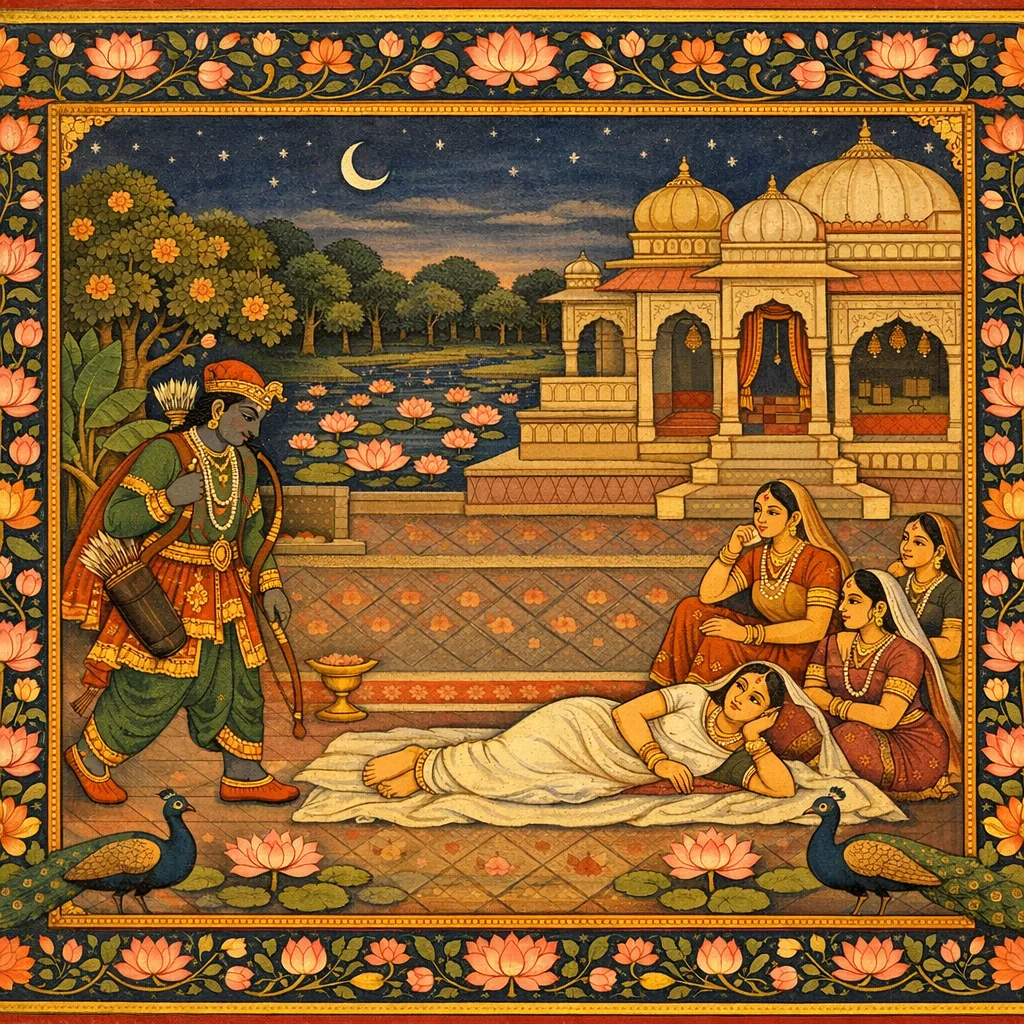
Continuing Nārada’s allegorical instruction to King Prācīnabarhiṣat, this chapter opens with a dense symbolic description of King Purañjana’s chariot-journey to the forest Pañca-prastha—an encoded portrait of embodied life: body, senses, mind, prāṇas, and the guṇic apparatus that carries the jīva into experience. Overcome by rājasic-tāmasic impulse, Purañjana leaves his queen and hunts, killing animals mercilessly; Nārada inserts a dharma-clarification that śāstra regulates animal-killing within sacrificial limits to curb passion and ignorance, while whimsical violence binds one to karma and repeated birth. Exhausted, the king returns, refreshes himself, and becomes Cupid-struck, seeking his queen as the source of domestic satisfaction. Finding her lying like a mendicant, he is bewildered and begins elaborate appeasement—touching her feet, flattering, offering protection, and confessing offense for hunting without her consent. The chapter thus bridges the allegory from outward sense-expansion (forest enjoyment/violence) to inward dependence on “queen” (intelligence/attachment), setting up the next movement where the deeper meanings of queen, city, and bondage will be further unpacked.
Shlokas
Verse 1
नारद उवाच स एकदा महेष्वासो रथं पञ्चाश्वमाशुगम् । द्वीषं द्विचक्रमेकाक्षं त्रिवेणुं पञ्चबन्धुरम् ॥ १ ॥ एकरश्म्येकदमनमेकनीडं द्विकूबरम् । पञ्चप्रहरणं सप्तवरूथं पञ्चविक्रमम् ॥ २ ॥ हैमोपस्करमारुह्य स्वर्णवर्माक्षयेषुधि: । एकादशचमूनाथ: पञ्चप्रस्थमगाद्वनम् ॥ ३ ॥
The great sage Nārada continued: My dear King, once upon a time King Purañjana took up his great bow, and equipped with golden armor and a quiver of unlimited arrows and accompanied by eleven commanders, he sat on his chariot driven by five swift horses and went to the forest named Pañca-prastha. He took with him in that chariot two explosive arrows. The chariot itself was situated on two wheels and one revolving axle. On the chariot were three flags, one rein, one chariot driver, one sitting place, two poles to which the harness was fixed, five weapons and seven coverings. The chariot moved in five different styles, and five obstacles lay before it. All the decorations of the chariot were made of gold.
Verse 2
नारद उवाच स एकदा महेष्वासो रथं पञ्चाश्वमाशुगम् । द्वीषं द्विचक्रमेकाक्षं त्रिवेणुं पञ्चबन्धुरम् ॥ १ ॥ एकरश्म्येकदमनमेकनीडं द्विकूबरम् । पञ्चप्रहरणं सप्तवरूथं पञ्चविक्रमम् ॥ २ ॥ हैमोपस्करमारुह्य स्वर्णवर्माक्षयेषुधि: । एकादशचमूनाथ: पञ्चप्रस्थमगाद्वनम् ॥ ३ ॥
The great sage Nārada continued: My dear King, once upon a time King Purañjana took up his great bow, and equipped with golden armor and a quiver of unlimited arrows and accompanied by eleven commanders, he sat on his chariot driven by five swift horses and went to the forest named Pañca-prastha. He took with him in that chariot two explosive arrows. The chariot itself was situated on two wheels and one revolving axle. On the chariot were three flags, one rein, one chariot driver, one sitting place, two poles to which the harness was fixed, five weapons and seven coverings. The chariot moved in five different styles, and five obstacles lay before it. All the decorations of the chariot were made of gold.
Verse 3
नारद उवाच स एकदा महेष्वासो रथं पञ्चाश्वमाशुगम् । द्वीषं द्विचक्रमेकाक्षं त्रिवेणुं पञ्चबन्धुरम् ॥ १ ॥ एकरश्म्येकदमनमेकनीडं द्विकूबरम् । पञ्चप्रहरणं सप्तवरूथं पञ्चविक्रमम् ॥ २ ॥ हैमोपस्करमारुह्य स्वर्णवर्माक्षयेषुधि: । एकादशचमूनाथ: पञ्चप्रस्थमगाद्वनम् ॥ ३ ॥
The great sage Nārada continued: My dear King, once upon a time King Purañjana took up his great bow, and equipped with golden armor and a quiver of unlimited arrows and accompanied by eleven commanders, he sat on his chariot driven by five swift horses and went to the forest named Pañca-prastha. He took with him in that chariot two explosive arrows. The chariot itself was situated on two wheels and one revolving axle. On the chariot were three flags, one rein, one chariot driver, one sitting place, two poles to which the harness was fixed, five weapons and seven coverings. The chariot moved in five different styles, and five obstacles lay before it. All the decorations of the chariot were made of gold.
Verse 4
चचार मृगयां तत्र दृप्त आत्तेषुकार्मुक: । विहाय जायामतदर्हां मृगव्यसनलालस: ॥ ४ ॥
It was almost impossible for King Purañjana to give up the company of his Queen even for a moment. Nonetheless, on that day, being very much inspired by the desire to hunt, he took up his bow and arrow with great pride and went to the forest, not caring for his wife.
Verse 5
आसुरीं वृत्तिमाश्रित्य घोरात्मा निरनुग्रह: । न्यहनन्निशितैर्बाणैर्वनेषु वनगोचरान् ॥ ५ ॥
At that time King Purañjana was very much influenced by demoniac propensities. Because of this, his heart became very hard and merciless, and with sharp arrows he killed many innocent animals in the forest, taking no consideration.
Verse 6
तीर्थेषु प्रतिदृष्टेषु राजा मेध्यान् पशून् वने । यावदर्थमलं लुब्धो हन्यादिति नियम्यते ॥ ६ ॥
If a king is too attracted to eating flesh, he may, according to the directions of the revealed scriptures on sacrificial performances, go to the forest and kill some animals that are recommended for killing. One is not allowed to kill animals unnecessarily or without restrictions. The Vedas regulate animal-killing to stop the extravagance of foolish men influenced by the modes of passion and ignorance.
Verse 7
य एवं कर्म नियतं विद्वान् कुर्वीत मानव: । कर्मणा तेन राजेन्द्र ज्ञानेन न स लिप्यते ॥ ७ ॥
Nārada Muni continued to speak to King Prācīnabarhiṣat: My dear King, any person who works according to the directions of the Vedic scriptures does not become involved in fruitive activities.
Verse 8
अन्यथा कर्म कुर्वाणो मानारूढो निबध्यते । गुणप्रवाहपतितो नष्टप्रज्ञो व्रजत्यध: ॥ ८ ॥
Otherwise, a person who acts whimsically falls down due to false prestige. Thus he becomes involved in the laws of nature, which are composed of the three qualities [goodness, passion and ignorance]. In this way a living entity becomes devoid of his real intelligence and becomes perpetually lost in the cycle of birth and death. Thus he goes up and down from a microbe in stool to a high position in the Brahmaloka planet.
Verse 9
तत्र निर्भिन्नगात्राणां चित्रवाजै: शिलीमुखै: । विप्लवोऽभूद्दु:खितानां दु:सह: करुणात्मनाम् ॥ ९ ॥
When King Purañjana was hunting in this way, many animals within the forest lost their lives with great pain, being pierced by the sharp arrowheads. Upon seeing these devastating, ghastly activities performed by the King, all the people who were merciful by nature became very unhappy. Such merciful persons could not tolerate seeing all this killing.
Verse 10
शशान् वराहान् महिषान् गवयान् रुरुशल्यकान् । मेध्यानन्यांश्च विविधान् विनिघ्नन् श्रममध्यगात् ॥ १० ॥
In this way King Purañjana killed many animals, including rabbits, boars, buffalo, bison, black deer, porcupines and other game animals. After killing and killing, the King became very tired.
Verse 11
तत: क्षुत्तृट्परिश्रान्तो निवृत्तो गृहमेयिवान् । कृतस्नानोचिताहार: संविवेश गतक्लम: ॥ ११ ॥
After this, the King, very much fatigued, hungry and thirsty, returned to his royal palace. After returning, he took a bath and had an appropriate dinner. Then he took rest and thus became freed from all restlessness.
Verse 12
आत्मानमर्हयां चक्रे धूपालेपस्रगादिभि: । साध्वलङ्कृतसर्वाङ्गो महिष्यामादधे मन: ॥ १२ ॥
After this, King Purañjana decorated his body with suitable ornaments. He also smeared scented sandalwood pulp over his body and put on flower garlands. In this way he became completely refreshed. After this, he began to search out his Queen.
Verse 13
तृप्तो हृष्ट: सुदृप्तश्च कन्दर्पाकृष्टमानस: । न व्यचष्ट वरारोहां गृहिणीं गृहमेधिनीम् ॥ १३ ॥
After taking his dinner and having his thirst and hunger satisfied, King Purañjana felt some joy within his heart. Instead of being elevated to a higher consciousness, he became captivated by Cupid, and was moved by a desire to find his wife, who kept him satisfied in his household life.
Verse 14
अन्त:पुरस्त्रियोऽपृच्छद्विमना इव वेदिषत् । अपि व: कुशलं रामा: सेश्वरीणां यथा पुरा ॥ १४ ॥
At that time King Purañjana was a little anxious, and he inquired from the household women: My dear beautiful women, are you and your mistress all very happy like before, or not?
Verse 15
न तथैतर्हि रोचन्ते गृहेषु गृहसम्पद: । यदि न स्याद्गृहे माता पत्नी वा पतिदेवता । व्यङ्गे रथ इव प्राज्ञ: को नामासीत दीनवत् ॥ १५ ॥
King Purañjana said: I do not understand why my household paraphernalia does not attract me as before. I think that if there is neither a mother nor devoted wife at home, the home is like a chariot without wheels. Where is the fool who will sit down on such an unworkable chariot?
Verse 16
क्व वर्तते सा ललना मज्जन्तं व्यसनार्णवे । या मामुद्धरते प्रज्ञां दीपयन्ती पदे पदे ॥ १६ ॥
Kindly let me know the whereabouts of that beautiful woman who always saves me when I am drowning in the ocean of danger. By giving me good intelligence at every step, she always saves me.
Verse 17
रामा ऊचु: नरनाथ न जानीमस्त्वत्प्रिया यद्वयवस्यति । भूतले निरवस्तारे शयानां पश्य शत्रुहन् ॥ १७ ॥
All the women addressed the King: O master of the citizens, we do not know why your dear wife has taken on this sort of existence. O killer of enemies, kindly look! She is lying on the ground without bedding. We cannot understand why she is acting this way.
Verse 18
नारद उवाच पुरञ्जन: स्वमहिषीं निरीक्ष्यावधुतां भुवि । तत्सङ्गोन्मथितज्ञानो वैक्लव्यं परमं ययौ ॥ १८ ॥
The great sage Nārada continued: My dear King Prācīnabarhi, as soon as King Purañjana saw his Queen lying on the ground, appearing like a mendicant, he immediately became bewildered.
Verse 19
सान्त्वयन् श्लक्ष्णया वाचा हृदयेन विदूयता । प्रेयस्या: स्नेहसंरम्भलिङ्गमात्मनि नाभ्यगात् ॥ १९ ॥
The King, with aggrieved mind, began to speak to his wife with very pleasing words. Although he was filled with regret and tried to pacify her, he could not see any symptom of anger caused by love within the heart of his beloved wife.
Verse 20
अनुनिन्येऽथ शनकैर्वीरोऽनुनयकोविद: । पस्पर्श पादयुगलमाह चोत्सङ्गलालिताम् ॥ २० ॥
Because the King was very expert in flattery, he began to pacify his Queen very slowly. First he touched her two feet, then embraced her nicely, seating her on his lap, and began to speak as follows.
Verse 21
पुरञ्जन उवाच नूनं त्वकृतपुण्यास्ते भृत्या येष्वीश्वरा: शुभे । कृताग:स्वात्मसात्कृत्वा शिक्षादण्डं न युञ्जते ॥ २१ ॥
King Purañjana said: My dear beautiful wife, when a master accepts a servant as his own man, but does not punish him for his offenses, the servant must be considered unfortunate.
Verse 22
परमोऽनुग्रहो दण्डो भृत्येषु प्रभुणार्पित: । बालो न वेद तत्तन्वि बन्धुकृत्यममर्षण: ॥ २२ ॥
My dear slender maiden, when a master chastises his servant, the servant should accept this as great mercy. One who becomes angry must be very foolish not to know that such is the duty of his friend.
Verse 23
सा त्वं मुखं सुदति सुभ्र्वनुरागभार व्रीडाविलम्बविलसद्धसितावलोकम् । नीलालकालिभिरुपस्कृतमुन्नसं न: स्वानां प्रदर्शय मनस्विनि वल्गुवाक्यम् ॥ २३ ॥
My dear wife, your teeth are very beautifully set, and your attractive features make you appear very thoughtful. Kindly give up your anger, be merciful upon me, and please smile upon me with loving attachment. When I see a smile on your beautiful face, and when I see your hair, which is as beautiful as the color blue, and see your raised nose and hear your sweet talk, you will become more beautiful to me and thus attract me and oblige me. You are my most respected mistress.
Verse 24
तस्मिन्दधे दममहं तव वीरपत्नि योऽन्यत्र भूसुरकुलात्कृतकिल्बिषस्तम् । पश्ये न वीतभयमुन्मुदितं त्रिलोक्या- मन्यत्र वै मुररिपोरितरत्र दासात् ॥ २४ ॥
O hero’s wife, kindly tell me if someone has offended you. I am prepared to give such a person punishment as long as he does not belong to the brāhmaṇa caste. But for the servant of Muraripu [Kṛṣṇa], I excuse no one within or beyond these three worlds. No one can freely move after offending you, for I am prepared to punish him.
Verse 25
वक्त्रं न ते वितिलकं मलिनं विहर्षं संरम्भभीममविमृष्टमपेतरागम् । पश्ये स्तनावपि शुचोपहतौ सुजातौ बिम्बाधरं विगतकुङ्कुमपङ्करागम् ॥ २५ ॥
My dear wife, until this day I have never seen your face without tilaka decorations, nor have I seen you so morose and without luster or affection. Nor have I seen your two nice breasts wet with tears from your eyes. Nor have I ever before seen your lips, which are ordinarily as red as the bimba fruit, without their reddish hue.
Verse 26
तन्मे प्रसीद सुहृद: कृतकिल्बिषस्य स्वैरं गतस्य मृगयां व्यसनातुरस्य । का देवरं वशगतं कुसुमास्त्रवेग विस्रस्तपौंस्नमुशती न भजेत कृत्ये ॥ २६ ॥
My dear Queen, due to my sinful desires I went to the forest to hunt without asking you. Therefore I must admit that I have offended you. Nonetheless, thinking of me as your most intimate subordinate, you should still be very much pleased with me. Factually I am very much bereaved, but being pierced by the arrow of Cupid, I am feeling lusty. But where is the beautiful woman who would give up her lusty husband and refuse to unite with him?
Frequently Asked Questions
The chariot functions as an allegorical schematic of embodied existence: the living entity rides within a constructed vehicle of body and subtle faculties, moved by the life-airs and guided by internal governance (mind/intelligence), while the senses (often indicated by “five” motifs) pull toward their objects. The ornate, detailed inventory signals that bondage is not random but systematized—experience is engineered through the guṇas and the psycho-physical apparatus, which, without devotion, carries the jīva into repeated karmic trajectories.
The chapter distinguishes śāstra-regulated violence within sacrificial frameworks from impulsive killing driven by passion and ignorance. Vedic regulation is portrayed as a restraining pedagogy: it limits and ritualizes tendencies so that the performer gradually becomes purified and less attracted to cruelty and flesh-eating. Whimsical hunting, however, is condemned as guṇa-driven indulgence that hardens the heart, entangles one in karma, and perpetuates saṁsāra.