Adhyaya 23
Pṛthu Mahārāja’s Renunciation, Austerities, Departure, and the Glory of Hearing His History
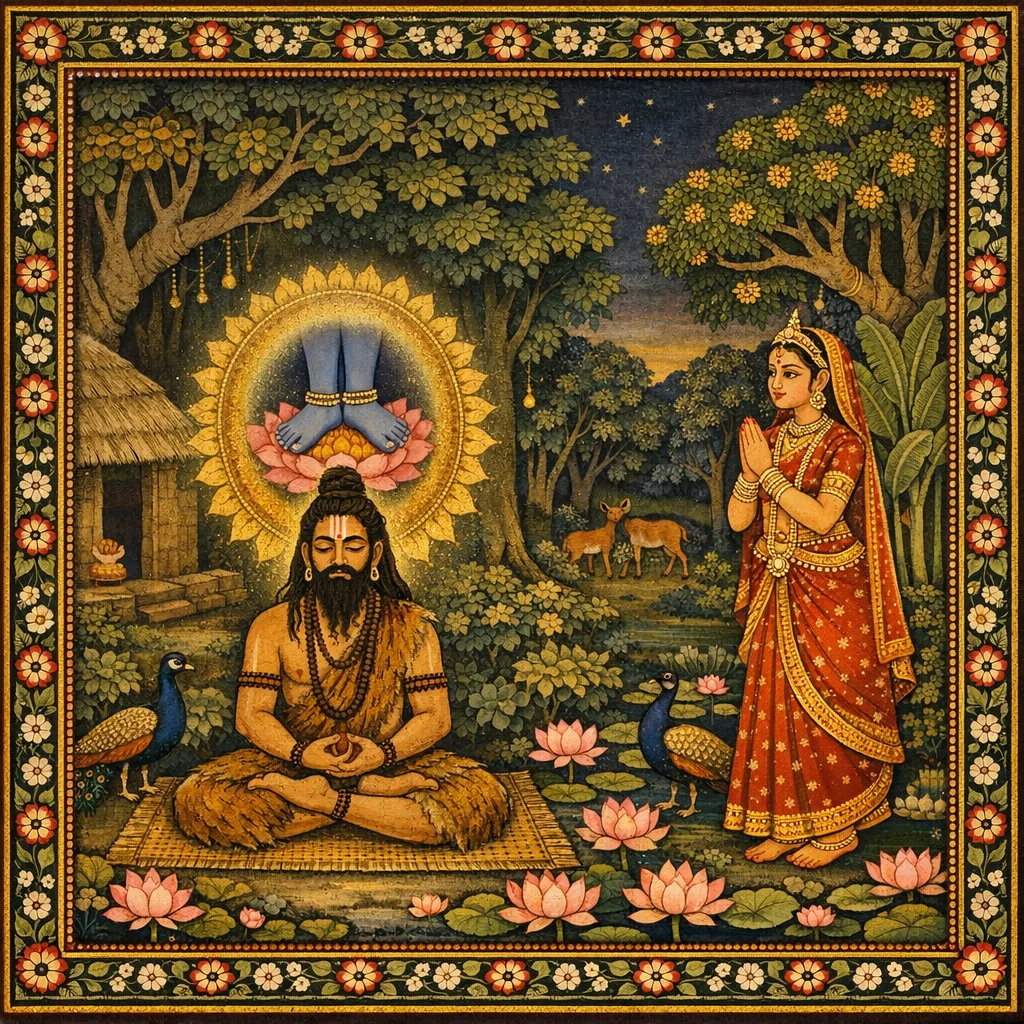
As the Pṛthu narrative approaches its conclusion, the king—seeing old age—transfers responsibility and distributes accumulated opulence across all beings, establishing orderly support according to dharma and entrusting his heirs to the Earth (personified as his daughter). Leaving behind grieving citizens, he enters the forest with Queen Arci and rigorously adopts vānaprastha disciplines. His tapas escalates from austere diet to breath-control, not for mystic display but solely for Kṛṣṇa’s satisfaction, culminating in unwavering bhakti, Paramātmā-realization, and the abandonment of ancillary yoga/jñāna aims. At death, Pṛthu fixes his mind on Kṛṣṇa’s lotus feet and performs a yogic withdrawal, merging the elements and relinquishing designations—depicting a Bhāgavata-inflected ‘return’ grounded in devotion. Arci, embodying pativratā-dharma, performs the final rites and enters the funeral fire, praised by celestial women. The chapter closes with Maitreya’s phala-śruti: hearing, reciting, and teaching Pṛthu’s character grants spiritual elevation and strengthens devotion—setting a transition toward subsequent dynastic and instructive narrations after Pṛthu’s departure.
Shlokas
Verse 1
मैत्रेय उवाच दृष्ट्वात्मानं प्रवयसमेकदा वैन्य आत्मवान् । आत्मना वर्धिताशेषस्वानुसर्ग: प्रजापति: ॥ १ ॥ जगतस्तस्थुषश्चापि वृत्तिदो धर्मभृत्सताम् । निष्पादितेश्वरादेशो यदर्थमिह जज्ञिवान् ॥ २ ॥ आत्मजेष्वात्मजां न्यस्य विरहाद्रुदतीमिव । प्रजासु विमन:स्वेक: सदारोऽगात्तपोवनम् ॥ ३ ॥
At the last stage of his life, when Mahārāja Pṛthu saw himself getting old, that great soul, who was king of the world, divided whatever opulence he had accumulated amongst all kinds of living entities, moving and nonmoving. He arranged pensions for everyone according to religious principles, and after executing the orders of the Supreme Personality of Godhead in complete coordination with Him, he dedicated his sons unto the earth, which was considered to be his daughter. Then Mahārāja Pṛthu left the presence of his citizens, who were almost lamenting and crying from feeling separation from the King, and went to the forest alone with his wife to perform austerities.
Verse 2
मैत्रेय उवाच दृष्ट्वात्मानं प्रवयसमेकदा वैन्य आत्मवान् । आत्मना वर्धिताशेषस्वानुसर्ग: प्रजापति: ॥ १ ॥ जगतस्तस्थुषश्चापि वृत्तिदो धर्मभृत्सताम् । निष्पादितेश्वरादेशो यदर्थमिह जज्ञिवान् ॥ २ ॥ आत्मजेष्वात्मजां न्यस्य विरहाद्रुदतीमिव । प्रजासु विमन:स्वेक: सदारोऽगात्तपोवनम् ॥ ३ ॥
At the last stage of his life, when Mahārāja Pṛthu saw himself getting old, that great soul, who was king of the world, divided whatever opulence he had accumulated amongst all kinds of living entities, moving and nonmoving. He arranged pensions for everyone according to religious principles, and after executing the orders of the Supreme Personality of Godhead in complete coordination with Him, he dedicated his sons unto the earth, which was considered to be his daughter. Then Mahārāja Pṛthu left the presence of his citizens, who were almost lamenting and crying from feeling separation from the King, and went to the forest alone with his wife to perform austerities.
Verse 3
मैत्रेय उवाच दृष्ट्वात्मानं प्रवयसमेकदा वैन्य आत्मवान् । आत्मना वर्धिताशेषस्वानुसर्ग: प्रजापति: ॥ १ ॥ जगतस्तस्थुषश्चापि वृत्तिदो धर्मभृत्सताम् । निष्पादितेश्वरादेशो यदर्थमिह जज्ञिवान् ॥ २ ॥ आत्मजेष्वात्मजां न्यस्य विरहाद्रुदतीमिव । प्रजासु विमन:स्वेक: सदारोऽगात्तपोवनम् ॥ ३ ॥
At the last stage of his life, when Mahārāja Pṛthu saw himself getting old, that great soul, who was king of the world, divided whatever opulence he had accumulated amongst all kinds of living entities, moving and nonmoving. He arranged pensions for everyone according to religious principles, and after executing the orders of the Supreme Personality of Godhead in complete coordination with Him, he dedicated his sons unto the earth, which was considered to be his daughter. Then Mahārāja Pṛthu left the presence of his citizens, who were almost lamenting and crying from feeling separation from the King, and went to the forest alone with his wife to perform austerities.
Verse 4
तत्राप्यदाभ्यनियमो वैखानससुसम्मते । आरब्ध उग्रतपसि यथा स्वविजये पुरा ॥ ४ ॥
After retiring from family life, Mahārāja Pṛthu strictly followed the regulations of retired life and underwent severe austerities in the forest. He engaged in these activities as seriously as he had formerly engaged in leading the government and conquering everyone.
Verse 5
कन्दमूलफलाहार: शुष्कपर्णाशन: क्वचित् । अब्भक्ष: कतिचित्पक्षान् वायुभक्षस्तत: परम् ॥ ५ ॥
In the tapo-vana, Mahārāja Pṛthu sometimes ate the trunks and roots of trees, sometimes he ate fruit and dried leaves, and for some weeks he drank only water. Finally he lived simply by breathing air.
Verse 6
ग्रीष्मे पञ्चतपा वीरो वर्षास्वासारषाण्मुनि: । आकण्ठमग्न: शिशिरे उदके स्थण्डिलेशय: ॥ ६ ॥
Following the principles of forest living and the footsteps of the great sages and munis, Pṛthu Mahārāja accepted five kinds of heating processes during the summer season, exposed himself to torrents of rain in the rainy season and, in the winter, stood in water up to his neck. He also used to simply lie down on the floor to sleep.
Verse 7
तितिक्षुर्यतवाग्दान्त ऊर्ध्वरेता जितानिल: । आरिराधयिषु: कृष्णमचरत्तप उत्तमम् ॥ ७ ॥
Mahārāja Pṛthu underwent all these severe austerities in order to control his words and his senses, to refrain from discharging his semen and to control the life air within his body. All this he did for the satisfaction of Kṛṣṇa. He had no other purpose.
Verse 8
तेन क्रमानुसिद्धेन ध्वस्तकर्ममलाशय: । प्राणायामै: सन्निरुद्धषड्वर्गश्छिन्नबन्धन: ॥ ८ ॥
By thus practicing severe austerities, Mahārāja Pṛthu gradually became steadfast in spiritual life and completely free of all desires for fruitive activities. He also practiced breathing exercises to control his mind and senses, and by such control he became completely free from all desires for fruitive activity.
Verse 9
सनत्कुमारो भगवान् यदाहाध्यात्मिकं परम् । योगं तेनैव पुरुषमभजत्पुरुषर्षभ: ॥ ९ ॥
Thus the best amongst human beings, Mahārāja Pṛthu, followed that path of spiritual advancement which was advised by Sanat-kumāra. That is to say, he worshiped the Supreme Personality of Godhead, Kṛṣṇa.
Verse 10
भगवद्धर्मिण: साधो: श्रद्धया यतत: सदा । भक्तिर्भगवति ब्रह्मण्यनन्यविषयाभवत् ॥ १० ॥
Mahārāja Pṛthu thus engaged completely in devotional service, executing the rules and regulations strictly according to principles, twenty-four hours daily. Thus his love and devotion unto the Supreme Personality of Godhead, Kṛṣṇa, developed and became unflinching and fixed.
Verse 11
तस्यानया भगवत: परिकर्मशुद्ध सत्त्वात्मनस्तदनुसंस्मरणानुपूर्त्या । ज्ञानं विरक्तिमदभून्निशितेन येन चिच्छेद संशयपदं निजजीवकोशम् ॥ ११ ॥
By regularly discharging devotional service, Pṛthu Mahārāja became transcendental in mind and could therefore constantly think of the lotus feet of the Lord. Because of this, he became completely detached and attained perfect knowledge by which he could transcend all doubt. Thus he was freed from the clutches of false ego and the material conception of life.
Verse 12
छिन्नान्यधीरधिगतात्मगतिर्निरीह- स्तत्तत्यजेऽच्छिनदिदं वयुनेन येन । तावन्न योगगतिभिर्यतिरप्रमत्तो यावद्गदाग्रजकथासु रतिं न कुर्यात् ॥ १२ ॥
When he became completely free from the conception of bodily life, Mahārāja Pṛthu realized Lord Kṛṣṇa sitting in everyone’s heart as the Paramātmā. Being thus able to get all instructions from Him, he gave up all other practices of yoga and jñāna. He was not even interested in the perfection of the yoga and jñāna systems, for he thoroughly realized that devotional service to Kṛṣṇa is the ultimate goal of life and that unless the yogīs and jñānīs become attracted to kṛṣṇa-kathā [narrations about Kṛṣṇa], their illusions concerning existence can never be dispelled.
Verse 13
एवं स वीरप्रवर: संयोज्यात्मानमात्मनि । ब्रह्मभूतो दृढं काले तत्याज स्वं कलेवरम् ॥ १३ ॥
In due course of time, when Pṛthu Mahārāja was to give up his body, he fixed his mind firmly upon the lotus feet of Kṛṣṇa, and thus, completely situated on the brahma-bhūta platform, he gave up the material body.
Verse 14
सम्पीड्य पायुं पार्ष्णिभ्यां वायुमुत्सारयञ्छनै: । नाभ्यां कोष्ठेष्ववस्थाप्य हृदुर:कण्ठशीर्षणि ॥ १४ ॥
When Mahārāja Pṛthu practiced a particular yogic sitting posture, he blocked the door of his anus with his ankles, pressed his right and left calves and gradually raised his life air upward, passing it on to the circle of his navel, up to his heart and throat, and finally pushed it upward to the central position between his two eyebrows.
Verse 15
उत्सर्पयंस्तु तं मूर्ध्नि क्रमेणावेश्य नि:स्पृह: । वायुं वायौ क्षितौ कायं तेजस्तेजस्ययूयुजत् ॥ १५ ॥
In this way, Pṛthu Mahārāja gradually raised his air of life up to the hole in his skull, whereupon he lost all desire for material existence. Gradually he merged his air of life with the totality of air, his body with the totality of earth, and the fire within his body with the totality of fire.
Verse 16
खान्याकाशे द्रवं तोये यथास्थानं विभागश: । क्षितिमम्भसि तत्तेजस्यदो वायौ नभस्यमुम् ॥ १६ ॥
In this way, according to the different positions of the various parts of the body, Pṛthu Mahārāja merged the holes of his senses with the sky; his bodily liquids, such as blood and various secretions, with the totality of water; and he merged earth with water, then water with fire, fire with air, air with sky, and so on.
Verse 17
इन्द्रियेषु मनस्तानि तन्मात्रेषु यथोद्भवम् । भूतादिनामून्युत्कृष्य महत्यात्मनि सन्दधे ॥ १७ ॥
He amalgamated the mind with the senses and the senses with the sense objects, according to their respective positions, and he also amalgamated the material ego with the total material energy, mahat-tattva.
Verse 18
तं सर्वगुणविन्यासं जीवे मायामये न्यधात् । तं चानुशयमात्मस्थमसावनुशयी पुमान् । ज्ञानवैराग्यवीर्येण स्वरूपस्थोऽजहात्प्रभु: ॥ १८ ॥
Pṛthu Mahārāja then offered the total designation of the living entity unto the supreme controller of illusory energy. Being released from all the designations by which the living entity became entrapped, he became free by knowledge and renunciation and by the spiritual force of his devotional service. In this way, being situated in his original constitutional position of Kṛṣṇa consciousness, he gave up this body as a prabhu, or controller of the senses.
Verse 19
अर्चिर्नाम महाराज्ञी तत्पत्न्यनुगता वनम् । सुकुमार्यतदर्हा च यत्पद्भ्यां स्पर्शनं भुव: ॥ १९ ॥
The Queen, the wife of Pṛthu Mahārāja, whose name was Arci, followed her husband into the forest. Since she was a queen, her body was very delicate. Although she did not deserve to live in the forest, she voluntarily touched her lotus feet to the ground.
Verse 20
अतीव भर्तुर्व्रतधर्मनिष्ठया शुश्रूषया चार्षदेहयात्रया । नाविन्दतार्तिं परिकर्शितापि सा प्रेयस्करस्पर्शनमाननिर्वृति: ॥ २० ॥
Although she was not accustomed to such difficulties, Queen Arci followed her husband in the regulative principles of living in the forest like great sages. She lay down on the ground and ate only fruits, flowers and leaves, and because she was not fit for these activities, she became frail and thin. Yet because of the pleasure she derived in serving her husband, she did not feel any difficulties.
Verse 21
देहं विपन्नाखिलचेतनादिकं पत्यु: पृथिव्या दयितस्य चात्मन: । आलक्ष्य किञ्चिच्च विलप्य सा सती चितामथारोपयदद्रिसानुनि ॥ २१ ॥
When Queen Arci saw that her husband, who had been so merciful to her and the earth, no longer showed symptoms of life, she lamented for a little while and then built a fiery pyre on top of a hill and placed the body of her husband on it.
Verse 22
विधाय कृत्यं ह्रदिनीजलाप्लुता दत्त्वोदकं भर्तुरुदारकर्मण: । नत्वा दिविस्थांस्त्रिदशांस्त्रि: परीत्य विवेश वह्निं ध्यायती भर्तृपादौ ॥ २२ ॥
After this, the Queen executed the necessary funerary functions and offered oblations of water. After bathing in the river, she offered obeisances to various demigods situated in the sky in the different planetary systems. She then circumambulated the fire and, while thinking of the lotus feet of her husband, entered its flames.
Verse 23
विलोक्यानुगतां साध्वीं पृथुं वीरवरं पतिम् । तुष्टुवुर्वरदा देवैर्देवपत्न्य: सहस्रश: ॥ २३ ॥
After observing this brave act performed by the chaste wife Arci, the wife of the great King Pṛthu, many thousands of the wives of the demigods, along with their husbands, offered prayers to the Queen, for they were very much satisfied.
Verse 24
कुर्वत्य: कुसुमासारं तस्मिन्मन्दरसानुनि । नदत्स्वमरतूर्येषु गृणन्ति स्म परस्परम् ॥ २४ ॥
At that time the demigods were situated on the top of Mandara Hill, and all their wives began to shower flowers on the funeral pyre and began to talk amongst themselves as follows.
Verse 25
देव्य ऊचु: अहो इयं वधूर्धन्या या चैवं भूभुजां पतिम् । सर्वात्मना पतिं भेजे यज्ञेशं श्रीर्वधूरिव ॥ २५ ॥
The wives of the demigods said: All glories to Queen Arci! We can see that this queen of the great King Pṛthu, the emperor of all the kings of the world, has served her husband with mind, speech and body exactly as the goddess of fortune serves the Supreme Personality of Godhead, Yajñeśa, or Viṣṇu.
Verse 26
सैषा नूनं व्रजत्यूर्ध्वमनु वैन्यं पतिं सती । पश्यतास्मानतीत्यार्चिर्दुर्विभाव्येन कर्मणा ॥ २६ ॥
The wives of the demigods continued: Just see how this chaste lady, Arci, by dint of her inconceivable pious activities, is still following her husband upward, as far as we can see.
Verse 27
तेषां दुरापं किं त्वन्यन्मर्त्यानां भगवत्पदम् । भुवि लोलायुषो ये वै नैष्कर्म्यं साधयन्त्युत ॥ २७ ॥
In this material world, every human being has a short span of life, but those who are engaged in devotional service go back home, back to Godhead, for they are actually on the path of liberation. For such persons, there is nothing which is not available.
Verse 28
स वञ्चितो बतात्मध्रुक् कृच्छ्रेण महता भुवि । लब्ध्वापवर्ग्यं मानुष्यं विषयेषु विषज्जते ॥ २८ ॥
Any person who engages himself within this material world in performing activities that necessitate great struggle, and who, after obtaining a human form of life — which is a chance to attain liberation from miseries — undertakes the difficult tasks of fruitive activities, must be considered to be cheated and envious of his own self.
Verse 29
मैत्रेय उवाच स्तुवतीष्वमरस्त्रीषु पतिलोकं गता वधू: । यं वा आत्मविदां धुर्यो वैन्य: प्रापाच्युताश्रय: ॥ २९ ॥
The great sage Maitreya continued speaking: My dear Vidura, when the wives of the denizens of heaven were thus talking amongst themselves, Queen Arci reached the planet which her husband, Mahārāja Pṛthu, the topmost self-realized soul, had attained.
Verse 30
इत्थम्भूतानुभावोऽसौ पृथु: स भगवत्तम: । कीर्तितं तस्य चरितमुद्दामचरितस्य ते ॥ ३० ॥
Maitreya continued: The greatest of all devotees, Mahārāja Pṛthu, was very powerful, and his character was liberal, magnificent and magnanimous. Thus I have described him to you as far as possible.
Verse 31
य इदं सुमहत्पुण्यं श्रद्धयावहित: पठेत् । श्रावयेच्छृणुयाद्वापि स पृथो: पदवीमियात् ॥ ३१ ॥
Any person who describes the great characteristics of King Pṛthu with faith and determination — whether he reads or hears of them himself or helps others to hear of them — is certain to attain the very planet which Mahārāja Pṛthu attained. In other words, such a person also returns home to the Vaikuṇṭha planets, back to Godhead.
Verse 32
ब्राह्मणो ब्रह्मवर्चस्वी राजन्यो जगतीपति: । वैश्य: पठन् विट्पति: स्याच्छूद्र: सत्तमतामियात् ॥ ३२ ॥
If one hears of the characteristics of Pṛthu Mahārāja and is a brāhmaṇa, he becomes perfectly qualified with brahminical powers; if he is a kṣatriya, he becomes a king of the world; if he is a vaiśya, he becomes a master of other vaiśyas and many animals; and if he is a śūdra, he becomes the topmost devotee.
Verse 33
त्रि: कृत्व इदमाकर्ण्य नरो नार्यथवादृता । अप्रज: सुप्रजतमो निर्धनो धनवत्तम: ॥ ३३ ॥
It does not matter whether one is a man or woman. Anyone who, with great respect, hears this narration of Mahārāja Pṛthu will become the parent of many children if without children, and will become the richest if without money.
Verse 34
अस्पष्टकीर्ति: सुयशा मूर्खो भवति पण्डित: । इदं स्वस्त्ययनं पुंसाममङ्गल्यनिवारणम् ॥ ३४ ॥
Also, one who hears this narration three times will become very reputable if he is not recognized in society, and he will become a great scholar if he is illiterate. In other words, hearing of the narrations of Pṛthu Mahārāja is so auspicious that it drives away all bad luck.
Verse 35
धन्यं यशस्यमायुष्यं स्वर्ग्यं कलिमलापहम् । धर्मार्थकाममोक्षाणां सम्यक्सिद्धिमभीप्सुभि: । श्रद्धयैतदनुश्राव्यं चतुर्णां कारणं परम् ॥ ३५ ॥
By hearing the narration of Pṛthu Mahārāja, one can become great, increase his duration of life, gain promotion to the heavenly planets and counteract the contaminations of this Age of Kali. In addition, one can promote the causes of religion, economic development, sense gratification and liberation. Therefore from all sides it is advisable for a materialistic person who is interested in such things to read and hear the narrations of the life and character of Pṛthu Mahārāja.
Verse 36
विजयाभिमुखो राजा श्रुत्वैतदभियाति यान् । बलिं तस्मै हरन्त्यग्रे राजान: पृथवे यथा ॥ ३६ ॥
If a king, who is desirous of attaining victory and ruling power, chants the narration of Pṛthu Mahārāja three times before going forth on his chariot, all subordinate kings will automatically render all kinds of taxes unto him — as they rendered them unto Mahārāja Pṛthu — simply upon his order.
Verse 37
मुक्तान्यसङ्गो भगवत्यमलां भक्तिमुद्वहन् । वैन्यस्य चरितं पुण्यं शृणुयाच्छ्रावयेत्पठेत् ॥ ३७ ॥
A pure devotee who is executing the different processes of devotional service may be situated in the transcendental position, being completely absorbed in Kṛṣṇa consciousness, but even he, while discharging devotional service, must hear, read and induce others to hear about the character and life of Pṛthu Mahārāja.
Verse 38
वैचित्रवीर्याभिहितं महन्माहात्म्यसूचकम् । अस्मिन् कृतमतिमर्त्यं पार्थवीं गतिमाप्नुयात् ॥ ३८ ॥
The great sage Maitreya continued: My dear Vidura, I have as far as possible spoken the narrations about Pṛthu Mahārāja, which enrich one’s devotional attitude. Whoever takes advantage of these benefits also goes back home, back to Godhead, like Mahārāja Pṛthu.
Verse 39
अनुदिनमिदमादरेण शृण्वन् पृथुचरितं प्रथयन् विमुक्तसङ्ग: । भगवति भवसिन्धुपोतपादे स च निपुणां लभते रतिं मनुष्य: ॥ ३९ ॥
Whoever, with great reverence and adoration, regularly reads, chants and describes the history of Mahārāja Pṛthu’s activities will certainly increase unflinching faith and attraction for the lotus feet of the Lord. The Lord’s lotus feet are the boat by which one can cross the ocean of nescience.
Frequently Asked Questions
Pṛthu’s distribution reflects rājadharma purified by devotion: kingship is stewardship, not ownership. By arranging sustenance and pensions according to religious principles, he demonstrates non-exploitative governance and detachment, ensuring social stability while he transitions to vānaprastha. The Bhāgavata frames this as completion of the Lord’s mandate—prosperity administered as service, then relinquished without possessiveness.
The text explicitly states his purpose: control of speech and senses, celibacy, and prāṇa regulation were undertaken “for the satisfaction of Kṛṣṇa,” not for siddhis, fame, or heavenly promotion. As devotion becomes fixed, he abandons separate pursuits of yoga and jñāna because he realizes bhakti to Kṛṣṇa is the ultimate goal and that without attraction to kṛṣṇa-kathā, illusion cannot be fully dispelled.
Anta-kāla-smaraṇa is presented as the culmination of a life of regulated devotion: remembrance is not accidental but the fruit of steady service. Pṛthu’s brahma-bhūta steadiness and absorption in the Lord’s lotus feet illustrate the Bhāgavata conclusion that liberation is secured through devotion, with yogic procedures functioning as supportive rather than independent means.
The narrative describes a yogic withdrawal where bodily constituents are returned to their cosmic totals (earth to earth, water to water, etc.), alongside the relinquishing of sense-identities and false ego (ahaṅkāra) into mahat-tattva. In Bhāgavata theology, this is not impersonal annihilation but freedom from upādhis (material labels) so the self can abide in its constitutional service identity, strengthened by bhakti.
Arci is Pṛthu’s chaste queen who voluntarily accepts forest hardship to serve her husband and, after his passing, performs the rites and enters the funeral fire while meditating on his lotus feet. The deva-patnīs praise her as paralleling Śrī (Lakṣmī) in service to Viṣṇu—highlighting loyalty, selflessness, and devotion-centered marital dharma as spiritually luminous when aligned with the Lord’s purpose.
Phala-śruti functions pedagogically: it motivates śravaṇa and kīrtana by declaring tangible and spiritual results, while ultimately steering the listener toward bhakti. The chapter states that faithful recitation and assisting others to hear leads to attaining Pṛthu’s destination (Vaikuṇṭha) and increases unflinching faith—asserting that contact with saintly character narratives purifies Kali-yuga contamination and awakens devotion.