Adhyaya 25
Nārada Instructs Prācīnabarhiṣat: The Purañjana Narrative Begins (City of Nine Gates)
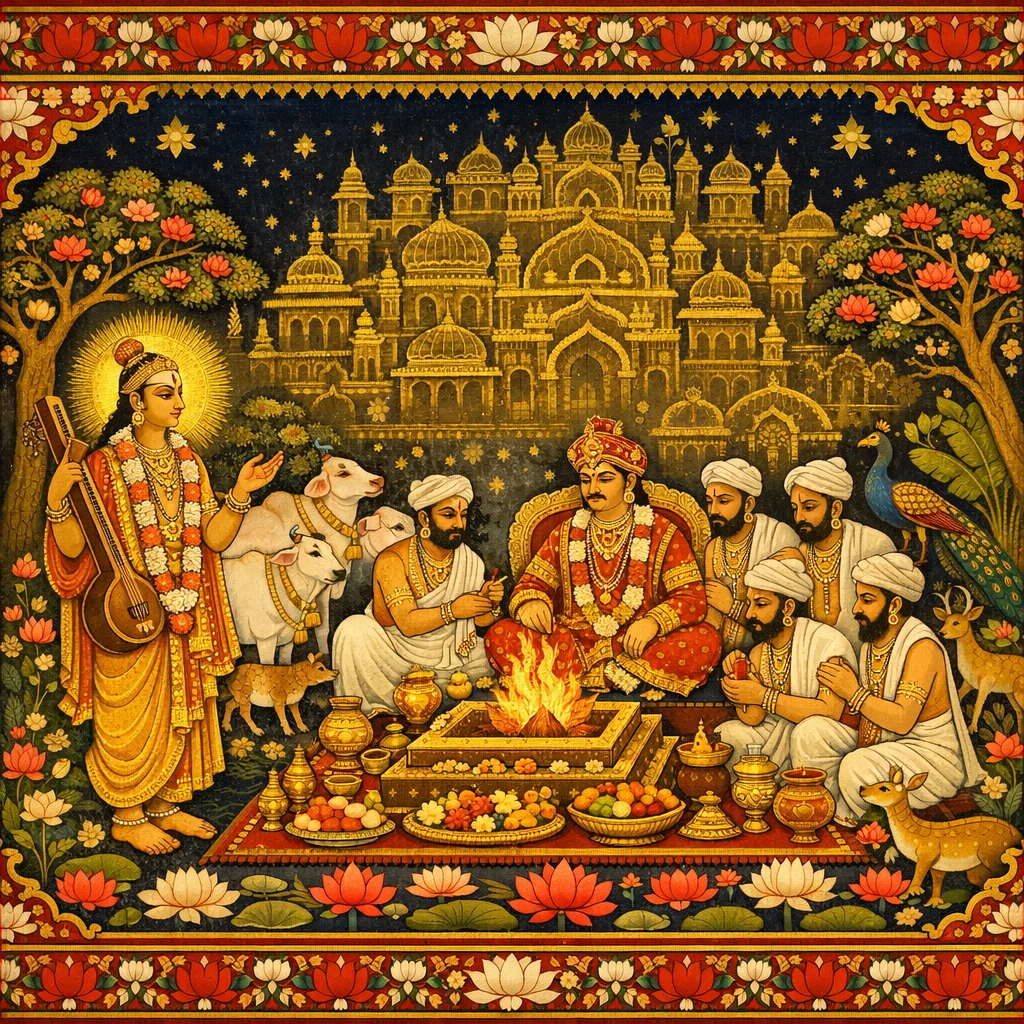
After Lord Śiva blesses the Pracetās and disappears, the princes remain in water for ten thousand years, continuously reciting Śiva’s prayers. Meanwhile, their father King Prācīnabarhiṣat intensifies fruitive sacrificial performances. Seeing the king’s karmic entanglement and the violence implicit in his yajñas, Nārada approaches out of compassion, challenging the very premise that ritual action can deliver freedom from misery and lasting happiness. He warns the king by revealing the sacrificed animals awaiting vengeance—an ethical and karmic critique meant to awaken vairāgya. To redirect the king toward ātma-tattva, Nārada introduces an ancient allegory: King Purañjana and his enigmatic friend Avijñāta. Purañjana wanders seeking fulfillment, finds a splendid city with nine gates, and meets a captivating woman guarded by a five-hooded serpent; she offers him a century of sense enjoyment. The chapter establishes the allegorical architecture (body, senses, mind, prāṇa, companions) and depicts the jīva’s increasing captivity through identification and imitation. This sets up the next chapters to decode the city’s gates, the king’s movements, and the consequences of absorption in household enjoyment.
Shlokas
Verse 1
मैत्रेय उवाच इति सन्दिश्य भगवान् बार्हिषदैरभिपूजित: । पश्यतां राजपुत्राणां तत्रैवान्तर्दधे हर: ॥ १ ॥
The great sage Maitreya continued speaking to Vidura: My dear Vidura, in this way Lord Śiva instructed the sons of King Barhiṣat. The sons of the King also worshiped Lord Śiva with great devotion and respect. Finally, Lord Śiva became invisible to the princes.
Verse 2
रुद्रगीतं भगवत: स्तोत्रं सर्वे प्रचेतस: । जपन्तस्ते तपस्तेपुर्वर्षाणामयुतं जले ॥ २ ॥
All the Pracetā princes simply stood in the water for ten thousand years and recited the prayers given to them by Lord Śiva.
Verse 3
प्राचीनबर्हिषं क्षत्त: कर्मस्वासक्तमानसम् । नारदोऽध्यात्मतत्त्वज्ञ: कृपालु: प्रत्यबोधयत् ॥ ३ ॥
While the princes were undergoing severe austerities in the water, their father was performing different types of fruitive activities. At this time the great saint Nārada, master and teacher of all spiritual life, became very compassionate upon the King and decided to instruct him about spiritual life.
Verse 4
श्रेयस्त्वं कतमद्राजन् कर्मणात्मन ईहसे । दु:खहानि: सुखावाप्ति: श्रेयस्तन्नेह चेष्यते ॥ ४ ॥
Nārada Muni asked King Prācīnabarhiṣat: My dear King, what do you desire to achieve by performing these fruitive activities? The chief aim of life is to get rid of all miseries and enjoy happiness, but these two things cannot be realized by fruitive activity.
Verse 5
राजोवाच न जानामि महाभाग परं कर्मापविद्धधी: । ब्रूहि मे विमलं ज्ञानं येन मुच्येय कर्मभि: ॥ ५ ॥
The King replied: O great soul, Nārada, my intelligence is entangled in fruitive activities; therefore I do not know the ultimate goal of life. Kindly instruct me in pure knowledge so that I can get out of the entanglement of fruitive activities.
Verse 6
गृहेषु कूटधर्मेषु पुत्रदारधनार्थधी: । न परं विन्दते मूढो भ्राम्यन् संसारवर्त्मसु ॥ ६ ॥
Those who are interested only in a so-called dutiful life — namely remaining as a householder entangled by sons and a wife and searching after wealth — think that such things are life’s ultimate goal. Such people simply wander in different types of bodies throughout this material existence without finding out the ultimate goal of life.
Verse 7
नारद उवाच भो भो: प्रजापते राजन् पशून् पश्य त्वयाध्वरे । संज्ञापिताञ्जीवसङ्घान्निर्घृणेन सहस्रश: ॥ ७ ॥
The great saint Nārada said: O ruler of the citizens, my dear King, please see in the sky those animals which you have sacrificed without compassion and without mercy in the sacrificial arena.
Verse 8
एते त्वां सम्प्रतीक्षन्ते स्मरन्तो वैशसं तव । सम्परेतम् अय:कूटैश्छिन्दन्त्युत्थितमन्यव: ॥ ८ ॥
All these animals are awaiting your death so that they can avenge the injuries you have inflicted upon them. After you die, they will angrily pierce your body with iron horns.
Verse 9
अत्र ते कथयिष्येऽमुमितिहासं पुरातनम् । पुरञ्जनस्य चरितं निबोध गदतो मम ॥ ९ ॥
In this connection I wish to narrate an old history connected with the character of a king called Purañjana. Please try to hear me with great attention.
Verse 10
आसीत्पुरञ्जनो नाम राजा राजन् बृहच्छ्रवा: । तस्याविज्ञातनामासीत्सखाविज्ञातचेष्टित: ॥ १० ॥
My dear King, once in the past lived a king named Purañjana, who was celebrated for his great activities. He had a friend named Avijñāta [“the unknown one”]. No one could understand the activities of Avijñāta.
Verse 11
सोऽन्वेषमाण: शरणं बभ्राम पृथिवीं प्रभु: । नानुरूपं यदाविन्ददभूत्स विमना इव ॥ ११ ॥
King Purañjana began to search for a suitable place to live, and thus he traveled all over the world. Even after a great deal of traveling, he could not find a place just to his liking. Finally he became morose and disappointed.
Verse 12
न साधु मेने ता: सर्वा भूतले यावती: पुर: । कामान् कामयमानोऽसौ तस्य तस्योपपत्तये ॥ १२ ॥
King Purañjana had unlimited desires for sense enjoyment; consequently he traveled all over the world to find a place where all his desires could be fulfilled. Unfortunately he found a feeling of insufficiency everywhere.
Verse 13
स एकदा हिमवतो दक्षिणेष्वथ सानुषु । ददर्श नवभिर्द्वार्भि: पुरं लक्षितलक्षणाम् ॥ १३ ॥
Once, while wandering in this way, he saw on the southern side of the Himālayas, in a place named Bhārata-varṣa [India], a city that had nine gates all about and was characterized by all auspicious facilities.
Verse 14
प्राकारोपवनाट्टालपरिखैरक्षतोरणै: । स्वर्णरौप्यायसै: शृङ्गै: सङ्कुलां सर्वतो गृहै: ॥ १४ ॥
That city was surrounded by walls and parks, and within it were towers, canals, windows and outlets. The houses there were decorated with domes made of gold, silver and iron.
Verse 15
नीलस्फटिकवैदूर्यमुक्तामरकतारुणै: । क्लृप्तहर्म्यस्थलीं दीप्तां श्रिया भोगवतीमिव ॥ १५ ॥
The floors of the houses in that city were made of sapphire, crystal, diamonds, pearls, emeralds and rubies. Because of the luster of the houses in the capital, the city was compared to the celestial town named Bhogavatī.
Verse 16
सभाचत्वररथ्याभिराक्रीडायतनापणै: । चैत्यध्वजपताकाभिर्युक्तां विद्रुमवेदिभि: ॥ १६ ॥
In that city there were many assembly houses, street crossings, streets, restaurants, gambling houses, markets, resting places, flags, festoons and beautiful parks. All these surrounded the city.
Verse 17
पुर्यास्तु बाह्योपवने दिव्यद्रुमलताकुले । नदद्विहङ्गालिकुलकोलाहलजलाशये ॥ १७ ॥
On the outskirts of that city were many beautiful trees and creepers encircling a nice lake. Also surrounding that lake were many groups of birds and bees that were always chanting and humming.
Verse 18
हिमनिर्झरविप्रुष्मत्कुसुमाकरवायुना । चलत्प्रवालविटपनलिनीतटसम्पदि ॥ १८ ॥
The branches of the trees standing on the bank of the lake received particles of water carried by the spring air from the falls coming down from the icy mountain.
Verse 19
नानारण्यमृगव्रातैरनाबाधे मुनिव्रतै: । आहूतं मन्यते पान्थो यत्र कोकिलकूजितै: ॥ १९ ॥
In such an atmosphere even the animals of the forest became nonviolent and nonenvious like great sages. Consequently, the animals did not attack anyone. Over and above everything was the cooing of the cuckoos. Any passenger passing along that path was invited by that atmosphere to take rest in that nice garden.
Verse 20
यदृच्छयागतां तत्र ददर्श प्रमदोत्तमाम् । भृत्यैर्दशभिरायान्तीमेकैकशतनायकै: ॥ २० ॥
While wandering here and there in that wonderful garden, King Purañjana suddenly came in contact with a very beautiful woman who was walking there without any engagement. She had ten servants with her, and each servant had hundreds of wives accompanying him.
Verse 21
पञ्चशीर्षाहिना गुप्तां प्रतीहारेण सर्वत: । अन्वेषमाणामृषभमप्रौढां कामरूपिणीम् ॥ २१ ॥
The woman was protected on all sides by a five-hooded snake. She was very beautiful and young, and she appeared very anxious to find a suitable husband.
Verse 22
सुनासां सुदतीं बालां सुकपोलां वराननाम् । समविन्यस्तकर्णाभ्यां बिभ्रतीं कुण्डलश्रियम् ॥ २२ ॥
The woman’s nose, teeth and forehead were all very beautiful. Her ears were equally very beautiful and were bedecked with dazzling earrings.
Verse 23
पिशङ्गनीवीं सुश्रोणीं श्यामां कनकमेखलाम् । पद्भ्यां क्वणद्भ्यां चलन्तीं नूपुरैर्देवतामिव ॥ २३ ॥
The waist and hips of the woman were very beautiful. She was dressed in a yellow sārī with a golden belt. While she walked, her ankle bells rang. She appeared exactly like a denizen of the heavens.
Verse 24
स्तनौ व्यञ्जितकैशोरौ समवृत्तौ निरन्तरौ । वस्त्रान्तेन निगूहन्तीं व्रीडया गजगामिनीम् ॥ २४ ॥
With the end of her sārī the woman was trying to cover her breasts, which were equally round and well placed side by side. She again and again tried to cover them out of shyness while she walked exactly like a great elephant.
Verse 25
तामाह ललितं वीर: सव्रीडस्मितशोभनाम् । स्निग्धेनापाङ्गपुङ्खेन स्पृष्ट: प्रेमोद्भ्रमद्भ्रुवा ॥ २५ ॥
Purañjana, the hero, became attracted by the eyebrows and smiling face of the very beautiful girl and was immediately pierced by the arrows of her lusty desires. When she smiled shyly, she looked very beautiful to Purañjana, who, although a hero, could not refrain from addressing her.
Verse 26
का त्वं कञ्जपलाशाक्षि कस्यासीह कुत: सति । इमामुप पुरीं भीरु किं चिकीर्षसि शंस मे ॥ २६ ॥
My dear lotus-eyed, kindly explain to me where you are coming from, who you are, and whose daughter you are. You appear very chaste. What is the purpose of your coming here? What are you trying to do? Please explain all these things to me.
Verse 27
क एतेऽनुपथा ये त एकादश महाभटा: । एता वा ललना: सुभ्रु कोऽयं तेऽहि: पुर:सर: ॥ २७ ॥
My dear lotus-eyed, who are those eleven strong bodyguards with you, and who are those ten specific servants? Who are those women following the ten servants, and who is the snake that is preceding you?
Verse 28
त्वं ह्रीर्भवान्यस्यथ वाग्रमा पतिं विचिन्वती किं मुनिवद्रहो वने । त्वदङ्घ्रिकामाप्तसमस्तकामं क्व पद्मकोश: पतित: कराग्रात् ॥ २८ ॥
My dear beautiful girl, you are exactly like the goddess of fortune or the wife of Lord Śiva or the goddess of learning, the wife of Lord Brahmā. Although you must be one of them, I see that you are loitering in this forest. Indeed, you are as silent as the great sages. Is it that you are searching after your own husband? Whoever your husband may be, simply by understanding that you are so faithful to him, he will come to possess all opulences. I think you must be the goddess of fortune, but I do not see the lotus flower in your hand. Therefore I am asking you where you have thrown that lotus.
Verse 29
नासां वरोर्वन्यतमा भुविस्पृक् पुरीमिमां वीरवरेण साकम् । अर्हस्यलङ्कर्तुमदभ्रकर्मणा लोकं परं श्रीरिव यज्ञपुंसा ॥ २९ ॥
O greatly fortunate one, it appears that you are none of the women I have mentioned because I see that your feet are touching the ground. But if you are some woman of this planet, you can, like the goddess of fortune — who, accompanied by Lord Viṣṇu, increases the beauty of the Vaikuṇṭha planets — also increase the beauty of this city by associating with me. You should understand that I am a great hero and a very powerful king on this planet.
Verse 30
यदेष मापाङ्गविखण्डितेन्द्रियं सव्रीडभावस्मितविभ्रमद्भ्रुवा । त्वयोपसृष्टो भगवान्मनोभव: प्रबाधतेऽथानुगृहाण शोभने ॥ ३० ॥
Certainly your glancing upon me today has very much agitated my mind. Your smile, which is full of shyness but at the same time lusty, is agitating the most powerful cupid within me. Therefore, O most beautiful, I ask you to be merciful upon me.
Verse 31
त्वदाननं सुभ्रु सुतारलोचनं व्यालम्बिनीलालकवृन्दसंवृतम् । उन्नीय मे दर्शय वल्गुवाचकं यद्व्रीडया नाभिमुखं शुचिस्मिते ॥ ३१ ॥
My dear girl, your face is so beautiful with your nice eyebrows and eyes and with your bluish hair scattered about. In addition, very sweet sounds are coming from your mouth. Nonetheless, you are so covered with shyness that you do not see me face to face. I therefore request you, my dear girl, to smile and kindly raise your head to see me.
Verse 32
नारद उवाच इत्थं पुरञ्जनं नारी याचमानमधीरवत् । अभ्यनन्दत तं वीरं हसन्ती वीर मोहिता ॥ ३२ ॥
Nārada continued: My dear King, when Purañjana became so attracted and impatient to touch the girl and enjoy her, the girl also became attracted by his words and accepted his request by smiling. By this time she was certainly attracted by the King.
Verse 33
न विदाम वयं सम्यक्कर्तारं पुरुषर्षभ । आत्मनश्च परस्यापि गोत्रं नाम च यत्कृतम् ॥ ३३ ॥
The girl said: O best of human beings, I do not know who has begotten me. I cannot speak to you perfectly about this. Nor do I know the names or the origin of the associates with me.
Verse 34
इहाद्य सन्तमात्मानं विदाम न तत: परम् । येनेयं निर्मिता वीर पुरी शरणमात्मन: ॥ ३४ ॥
O great hero, we only know that we are existing in this place. We do not know what will come after. Indeed, we are so foolish that we do not care to understand who has created this beautiful place for our residence.
Verse 35
एते सखाय: सख्यो मे नरा नार्यश्च मानद । सुप्तायां मयि जागर्ति नागोऽयं पालयन् पुरीम् ॥ ३५ ॥
My dear gentleman, all these men and women with me are known as my friends, and the snake, who always remains awake, protects this city even during my sleeping hours. So much I know. I do not know anything beyond this.
Verse 36
दिष्ट्यागतोऽसि भद्रं ते ग्राम्यान् कामानभीप्ससे । उद्वहिष्यामि तांस्तेऽहं स्वबन्धुभिररिन्दम ॥ ३६ ॥
O killer of the enemy, you have somehow or other come here. This is certainly great fortune for me. I wish all auspicious things for you. You have a great desire to satisfy your senses, and all my friends and I shall try our best in all respects to fulfill your desires.
Verse 37
इमां त्वमधितिष्ठस्व पुरीं नवमुखीं विभो । मयोपनीतान् गृह्णान: कामभोगान् शतं समा: ॥ ३७ ॥
My dear lord, I have just arranged this city of nine gates for you so that you can have all kinds of sense gratification. You may live here for one hundred years, and everything for your sense gratification will be supplied.
Verse 38
कं नु त्वदन्यं रमये ह्यरतिज्ञमकोविदम् । असम्परायाभिमुखमश्वस्तनविदं पशुम् ॥ ३८ ॥
How can I expect to unite with others, who are neither conversant about sex nor capable of knowing how to enjoy life while living or after death? Such foolish persons are like animals because they do not know the process of sense enjoyment in this life and after death.
Verse 39
धर्मो ह्यत्रार्थकामौ च प्रजानन्दोऽमृतं यश: । लोका विशोका विरजा यान्न केवलिनो विदु: ॥ ३९ ॥
The woman continued: In this material world, a householder’s life brings all kinds of happiness in religion, economic development, sense gratification and the begetting of children, sons and grandsons. After that, one may desire liberation as well as material reputation. The householder can appreciate the results of sacrifices, which enable him to gain promotion to superior planetary systems. All this material happiness is practically unknown to the transcendentalists. They cannot even imagine such happiness.
Verse 40
पितृदेवर्षिमर्त्यानां भूतानामात्मनश्च ह । क्षेम्यं वदन्ति शरणं भवेऽस्मिन् यद्गृहाश्रम: ॥ ४० ॥
The woman continued: According to authorities, the householder life is pleasing not only to oneself but to all the forefathers, demigods, great sages, saintly persons and everyone else. A householder life is thus beneficial.
Verse 41
का नाम वीर विख्यातं वदान्यं प्रियदर्शनम् । न वृणीत प्रियं प्राप्तं मादृशी त्वादृशं पतिम् ॥ ४१ ॥
O my dear hero, who in this world will not accept a husband like you? You are so famous, so magnanimous, so beautiful and so easily gotten.
Verse 42
कस्या मनस्ते भुवि भोगिभोगयो: स्त्रिया न सज्जेद्भुजयोर्महाभुज । योऽनाथवर्गाधिमलं घृणोद्धत स्मितावलोकेन चरत्यपोहितुम् ॥ ४२ ॥
O mighty-armed, who in this world will not be attracted by your arms, which are just like the bodies of serpents? Actually you relieve the distress of husbandless women like us by your attractive smile and your aggressive mercy. We think that you are traveling on the surface of the earth just to benefit us only.
Verse 43
नारद उवाच इति तौ दम्पती तत्र समुद्य समयं मिथ: । तां प्रविश्य पुरीं राजन्मुमुदाते शतं समा: ॥ ४३ ॥
The great sage Nārada continued: My dear King, those two — the man and the woman — supporting one another through mutual understanding, entered that city and enjoyed life for one hundred years.
Verse 44
उपगीयमानो ललितं तत्र तत्र च गायकै: । क्रीडन् परिवृत: स्त्रीभिर्ह्रदिनीमाविशच्छुचौ ॥ ४४ ॥
Many professional singers used to sing about the glories of King Purañjana and his glorious activities. When it was too hot in the summer, he used to enter a reservoir of water. He would surround himself with many women and enjoy their company.
Verse 45
सप्तोपरि कृता द्वार: पुरस्तस्यास्तु द्वे अध: । पृथग्विषयगत्यर्थं तस्यां य: कश्चनेश्वर: ॥ ४५ ॥
Of the nine gates in that city, seven were on the surface and two were subterranean. A total of nine doors were constructed, and these led to different places. All the gates were used by the city’s governor.
Verse 46
पञ्च द्वारस्तु पौरस्त्या दक्षिणैका तथोत्तरा । पश्चिमे द्वे अमूषां ते नामानि नृप वर्णये ॥ ४६ ॥
My dear King, of the nine doors, five led toward the eastern side, one led toward the northern side, one led toward the southern side, and two led toward the western side. I shall try to give the names of these different doors.
Verse 47
खद्योताविर्मुखी च प्राग्द्वारावेकत्र निर्मिते । विभ्राजितं जनपदं याति ताभ्यां द्युमत्सख: ॥ ४७ ॥
The two gates named Khadyotā and Āvirmukhī were situated facing the eastern side, but they were constructed in one place. Through those two gates the King used to go to the city of Vibhrājita accompanied by a friend whose name was Dyumān.
Verse 48
नलिनी नालिनी च प्राग्द्वारावेकत्र निर्मिते । अवधूतसखस्ताभ्यां विषयं याति सौरभम् ॥ ४८ ॥
Similarly in the east there were two sets of gates named Nalinī and Nālinī, and these were also constructed in one place. Through these gates the King, accompanied by a friend named Avadhūta, used to go to the city of Saurabha.
Verse 49
मुख्या नाम पुरस्ताद् द्वास्तयापणबहूदनौ । विषयौ याति पुरराड्रसज्ञविपणान्वित: ॥ ४९ ॥
The fifth gate situated on the eastern side was named Mukhyā, or the chief. Through this gate, accompanied by his friends named Rasajña and Vipaṇa, he used to visit two places named Bahūdana and Āpaṇa.
Verse 50
पितृहूर्नृप पुर्या द्वार्दक्षिणेन पुरञ्जन: । राष्ट्रं दक्षिणपञ्चालं याति श्रुतधरान्वित: ॥ ५० ॥
The southern gate of the city was known as Pitṛhū, and through that gate King Purañjana used to visit the city named Dakṣiṇa-pañcāla, accompanied by his friend Śrutadhara.
Verse 51
देवहूर्नाम पुर्या द्वा उत्तरेण पुरञ्जन: । राष्ट्रमुत्तरपञ्चालं याति श्रुतधरान्वित: ॥ ५१ ॥
On the northern side was the gate named Devahū. Through that gate, King Purañjana used to go with his friend Śrutadhara to the place known as Uttara-pañcāla.
Verse 52
आसुरी नाम पश्चाद् द्वास्तया याति पुरञ्जन: । ग्रामकं नाम विषयं दुर्मदेन समन्वित: ॥ ५२ ॥
On the western side was a gate named Āsurī. Through that gate King Purañjana used to go to the city of Grāmaka, accompanied by his friend Durmada.
Verse 53
निऋर्तिर्नाम पश्चाद् द्वास्तया याति पुरञ्जन: । वैशसं नाम विषयं लुब्धकेन समन्वित: ॥ ५३ ॥
Another gate on the western side was known as Nirṛti. Purañjana used to go through this gate to the place known as Vaiśasa, accompanied by his friend Lubdhaka.
Verse 54
अन्धावमीषां पौराणां निर्वाक्पेशस्कृतावुभौ । अक्षण्वतामधिपतिस्ताभ्यां याति करोति च ॥ ५४ ॥
Of the many inhabitants of this city, there are two persons named Nirvāk and Peśaskṛt. Although King Purañjana was the ruler of citizens who possessed eyes, he unfortunately used to associate with these blind men. Accompanied by them, he used to go here and there and perform various activities.
Verse 55
स यर्ह्यन्त:पुरगतो विषूचीनसमन्वित: । मोहं प्रसादं हर्षं वा याति जायात्मजोद्भवम् ॥ ५५ ॥
Sometimes he used to go to his private home with one of his chief servants [the mind], who was named Viṣūcīna. At that time, illusion, satisfaction and happiness used to be produced from his wife and children.
Verse 56
एवं कर्मसु संसक्त: कामात्मा वञ्चितोऽबुध: । महिषी यद्यदीहेत तत्तदेवान्ववर्तत ॥ ५६ ॥
Being thus entangled in different types of mental concoction and engaged in fruitive activities, King Purañjana came completely under the control of material intelligence and was thus cheated. Indeed, he used to fulfill all the desires of his wife, the Queen.
Verse 57
क्वचित्पिबन्त्यां पिबति मदिरां मदविह्वल: । अश्नन्त्यां क्वचिदश्नाति जक्षत्यां सह जक्षिति ॥ ५७ ॥ क्वचिद्गायति गायन्त्यां रुदत्यां रुदति क्वचित् । क्वचिद्धसन्त्यां हसति जल्पन्त्यामनु जल्पति ॥ ५८ ॥ क्वचिद्धावति धावन्त्यां तिष्ठन्त्यामनु तिष्ठति । अनु शेते शयानायामन्वास्ते क्वचिदासतीम् ॥ ५९ ॥ क्वचिच्छृणोति शृण्वन्त्यां पश्यन्त्यामनु पश्यति । क्वचिज्जिघ्रति जिघ्रन्त्यां स्पृशन्त्यां स्पृशति क्वचित् ॥ ६० ॥ क्वचिच्च शोचतीं जायामनुशोचति दीनवत् । अनु हृष्यति हृष्यन्त्यां मुदितामनु मोदते ॥ ६१ ॥
When the Queen drank liquor, King Purañjana also engaged in drinking. When the Queen dined, he used to dine with her, and when she chewed, King Purañjana used to chew along with her. When the Queen sang, he also sang. Similarly, when the Queen cried, he also cried, and when the Queen laughed, he also laughed. When the Queen talked loosely, he also talked loosely, and when the Queen walked, the King walked behind her. When the Queen would stand still, the King would also stand still, and when the Queen would lie down in bed, he would also follow and lie down with her. When the Queen sat, he would also sit, and when the Queen heard something, he would follow her to hear the same thing. When the Queen saw something, the King would also look at it, and when the Queen smelled something, the King would follow her to smell the same thing. When the Queen touched something, the King would also touch it, and when the dear Queen was lamenting, the poor King also had to follow her in lamentation. In the same way, when the Queen felt enjoyment, he also enjoyed, and when the Queen was satisfied, the King also felt satisfaction.
Verse 58
क्वचित्पिबन्त्यां पिबति मदिरां मदविह्वल: । अश्नन्त्यां क्वचिदश्नाति जक्षत्यां सह जक्षिति ॥ ५७ ॥ क्वचिद्गायति गायन्त्यां रुदत्यां रुदति क्वचित् । क्वचिद्धसन्त्यां हसति जल्पन्त्यामनु जल्पति ॥ ५८ ॥ क्वचिद्धावति धावन्त्यां तिष्ठन्त्यामनु तिष्ठति । अनु शेते शयानायामन्वास्ते क्वचिदासतीम् ॥ ५९ ॥ क्वचिच्छृणोति शृण्वन्त्यां पश्यन्त्यामनु पश्यति । क्वचिज्जिघ्रति जिघ्रन्त्यां स्पृशन्त्यां स्पृशति क्वचित् ॥ ६० ॥ क्वचिच्च शोचतीं जायामनुशोचति दीनवत् । अनु हृष्यति हृष्यन्त्यां मुदितामनु मोदते ॥ ६१ ॥
When the Queen drank liquor, King Purañjana also engaged in drinking. When the Queen dined, he used to dine with her, and when she chewed, King Purañjana used to chew along with her. When the Queen sang, he also sang. Similarly, when the Queen cried, he also cried, and when the Queen laughed, he also laughed. When the Queen talked loosely, he also talked loosely, and when the Queen walked, the King walked behind her. When the Queen would stand still, the King would also stand still, and when the Queen would lie down in bed, he would also follow and lie down with her. When the Queen sat, he would also sit, and when the Queen heard something, he would follow her to hear the same thing. When the Queen saw something, the King would also look at it, and when the Queen smelled something, the King would follow her to smell the same thing. When the Queen touched something, the King would also touch it, and when the dear Queen was lamenting, the poor King also had to follow her in lamentation. In the same way, when the Queen felt enjoyment, he also enjoyed, and when the Queen was satisfied, the King also felt satisfaction.
Verse 59
क्वचित्पिबन्त्यां पिबति मदिरां मदविह्वल: । अश्नन्त्यां क्वचिदश्नाति जक्षत्यां सह जक्षिति ॥ ५७ ॥ क्वचिद्गायति गायन्त्यां रुदत्यां रुदति क्वचित् । क्वचिद्धसन्त्यां हसति जल्पन्त्यामनु जल्पति ॥ ५८ ॥ क्वचिद्धावति धावन्त्यां तिष्ठन्त्यामनु तिष्ठति । अनु शेते शयानायामन्वास्ते क्वचिदासतीम् ॥ ५९ ॥ क्वचिच्छृणोति शृण्वन्त्यां पश्यन्त्यामनु पश्यति । क्वचिज्जिघ्रति जिघ्रन्त्यां स्पृशन्त्यां स्पृशति क्वचित् ॥ ६० ॥ क्वचिच्च शोचतीं जायामनुशोचति दीनवत् । अनु हृष्यति हृष्यन्त्यां मुदितामनु मोदते ॥ ६१ ॥
When the Queen drank liquor, King Purañjana also engaged in drinking. When the Queen dined, he used to dine with her, and when she chewed, King Purañjana used to chew along with her. When the Queen sang, he also sang. Similarly, when the Queen cried, he also cried, and when the Queen laughed, he also laughed. When the Queen talked loosely, he also talked loosely, and when the Queen walked, the King walked behind her. When the Queen would stand still, the King would also stand still, and when the Queen would lie down in bed, he would also follow and lie down with her. When the Queen sat, he would also sit, and when the Queen heard something, he would follow her to hear the same thing. When the Queen saw something, the King would also look at it, and when the Queen smelled something, the King would follow her to smell the same thing. When the Queen touched something, the King would also touch it, and when the dear Queen was lamenting, the poor King also had to follow her in lamentation. In the same way, when the Queen felt enjoyment, he also enjoyed, and when the Queen was satisfied, the King also felt satisfaction.
Verse 60
क्वचित्पिबन्त्यां पिबति मदिरां मदविह्वल: । अश्नन्त्यां क्वचिदश्नाति जक्षत्यां सह जक्षिति ॥ ५७ ॥ क्वचिद्गायति गायन्त्यां रुदत्यां रुदति क्वचित् । क्वचिद्धसन्त्यां हसति जल्पन्त्यामनु जल्पति ॥ ५८ ॥ क्वचिद्धावति धावन्त्यां तिष्ठन्त्यामनु तिष्ठति । अनु शेते शयानायामन्वास्ते क्वचिदासतीम् ॥ ५९ ॥ क्वचिच्छृणोति शृण्वन्त्यां पश्यन्त्यामनु पश्यति । क्वचिज्जिघ्रति जिघ्रन्त्यां स्पृशन्त्यां स्पृशति क्वचित् ॥ ६० ॥ क्वचिच्च शोचतीं जायामनुशोचति दीनवत् । अनु हृष्यति हृष्यन्त्यां मुदितामनु मोदते ॥ ६१ ॥
When the Queen drank liquor, King Purañjana also engaged in drinking. When the Queen dined, he used to dine with her, and when she chewed, King Purañjana used to chew along with her. When the Queen sang, he also sang. Similarly, when the Queen cried, he also cried, and when the Queen laughed, he also laughed. When the Queen talked loosely, he also talked loosely, and when the Queen walked, the King walked behind her. When the Queen would stand still, the King would also stand still, and when the Queen would lie down in bed, he would also follow and lie down with her. When the Queen sat, he would also sit, and when the Queen heard something, he would follow her to hear the same thing. When the Queen saw something, the King would also look at it, and when the Queen smelled something, the King would follow her to smell the same thing. When the Queen touched something, the King would also touch it, and when the dear Queen was lamenting, the poor King also had to follow her in lamentation. In the same way, when the Queen felt enjoyment, he also enjoyed, and when the Queen was satisfied, the King also felt satisfaction.
Verse 61
क्वचित्पिबन्त्यां पिबति मदिरां मदविह्वल: । अश्नन्त्यां क्वचिदश्नाति जक्षत्यां सह जक्षिति ॥ ५७ ॥ क्वचिद्गायति गायन्त्यां रुदत्यां रुदति क्वचित् । क्वचिद्धसन्त्यां हसति जल्पन्त्यामनु जल्पति ॥ ५८ ॥ क्वचिद्धावति धावन्त्यां तिष्ठन्त्यामनु तिष्ठति । अनु शेते शयानायामन्वास्ते क्वचिदासतीम् ॥ ५९ ॥ क्वचिच्छृणोति शृण्वन्त्यां पश्यन्त्यामनु पश्यति । क्वचिज्जिघ्रति जिघ्रन्त्यां स्पृशन्त्यां स्पृशति क्वचित् ॥ ६० ॥ क्वचिच्च शोचतीं जायामनुशोचति दीनवत् । अनु हृष्यति हृष्यन्त्यां मुदितामनु मोदते ॥ ६१ ॥
When the Queen drank liquor, King Purañjana also engaged in drinking. When the Queen dined, he used to dine with her, and when she chewed, King Purañjana used to chew along with her. When the Queen sang, he also sang. Similarly, when the Queen cried, he also cried, and when the Queen laughed, he also laughed. When the Queen talked loosely, he also talked loosely, and when the Queen walked, the King walked behind her. When the Queen would stand still, the King would also stand still, and when the Queen would lie down in bed, he would also follow and lie down with her. When the Queen sat, he would also sit, and when the Queen heard something, he would follow her to hear the same thing. When the Queen saw something, the King would also look at it, and when the Queen smelled something, the King would follow her to smell the same thing. When the Queen touched something, the King would also touch it, and when the dear Queen was lamenting, the poor King also had to follow her in lamentation. In the same way, when the Queen felt enjoyment, he also enjoyed, and when the Queen was satisfied, the King also felt satisfaction.
Verse 62
विप्रलब्धो महिष्यैवं सर्वप्रकृतिवञ्चित: । नेच्छन्ननुकरोत्यज्ञ: क्लैब्यात्क्रीडामृगो यथा ॥ ६२ ॥
In this way, King Purañjana was captivated by his nice wife and was thus cheated. Indeed, he became cheated in his whole existence in the material world. Even against that poor foolish King’s desire, he remained under the control of his wife, just like a pet animal that dances according to the order of its master.
Frequently Asked Questions
Nārada targets the king’s kāmya orientation—rituals performed for results rather than for Bhagavān—and highlights their हिंसा (violence) and karmic backlash. The vision of sacrificed animals awaiting revenge dramatizes the doctrine of karma: even religiously framed action can bind when driven by desire, cruelty, or ego, whereas true dharma culminates in ātma-jñāna and devotion.
Avijñāta signifies the unknowable controller within worldly perception—often explained in the tradition as Paramātmā (the indwelling Lord) whose guidance is present yet not recognized by the materially absorbed jīva. The name underscores that without spiritual knowledge, the soul cannot properly interpret the divine witness and director accompanying it through embodied life.
The ‘city of nine gates’ (nava-dvāra-purī) denotes the human body with its primary openings through which consciousness engages the world. The allegory teaches that when the soul (Purañjana) identifies with this city and accepts sense gratification as life’s aim, it becomes governed by the mind, senses, and prāṇa, losing autonomy and forgetting its spiritual purpose.
She represents the allure of material enjoyment and household entanglement—often mapped to buddhi/pravṛtti that promises happiness through sense life—while the five-hooded serpent commonly indicates prāṇa (life-air) or the vital force sustaining the body. Together they portray how embodied life is maintained and defended while simultaneously pulling the jīva into deeper identification and dependence.