Adhyaya 4
Satī at Dakṣa’s Sacrifice: Condemnation of Blasphemy and Voluntary Departure by Yoga-Fire
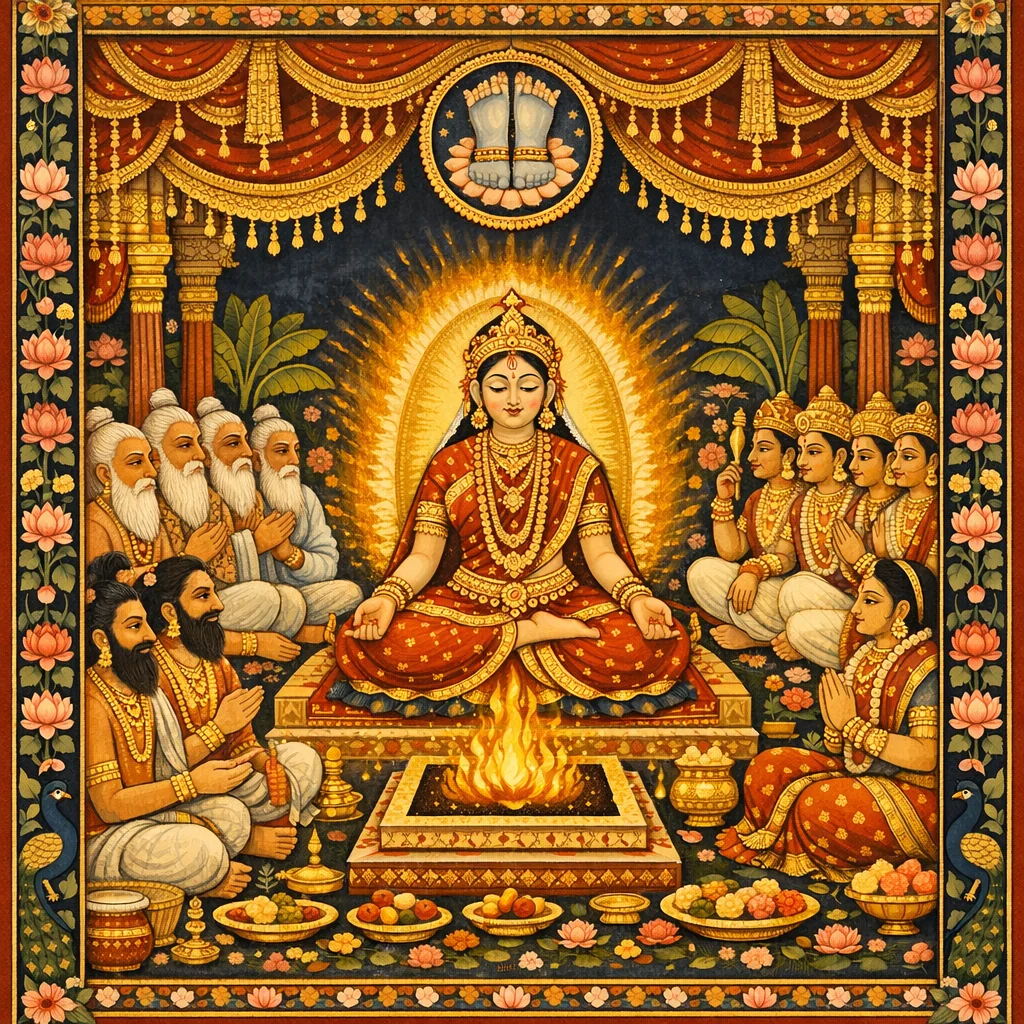
After Lord Śiva warns Satī about Dakṣa’s hostile mentality, she wavers between filial affection and obedience to her husband. Overcome by longing and sorrow, she leaves for her father’s sacrifice despite Śiva’s counsel, escorted by Śiva’s gaṇas and royal-like paraphernalia. Entering the yajña arena, she finds the assembly intimidated by Dakṣa; only her mother and sisters welcome her, while Dakṣa pointedly neglects her and offers no share to Śiva. Satī’s grief turns to righteous fury: she denounces prideful fruitive ritualism, defends Śiva’s stainless character, and states the dharmic response to blasphemy of the Lord and the master of religion. Ashamed to bear a body received from an offender, she sits facing north, performs yogic concentration, meditates on Śiva’s lotus feet, and burns her body through inner fire. The universe resounds; observers lament Dakṣa’s hard-heartedness. Śiva’s attendants attempt retaliation, but Bhṛgu invokes Yajur-mantras; the Ṛbhus manifest and rout the gaṇas—setting up the next chapter’s escalation toward the destruction of Dakṣa’s sacrifice and the wider cosmic repercussions of Satī’s death.
Shlokas
Verse 1
मैत्रेय उवाच एतावदुक्त्वा विरराम शङ्कर: पत्न्यङ्गनाशं ह्युभयत्र चिन्तयन् । सुहृद्दिदृक्षु: परिशङ्किता भवान् निष्क्रामती निर्विशती द्विधास सा ॥ १ ॥
The sage Maitreya said: Lord Śiva was silent after speaking to Satī, seeing her between decisions. Satī was very much anxious to see her relatives at her father’s house, but at the same time she was afraid of Lord Śiva’s warning. Her mind unsettled, she moved in and out of the room as a swing moves this way and that.
Verse 2
सुहृद्दिदृक्षाप्रतिघातदुर्मना: स्नेहाद्रुदत्यश्रुकलातिविह्वला । भवं भवान्यप्रतिपूरुषं रुषा प्रधक्ष्यतीवैक्षत जातवेपथु: ॥ २ ॥
Satī felt very sorry at being forbidden to go see her relatives at her father’s house, and due to affection for them, tears fell from her eyes. Shaking and very much afflicted, she looked at her uncommon husband, Lord Śiva, as if she were going to blast him with her vision.
Verse 3
ततो विनि:श्वस्य सती विहाय तं शोकेन रोषेण च दूयता हृदा । पित्रोरगात्स्त्रैणविमूढधीर्गृहान् प्रेम्णात्मनो योऽर्धमदात्सतां प्रिय: ॥ ३ ॥
Thereafter Satī left her husband, Lord Śiva, who had given her half his body due to affection. Breathing very heavily because of anger and bereavement, she went to the house of her father. This less intelligent act was due to her being a weak woman.
Verse 4
तामन्वगच्छन् द्रुतविक्रमां सतीम् एकां त्रिनेत्रानुचरा: सहस्रश: । सपार्षदयक्षा मणिमन्मदादय: पुरोवृषेन्द्रास्तरसा गतव्यथा: ॥ ४ ॥
When they saw Satī leaving alone very rapidly, thousands of Lord Śiva’s disciples, headed by Maṇimān and Mada, quickly followed her with his bull Nandi in front and accompanied by the Yakṣas.
Verse 5
तां सारिकाकन्दुकदर्पणाम्बुज श्वेतातपत्रव्यजनस्रगादिभि: । गीतायनैर्दुन्दुभिशङ्खवेणुभि- र्वृषेन्द्रमारोप्य विटङ्किता ययु: ॥ ५ ॥
The disciples of Lord Śiva arranged for Satī to be seated on the back of a bull and gave her the bird which was her pet. They bore a lotus flower, a mirror and all such paraphernalia for her enjoyment and covered her with a great canopy. Followed by a singing party with drums, conchshells and bugles, the entire procession was as pompous as a royal parade.
Verse 6
आब्रह्मघोषोर्जितयज्ञवैशसं विप्रर्षिजुष्टं विबुधैश्च सर्वश: । मृद्दार्वय:काञ्चनदर्भचर्मभि- र्निसृष्टभाण्डं यजनं समाविशत् ॥ ६ ॥
She then reached her father’s house, where the sacrifice was being performed, and entered the arena where everyone was chanting the Vedic hymns. The great sages, brāhmaṇas and demigods were all assembled there, and there were many sacrificial animals, as well as pots made of clay, stone, gold, grass and skin, which were all requisite for the sacrifice.
Verse 7
तामागतां तत्र न कश्चनाद्रियद् विमानितां यज्ञकृतो भयाज्जन: । ऋते स्वसृर्वै जननीं च सादरा: प्रेमाश्रुकण्ठ्य: परिषस्वजुर्मुदा ॥ ७ ॥
When Satī, with her followers, reached the arena, because all the people assembled were afraid of Dakṣa, none of them received her well. No one welcomed her but her mother and sisters, who, with tears in their eyes and with glad faces, welcomed her and talked with her very pleasingly.
Verse 8
सौदर्यसम्प्रश्नसमर्थवार्तया मात्रा च मातृष्वसृभिश्च सादरम् । दत्तां सपर्यां वरमासनं च सा नादत्त पित्राप्रतिनन्दिता सती ॥ ८ ॥
Although she was received by her sisters and mother, she did not reply to their words of reception, and although she was offered a seat and presents, she did not accept anything, for her father neither talked with her nor welcomed her by asking about her welfare.
Verse 9
अरुद्रभागं तमवेक्ष्य चाध्वरं पित्रा च देवे कृतहेलनं विभौ । अनादृता यज्ञसदस्यधीश्वरी चुकोप लोकानिव धक्ष्यती रुषा ॥ ९ ॥
Present in the arena of sacrifice, Satī saw that there were no oblations for her husband, Lord Śiva. Next she realized that not only had her father failed to invite Lord Śiva, but when he saw Lord Śiva’s exalted wife, Dakṣa did not receive her either. Thus she became greatly angry, so much so that she looked at her father as if she were going to burn him with her eyes.
Verse 10
जगर्ह सामर्षविपन्नया गिरा शिवद्विषं धूमपथश्रमस्मयम् । स्वतेजसा भूतगणान्समुत्थितान् निगृह्य देवी जगतोऽभिशृण्वत: ॥ १० ॥
The followers of Lord Śiva, the ghosts, were ready to injure or kill Dakṣa, but Satī stopped them by her order. She was very angry and sorrowful, and in that mood she began to condemn the process of sacrificial fruitive activities and persons who are very proud of such unnecessary and troublesome sacrifices. She especially condemned her father, speaking against him in the presence of all.
Verse 11
देव्युवाच न यस्य लोकेऽस्त्यतिशायन: प्रिय- स्तथाप्रियो देहभृतां प्रियात्मन: । तस्मिन्समस्तात्मनि मुक्तवैरके ऋते भवन्तं कतम: प्रतीपयेत् ॥ ११ ॥
The blessed goddess said: Lord Śiva is the most beloved of all living entities. He has no rival. No one is very dear to him, and no one is his enemy. No one but you could be envious of such a universal being, who is free from all enmity.
Verse 12
दोषान् परेषां हि गुणेषु साधवो गृह्णन्ति केचिन्न भवादृशो द्विज । गुणांश्च फल्गून् बहुलीकरिष्णवो महत्तमास्तेष्वविदद्भवानघम् ॥ १२ ॥
Twice-born Dakṣa, a man like you can simply find fault in the qualities of others. Lord Śiva, however, not only finds no faults with others’ qualities, but if someone has a little good quality, he magnifies it greatly. Unfortunately, you have found fault with such a great soul.
Verse 13
नाश्चर्यमेतद्यदसत्सु सर्वदा महद्विनिन्दा कुणपात्मवादिषु । सेर्ष्यं महापूरुषपादपांसुभि- र्निरस्ततेज:सु तदेव शोभनम् ॥ १३ ॥
It is not wonderful for persons who have accepted the transient material body as the self to engage always in deriding great souls. Such envy on the part of materialistic persons is very good because that is the way they fall down. They are diminished by the dust of the feet of great personalities.
Verse 14
यद्वयक्षरं नाम गिरेरितं नृणां सकृत्प्रसङ्गादघमाशु हन्ति तत् । पवित्रकीर्तिं तमलङ्घ्यशासनं भवानहो द्वेष्टि शिवं शिवेतर: ॥ १४ ॥
Satī continued: My dear father, you are committing the greatest offense by envying Lord Śiva, whose very name, consisting of two syllables, śi and va, purifies one of all sinful activities. His order is never neglected. Lord Śiva is always pure, and no one but you envies him.
Verse 15
यत्पादपद्मं महतां मनोऽलिभि- र्निषेवितं ब्रह्मरसासवार्थिभि: । लोकस्य यद्वर्षति चाशिषोऽर्थिन- स्तस्मै भवान्द्रुह्यति विश्वबन्धवे ॥ १५ ॥
You are envious of Lord Śiva, who is the friend of all living entities within the three worlds. For the common man he fulfills all desires, and because of their engagement in thinking of his lotus feet, he also blesses higher personalities who are seeking after brahmānanda [transcendental bliss].
Verse 16
किं वा शिवाख्यमशिवं न विदुस्त्वदन्ये ब्रह्मादयस्तमवकीर्य जटा: श्मशाने । तन्माल्यभस्मनृकपाल्यवसत्पिशाचै- र्ये मूर्धभिर्दधति तच्चरणावसृष्टम् ॥ १६ ॥
Do you think that greater, more respectable personalities than you, such as Lord Brahmā, do not know this inauspicious person who goes under the name Lord Śiva? He associates with the demons in the crematorium, his locks of hair are scattered all over his body, and he is garlanded with human skulls and smeared with ashes from the crematorium, but in spite of all these inauspicious qualities, great personalities like Brahmā honor him by accepting the flowers offered to his lotus feet and placing them with great respect on their heads.
Verse 17
कर्णौ पिधाय निरयाद्यदकल्प ईशे धर्मावितर्यसृणिभिर्नृभिरस्यमाने । छिन्द्यात्प्रसह्य रुशतीमसतीं प्रभुश्चे- ज्जिह्वामसूनपि ततो विसृजेत्स धर्म: ॥ १७ ॥
Satī continued: If one hears an irresponsible person blaspheme the master and controller of religion, one should block his ears and go away if unable to punish him. But if one is able to kill, then one should by force cut out the blasphemer’s tongue and kill the offender, and after that one should give up his own life.
Verse 18
अतस्तवोत्पन्नमिदं कलेवरं न धारयिष्ये शितिकण्ठगर्हिण: । जग्धस्य मोहाद्धि विशुद्धिमन्धसो जुगुप्सितस्योद्धरणं प्रचक्षते ॥ १८ ॥
Therefore I shall no longer bear this unworthy body, which has been received from you, who have blasphemed Lord Śiva. If someone has taken food which is poisonous, the best treatment is to vomit.
Verse 19
न वेदवादाननुवर्तते मति: स्व एव लोके रमतो महामुने: । यथा गतिर्देवमनुष्ययो: पृथक् स्व एव धर्मे न परं क्षिपेत्स्थित: ॥ १९ ॥
It is better to execute one’s own occupational duty than to criticize others’. Elevated transcendentalists may sometimes forgo the rules and regulations of the Vedas, since they do not need to follow them, just as the demigods travel in space whereas ordinary men travel on the surface of the earth.
Verse 20
कर्म प्रवृत्तं च निवृत्तमप्यृतं वेदे विविच्योभयलिङ्गमाश्रितम् । विरोधि तद्यौगपदैककर्तरि द्वयं तथा ब्रह्मणि कर्म नर्च्छति ॥ २० ॥
In the Vedas there are directions for two kinds of activities — activities for those who are attached to material enjoyment and activities for those who are materially detached. In consideration of these two kinds of activities, there are two kinds of people, who have different symptoms. If one wants to see two kinds of activities in one person, that is contradictory. But both kinds of activities may be neglected by a person who is transcendentally situated.
Verse 21
मा व: पदव्य: पितरस्मदास्थिता या यज्ञशालासु न धूमवर्त्मभि: । तदन्नतृप्तैरसुभृद्भिरीडिता अव्यक्तलिङ्गा अवधूतसेविता: ॥ २१ ॥
My dear father, the opulence we possess is impossible for either you or your flatterers to imagine, for persons who engage in fruitive activities by performing great sacrifices are concerned with satisfying their bodily necessities by eating foodstuff offered as a sacrifice. We can exhibit our opulences simply by desiring to do so. This can be achieved only by great personalities who are renounced, self-realized souls.
Verse 22
नैतेन देहेन हरे कृतागसो देहोद्भवेनालमलं कुजन्मना । व्रीडा ममाभूत्कुजनप्रसङ्गत- स्तज्जन्म धिग्यो महतामवद्यकृत् ॥ २२ ॥
You are an offender at the lotus feet of Lord Śiva, and unfortunately I have a body produced from yours. I am very much ashamed of our bodily relationship, and I condemn myself because my body is contaminated by a relationship with a person who is an offender at the lotus feet of the greatest personality.
Verse 23
गोत्रं त्वदीयं भगवान्वृषध्वजो दाक्षायणीत्याह यदा सुदुर्मना: । व्यपेतनर्मस्मितमाशु तदाऽहं व्युत्स्रक्ष्य एतत्कुणपं त्वदङ्गजम् ॥ २३ ॥
Because of our family relationship, when Lord Śiva addresses me as Dākṣāyaṇī I at once become morose, and my jolliness and my smile at once disappear. I feel very much sorry that my body, which is just like a bag, has been produced by you. I shall therefore give it up.
Verse 24
मैत्रेय उवाच इत्यध्वरे दक्षमनूद्य शत्रुहन् क्षितावुदीचीं निषसाद शान्तवाक् । स्पृष्ट्वा जलं पीतदुकूलसंवृता निमील्य दृग्योगपथं समाविशत् ॥ २४ ॥
Maitreya the sage told Vidura: O annihilator of enemies, while thus speaking to her father in the arena of sacrifice, Satī sat down on the ground and faced north. Dressed in saffron garments, she sanctified herself with water and closed her eyes to absorb herself in the process of mystic yoga.
Verse 25
कृत्वा समानावनिलौ जितासना सोदानमुत्थाप्य च नाभिचक्रत: । शनैर्हृदि स्थाप्य धियोरसि स्थितं कण्ठाद्भ्रुवोर्मध्यमनिन्दितानयत् ॥ २५ ॥
First of all she sat in the required sitting posture, and then she carried the life air upwards and placed it in the position of equilibrium near the navel. Then she raised her life air, mixed with intelligence, to the heart and then gradually towards the pulmonary passage, and from there to between her eyebrows.
Verse 26
एवं स्वदेहं महतां महीयसा मुहु: समारोपितमङ्कमादरात् । जिहासती दक्षरुषा मनस्विनी दधार गात्रेष्वनिलाग्निधारणाम् ॥ २६ ॥
Thus, in order to give up her body, which had been so respectfully and affectionately seated on the lap of Lord Śiva, who is worshiped by great sages and saints, Satī, due to anger towards her father, began to meditate on the fiery air within the body.
Verse 27
तत: स्वभर्तुश्चरणाम्बुजासवं जगद्गुरोश्चिन्तयती न चापरम् । ददर्श देहो हतकल्मष: सती सद्य: प्रजज्वाल समाधिजाग्निना ॥ २७ ॥
Satī concentrated all her meditation on the holy lotus feet of her husband, Lord Śiva, who is the supreme spiritual master of all the world. Thus she became completely cleansed of all taints of sin and quit her body in a blazing fire by meditation on the fiery elements.
Verse 28
तत्पश्यतां खे भुवि चाद्भुतं महद् हाहेति वाद: सुमहानजायत । हन्त प्रिया दैवतमस्य देवी जहावसून् केन सती प्रकोपिता ॥ २८ ॥
When Satī annihilated her body in anger, there was a tumultuous roar all over the universe. Why had Satī, the wife of the most respectable demigod, Lord Śiva, quit her body in such a manner?
Verse 29
अहो अनात्म्यं महदस्य पश्यत प्रजापतेर्यस्य चराचरं प्रजा: । जहावसून् यद्विमतात्मजा सती मनस्विनी मानमभीक्ष्णमर्हति ॥ २९ ॥
It was astonishing that Dakṣa, who was Prajāpati, the maintainer of all living entities, was so disrespectful to his own daughter Satī, who was not only chaste but was also a great soul, that she gave up her body because of his neglect.
Verse 30
सोऽयं दुर्मर्षहृदयो ब्रह्मध्रुक् च लोकेऽपकीर्तिं महतीमवाप्स्यति । यदङ्गजां स्वां पुरुषद्विडुद्यतां न प्रत्यषेधन्मृतयेऽपराधत: ॥ ३० ॥
Dakṣa, who is so hardhearted that he is unworthy to be a brāhmaṇa, will gain extensive ill fame because of his offenses to his daughter, because of not having prevented her death, and because of his great envy of the Supreme Personality of Godhead.
Verse 31
वदत्येवं जने सत्या दृष्ट्वासुत्यागमद्भुतम् । दक्षं तत्पार्षदा हन्तुमुदतिष्ठन्नुदायुधा: ॥ ३१ ॥
While people were talking among themselves about the wonderful voluntary death of Satī, the attendants who had come with her readied themselves to kill Dakṣa with their weapons.
Verse 32
तेषामापततां वेगं निशाम्य भगवान् भृगु: । यज्ञघ्नघ्नेन यजुषा दक्षिणाग्नौ जुहाव ह ॥ ३२ ॥
They came forward forcibly, but Bhṛgu Muni saw the danger and, offering oblations into the southern side of the sacrificial fire, immediately uttered mantric hymns from the Yajur Veda by which the destroyers of yajñic performances could be killed immediately.
Verse 33
अध्वर्युणा हूयमाने देवा उत्पेतुरोजसा । ऋभवो नाम तपसा सोमं प्राप्ता: सहस्रश: ॥ ३३ ॥
When Bhṛgu Muni offered oblations in the fire, immediately many thousands of demigods named Ṛbhus became manifested. All of them were powerful, having achieved strength from Soma, the moon.
Verse 34
तैरलातायुधै: सर्वे प्रमथा: सहगुह्यका: । हन्यमाना दिशो भेजुरुशद्भिर्ब्रह्मतेजसा ॥ ३४ ॥
When the Ṛbhu demigods attacked the ghosts and Guhyakas with half-burned fuel from the yajña fire, all these attendants of Satī fled in different directions and disappeared. This was possible simply because of brahma-tejas, brahminical power.
Frequently Asked Questions
Satī is portrayed as torn between two dharmic pulls: loyalty to her husband’s counsel and intense affection for her natal family. Her agitation and repeated wavering indicate inner conflict; ultimately, attachment and grief override discernment, and she goes—only to witness Dakṣa’s public disrespect of Śiva and herself, which becomes the immediate cause of her decisive renunciation.
In the Bhāgavata’s theology, excluding a महान् (great lord/devotee) from yajña reveals that the ritual has become ego-driven rather than God-centered. The omission symbolizes sectarian contempt and the spiritual invalidation of the sacrifice’s purpose—prompting Satī’s condemnation of fruitive ritualism divorced from reverence and devotion.
Satī states a graded dharmic response: if one cannot punish the blasphemer, one should block the ears and leave; if capable, one should forcibly stop the blasphemy. Her intent is to stress the seriousness of insulting the controller of religion and the Lord’s devotee, not to license indiscriminate violence; the narrative then shows consequences unfolding through cosmic, not personal, retribution.
The chapter frames it as yogic departure (yoga-mṛtyu): Satī sits in posture, raises prāṇa through the inner channels, concentrates on the fiery element, and meditates on Śiva’s lotus feet, becoming purified and leaving the body in a blaze generated by meditation. The emphasis is on tapas and yogic mastery, though it is triggered by moral outrage and grief.
The Ṛbhus are a class of empowered demigods manifested through Bhṛgu’s oblations and Yajur-mantras. They embody mantra-śakti and brahma-tejas protecting the sacrificial establishment; they attack Śiva’s attendants and drive them away, intensifying the conflict that will culminate in the larger destruction of Dakṣa’s yajña.