Adhyaya 16
The Sūtas Foretell the Glories and Future Deeds of King Pṛthu
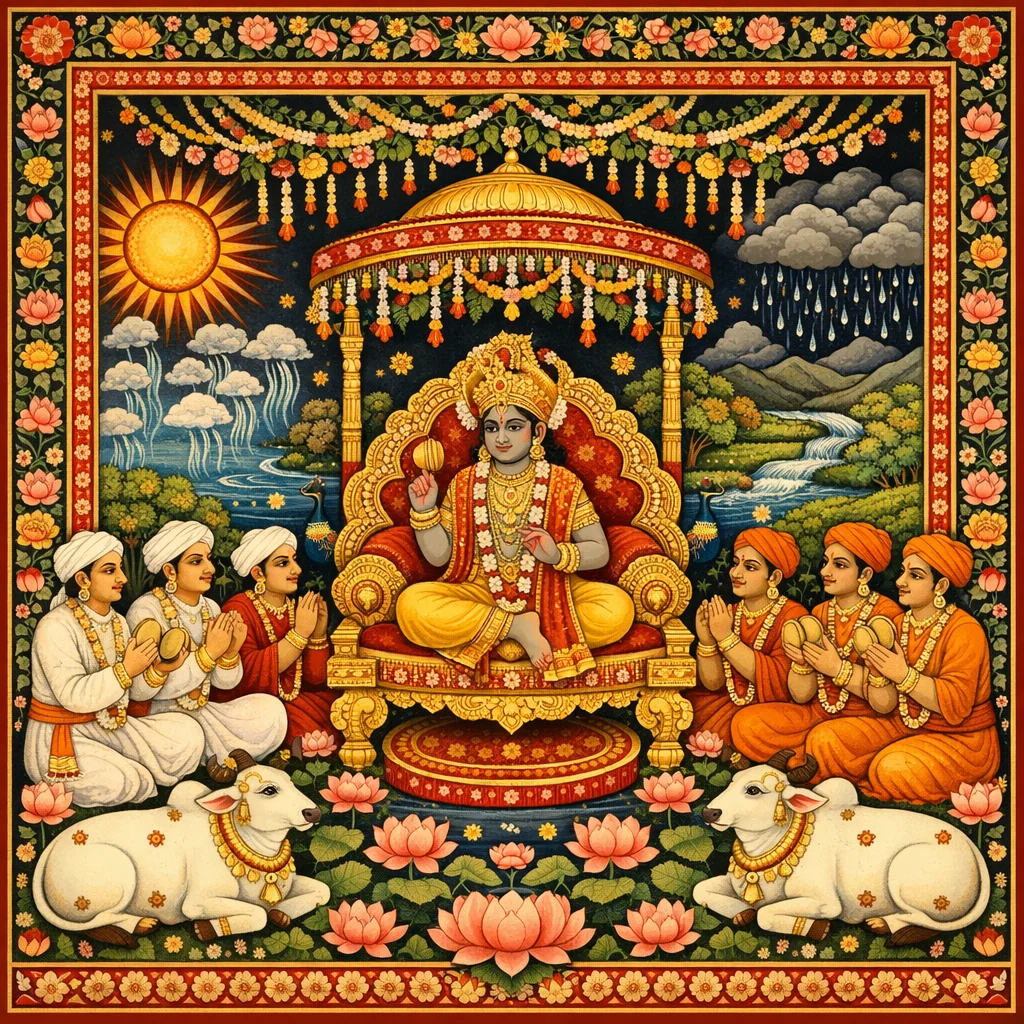
Maitreya narrates how the reciters (sūtas/bandīs), delighted by Pṛthu’s humility, renew their praise with elevated prayers. They declare him a direct empowerment of Viṣṇu and admit that even Brahmā and the devas cannot fully describe his greatness, yet they speak as instructed by realized sages. Their eulogy outlines Pṛthu’s forthcoming reign: he will protect dharma, chastise irreligion, administer like the devas through departmental order, and balance taxation with benevolent redistribution—likened to the sun’s evaporation and rainfall cycle. He will be tolerant like earth, neutral like air, and impartial in justice even toward friend and foe. His influence will extend across the globe; rogues will hide at his approach. The prophecy also foreshadows key plot points that lead into subsequent chapters: Pṛthu’s world-conquest, his ‘milking’ of the Earth for prosperity, his performance of one hundred aśvamedhas (with Indra’s theft of the horse), and his meeting with Sanat-kumāra, from whom he will receive liberating instruction—transitioning the narrative from royal conquest to spiritual culmination.
Shlokas
Verse 1
मैत्रेय उवाच इति ब्रुवाणं नृपतिं गायका मुनिचोदिता: । तुष्टुवुस्तुष्टमनसस्तद्वागमृतसेवया ॥ १ ॥
The great sage Maitreya continued: While King Pṛthu thus spoke, the humility of his nectarean speeches pleased the reciters very much. Then again they continued to praise the King highly with exalted prayers, as they had been instructed by the great sages.
Verse 2
नालं वयं ते महिमानुवर्णने यो देववर्योऽवततार मायया । वेनाङ्गजातस्य च पौरुषाणि ते वाचस्पतीनामपि बभ्रमुर्धिय: ॥ २ ॥
The reciters continued: Dear King, you are a direct incarnation of the Supreme Personality of Godhead, Lord Viṣṇu, and by His causeless mercy you have descended to this earth. Therefore it is not possible for us to actually glorify your exalted activities. Although you have appeared through the body of King Vena, even great orators and speakers like Lord Brahmā and other demigods cannot exactly describe the glorious activities of Your Lordship.
Verse 3
अथाप्युदारश्रवस: पृथोर्हरे: कलावतारस्य कथामृतादृता: । यथोपदेशं मुनिभि: प्रचोदिता: श्लाघ्यानि कर्माणि वयं वितन्महि ॥ ३ ॥
Although we are unable to glorify you adequately, we nonetheless have a transcendental taste for glorifying your activities. We shall try to glorify you according to the instructions received from authoritative sages and scholars. Whatever we speak, however, is always inadequate and very insignificant. Dear King, because you are a direct incarnation of the Supreme Personality of Godhead, all your activities are liberal and ever laudable.
Verse 4
एष धर्मभृतां श्रेष्ठो लोकं धर्मेऽनुवर्तयन् । गोप्ता च धर्मसेतूनां शास्ता तत्परिपन्थिनाम् ॥ ४ ॥
This King, Mahārāja Pṛthu, is the best amongst those who are following religious principles. As such, he will engage everyone in the pursuit of religious principles and give those principles all protection. He will also be a great chastiser to the irreligious and atheistic.
Verse 5
एष वै लोकपालानां बिभर्त्येकस्तनौ तनू: । काले काले यथाभागं लोकयोरुभयोर्हितम् ॥ ५ ॥
This King alone, in his own body, will be able in due course of time to maintain all living entities and keep them in a pleasant condition by manifesting himself as different demigods to perform various departmental activities. Thus he will maintain the upper planetary system by inducing the populace to perform Vedic sacrifices. In due course of time he will also maintain this earthly planet by discharging proper rainfall.
Verse 6
वसु काल उपादत्ते काले चायं विमुञ्चति । सम: सर्वेषु भूतेषु प्रतपन् सूर्यवद्विभु: ॥ ६ ॥
This King Pṛthu will be as powerful as the sun-god, and just as the sun-god equally distributes his sunshine to everyone, King Pṛthu will distribute his mercy equally. Similarly, just as the sun-god evaporates water for eight months and, during the rainy season, returns it profusely, this King will also exact taxes from the citizens and return these monies in times of need.
Verse 7
तितिक्षत्यक्रमं वैन्य उपर्याक्रमतामपि । भूतानां करुण: शश्वदार्तानां क्षितिवृत्तिमान् ॥ ७ ॥
This King Pṛthu will be very, very kind to all citizens. Even though a poor person may trample over the King’s head by violating the rules and regulations, the King, out of his causeless mercy, will be forgetful and forgiving. As a protector of the world, he will be as tolerant as the earth itself.
Verse 8
देवेऽवर्षत्यसौ देवो नरदेववपुर्हरि: । कृच्छ्रप्राणा: प्रजा ह्येष रक्षिष्यत्यञ्जसेन्द्रवत् ॥ ८ ॥
When there is no rainfall and the citizens are in great danger due to the scarcity of water, this royal Personality of Godhead will be able to supply rains exactly like the heavenly King Indra. Thus he will very easily be able to protect the citizens from drought.
Verse 9
आप्याययत्यसौ लोकं वदनामृतमूर्तिना । सानुरागावलोकेन विशदस्मितचारुणा ॥ ९ ॥
This King, Pṛthu Mahārāja, by virtue of his affectionate glances and beautiful moonlike face, which is always smiling with great affection for the citizens, will enhance everyone’s peaceful life.
Verse 10
अव्यक्तवर्त्मैष निगूढकार्योगम्भीरवेधा उपगुप्तवित्त: । अनन्तमाहात्म्यगुणैकधामापृथु: प्रचेता इव संवृतात्मा ॥ १० ॥
The reciters continued: No one will be able to understand the policies the King will follow. His activities will also be very confidential, and it will not be possible for anyone to know how he will make every activity successful. His treasury will always remain unknown to everyone. He will be the reservoir of unlimited glories and good qualities, and his position will be maintained and covered just as Varuṇa, the deity of the seas, is covered all around by water.
Verse 11
दुरासदो दुर्विषह आसन्नोऽपि विदूरवत् । नैवाभिभवितुं शक्यो वेनारण्युत्थितोऽनल: ॥ ११ ॥
King Pṛthu was born of the dead body of King Vena as fire is produced from araṇi wood. Thus King Pṛthu will always remain just like fire, and his enemies will not be able to approach him. Indeed, he will be unbearable to his enemies, for although staying very near him, they will never be able to approach him but will have to remain as if far away. No one will be able to overcome the strength of King Pṛthu.
Verse 12
अन्तर्बहिश्च भूतानां पश्यन् कर्माणि चारणै: । उदासीन इवाध्यक्षो वायुरात्मेव देहिनाम् ॥ १२ ॥
King Pṛthu will be able to see all the internal and external activities of every one of his citizens. Still, no one will be able to know his system of espionage, and he himself will remain neutral regarding all matters of glorification or vilification paid to him. He will be exactly like air, the life force within the body, which is exhibited internally and externally but is always neutral to all affairs.
Verse 13
नादण्ड्यं दण्डयत्येष सुतमात्मद्विषामपि । दण्डयत्यात्मजमपि दण्ड्यं धर्मपथे स्थित: ॥ १३ ॥
Since this King will always remain on the path of piety, he will be neutral to both his son and the son of his enemy. If the son of his enemy is not punishable, he will not punish him, but if his own son is punishable, he will immediately punish him.
Verse 14
अस्याप्रतिहतं चक्रं पृथोरामानसाचलात् । वर्तते भगवानर्को यावत्तपति गोगणै: ॥ १४ ॥
Just as the sun-god expands his shining rays up to the Arctic region without impedance, the influence of King Pṛthu will cover all tracts of land up to the Arctic region and will remain undisturbed as long as he lives.
Verse 15
रञ्जयिष्यति यल्लोकमयमात्मविचेष्टितै: । अथामुमाहू राजानं मनोरञ्जनकै: प्रजा: ॥ १५ ॥
This King will please everyone by his practical activities, and all of his citizens will remain very satisfied. Because of this the citizens will take great satisfaction in accepting him as their ruling king.
Verse 16
दृढव्रत: सत्यसन्धो ब्रह्मण्यो वृद्धसेवक: । शरण्य: सर्वभूतानां मानदो दीनवत्सल: ॥ १६ ॥
The King will be firmly determined and always situated in truth. He will be a lover of the brahminical culture and will render all service to old men and give shelter to all surrendered souls. Giving respect to all, he will always be merciful to the poor and innocent.
Verse 17
मातृभक्ति: परस्त्रीषु पत्न्यामर्ध इवात्मन: । प्रजासु पितृवत्स्निग्ध: किङ्करो ब्रह्मवादिनाम् ॥ १७ ॥
The King will respect all women as if they were his own mother, and he will treat his own wife as the other half of his body. He will be just like an affectionate father to his citizens, and he will treat himself as the most obedient servant of the devotees, who always preach the glories of the Lord.
Verse 18
देहिनामात्मवत्प्रेष्ठ: सुहृदां नन्दिवर्धन: । मुक्तसङ्गप्रसङ्गोऽयं दण्डपाणिरसाधुषु ॥ १८ ॥
The King will consider all embodied living entities as dear as his own self, and he will always be increasing the pleasures of his friends. He will intimately associate with liberated persons, and he will be a chastising hand to all impious persons.
Verse 19
अयं तु साक्षाद्भगवांस्त्र्यधीश:कूटस्थ आत्मा कलयावतीर्ण: । यस्मिन्नविद्यारचितं निरर्थकंपश्यन्ति नानात्वमपि प्रतीतम् ॥ १९ ॥
This King is the master of the three worlds, and he is directly empowered by the Supreme Personality of Godhead. He is without change, and he is an incarnation of the Supreme known as a śaktyāveśa-avatāra. Being a liberated soul and completely learned, he sees all material varieties as meaningless because their basic principle is nescience.
Verse 20
अयं भुवो मण्डलमोदयाद्रे-र्गोप्तैकवीरो नरदेवनाथ: । आस्थाय जैत्रं रथमात्तचाप:पर्यस्यते दक्षिणतो यथार्क: ॥ २० ॥
This King, being uniquely powerful and heroic, will have no competitor. He will travel around the globe on his victorious chariot, holding his invincible bow in his hand and appearing exactly like the sun, which rotates in its own orbit from the south.
Verse 21
अस्मै नृपाला: किल तत्र तत्रबलिं हरिष्यन्ति सलोकपाला: । मंस्यन्त एषां स्त्रिय आदिराजंचक्रायुधं तद्यश उद्धरन्त्य: ॥ २१ ॥
When the King travels all over the world, other kings, as well as the demigods, will offer him all kinds of presentations. Their queens will also consider him the original king, who carries in His hands the emblems of club and disc, and will sing of his fame, for he will be as reputable as the Supreme Personality of Godhead.
Verse 22
अयं महीं गां दुदुहेऽधिराज:प्रजापतिर्वृत्तिकर: प्रजानाम् । यो लीलयाद्रीन् स्वशरासकोट्याभिन्दन् समां गामकरोद्यथेन्द्र: ॥ २२ ॥
This King, this protector of the citizens, is an extraordinary king and is equal to the Prajāpati demigods. For the living facility of all citizens, he will milk the earth, which is like a cow. Not only that, but he will level the surface of the earth with the pointed ends of his bow, breaking all the hills exactly as King Indra, the heavenly King, breaks mountains with his powerful thunderbolt.
Verse 23
विस्फूर्जयन्नाजगवं धनु: स्वयंयदाचरत्क्ष्मामविषह्यमाजौ । तदा निलिल्युर्दिशि दिश्यसन्तोलाङ्गूलमुद्यम्य यथा मृगेन्द्र: ॥ २३ ॥
When the lion travels in the forest with its tail turned upward, all menial animals hide themselves. Similarly, when King Pṛthu will travel over his kingdom and vibrate the string of his bow, which is made of the horns of goats and bulls and is irresistible in battle, all demoniac rogues and thieves will hide themselves in all directions.
Verse 24
एषोऽश्वमेधाञ् शतमाजहारसरस्वती प्रादुरभावि यत्र । अहार्षीद्यस्य हयं पुरन्दर:शतक्रतुश्चरमे वर्तमाने ॥ २४ ॥
At the source of the river Sarasvatī, this King will perform one hundred sacrifices known as aśvamedha. In the course of the last sacrifice, the heavenly King Indra will steal the sacrificial horse.
Verse 25
एष स्वसद्मोपवने समेत्यसनत्कुमारं भगवन्तमेकम् । आराध्य भक्त्यालभतामलं तज्ज्ञानं यतो ब्रह्म परं विदन्ति ॥ २५ ॥
This King Pṛthu will meet Sanat-kumāra, one of the four Kumāras, in the garden of his palace compound. The King will worship him with devotion and will be fortunate to receive instructions by which one can enjoy transcendental bliss.
Verse 26
तत्र तत्र गिरस्तास्ता इति विश्रुतविक्रम: । श्रोष्यत्यात्माश्रिता गाथा: पृथु: पृथुपराक्रम: ॥ २६ ॥
In this way, when the chivalrous activities of King Pṛthu come to be known to the people in general, King Pṛthu will always hear about himself and his uniquely powerful activities.
Verse 27
दिशो विजित्याप्रतिरुद्धचक्र:स्वतेजसोत्पाटितलोकशल्य: । सुरासुरेन्द्रैरुपगीयमानमहानुभावो भविता पतिर्भुव: ॥ २७ ॥
No one will be able to disobey the orders of Pṛthu Mahārāja. After conquering the world, he will completely eradicate the threefold miseries of the citizens. Then he will be recognized all over the world. At that time both the suras and the asuras will undoubtedly glorify his magnanimous activities.
Frequently Asked Questions
Their statement underscores two Bhāgavata principles: (1) Bhagavān-tattva and His empowered manifestations are ultimately beyond the reach of finite speech, even for celestial intellects; and (2) praise becomes valid when it is śruti-smṛti-sādhu guided—spoken under instruction from realized authorities rather than from ego. Thus, their humility safeguards the glorification from becoming mere rhetoric and frames it as service (kīrtana) aligned with paramparā.
An ideal king is portrayed as simultaneously compassionate and strict: he protects dharma, supports yajña and brāhmaṇical culture, shelters the surrendered, and cares for the poor—yet he also punishes irreligion and theft. He is impartial (punishes even his own son if guilty), administratively intelligent (confidential policies, effective espionage), and welfare-oriented (taxation returned as public benefit), reflecting cosmic order through analogies to the sun, earth, air, and Varuṇa.
It foreshadows a coming conflict that tests the limits of royal ambition and divine hierarchy. The aśvamedha establishes sovereignty, but Indra’s theft introduces envy and rivalry even among devas, setting up later chapters where Pṛthu’s power, restraint, and ultimate orientation toward spiritual instruction are highlighted. The episode functions as narrative tension and as a lesson that even dharmic power must remain subordinate to higher devotional and transcendental aims.
Sanat-kumāra is one of the four Kumāras—primordial sages renowned for jñāna and devotion. His meeting with Pṛthu signals the canto’s shift from external conquest to internal liberation: the ideal ruler culminates not merely in prosperity and order, but in receiving and embodying teachings that grant ānanda beyond material success. This encounter anchors kingship within the Bhāgavata telos—bhakti leading to realization.