Adhyaya 14
King Vena’s Tyranny, the Sages’ Counsel, and the Birth of Niṣāda
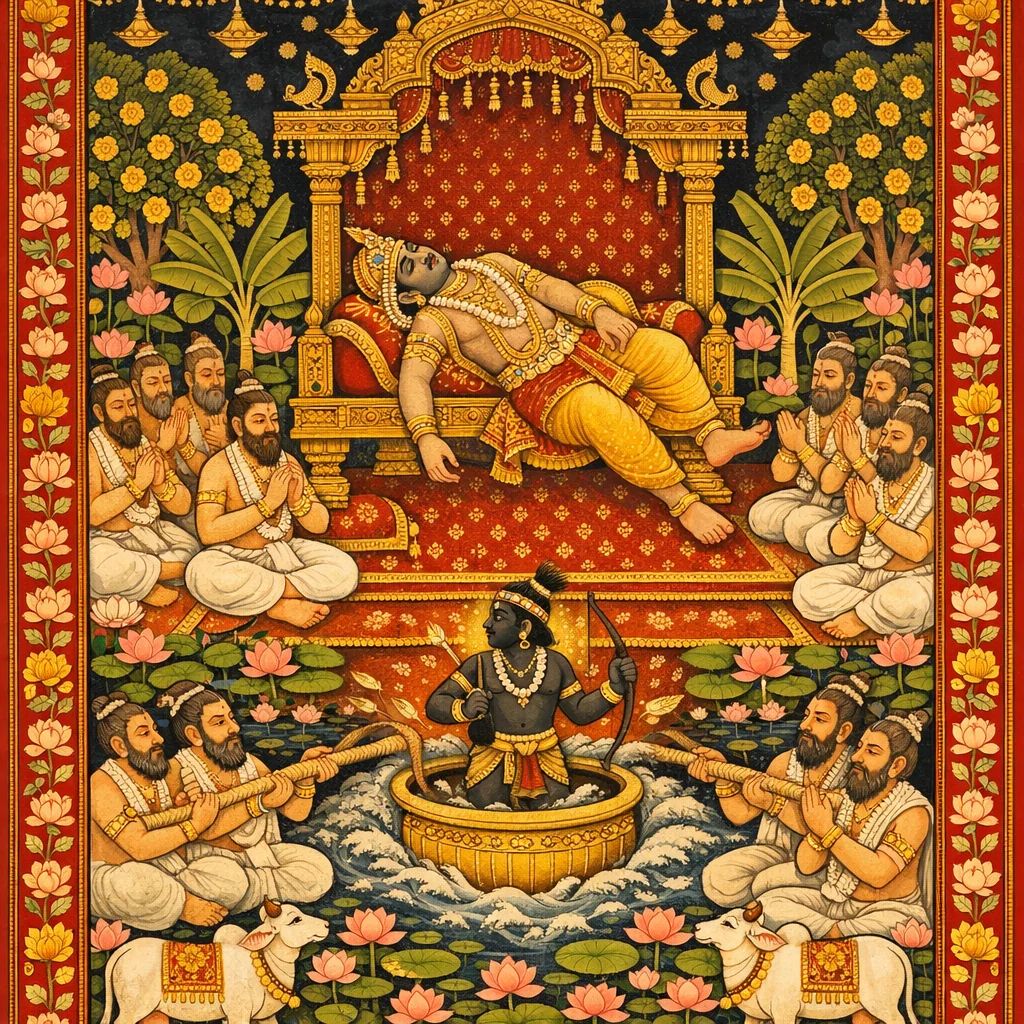
With King Aṅga absent and social order weakening, Bhṛgu and other sages install Vena under Queen Sunīthā’s consent, despite ministerial misgivings. Vena’s harsh rule initially terrifies criminals, but his newfound opulence inflames pride and he suppresses sacrifice and charity, halting yajña across the realm. Seeing citizens trapped between royal irresponsibility and resurgent thieves, the sages deliberate: they enthroned Vena for protection, yet he has become the threat. They approach him diplomatically, teaching that a king gains legitimacy by protecting subjects and enabling varṇāśrama and Viṣṇu-worship through sacrifice. Vena rejects their counsel, claims the king is the supreme worshipable, and insults devotion to Viṣṇu and the devas. The sages, concluding he will burn the world through adharma, kill him by potent mantric words. After his death, disorder erupts; thieves plunder. The sages decide governance must continue through Aṅga’s line and churn Vena’s body, producing the dark dwarf Bāhuka, named Niṣāda, who absorbs Vena’s sins—setting the narrative bridge toward the emergence of a righteous successor (Pr̥thu) and restoration of dharma.
Shlokas
Verse 1
मैत्रेय उवाच भृग्वादयस्ते मुनयो लोकानां क्षेमदर्शिन: । गोप्तर्यसति वै नृणां पश्यन्त: पशुसाम्यताम् ॥ १ ॥
The great sage Maitreya continued: O great hero Vidura, the great sages, headed by Bhṛgu, were always thinking of the welfare of the people in general. When they saw that in the absence of King Aṅga there was no one to protect the interests of the people, they understood that without a ruler the people would become independent and nonregulated.
Verse 2
वीरमातरमाहूय सुनीथां ब्रह्मवादिन: । प्रकृत्यसम्मतं वेनमभ्यषिञ्चन् पतिं भुव: ॥ २ ॥
The great sages then called for the Queen Mother, Sunīthā, and with her permission they installed Vena on the throne as master of the world. All the ministers, however, disagreed with this.
Verse 3
श्रुत्वा नृपासनगतं वेनमत्युग्रशासनम् । निलिल्युर्दस्यव: सद्य: सर्पत्रस्ता इवाखव: ॥ ३ ॥
It was already known that Vena was very severe and cruel; therefore, as soon as all the thieves and rogues in the state heard of his ascendance to the royal throne, they became very much afraid of him. Indeed, they hid themselves here and there as rats hide themselves from snakes.
Verse 4
स आरूढनृपस्थान उन्नद्धोऽष्टविभूतिभि: । अवमेने महाभागान् स्तब्ध: सम्भावित: स्वत: ॥ ४ ॥
When the King ascended to the throne, he became all-powerful with eight kinds of opulences. Consequently he became too proud. By virtue of his false prestige, he considered himself to be greater than anyone. Thus he began to insult great personalities.
Verse 5
एवं मदान्ध उत्सिक्तो निरङ्कुश इव द्विप: । पर्यटन् रथमास्थाय कम्पयन्निव रोदसी ॥ ५ ॥
When he became overly blind due to his opulences, King Vena mounted a chariot and, like an uncontrolled elephant, began to travel through the kingdom, causing the sky and earth to tremble wherever he went.
Verse 6
न यष्टव्यं न दातव्यं न होतव्यं द्विजा: क्वचित् । इति न्यवारयद्धर्मं भेरीघोषेण सर्वश: ॥ ६ ॥
All the twice-born [brāhmaṇas] were forbidden henceforward to perform any sacrifice, and they were also forbidden to give charity or offer clarified butter. Thus King Vena sounded kettledrums throughout the countryside. In other words, he stopped all kinds of religious rituals.
Verse 7
वेनस्यावेक्ष्य मुनयो दुर्वृत्तस्य विचेष्टितम् । विमृश्य लोकव्यसनं कृपयोचु: स्म सत्रिण: ॥ ७ ॥
Therefore all the great sages assembled together and, after observing cruel Vena’s atrocities, concluded that a great danger and catastrophe was approaching the people of the world. Thus out of compassion they began to talk amongst themselves, for they themselves were the performers of the sacrifices.
Verse 8
अहो उभयत: प्राप्तं लोकस्य व्यसनं महत् । दारुण्युभयतो दीप्ते इव तस्करपालयो: ॥ ८ ॥
When the great sages consulted one another, they saw that the people were in a dangerous position from both directions. When a fire blazes on both ends of a log, the ants in the middle are in a very dangerous situation. Similarly, at that time the people in general were in a dangerous position due to an irresponsible king on one side and thieves and rogues on the other.
Verse 9
अराजकभयादेष कृतो राजातदर्हण: । ततोऽप्यासीद्भयं त्वद्य कथं स्यात्स्वस्ति देहिनाम् ॥ ९ ॥
Thinking to save the state from irregularity, the sages began to consider that it was due to a political crisis that they made Vena king although he was not qualified. But alas, now the people were being disturbed by the king himself. Under such circumstances, how could the people be happy?
Verse 10
अहेरिव पय:पोष: पोषकस्याप्यनर्थभृत् । वेन: प्रकृत्यैव खल: सुनीथागर्भसम्भव: ॥ १० ॥
The sages began to think within themselves: Because he was born from the womb of Sunīthā, King Vena is by nature very mischievous. Supporting this mischievous king is exactly like maintaining a snake with milk. Now he has become a source of all difficulties.
Verse 11
निरूपित: प्रजापाल: स जिघांसति वै प्रजा: । तथापि सान्त्वयेमामुं नास्मांस्तत्पातकं स्पृशेत् ॥ ११ ॥
We appointed this Vena king of the state in order to give protection to the citizens, but now he has become the enemy of the citizens. Despite all these discrepancies, we should at once try to pacify him. By doing so, we may not be touched by the sinful results caused by him.
Verse 12
तद्विद्वद्भिरसद्वृत्तो वेनोऽस्माभि: कृतो नृप: । सान्त्वितो यदि नो वाचं न ग्रहीष्यत्यधर्मकृत् । लोकधिक्कारसन्दग्धं दहिष्याम: स्वतेजसा ॥ १२ ॥
The saintly sages continued thinking: Of course, we were completely aware of his mischievous nature, yet we nevertheless enthroned Vena. If we cannot persuade King Vena to accept our advice, he will be condemned by the public, and we will join them. Thus by our prowess we shall burn him to ashes.
Verse 13
एवमध्यवसायैनं मुनयो गूढमन्यव: । उपव्रज्याब्रुवन् वेनं सान्त्वयित्वा च सामभि: ॥ १३ ॥
The great sages, having thus decided, approached King Vena. Concealing their real anger, they pacified him with sweet words and then spoke as follows.
Verse 14
मुनय ऊचु: नृपवर्य निबोधैतद्यत्ते विज्ञापयाम भो: । आयु:श्रीबलकीर्तीनां तव तात विवर्धनम् ॥ १४ ॥
The great sages said: Dear King, we have come to give you good advice. Kindly hear us with great attention. By doing so, your duration of life and your opulence, strength and reputation will increase.
Verse 15
धर्म आचरित: पुंसां वाङ्मन:कायबुद्धिभि: । लोकान् विशोकान् वतरत्यथानन्त्यमसङ्गिनाम् ॥ १५ ॥
Those who live according to religious principles and who follow them by words, mind, body and intelligence are elevated to the heavenly kingdom, which is devoid of all miseries. Being thus rid of the material influence, they achieve unlimited happiness in life.
Verse 16
स ते मा विनशेद्वीर प्रजानां क्षेमलक्षण: । यस्मिन् विनष्टे नृपतिरैश्वर्यादवरोहति ॥ १६ ॥
The sages continued: O great hero, for this reason you should not be the cause of spoiling the spiritual life of the general populace. If their spiritual life is spoiled because of your activities, you will certainly fall down from your opulent and royal position.
Verse 17
राजन्नसाध्वमात्येभ्यश्चोरादिभ्य: प्रजा नृप: । रक्षन्यथा बलिं गृह्णन्निह प्रेत्य च मोदते ॥ १७ ॥
The saintly persons continued: When the king protects the citizens from the disturbances of mischievous ministers as well as from thieves and rogues, he can, by virtue of such pious activities, accept taxes given by his subjects. Thus a pious king can certainly enjoy himself in this world as well as in the life after death.
Verse 18
यस्य राष्ट्रे पुरे चैव भगवान् यज्ञपूरुष: । इज्यते स्वेन धर्मेण जनैर्वर्णाश्रमान्वितै: ॥ १८ ॥
The king is supposed to be pious in whose state and cities the general populace strictly observes the system of eight social orders of varṇa and āśrama, and where all citizens engage in worshiping the Supreme Personality of Godhead by their particular occupations.
Verse 19
तस्य राज्ञो महाभाग भगवान् भूतभावन: । परितुष्यति विश्वात्मा तिष्ठतो निजशासने ॥ १९ ॥
O noble one, if the king sees that the Supreme Personality of Godhead, the original cause of the cosmic manifestation and the Supersoul within everyone, is worshiped, the Lord will be satisfied.
Verse 20
तस्मिंस्तुष्टे किमप्राप्यं जगतामीश्वरेश्वरे । लोका: सपाला ह्येतस्मै हरन्ति बलिमादृता: ॥ २० ॥
The Supreme Personality of Godhead is worshiped by the great demigods who are controllers of universal affairs. When He is satisfied, nothing is impossible to achieve. For this reason all the demigods, presiding deities of different planets, as well as the inhabitants of their planets, take great pleasure in offering all kinds of paraphernalia for His worship.
Verse 21
तं सर्वलोकामरयज्ञसङ्ग्रहं त्रयीमयं द्रव्यमयं तपोमयम् । यज्ञैर्विचित्रैर्यजतो भवाय ते राजन् स्वदेशाननुरोद्धुमर्हसि ॥ २१ ॥
Dear King, the Supreme Personality of Godhead, along with the predominating deities, is the enjoyer of the results of all sacrifices in all planets. The Supreme Lord is the sum total of the three Vedas, the owner of everything, and the ultimate goal of all austerity. Therefore your countrymen should engage in performing various sacrifices for your elevation. Indeed, you should always direct them towards the offering of sacrifices.
Verse 22
यज्ञेन युष्मद्विषये द्विजातिभि- र्वितायमानेन सुरा: कला हरे: । स्विष्टा: सुतुष्टा: प्रदिशन्ति वाञ्छितं तद्धेलनं नार्हसि वीर चेष्टितुम् ॥ २२ ॥
When all the brāhmaṇas engage in performing sacrifices in your kingdom, all the demigods, who are plenary expansions of the Lord, will be very much satisfied by their activities and will give you your desired result. Therefore, O hero, do not stop the sacrificial performances. If you stop them, you will disrespect the demigods.
Verse 23
वेन उवाच बालिशा बत यूयं वा अधर्मे धर्ममानिन: । ये वृत्तिदं पतिं हित्वा जारं पतिमुपासते ॥ २३ ॥
King Vena replied: You are not at all experienced. It is very much regrettable that you are maintaining something which is not religious and are accepting it as religious. Indeed, I think you are giving up your real husband, who maintains you, and are searching after some paramour to worship.
Verse 24
अवजानन्त्यमी मूढा नृपरूपिणमीश्वरम् । नानुविन्दन्ति ते भद्रमिह लोके परत्र च ॥ २४ ॥
Those who, out of gross ignorance, do not worship the king, who is actually the Supreme Personality of Godhead, experience happiness neither in this world nor in the world after death.
Verse 25
को यज्ञपुरुषो नाम यत्र वो भक्तिरीदृशी । भर्तृस्नेहविदूराणां यथा जारे कुयोषिताम् ॥ २५ ॥
You are so much devoted to the demigods, but who are they? Indeed, your affection for these demigods is exactly like the affection of an unchaste woman who neglects her married life and gives all attention to her paramour.
Verse 26
विष्णुर्विरिञ्चो गिरिश इन्द्रो वायुर्यमो रवि: । पर्जन्यो धनद: सोम: क्षितिरग्निरपाम्पति: ॥ २६ ॥ एते चान्ये च विबुधा: प्रभवो वरशापयो: । देहे भवन्ति नृपते: सर्वदेवमयो नृप: ॥ २७ ॥
Lord Viṣṇu; Lord Brahmā; Lord Śiva; Lord Indra; Vāyu, the master of air; Yama, the superintendent of death; the sun-god; the director of rainfall; Kuvera, the treasurer; the moon-god; the predominating deity of the earth; Agni, the fire-god; Varuṇa, the lord of waters; and all others who are great and competent to bestow benedictions or to curse — all abide in the body of the king. For this reason the king is known as the reservoir of all demigods, who are simply parts and parcels of the king’s body.
Verse 27
विष्णुर्विरिञ्चो गिरिश इन्द्रो वायुर्यमो रवि: । पर्जन्यो धनद: सोम: क्षितिरग्निरपाम्पति: ॥ २६ ॥ एते चान्ये च विबुधा: प्रभवो वरशापयो: । देहे भवन्ति नृपते: सर्वदेवमयो नृप: ॥ २७ ॥
Lord Viṣṇu; Lord Brahmā; Lord Śiva; Lord Indra; Vāyu, the master of air; Yama, the superintendent of death; the sun-god; the director of rainfall; Kuvera, the treasurer; the moon-god; the predominating deity of the earth; Agni, the fire-god; Varuṇa, the lord of waters; and all others who are great and competent to bestow benedictions or to curse — all abide in the body of the king. For this reason the king is known as the reservoir of all demigods, who are simply parts and parcels of the king’s body.
Verse 28
तस्मान्मां कर्मभिर्विप्रा यजध्वं गतमत्सरा: । बलिं च मह्यं हरत मत्तोऽन्य: कोऽग्रभुक्पुमान् ॥ २८ ॥
King Vena continued: For this reason, O brāhmaṇas, you should abandon your envy of me, and by your ritualistic activities you should worship me and offer me all paraphernalia. If you are intelligent, you should know that there is no personality superior to me who can accept the first oblations of all sacrifices.
Verse 29
मैत्रेय उवाच इत्थं विपर्ययमति: पापीयानुत्पथं गत: । अनुनीयमानस्तद्याच्ञां न चक्रे भ्रष्टमङ्गल: ॥ २९ ॥
The great sage Maitreya continued: Thus the King, who became unintelligent due to his sinful life and deviation from the right path, became actually bereft of all good fortune. He could not accept the requests of the great sages, which the sages put before him with great respect, and therefore he was condemned.
Verse 30
इति तेऽसत्कृतास्तेन द्विजा: पण्डितमानिना । भग्नायां भव्ययाच्ञायां तस्मै विदुर चुक्रुधु: ॥ ३० ॥
My dear Vidura, all good fortune unto you. The foolish King, who thought himself very learned, thus insulted the great sages, and the sages, being brokenhearted by the King’s words, became very angry at him.
Verse 31
हन्यतां हन्यतामेष पाप: प्रकृतिदारुण: । जीवञ्जगदसावाशु कुरुते भस्मसाद् ध्रुवम् ॥ ३१ ॥
All the great saintly sages immediately cried: Kill him! Kill him! He is the most dreadful, sinful person. If he lives, he will certainly turn the whole world into ashes in no time.
Verse 32
नायमर्हत्यसद्वृत्तो नरदेववरासनम् । योऽधियज्ञपतिं विष्णुं विनिन्दत्यनपत्रप: ॥ ३२ ॥
The saintly sages continued: This impious, impudent man does not deserve to sit on the throne at all. He is so shameless that he even dared insult the Supreme Personality of Godhead, Lord Viṣṇu.
Verse 33
को वैनं परिचक्षीत वेनमेकमृतेऽशुभम् । प्राप्त ईदृशमैश्वर्यं यदनुग्रहभाजन: ॥ ३३ ॥
But for King Vena, who is simply inauspicious, who would blaspheme the Supreme Personality of Godhead, by whose mercy one is awarded all kinds of fortune and opulence?
Verse 34
इत्थं व्यवसिता हन्तुमृषयो रूढमन्यव: । निजघ्नुर्हुङ्कृतैर्वेनं हतमच्युतनिन्दया ॥ ३४ ॥
The great sages, thus manifesting their covert anger, immediately decided to kill the King. King Vena was already as good as dead due to his blasphemy against the Supreme Personality of Godhead. Thus without using any weapons, the sages killed King Vena simply by high-sounding words.
Verse 35
ऋषिभि: स्वाश्रमपदं गते पुत्रकलेवरम् । सुनीथा पालयामास विद्यायोगेन शोचती ॥ ३५ ॥
After all the sages returned to their respective hermitages, the mother of King Vena, Sunīthā, became very much aggrieved because of her son’s death. She decided to preserve the dead body of her son by the application of certain ingredients and by chanting mantras [mantra-yogena].
Verse 36
एकदा मुनयस्ते तु सरस्वत्सलिलाप्लुता: । हुत्वाग्नीन् सत्कथाश्चक्रुरुपविष्टा: सरित्तटे ॥ ३६ ॥
Once upon a time, the same saintly persons, after taking their bath in the river Sarasvatī, began to perform their daily duties by offering oblations into the sacrificial fires. After this, sitting on the bank of the river, they began to talk about the transcendental person and His pastimes.
Verse 37
वीक्ष्योत्थितांस्तदोत्पातानाहुर्लोकभयङ्करान् । अप्यभद्रमनाथाया दस्युभ्यो न भवेद्भुव: ॥ ३७ ॥
In those days there were various disturbances in the country that were creating a panic in society. Therefore all the sages began to talk amongst themselves: Since the King is dead and there is no protector in the world, misfortune may befall the people in general on account of rogues and thieves.
Verse 38
एवं मृशन्त ऋषयो धावतां सर्वतोदिशम् । पांसु: समुत्थितो भूरिश्चोराणामभिलुम्पताम् ॥ ३८ ॥
When the great sages were carrying on their discussion in this way, they saw a dust storm arising from all directions. This storm was caused by the running of thieves and rogues, who were engaged in plundering the citizens.
Verse 39
तदुपद्रवमाज्ञाय लोकस्य वसु लुम्पताम् । भर्तर्युपरते तस्मिन्नन्योन्यं च जिघांसताम् ॥ ३९ ॥ चोरप्रायं जनपदं हीनसत्त्वमराजकम् । लोकान्नावारयञ्छक्ता अपि तद्दोषदर्शिन: ॥ ४० ॥
Upon seeing the dust storm, the saintly persons could understand that there were a great deal of irregularities due to the death of King Vena. Without government, the state was devoid of law and order, and consequently there was a great uprising of murderous thieves and rogues, who were plundering the riches of the people in general. Although the great sages could subdue the disturbance by their powers — just as they could kill the King — they considered it improper on their part to do so. Thus they did not attempt to stop the disturbance.
Verse 40
तदुपद्रवमाज्ञाय लोकस्य वसु लुम्पताम् । भर्तर्युपरते तस्मिन्नन्योन्यं च जिघांसताम् ॥ ३९ ॥ चोरप्रायं जनपदं हीनसत्त्वमराजकम् । लोकान्नावारयञ्छक्ता अपि तद्दोषदर्शिन: ॥ ४० ॥
Upon seeing the dust storm, the saintly persons could understand that there were a great deal of irregularities due to the death of King Vena. Without government, the state was devoid of law and order, and consequently there was a great uprising of murderous thieves and rogues, who were plundering the riches of the people in general. Although the great sages could subdue the disturbance by their powers — just as they could kill the King — they considered it improper on their part to do so. Thus they did not attempt to stop the disturbance.
Verse 41
ब्राह्मण: समदृक् शान्तो दीनानां समुपेक्षक: । स्रवते ब्रह्म तस्यापि भिन्नभाण्डात्पयो यथा ॥ ४१ ॥
The great sages began to think that although a brāhmaṇa is peaceful and impartial because he is equal to everyone, it is still not his duty to neglect poor humans. By such neglect, a brāhmaṇa’s spiritual power diminishes, just as water kept in a cracked pot leaks out.
Verse 42
नाङ्गस्य वंशो राजर्षेरेष संस्थातुमर्हति । अमोघवीर्या हि नृपा वंशेऽस्मिन् केशवाश्रया: ॥ ४२ ॥
The sages decided that the descendants of the family of the saintly King Aṅga should not be stopped, for in this family the semen was very powerful and the children were prone to become devotees of the Lord.
Verse 43
विनिश्चित्यैवमृषयो विपन्नस्य महीपते: । ममन्थुरूरुं तरसा तत्रासीद्बाहुको नर: ॥ ४३ ॥
After making a decision, the saintly persons and sages churned the thighs of the dead body of King Vena with great force and according to a specific method. As a result of this churning, a dwarflike person was born from King Vena’s body.
Verse 44
काककृष्णोऽतिह्रस्वाङ्गो ह्रस्वबाहुर्महाहनु: । ह्रस्वपान्निम्ननासाग्रो रक्ताक्षस्ताम्रमूर्धज: ॥ ४४ ॥
This person born from King Vena’s thighs was named Bāhuka, and his complexion was as black as a crow’s. All the limbs of his body were very short, his arms and legs were short, and his jaws were large. His nose was flat, his eyes were reddish, and his hair copper-colored.
Verse 45
तं तु तेऽवनतं दीनं किं करोमीति वादिनम् । निषीदेत्यब्रुवंस्तात स निषादस्ततोऽभवत् ॥ ४५ ॥
He was very submissive and meek, and immediately after his birth he bowed down and inquired, “Sirs, what shall I do?” The great sages replied, “Please sit down [niṣīda].” Thus Niṣāda, the father of the Naiṣāda race, was born.
Verse 46
तस्य वंश्यास्तु नैषादा गिरिकाननगोचरा: । येनाहरज्जायमानो वेनकल्मषमुल्बणम् ॥ ४६ ॥
After his [Niṣāda’s] birth, he immediately took charge of all the resultant actions of King Vena’s sinful activities. As such, this Naiṣāda class are always engaged in sinful activities like stealing, plundering and hunting. Consequently they are only allowed to live in the hills and forests.
Frequently Asked Questions
The sages perceived that without a ruler, society would become unregulated and vulnerable to thieves and rogue elements—an anarchy that would rapidly destroy dharma. In rāja-dharma terms, imperfect kingship can seem preferable to no kingship. Their later regret underscores a Bhāgavatam principle: political necessity cannot override moral qualification for leadership, because an adharmic ruler can become a greater calamity than external criminals.
In the Bhāgavatam’s framework, yajña is not mere ritualism; it sustains reciprocal harmony between humans, devas (as administrative powers), and the Supreme Lord as the ultimate enjoyer of sacrifice. By stopping sacrifice, charity, and offerings, Vena severed the religious economy that stabilizes varṇāśrama duties and divine satisfaction. The result is both inner decline (loss of spiritual culture) and outer breakdown (law-and-order deterioration and fear-driven social unrest).
Vena’s claim is the theological error of conflating delegated authority with the Absolute. While śāstra describes the king as embodying administrative aspects of various devas (a functional representation of cosmic governance), this does not make him Bhagavān. Vena turns a symbolic principle into self-worship, rejects Viṣṇu-yajña, and commits blasphemy—thereby violating the Bhāgavatam’s central axiom that all power is subordinate to the Supreme Lord.
The text presents brāhmaṇa-śakti: the potency of truth-aligned speech and mantra, rooted in tapas (austerity), purity, and realization. Their “high-sounding words” function as a sanctioned spiritual force, not personal vengeance. The narrative also implies a moral jurisprudence: when a ruler becomes a systemic threat to dharma and blasphemes the Lord, saintly authority may enact extraordinary correction to prevent wider catastrophe.
Niṣāda (first named Bāhuka) emerges when the sages churn Vena’s thigh, producing a being who immediately takes on the karmic residue of Vena’s sins. Symbolically, the “thigh” indicates a lower, supporting stratum of the social body, and the resulting Naiṣāda lineage is described as inclined toward activities like hunting and plundering. The episode frames a purification mechanism: extracting sin before generating a righteous successor, thereby preparing the state for restoration of dharma.