Adhyaya 27
Purañjana Captivated by Lust; Time (Caṇḍavega) and Old Age (Kālakanyā) Begin the Siege
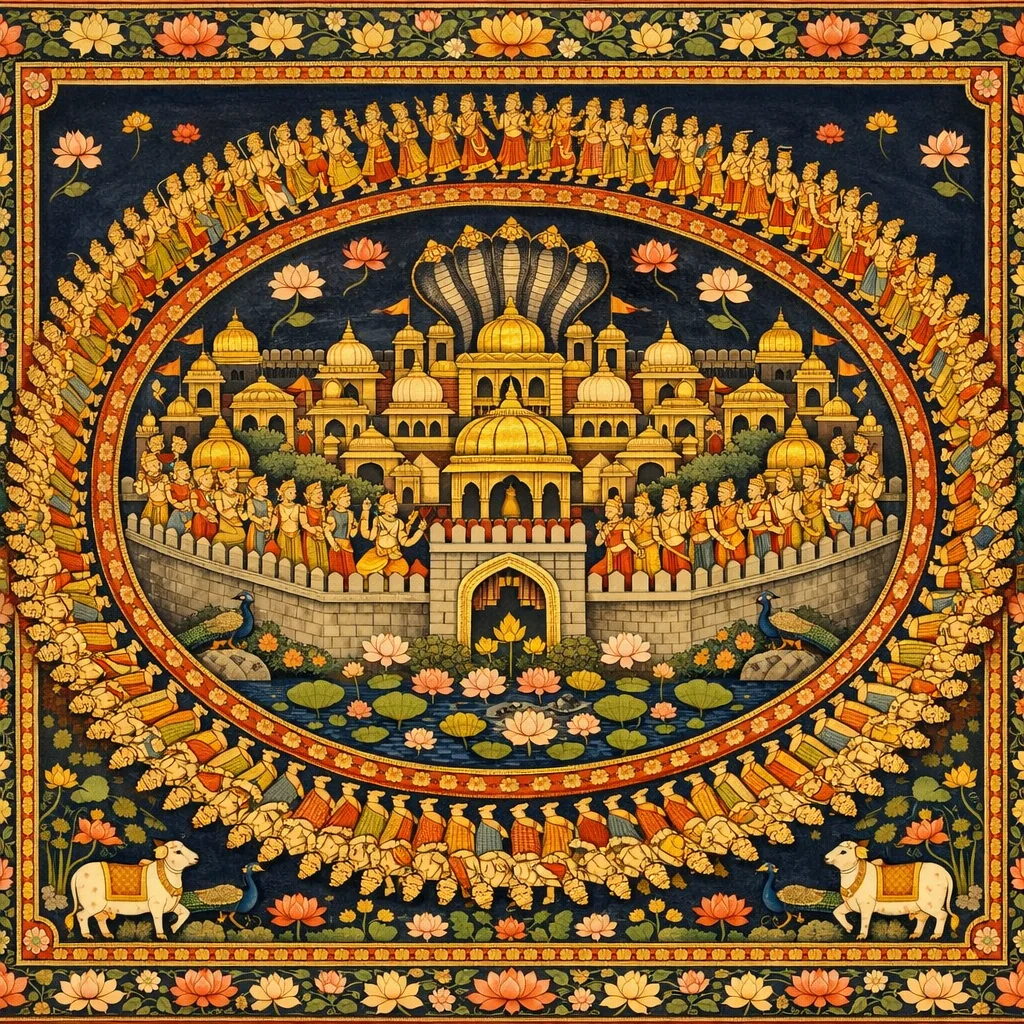
Continuing Nārada’s allegorical instruction to King Prācīnabarhiṣat, the chapter depicts King Purañjana’s deepening entanglement in conjugal attachment: captivated by his queen, he loses discrimination and fails to perceive that days and nights are silently reducing his lifespan. Absorbed in sense pleasure and fruitive religiosity, he begets an enormous progeny and becomes further bound by possessions, family expansion, and karma-kāṇḍa sacrifices tinged with violence. The narrative then pivots from domestic illusion to cosmic inevitability: Caṇḍavega, the Gandharva king (symbolizing the marching days), with 360 soldiers and their female counterparts (days and nights), repeatedly plunders the city of enjoyment. The city’s five-hooded serpent protector resists for ‘one hundred years’ but weakens—signaling the fading life-air and bodily defenses. As death approaches, Old Age—Kālakanyā, daughter of Time—enters the three worlds seeking a husband, is rejected by all, and finally joins the Yavana king Bhaya (Fear). Their alliance, with Prajvāra (fever) and soldiers, sets the stage for the next chapter’s intensified assault on Purañjana’s city-body and the inevitable collapse of material security.
Shlokas
Verse 1
नारद उवाच इत्थं पुरञ्जनं सध्र्यग्वशमानीय विभ्रमै: । पुरञ्जनी महाराज रेमे रमयती पतिम् ॥ १ ॥
The great sage Nārada continued: My dear King, after bewildering her husband in different ways and bringing him under her control, the wife of King Purañjana gave him all satisfaction and enjoyed sex life with him.
Verse 2
स राजा महिषीं राजन् सुस्नातां रुचिराननाम् । कृतस्वस्त्ययनां तृप्तामभ्यनन्ददुपागताम् ॥ २ ॥
The Queen took her bath and dressed herself nicely with all auspicious garments and ornaments. After taking food and becoming completely satisfied, she returned to the King. Upon seeing her beautifully decorated attractive face, the King welcomed her with all devotion.
Verse 3
तयोपगूढ: परिरब्धकन्धरो रहोऽनुमन्त्रैरपकृष्टचेतन: । न कालरंहो बुबुधे दुरत्ययं दिवा निशेति प्रमदापरिग्रह: ॥ ३ ॥
Queen Purañjanī embraced the King, and the King also responded by embracing her shoulders. In this way, in a solitary place, they enjoyed joking words. Thus King Purañjana became very much captivated by his beautiful wife and deviated from his good sense. He forgot that the passing of days and nights meant that his span of life was being reduced without profit.
Verse 4
शयान उन्नद्धमदो महामना महार्हतल्पे महिषीभुजोपधि: । तामेव वीरो मनुते परं यत- स्तमोऽभिभूतो न निजं परं च यत् ॥ ४ ॥
In this way, increasingly overwhelmed by illusion, King Purañjana, although advanced in consciousness, remained always lying down with his head on the pillow of his wife’s arms. In this way he considered woman to be his ultimate life and soul. Becoming thus overwhelmed by the mode of ignorance, he could not understand the meaning of self-realization, whether regarding his own self or the Supreme Personality of Godhead.
Verse 5
तयैवं रममाणस्य कामकश्मलचेतस: । क्षणार्धमिव राजेन्द्र व्यतिक्रान्तं नवं वय: ॥ ५ ॥
My dear King Prācīnabarhiṣat, in this way King Purañjana, with his heart full of lust and sinful reactions, began to enjoy sex with his wife, and in this way his new life and youth expired in half a moment.
Verse 6
तस्यामजनयत्पुत्रान् पुरञ्जन्यां पुरञ्जन: । शतान्येकादश विराडायुषोऽर्धमथात्यगात् ॥ ६ ॥
The great sage Nārada then addressed King Prācīnabarhiṣat: O one whose life span is great [virāṭ], in this way King Purañjana begot 1,100 sons within the womb of his wife, Purañjanī. However, in this business he passed away half of his life span.
Verse 7
दुहितृर्दशोत्तरशतं पितृमातृयशस्करी: । शीलौदार्यगुणोपेता: पौरञ्जन्य: प्रजापते ॥ ७ ॥
O Prajāpati, King Prācīnabarhiṣat, in this way King Purañjana also begot 110 daughters. All of these were equally glorified like the father and mother. Their behavior was gentle, and they possessed magnanimity and other good qualities.
Verse 8
स पञ्चालपति: पुत्रान् पितृवंशविवर्धनान् । दारै: संयोजयामास दुहितृ: सदृशैर्वरै: ॥ ८ ॥
After this, King Purañjana, King of the Pañcāla country, in order to increase the descendants of his paternal family, married his sons with qualified wives and married his daughters with qualified husbands.
Verse 9
पुत्राणां चाभवन्पुत्रा एकैकस्य शतं शतम् । यैर्वै पौरञ्जनो वंश: पञ्चालेषु समेधित: ॥ ९ ॥
Of these many sons, each produced hundreds and hundreds of grandsons. In this way the whole city of Pañcāla became overcrowded by these sons and grandsons of King Purañjana.
Verse 10
तेषु तद्रिक्थहारेषु गृहकोशानुजीविषु । निरूढेन ममत्वेन विषयेष्वन्वबध्यत ॥ १० ॥
These sons and grandsons were virtually plunderers of King Purañjana’s riches, including his home, treasury, servants, secretaries and all other paraphernalia. Purañjana’s attachment for these things was very deep-rooted.
Verse 11
ईजे च क्रतुभिर्घोरैर्दीक्षित: पशुमारकै: । देवान् पितृन् भूतपतीन्नानाकामो यथा भवान् ॥ ११ ॥
The great sage Nārada continued: My dear King Prācīnabarhiṣat, like you King Purañjana also became implicated in so many desires. Thus he worshiped demigods, forefathers and social leaders with various sacrifices which were all very ghastly because they were inspired by the desire to kill animals.
Verse 12
युक्तेष्वेवं प्रमत्तस्य कुटुम्बासक्तचेतस: । आससाद स वै कालो योऽप्रिय: प्रिययोषिताम् ॥ १२ ॥
Thus King Purañjana, being attached to fruitive activities [karma-kāṇḍīya] as well as kith and kin, and being obsessed with polluted consciousness, eventually arrived at that point not very much liked by those who are overly attached to material things.
Verse 13
चण्डवेग इति ख्यातो गन्धर्वाधिपतिर्नृप । गन्धर्वास्तस्य बलिन: षष्ट्युत्तरशतत्रयम् ॥ १३ ॥
O King! In Gandharvaloka there is a king named Caṇḍavega. Under him there are 360 very powerful Gandharva soldiers.
Verse 14
गन्धर्व्यस्तादृशीरस्य मैथुन्यश्च सितासिता: । परिवृत्त्या विलुम्पन्ति सर्वकामविनिर्मिताम् ॥ १४ ॥
Along with Caṇḍavega were as many female Gandharvīs as there were soldiers, and all of them repetitively plundered all the paraphernalia for sense enjoyment.
Verse 15
ते चण्डवेगानुचरा: पुरञ्जनपुरं यदा । हर्तुमारेभिरे तत्र प्रत्यषेधत्प्रजागर: ॥ १५ ॥
When King Gandharva-rāja [Caṇḍavega] and his followers began to plunder the city of Purañjana, a snake with five hoods began to defend the city.
Verse 16
स सप्तभि: शतैरेको विंशत्या च शतं समा: । पुरञ्जनपुराध्यक्षो गन्धर्वैर्युयुधे बली ॥ १६ ॥
The five-hooded serpent, the superintendent and protector of the city of King Purañjana, fought with the Gandharvas for one hundred years. He fought alone, with all of them, although they numbered 720.
Verse 17
क्षीयमाणे स्वसम्बन्धे एकस्मिन् बहुभिर्युधा । चिन्तां परां जगामार्त: सराष्ट्रपुरबान्धव: ॥ १७ ॥
Because he had to fight alone with so many soldiers, all of whom were great warriors, the serpent with five hoods became very weak. Seeing that his most intimate friend was weakening, King Purañjana and his friends and citizens living within the city all became very anxious.
Verse 18
स एव पुर्यां मधुभुक्पञ्चालेषु स्वपार्षदै: । उपनीतं बलिं गृह्णन् स्त्रीजितो नाविदद्भयम् ॥ १८ ॥
King Purañjana collected taxes in the city known as Pañcāla and thus was able to engage in sexual indulgence. Being completely under the control of women, he could not understand that his life was passing away and that he was reaching the point of death.
Verse 19
कालस्य दुहिता काचित्त्रिलोकीं वरमिच्छती । पर्यटन्ती न बर्हिष्मन् प्रत्यनन्दत कश्चन ॥ १९ ॥
My dear King Prācīnabarhiṣat, at this time the daughter of formidable Time was seeking her husband throughout the three worlds. Although no one agreed to accept her, she came.
Verse 20
दौर्भाग्येनात्मनो लोके विश्रुता दुर्भगेति सा । या तुष्टा राजर्षये तु वृतादात्पूरवे वरम् ॥ २० ॥
The daughter of Time [Jarā] was very unfortunate. Consequently she was known as Durbhagā [“ill-fated”]. However, she was once pleased with a great king, and because the king accepted her, she granted him a great benediction.
Verse 21
कदाचिदटमाना सा ब्रह्मलोकान्महीं गतम् । वव्रे बृहद्व्रतं मां तु जानती काममोहिता ॥ २१ ॥
When I once came to this earth from Brahmaloka, the highest planetary system, the daughter of Time, wandering over the universe, met me. Knowing me to be an avowed brahmacārī, she became lusty and proposed that I accept her.
Verse 22
मयि संरभ्य विपुलमदाच्छापं सुदु:सहम् । स्थातुमर्हसि नैकत्र मद्याच्ञाविमुखो मुने ॥ २२ ॥
The great sage Nārada continued: When I refused to accept her request, she became very angry at me and cursed me severely. Because I refused her request, she said that I would not be able to stay in one place for a long time.
Verse 23
ततो विहतसङ्कल्पा कन्यका यवनेश्वरम् । मयोपदिष्टमासाद्य वव्रे नाम्ना भयं पतिम् ॥ २३ ॥
After she was thus disappointed by me, with my permission she approached the King of the Yavanas, whose name was Bhaya, or Fear, and she accepted him as her husband.
Verse 24
ऋषभं यवनानां त्वां वृणे वीरेप्सितं पतिम् । सङ्कल्पस्त्वयि भूतानां कृत: किल न रिष्यति ॥ २४ ॥
Approaching the King of the Yavanas, Kālakanyā addressed him as a great hero, saying: My dear sir, you are the best of the untouchables. I am in love with you, and I want you as my husband. I know that no one is baffled if he makes friends with you.
Verse 25
द्वाविमावनुशोचन्ति बालावसदवग्रहौ । यल्लोकशास्त्रोपनतं न राति न तदिच्छति ॥ २५ ॥
One who does not give charity according to the customs or injunctions of the scriptures and one who does not accept charity in that way are considered to be in the mode of ignorance. Such persons follow the path of the foolish. Surely they must lament at the end.
Verse 26
अथो भजस्व मां भद्र भजन्तीं मे दयां कुरु । एतावान् पौरुषो धर्मो यदार्ताननुकम्पते ॥ २६ ॥
Kālakanyā continued: O gentle one, I am now present before you to serve you. Please accept me and thus show me mercy. It is a gentleman’s greatest duty to be compassionate upon a person who is distressed.
Verse 27
कालकन्योदितवचो निशम्य यवनेश्वर: । चिकीर्षुर्देवगुह्यं स सस्मितं तामभाषत ॥ २७ ॥
After hearing the statement of Kālakanyā, daughter of Time, the King of the Yavanas began to smile and devise a means for executing his confidential duty on behalf of providence. He then addressed Kālakanyā as follows.
Verse 28
मया निरूपितस्तुभ्यं पतिरात्मसमाधिना । नाभिनन्दति लोकोऽयं त्वामभद्रामसम्मताम् ॥ २८ ॥
The King of the Yavanas replied: After much consideration, I have arrived at a husband for you. Actually, as far as everyone is concerned, you are inauspicious and mischievous. Since no one likes you, how can anyone accept you as his wife?
Verse 29
त्वमव्यक्तगतिर्भुङ्क्ष्व लोकं कर्मविनिर्मितम् । या हि मे पृतनायुक्ता प्रजानाशं प्रणेष्यसि ॥ २९ ॥
This world is a product of fruitive activities. Therefore you may imperceptibly attack people in general. Helped by my soldiers, you can kill them without opposition.
Verse 30
प्रज्वारोऽयं मम भ्राता त्वं च मे भगिनी भव । चराम्युभाभ्यां लोकेऽस्मिन्नव्यक्तो भीमसैनिक: ॥ ३० ॥
The King of the Yavanas continued: Here is my brother Prajvāra. I now accept you as my sister. I shall employ both of you, as well as my dangerous soldiers, to act imperceptibly within this world.
Frequently Asked Questions
Caṇḍavega allegorically represents the force of time acting through the cycle of days. His 360 powerful Gandharvas indicate the days of the year, and their corresponding female Gandharvīs indicate the nights. Together they ‘plunder’ the city by steadily consuming the jīva’s allotted lifespan, regardless of the resident’s plans for enjoyment.
In the allegory, the five-hooded serpent signifies the body’s vital force and protective functions—often explained as the pañca-prāṇa (five life-airs) or the life-breath system sustaining the ‘city.’ Its long struggle with time indicates that vitality can resist decline for a period, but inevitably weakens under the relentless passage of kāla.
Kālakanyā personifies old age, which is universally unwelcome because it diminishes beauty, strength, and sense enjoyment. Her marriage to Bhaya (Fear) conveys the psychological reality that aging naturally intensifies fear—of loss, disease, dependency, and death. In devotional readings, this warns that ignoring self-realization causes old age and fear to become the governing forces of one’s consciousness.
It portrays Purañjana’s ritual worship of demigods, forefathers, and leaders as desire-driven and ‘ghastly’ due to animal-killing intent. The critique is not of Vedic order itself, but of ritual performed for sense expansion and prestige. Such acts deepen identification with the body-city and do not stop time’s plunder; only purification of consciousness through devotion and knowledge redirects life toward liberation.