Adhyaya 15
The Appearance and Coronation of King Pṛthu (Pṛthu-avatāra) and His Humble Refusal of Premature Praise
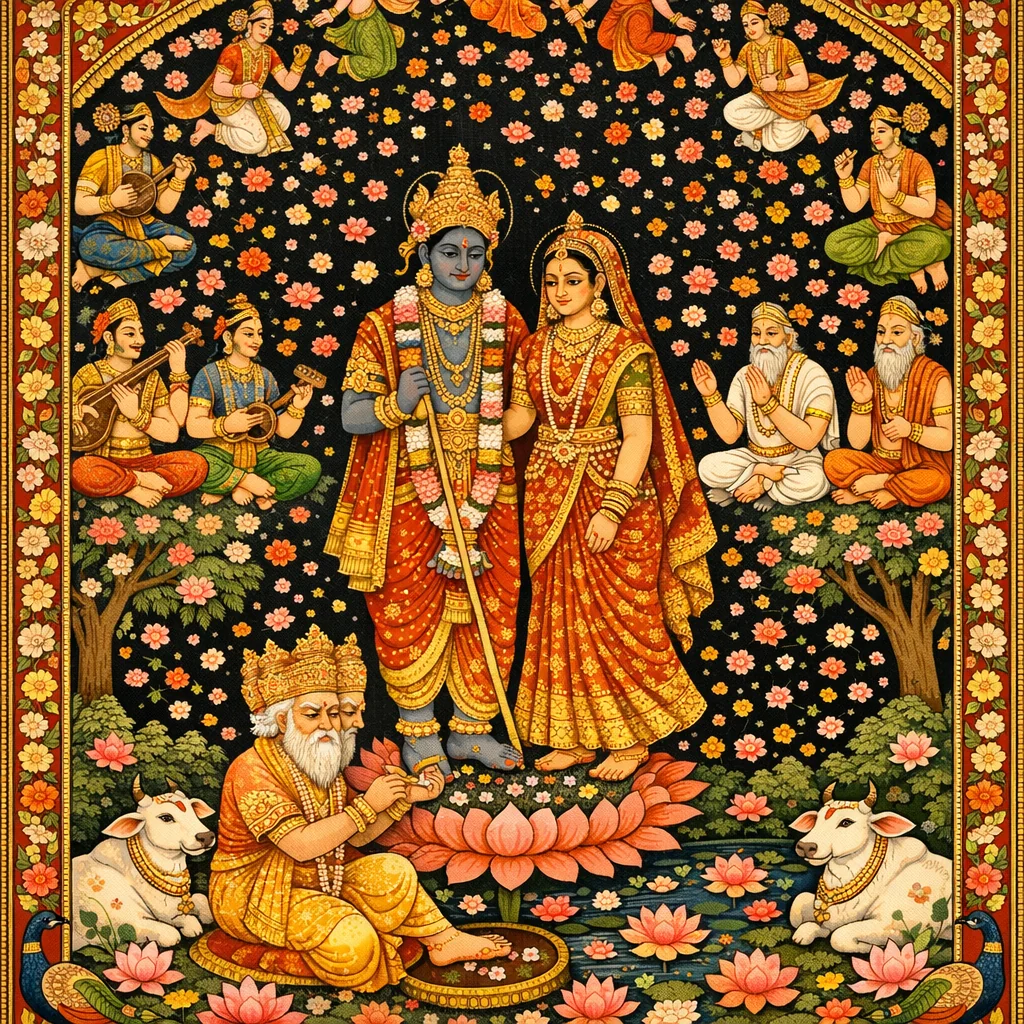
Following the downfall and death of the irreligious King Vena (previous arc), the brāhmaṇas and sages churn Vena’s body to extract a divinely ordained resolution for the kingdom’s crisis. From his arms manifest a male-female pair—Pṛthu and Arci—recognized as partial expansions: Pṛthu as an empowered manifestation of Viṣṇu’s ruling potency and Arci as a partial manifestation of Śrī (Lakṣmī), ensuring dharma and prosperity re-enter the world together. Cosmic celebration follows: Gandharvas sing, Siddhas shower flowers, and Brahmā arrives, verifying Pṛthu’s avatāric identity through auspicious bodily signs (Viṣṇu-lakṣaṇas) such as the cakra marking on the palm and lotus marks on the feet. The brāhmaṇas arrange the coronation, and all strata of creation—from rivers and mountains to demigods—offer royal gifts (weapons, insignia, knowledge-armor, opulences), establishing Pṛthu as universal sovereign. Yet when professional bards (sūta, māgadha, vandī) praise him, Pṛthu checks flattery: he rejects attributing unmanifest virtues to a human ruler and redirects praise toward the Supreme until his deeds truly warrant acclaim—setting the ethical tone for his forthcoming governance (next chapter arc: his active kingship and restoration of prosperity).
Shlokas
Verse 1
मैत्रेय उवाच अथ तस्य पुनर्विप्रैरपुत्रस्य महीपते: । बाहुभ्यां मथ्यमानाभ्यां मिथुनं समपद्यत ॥ १ ॥
The great sage Maitreya continued: My dear Vidura, thus the brāhmaṇas and the great sages again churned the two arms of King Vena’s dead body. As a result a male and female couple came out of his arms.
Verse 2
तद् दृष्ट्वा मिथुनं जातमृषयो ब्रह्मवादिन: । ऊचु: परमसन्तुष्टा विदित्वा भगवत्कलाम् ॥ २ ॥
The great sages were highly learned in Vedic knowledge. When they saw the male and female born of the arms of Vena’s body, they were very pleased, for they could understand that the couple was an expansion of a plenary portion of Viṣṇu, the Supreme Personality of Godhead.
Verse 3
ऋषय ऊचु: एष विष्णोर्भगवत: कला भुवनपालिनी । इयं च लक्ष्म्या: सम्भूति: पुरुषस्यानपायिनी ॥ ३ ॥
The great sages said: The male is a plenary expansion of the power of Lord Viṣṇu, who maintains the entire universe, and the female is a plenary expansion of the goddess of fortune, who is never separated from the Lord.
Verse 4
अयं तु प्रथमो राज्ञां पुमान् प्रथयिता यश: । पृथुर्नाम महाराजो भविष्यति पृथुश्रवा: ॥ ४ ॥
Of the two, the male will be able to expand his reputation throughout the world. His name will be Pṛthu. Indeed, he will be the first among kings.
Verse 5
इयं च सुदती देवी गुणभूषणभूषणा । अर्चिर्नाम वरारोहा पृथुमेवावरुन्धती ॥ ५ ॥
The female has such beautiful teeth and beautiful qualities that she will actually beautify the ornaments she wears. Her name will be Arci. In the future she will accept King Pṛthu as her husband.
Verse 6
एष साक्षाद्धरेरंशो जातो लोकरिरक्षया । इयं च तत्परा हि श्रीरनुजज्ञेऽनपायिनी ॥ ६ ॥
In the form of King Pṛthu, the Supreme Personality of Godhead has appeared through a part of His potency to protect the people of the world. The goddess of fortune is the constant companion of the Lord, and therefore she has incarnated partially as Arci to become King Pṛthu’s queen.
Verse 7
मैत्रेय उवाच प्रशंसन्ति स्म तं विप्रा गन्धर्वप्रवरा जगु: । मुमुचु: सुमनोधारा: सिद्धा नृत्यन्ति स्व:स्त्रिय: ॥ ७ ॥
The great sage Maitreya continued: My dear Vidurajī, at that time all the brāhmaṇas highly praised and glorified King Pṛthu, and the best singers of Gandharvaloka chanted his glories. The inhabitants of Siddhaloka showered flowers, and the beautiful women in the heavenly planets danced in ecstasy.
Verse 8
शङ्खतूर्यमृदङ्गाद्या नेदुर्दुन्दुभयो दिवि । तत्र सर्व उपाजग्मुर्देवर्षिपितृणां गणा: ॥ ८ ॥
Conchshells, bugles, drums and kettledrums vibrated in outer space. Great sages, forefathers and personalities from the heavenly planets all came to earth from various planetary systems.
Verse 9
ब्रह्मा जगद्गुरुर्देवै: सहासृत्य सुरेश्वरै: । वैन्यस्य दक्षिणे हस्ते दृष्ट्वा चिह्नं गदाभृत: ॥ ९ ॥ पादयोररविन्दं च तं वै मेने हरे: कलाम् । यस्याप्रतिहतं चक्रमंश: स परमेष्ठिन: ॥ १० ॥
Lord Brahmā, the master of the entire universe, arrived there accompanied by all the demigods and their chiefs. Seeing the lines of Lord Viṣṇu’s palm on King Pṛthu’s right hand and impressions of lotus flowers on the soles of his feet, Lord Brahmā could understand that King Pṛthu was a partial representation of the Supreme Personality of Godhead. One whose palm bears the sign of a disc, as well as other such lines, should be considered a partial representation or incarnation of the Supreme Lord.
Verse 10
ब्रह्मा जगद्गुरुर्देवै: सहासृत्य सुरेश्वरै: । वैन्यस्य दक्षिणे हस्ते दृष्ट्वा चिह्नं गदाभृत: ॥ ९ ॥ पादयोररविन्दं च तं वै मेने हरे: कलाम् । यस्याप्रतिहतं चक्रमंश: स परमेष्ठिन: ॥ १० ॥
Lord Brahmā, the master of the entire universe, arrived there accompanied by all the demigods and their chiefs. Seeing the lines of Lord Viṣṇu’s palm on King Pṛthu’s right hand and impressions of lotus flowers on the soles of his feet, Lord Brahmā could understand that King Pṛthu was a partial representation of the Supreme Personality of Godhead. One whose palm bears the sign of a disc, as well as other such lines, should be considered a partial representation or incarnation of the Supreme Lord.
Verse 11
तस्याभिषेक आरब्धो ब्राह्मणैर्ब्रह्मवादिभि: । आभिषेचनिकान्यस्मै आजह्रु: सर्वतो जना: ॥ ११ ॥
The learned brāhmaṇas, who were very attached to the Vedic ritualistic ceremonies, then arranged for the King’s coronation. People from all directions collected all the different paraphernalia for the ceremony. Thus everything was complete.
Verse 12
सरित्समुद्रा गिरयो नागा गाव: खगा मृगा: । द्यौ: क्षिति: सर्वभूतानि समाजह्रुरुपायनम् ॥ १२ ॥
All the rivers, seas, hills, mountains, serpents, cows, birds, animals, heavenly planets, the earthly planet and all other living entities collected various presentations, according to their ability, to offer the King.
Verse 13
सोऽभिषिक्तो महाराज: सुवासा: साध्वलड़्क़ृत: । पत्न्यार्चिषालड्क़ृतया विरेजेऽग्निरिवापर: ॥ १३ ॥
Thus the great King Pṛthu, exquisitely dressed with garments and ornaments, was coronated and placed on the throne. The King and his wife, Arci, who was also exquisitely ornamented, appeared exactly like fire.
Verse 14
तस्मै जहार धनदो हैमं वीर वरासनम् । वरुण: सलिलस्रावमातपत्रं शशिप्रभम् ॥ १४ ॥
The great sage continued: My dear Vidura, Kuvera presented the great King Pṛthu with a golden throne. The demigod Varuṇa presented him with an umbrella that constantly sprayed fine particles of water and was as brilliant as the moon.
Verse 15
वायुश्च वालव्यजने धर्म: कीर्तिमयीं स्रजम् । इन्द्र: किरीटमुत्कृष्टं दण्डं संयमनं यम: ॥ १५ ॥
The demigod of air, Vāyu, presented King Pṛthu with two whisks [cāmaras] of hair; the King of religion, Dharma, presented him with a flower garland which would expand his fame; the King of heaven, Indra, presented him with a valuable helmet; and the superintendent of death, Yamarāja, presented him with a scepter with which to rule the world.
Verse 16
ब्रह्मा ब्रह्ममयं वर्म भारती हारमुत्तमम् । हरि: सुदर्शनं चक्रं तत्पत्न्यव्याहतां श्रियम् ॥ १६ ॥
Lord Brahmā presented King Pṛthu with a protective garment made of spiritual knowledge. Bhāratī [Sarasvatī], the wife of Brahmā, gave him a transcendental necklace. Lord Viṣṇu presented him with a Sudarśana disc, and Lord Viṣṇu’s wife, the goddess of fortune, gave him imperishable opulences.
Verse 17
दशचन्द्रमसिं रुद्र: शतचन्द्रं तथाम्बिका । सोमोऽमृतमयानश्वांस्त्वष्टा रूपाश्रयं रथम् ॥ १७ ॥
Lord Śiva presented him with a sword within a sheath marked with ten moons, and his wife, the goddess Durgā, presented him with a shield marked with one hundred moons. The moon-demigod presented him with horses made of nectar, and the demigod Viśvakarmā presented him with a very beautiful chariot.
Verse 18
अग्निराजगवं चापं सूर्यो रश्मिमयानिषून् । भू: पादुके योगमय्यौ द्यौ: पुष्पावलिमन्वहम् ॥ १८ ॥
The demigod of fire, Agni, presented him with a bow made of the horns of goats and cows. The sun-god presented him with arrows as brilliant as sunshine. The predominating deity of Bhūrloka presented him with slippers full of mystic power. The demigods from outer space brought him presentations of flowers again and again.
Verse 19
नाट्यं सुगीतं वादित्रमन्तर्धानं च खेचरा: । ऋषयश्चाशिष: सत्या: समुद्र: शङ्खमात्मजम् ॥ १९ ॥
The demigods who always travel in outer space gave King Pṛthu the arts to perform dramas, sing songs, play musical instruments and disappear at his will. The great sages also offered him infallible blessings. The ocean offered him a conchshell produced from the ocean.
Verse 20
सिन्धव: पर्वता नद्यो रथवीथीर्महात्मन: । सूतोऽथ मागधो वन्दी तं स्तोतुमुपतस्थिरे ॥ २० ॥
The seas, mountains and rivers gave him room to drive his chariot without impediments, and a sūta, a māgadha and a vandī offered prayers and praises. They all presented themselves before him to perform their respective duties.
Verse 21
स्तावकांस्तानभिप्रेत्य पृथुर्वैन्य: प्रतापवान् । मेघनिर्ह्रादया वाचा प्रहसन्निदमब्रवीत् ॥ २१ ॥
Thus when the greatly powerful King Pṛthu, the son of Vena, saw the professionals before him, to congratulate them he smiled, and with the gravity of the vibrating sounds of clouds he spoke as follows.
Verse 22
पृथुरुवाच भो: सूत हे मागध सौम्य वन्दिँ- ल्लोकेऽधुनास्पष्टगुणस्य मे स्यात् । किमाश्रयो मे स्तव एष योज्यतां मा मय्यभूवन्वितथा गिरो व: ॥ २२ ॥
King Pṛthu said: O gentle sūta, māgadha and other devotee offering prayers, the qualities of which you have spoken are not distinct in me. Why then should you praise me for all these qualities when I do not shelter these features? I do not wish for these words meant for me to go in vain, but it is better that they be offered to someone else.
Verse 23
तस्मात्परोक्षेऽस्मदुपश्रुतान्यलं करिष्यथ स्तोत्रमपीच्यवाच: । सत्युत्तमश्लोकगुणानुवादे जुगुप्सितं न स्तवयन्ति सभ्या: ॥ २३ ॥
O gentle reciters, offer such prayers in due course of time, when the qualities of which you have spoken actually manifest themselves in me. The gentle who offer prayers to the Supreme Personality of Godhead do not attribute such qualities to a human being, who does not actually have them.
Verse 24
महद्गुणानात्मनि कर्तुमीश: क: स्तावकै: स्तावयतेऽसतोऽपि । तेऽस्याभविष्यन्निति विप्रलब्धो जनावहासं कुमतिर्न वेद ॥ २४ ॥
How could an intelligent man competent enough to possess such exalted qualities allow his followers to praise him if he did not actually have them? Praising a man by saying that if he were educated he might have become a great scholar or great personality is nothing but a process of cheating. A foolish person who agrees to accept such praise does not know that such words simply insult him.
Verse 25
प्रभवो ह्यात्मन: स्तोत्रं जुगुप्सन्त्यपि विश्रुता: । ह्रीमन्त: परमोदारा: पौरुषं वा विगर्हितम् ॥ २५ ॥
As a person with a sense of honor and magnanimity does not like to hear about his abominable actions, a person who is very famous and powerful does not like to hear himself praised.
Verse 26
वयं त्वविदिता लोके सूताद्यापि वरीमभि: । कर्मभि: कथमात्मानं गापयिष्याम बालवत् ॥ २६ ॥
King Pṛthu continued: My dear devotees, headed by the sūta, just now I am not very famous for my personal activities because I have not done anything praiseworthy you could glorify. Therefore how could I engage you in praising my activities exactly like children?
Frequently Asked Questions
The churning is a dhārmic intervention to extract order from chaos after Vena’s misrule. Śāstrically, it shows that when adharma destabilizes society, the brāhmaṇas’ spiritual power and the Lord’s plan can reconstitute governance. Symbolically, it mirrors samudra-manthana: from disturbance, providence brings forth what is needed for universal maintenance—here, the righteous king Pṛthu and his śrī-sahacāriṇī, Arci.
Pṛthu is described as a partial manifestation empowered by Viṣṇu’s maintaining potency—fit to become the first among kings in exemplary rule—while Arci is a partial manifestation of the goddess of fortune (Śrī/Lakṣmī), who is never separated from the Lord. Their pairing teaches that righteous sovereignty and prosperity must co-exist under divine alignment.
Brahmā observes auspicious marks associated with Viṣṇu—such as the cakra sign on the palm and lotus impressions on the soles—classical indicators in Purāṇic and āyur-physiognomic traditions that denote an avatāric or divinely empowered status. This establishes Pṛthu’s legitimacy beyond mere heredity.
The offerings depict cosmic cooperation when dharma is restored: each deva empowers the king’s service—protection (weapons), moral authority (scepter), fame aligned with virtue (garland), and inner protection (Brahmā’s ‘garment’ of spiritual knowledge). The message is that nature and heaven support a ruler who rules as Viṣṇu’s representative, not as an egoistic enjoyer.
Pṛthu rejects praise for qualities not yet demonstrated, calling it deceitful and ultimately insulting. He teaches that kīrtana and stuti must be truthful and properly directed: the Supreme Lord is the rightful object of unqualified glorification, while a human leader should accept praise only when earned through verifiable dhārmic action—an essential safeguard against royal vanity.