Adhyaya 30
The Pracetās Meet Lord Viṣṇu—Benedictions, Pure Prayer, and the Birth of Dakṣa
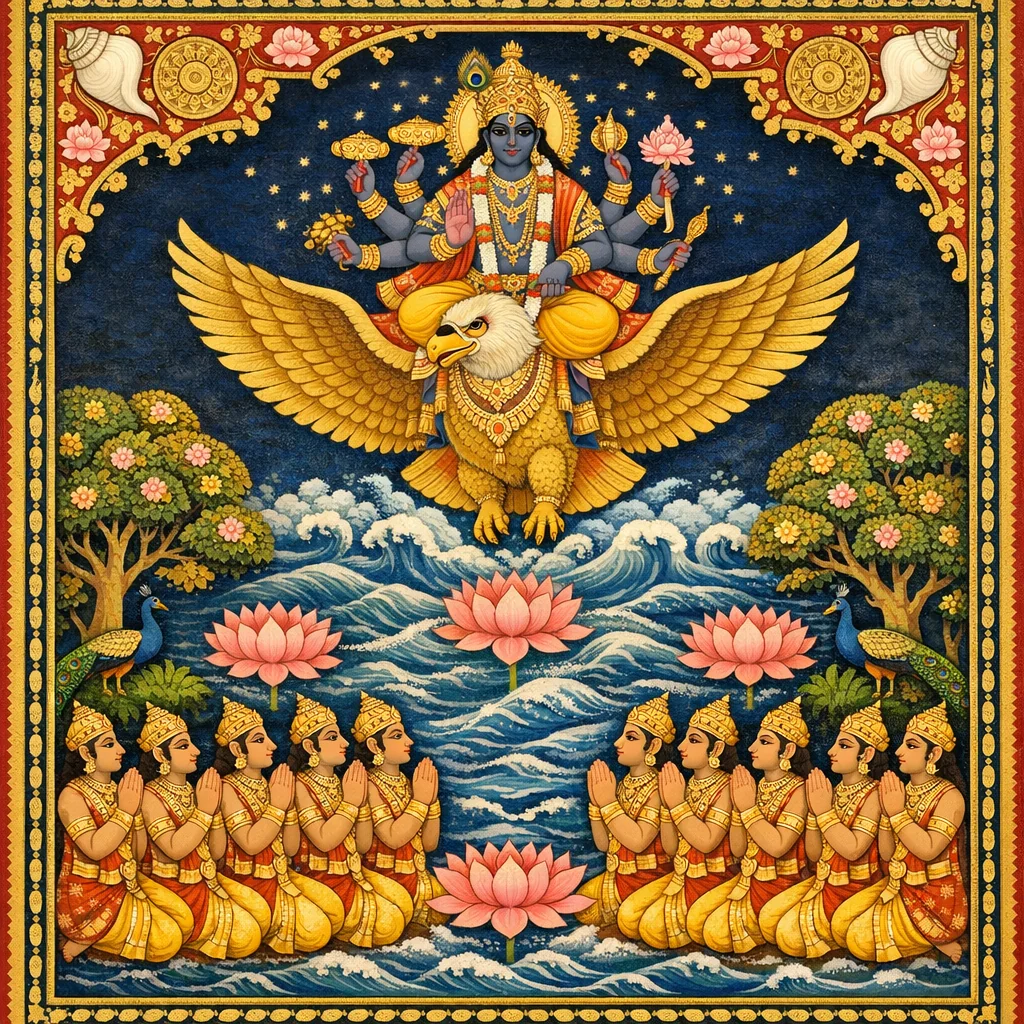
Vidura asks Maitreya what the Pracetās gained by chanting Śiva’s prayer and satisfying Viṣṇu. Maitreya recounts their ten-thousand-year austerity in the ocean and the Lord’s appearance on Garuḍa in an eight-armed, effulgent form. Pleased especially by their mutual friendship and single-minded bhakti, Viṣṇu offers benedictions: fame, the future birth of an extraordinary son, and long enjoyment of worldly and heavenly facilities—followed by inevitable purification into unalloyed devotion and return to Godhead. The Pracetās respond with a theology-rich stuti (praise), asking not for wealth but for the Lord’s satisfaction and continued association with devotees life after life, extolling saṅkīrtana and the incomparable value of sādhu-saṅga. After the Lord departs, the brothers emerge to find the earth overrun by trees; in anger they burn them with fire and air from their mouths. Brahmā pacifies them; the remaining trees offer Māriṣā, whom the Pracetās marry. From her is born Dakṣa (a rebirth due to offense to Śiva), who resumes population work—setting up the next narrative arc concerning progeny, ritual power, and its purification.
Shlokas
Verse 1
विदुर उवाच ये त्वयाभिहिता ब्रह्मन् सुता: प्राचीनबर्हिष: । ते रुद्रगीतेन हरिं सिद्धिमापु: प्रतोष्य काम् ॥ १ ॥
Vidura inquired from Maitreya: O brāhmaṇa, you formerly spoke about the sons of Prācīnabarhi and informed me that they satisfied the Supreme Personality of Godhead by chanting a song composed by Lord Śiva. What did they achieve in this way?
Verse 2
किं बार्हस्पत्येह परत्र वाथ कैवल्यनाथप्रियपार्श्ववर्तिन: । आसाद्य देवं गिरिशं यदृच्छया प्रापु: परं नूनमथ प्रचेतस: ॥ २ ॥
My dear Bārhaspatya, what did the sons of King Barhiṣat, known as the Pracetās, obtain after meeting Lord Śiva, who is very dear to the Supreme Personality of Godhead, the bestower of liberation? Certainly they were transferred to the spiritual world, but apart from that, what did they obtain within this material world, either in this life or in other lives?
Verse 3
मैत्रेय उवाच प्रचेतसोऽन्तरुदधौ पितुरादेशकारिण: । जपयज्ञेन तपसा पुरञ्जनमतोषयन् ॥ ३ ॥
The great sage Maitreya said: The sons of King Prācīnabarhi, known as the Pracetās, underwent severe austerities within the seawater to carry out the order of their father. By chanting and repeating the mantras given by Lord Śiva, they were able to satisfy Lord Viṣṇu, the Supreme Personality of Godhead.
Verse 4
दशवर्षसहस्रान्ते पुरुषस्तु सनातन: । तेषामाविरभूत्कृच्छ्रं शान्तेन शमयन् रुचा ॥ ४ ॥
At the end of ten thousand years of severe austerities performed by the Pracetās, the Supreme Personality of Godhead, to reward their austerities, appeared before them in His very pleasing form. This appealed to the Pracetās and satisfied the labor of their austerities.
Verse 5
सुपर्णस्कन्धमारूढो मेरुशृङ्गमिवाम्बुद: । पीतवासा मणिग्रीव: कुर्वन्वितिमिरा दिश: ॥ ५ ॥
The Personality of Godhead, appearing on the shoulder of Garuḍa, seemed like a cloud resting on the summit of the mountain known as Meru. The transcendental body of the Personality of Godhead was covered by attractive yellow garments, and His neck was decorated with the jewel known as Kaustubha-maṇi. The bodily effulgence of the Lord dissipated all the darkness of the universe.
Verse 6
काशिष्णुना कनकवर्णविभूषणेन भ्राजत्कपोलवदनो विलसत्किरीट: । अष्टायुधैरनुचरैर्मुनिभि: सुरेन्द्रै- रासेवितो गरुडकिन्नरगीतकीर्ति: ॥ ६ ॥
The Lord’s face was very beautiful, and His head was decorated with a shining helmet and golden ornaments. The helmet was dazzling and was very beautifully situated on His head. The Lord had eight arms, which each held a particular weapon. The Lord was surrounded by demigods, great sages and other associates. These were all engaged in His service. Garuḍa, the carrier of the Lord, glorified the Lord with Vedic hymns by flapping his wings. Garuḍa appeared to be an inhabitant of the planet known as Kinnaraloka.
Verse 7
पीनायताष्टभुजमण्डलमध्यलक्ष्म्या स्पर्धच्छ्रिया परिवृतो वनमालयाद्य: । बर्हिष्मत: पुरुष आह सुतान् प्रपन्नान् पर्जन्यनादरुतया सघृणावलोक: ॥ ७ ॥
Around the neck of the Personality of Godhead hung a flower garland that reached to His knees. His eight stout and elongated arms were decorated with that garland, which challenged the beauty of the goddess of fortune. With a merciful glance and a voice like thunder, the Lord addressed the sons of King Prācīnabarhiṣat, who were very much surrendered unto Him.
Verse 8
श्रीभगवानुवाच वरं वृणीध्वं भद्रं वो यूयं मे नृपनन्दना: । सौहार्देनापृथग्धर्मास्तुष्टोऽहं सौहृदेन व: ॥ ८ ॥
The Supreme Personality of Godhead said: My dear sons of the King, I am very much pleased by the friendly relationships among you. All of you are engaged in one occupation — devotional service. I am so pleased with your mutual friendship that I wish you all good fortune. Now you may ask a benediction of Me.
Verse 9
योऽनुस्मरति सन्ध्यायां युष्माननुदिनं नर: । तस्य भ्रातृष्वात्मसाम्यं तथा भूतेषु सौहृदम् ॥ ९ ॥
The Lord continued: Those who remember you every evening of every day will become friendly with their brothers and with all other living entities.
Verse 10
ये तु मां रुद्रगीतेन सायं प्रात: समाहिता: । स्तुवन्त्यहं कामवरान्दास्ये प्रज्ञां च शोभनाम् ॥ १० ॥
Those who will offer Me the prayers composed by Lord Śiva, both in the morning and in the evening, will be given benedictions by Me. In this way they can both fulfill their desires and attain good intelligence.
Verse 11
यद्यूयं पितुरादेशमग्रहीष्ट मुदान्विता: । अथो व उशती कीर्तिर्लोकाननु भविष्यति ॥ ११ ॥
Because you have with pleasure accepted within your hearts the orders of your father and have executed those orders very faithfully, your attractive qualities will be celebrated all over the world.
Verse 12
भविता विश्रुत: पुत्रोऽनवमो ब्रह्मणो गुणै: । य एतामात्मवीर्येण त्रिलोकीं पूरयिष्यति ॥ १२ ॥
You will have a nice son, who will be in no way inferior to Lord Brahmā. Consequently, he will be very famous all over the universe, and the sons and grandsons generated by him will fill the three worlds.
Verse 13
कण्डो: प्रम्लोचया लब्धा कन्या कमललोचना । तां चापविद्धां जगृहुर्भूरुहा नृपनन्दना: ॥ १३ ॥
O sons of King Prācīnabarhiṣat, the heavenly society girl named Pramlocā kept the lotus-eyed daughter of Kaṇḍu in the care of the forest trees. Then she went back to the heavenly planet. This daughter was born by the coupling of the Apsarā named Pramlocā with the sage Kaṇḍu.
Verse 14
क्षुत्क्षामाया मुखे राजा सोम: पीयूषवर्षिणीम् । देशिनीं रोदमानाया निदधे स दयान्वित: ॥ १४ ॥
Thereafter the child, who was left to the care of the trees, began to cry in hunger. At that time the king of the forest, namely the king of the moon planet, out of compassion placed his finger, which poured forth nectar, within the child’s mouth. Thus the child was raised by the mercy of the king of the moon.
Verse 15
प्रजाविसर्ग आदिष्टा: पित्रा मामनुवर्तता । तत्र कन्यां वरारोहां तामुद्वहत मा चिरम् ॥ १५ ॥
Since all of you are very much obedient to My orders, I ask you to immediately marry that girl, who is so well qualified with beauty and good qualities. According to the order of your father, create progeny through her.
Verse 16
अपृथग्धर्मशीलानां सर्वेषां व: सुमध्यमा । अपृथग्धर्मशीलेयं भूयात्पत्न्यर्पिताशया ॥ १६ ॥
You brothers are all of the same nature, being My devotees and obedient sons of your father. Similarly, that girl is also of the same type and is dedicated to all of you. Thus both the girl and you, the sons of Prācīnabarhiṣat, are on the same platform, being united on a common principle.
Verse 17
दिव्यवर्षसहस्राणां सहस्रमहतौजस: । भौमान् भोक्ष्यथ भोगान् वै दिव्यांश्चानुग्रहान्मम ॥ १७ ॥
The Lord then blessed all the Pracetās, saying: My dear princes, by My mercy you can enjoy all the facilities of this world as well as the heavenly world. Indeed, you can enjoy all of them without hindrance and with full strength for one million celestial years.
Verse 18
अथ मय्यनपायिन्या भक्त्या पक्वगुणाशया: । उपयास्यथ मद्धाम निर्विद्य निरयादत: ॥ १८ ॥
Thereafter you will develop unadulterated devotional service unto Me and be freed from all material contamination. At that time, being completely unattached to material enjoyment in the so-called heavenly planets as well as in hellish planets, you will return home, back to Godhead.
Verse 19
गृहेष्वाविशतां चापि पुंसां कुशलकर्मणाम् । मद्वार्तायातयामानां न बन्धाय गृहा मता: ॥ १९ ॥
Those who are engaged in auspicious activities in devotional service certainly understand that the ultimate enjoyer or beneficiary of all activities is the Supreme Personality of Godhead. Thus when one acts, he offers the results to the Supreme Personality of Godhead and passes life always engaged in the topics of the Lord. Even though such a person may be participating in family life, he is not affected by the results of his actions.
Verse 20
नव्यवद्धृदये यज्ज्ञो ब्रह्मैतद्ब्रह्मवादिभि: । न मुह्यन्ति न शोचन्ति न हृष्यन्ति यतो गता: ॥ २० ॥
Always engaging in the activities of devotional service, devotees feel ever-increasingly fresh and new in all their activities. The all-knower, the Supersoul within the heart of the devotee, makes everything increasingly fresh. This is known as the Brahman position by the advocates of the Absolute Truth. In such a liberated stage [brahma-bhūta], one is never bewildered. Nor does one lament or become unnecessarily jubilant. This is due to the brahma-bhūta situation.
Verse 21
मैत्रेय उवाच एवं ब्रुवाणं पुरुषार्थभाजनं जनार्दनं प्राञ्जलय: प्रचेतस: । तद्दर्शनध्वस्ततमोरजोमला गिरागृणन् गद्गदया सुहृत्तमम् ॥ २१ ॥
The great sage Maitreya said: After the Personality of Godhead spoke thus, the Pracetās began to offer Him prayers. The Lord is the bestower of all success in life and is the supreme benefactor. He is also the supreme friend who takes away all miserable conditions experienced by a devotee. In a faltering voice, due to ecstasy, the Pracetās began to offer prayers. They were purified by the presence of the Lord, who was before them face to face.
Verse 22
प्रचेतस ऊचुः । नमो नमः क्लेशविनाशनाय । निरूपितोदारगुणाह्वयाय । मनोवचोवेगपुरोजवाय । सर्वाक्षमार्गैरगताध्वने नमः ॥ २२ ॥
The Pracetās spoke as follows: Dear Lord, You relieve all kinds of material distress. Your magnanimous transcendental qualities and holy name are all-auspicious. This conclusion is already settled. You can go faster than the speed of mind and words. You cannot be perceived by material senses. We therefore offer You respectful obeisances again and again.
Verse 23
शुद्धाय शान्ताय नम: स्वनिष्ठया मनस्यपार्थं विलसद्द्वयाय । नमो जगत्स्थानलयोदयेषु गृहीतमायागुणविग्रहाय ॥ २३ ॥
Dear Lord, we beg to offer our obeisances unto You. When the mind is fixed upon You, the world of duality, although a place for material enjoyment, appears meaningless. Your transcendental form is full of transcendental bliss. We therefore offer our respects unto You. Your appearances as Lord Brahmā, Lord Viṣṇu and Lord Śiva are meant for the purpose of creating, maintaining and annihilating this cosmic manifestation.
Verse 24
नमो विशुद्धसत्त्वाय हरये हरिमेधसे । वासुदेवाय कृष्णाय प्रभवे सर्वसात्वताम् ॥ २४ ॥
Dear Lord, we offer our respectful obeisances unto You because Your existence is completely independent of all material influences. Your Lordship always takes away the devotee’s miserable conditions, for Your brain plans how to do so. You live everywhere as Paramātmā; therefore You are known as Vāsudeva. You also accept Vasudeva as Your father, and You are celebrated by the name Kṛṣṇa. You are so kind that You always increase the influence of all kinds of devotees.
Verse 25
नम: कमलनाभाय नम: कमलमालिने । नम: कमलपादाय नमस्ते कमलेक्षण ॥ २५ ॥
Dear Lord, we offer our respectful obeisances unto You because from Your abdomen sprouts the lotus flower, the origin of all living entities. You are always decorated with a lotus garland, and Your feet resemble the lotus flower with all its fragrance. Your eyes are also like the petals of a lotus flower. Therefore we always offer our respectful obeisances unto You.
Verse 26
नम: कमलकिञ्जल्कपिशङ्गामलवाससे । सर्वभूतनिवासाय नमोऽयुङ्क्ष्महि साक्षिणे ॥ २६ ॥
Dear Lord, the garment You have put on is yellowish in color, like the saffron of a lotus flower, but it is not made of anything material. Since You live in everyone’s heart, You are the direct witness of all the activities of all living entities. We offer our respectful obeisances unto You again and again.
Verse 27
रूपं भगवता त्वेतदशेषक्लेशसङ्क्षयम् । आविष्कृतं न: क्लिष्टानां किमन्यदनुकम्पितम् ॥ २७ ॥
Dear Lord, we conditioned souls are always covered by ignorance in the bodily conception of life. We therefore always prefer the miserable conditions of material existence. To deliver us from these miserable conditions, You have advented Yourself in this transcendental form. This is evidence of Your unlimited causeless mercy upon those of us who are suffering in this way. Then what to speak of the devotees to whom You are always so favorably disposed?
Verse 28
एतावत्त्वं हि विभुभिर्भाव्यं दीनेषु वत्सलै: । यदनुस्मर्यते काले स्वबुद्ध्याभद्ररन्धन ॥ २८ ॥
Dear Lord, You are the killer of all inauspicious things. You are compassionate upon Your poor devotees through the expansion of Your arcā-vigraha. You should certainly think of us as Your eternal servants.
Verse 29
येनोपशान्तिर्भूतानां क्षुल्लकानामपीहताम् । अन्तर्हितोऽन्तर्हृदये कस्मान्नो वेद नाशिष: ॥ २९ ॥
When the Lord, out of His natural compassion, thinks of His devotee, by that process only are all desires of the neophyte devotee fulfilled. The Lord is situated in every living entity’s heart, although the living entity may be very insignificant. The Lord knows everything about the living entity, including all his desires. Although we are very insignificant, why should the Lord not know our desires?
Verse 30
असावेव वरोऽस्माकमीप्सितो जगत: पते । प्रसन्नो भगवान् येषामपवर्गगुरुर्गति: ॥ ३० ॥
O Lord of the universe, You are the actual teacher of the science of devotional service. We are satisfied that Your Lordship is the ultimate goal of our life, and we pray that You will be satisfied with us. That is our benediction. We do not desire anything other than Your full satisfaction.
Verse 31
वरं वृणीमहेऽथापि नाथ त्वत्परत: परात् । न ह्यन्तस्त्वद्विभूतीनां सोऽनन्त इति गीयसे ॥ ३१ ॥
Dear Lord, we shall therefore pray for Your benediction because You are the Supreme, beyond all transcendence, and because there is no end to Your opulences. Consequently, You are celebrated by the name Ananta.
Verse 32
पारिजातेऽञ्जसा लब्धे सारङ्गोऽन्यन्न सेवते । त्वदङ्घ्रिमूलमासाद्य साक्षात्किं किं वृणीमहि ॥ ३२ ॥
Dear Lord, when the bee approaches the celestial tree called the pārijāta, it certainly does not leave the tree, because there is no need for such action. Similarly, when we have approached Your lotus feet and taken shelter of them, what further benediction may we ask of You?
Verse 33
यावत्ते मायया स्पृष्टा भ्रमाम इह कर्मभि: । तावद्भवत्प्रसङ्गानां सङ्ग: स्यान्नो भवे भवे ॥ ३३ ॥
Dear Lord, as long as we have to remain within this material world due to our material contamination and wander from one type of body to another and from one planet to another, we pray that we may associate with those who are engaged in discussing Your pastimes. We pray for this benediction life after life, in different bodily forms and on different planets.
Verse 34
तुलयाम लवेनापि न स्वर्गं नापुनर्भवम् । भगवत्सङ्गिसङ्गस्य मर्त्यानां किमुताशिष: ॥ ३४ ॥
Even a moment’s association with a pure devotee cannot be compared to being transferred to heavenly planets or even merging into the Brahman effulgence in complete liberation. For living entities who are destined to give up the body and die, association with pure devotees is the highest benediction.
Verse 35
यत्रेड्यन्ते कथा मृष्टास्तृष्णाया: प्रशमो यत: । निर्वैरं यत्र भूतेषु नोद्वेगो यत्र कश्चन ॥ ३५ ॥
Whenever pure topics of the transcendental world are discussed, the members of the audience forget all kinds of material hankerings, at least for the time being. Not only that, but they are no longer envious of one another, nor do they suffer from anxiety or fear.
Verse 36
यत्र नारायण: साक्षाद्भगवान्न्यासिनां गति: । संस्तूयते सत्कथासु मुक्तसङ्गै: पुन: पुन: ॥ ३६ ॥
The Supreme Lord, Nārāyaṇa, is present among devotees who are engaged in hearing and chanting the holy name of the Supreme Personality of Godhead. Lord Nārāyaṇa is the ultimate goal of sannyāsīs, those in the renounced order of life, and Nārāyaṇa is worshiped through this saṅkīrtana movement by those who are liberated from material contamination. Indeed, they recite the holy name again and again.
Verse 37
तेषां विचरतां पद्भ्यां तीर्थानां पावनेच्छया । भीतस्य किं न रोचेत तावकानां समागम: ॥ ३७ ॥
Dear Lord, Your personal associates, devotees, wander all over the world to purify even the holy places of pilgrimage. Is not such activity pleasing to those who are actually afraid of material existence?
Verse 38
वयं तु साक्षाद्भगवन् भवस्य प्रियस्य सख्यु: क्षणसङ्गमेन । सुदुश्चिकित्स्यस्य भवस्य मृत्यो- र्भिषक्तमं त्वाद्य गतिं गता: स्म ॥ ३८ ॥
Dear Lord, by virtue of a moment’s association with Lord Śiva, who is very dear to You and who is Your most intimate friend, we were fortunate to attain You. You are the most expert physician, capable of treating the incurable disease of material existence. On account of our great fortune, we have been able to take shelter at Your lotus feet.
Verse 39
यन्न: स्वधीतं गुरव: प्रसादिता विप्राश्च वृद्धाश्च सदानुवृत्त्या । आर्या नता: सुहृदो भ्रातरश्च सर्वाणि भूतान्यनसूययैव ॥ ३९ ॥ यन्न: सुतप्तं तप एतदीश निरन्धसां कालमदभ्रमप्सु । सर्वं तदेतत्पुरुषस्य भूम्नो वृणीमहे ते परितोषणाय ॥ ४० ॥
Dear Lord, we have studied the Vedas, accepted a spiritual master and offered respect to brāhmaṇas, advanced devotees and aged personalities who are spiritually very advanced. We have offered our respects to them, and we have not been envious of any brother, friends or anyone else. We have also undergone severe austerities within the water and have not taken food for a long time. All these spiritual assets of ours are simply offered for Your satisfaction. We pray for this benediction only, and nothing more.
Verse 40
यन्न: स्वधीतं गुरव: प्रसादिता विप्राश्च वृद्धाश्च सदानुवृत्त्या । आर्या नता: सुहृदो भ्रातरश्च सर्वाणि भूतान्यनसूययैव ॥ ३९ ॥ यन्न: सुतप्तं तप एतदीश निरन्धसां कालमदभ्रमप्सु । सर्वं तदेतत्पुरुषस्य भूम्नो वृणीमहे ते परितोषणाय ॥ ४० ॥
Dear Lord, we have studied the Vedas, accepted a spiritual master and offered respect to brāhmaṇas, advanced devotees and aged personalities who are spiritually very advanced. We have offered our respects to them, and we have not been envious of any brother, friends or anyone else. We have also undergone severe austerities within the water and have not taken food for a long time. All these spiritual assets of ours are simply offered for Your satisfaction. We pray for this benediction only, and nothing more.
Verse 41
मनु: स्वयम्भूर्भगवान् भवश्च येऽन्ये तपोज्ञानविशुद्धसत्त्वा: । अदृष्टपारा अपि यन्महिम्न: स्तुवन्त्यथो त्वात्मसमं गृणीम: ॥ ४१ ॥
Dear Lord, even great yogīs and mystics who are very much advanced by virtue of austerities and knowledge and who have completely situated themselves in pure existence, as well as great personalities like Manu, Lord Brahmā and Lord Śiva, cannot fully understand Your glories and potencies. Nonetheless they have offered their prayers according to their own capacities. In the same way, we, although much lower than these personalities, also offer our prayers according to our own capability.
Verse 42
नम: समाय शुद्धाय पुरुषाय पराय च । वासुदेवाय सत्त्वाय तुभ्यं भगवते नम: ॥ ४२ ॥
Dear Lord, You have no enemies or friends. Therefore You are equal to everyone. You cannot be contaminated by sinful activities, and Your transcendental form is always beyond the material creation. You are the Supreme Personality of Godhead because You remain everywhere within all existence. You are consequently known as Vāsudeva. We offer You our respectful obeisances.
Verse 43
मैत्रेय उवाच इति प्रचेतोभिरभिष्टुतो हरि: प्रीतस्तथेत्याह शरण्यवत्सल: । अनिच्छतां यानमतृप्तचक्षुषां ययौ स्वधामानपवर्गवीर्य: ॥ ४३ ॥
The great sage Maitreya continued: My dear Vidura, the Supreme Personality of Godhead, who is the protector of surrendered souls, being thus addressed by the Pracetās and worshiped by them, replied, “May whatever you have prayed for be fulfilled.” After saying this, the Supreme Personality of Godhead, whose prowess is never defeated, left. The Pracetās were unwilling to be separated from Him because they had not seen Him to their full satisfaction.
Verse 44
अथ निर्याय सलिलात्प्रचेतस उदन्वत: । वीक्ष्याकुप्यन्द्रुमैश्छन्नां गां गां रोद्धुमिवोच्छ्रितै: ॥ ४४ ॥
Thereafter all the Pracetās emerged from the waters of the sea. They then saw that all the trees on land had grown very tall, as if to obstruct the path to the heavenly planets. These trees had covered the entire surface of the world. At this time the Pracetās became very angry.
Verse 45
ततोऽग्निमारुतौ राजन्नमुञ्चन्मुखतो रुषा । महीं निर्वीरुधं कर्तुं संवर्तक इवात्यये ॥ ४५ ॥
My dear King, at the time of devastation, Lord Śiva emits fire and air from his mouth out of anger. To make the surface of the earth completely treeless, the Pracetās also emitted fire and air from their mouths.
Verse 46
भस्मसात्क्रियमाणांस्तान् द्रुमान्वीक्ष्य पितामह: । आगत: शमयामास पुत्रान् बर्हिष्मतो नयै: ॥ ४६ ॥
After seeing that all the trees on the surface of the earth were being turned to ashes, Lord Brahmā immediately came to the sons of King Barhiṣmān and pacified them with words of logic.
Verse 47
तत्रावशिष्टा ये वृक्षा भीता दुहितरं तदा । उज्जह्रुस्ते प्रचेतोभ्य उपदिष्टा: स्वयम्भुवा ॥ ४७ ॥
The remaining trees, being very much afraid of the Pracetās, immediately delivered their daughter at the advice of Lord Brahmā.
Verse 48
ते च ब्रह्मण आदेशान्मारिषामुपयेमिरे । यस्यां महदवज्ञानादजन्यजनयोनिज: ॥ ४८ ॥
Following the order of Lord Brahmā, all the Pracetās accepted the girl as their wife. From the womb of this girl, the son of Lord Brahmā named Dakṣa took birth. Dakṣa had to take birth from the womb of Māriṣā due to his disobeying and disrespecting Lord Mahādeva [Śiva]. Consequently he had to give up his body twice.
Verse 49
चाक्षुषे त्वन्तरे प्राप्ते प्राक्सर्गे कालविद्रुते । य: ससर्ज प्रजा इष्टा: स दक्षो दैवचोदित: ॥ ४९ ॥
His previous body had been destroyed, but he, the same Dakṣa, inspired by the supreme will, created all the desired living entities in the Cākṣuṣa manvantara.
Verse 50
यो जायमान: सर्वेषां तेजस्तेजस्विनां रुचा । स्वयोपादत्त दाक्ष्याच्च कर्मणां दक्षमब्रुवन् ॥ ५० ॥ तं प्रजासर्गरक्षायामनादिरभिषिच्य च । युयोज युयुजेऽन्यांश्च स वै सर्वप्रजापतीन् ॥ ५१ ॥
After being born, Dakṣa, by the superexcellence of his bodily luster, covered all others’ bodily opulence. Because he was very expert in performing fruitive activity, he was called by the name Dakṣa, meaning “the very expert.” Lord Brahmā therefore engaged Dakṣa in the work of generating living entities and maintaining them. In due course of time, Dakṣa also engaged other Prajāpatis [progenitors] in the process of generation and maintenance.
Verse 51
यो जायमान: सर्वेषां तेजस्तेजस्विनां रुचा । स्वयोपादत्त दाक्ष्याच्च कर्मणां दक्षमब्रुवन् ॥ ५० ॥ तं प्रजासर्गरक्षायामनादिरभिषिच्य च । युयोज युयुजेऽन्यांश्च स वै सर्वप्रजापतीन् ॥ ५१ ॥
After being born, Dakṣa, by the superexcellence of his bodily luster, covered all others’ bodily opulence. Because he was very expert in performing fruitive activity, he was called by the name Dakṣa, meaning “the very expert.” Lord Brahmā therefore engaged Dakṣa in the work of generating living entities and maintaining them. In due course of time, Dakṣa also engaged other Prajāpatis [progenitors] in the process of generation and maintenance.
Frequently Asked Questions
Their unity shows purified consciousness: no envy, one purpose, and cooperative devotional service. In Bhāgavata theology, such non-envious harmony is a sign of sattva refined by bhakti; it is especially pleasing to the Lord because it mirrors the spiritual world’s relational fabric, where devotion is expressed through loving cooperation rather than competition.
The Lord frames their enjoyment as non-obstructive because it is granted under His shelter and followed by the rise of unadulterated bhakti. The chapter explicitly states the bhakti principle: one who offers the results of action to Bhagavān is not bound even while living in family life. Thus, enjoyment does not become bondage when detached and dedicated to the Supreme.
It expresses mature bhakti: they value the means that continually awakens love of God—association and hari-kathā—above heaven, mystic success, or even impersonal liberation. The chapter asserts that even a moment with a pure devotee surpasses heavenly promotion and Brahman merging, because sādhu-saṅga directly plants and nourishes devotion.
Māriṣā is the daughter connected to Pramlocā and Kaṇḍu, cared for by the trees and nourished by the Moon’s nectar. Her marriage to the Pracetās fulfills the cosmic order to generate progeny while keeping their shared unity intact; it also becomes the instrument for Dakṣa’s rebirth, linking this chapter to the broader Dakṣa–Śiva narrative tensions in the Purāṇa.
Dakṣa’s rebirth is attributed to disobedience and disrespect toward Śiva (Mahādeva), showing that even powerful administrators are accountable to dharma and Vaiṣṇava principles. The narrative uses Dakṣa to illustrate how pride in ritual power can lead to downfall, and how cosmic administration (visarga/prajā-sarga) must remain aligned with devotion and respect for the Lord’s devotees.