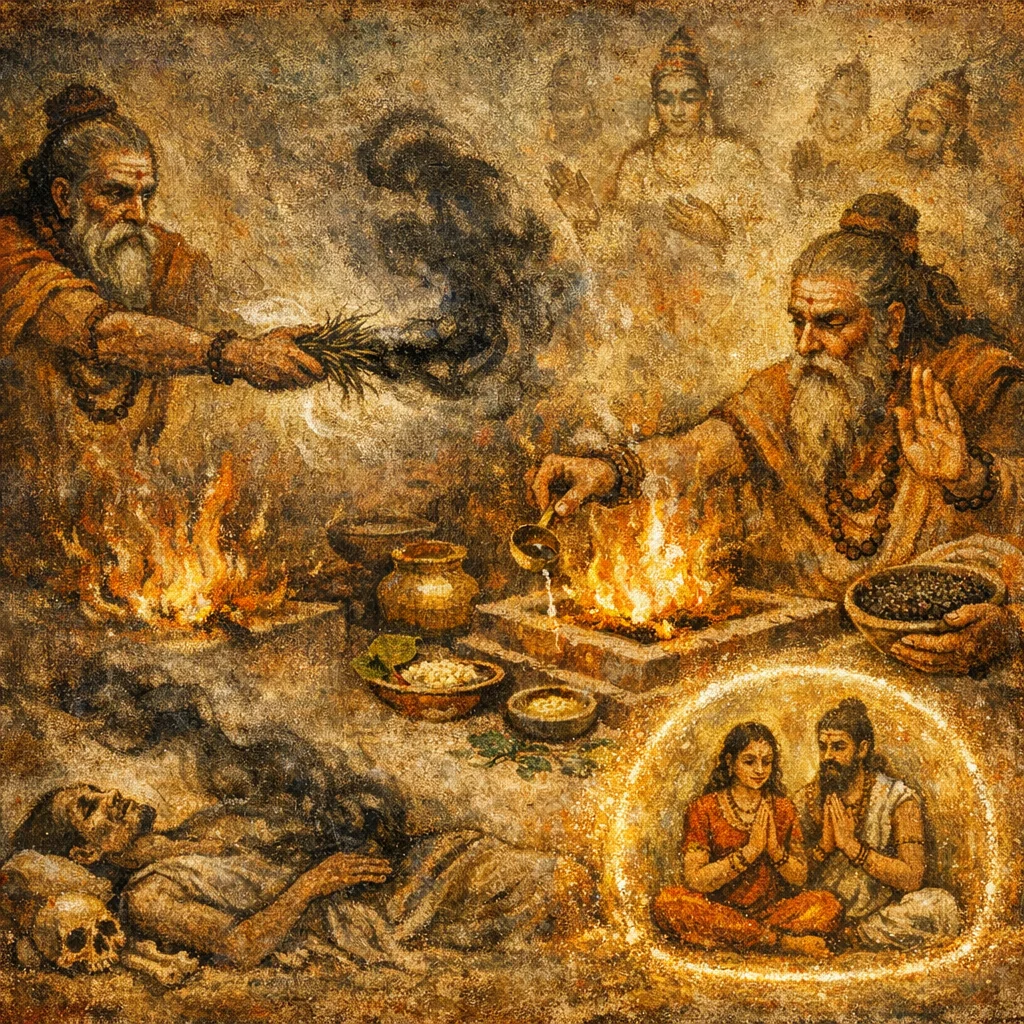
Sukta 2
Rishi: Atharvanic tradition (often transmitted under Atharvan/Angiras lineages for this kṣema–śānti material)
Devata: Agni (as purifier; Saṅkasuka as named form/function of Agni)
Chandas: Anuṣṭubh (4 pādas of 8 syllables; with Atharvanic flexibility)
Mantras
Mantra 1
(१६ ककुम्मती पराबृहती, १८ निचृत् ४० पुरस्तात् ककुम्मती), ३ आस्तारपङ्क्तिः, ६ भुरिगार्षी पङ्क्तिः, नडमा रोह न ते अत्र लोक इदं सीसं भागधेयं त एहि । यो गोषु यक्ष्मः पुरुषेषु यक्ष्मस्तेन त्वं साकमधराङ् परेहि
Climb thou upon the reed: no place is thine here. This lead is thy allotted portion—come, take it. The yákṣma that is in cattle, the yákṣma that is in men—with that, together, go thou downward and away.
Mantra 2
अघशंसदुःशंसाभ्यां करेणानुकरेण च । यक्ष्मं च सर्वं तेनेतो मृत्युं च निरजामसि
With evil-speaking and ill-imprecation, with the hand and with the counter-hand, with that from hence we drive forth all yákṣma, and Death as well.
Mantra 3
निरितो मृत्युं निरृतिं निररातिमजामसि । यो नो द्वेष्टि तमद्ध्यग्ने अक्रव्याद् यमु द्विष्मस्तमु ते प्र सुवामसि
From hence we drive away Death; we drive away Nirṛti; we drive away hostile ill. Whoso hateth us—him, O Agni, devour, thou that art no flesh-eater; and whom we in turn do hate, him verily to thee we send forth.
Mantra 4
यद्यग्निः क्रव्याद् यदि वा व्याघ्र इमं गोष्ठं प्रविवेशान्योकाः । तं माषाज्यं कृत्वा प्र हिणोमि दूरं स गच्छत्वप्सुषदोऽप्यग्नीन्
If Agni, flesh-devouring, or if a tiger, an alien-dweller, hath entered this cowshed, him—having made the bean-and-ghee—do I drive forth afar: let him depart unto the water-seated fires.
Mantra 5
यत् त्वा क्रुद्धाः प्रचक्रुर्मन्युना पुरुषे मृते। सुकल्पमग्ने तत् त्वया पुनस्त्वोद् दीपयामसि
What, in their wrath, with anger, men have wrought against thee in the matter of a dead man—this, O Agni, to right order, by thy aid, we now restore, and thee anew we kindle up.
Mantra 6
पुनस्त्वादित्या रुद्रा वसवः पुनर्ब्रह्मा वसुनीतिरग्ने । पुनस्त्वा ब्रह्मणस्पतिराधाद् दीर्घायुत्वाय शतशारदाय
Anew the Ādityas, the Rudras, and the Vasus (set) thee; anew doth Brahmā, bringing good guidance, (set) thee, O Agni. Anew hath Brahmaṇaspati established thee, for long life, for a hundred autumns.
Mantra 7
यो अग्निः क्रव्यात् प्रविवेश नो गृहमिमं पश्यन्नितरं जातवेदसम्। तं हरामि पितृयज्ञाय दूरं स घर्ममिन्धां परमे सधस्थे
The fire, corpse-devouring, that hath entered this our house, beholding the other Jātavedas—him do I carry far away for the Fathers’ sacrifice: let him kindle heat in the highest station.
Mantra 8
क्रव्यादमग्निं प्र हिणोमि दूरं यमराज्ञो गच्छतु रिप्रवाहः । इहायमितरो जातवेदा देवो देवेभ्यो हव्यं वहतु प्रजानन्
The flesh-devouring Agni forth do I drive afar: let him, the bearer-off of taint, depart unto King Yama. Here let this other Jātavedas, the God, with knowing mind convey the oblation unto the Gods.
Mantra 9
क्रव्यादमग्निमिषितो हरामि जनान् दृंहन्तं वज्रेण मृत्युम्। नि तं शास्मि गार्हपत्येन विद्वान् पितृणां लोकेऽपि भागो अस्तु
The flesh-devouring Agni, when impelled, I take away; and Death who maketh men firm-fast I smite with thunderbolt. Him I restrain, with the Gārhapatya, knowing well: in the world of the Fathers let there be his portion also.
Mantra 10
क्रव्यादमग्निं शशमानमुक्थ्यं१ हिणोमि पथिभिः पितृयाणैः । मा देवयानैः पुनरा गा अत्रैवैधि पितृषु जागृहि त्वम्
The flesh-devouring Agni, now laid to rest, hymn-worthy, I send by the Fathers’ paths. By the Gods’ paths come not thou back again: there, even there, among the Fathers be thou kindled; among the Fathers keep watch, thou.
Mantra 11
समिन्धते संकसुकं स्वस्तये शुद्धा भवन्तः शुचयः पावकाः । जहाति रिप्रमत्येन एति समिद्धो अग्निः सुपुना पुनाति
They kindle the saṅkasuka for welfare; becoming pure, the bright Pāvakas. He leaveth stain behind and passeth onward: Agni, when kindled, with good cleansing purifieth.
Mantra 12
देवो अग्निः संकसुको दिवस्पृष्ठान्यारुहत्। मुच्यमानो निरेणसोऽमोगस्मां अशस्त्याः
Agni the God, saṅkasuka, hath mounted the heavenly ridges; being loosed forth from guilt, unfailing, he delivereth us from evil blame.
Mantra 13
अस्मिन् वयं संकसुके अग्नौ रिप्राणि मृज्महे । अभूम यज्ञियाः शुद्धाः प्र ण आयूंषि तारिषत्
In this Saṅkasuka-fire, in Agni, we scour away our stains; we have become, purified, meet for sacrifice: may he bear our life-spans safely onward.
Mantra 14
संकसुको विकसुको निरृथो यश्च निस्वरः । ते ते यक्ष्मं सवेदसो दूराद् दूरमनीनशन्
Saṅkasuka, Vikasuka, Nirṛtha, and Nisvara—those, those knowing ones—have chased the yákṣma from afar to far away.
Mantra 15
यो नो अश्वेषु वीरेषु यो नो गोष्वजाविषु । क्रव्यादं निर्णुदामसि यो अग्निर्जनयोपनः
Whoso, among our horses and our men, whoso among our cows and goats-and-sheep—him, the flesh-eater, we thrust away: even Agni, the helper who draws near to our folk.
Mantra 16
अन्येभ्यस्त्वा पुरुषेभ्यो गोभ्यो अश्वेभ्यस्त्वा । निः क्रव्यादं नुदामसि यो अग्निर्जीवितयोपनः
From other men, from cattle, from horses—from them we guard thee: the flesh-eater we drive forth, even Agni who draws near with life.
Mantra 17
यस्मिन् देवा अमृजत यस्मिन् मनुष्याऽ उत। तस्मिन् घृतस्तावो मृष्ट्वा त्वमग्ने दिवं रुह
In which the Gods have cleansed them, in which men also cleanse—therein, when thou hast cleansed with the ghee-stream, O Agni, ascend unto heaven.
Mantra 18
समिद्धो अग्न आहुत स नो माभ्यपक्रमीः । अत्रैव दीदिहि द्यवि ज्योक् च सूर्यं दृशे
Kindled art thou, O Agni, and invoked with offering: from us depart not, withdraw not. Here verily blaze thou; in heaven shine long, and grant us sight of the Sun.
Mantra 19
सीसे मृड्ढ्वं नडे मृड्ढ्वमग्नौ संकसुके च यत्। अथो अव्यां रामायां शीर्षक्तिमुपबर्हणे
In lead be ye gracious; in the reed be gracious; in the fire, and in what is in the saṅkasuka. And also in the ewe’s soft wool, in the head-band, upon the pillow’s rest.
Mantra 20
सीसे मलं सादयित्वा शीर्षक्तिमुपबर्हणे । अव्यामसिक्न्यां मृष्ट्वा शुद्धा भवत यज्ञियाः
Having made the foulness settle in the lead, (and) at the pillow the head-band; having wiped with the ewe’s black wool—be ye purified, meet for sacrifice.
Mantra 21
परं मृत्यो अनु परेहि पन्थां यस्त एष इतरो देवयानात्। चक्षुष्मते शृण्वते ते ब्रवीमीहेमे वीरा बहवो भवन्तु
Far from Death, go thou forth upon thy path—the path that is for thee, this other, apart from the gods’ way. To him that hath sight and heareth I speak: here may these heroes be, and many may they become.
Mantra 22
इमे जीवा वि मृतैराववृत्रन्नभूद् भद्रा देवहुतिर्नो अद्य। प्राञ्चो अगाम नृतये हसाय सुवीरासो विदथमा वदेम
These living have turned them away from the dead: auspicious hath our oblation to the Gods become to-day. Forward have we gone—to dance, to laugh; rich in brave sons, may we address the assembly again.
Mantra 23
इमं जीवेभ्यः परिधिं दधामि मैषां नु गादपरो अर्थमेतम्। शतं जीवन्तः शरदः पुरूचीस्तिरो मृत्युं दधतां पर्वतेन
This rampart for the living I set in place: let not for these, even now, the later end—this doom—be reached. Living, may they attain a hundred autumns, many in number; may they set themselves beyond Death, as by a mountain-barrier.
Mantra 24
आ रोहतायुर्जरसं वृणाना अनुपूर्वं यतमाना यति स्थ। तान् वस्त्वष्टा सुजनिमा सजोषाः सर्वमायुर्नयतु जीवनाय
Ascend ye unto life, choosing old age; striving in due succession, as ye go, so stand. Those may Vāstu-Tvaṣṭṛ, with good generation in concord, lead on to the whole of life, for living.
Mantra 25
यथाहान्यनुपूर्वं भवन्ति यथर्तव ऋतुभिर्यन्ति साकम्। यथा न पूर्वमपरो जहात्येवा धातरायूंषि कल्पयैषाम्
As days come on in ordered sequence; as seasons with the seasons move together; as the later doth not abandon the earlier—so, O Dhātṛ, do thou dispose for these their spans of life.
Mantra 26
अश्मन्वती रीयते सं रभध्वं वीरयध्वं प्र तरता सखायः । अत्रा जहीत ये असन् दुरेवा अनमीवानुत्तरेमाभि वाजान्
Stone-strewn she flows: together lay hold; show ye your manhood; press forward, comrades, cross! Here leave behind whatever evils there have been; disease-unstricken may we come up and over, unto the prizes.
Mantra 27
उत् तिष्ठता प्र तरता सखायोऽश्मन्वती नदी स्यन्दत इयम्। अत्रा जहीत ये असन्नशिवाः शिवान्त्स्योनानुत्तरेमाभि वाजान्
Up, stand ye forth; cross onward, comrades: this rocky river here is streaming. Here leave behind what things were inauspicious; unto auspicious, safe abodes may we come up and over, unto the prizes.
Mantra 28
वैश्वदेवीं वर्चस आ रभध्वं शुद्धा भवन्तः शुचयः पावकाः । अतिक्रामन्तो दुरिता पदानि शतं हिमाः सर्ववीरा मदेम
Lay hold upon the Vaiśvadeva glory and the lustre: be ye made pure—ye pure ones, ye purifiers. Passing beyond the evil steps and perilous stations, may we rejoice a hundred winters, with all our heroes about us.
Mantra 29
उदीचीनैः पथिभिर्वायुमद्भिरतिक्रामन्तोऽवरान् परेभिः । त्रिः सप्त कृत्व ऋषयः परेता मृत्युं प्रत्यौहन् पदयोपनेन
By northward paths, by ways possessed of wind, overstepping the lower by the higher, the Seers, having gone beyond, after doing it thrice seven times, smote back Death by the rite of foot-leading.
Mantra 30
मृत्योः पदं योपयन्त एत द्राघीय आयुः प्रतरं दधानाः । आसीना मृत्युं नुदता सधस्थेऽथ जीवासो विदथमा वदेम
Hiding away this footprint of Death, establishing a life more long and further on—sitting in the common seat, thrust ye Death away; then may we, the living, speak forth in the assembly.
Mantra 31
इमा नारीरविधवाः सुपत्नीराञ्जनेन सर्पिषा सं स्पृशन्ताम्। अनश्रवो अनमीवाः सुरत्ना आ रोहन्तु जनयो योनिमग्रे
Let these women—unwidowed, good wives—touch themselves with collyrium and with ghee. Without ill report, without disease, rich in good treasure, let the wives ascend unto the womb, in the first place.
Mantra 32
व्याकरोमि हविषाहमेतौ तौ ब्रह्मणा व्य१हं कल्पयामि । स्वधां पितृभ्यो अजरां कृणोमि दीर्घेणायुषा समिमान्त्सृजामि
With oblation I set these two in order; with sacred brahman I, in due wise, fashion them. For the Fathers I make the svadhā imperishable; with length of life I send these here forth in completeness.
Mantra 33
यो नो अग्निः पितरो हृत्स्व१न्तराविवेशामृतो मर्त्येषु । मय्यहं तं परि गृह्णामि देवं मा सो अस्मान् द्विक्षत मा वयं तम्
That Agni of ours, O Fathers, who, immortal, hath entered within the hearts of mortals,—him, the God, I compass and take to me: let him not hate us, nor we be hostile unto him.
Mantra 34
अपावृत्य गार्हपत्यात् क्रव्यादा प्रेत दक्षिणा। प्रियं पितृभ्य आत्मने ब्रह्मभ्यः कृणुता प्रियम्
Having turned away from the Household Fire the flesh-devouring power, go forth to the right: make ye what is dear for the Fathers, dear for oneself, dear for the Brahmans.
Mantra 35
द्विभागधनमादाय प्र क्षिणात्यवर्त्या । अग्निः पुत्रस्य ज्येष्ठस्य यः क्रव्यादनिराहितः
Taking the twofold portion of wealth, he wasteth it utterly by returning again:—that Agni, the flesh-devourer, not duly established, (preyeth) upon the eldest son.
Mantra 36
यत् कृषते यद् वनुते यच्च वस्नेन विन्दते । सर्वं मर्त्यस्य तन्नास्ति क्रव्याच्चेदनिराहितः
What he gaineth by tillage, what he winneth, and what he findeth by purchase,—all that of a mortal is not (secure), if the flesh-devourer be not duly established.
Mantra 37
अयज्ञियो हतवर्चा भवति नैनेन हविरत्तवे । छिनत्ति कृष्या गोर्धनाद् यं क्रव्यादनुवर्तते
Unfit for sacrifice, with splendour smitten down, he becometh; by him the oblation is not for eating: the flesh-devourer, following whom, cutteth him off from tillage and from cattle-wealth.
Mantra 38
मुहुर्गृध्यैः प्र वदत्यार्तिं मर्त्यो नीत्य । क्रव्याद् यानग्निरन्तिकादनुविद्वान् वितावति
Again and again the mortal, led as it were away, cries forth his anguish amid the ravening ones; but Agni, tracking them from near at hand, driveth off those flesh-devourers.
Mantra 39
ग्राह्या गृहाः सं सृज्यन्ते स्त्रिया यन्म्रियते पतिः । ब्रह्मैव विद्वानेष्यो३ यः क्रव्यादं निरादधत्
Seizable, disordered, are the houses when the woman’s husband dieth; but the knowing Brahman—he alone is to be sought—who hath set the flesh-devourer forth and away.
Mantra 40
यद् रिप्रं शमलं चकृम यच्च दुष्कृतम्। आपो मा तस्माच्छुम्भन्त्वग्नेः संकसुकाच्च यत्
What stain and what foul taint we have wrought, and whatsoever ill deed—may the Waters cleanse me from that, and from what pertaineth to Agni, and from whatever sankasuka there is.
Mantra 41
ता अधरादुदीचीराववृत्रन् प्रजानतीः पथिभिर्देवयानैः । पर्वतस्य वृषभस्याधि पृष्ठे नवाश्चरन्ति सरितः पुराणीः
Those, knowing, have rolled forth from below, northward, by paths that are god-going; upon the back of the bull-mountain the ancient rivers move, new-born ever anew.
Mantra 42
अग्ने अक्रव्यान्निः क्रव्यादं नुदा देवयजनं वह
O Agni, thou that art no flesh-eater, thrust forth the flesh-devourer; bear onward the worship of the Gods.
Mantra 43
इमं क्रव्यादा विवेशायं क्रव्यादमन्वगात्। व्याग्रौ कृत्वा नानानं तं हरामि शिवापरम्
This flesh-devourer hath entered in; this flesh-devourer have I followed. Assuming tiger-fury, I bear away that manifold one, unto the auspicious farther side.
Mantra 44
अन्तर्धिर्देवानां परिधिर्मनुष्याऽणामग्निर्गार्हपत्य उभयानन्तरा श्रितः
A screen for Gods, a fence for men is Agni, the House-Fire: between the twain he standeth, set as the middle stay.
Mantra 45
जीवानामायुः प्र तिर त्वमग्ने पितॄणां लोकमपि गच्छन्तु ये मृताः । सुगार्हपत्यो वितपन्नरातिमुषामुषां श्रेयसीं धेह्यस्मै
Bear thou the life of living men clean through, O Agni; and let the dead depart unto the Fathers’ world. Thou good House-Fire, scorching off malignity, bestow on him, from dawn to dawn, a better, higher weal.
Mantra 46
सर्वानग्ने सहमानः सपत्नानैषामूर्जं रयिमस्मासु धेहि
O Agni, overpowering all our rivals, set thou their strength, their substance, and their wealth within ourselves.
Mantra 47
इममिन्द्रं वह्निं पप्रिमन्वारभध्वं स वो निर्वक्षद् दुरितादवद्यात्। तेनाप हत शरुमापतन्तं तेन रुद्रस्य परि पातास्ताम्
Lay hold on this Indra, bearer and protector; he shall lead you forth from evil and from blame. With him smite off the arrow as it flieth toward you; with him, from Rudra’s power, may ye be guarded round about—so be it.
Mantra 48
अनड्वाहं प्लवमन्वारभध्वं स वो निर्वक्षद् दुरितादवद्यात्। आ रोहत सवितुर्नावमेतां षड्भिरुर्वीभिरमतिं तरेम
Lay hold upon the draught-ox, the float: may it bear you forth from trouble and from blame. Mount ye this boat of Savitar; with six broad supports may we pass beyond unwisdom.
Mantra 49
अहोरात्रे अन्वेषि बिभ्रत् क्षेम्यस्तिष्ठन् प्रतरणः सुवीरः । अनातुरान्त्सुमनसस्तल्प बिभ्रज्ज्योगेव नः पुरुषगन्धिरेधि
Day and night thou seekest, bearing security; standing fast, a furtherer across, rich in goodly heroes. Bearing for us a couch for the untroubled, the kindly-minded—like a yoking—thrive thou, with the scent of men about thee.
Mantra 50
ते देवेभ्य आ वृश्चन्ते पापं जीवन्ति सर्वदा। क्रव्याद् यानग्निरन्तिकादश्व इवानुवपते नडम्
For the Gods they cut away their evil; they live for evermore. The flesh-eaters whom Agni, from close at hand, smites down—like a horse that tramples reeds.
Mantra 51
येऽश्रद्धा धनकाम्या क्रव्यादा समासते । ते वा अन्येषां कुम्भीं पर्यादधति सर्वदा
They who, faithless, wealth-desiring, flesh-eaters, sit in conclave—these verily set a pot about other men, at all times.
Mantra 52
प्रेव पिपतिषति मनसा मुहुरा वर्तते पुनः । क्रव्याद् यानग्निरन्तिकादनुविद्वान् वितावति
As though he would dart forward, with his mind he flutters; again and again he turns back once more. The flesh-eaters whom Agni, from close at hand, tracking them out, drives asunder and scatters.
Mantra 53
अविः कृष्णा भागधेयं पशूनां सीसं क्रव्यादपि चन्द्रं त आहुः । माषाः पिष्टा भागधेयं ते हव्यमरण्यान्या गह्वरं सचस्व
A black ewe is the rightful portion among the beasts; and lead, men say, is thy portion also, O flesh-devouring one, yea even the shining share. Pounded beans are thy allotted due, an oblation meet for offering: O Araṇyānī, cleave thou to the deep woodland hollow.
Mantra 54
इषीकां जरतीमिष्ट्वा तिल्पिञ्जं दण्डनं नडम्। तमिन्द्र इध्मं कृत्वा यमस्याग्निं निरादधौ
A withered reed he worshipped, and tilpiñja-grass, and reed-stalk as a staff: that Indra, making it kindling-fuel, set forth as Yama’s fire and duly laid it down.
Mantra 55
प्रत्यञ्चमर्कं प्रत्यर्पयित्वा प्रविद्वान् पन्थां वि ह्याऽविवेश । परामीषामसून् दिदेश दीर्घेणायुषा समिमान्त्सृजामि
Having turned back the counter-facing sun-ray, the wise man entered forth upon the path indeed. Away he directed the lives of those adversaries: with length of days I wholly set these here at liberty—yea, I send them forth endowed with life.
Frequently Asked Questions
It purifies the sacrificer and ritual space through Agni (Saṅkasuka), removes defilement, and protects life and ritual order by keeping death-linked forces from returning.
It ritually directs kravyād (funerary, dangerous) Agni along the Fathers’ path (pitṛyāna) and forbids its return via the Gods’ path (devayāna), so funerary pollution does not re-enter living rites.
Yes. Alongside purification, it is bhaiṣajya in effect: it repels hostile influences and explicitly asks for protection and extension of lifespan (āyuṣ).