Adhyaya 21
वैष्णवीमायावितानम्, उग्रसेनाभिषेकः, सुधर्मासभा, सांदीपनिगमनम्, पाञ्चजन्य-प्राप्तिः, गुरुदक्षिणा
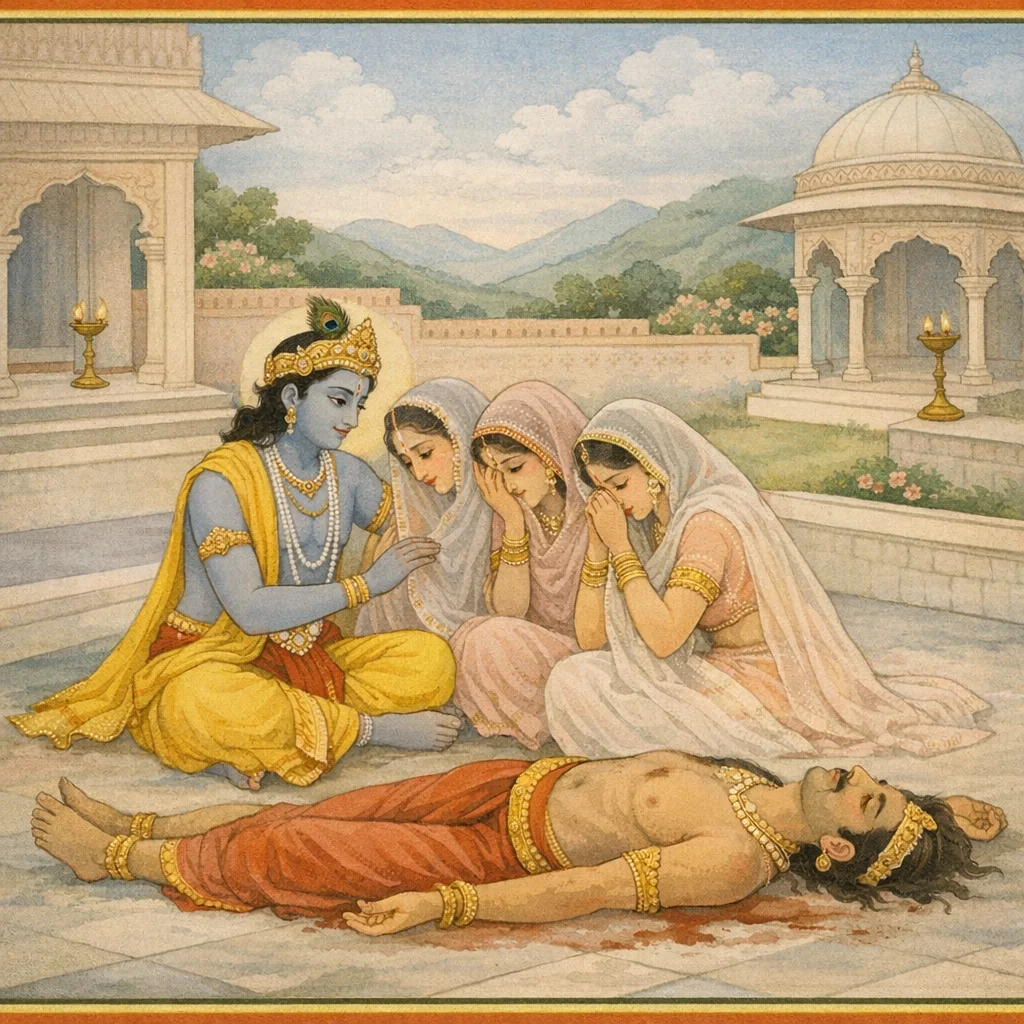
Parasara relates: Devaki and Vasudeva, witnessing the Lord’s deeds, awaken to true knowledge; then Hari again spreads Vaishnavi Maya so the course of lila in the Yadu line remains unbroken. Krishna lovingly consoles his parents and speaks of their long separation caused by fear of Kamsa; Parasara then teaches Maitreya the dharma of honoring and worshiping one’s mother and father. Kamsa’s wives and mothers grieve, and Hari, tear-eyed, comforts them. Madhusudana frees Ugrasena from bondage and anoints him king; Ugrasena performs the rites for the departed and takes the throne. Krishna commands Vayu to bring from Indra the Sudharma assembly-hall for the Yadus; the divine hall arrives, and the Yadavas enjoy it under Govinda’s protection. Though all-knowing, Krishna and Balarama uphold the teacher–disciple order by going to Avanti to Sandipani and mastering, in sixty-four days and nights, Dhanurveda with its secrets. As guru-dakshina the teacher asks for his dead son’s return; Krishna slays Panchajana, gains the Panchajanya conch, goes to Yama’s realm, rescues the boy and restores him to his father, and then returns to Mathura ruled by Ugrasena.
Shlokas
Verse 1
तौ समुत्पन्नविज्ञानौ भगवत्कर्मदर्शनात् देवकीवसुदेवौ तु दृष्ट्वा मायां पुनर् हरिः मोहाय यदुचक्रस्य विततान स वैष्णवीम्
When Devakī and Vasudeva, by beholding the Lord’s wondrous deeds, awakened to true understanding, Hari—knowing that the veil of māyā had been seen through—once more spread forth His own Vaiṣṇavī māyā, so that the Yadu clan might remain in divine bewilderment.
Verse 2
उवाच चाम्ब भोस् तात चिराद् उत्कण्ठितेन मे भवन्तौ कंसभीतेन दृष्टौ संकर्षणेन च
Then (Kṛṣṇa) spoke: “O mother, O dear father—because of fear of Kaṃsa I have long endured anxious longing; today at last I have seen you both, and so has Saṅkarṣaṇa.”
Verse 3
कुर्वतां याति यः कालो मातापित्रोर् अपूजनम् तत् खण्डम् आयुषो व्यर्थं साधूनाम् उपजायते
For those who let their days pass without honoring mother and father, the time that slips away thus becomes, to the wise, a wasted fragment cut from the span of life.
Verse 4
गुरुदेवद्विजातीनां मातापित्रोश् च पूजनम् कुर्वतां सफलं जन्म देहिनां तात जायते
Dear one, for embodied beings life becomes truly fulfilled when they devote themselves to honoring the guru, the gods, the twice-born, and also to reverently worshiping their mother and father.
Verse 5
तत् क्षन्तव्यम् इदं सर्वम् अतिक्रमकृतं पितः कंसप्रतापवीर्याभ्याम् आवयोः परवश्ययोः
Father, forgive all this—whatever transgression has been committed. Overpowered by Kaṃsa’s might and ruthless valor, we were made helpless, compelled to act under another’s control.
Verse 6
इत्य् उक्त्वाथ प्रणम्योभौ यदुवृद्धान् अनुक्रमात् यथावद् अभिपूज्याथ चक्रतुः पौरमाननम्
Thus having spoken, the two bowed in due order to the venerable elders of the Yadu line; and, having honored them properly according to custom, they then offered reverent homage to the assembled citizens.
Verse 7
कंसपत्न्यस् ततः कंसं परिवार्य हतं भुवि विलेपुर् मातरश् चास्य दुःखशोकपरिप्लुताः
Then Kamsa’s wives gathered around him as he lay slain upon the earth, and they wept; and his mothers too, overwhelmed and flooded by grief and sorrow, lamented bitterly.
Verse 8
बहुप्रकारम् अत्यर्थं पश्चात्तापातुरो हरिः ताः समाश्वासयाम् आस स्वयम् अस्राविलेक्षणः
Hari, stricken with intense remorse in many ways, personally soothed them again and again—his own eyes streaming with tears.
Verse 9
उग्रसेनं ततो बन्धान् मुमोच मधुसूदनः अभ्यषिञ्चत् तथैवैनं निजराज्ये हतात्मजम्
Then Madhusūdana released Ugrasena from his bonds, and in that very moment consecrated him again in his own kingdom, though he was stricken with grief at the loss of his son.
Verse 10
राज्ये ऽभिषिक्तः कृष्णेन यदुसिंहः सुतस्य सः चकार प्रेतकार्याणि ये चान्ये तत्र घातिताः
Consecrated to kingship by Kṛṣṇa, that lion among the Yadus performed the funerary rites for his son—and for all the others who had been slain there.
Verse 11
कृतौर्ध्वदैहिकं चैनं सिंहासनगतं हरिः उवाचाज्ञापय विभो यत् कार्यम् अविशङ्कितः
When the post-funeral rites were duly completed, Hari, seated upon the throne, said to him: “O mighty one, command without hesitation whatever must be done.”
Verse 12
ययातिशापाद् वंशो ऽयम् अराज्यार्हो ऽपि साम्प्रतम् मयि भृत्ये स्थिते देवान् आज्ञापयतु किं नृपैः
“By Yayāti’s curse, this lineage—though truly fit to rule—has for the present been made unworthy of kingship. Yet while I stand here as your servant, what need have you of earthly kings? Command the very gods.”
Verse 13
इत्य् उक्त्वा सो ऽस्मरद् वायुम् आजगाम च तत्क्षणात् उवाच चैनं भगवान् केशवः कार्यमानुषः
Having spoken thus, he called Vāyu to mind, and in that very instant Vāyu arrived. Then Bhagavān Keśava, who had assumed human form for the sake of divine purpose, addressed him.
Verse 14
गच्छेन्द्रं ब्रूहि वायो त्वम् अलं गर्वेण वासव दीयताम् उग्रसेनाय सुधर्मा भवता सभा
“Go, O Vāyu, and tell Indra: enough of this pride, O Vāsava! Let the Sudharmā—your assembly hall—be given to Ugrasena.”
Verse 15
कृष्णो ब्रवीति राजार्हम् एतद् रत्नम् अनुत्तमम् सुधर्माख्या सभा युक्तम् अस्यां यदुभिर् आसितुम्
Krishna spoke: “This is an unsurpassed jewel, truly fit for kings—this assembly hall named Sudharmā—made ready so that the Yadus may sit and convene within it.”
Verse 16
इत्य् उक्तः पवनो गत्वा सर्वम् आह शचीपतिम् ददौ सो ऽपि सुधर्माख्यां सभां वायोः पुरंदरः
Thus instructed, Vāyu departed and reported everything in full to Indra, the lord of Śacī. In return, Purandara bestowed upon Vāyu the famed celestial assembly-hall called Sudharmā.
Verse 17
वायुना चाहृतां दिव्यां सभां ते यदुपुंगवाः बुभुजुः सर्वरत्नाढ्यां गोविन्दभुजसंश्रयात्
That celestial assembly-hall brought by Vāyu—abounding in every jewel—was enjoyed by the foremost of the Yadus, for it rested in the shelter of Govinda’s mighty arm; under Śrī Kṛṣṇa’s sovereign protection, splendor became their natural portion.
Verse 18
विदिताखिलविज्ञानौ सर्वज्ञानमयाव् अपि शिष्याचार्यक्रमं वीरौ ख्यापयन्तौ यदूत्तमौ
Though they had mastered every branch of knowledge and were as embodiments of all learning, those two heroic scions—foremost among the Yadus—still made known to the world the sacred order of disciple and teacher, honoring the proper succession of instruction.
Verse 19
ततः सान्दीपनिं काश्यम् अवन्तीपुरवासिनम् अस्त्रार्थं जग्मतुर् वीरौ बलदेवजनार्दनौ
Thereafter, the two heroic brothers—Baladeva and Janārdana—went to Sāndīpani of the Kāśyapa lineage, who dwelt in the city of Avantī, to master the knowledge of weapons and sacred martial disciplines.
Verse 20
तस्य शिष्यत्वम् अभ्येत्य गुरुवृत्तिपरौ हि तौ दर्शयां चक्रतुर् वीराव् आचारम् अखिले जने
Having accepted discipleship under him, those two heroes—ever devoted to the duties owed to a teacher—made the right code of conduct visible to all people by their own example.
Verse 21
सरहस्यं धनुर्वेदं ससंग्रहम् अधीयताम् अहोरात्रैश् चतुःषष्ट्या तद् अद्भुतम् अभूद् द्विज
O brāhmaṇa, he studied the Dhanurveda—the sacred science of archery—together with its compendium and guarded secrets; and in merely sixty-four days and nights, that wondrous mastery was attained.
Verse 22
सांदीपनिर् असंभाव्यं तयोः कर्मातिमानुषम् विचिन्त्य तौ तदा मेने प्राप्तौ चन्द्रदिवाकरौ
Sandīpani, reflecting on the unimaginable, superhuman deeds of those two, concluded that the Moon and the Sun themselves had come to him.
Verse 23
अस्त्रग्रामम् अशेषं च प्रोक्तमात्रम् अवाप्य तौ ऊचतुर् व्रियतां या ते दातव्या गुरुदक्षिणा
Having received in full the entire compendium of sacred weapons exactly as taught, the two said: “Choose what you wish; we shall offer the guru-dakṣiṇā that is due to you.”
Verse 24
सो ऽप्य् अतीन्द्रियम् आलोक्य तयोः कर्म महामतिः अयाचत मृतं पुत्रं प्रभासे लवणार्णवे
Beholding that suprasensory marvel and understanding the power of their deed, the great-souled one at Prabhāsa, on the shore of the salt ocean, implored them for the return of his son who had died.
Verse 25
गृहीतास्त्रौ ततस् तौ तु सार्घपात्रो महोदधिः उवाच न मया पुत्रो हृतः सांदीपनेर् इति
Then the two, taking up their divine weapons, approached the mighty Ocean, bearer of the conch and discus. And the great sea spoke: “It was not I who took away Sandīpani’s son.”
Verse 26
दैत्यः पञ्चजनो नाम शङ्खरूपः स बालकम् जग्राह सो ऽस्ति सलिले ममैवासुरसूदन
A Daitya named Pañcajana, who had taken the form of a conch, has seized the child. He is there within the waters, O slayer of the Asuras, and the boy is truly mine.
Verse 27
इत्य् उक्तो ऽन्तर् जलं गत्वा हत्वा पञ्चजनं च तम् कृष्णो जग्राह तस्यास्थिप्रभवं शङ्खम् उत्तमम्
Thus addressed, Kṛṣṇa plunged into the depths of the waters; and having slain Pañcajana, he took up the excellent conch born from that being’s very bones—the famed Pāñcajanya.
Verse 28
यस्य नादेन दैत्यानां बलहानिर् अजायत देवानां ववृधे तेजो यात्य् अधर्मश् च संक्षयम्
By its very sound, the Daityas’ strength was diminished; the Devas’ radiance increased; and unrighteousness itself moved toward its dissolution.
Verse 29
तं पाञ्चजन्यम् आपूर्य गत्वा यमपुरीं हरिः बलदेवश् च बलवाञ् जित्वा वैवस्वतं यमम्
Filling the conch Pāñcajanya with a resounding blast, Hari set forth to the city of Yama; and mighty Balarāma too, having overcome Vaivasvata Yama, pressed onward.
Verse 30
तं बालं यातनासंस्थं यथापूर्वशरीरिणम् पित्रे प्रदत्तवान् कृष्णो बलश् च बलिनां वरः
Then Kṛṣṇa—together with Bala, foremost among the mighty—restored that child who had been held in torment to his former bodily state, and delivered him back to his father.
Verse 31
मथुरां च पुनः प्राप्ताव् उग्रसेनेन पालिताम् प्रहृष्टपुरुषस्त्रीकाव् उभौ रामजनार्दनौ
Then Rāma and Janārdana returned once more to Mathurā, now ruled by Ugrasena; and as they entered, the city’s men and women rejoiced in glad devotion.
Frequently Asked Questions
To preserve the avatāra-līlā’s social and relational order within the Yadu clan—so that divine play can proceed without collapsing into constant transcendental disclosure.
It models ācāra: despite omniscience, Krishna and Balarama enact śiṣya-bhāva, honoring guru-dharma and offering gurudakṣiṇā—teaching that dharma and paramparā are upheld by the Lord Himself.