Adhyaya 17
नग्न-परिभाषा तथा देव-स्तोत्रपूर्वक मायामोह-उत्पत्ति (Defining ‘Nagna’ and the Devas’ Hymn Leading to Māyāmoha)
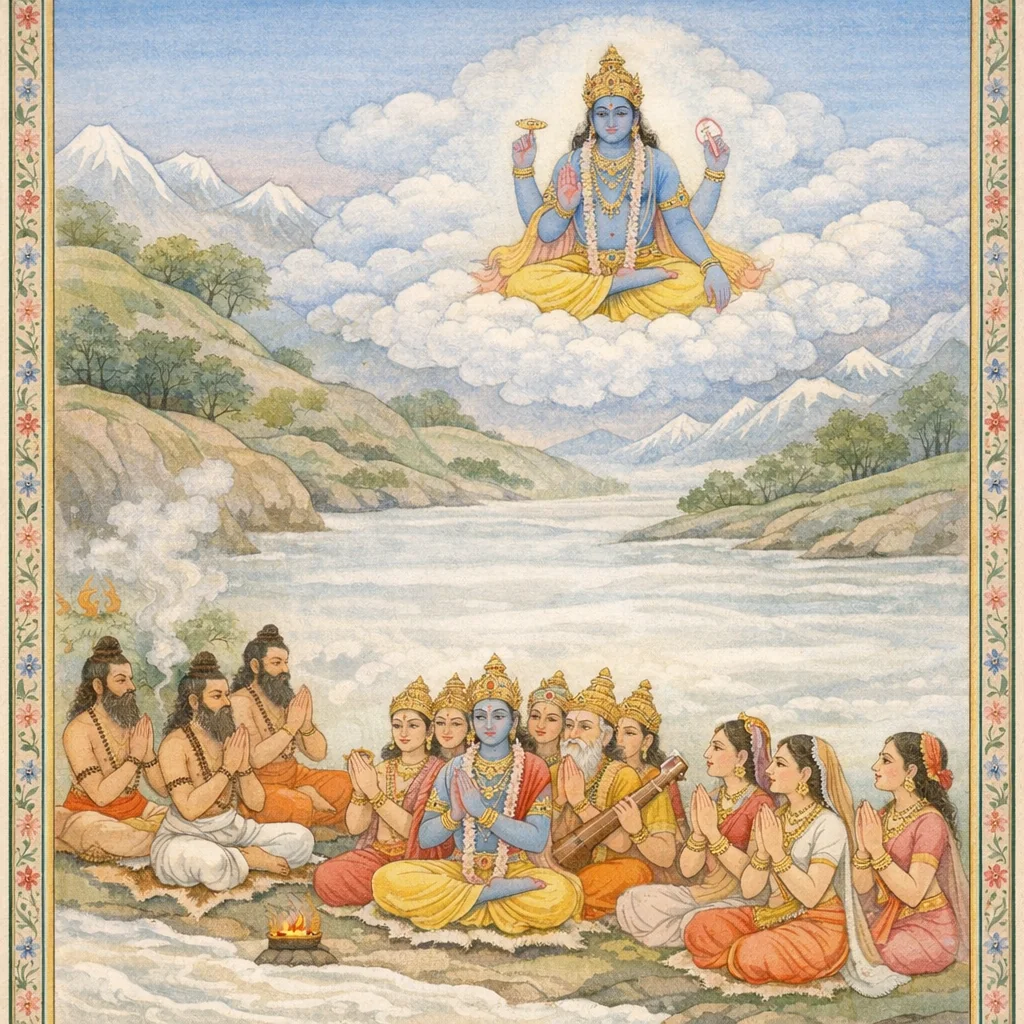
Parāśara concludes the sadācāra teaching attributed to Aurva for King Sagara and warns Maitreya that violating right conduct never yields true auspiciousness. Maitreya asks who is called ‘nagna’ (naked) and by what conduct. Parāśara replies that the true covering of the twice-born is the Vedic triad (Ṛg–Yajus–Sāman); abandoning it is real nakedness and sin. He then turns to an older transmission (Vasiṣṭha to Bhīṣma) and recounts a Deva–Asura war: the defeated Devas perform austerities on the northern shore of the Milk Ocean and sing a stotra to Viṣṇu, praising Him as the elements, inner faculties, deities, time, dissolution, and the transcendent cause beyond all qualifiers—the cause of causes. Pleased, Viṣṇu appears and, at their request, emanates Māyāmoha to delude the Daityas away from the Vedic path, making them vulnerable so cosmic order is restored.
Shlokas
Verse 1
इत्य् आह भगवान् और्वः सगराय महात्मने सदाचारान् पुरा सम्यङ् मैत्रेय परिपृच्छते
Thus spoke the venerable sage Aurva to the great-souled King Sagara, setting forth in full and proper measure the ancient disciplines of righteous conduct, when, O Maitreya, he was duly questioned.
Verse 2
मयाप्य् एतद् अशेषेण कथितं भवतो द्विज समुल्लङ्घ्य सदाचारं कश्चिन् नाप्नोति शोभनम्
Thus have I explained this to you completely, O twice-born. For one who oversteps the bounds of sadācāra, no true excellence—no genuine auspiciousness or splendor—can ever be attained.
Verse 3
षण्डापविद्धप्रमुखा विदिता भगवन् मया उदक्याद्याश् च ये सर्वे नग्नम् इच्छामि वेदितुम्
O venerable one, I have understood those headed by the ṣaṇḍa and the āpaviddha, and also all such as the udakyā and the rest. Now I wish to know about the ‘nagna’.
Verse 4
को नग्नः किंसमाचारो नग्नसंज्ञां नरो लभेत् नग्नस्वरूपम् इच्छामि यथावत् गदितं त्वया
Who, indeed, is to be called ‘naked’? What manner of conduct marks such a one? By what does a man obtain the designation ‘naked’? I wish to know, exactly as it is, the true nature of this ‘nakedness’—declare it fully.
Verse 5
ऋग्यजुःसामसंज्ञेयं त्रयी वर्णावृतिर् द्विज एताम् उज्झति यो मोहात् स नग्नः पातकी स्मृतः
O twice-born, the threefold Veda—known as Ṛg, Yajus, and Sāman—is the covering of one’s sacred station. Whoever, through delusion, casts away that Vedic mantle is regarded as ‘naked’ and remembered as a sinner.
Verse 6
त्रयी समस्तवर्णानां द्विज संवरणं यतः नग्नो भवत्य् उज्झितायाम् अतस् तस्याम् असंशयम्
For among all the social orders, the covering of the twice-born is the triple Veda; when it is cast aside, that dvija becomes, without doubt, ‘naked’.
Verse 7
इदं च श्रूयताम् अन्यद् भीष्माय सुमहात्मने कथयाम् आस धर्मज्ञो वसिष्ठो ऽस्मत्पितामहः
And now, hear yet another account: to the great-souled Bhīṣma, our grandsire Vasiṣṭha—knower of dharma—once related this very teaching.
Verse 8
मयापि तस्य गदतः श्रुतम् एतन् महात्मनः नग्नसंबन्धि मैत्रेय यत् पृष्टो ऽहम् इह त्वया
O Maitreya—kinsman of the sage Nagnā—this very teaching that you ask me about here, I too once heard directly from that great-souled one as he spoke.
Verse 9
देवासुरम् अभूद् युद्धं दिव्यम् अब्दं पुरा द्विज तस्मिन् पराजिता देवा दैत्यैर् ह्रादपुरोगमैः
O twice-born one, in ancient times there arose a war between the Devas and the Asuras that endured for a full divine year. In that conflict the Devas were defeated—overpowered by the Daityas, led foremost by Hrāda.
Verse 10
क्षीरोदस्योत्तरं कूलं गत्वातप्यन्त वै तपः विष्णोर् आराधनार्थाय जगुश् चेमं स्तवं तदा
Having gone to the northern shore of the Ocean of Milk, they undertook severe austerities indeed; and for the sake of worshipping Lord Viṣṇu, they then chanted this very hymn of praise.
Verse 11
आराधनाय लोकानां विष्णोर् ईशस्य यां गिरम् वक्ष्यामो भगवान् आद्यस् तया विष्णुः प्रसीदतु
For the worship of all the worlds, we shall now utter the sacred speech that belongs to Vishnu—the Lord. By that hymn, may Vishnu, the Primordial Blessed One, be gracious and well-pleased.
Verse 12
यतो भूतान्य् अशेषाणि प्रसूतानि महात्मनः यस्मिंश् च लयम् एष्यन्ति कस् तं संस्तोतुम् ईश्वरः
From that Great Self all beings, without remainder, are brought forth; and into Him again they pass at dissolution. Who, then, has the power to praise Him as He truly is?
Verse 13
तथाप्य् अरातिविध्वंसध्वस्तवीर्या भवार्थिनः त्वां स्तोष्यामस् तवोक्तीनां याथार्थ्यं नैव गोचरे
Yet even so—though our strength has been shattered by the crushing force of hostile powers—we, who seek release from worldly becoming, will praise You; for the true reality of what is spoken of You does not fully lie within the reach of speech.
Verse 14
त्वम् उर्वी सलिलं वह्निर् वायुर् आकाशम् एव च समस्तम् अन्तःकरणं प्रधानं तत्परः पुमान्
You are the earth, the waters, the fire, the wind, and the very ether. You are the whole inner instrument of awareness, the Pradhāna, and the Supreme Person who transcends it and yet pervades all that proceeds from it.
Verse 15
एकं तवैतद् भूतात्मन् मूर्तामूर्तमयं वपुः आब्रह्मस्तम्बपर्यन्तं स्थानकालविभेदवत्
O Indwelling Soul of all beings, this is Your single form—at once manifest and unmanifest—extending from Brahmā down to a blade of grass, appearing differentiated only through distinctions of place and time.
Verse 16
तत्रेश तव यत् पूर्वं त्वन्नाभिकमलोद्भवम् रूपं सर्गोपकाराय तस्मै ब्रह्मात्मने नमः
O Lord, that primordial form of Yours—Brahmā, born from the lotus of Your navel—manifested for the purpose of creation; to that Brahmā, who is Your own self in the work of sarga, I bow.
Verse 17
शक्रार्करुद्रवस्वश्विमरुत्सोमादिभेदवत् वयम् एवं स्वरूपं ते तस्मै देवात्मने नमः
As Your being appears differentiated into Indra, the Sun, Rudra, the Vasus, the Aśvins, the Maruts, Soma, and the other gods, so do we recognize this as Your very form. Therefore, to that One whose essence is divinity itself—the indwelling Soul of the gods—we bow in reverence.
Verse 18
दम्भप्रायम् असंबोधि तितिक्षादमवर्जितम् यद् रूपं तव गोविन्द तस्मै दैत्यात्मने नमः
O Govinda, that form of Yours—steeped in arrogance, devoid of true understanding, and bereft of forbearance and self-restraint—to that guise of daitya-nature I bow.
Verse 19
नातिज्ञानवहा यस्मिन् नाड्यः स्तिमिततेजसि शब्दादिलोभि यत् तस्मै तुभ्यं यक्षात्मने नमः
Salutations to You in Your Yakṣa-nature: wherein the nāḍīs bear no excessive cognition, the inner radiance stands stilled, and the senses—greedy for sound and the rest—are restrained and turned back by Your power.
Verse 20
क्रौर्यमायामयं घोरं यच् च रूपं तवासितम् निशाचरात्मने तस्मै नमस् ते पुरुषोत्तम
O Puruṣottama, that dark form of Yours—terrifying and dreadful, woven of cruelty and māyā—unto that guise of niśācara-nature I bow.
Verse 21
स्वर्गस्थधर्मिसद्धर्मफलोपकरणं तव धर्माख्यं च तथा रूपं नमस् तस्मै जनार्दन
O Janārdana, even the means by which the righteous in heaven attain the fruits of true Dharma is Your own form, known as Dharma itself. To that form I bow.
Verse 22
हर्षप्रायम् असंसर्गि गतिमद् गमनादिषु सिद्धात्मंस् तव यद् रूपं तस्मै सिद्धात्मने नमः
Salutations to Your form as Siddhātman: ever inclined toward bliss, untouched by association, and yet possessed of movement in going and other acts; to that accomplished, self-established Reality I bow.
Verse 23
अतितिक्षाधनं क्रूरम् उपभोगसहं हरे द्विजिह्वं तव यद् रूपं तस्मै सर्पात्मने नमः
O Hari, salutations to Your serpent-natured form—of extreme endurance, fierce in power, able to bear and partake of enjoyments, and marked with a double tongue.
Verse 24
अवबोधि च यच् छान्तम् अदोषम् अपकल्मषम् ऋषिरूपात्मने तस्मै विष्णो रूपाय ते नमः
Salutations to that form of Vishnu whose very nature is the sage—awakening-awareness itself: serene, flawless, and untouched by impurity.
Verse 25
भक्षयत्य् अथ कल्पान्ते भूतानि यद् अवारितम् त्वद्रूपं पुण्डरीकाक्ष तस्मै कालात्मने नमः
O Lotus-eyed Lord, at the end of a kalpa Your own unimpeded form consumes all beings; salutations to You as Time itself.
Verse 26
संभक्ष्य सर्वभूतानि देवादीन्य् अविशेषतः नृत्यत्य् अन्ते च यद् रूपं तस्मै रुद्रात्मने नमः
Salutations to Your Rudra-natured form which, at the end of time, consumes all beings without distinction—even the gods—and then dances in the final dissolution.
Verse 27
प्रवृत्त्या रजसो यच् च कर्मणां कारणात्मकम् जनार्दन नमस् तस्मै त्वद्रूपाय नरात्मने
Salutations to You, Janārdana, in Your form as the human inner Self: through the outward-driving force of rajas You become the causal essence of actions and set embodied beings into activity.
Verse 28
अष्टाविंशद्वधोपेतं यद् रूपं तामसं तव उन्मार्गगामि सर्वात्मंस् तस्मै पश्वात्मने नमः
O All-Indwelling Self, salutations to that Tamas-born form of Yours, endowed with the twenty-eight powers of destruction, moving upon the trackless way; to that Lord who abides as the very soul even in beasts, I bow.
Verse 29
यज्ञाङ्गभूतं यद् रूपं जगतः सिद्धिसाधनम् वृक्षादिभेदैर् यद् भेदि तस्मै मुख्यात्मने नमः
Salutations to the Primal, Supreme Self—whose very form becomes a limb of yajña, the means by which the world attains its ordered fulfillment; and who, though appearing divided through distinctions such as trees and other forms, remains the one essential Reality within all.
Verse 30
तिर्यङ्मनुष्यदेवादिव्योमशब्दादिकं च यत् रूपं तवादेः सर्वस्य तस्मै सर्वात्मने नमः
Salutations to You, the primordial source of all, whose manifestation becomes everything—beasts, humans, gods, and even the sky, sound, and all other elements and principles; to that All-Self I bow.
Verse 31
प्रधानबुद्ध्यादिमयाद् अशेषाद् यद् अन्यद् अस्मात् परमं परात्मन् रूपं तवाद्यं न यद् अन्यतुल्यं तस्मै नमः कारणकारणाय
O Supreme Self, beyond the entirety of Pradhāna, buddhi, and all derivative principles stands the highest Reality. That primordial form is Yours alone, unequalled by anything else. Salutations to You, the Cause of all causes.
Verse 32
शुक्लादिदीर्घादिघनादिहीनम् अगोचरे यच् च विशेषणानाम् शुद्धातिशुद्धं परमर्षिदृश्यं रूपाय तस्मै भगवन् नताः स्मः
O Bhagavān, we bow to that form of Yours—free from all descriptions such as “white,” “long,” “dense,” and the like; beyond the reach of qualifying attributes; purity itself, surpassing even the pure; and perceptible only to the highest seers.
Verse 33
यन् नः शरीरेषु यद् अन्यदेहेष्व् अशेषवस्तुष्व् अजम् अव्ययं यत् यस्माच् च नान्यद् व्यतिरिक्तम् अस्ति ब्रह्मस्वरूपाय नताः स्म तस्मै
That Reality abiding in our bodies, in other bodies too, and in all things without remainder—unborn and imperishable, from which nothing stands apart: to That One, whose very nature is Brahman, we bow in reverence.
Verse 34
सकलम् इदम् अजस्य यस्य रूपं परमपदात्मवतः सनातनस्य तम् अनिधनम् अशेषबीजभूतं प्रभुम् अमलं प्रणताः स्म वासुदेवम्
We bow to the spotless Lord Vasudeva—eternal and without end—whose form is this entire universe; though unborn, He is the Self of the supreme abode, the seed-source of all seeds.
Verse 35
स्तोत्रस्यास्यावसाने तु ददृशुः परमेश्वरम् शङ्खचक्रगदापाणिं गरुडस्थं सुरा हरिम्
When the hymn came to its close, the gods beheld the Supreme Lord—Hari—seated upon Garuḍa, His hands bearing the conch, the discus, and the mace; the Sovereign of the devas stood revealed before them.
Verse 36
तम् ऊचुः सकला देवाः प्रणिपातपुरःसरम् प्रसीद देव दैत्येभ्यस् त्राहीति शरणार्थिनः
Then all the gods addressed Him, first bowing down in reverence: “Be gracious, O Lord. From the Daityas—save us!” Thus, as seekers of refuge, they pleaded for protection.
Verse 37
त्रैलोक्यं यज्ञभागाश् च दैत्यैर् ह्रादपुरोगमैः हृतं नो ब्रह्मणो ऽप्य् आज्ञाम् उल्लङ्घ्य परमेश्वर
O Supreme Lord, the Daityas—led by Hrāda—have seized the three worlds and our rightful shares in the sacrifices, trampling even the command of Brahmā.
Verse 38
यद्य् अप्य् अशेषभूतस्य वयं ते च तवांशकाः तथाप्य् अविद्याभेदेन भिन्नं पश्यामहे जगत्
Although we—and you as well—are but portions of You, the One who is the essence of all beings, still, because ignorance creates the sense of division, we perceive this world as though it were separate and manifold.
Verse 39
स्ववर्णधर्माभिरता वेदमार्गानुसारिणः न शक्यास् ते ऽरयो हन्तुम् अस्माभिस् तपसान्विताः
Devoted to the duties of their own station and steadfast followers of the Vedic path, those foes cannot be slain by us—men endowed only with austerity.
Verse 40
तम् उपायम् अशेषात्मन्न् अस्माकं दातुम् अर्हसि येन तान् असुरान् हन्तुं भवेम भगवन् क्षमाः
O Lord—You who are the Self of all without remainder—be pleased to grant us that means by which we may be able to slay those Asuras. O Blessed One, make us capable of accomplishing it.
Verse 41
इत्य् उक्तो भगवांस् तेभ्यो मायामोहं शरीरतः समुत्पाद्य ददौ विष्णुः प्राह चेदं सुरोत्तमान्
Thus addressed, the Blessed Lord Viṣṇu—bringing forth from his own being the power of delusive bewilderment (māyā-moha)—bestowed it upon them; and then the Supreme among the gods spoke these words to the foremost of the devas.
Verse 42
मायामोहो ऽयम् अखिलान् दैत्यांस् तान् मोहयिष्यति ततो वध्या भविष्यन्ति वेदमार्गबहिष्कृताः
This very delusion, born of māyā, will bewilder all those Daityas; and then—cast out from the path of the Veda—they will become fit to be slain.
Verse 43
स्थितौ स्थितस्य मे वध्या यावन्तः परिपन्थिनः ब्रह्मणो ह्य् अधिकारस्य देवा दैत्यादिकाः सुराः
So long as I remain established in my appointed station, all who stand as obstructors must be struck down—whoever they may be—for the rightful authority of Brahmā must not be hindered, whether the opponents be gods, Daityas, or other celestial powers.
Verse 44
तद् गच्छत न भीः कार्या मायामोहो ऽयम् अग्रतः गच्छत्व् अद्योपकाराय भवतां भविता सुराः
“Then go forward—let no fear arise within you. This bewilderment born of Māyā stands before you; proceed today for your welfare, and the Devas shall become the means of your aid.”
Verse 45
इत्य् उक्ताः प्रणिपत्यैनं ययुर् देवा यथागतम् मायामोहो ऽपि तैः सार्धं ययौ यत्र महासुराः
Thus instructed, the gods bowed down to him and departed, returning by the very way they had come. And Māyāmoha too went along with them to the place where the mighty Asuras were, so that, by the Lord’s ordained delusion, their power might be turned away from the true order of dharma.
Frequently Asked Questions
‘Nagna’ is defined as the dharmic nakedness of casting off the Vedic triad—the normative covering of the twice-born—rather than merely physical nudity; it signifies Veda-bāhya conduct and loss of dharmic identity.
It presents Viṣṇu as all-pervading (elements, deities, mind) and also beyond attributes and beyond pradhāna-buddhi—thereby affirming Him as both immanent ground and transcendent supreme cause (kāraṇa-kāraṇa).
Māyāmoha functions as a strategic instrument: by turning the Daityas away from the Vedic path, they lose dharmic protection and become ‘fit to be slain,’ enabling restoration of cosmic order without undermining Viṣṇu’s sovereignty.