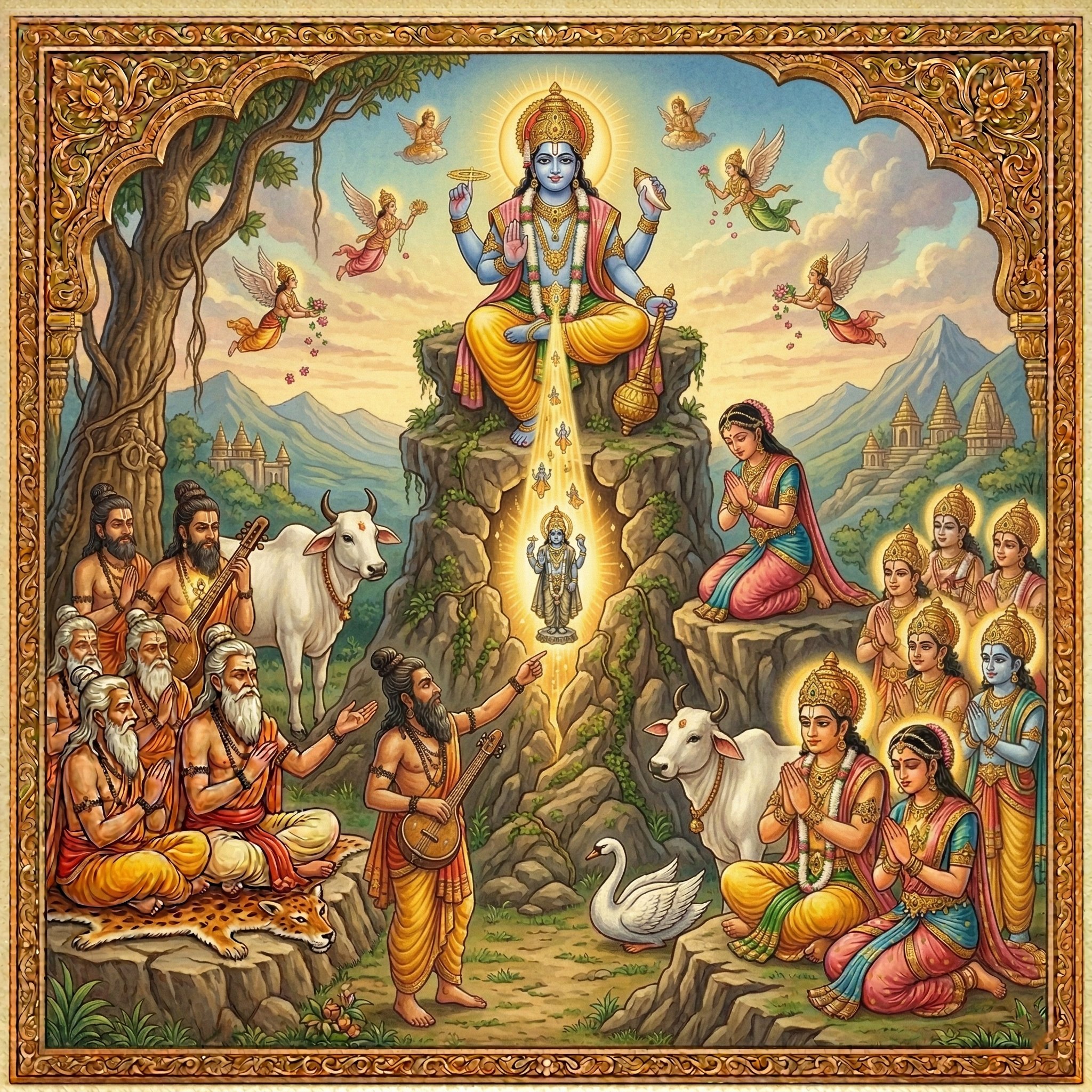
Venkatachala Mahatmya
Venkatachala Mahatmya
This section is anchored in the sacred mountain geography of Veṅkaṭācala (Tirumala–Veṅkaṭeśvara hill complex in South India), presenting the landscape as a theologically charged tīrtha where divine presence is narrated through temple-centric myth, ritual instruction, and merit discourse. The setting repeatedly ties mountain topography to Vaiṣṇava iconography (Śrīnivāsa/Janārdana) and to the protective, stabilizing symbolism of Varāha in relation to Bhūdevī (Dharaṇī).
Adhyayas in Venkatachala Mahatmya
40 chapters to explore.
Adhyaya 1
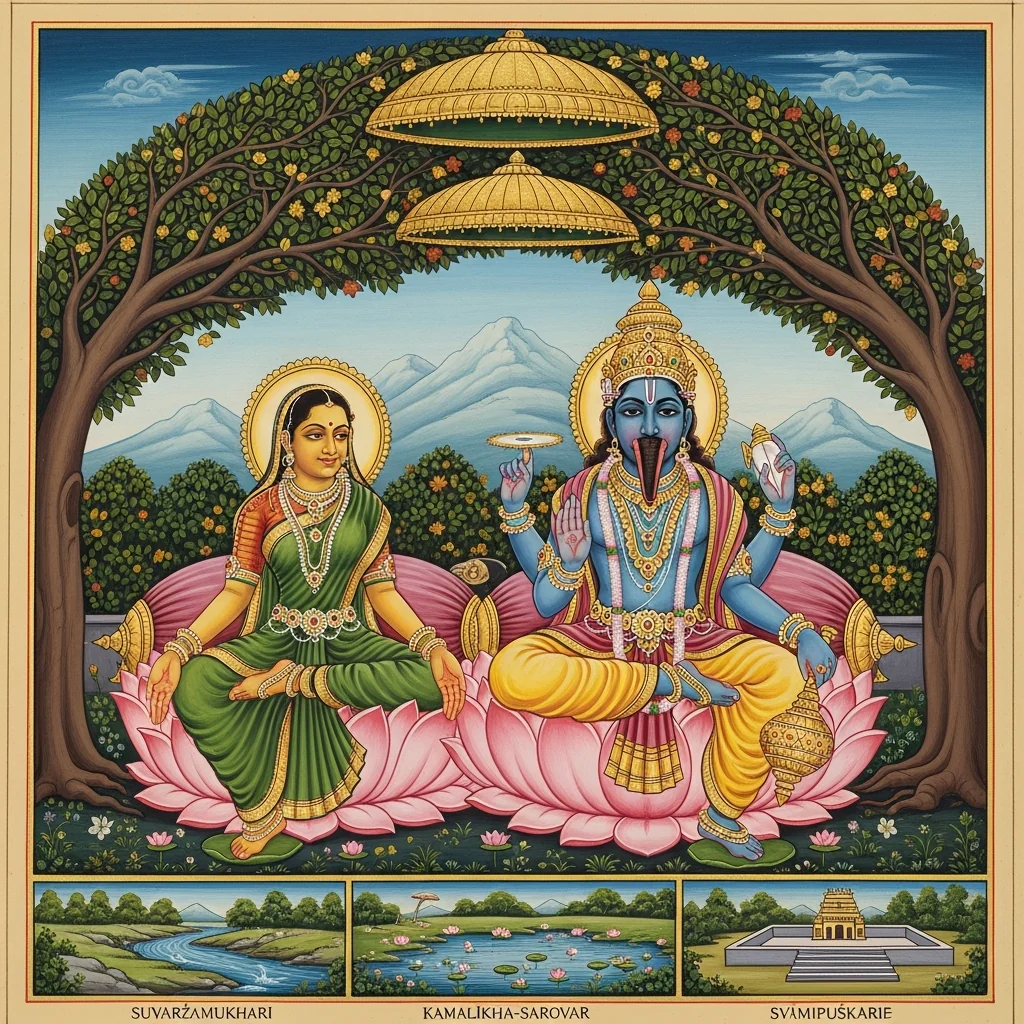
Veṅkaṭācalamāhātmya (Adhyāya 1): Nāradasya Varāhadarśanam, Dharaṇī–Varāha-saṃvādaḥ, Tīrtha-māhātmya-nirdeśaḥ
Adhyāya 1 begins in the classic Purāṇic setting of Naimiṣāraṇya, where Śaunaka and other sages perform a twelve-year satra for the protection of the world and invite the paurāṇika Sūta (Ugraśravas) to narrate the Skanda Purāṇa. Sūta recalls an earlier question he posed to Vyāsa, and Vyāsa relates an ancient episode: Nārada ascends Sumeru, beholds a radiant divine pavilion beneath the cosmic pippala tree, and attains darśana of Puruṣottama with the face of Varāha, seated upon a lotus-throne amid sages and celestial beings. Dharaṇī (Earth), arriving with companions and offerings, is embraced by Varāha and asks about the chief mountains established as her supports. Varāha names the great mountain ranges and then turns to the southern sacred landscape near rivers and lakes, identifying Nārāyaṇādri/Śrīveṅkaṭācala and nearby holy features such as Suvarṇamukharī, Kamalākha-sarovar, and the temple region. The chapter then ranks the tīrthas, exalting Svāmipuṣkariṇī as supreme and describing the multitude of tīrthas within it (including the traditional formula of “sixty-six crores”). It specifies six principal tīrthas and the timed bathing merits at Kumāradhārikā, Tuṃba, Ākāśagaṅgā, Pāṇḍava, Pāpanāśana, and Devatīrtha. It closes with Dharaṇī’s hymn to Varāha, Varāha’s movement with her to Vṛṣabhācala/Śeṣācala, and a phalaśruti promising rank and desired attainments to those who faithfully listen or recite.
Adhyaya 2
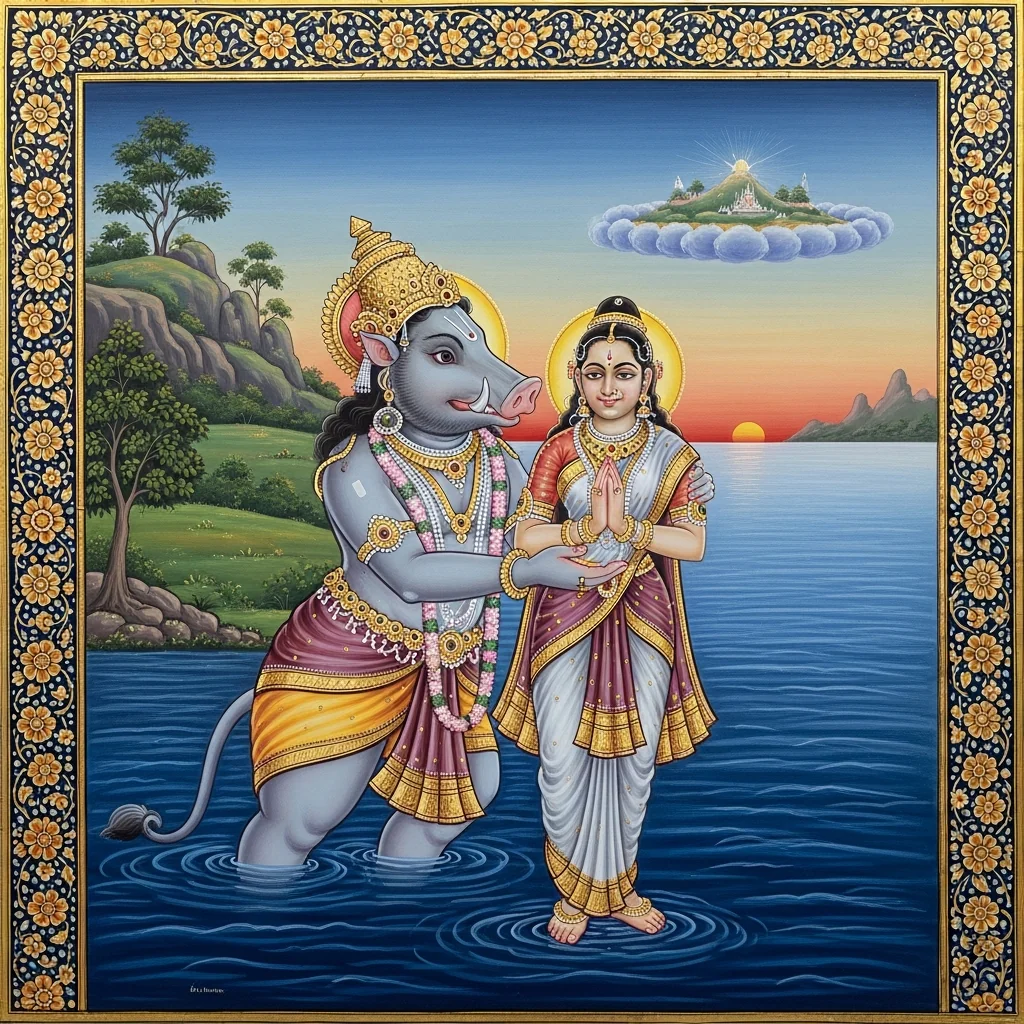
Śrīvarāha-mantrārādhanavidhiḥ (The Ritual Procedure for Worship through the Śrīvarāha Mantra)
This chapter is framed as a received dialogue: Sūta recounts an ancient episode from the Vaivasvata Manvantara in the Kṛta Yuga. Dharaṇī approaches Lord Varāha on Nārāyaṇādri and asks for the specific mantra that pleases Him and grants complete results—prosperity, marks of sovereignty, progeny, and finally the attainment of the Lord’s “Foot” for disciplined practitioners. Varāha reveals a “supremely secret” mantra, stressing that it should be transmitted only to the devoted and self-restrained. The chapter then gives a compact mantra-śāstra profile: the mantra “oṃ namaḥ śrīvarāhāya dharaṇyuddharaṇāya ca”, its promised efficacy, and its ritual identifiers—ṛṣi (Saṅkarṣaṇa), devatā (Varāha), chandas (Paṅkti), and bīja (śrī-bīja). It prescribes four lakhs of japa for one who has received it from a true teacher, followed by a homa with payasa (milk-rice) mixed with honey and ghee. A dhyāna describes Varāha’s form—crystal-like radiance, lotus-red eyes, boar-faced yet gentle, four-armed with cakra and śaṅkha, bestowing abhaya and holding a lotus, adorned in red-gold garments and ornaments, with cosmic supports such as Śeṣa imagery. The conclusion states the phala clearly: regular recitation (108 times) fulfills desired aims and culminates in liberation. Varāha then cites exempla of earlier practitioners—Manu named Dharma attaining the Lord’s state, Indra regaining heaven after a curse, sages reaching higher destiny, and Ananta becoming a “support of the earth” after japa at Śvetadvīpa—before Dharaṇī asks about Śrīnivāsa’s coming and enduring residence on Veṅkaṭa.
Adhyaya 3
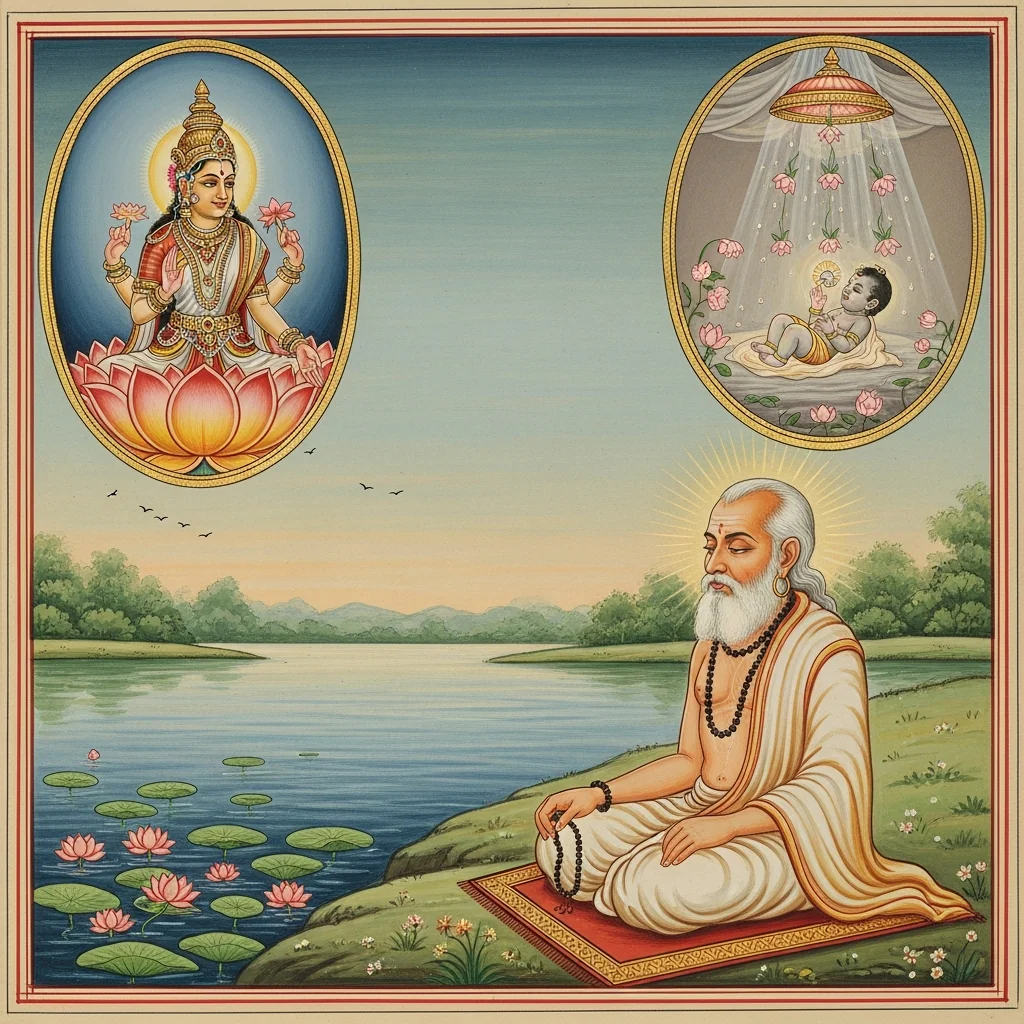
अगस्त्यप्रार्थनया भगवतः सर्वजनदृग्गोचरत्ववर्णनम्; तथा पद्मावत्युत्पत्तिः वसुदानजन्म च (Agastya’s Petition for Divine Visibility; Origins of Padmāvatī and Birth of Vasudāna)
Chapter 3 is framed as a dialogue in which Śrīvarāha recounts to Dharaṇī (Earth) an ancient episode. First, Śrīnिवāsa/Harī is described as dwelling near Svāmipuṣkariṇī on Veṅkaṭācala within a sublime vimāna—remaining unseen to mortals until the end of an aeon, yet, by divine ordinance, becoming the rightful object of worship. Dharaṇī raises a ritual-theological doubt: if the Lord is “invisible” to human beings, how can public worship endure? Śrīvarāha answers by telling of the sage Agastya’s twelve-year devotion (ārādhana) and his petition that the Lord become visible to all embodied beings. The Lord grants this universal visibility while preserving the vimāna’s exceptional sanctity. The narrative then turns to dynastic origins: the rise of King Mitravarmā and the lineage leading to Ākāśarāja. In an etiological episode, Padmāvatī is found arising from the earth during ritual ploughing, accepted as a daughter, and entrusted to Queen Dharaṇī; thereafter Dharaṇī conceives and gives birth to Vasudāna amid auspicious signs, and his training in weapons and disciplines is summarized to establish royal virtue, legitimacy, and the region’s sacred history.
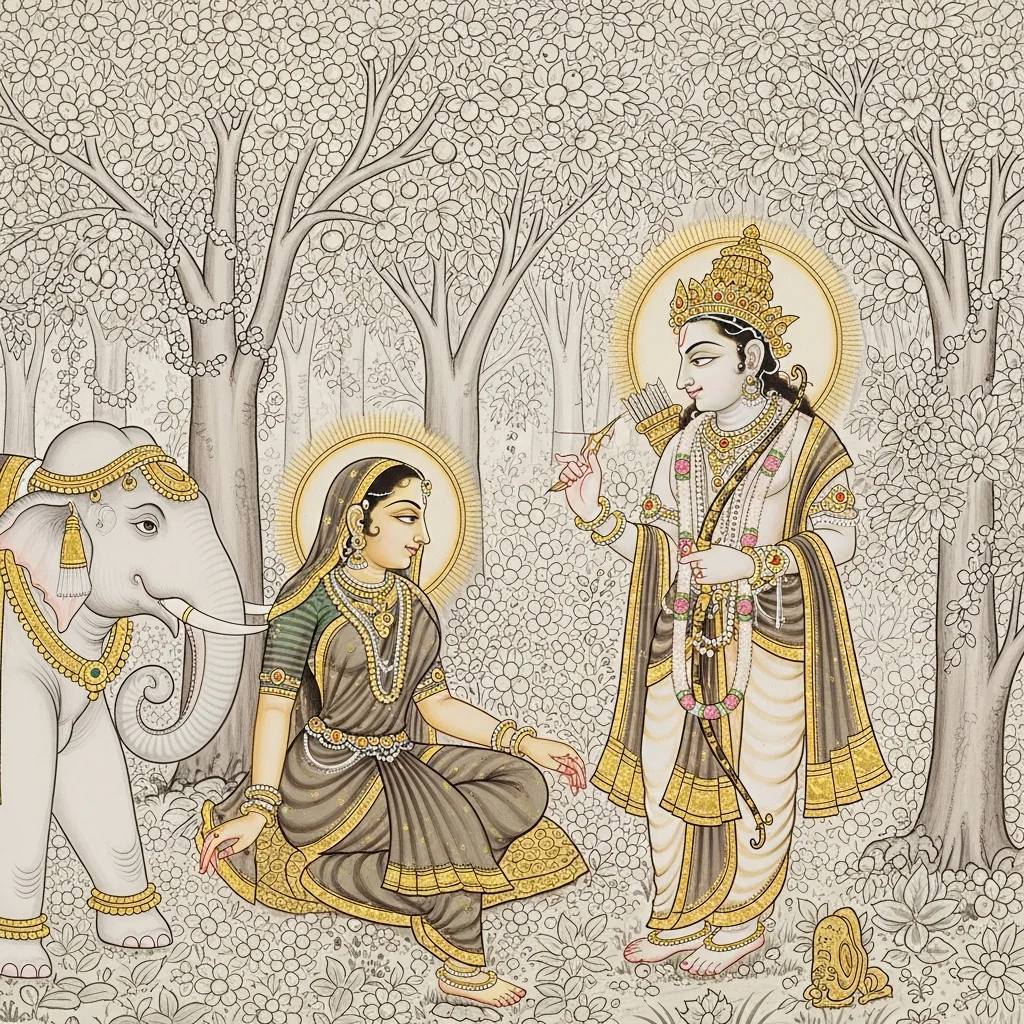
Adhyaya 4
Pad्मिनी/Pad्मावती-Lakṣaṇa and Śrīnिवास Encounter in the Puṣpāṭavī (Chapter 4)
Chapter 4 unfolds through layered narration: Sūta reports Dharaṇī’s question, and Varāha replies by recounting how Ākāśarāja named the Earth-born daughter “Padminī.” The scene then shifts to Padmāvatī’s garden-forest dwelling, where the sage Nārada arrives unexpectedly. At Padmāvatī’s request, Nārada gives a detailed catalogue of auspicious bodily marks (lakṣaṇa) and interprets her form as “Viṣṇu-yogya” (suited for Viṣṇu), likening her to Lakṣmī. After Nārada vanishes, Padminī/Padmāvatī and her companions enter the Puṣpāṭavī to gather spring flowers; many blossoms are named, and the forest is framed as a sacred, ritual-aesthetic space. A threatening elephant appears and fear rises, but the narrative turns with the arrival of a radiant horseman bearing a bow—Śrīnivāsa, the dweller of Veṅkaṭādri—who, in this local idiom, identifies himself as “Kṛṣṇa” of the Sūrya lineage. The women deny seeing the sought ‘īhāmṛga,’ challenge his entry into the protected royal forest, and question his identity. He says he came hunting, then admits he was drawn to Padmāvatī at first sight; warned of royal punishment, he departs swiftly toward the mountain with his attendants.
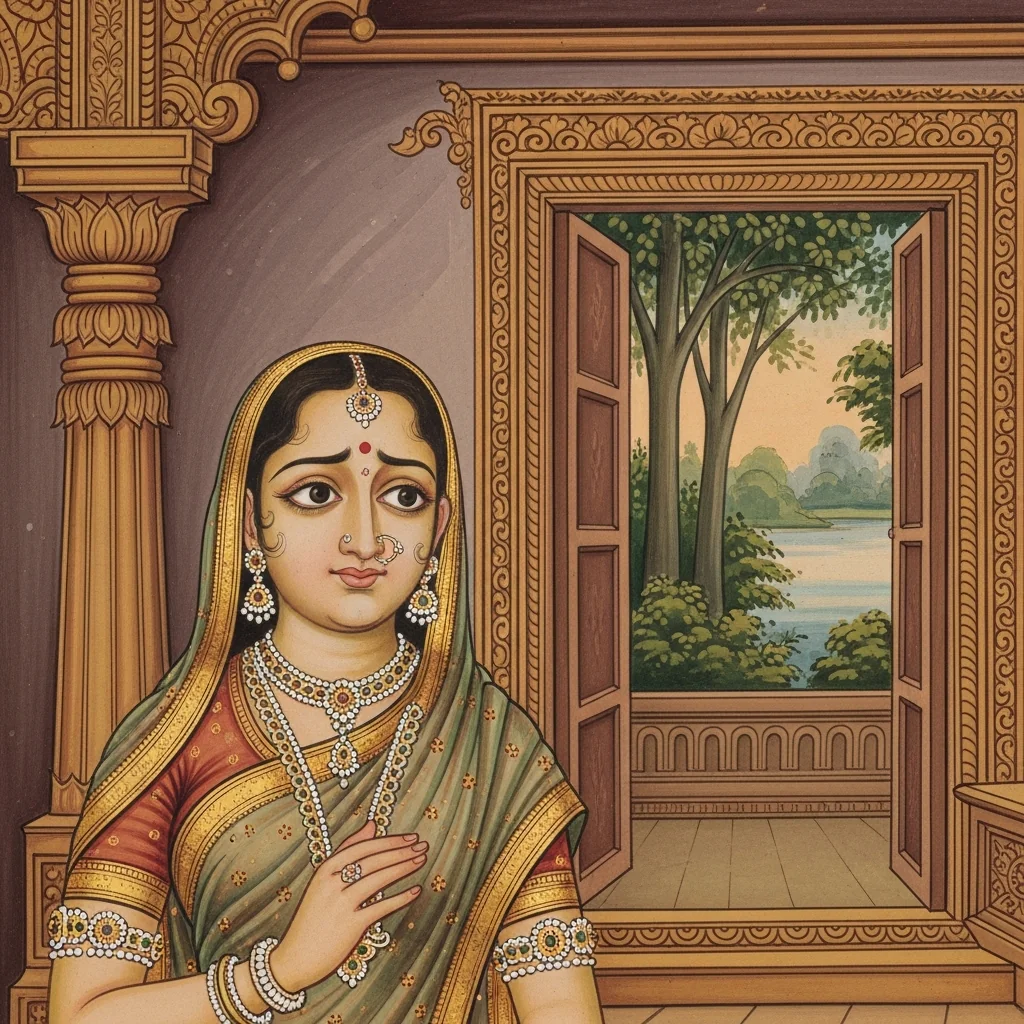
Adhyaya 5
पद्मावतीदर्शन-प्रसङ्गः तथा बकुलमालिकाया यात्रामार्ग-निर्देशः (Padmāvatī Encounter and Bakulamālikā’s Route Instructions)
This chapter turns from divine arrival to inward longing. Śrīnिवास enters a jewel-adorned pavilion, becomes wholly absorbed in remembering Padmāvatī’s beauty, and sinks into moha—bewildering infatuation—like a trance. Bakulamālikā approaches with carefully prepared offerings and, through pointed questions, reads his condition from the visible signs of body and mind. Śrīnिवास then gives an origin-account that links Padmāvatī to earlier mythic time: the Veda-vatī/Sītā connection and a promise deferred to a later age, affirming the present love as the continuation of a dharmic vow and divine intent. The chapter next becomes sacred route-instruction: he directs Bakulamālikā to travel via Nṛsiṃha-guhā, Agastya’s hermitage and the Agastyeśa-liṅga on the Suvarṇamukharī, onward through named forests and lakes, until she reaches Nārāyaṇapurī, the city of Ākāśarāja. Rich catalogues of trees, birds, and animals form a textual map binding theology to landscape. It closes with Bakulamālikā setting out and meeting Padmāvatī’s companions, opening the next dialogue.
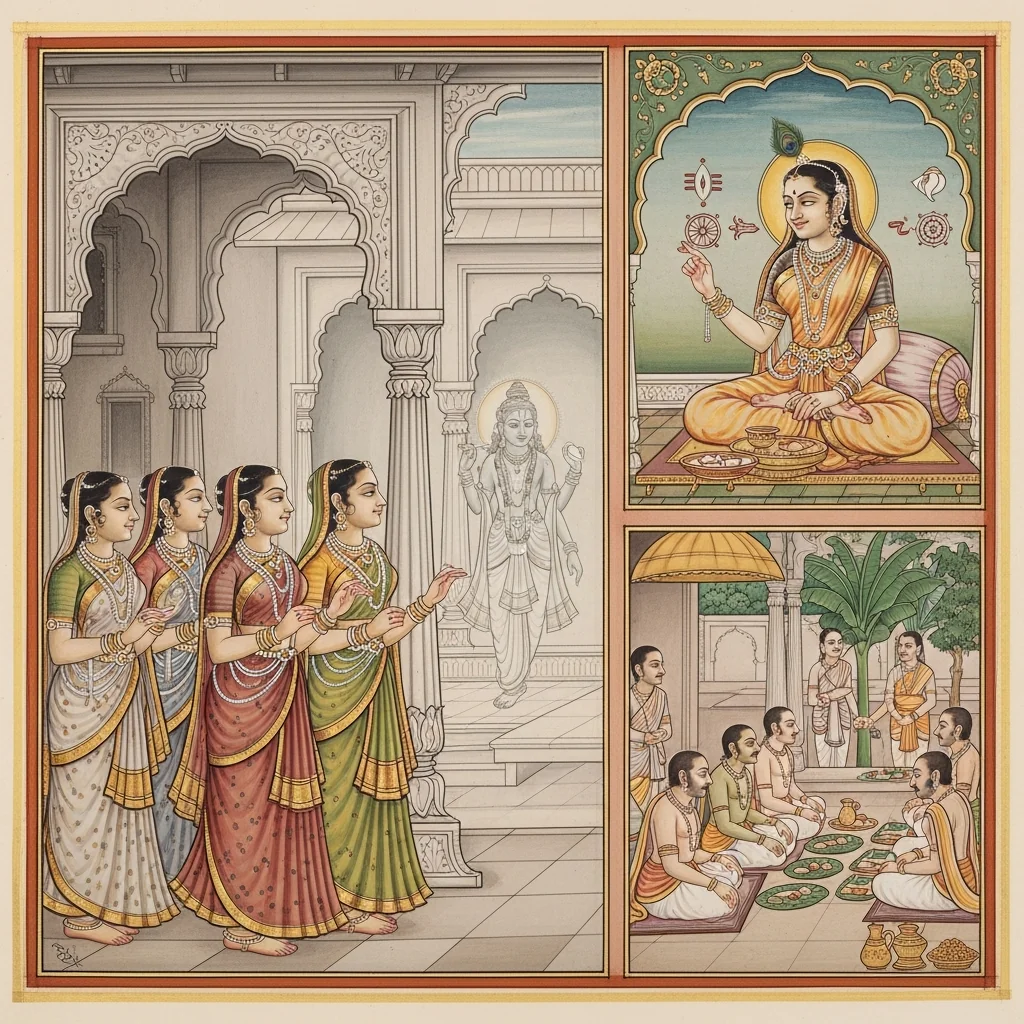
Adhyaya 6
Padmāvatī’s Vision, Royal Divination, and Vaiṣṇava Marks of Devotion (Chapter 6)
Chapter 6 weaves a courtly episode with sacred instruction. The women of Ākāśarāja’s inner quarters report that, while gathering flowers with the princess, they saw beneath a tree a wondrous man—dark like indranīla, adorned with golden ornaments and weapons—who vanished at once, leaving Padmāvatī faint. The king consults a daivajña, who deems the planetary signs largely auspicious yet notes a troubling anomaly: the princess has been struck by the sight of an exceptional man and will in time be united with him; moreover, a woman-messenger will arrive with beneficial counsel. As a practical remedy he prescribes a Brahmin-led abhiṣeka for the Agastyeśa-liṅga. The narrative then brings in Bakulamālikā, arriving from Śrī Veṅkaṭādri and escorted into the palace. Dharaṇī questions a Pulindinī, who speaks truthfully: Padmāvatī’s affliction is love-born and caused by the Deity himself—Hari from Vaikuṇṭha—who roams Veṅkaṭādri near Svāmipuṣkariṇī; he will send Lalitā as intermediary, and the union will surely occur. The chapter culminates in Padmāvatī’s teaching on bhakta-lakṣaṇa, the marks of a devotee: outward signs such as śaṅkha-cakra emblems, ūrdhva-puṇḍra, and the twelve nāma-dhāraṇas, and inward disciplines such as Veda recitation, truthfulness, freedom from malice, sexual restraint, and compassion. It further details the rite of imprinting the pañcāyudhas (conch, discus, bow/arrow, mace, sword) through homa and heated emblems, defining the Vaiṣṇava as ethically regulated and ritually marked. The women then complete Agastyeśa worship and honor the Brahmins with food and gifts.
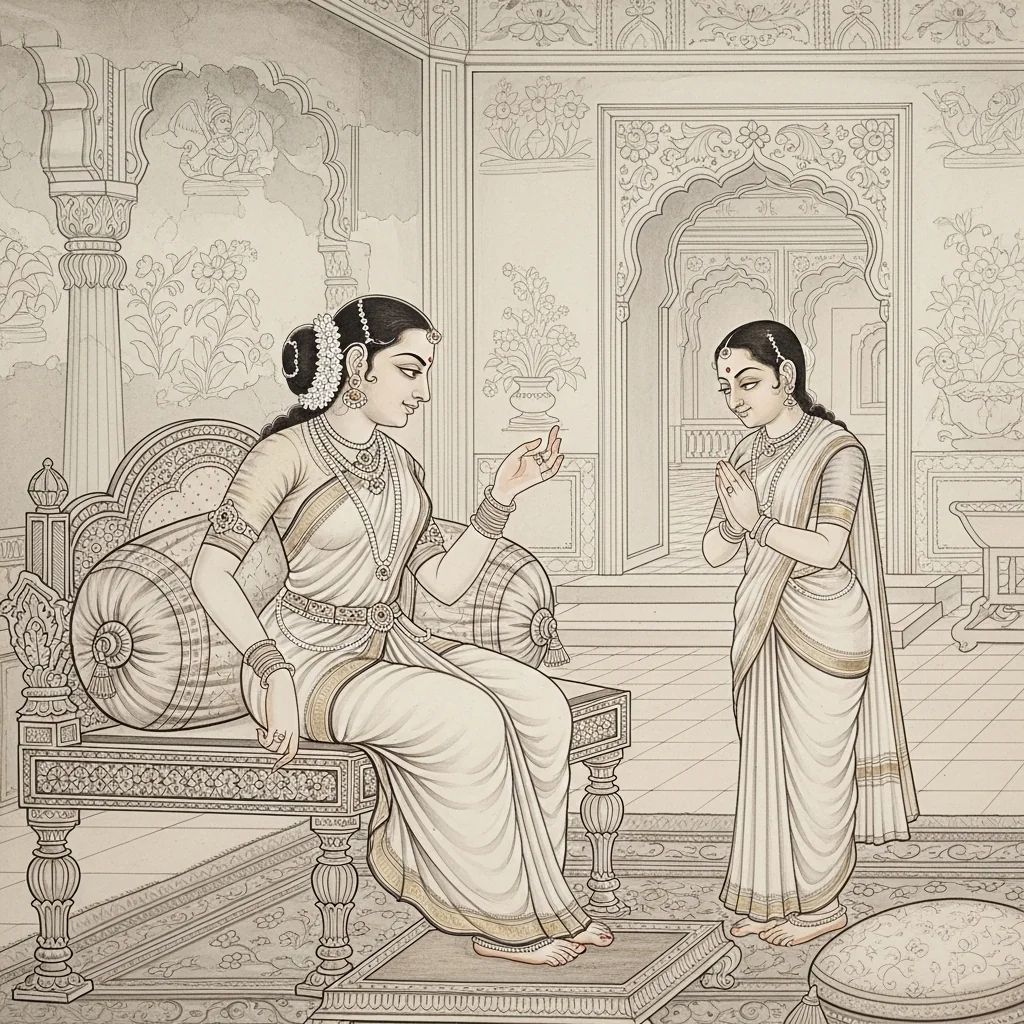
Adhyaya 7
बकुलमालिकादूत्यं पद्मावतीपरिणयनिश्चयश्च (Bakula-mālikā’s Embassy and the Determination of Padmāvatī’s Marriage)
This chapter traces a diplomatic movement from court to temple, formally situating the Padmāvatī–Śrīnivāsa marriage story within ritual and royal administration. It begins with Queen Dharaṇī questioning the identity and purpose of the divine attendant Bakula-mālikā, thereby establishing standards of inquiry and trust. Bakula-mālikā recounts Śrīnivāsa’s course on Veṅkaṭādri—encounters in the forest and the meeting with King Śaṅkha at Svāmitīrtha—where ascetic discipline and the founding of shrines are affirmed as valid forms of devotion. Śrīnivāsa gives route-specific instructions, such as honoring Viṣvaksena and bathing at Svāmipuṣkariṇī, linking sacred geography with authorized practice. The narrative then turns to royal decision: Ākāśarāja consults ministers and the priestly-astrological authority Bṛhaspati, who fixes the wedding time (Uttaraphālgunī; Vaiśākha). A civic-cosmic celebration follows—Viśvakarmā adorns the city, Indra sends a rain of flowers, and other deities contribute—portraying auspicious order as a shared ritual ecology. Finally, Bakula-mālikā and the parrot-messenger (śuka) return to Śrīnivāsa with Padmāvatī’s petition. Śrīnivāsa signals acceptance by sending a garland, and preparations begin, along with royal hospitality protocols for the Lord’s arrival.
Adhyaya 8
Śrīnिवासस्य लक्ष्म्यादिकृत-परिणयालंकारः — The Bridal Adornment and Marriage Procession of Śrīnिवास
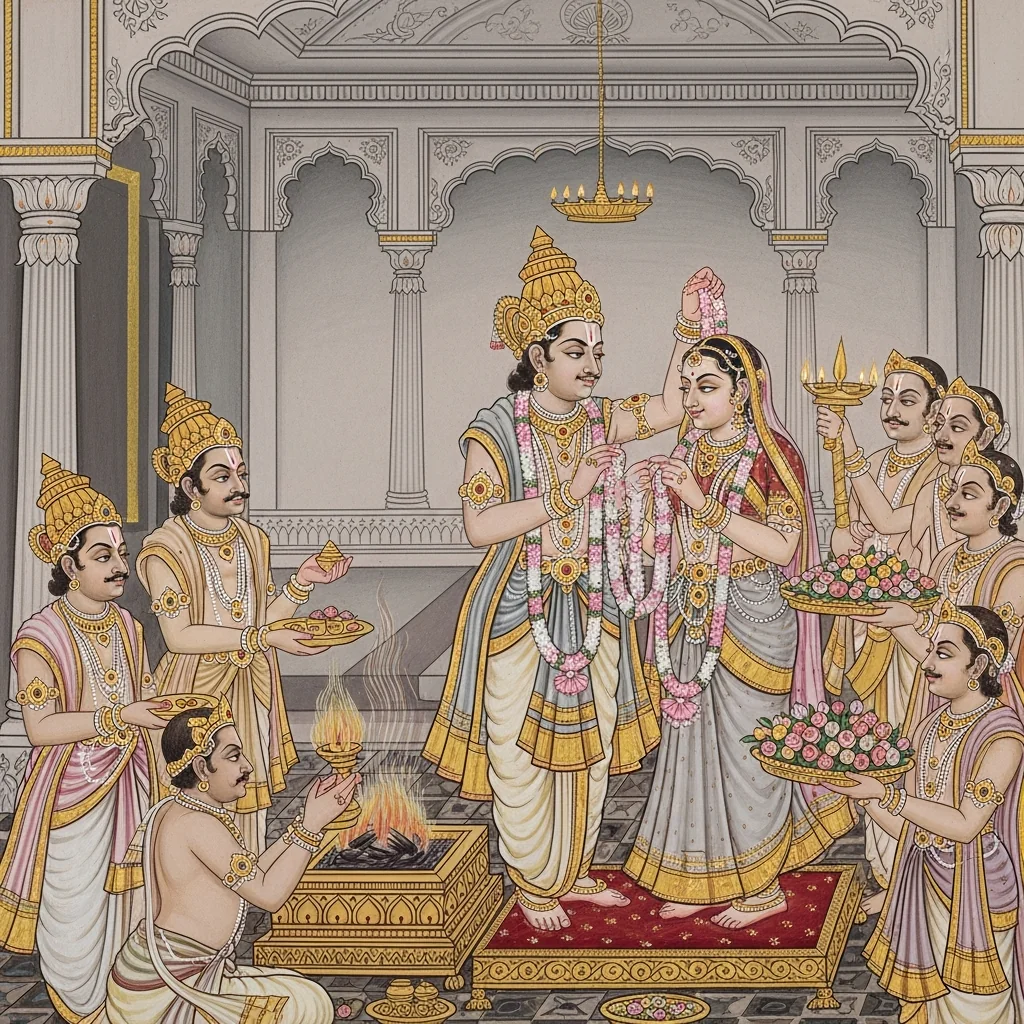
Narrated by Śrīvarāha, this chapter unfolds as a complete ceremonial sequence. Śrīnivāsa summons Lakṣmī and appoints her to oversee the wedding preparations. Personified virtues and Vedic categories—Śruti, Smṛti, Dhṛti, Śānti, Hrī, Kīrti—arrive bearing ritual requisites such as fragrant oils, garments, ornaments, a mirror, musk, and royal insignia, forming a symbolic inventory of dharma-ordered adornment. Lakṣmī performs the anointing and bathing rites with scented waters gathered from celestial sources and sacred tīrthas, then dresses and ornaments the Lord. Śrīnivāsa applies the ūrdhva-puṇḍra and mounts Garuḍa. A joyous public procession proceeds to Nārāyaṇapurī, the city of Ākāśarāja, accompanied by devas, sages, Gandharvas, and Apsarases with auspicious recitations. The marriage with Padmāvatī is completed through the threefold exchange of garlands, entry into the auspicious house, and the standard wedding rites, including the tying of the maṅgalya-sūtra and the lājā-homa. Thereafter, gifts (prābhṛta) are cataloged at length—grains, ghee, dairy, fruits, textiles, gold, gems, livestock, horses, elephants, and attendants—presenting royal generosity as a dharmic offering. Śrīnivāsa grants Ākāśarāja the boon of unwavering devotion and a mind fixed upon the divine feet; the gods return to their abodes, and the Lord remains near Svāmipuṣkariṇī, continuing to receive worship.
Adhyaya 9
अथ वसुनिषादवृत्तान्तः—रंगदासकैंकर्यं—तोण्डमान्नृपकथा—पद्मसरोवरमाहात्म्यम् (Vasu the Niṣāda, Raṅgadāsa’s service, Toṇḍamān’s encounter, and the Padma-saras glory)
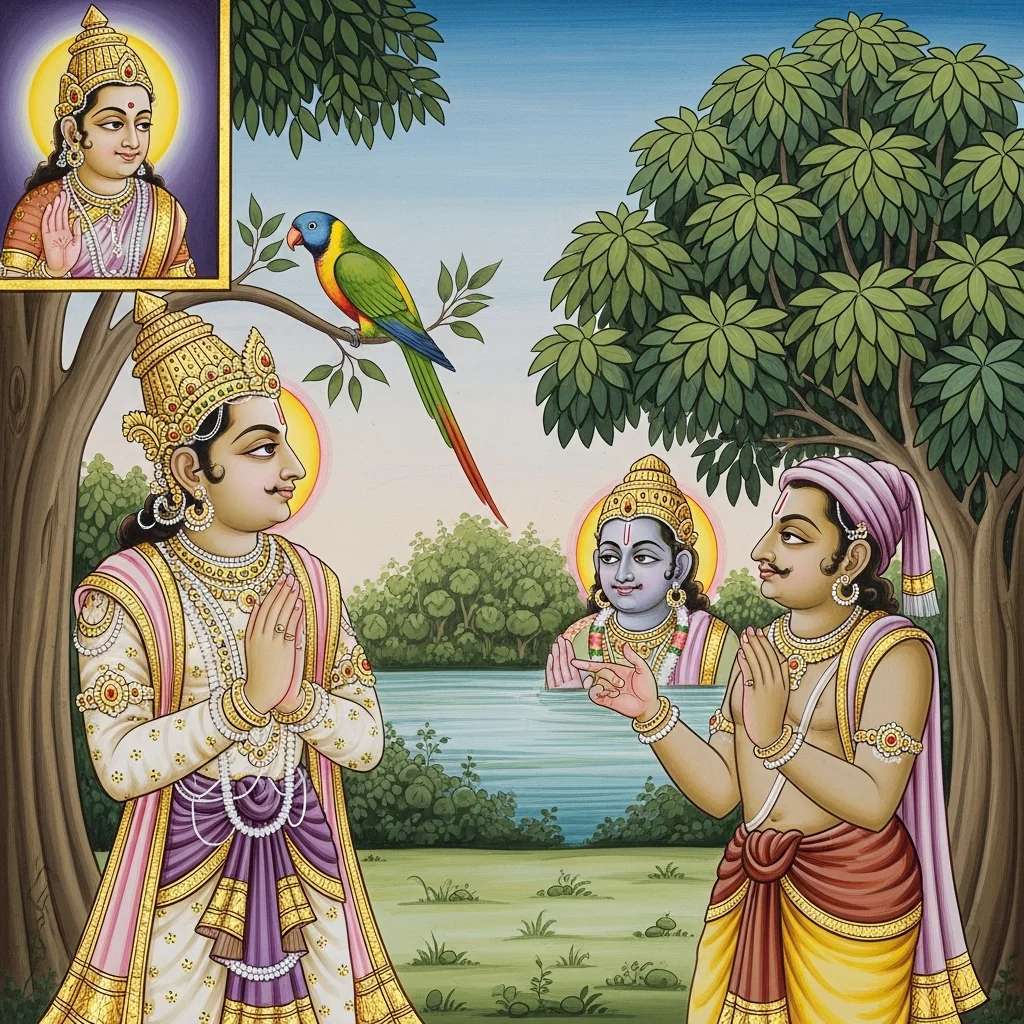
This chapter is framed as a dialogue on tīrtha and divine presence: Dharaṇī asks whether, in Kali-yuga, the Lord’s presence on the hill will still be perceptible, and Varāha replies through exemplary narratives. First, Vasu, a forest-dwelling Niṣāda devoted to Puruṣottama, offers cooked śyāmāka grains mixed with honey to Viṣṇu with Śrī and Bhū. When Vasu returns from gathering honey and mistakes his son’s eating of the offering for theft, he raises a sword; Viṣṇu manifests from the tree, restrains him, and teaches that the child’s devotion is especially dear, affirming His continuing presence at Svāmi-saras/Svāmipuṣkariṇī. Next, Raṅgadāsa, a devotee from the Pāṇḍya region, completes a pilgrimage through the Varāha shrine, Suvarṇamukharī, Kāmalākhyasaras, and Cakratīrtha, and beholds Śrīnivāsa near Svāmipuṣkariṇī. He establishes a garden, wells, and daily flower-service; later, captivated by a Gandharva’s water-sport spectacle, he neglects his duties and feels ashamed. The deity consoles him, weighs the lapse by inner intention, and foretells king-like prosperity joined to steadfast devotion, ending in liberation. The narrative then turns to Toṇḍamān, a Somakula king. While hunting near Veṅkaṭādri he passes through tīrthas, encounters the goddess Reṇukā, and is guided by a five-colored parrot crying “Śrīnivāsa” to a Niṣāda forest-keeper, who leads him to the hidden deity near Svāmipuṣkariṇī. Both worship and share the śyāmāka-honey offering; on his return Reṇukā grants a political boon—an unconquered kingdom and a capital bearing his name—as “devadeva-prasāda.” Finally, Śuka proclaims the Padma-saras māhātmya: Lakṣmī (Padmā/Ramā), under Durvāsas’ curse, performs austerities at the lotus-filled lake; the gods praise her with a formal hymn. Lakṣmī grants boons—restoration of lost status, prosperity, and mokṣa to those who bathe and worship with bilva leaves and this stuti—then returns to Vaikuṇṭha with Viṣṇu upon Garuḍa.
Adhyaya 10
Toṇḍamān’s Accession; Varāha Revelation at the Valmīka; Bilamārga Guidance; Aṣṭhi-saras Revival; Bhīma the Potter’s Liberation; Phalaśruti
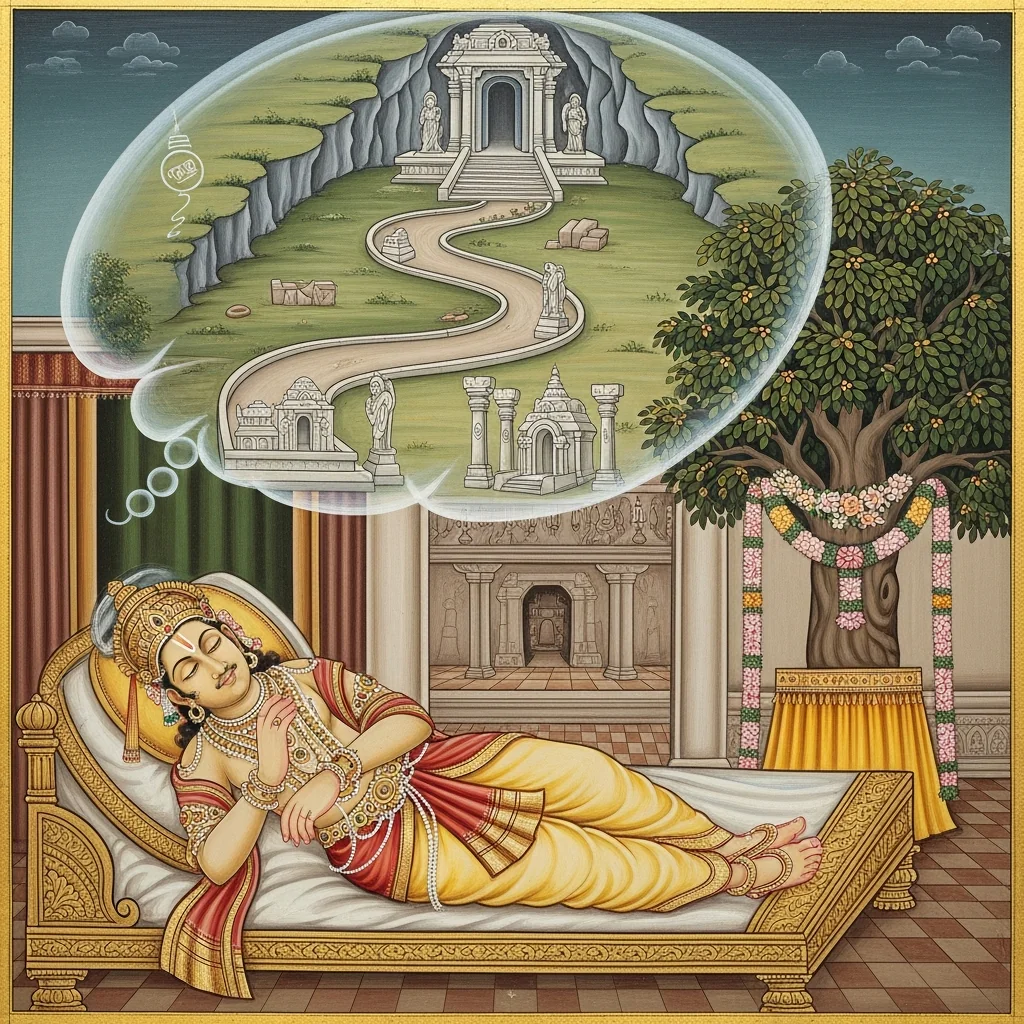
Adhyāya 10 weaves together royal legitimacy, the discovery of sacred presence, and the ordering of worship at Veṅkaṭācala. It opens with Toṇḍamān’s accession, and extols Padmasaras as a purifying, prosperity-bestowing tīrtha, where merit arises through kīrtana, smaraṇa, and snānā. In a parallel account, Vasu, chief among forest-dwellers, beholds a radiant Varāha entering a valmīka; the Lord instructs that the anthill be washed with cow’s milk, the icon on its stone base be lifted and recognized, and worship be established with Vaikhānasa specialists. Toṇḍamān then receives confirmation through a dream-revelation of a bilamārga (tunnel route), follows divine signs (pallava traces), and begins protective works—prākāra walls and gateways—while being charged to preserve the tamarind and campaka trees as lasting marks of the Lord’s presence. A moral-administrative trial follows: his temporary guardianship of a pregnant brāhmaṇī ends in neglect and death, yet Śrīnivāsa prescribes a remedial rite at Aṣṭhi-saras, famed as apamṛtyu-nivāraṇa, and through sacred bathing she is restored to life. The chapter also affirms humble bhakti through Bhīma the potter of Kurvagrāma, whose simple offerings are accepted; when the king visits, Bhīma and his wife attain Vaikuṇṭha. In closing, Toṇḍamān arranges succession, practices austerity, gains divine audience, and reaches sā-rūpya and Viṣṇupada, while the phalaśruti promises exalted fruits for faithful hearing and recitation.
Adhyaya 11
स्वामिपुष्करिणी-स्नानमाहात्म्यं तथा काश्यपोपाख्यानम् (Glory of bathing in Swāmipuṣkariṇī and the Kāśyapa episode)
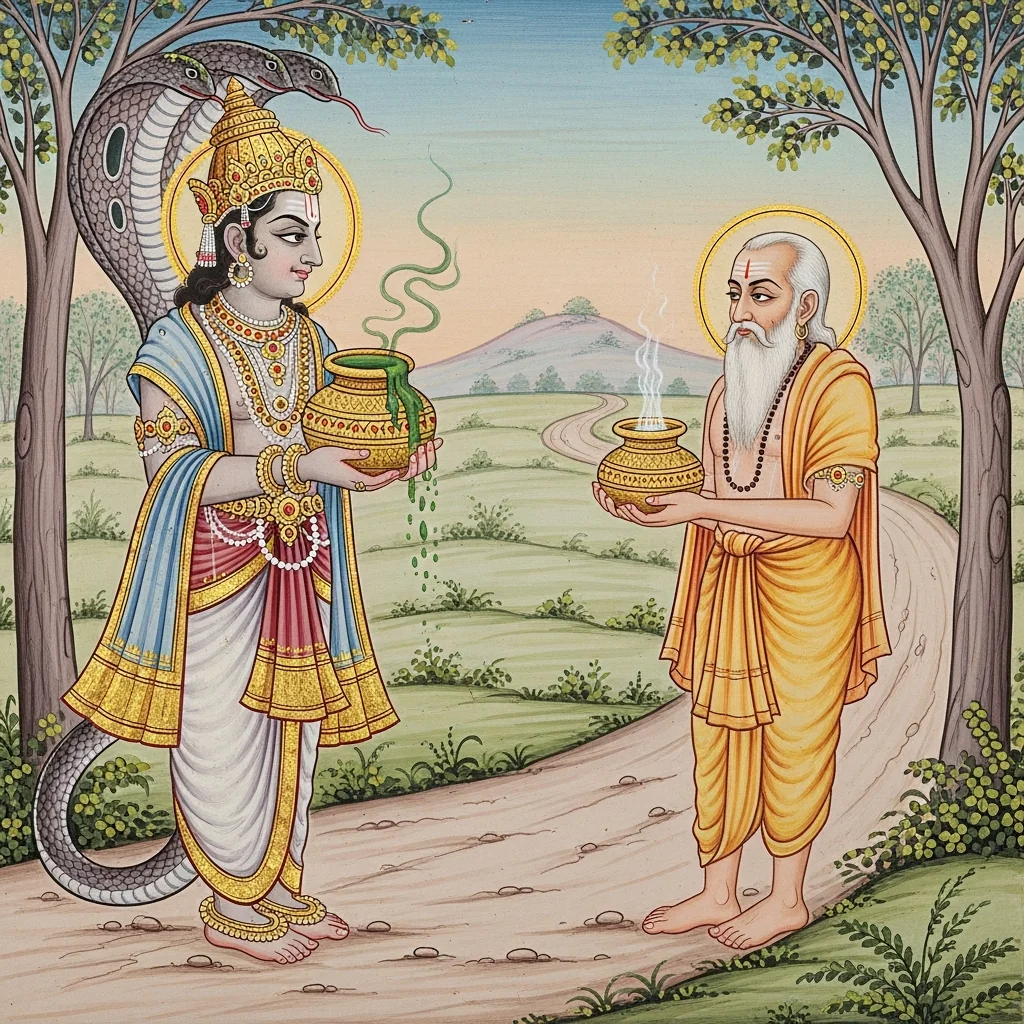
Chapter 11 extols Swāmipuṣkariṇī as a purifying tīrtha through an embedded moral narrative. Sūta declares that Kāśyapa’s bath in Swāmipuṣkariṇī destroys even grave ethical impurities. When the ṛṣis ask how Kāśyapa incurred fault yet attained sudden release, Sūta recounts a connected episode beginning with King Parīkṣit. While hunting, Parīkṣit encounters a silent sage and, angered by the lack of reply, places a dead serpent on the sage’s shoulder. The sage’s son Śṛṅgī curses the king to die within seven days by Takṣaka’s bite. Despite safeguards, Takṣaka fulfills the curse by deception—mingling among brahmin-like figures and hiding in fruit as a worm. Kāśyapa, a mantra-physician able to counter venom, is intercepted by Takṣaka and turned back through a display of power and material inducement; afterward he is publicly censured for failing to save the king. Seeking remedy, Kāśyapa approaches the sage Śākalya, who defines the breach as withholding aid when one has the capacity to save a life from poison, a severe fault with social consequences. Śākalya prescribes expiation: pilgrimage to Veṅkaṭādri, bathe in Swāmipuṣkariṇī with saṅkalpa, worship Varāhasvāmin and then Śrīnivāsa; through darśana and disciplined observance, Kāśyapa’s health, standing, and honor are restored. The chapter ends with a phalaśruti promising exalted status to faithful hearers, linking purification with devotion, intention, and sacred place.
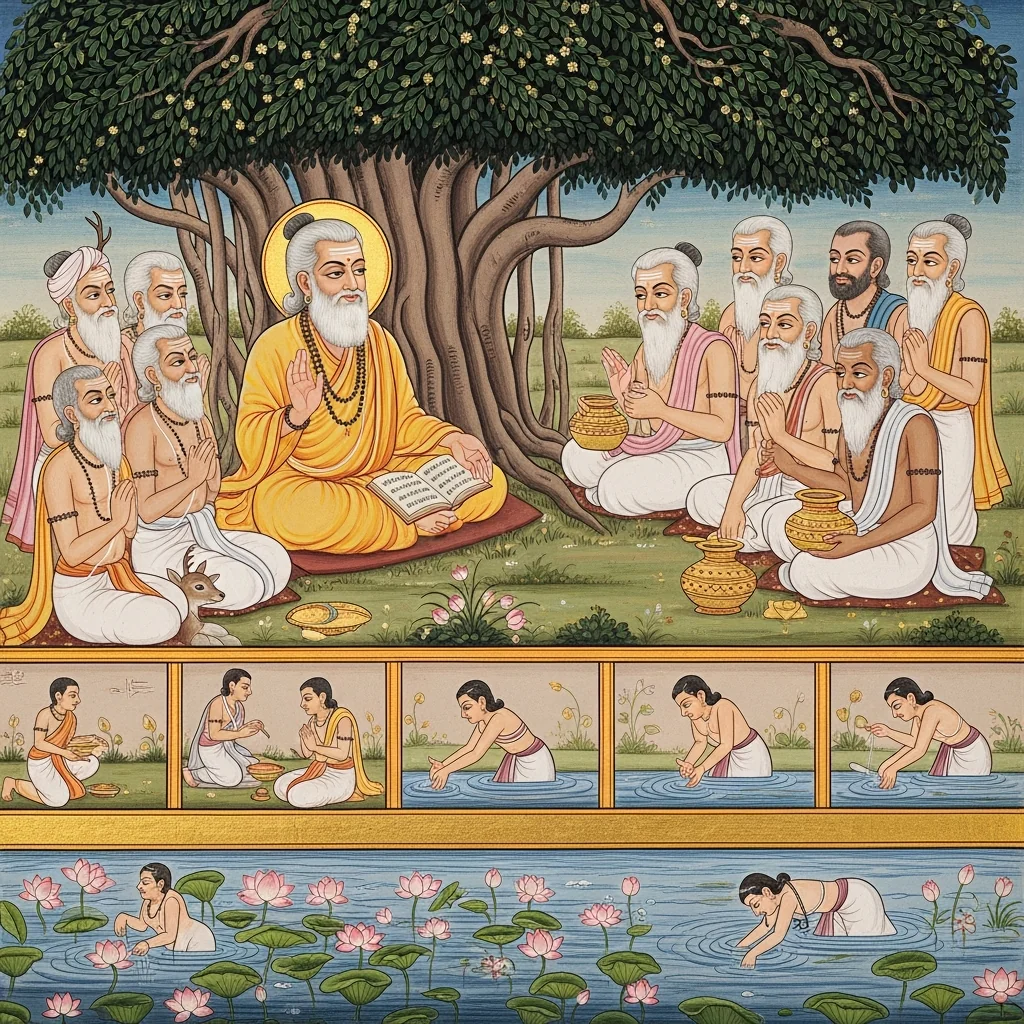
Adhyaya 12
स्वामिपुष्करिणी-स्नानात् नरकनिस्तारः (Deliverance from Naraka through Bathing in Swāmi Puṣkariṇī)
In this adhyāya, the sages ask Sūta to explain the greatness (vaibhava) of Śrī Swāmi Puṣkariṇī/Swāmi-tīrtha, said to grant deliverance even by mere remembrance. Sūta replies that those who praise it, recount its glory, or bathe in it do not suffer the fate of the twenty-eight narakas. The chapter then lists these hell-realms by name and links select moral transgressions to specific punitive destinations: seizing others’ wealth and relationships; hatred toward parents and learned persons; straying from the Vedic path; harmful disruption of beings; sexual misconduct; anti-dharma sectarian agitation; impurity of conduct; violence toward animals; and ritual hypocrisy. After each illustrative case, a refrain-like assurance declares that bathing in Swāmi-tīrtha prevents such a fall. The phalaśruti concludes that its merit equals great sacrifices and gifts, purifies even grave sins at once, and gives rise to virtues such as wisdom, detachment, and clarity of mind. It warns against dismissing this praise as exaggeration, portraying disbelief as spiritually perilous. Finally, seeing, bathing, praising, touching, and bowing at the tīrtha are proclaimed as comprehensive means to freedom from death-fear and to bhukti–mukti (worldly welfare and liberation).
Adhyaya 13
धर्मगुप्तचरित्रवर्णनम् | Dharma-gupta’s Episode and the Efficacy of Svāmipuṣkariṇī
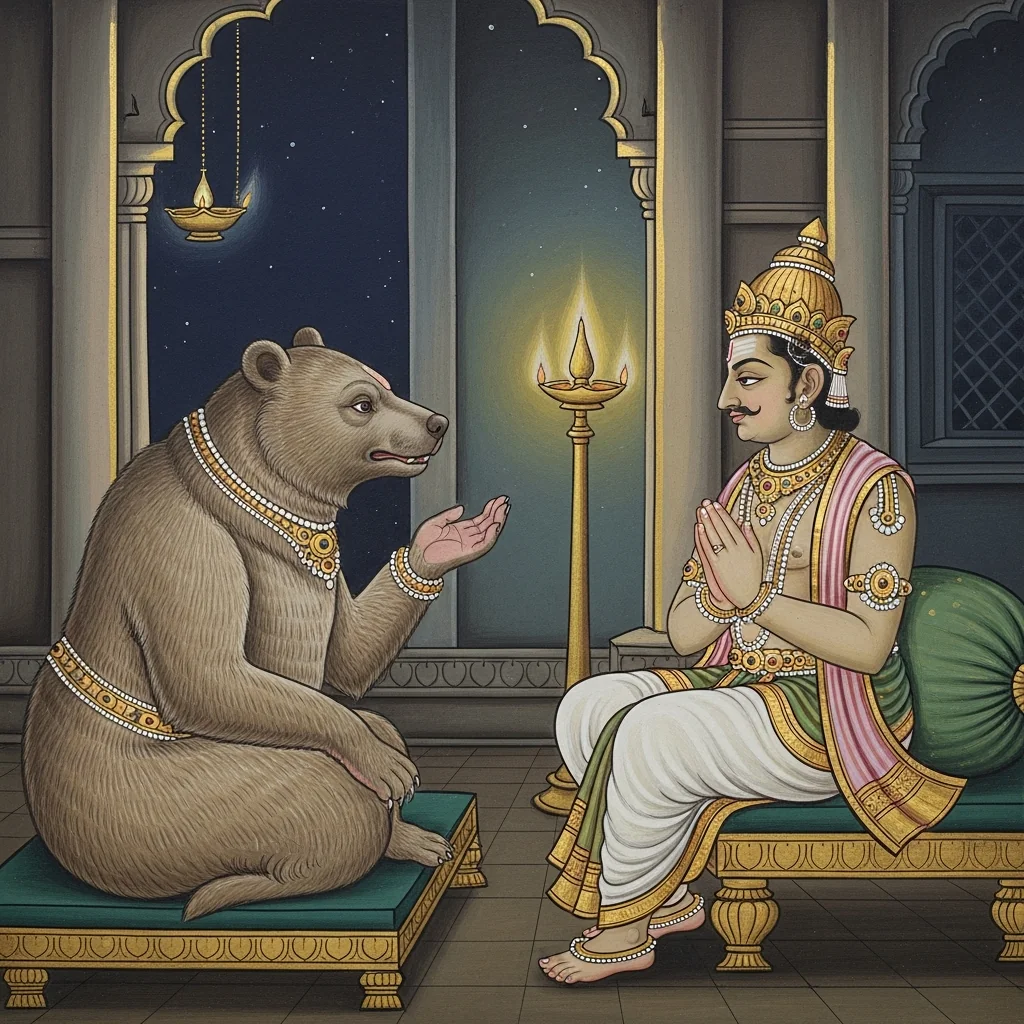
Sūta continues to proclaim the greatness of Svāmitīrtha by recounting the life of King Dharmagupta, son of Nanda of the Soma lineage. Nanda entrusts the kingdom to his son and retires to the forest; Dharmagupta rules with sound policy, sacrifices, and generous gifts to brāhmaṇas, preserving social order and keeping the realm free from predation. On a hunting expedition he is overtaken by night in a dreadful forest. After worshiping the evening sandhyā and reciting the Gāyatrī, he takes refuge in a tree, where a bear fleeing a lion also climbs. The bear proposes a pact to keep watch through the night; the lion tries to provoke betrayal, but the bear warns that violating trust (viśvāsa-ghāta) is a sin graver than many others. When the king later drops the sleeping bear, the bear reveals himself as the shape-shifting sage Dhyānakāṣṭha and curses the king with madness. The sage also discloses that the lion is the yakṣa Bhadranāma, once Kubera’s minister, cursed by Gautama into lion-form; through dialogue with Dhyānakāṣṭha the yakṣa is released and returns to Alakā. Ministers report Dharmagupta’s madness to Nanda, who consults the sage Jaimini. Jaimini prescribes bathing the prince in Svāmipuṣkariṇī on Veṅkaṭa near the Suvarṇamukharī; the bath instantly removes the madness. Father and son worship Veṅkaṭeśa/Śrīnivāsa, Dharmagupta gives gifts, and he returns to righteous rule. The chapter ends with a phalaśruti: immersion in Svāmipuṣkariṇī frees those afflicted by madness, seizure-like ailments, and malignant grahas; and reciting “Svāmitīrtham” three times before bathing in any water leads to Brahman’s abode. Mere hearing of this narrative is said to destroy even grave sin.
Adhyaya 14
सुमत्याख्यद्विजवृत्तान्तः — The Account of the Brahmin Sumati and Purification at Svāmi-puṣkariṇī
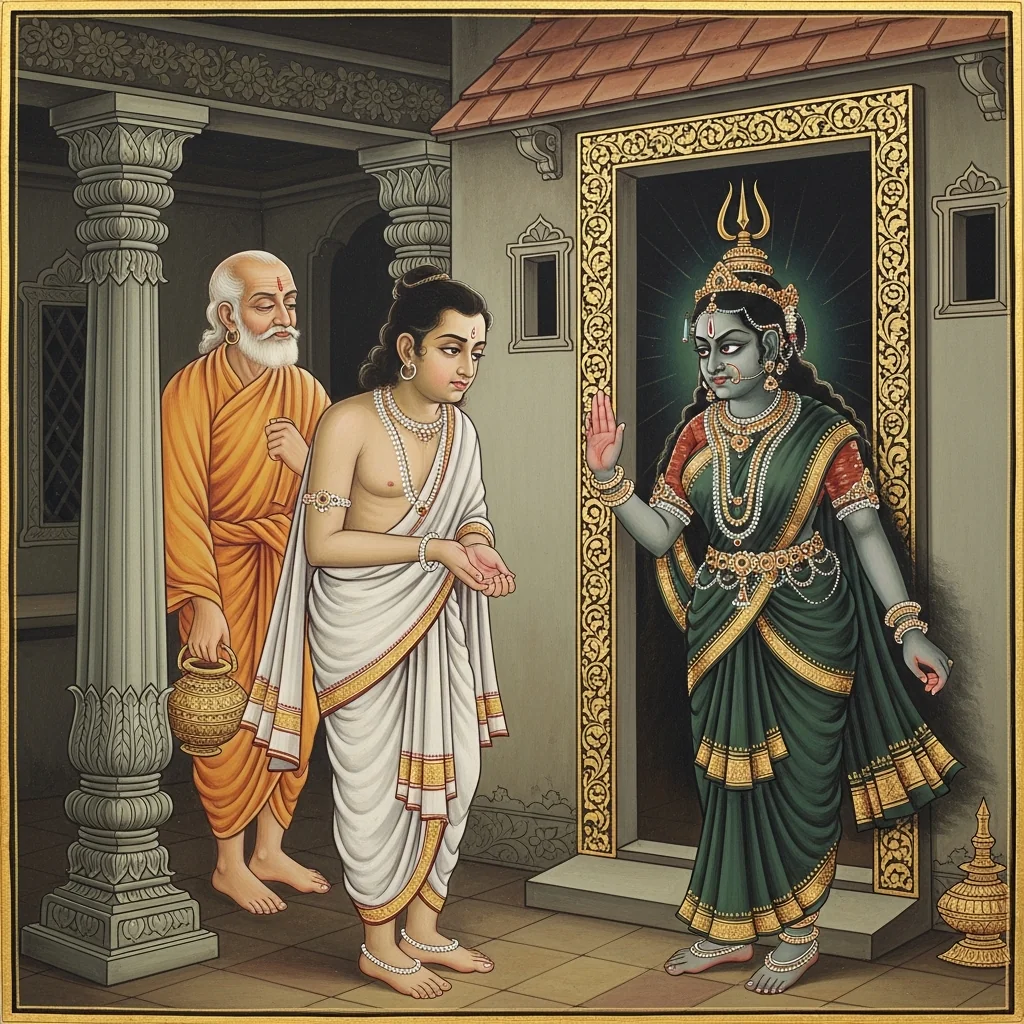
Chapter 14, narrated by Sūta to the sages of Naimiṣāraṇya, presents a didactic itihāsa to proclaim the purificatory power of Svāmitīrtha/Svāmi-puṣkariṇī. The sages ask about Sumati—his lineage, his moral downfall, and the means of his redemption. Sūta says Sumati was the son of Yajñadeva, a learned and devout brāhmaṇa of Mahārāṣṭra. Sumati, however, collapses into grave adharma: he abandons his father and faithful wife, keeps company with a seductive kirātī, turns to theft and intoxication, and finally—disguised for robbery—kills a brāhmaṇa. This is declared a mahāpātaka, and its consequence is personified as the terrifying Brahmahatyā, who pursues him home and warns Yajñadeva that sheltering a patita imperils the whole household, underscoring the weight of transgression and social-ritual exclusion. At the crisis, the sage Durvāsas (a Rudra-aṃśa) arrives; Yajñadeva begs for an expiation. Durvāsas affirms ordinary atonement is nearly impossible, yet prescribes a place-based remedy: bathing at Veṅkaṭādri’s supremely meritorious tīrtha, Svāmi-puṣkariṇī. When Sumati bathes there, an ākāśavāṇī proclaims immediate purification and praises the tīrtha as an “axe to the tree of sin.” The chapter ends with a phalaśruti promising exalted merit to those who hear or recite this account.
Adhyaya 15
कृष्णतीर्थमाहात्म्य (Kṛṣṇatīrtha Māhātmya / The Glory of Kṛṣṇatīrtha)
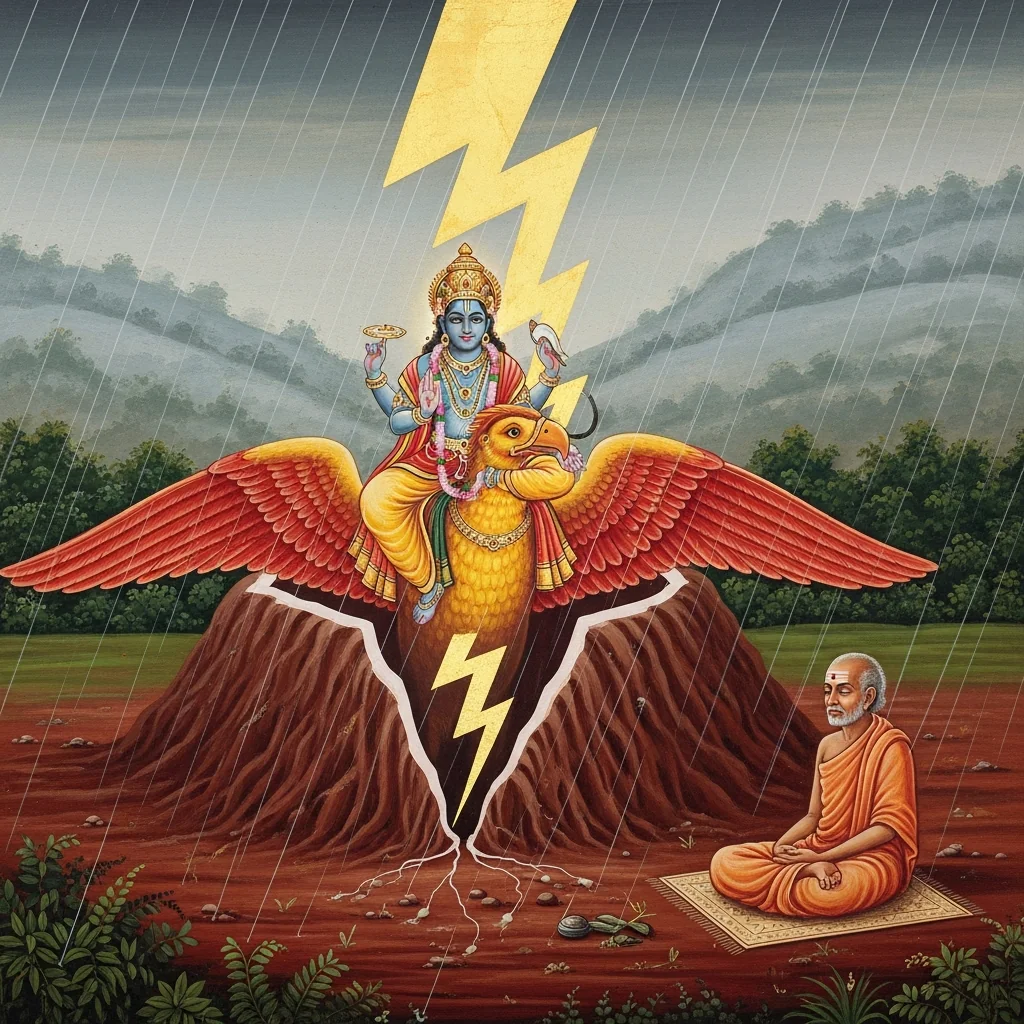
The chapter begins with Śrī Sūta proclaiming the māhātmya of Kṛṣṇatīrtha on the supremely meritorious Veṅkaṭa mountain, praising it as a destroyer of sins. It stresses moral renewal: even the kṛtaghna (the ungrateful) and those who dishonor parents and teachers are said to be purified by bathing there. An origin legend follows. A sage named Kṛṣṇa (within the broader Rāmakṛṣṇa framing) performs intense, motionless tapas on Veṅkaṭācala for many years; an anthill (valmīka) covers his body, and fierce rains and thunder break over him, yet he remains steadfast. When lightning shatters the anthill’s summit, Viṣṇu/Śrīnivāsa appears in a theophany—bearing śaṅkha, cakra, and gadā, mounted on Garuḍa, and adorned with a forest garland. Pleased, the Lord declares an especially auspicious bathing time tied to the day of His manifestation: when the sun is in Makara (Capricorn), on a Paurṇamāsī (full moon) aligned with the Puṣya nakṣatra. Bathing in Kṛṣṇatīrtha then grants freedom from sins and fulfillment of aims; gods, humans, and the guardians of the directions are said to gather for purification. The tīrtha is proclaimed to become famous by the sage’s name, and the chapter ends with a phalaśruti: hearing and reciting this account leads to Viṣṇu-loka.
Adhyaya 16
Jaladāna-praśaṃsā at Veṅkaṭādri (Praise of Water-Giving at Veṅkaṭācala)
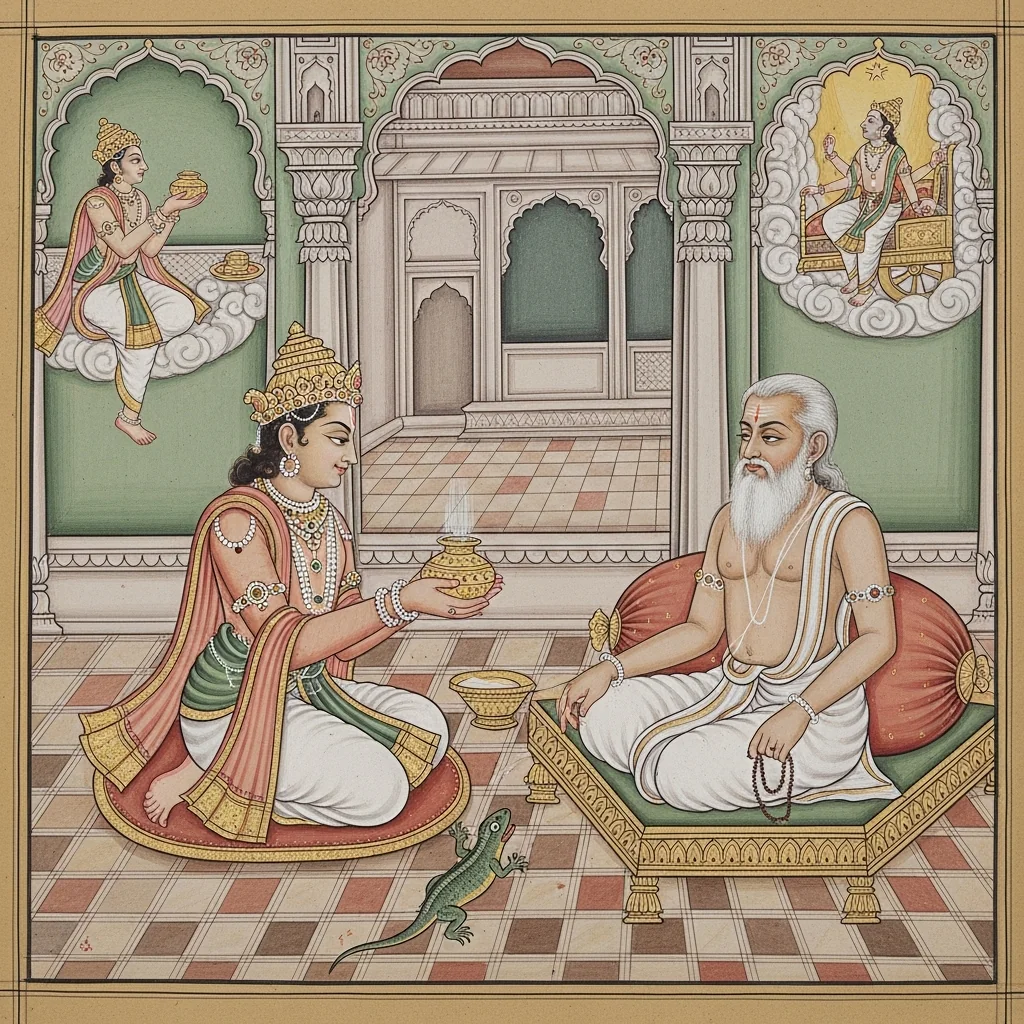
This chapter extols jaladāna—the gifting and provisioning of water—at Veṅkaṭādri as a decisive moral act whose karmic fruit is greatly intensified there. Śrīsūta declares that neglecting water-giving, especially to the thirsty, can lead to painful and adverse rebirth. An illustrative itihāsa follows: King Hemāṅga of the Ikṣvāku line is generous with cows, wealth, and ritual patronage, yet he withholds water, reasoning that it is “easily available” and thus not truly meritorious. He also misplaces honor and gifts, failing in pātra-viveka (discernment of worthy recipients), and neglects learned, disciplined brāhmaṇas. As a result he falls through degraded births, finally becoming a house-lizard (gṛhagodhikā) in Mithilā. When the sage Śrutadeva is received with reverence by the local king, the foot-washing water (pādodaka) splashes; droplets touch the lizard and awaken jāti-smaraṇa, memory of former lives. Hemāṅga confesses, and Śrutadeva explains the causal chain: the omission of jaladāna at Veṅkaṭādri and improper giving. Through transfer of merit and sanctification by water-contact, the sage frees him from the animal state; Hemāṅga ascends to heaven, later gains royal rebirth, and ultimately attains Viṣṇu-sāyujya, the closest union with Viṣṇu. The chapter closes by reaffirming Veṅkaṭādri’s purifying power and jaladāna as Viṣṇuloka-prada, leading to Viṣṇu’s realm.
Adhyaya 17
Śrīveṅkaṭācala-kṣetrādi-varṇanam (Description of Veṅkaṭācala and its Sacred Preeminence)
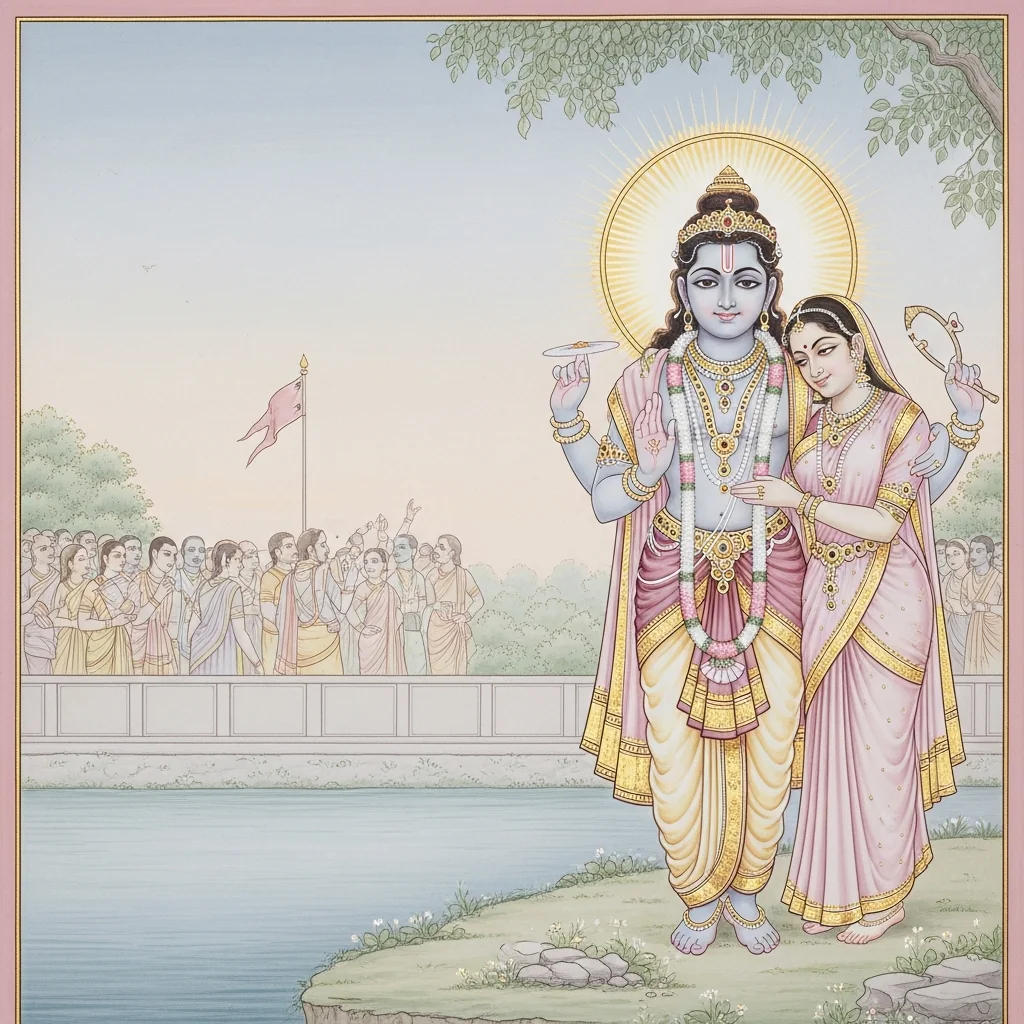
This chapter continues Sūta’s praise of Veṅkaṭādri/Veṅkaṭācala, declaring that all tīrthas—earthly and cosmic—are contained within the Veṅkaṭa mountain, making it a complete sacred microcosm. The Lord is portrayed in classical Vaiṣṇava form, bearing śaṅkha and cakra, clad in pītāmbara, and adorned with the Kaustubha jewel, emphasizing His protective, Veda-grounded sanctity. It then depicts widespread regional participation in the annual service and situates the account in the Bhādrapada festival setting, where ritual attendance brings purification. A key institutional feature is the Brahmotsava: Brahmā is said to have established the dhvaja-ārohaṇa (flag-raising) observance in the Kanyā month, and the yearly festival is presented as a grand gathering of humans, devas, gandharvas, siddhas, and learned dvijas. Through repeated superlative comparisons (Gaṅgā among rivers, Viṣṇu among devas), Veṅkaṭa is affirmed as “uttamottama” among kṣetras. The phalaśruti concludes that hearing this with devotion leads to exalted status in Viṣṇu’s realm. The chapter also introduces Śrīsvāmi-puṣkariṇī as a principal tīrtha, near which the Lord abides, embraced by Lakṣmī and granting boons.
Adhyaya 18
Śrīveṅkaṭeśvaravaibhava-varṇanam (Theological Description of the Glory of Veṅkaṭeśvara)
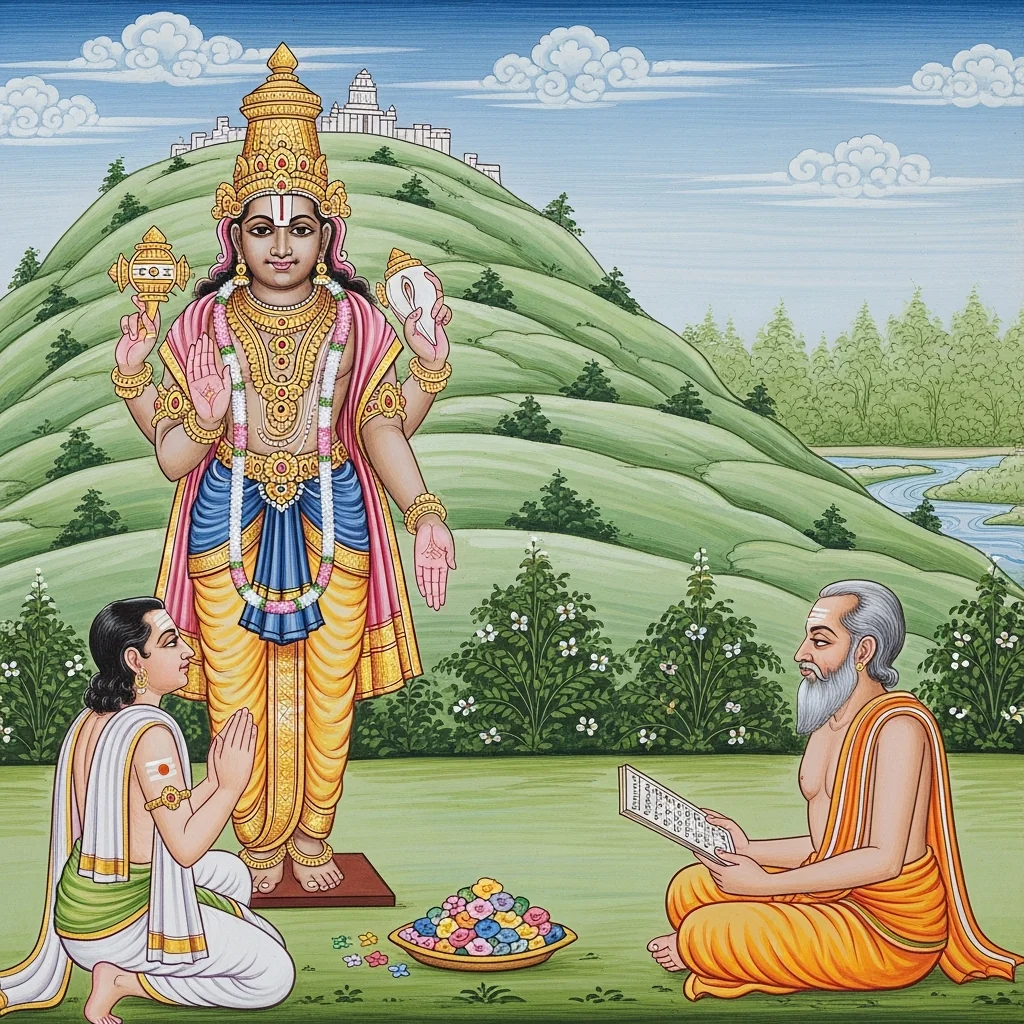
Chapter 18 is framed as Sūta’s theological exposition of the saving power of Śrīnivāsa/Veṅkaṭeśvara. It teaches a place-centered soteriology: a single darśana of Veṅkaṭeśvara is declared sufficient to grant liberation and Viṣṇu-sāyujya, with yuga-comparisons stressing the swift, immediate fruit of merit in Kali-yuga. Veṅkaṭācala is praised as an all-encompassing tīrtha-field that contains the efficacy of many holy places and is symbolically inhabited by devas, munis, and pitṛs. The chapter repeatedly elevates remembrance and praise above external rites, while outlining aṣṭavidhā bhakti—eight modes of devotion—such as affection for devotees, contentment through worship, personal service, eagerness to hear the Lord’s greatness, and continual remembrance. Ethical counsel appears as warnings against neglecting or opposing this sacred center. Phalaśruti passages promise freedom from pāpa, escape from Yama’s afflictions, ascent to Viṣṇu’s realm, and manifold benefits for those who hear or recite the chapter with devotion.
Adhyaya 19
Veṅkaṭācala-Nityāvasthā, Ārohaṇa-Krama, and Pāpavināśana-Tīrtha Māhātmya (दर्शन-आरोहण-तीर्थमाहात्म्य)
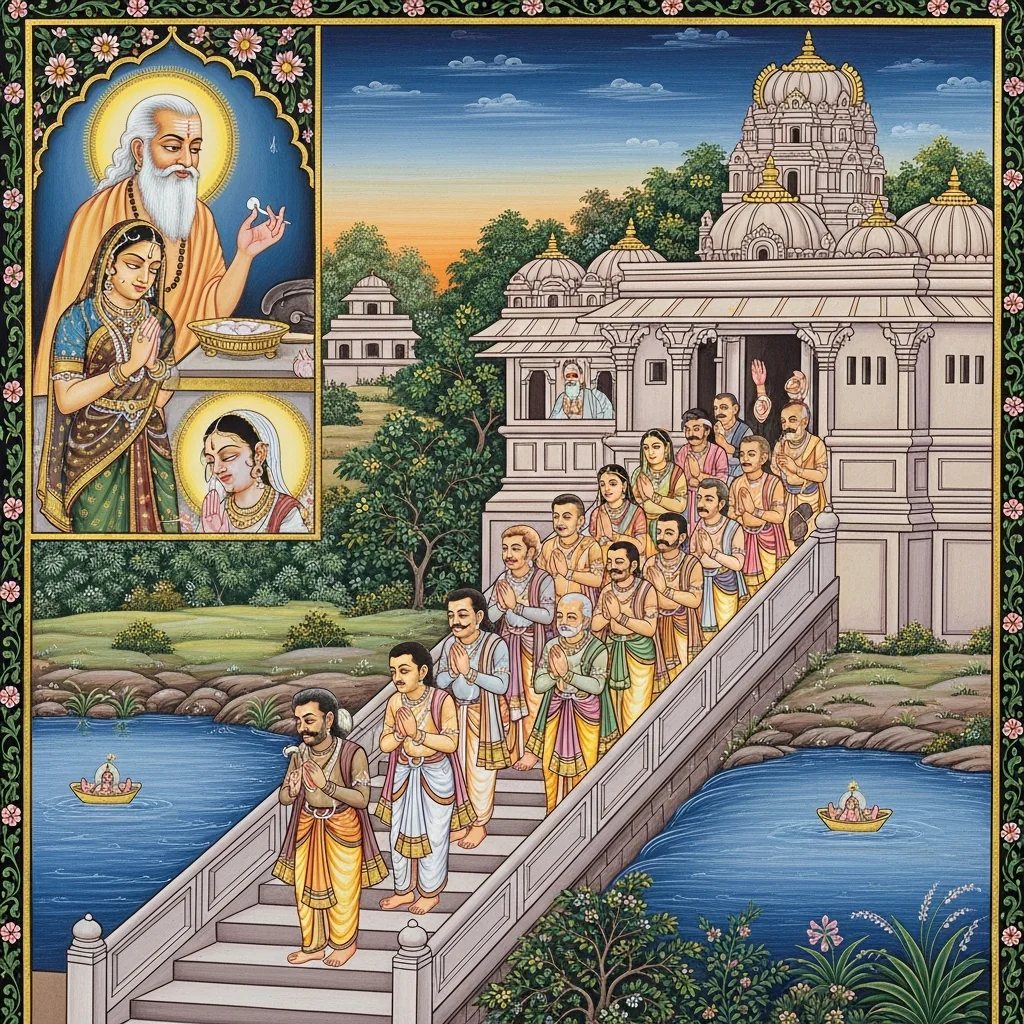
Chapter 19 portrays Veṅkaṭācala as an eternally sanctified realm, filled with countless lakes, rivers, seas, forests, and āśramas, inhabited by sages such as Vasiṣṭha, along with siddhas, cāraṇas, and kinnaras. The hill is depicted as a continuous sacred assembly where major deities abide—Viṣṇu with Lakṣmī and Dharaṇī, Brahmā with Sāvitrī and Sarasvatī, Śiva with Pārvatī, Gaṇeśa and Ṣaṇmukha, Indra and other devas, planetary deities, vasus, pitṛs, and lokapālas. It then lays down a pilgrimage protocol for ascent: the pilgrim verbally seeks Veṅkaṭādri’s forgiveness and prays for the vision of Mādhava, proceeding with gentle steps onto the holy ground. At Svāmipuṣkariṇī one bathes with restraint and offers even a small piṇḍadāna to the ancestors, with the promise of uplift through post-mortem states. The chapter’s focus is the glory of Pāpavināśana tīrtha, famed across worlds: mere remembrance is said to avert the fate of “womb-dwelling,” and bathing north of Svāmi-tīrtha grants ascent to Vaikuṇṭha. Answering the ṛṣis, Sūta narrates a didactic legend: near Himavat in Brahmāśrama, the śūdra Dṛḍhamati seeks advanced rites but is refused initiation by a kulapati brāhmaṇa who cites strict eligibility norms; Dṛḍhamati instead undertakes austerities and builds devotional works. Later, the brāhmaṇa Sumati—through long association—teaches him Vedic rites and performs pitṛ-karmas, which leads to Sumati’s terrible suffering after death and a long chain of rebirths. Agastya reveals the karmic cause and prescribes the sole remedy: a three-day bath at Pāpavināśana on Veṅkaṭācala, destroying the brahmarākṣasa affliction and restoring wellbeing; father and son attain liberation at death. Dṛḍhamati too, after degraded births, drinks and bathes there as a bird and is instantly transformed, ascending in a divine vehicle—reaffirming the tīrtha’s power to purify and to rectify even ethically compromised lives.
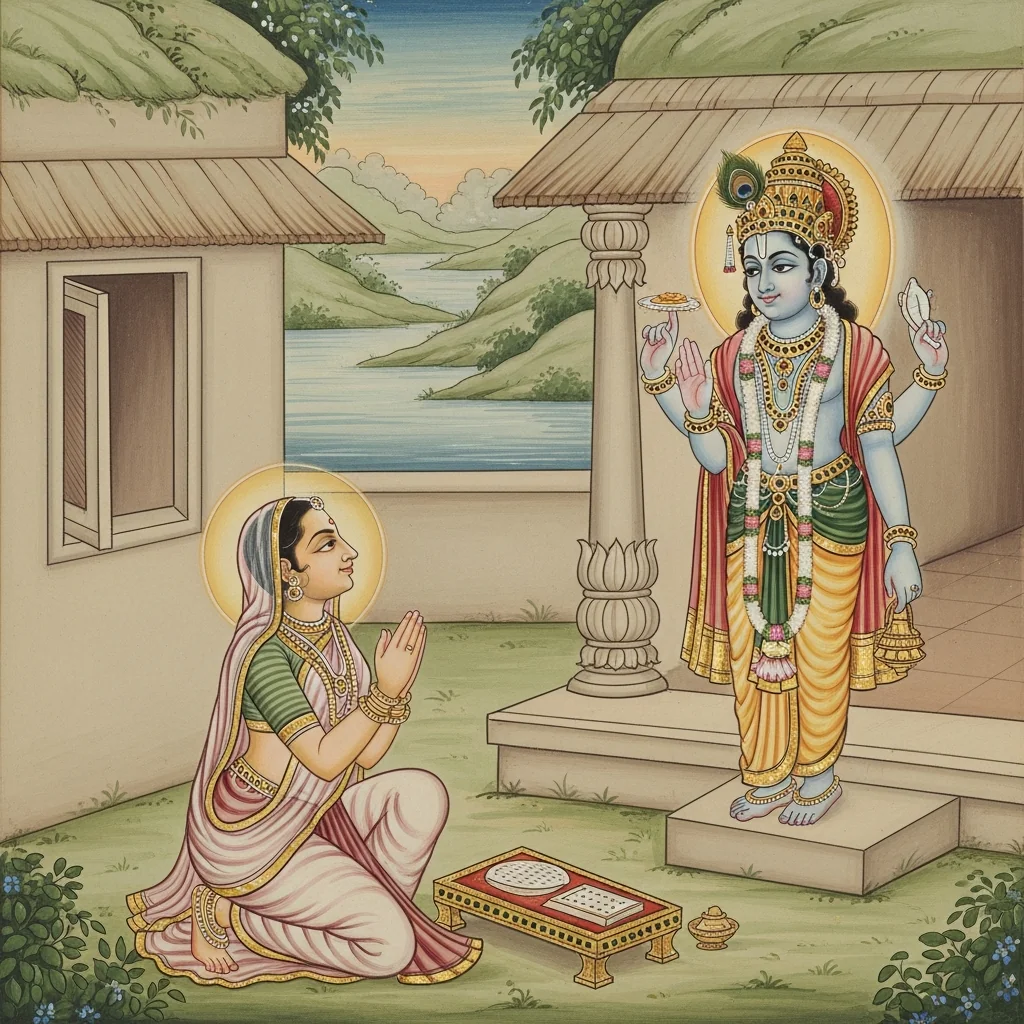
Adhyaya 20
पापनाशनतीर्थमाहात्म्यं तथा भूमिदानप्रशंसा (Glory of Pāpanāśana Tīrtha and the Praise of Land-Donation)
Śrī Sūta proclaims the sin-destroying power of Pāpanāśana-tīrtha through an exemplary tale. Bhadrmati, a learned brāhmaṇa of good conduct yet crushed by poverty, laments how want brings social disregard and inner anguish. His wife Kāminī—portrayed as a discerning pativratā—urges a pilgrimage to Veṅkaṭācala: bathe with saṅkalpa, seek Śrīnivāsa, and perform bhū-dāna (the gift of land), citing Nārada’s teaching and her father’s precedent. The chapter extols bhū-dāna as the highest of gifts, listing its superior fruits and even lofty ritual equivalences, and declaring that it can annul grave sins when given to a worthy recipient (śrotriya, ahi-tāgni). The donor Sughōṣa grants Bhadrmati a measured plot, dedicating the act to Janārdana, and thereby attains an auspicious post-mortem destiny. Bhadrmati then journeys with his family to Veṅkaṭācala, bathes at Svāmi-saras, beholds Veṅkaṭeśvara, and completes the land-donation at Pāpanāśana-tīrtha. By the rite’s power Viṣṇu appears, bearing conch, discus, and mace, receives Bhadrmati’s hymn, and grants assurance of worldly welfare and final liberation; Sūta closes by reaffirming the māhātmya of the tīrtha and of land-donation.
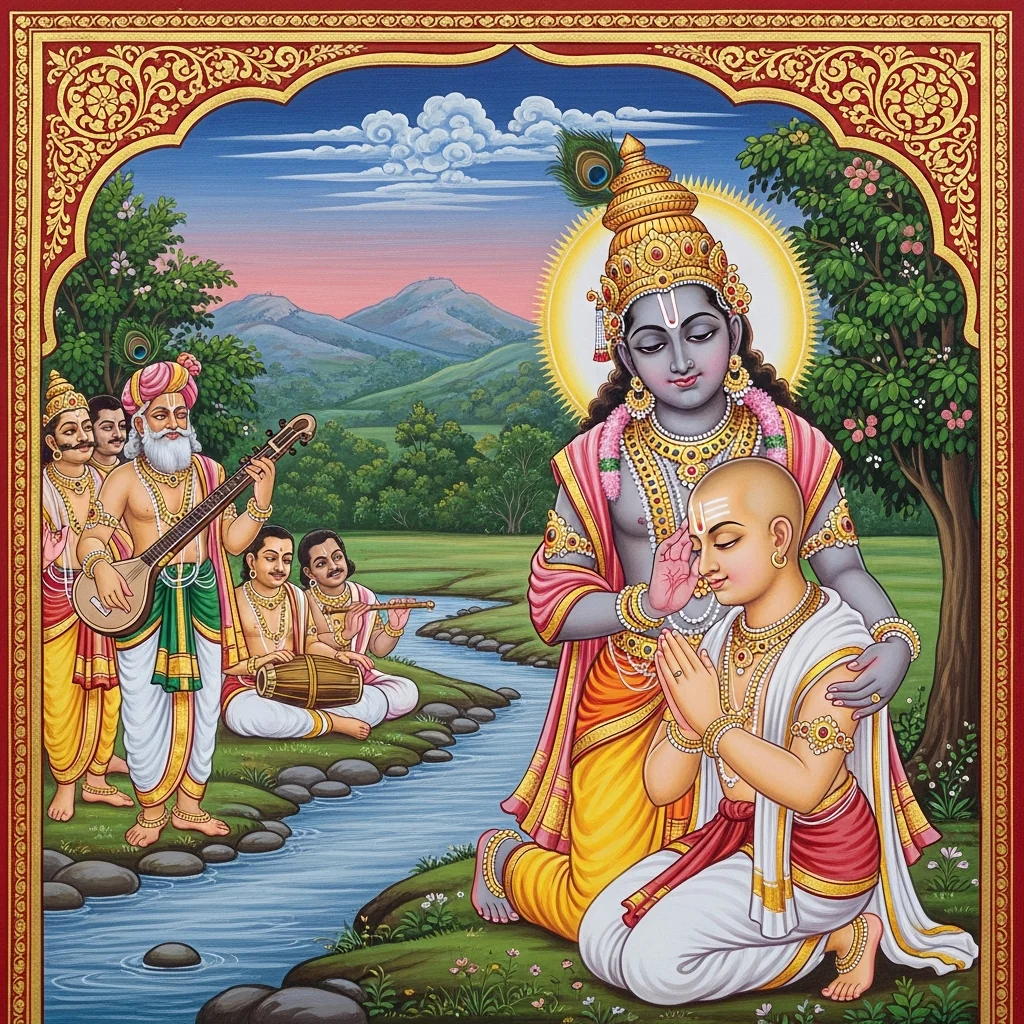
Adhyaya 21
Ākāśagaṅgā-tīrtha Māhātmya and Bhāgavata-Lakṣaṇa (रामानुजतपः, वेंकटेशदर्शनम्, भागवतलक्षणानि)
Śrī Sūta, speaking to the sages of Naimiṣāraṇya, narrates the supreme glory of the Ākāśagaṅgā tīrtha and the marks of true bhāgavatas. A brāhmaṇa named Rāmānuja—learned in śāstra, self-controlled, and devoted to Vaikhānasa discipline—undertakes long, season-ordered austerities on Ākāśagaṅgā’s bank: pañcāgni in summer, exposure during the rains, and water-rest in winter, along with aṣṭākṣara mantra-japa and inward meditation on Janārdana. Veṅkaṭeśa/Śrīnivāsa then manifests in a radiant epiphany, bearing conch, discus, and mace, with Śrī Lakṣmī upon His chest, attended by divine retinues, Nārada, and celestial music. Receiving Rāmānuja’s stuti, the Lord embraces him and offers a boon; Rāmānuja asks only for unwavering bhakti, declaring darśana the highest attainment, and the discourse affirms the saving power of the Lord’s Name and sight. The deity specifies a most fruitful bathing time at Ākāśagaṅgā—Mesha-saṅkrānti coinciding with Citrā nakṣatra on the pūrṇimā—promising access to the supreme, non-returning abode. He also explains how to recognize bhāgavatas, listing the qualities of bhāgavata-uttamas: non-harm, freedom from envy, restraint, truthfulness, service to parents, brāhmaṇas, and cows, love of hearing sacred narratives, pilgrimage-mindedness, gifts of water and food, Ekādaśī observance, delight in Hari-nāma, reverence for tulasī, and public works such as tanks, wells, gardens, and temples. Sūta concludes that this is the “uttama” māhātmya of Viyadgaṅgā at Vṛṣādri/Veṅkaṭādri.
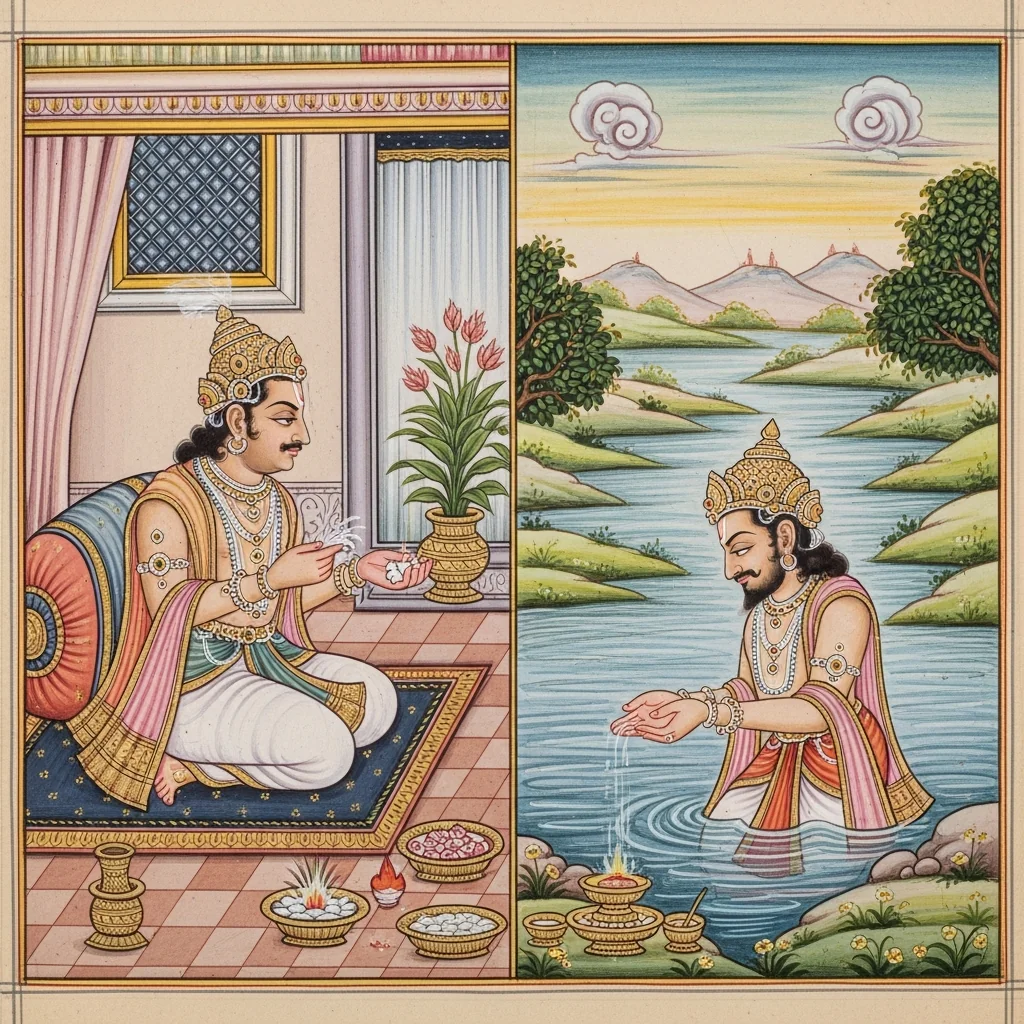
Adhyaya 22
दानार्हसत्पात्रनिर्णयः तथा आकाशगंगामाहात्म्यम् (Eligibility for Worthy Recipients of Gifts and the Glory of Ākāśagaṅgā/Viyadgaṅgā)
The chapter begins with the ṛṣis asking Sūta who is fit to receive dāna and what times and conditions make giving proper. Sūta sets out a normative order in which the brāhmaṇa is the chief ritual recipient, yet acceptance is restricted to those of proven ethics and discipline. He supplies a long list of exclusions—those hostile to Veda and dharma, deceitful, violent, selling sacred knowledge for gain, or persistently begging—declaring gifts to such persons niṣphala (fruitless). He then explains the etiquette of salutations (abhivādana), noting situations and persons where salutations are discouraged and warning that indiscriminate or procedurally faulty reverence diminishes prior merit. A second section presents the māhātmya of Ākāśagaṅgā/Viyadgaṅgā through an embedded tale transmitted from Nārada to Sanatkumāra. Puṇyaśīla, a virtuous brāhmaṇa, performs annual śrāddha but mistakenly appoints a “vandhyāpati” (husband of a barren woman, treated here as ineligible) as officiant, and his face becomes donkey-like (gārdabha-ānana). Seeking Agastya, he learns the ritual fault and receives stricter rules for śrāddha invitations: choose a qualified householder brāhmaṇa with offspring and discipline; failing that, a close kinsman or oneself. Agastya prescribes atonement by pilgrimage to Veṅkaṭācala—bathing first in Swāmipuṣkariṇī and then, according to tīrtha-vidhi, in Viyadgaṅgā/Ākāśagaṅgā—after which the deformity is said to vanish at once. Sūta concludes by reaffirming the lineage of transmission.
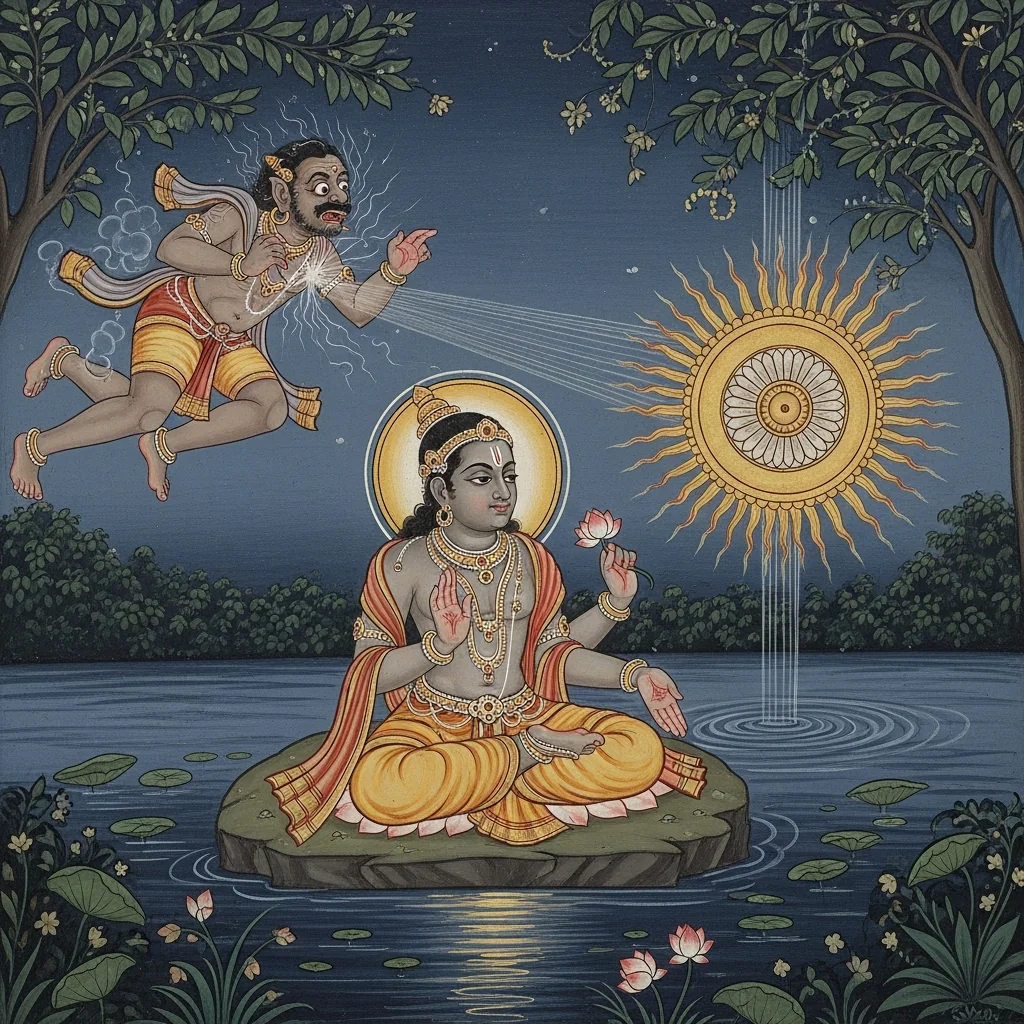
Adhyaya 23
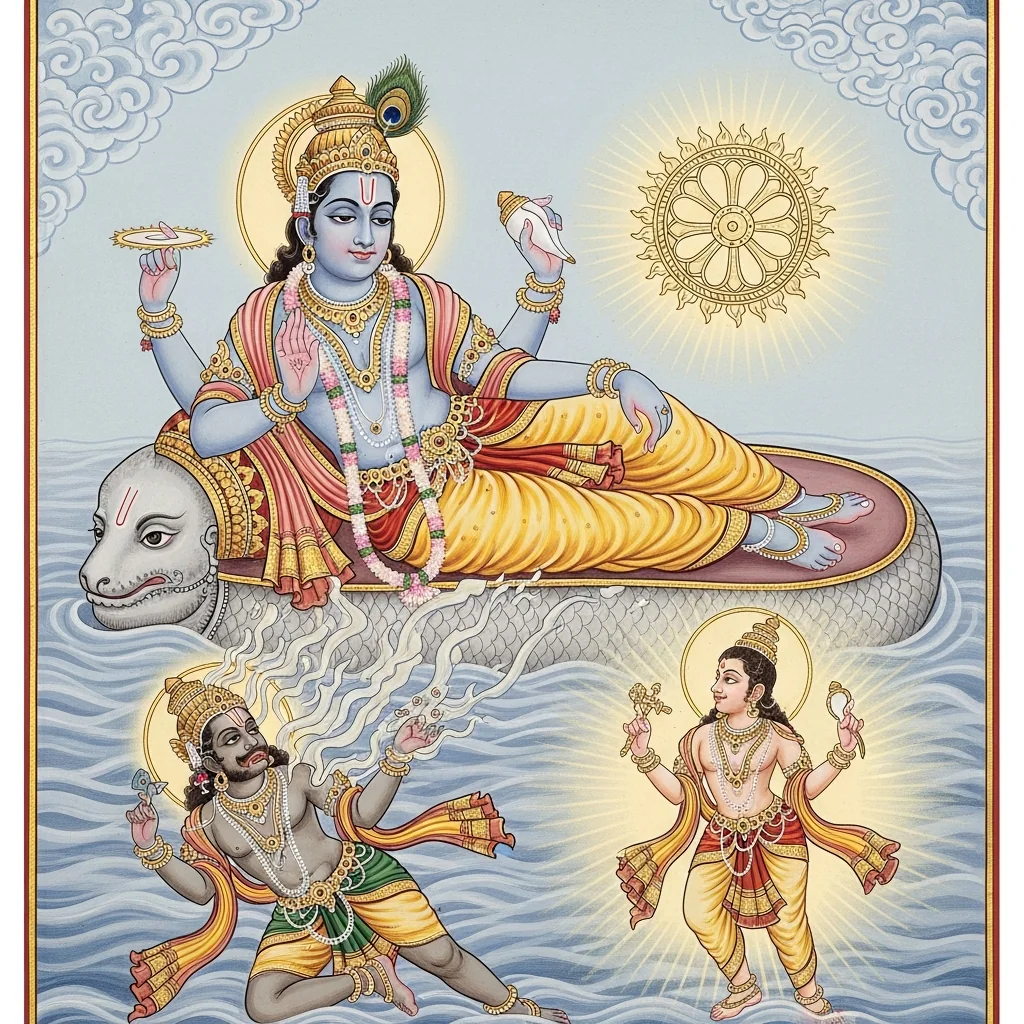
Cakratīrtha-māhātmya and Padmanābha’s Tapas; Sudarśana’s Protection (चक्रतीर्थमाहात्म्यं)
Sūta addresses the sages and proclaims the māhātmya of Cakratīrtha as a teaching centered on purification. Hearing its greatness is said to remove moral taints and turn the devotee’s mind toward Viṣṇu’s abode. The narrative introduces Padmanābha, a disciplined brāhmaṇa-ascetic, who performs long tapas on the bank of Cakrapuṣkariṇī, marked by truthfulness, compassion, restraint, non-attachment, and goodwill to all beings. Pleased, Śrīnivāsa/Veṅkaṭeśvara manifests, receives Padmanābha’s formal stuti praising Him as protector, remover of impurity, cosmic witness, and refuge of devotees, and instructs him to dwell by the tīrtha in unbroken worship. A rākṣasa then threatens the sage; Padmanābha seeks refuge in the Lord. Viṣṇu sends Sudarśana, the divine discus, blazing with fiery brilliance; the demon flees and is slain. Padmanābha praises Sudarśana and asks for lasting protection, and Sudarśana grants the boon of abiding at Cakratīrtha for the welfare of beings, establishing the site’s protective fame. Bathing there is declared mokṣa-oriented and purifying even for one’s descendants; the chapter ends by reaffirming the merit of reciting and hearing, and by exalting Cakratīrtha as incomparable among tīrthas, promising liberation to bathers.
Adhyaya 24
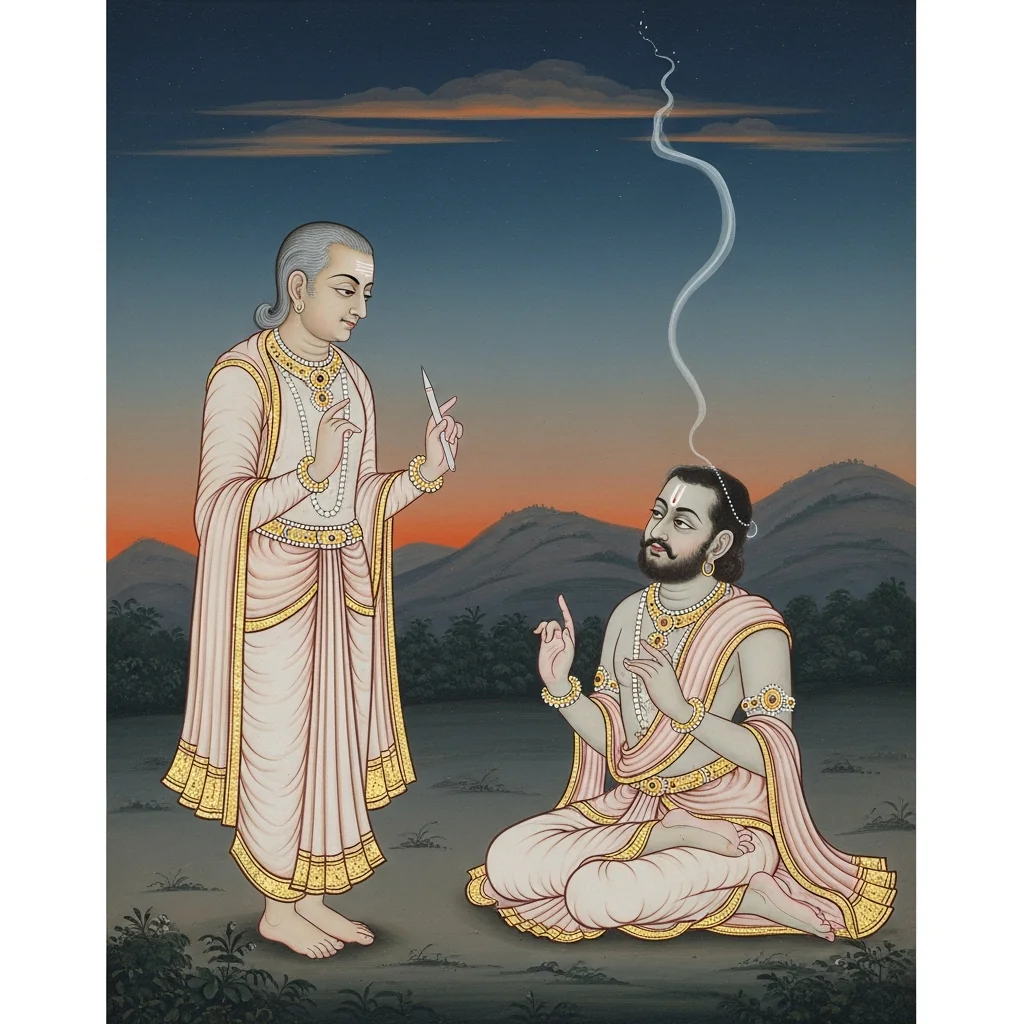
सुन्दरगन्धर्वस्य शापः, राक्षसत्वनिवृत्तिः, चक्रतीर्थमाहात्म्यम् (Sundara Gandharva’s Curse, Release from Rākṣasa-form, and the Glory of Cakratīrtha)
The chapter begins with the ṛṣis asking Sūta about a cruel rākṣasa who harmed a Viṣṇu-devoted brāhmaṇa. Sūta recalls an earlier episode at Śrīraṅga, portrayed as Vaikuṇṭha-like, where devotees worship Śrīraṅganātha. There the gandharva Sundara, son of Vīrabāhu, behaves immodestly with many women at a water-site. When Vasiṣṭha arrives for the midday rites, the women cover themselves but Sundara does not; for this shamelessness Vasiṣṭha curses him to become a rākṣasa. The women plead for mercy, stressing the social and ethical harm. Vasiṣṭha upholds the truth of his word yet grants a remedy: the curse will last sixteen years; afterward Sundara, wandering in rākṣasa form, will reach auspicious Veṅkaṭādri and Cakratīrtha. There dwells the yogin Padmanābha; when the rākṣasa attacks him, Viṣṇu’s Sudarśana will be moved to protect the brāhmaṇa, sever the rākṣasa’s head, and thus release Sundara back to his divine form and to heaven. The narrative unfolds accordingly: Sundara becomes a terrifying rākṣasa, roams for sixteen years, and finally assaults Padmanābha at Cakratīrtha. The yogin praises Janārdana; Sudarśana arrives and slays the rākṣasa. Restored and radiant, Sundara extols Sudarśana and asks leave to return to heaven and to meet his grieving wives; Sudarśana grants it. Padmanābha then petitions Sudarśana to remain at Cakratīrtha for ongoing sin-removal, liberation, and protection from fear of beings such as bhūtas and piśācas. Sūta concludes that hearing this account frees people from sins and that the tīrtha’s purifying glory has been declared.
Adhyaya 25
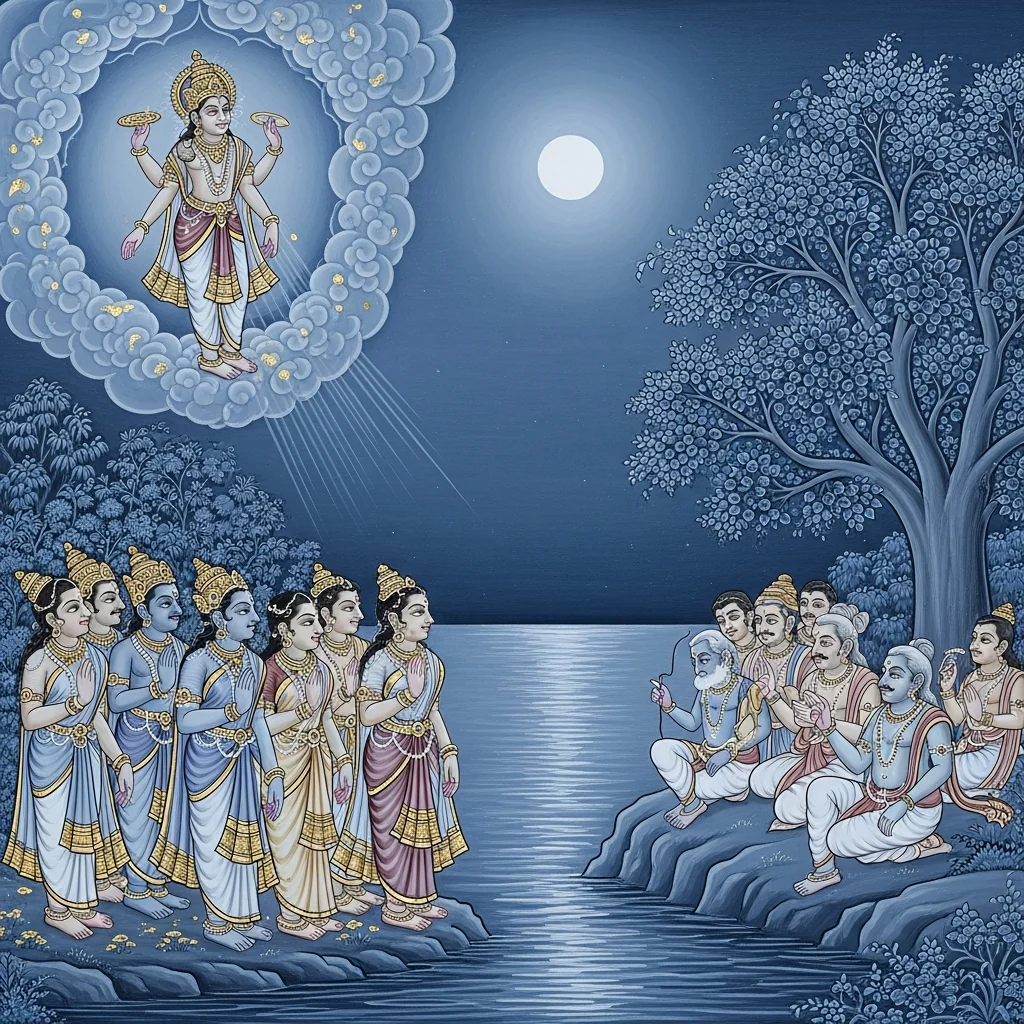
जाबालितीर्थमाहात्म्यवर्णनम् | The Glory of Jābāli Tīrtha (Jābālītīrtha Māhātmya)
Chapter 25 is a tīrtha-māhātmya related by Śrī Sūta to the sages of Naimiṣāraṇya. He proclaims the greatness of Jābālītīrtha on Veṅkaṭādri, a sacred ford said to destroy all sins. The sages ask about a man named Durācāra and the nature of his wrongdoing. Sūta explains that Durācāra, a brāhmaṇa living near the Kāverī, kept long company with perpetrators of mahāpātakas—such as a slayer of a brāhmaṇa, a drinker of liquor, a thief, and one who violates the guru’s bed. The text sets out a graded teaching on ritual-social defilement: through prolonged cohabitation, contact, eating, and sleeping with such offenders, one’s “brāhmaṇya” steadily diminishes until one becomes equal in fault. Durācāra is then afflicted, seized by a vetāla, and wanders in misery. By residual merit and providential convergence he reaches Veṅkaṭādri and is plunged into Jābālītīrtha; he is immediately freed from the vetāla and from sin. He approaches the sage Jābāli for an explanation, and Jābāli reveals that the vetāla was once a brāhmaṇa who neglected the prescribed pārvaṇa-śrāddha on the death-day, was cursed by the ancestors, and became a vetāla—yet bathing in Jābālītīrtha releases even such a being to Viṣṇuloka. The chapter warns that neglecting śrāddha for deceased parents leads to a vetāla-state and then to hell, and it closes with a phalaśruti: mere bathing at Jābālītīrtha removes even hard-to-expiate sins, including those without a clear prāyaścitta in smṛti, and hearing this account is likewise purifying and liberative.
Adhyaya 26
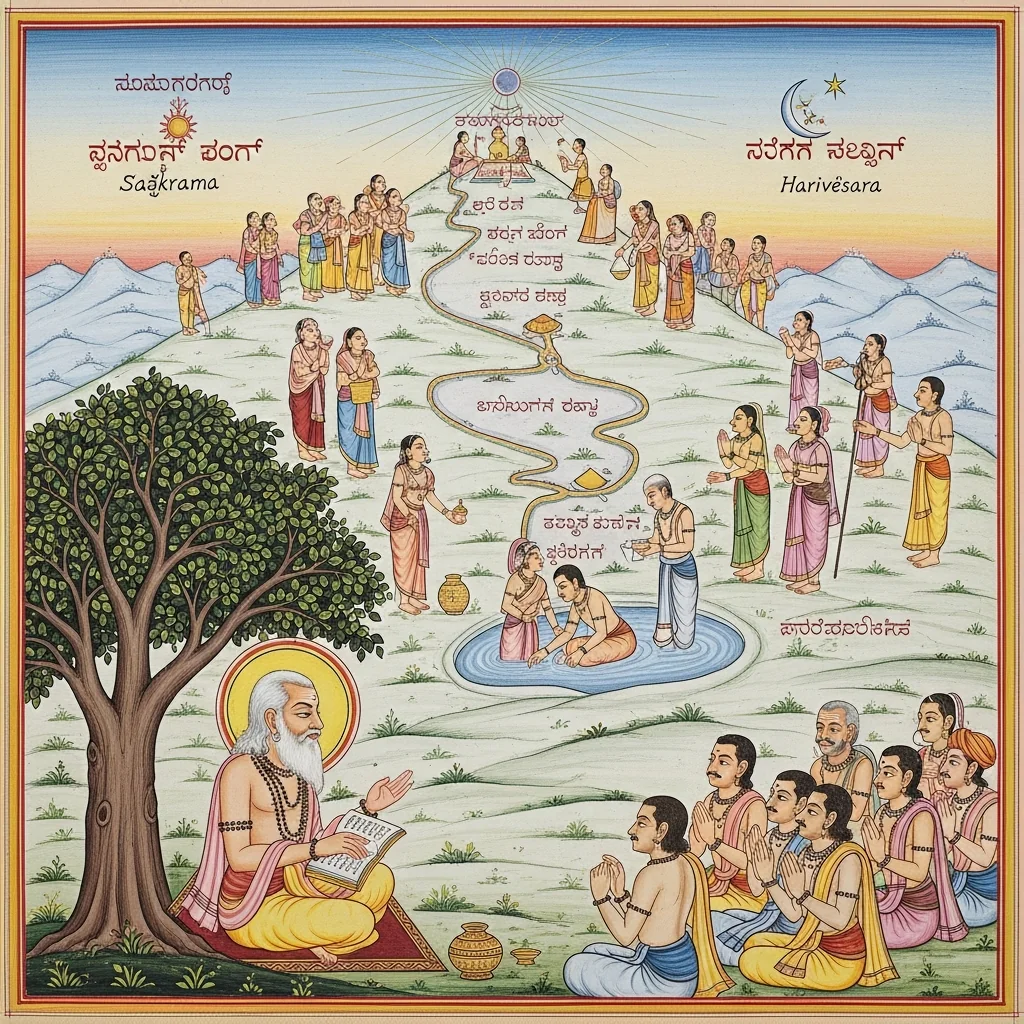
Ghōṇa-tīrtha (Tumburu-tīrtha) Māhātmya and the Tumburu Gandharva Narrative
Chapter 26 unfolds the exceptional purifying power of Ghōṇa-tīrtha. Śrī Sūta declares the most auspicious time for bathing there: when Uttarā-Phālgunī coincides with the bright fortnight and the Sun enters Mīna, for then the great tīrthas—Gaṅgā and others—are said to converge at this spot. A doctrinal and ethical warning follows: those who turn away from bathing at Ghōṇa-tīrtha are portrayed through a catalogue of grave social and ritual offenses, strengthening the duty of pilgrimage and the logic of repentance. The text then shifts to redemption, listing many kinds of wrongdoing that are cleansed by bathing, drinking the water, and devoted engagement with the tīrtha, presenting it as a ritual means of moral restoration. An embedded legend (itihāsa) explains the name Tumburu-tīrtha: Devala tells Gārgya that Tumburu the Gandharva, after a household conflict leading to a curse, attains Viṣṇuloka by bathing and worshiping Veṅkaṭeśvara. The cursed wife becomes a frog living in a pippala hollow near the tīrtha until Agastya arrives, teaches pativratā-dharma, and restores her. The phalaśruti concludes that bathing at Ghōṇa-tīrtha on Paurṇamāsī yields fruits equal to great gifts and sacrifices, and that hearing this chapter grants Vājapeya-like merit and enduring Viṣṇuloka.
Adhyaya 27
Veṅkaṭācala as the Basis of All Tīrthas: Tīrtha-Enumeration, Auspicious Bathing Times, and the Merit of Purāṇa-Śravaṇa
Chapter 27 begins with the sages questioning Sūta about Veṅkaṭādri’s standing as a “mountain of great merit,” asking for a quantified hierarchy of its tīrthas: the total number, the principal ones, and those that bestow dharma-inclination, knowledge, devotion with detachment (bhakti–vairāgya), and liberation (mokṣa). Sūta replies with a structured enumeration—an immense total, a smaller set marked as “principal,” and further classes defined by their ethical and salvific fruits. The chapter then presents a practical pilgrimage calendar for liberation-linked tīrthas on the summit of Veṅkaṭācala, naming Svāmipuṣkariṇī, Viyadgaṅgā, Pāpavināśana, Pāṇḍutīrtha, Kumāradhārikā, and Tuṃboṣṭīrtha. It specifies auspicious bathing times keyed to months, yogas, and the Sun’s position (e.g., Kumbha-māsa with Maghā-yoga; Ravi in Mīna; Meṣa-saṅkrama with Citrā; Ravi in Vṛṣabha with Dvādaśī/Harivāsara; Dhanuḥ-māsa Dvādaśī at dawn), each paired with promised results—royal-sacrifice equivalences, removal of obstacles, sin-destruction, and mokṣa—and with dāna norms such as gifts of gold, cows, Śālagrāma-śilā, and giving according to one’s capacity. Finally, it shifts from place-bound rite to portable practice, extolling attentive listening to Viṣṇu’s purāṇic narrative as supremely efficacious in Kali-yuga, even equating brief focused hearing with the aggregate fruits of sacrifices and donations, and joining it with nāma-saṅkīrtana. It also lays down ethical guidelines for speaker and audience—honor due to the reciter, proper venues, disciplined listening manners, and adverse consequences for disrespect or inattention—before the sages honor Sūta and rejoice in the teaching received.
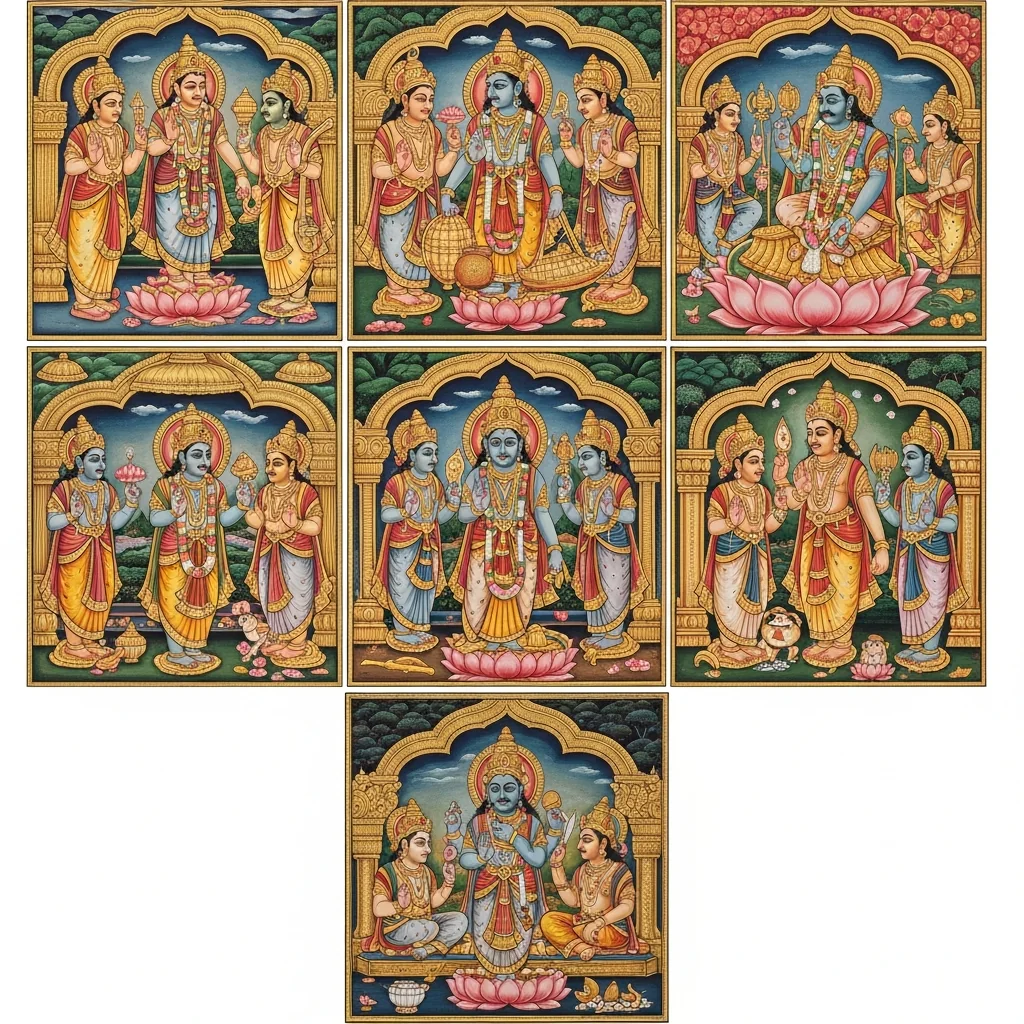
Adhyaya 28
कटाहतीर्थमाहात्म्यम् (Kataha Tīrtha Māhātmya) — Glory and Ritual Use of Kataha Tīrtha
Adhyāya 28 unfolds as a multi-voiced theological discourse on the sanctity of Kaṭāhatīrtha at Śrīveṅkaṭācala. The ṛṣis seek instruction on its renown across the three worlds; Nārada is invoked as an authority, and it is affirmed that even Mahādeva knows its full grandeur. Sacred rivers and famed tīrthas—such as the Gaṅgā—are portrayed as coming to Kaṭāhatīrtha for their own purification, establishing its supreme rank among holy waters. A stern warning follows: the praise of this tīrtha must not be dismissed as mere arthavāda (empty eulogy), for skepticism is deemed spiritually perilous. The chapter then teaches the proper drinking rite (pāna-krama): one should drink while reciting the aṣṭākṣara mantra or the names of Viṣṇu (including triadic naming); if one drinks without mantra, a penitential utterance is prescribed. The teaching culminates in an exemplum. The brahmin Keśava, ruined by vice and violence, incurs brahmahatyā and is hounded by a personified sin; guided by Bharadvāja, he undertakes a pilgrimage sequence—bathing at Svāmipuṣkariṇī, worship of Varāha, darśana of Śrīnिवāsa/Veṅkaṭeśa, and drinking at Kaṭāhatīrtha—by which the brahmahatyā dissolves, confirmed by Veṅkaṭeśa’s divine word. The account closes as an itihāsa-grounded narration faithfully transmitted.
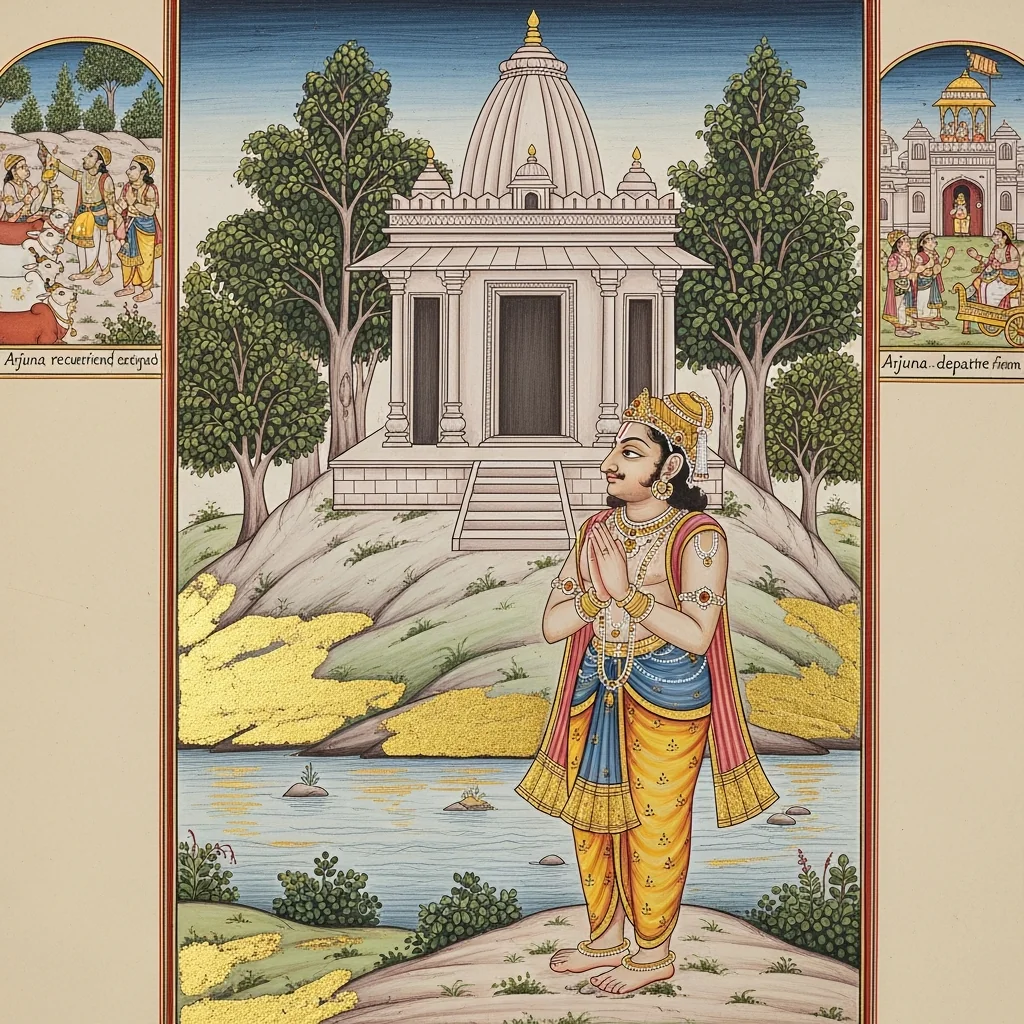
Adhyaya 29
अर्जुनस्य तीर्थयात्रा-प्रसङ्गः तथा सुवर्णमुखरी-वेङ्कटाचल-प्राप्तिः (Arjuna’s Pilgrimage Prelude and Arrival at Suvarṇamukharī and Veṅkaṭācala)
The chapter begins with sages asking for fuller details on the origin and sacred efficacy of the Suvarṇamukharī river and its connected tīrtha-complex. After invocatory salutations, Sūta relates an account attributed to Bharadvāja and turns to an epic-linked narrative: the Pāṇḍavas’ life at Indraprastha and the household vow-arrangement concerning Draupadī. A condition of the vow is stated: if any brother encounters Draupadī in another brother’s residence, he must undertake a year-long pilgrimage. A civic incident follows—Arjuna restores a stolen cow to a brāhmaṇa, but must enter the weapons-house where Draupadī and Yudhiṣṭhira are present, thereby incurring the vow’s consequence. A dharma debate ensues: Yudhiṣṭhira deems the act ethically defensible as protection of a brāhmaṇa and property, while Arjuna insists that vow-integrity must be upheld lest honor and moral order collapse. With royal consent, Arjuna departs with attendants and resources, visits major tīrthas—Gaṅgā, Prayāga, Kāśī, the southern ocean, Purī/Puruṣottama, Siṃhācala, Godāvarī, and other rivers—and finally reaches Śrīparvata and Veṅkaṭācala. There he worships Hari on the summit and beholds the Suvarṇamukharī, said to have been brought by the pot-born sage Agastya, grounding the river’s sanctity in authoritative ascetic power.
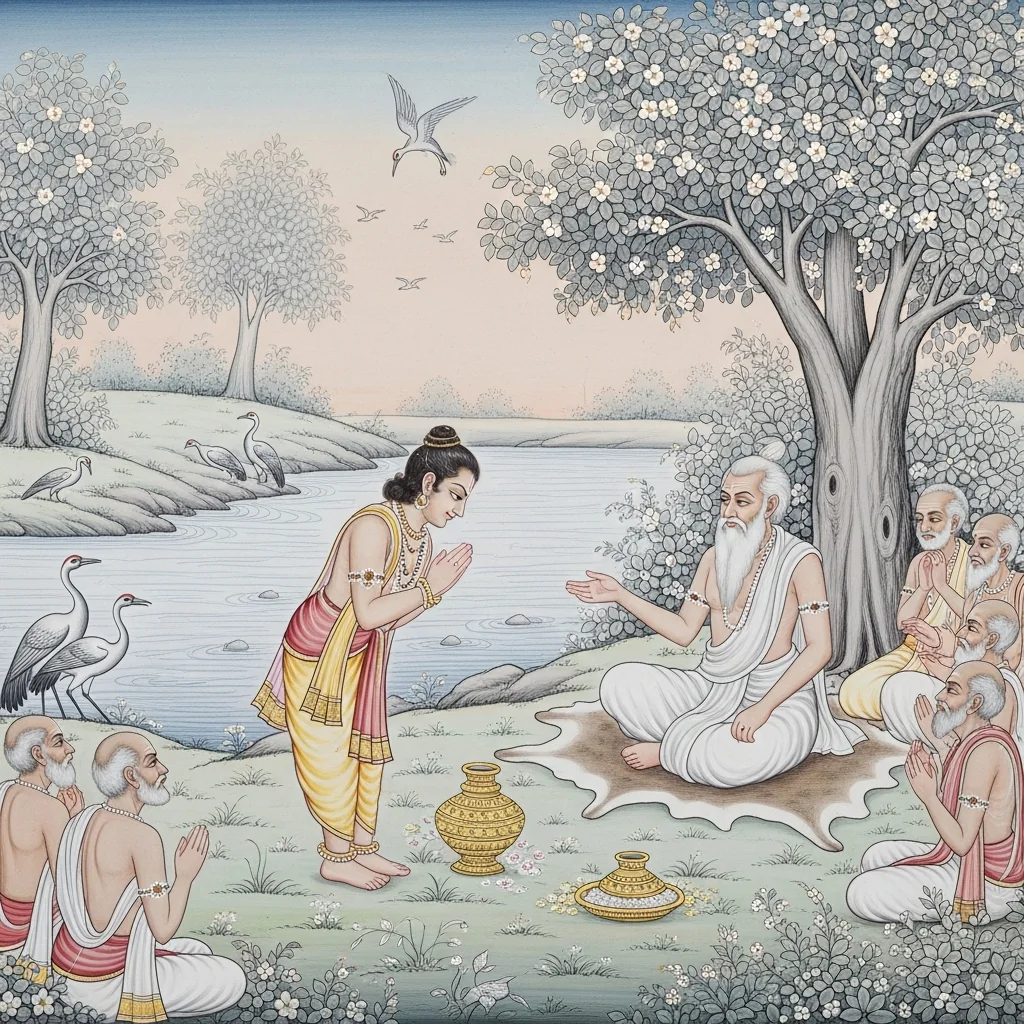
Adhyaya 30
सुवर्णमुखरीवर्णनम् — Description of the Suvarṇamukharī and Arjuna’s visits to Kālahastīśvara and Bharadvāja’s āśrama
In Sūta’s narrative frame, this chapter offers a lyrical, topographical praise of the Suvarṇamukharī river—its cooling breezes, rippling waves, lotuses, waterfowl, and the sanctity of a tīrtha. The river is exalted as a holy power that nourishes fields and sustains ascetic settlements, its natural beauty signaling spiritual potency. Arjuna then beholds the famed mountain linked with Kālahastī, bathes in the river, and performs darśana and worship of Kālahastīśvara (Śiva), feeling the rite brought to completion. Traveling onward, he observes siddhas, gandharvas, yogins, tranquil hermitages, and disciplined muni communities, revealing an ethical ecology where landscape and spiritual practice reinforce one another. The narrative turns to Arjuna’s approach to Bharadvāja’s āśrama, richly portrayed with groves, flowering trees, birds, and serene lakes. Bharadvāja receives him with formal hospitality (arghya, seating, inquiry into wellbeing), and the wish-fulfilling cow is recalled to provide food. The chapter ends with Arjuna’s curiosity about the river’s wondrous origin and power, setting up the next explanation.
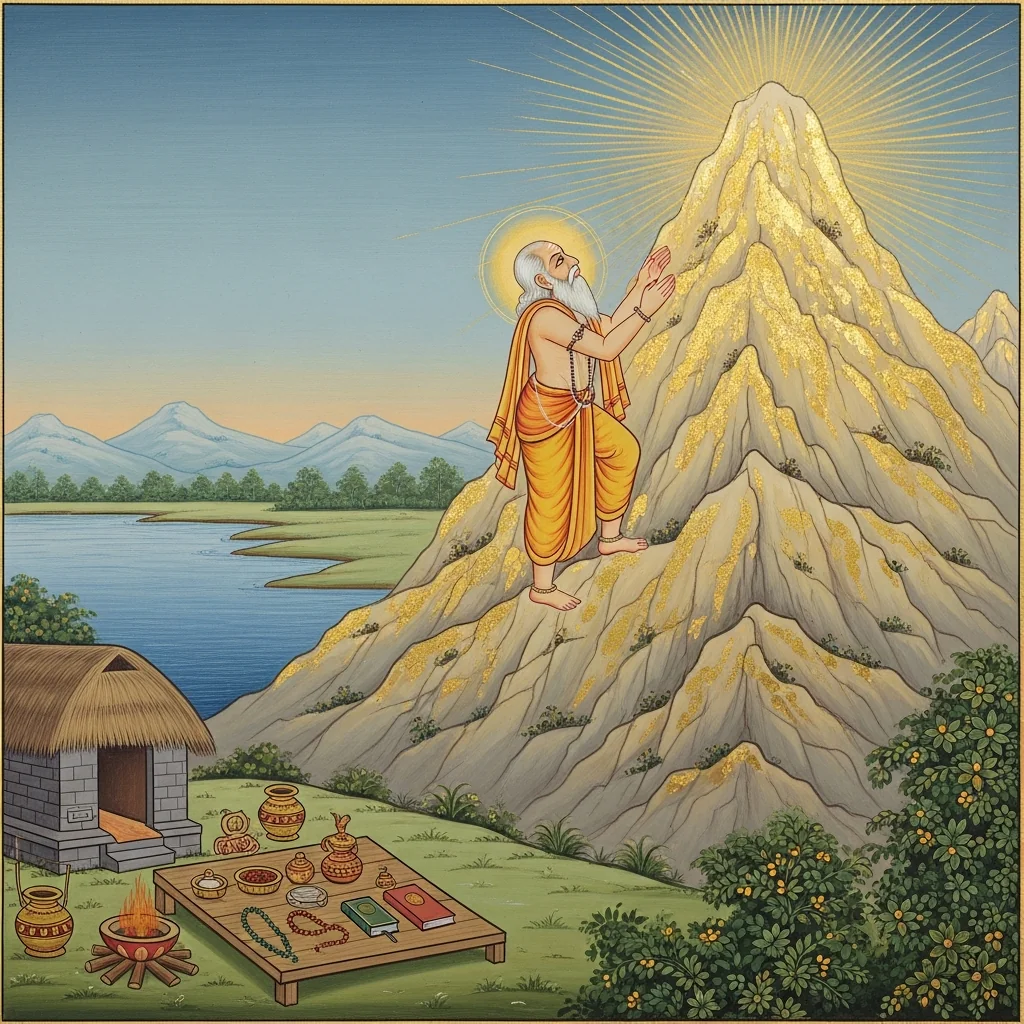
Adhyaya 31
अर्जुन–भरद्वाजसंवादः । अगस्त्यदक्षिणगमनं च (Arjuna–Bhāradvāja Dialogue and Agastya’s Southward Journey)
The chapter begins in the Purāṇic frame: after completing his evening observances, Arjuna reverently approaches the sage Bhāradvāja and asks about the origin of a great river and the merits gained by bathing and giving gifts there. Bhāradvāja praises Arjuna’s virtues and lineage and introduces a purifying “divine account” which, when heard with attentive mind, is said to ease the suffering born of wrongdoing. The narration then turns to a cosmological and ritual episode connected with Śaṅkara’s (Mahādeva’s) marriage. As beings and gods gather to celebrate, the earth becomes overburdened and unstable. Perceiving the imbalance, Mahādeva commissions Agastya—born of divine potency and devoted to protecting the world—to journey south and restore equilibrium. Agastya crosses the Vindhya range, the earth regains balance, and the celestials praise him. Agastya then beholds an exalted mountain, radiant like a fashioned sun, ascends it, and establishes an āśrama near a beautiful lake on its northern bank. There he worships the ancestors, the gods, the sages, and the Vāstu-deities according to rule. Thus the chapter weaves together dialogic inquiry, sacred-geographic origins, and an ethical model of ascetic action that stabilizes the world.
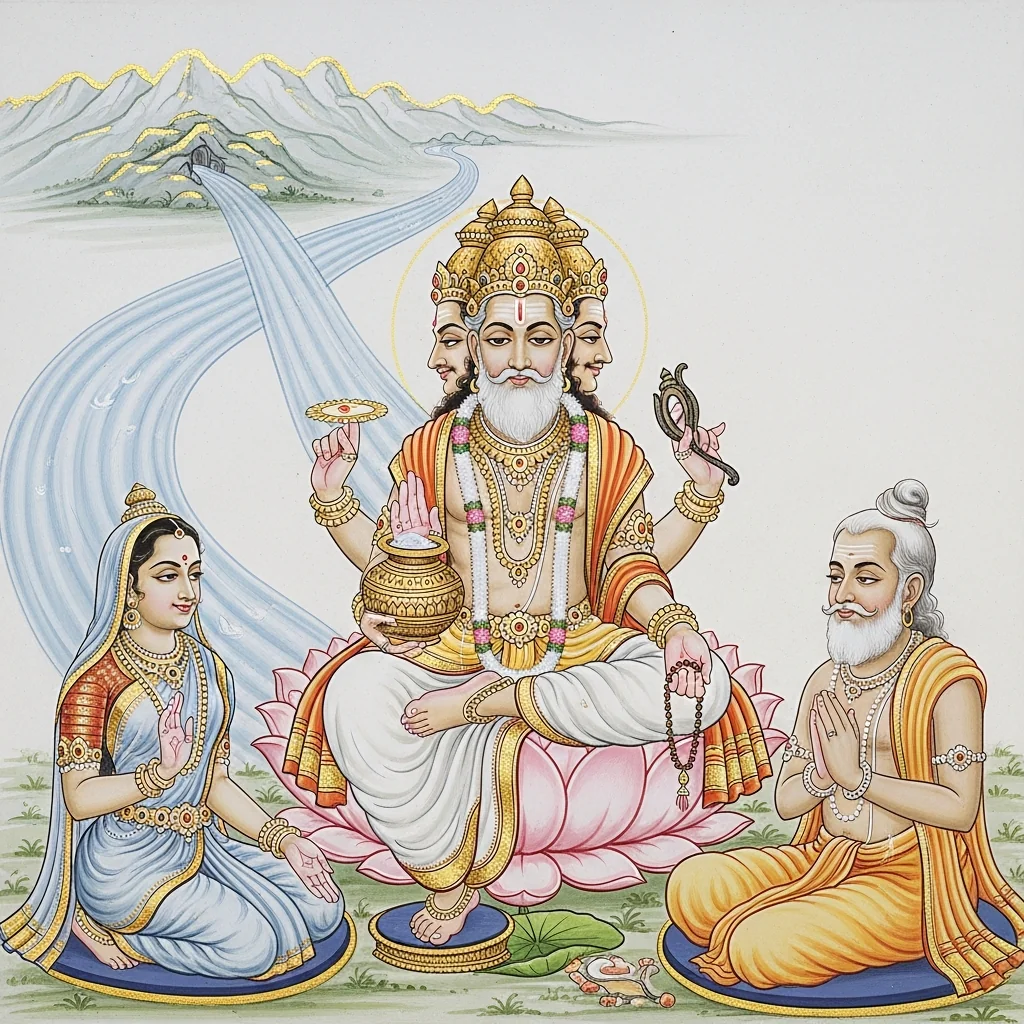
Adhyaya 32
सुवर्णमुखरी-नदी-प्रवर्तनम् (The Manifestation and Course-Setting of the Suvarṇamukharī River)
This adhyāya offers an etiological theological account of how a sacred river is established in a land without rivers for the welfare of all beings. Bharadvāja relates that Agastya, after completing his morning rites and worship, hears an unseen divine proclamation from the sky (ākāśavāṇī) declaring that a riverless country lacks ritual and cultural radiance, and urging him to set in motion a beneficent river that dispels fear born of deep moral affliction. Agastya consults the assembled sages, who praise his earlier extraordinary deeds and request that he bring forth a great river so that sacred bathing and purification may be possible. He then undertakes intense tapas, strengthening his disciplines through harsh seasons; the power of his austerity disturbs the cosmos and fills beings with dread. The devas appeal to Brahmā, who appears at Agastya’s hermitage, grants a boon, and hears his petition. Agastya asks that the land be sanctified and protected by a mighty river. Brahmā summons Gaṅgā and instructs her to descend by a partial emanation (svāṃśa), becoming a river that purifies the people and is continually served by sages and divine beings. Gaṅgā reveals a radiant form born of her own portion and promises fulfillment; Agastya indicates the course, and the chapter concludes with him leading this river-form from the mountain heights along the desired path, establishing the sacred foundation of the Suvarṇamukharī.
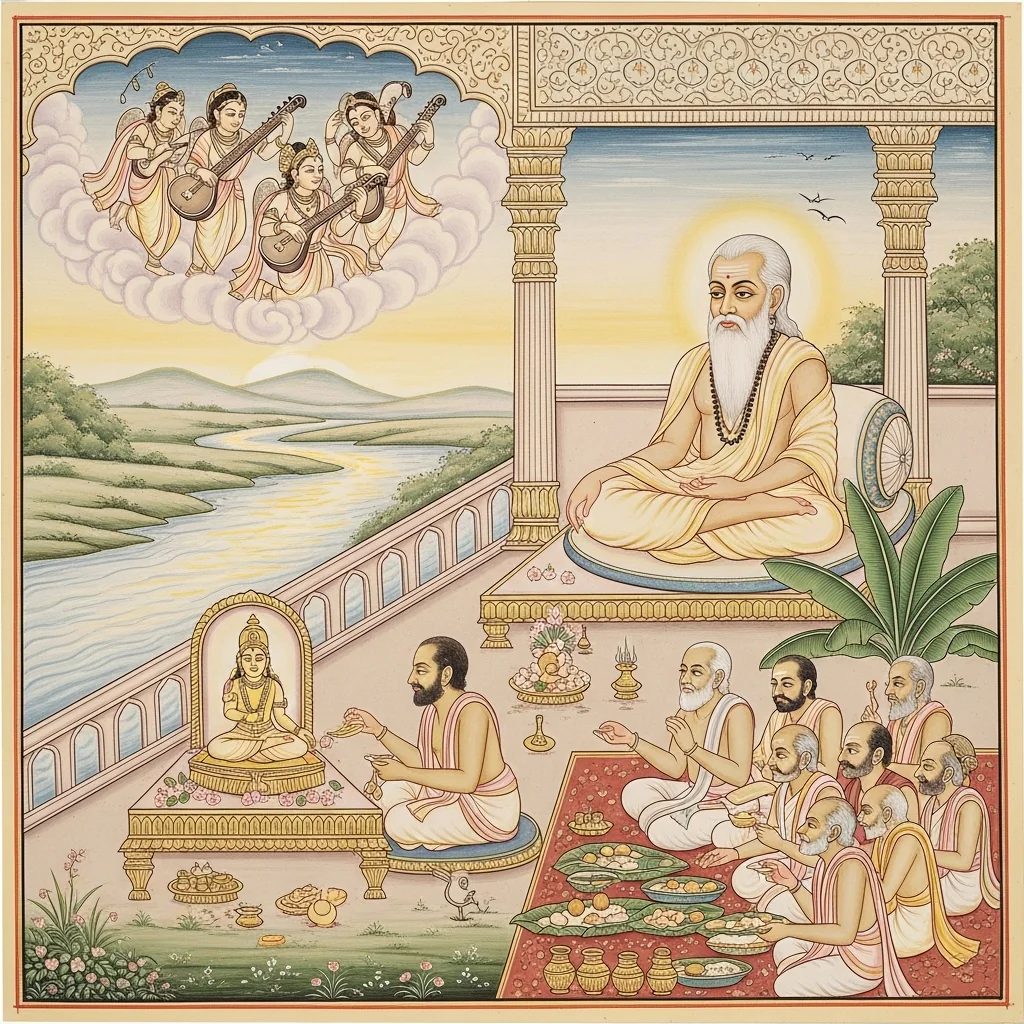
Adhyaya 33
सुवर्णमुखरीप्रभावप्रशंसा (Praise of the Efficacy of the Suvarṇamukharī River)
Chapter 33 recounts the manifestation, naming, and ritual-theological standing of the Suvarṇamukharī River within the Veṅkaṭācalamāhātmya. Bharadvāja describes how the devas led by Śakra, along with assemblies of sages, siddhas, cāraṇas, and gandharvas, extol the river as it accompanies Agastya. Vāyu then explains its origin and renown: brought down to earth by Agastya, it is destined to be praised as “Suvarṇamukharī,” foremost among rivers and worthy of devoted service. An extended māhātmya follows: remembrance (smaraṇa) and sacred bathing (snāna) destroy sin; immersion of bones aids ascent; and rites performed on its banks gain multiplied efficacy. A dense phalaśruti lists benefits for health, removal of obstacles, ancestral rites, and calendrical observances such as eclipses and saṅkrānti. Finally, an annual vow is prescribed for Agastya’s rising day—crafting and gifting a golden image of Agastya with ritual honor, feeding brāhmaṇas, and dedicating the merit—promising release from accumulated faults and enduring spiritual fruit.
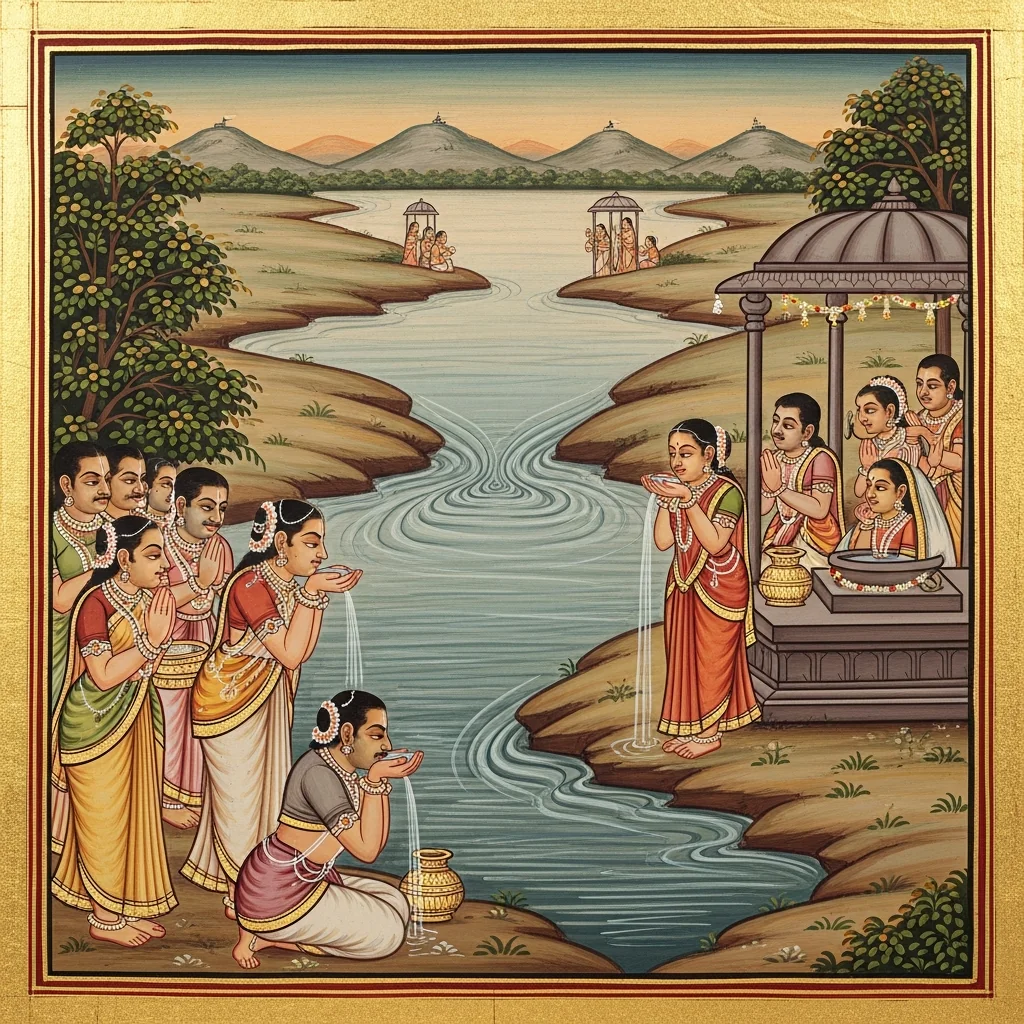
Adhyaya 34
अगस्त्यतीर्थ–अगस्त्येश्वरप्रभावः; देवर्षिपितृतीर्थमाहात्म्यम्; सुवर्णमुखरी–वेणासङ्गमः; व्याघ्रपदासङ्गमः; शङ्खतीर्थवर्णनम् (Agastya Tīrtha and Agastyeśvara; Deva–Ṛṣi–Pitṛ Tīrthas; River Confluences; Śaṅkha Tīrtha)
The chapter unfolds as a question-and-answer guide to sacred geography and rite. Arjuna, eager to hear more, asks the sage to list the tīrthas along the river, the confluences (saṅgama), and the particular merits of bathing and worship at each. Bharadvāja replies in sequence, beginning with Agastya Tīrtha, said to purify even grave wrongdoing, and then describing Agastyeśvara, the liṅga installed by Ṛṣi Agastya; worship after river-bathing is praised as yielding sacrifice-like merit. A calendrical note marks an auspicious bathing season connected with the Sun’s entry into Makara, and Agastyeśa-darśana is enjoined at that time. The narrative then identifies the Deva–Ṛṣi–Pitṛ triad of tīrthas, where proper bathing and tarpaṇa are declared to remove the “three debts” (ṛṇa-traya). Next, the river’s movements and meeting points are mapped: Suvarṇamukharī joins Veṇā, and Suvarṇamukharī joins Vyāghrapadā, each saṅgama extolled as a merit-amplifying node. Finally, Śaṅkha Tīrtha and Śaṅkheśa (installed by the sage Śaṅkha) are introduced, emphasizing the combined efficacy of darśana, snāna, and pāna (ritual drinking) as a devotional itinerary toward the Vṛṣabhācala region.
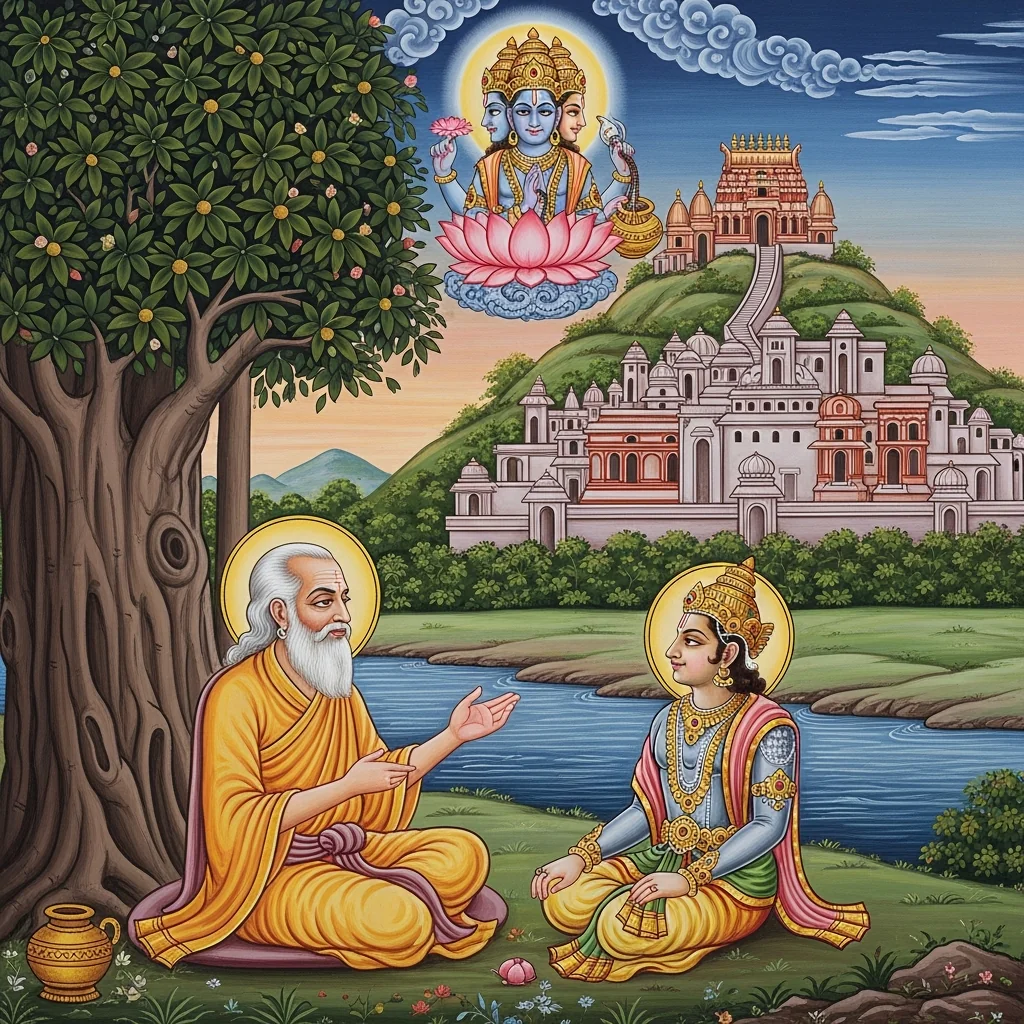
Adhyaya 35
सुवर्णमुखरी–कल्यानदीसंगमः, वेंकटाचलवर्णनम्, नारायणमाहात्म्यं च (Suvarṇamukharī–Kalyā Saṅgama, Description of Veṅkaṭācala, and the Greatness of Nārāyaṇa)
Chapter 35 unfolds in three coordinated movements. (1) Tīrtha-topography: Bhāradvāja describes the Suvarṇamukharī joining the sacred Kalyā river, praising the confluence as supremely purifying. Bathing there is said to grant the great fruits of major sacrifices and to lessen even grave defilements—sins of the brahmahatyā type—through the sangama’s sanctity and abhiṣeka-linked purification. (2) Mountain theology as sacred place: the narration turns to Veṅkaṭācala, its location and eminence, hailed as an “asylum of all tīrthas” and as Varāha-kṣetra. Viṣṇu, Acyuta, is said to dwell there with Śrī, while siddhas, gandharvas, sages, and humans attend upon the Lord. Remembrance of the Lord of Veṅkaṭādri is presented as removing adversity and leading toward an imperishable state. (3) Doctrinal exposition: prompted by Arjuna’s questions about divine manifestation and the bestowal of bhukti and mukti, Bhāradvāja expounds Nārāyaṇa’s supremacy, names and equivalences, the fourfold emanational scheme, mantra-centered discipline, and a cosmogonic outline—deities and cosmic principles arising from the divine body, periodic dissolution and yoganidrā, Brahmā’s re-emergence, and the Lord’s assumption of forms to restore dharma. The chapter thus unites pilgrimage ethics, devotional soteriology, and Purāṇic metaphysics into a single instruction.
Adhyaya 36
Varāha-kṛta-dharaṇyuddharaṇa-kramaḥ and Śvetavarāha-kalpa-vṛttānta (Varāha’s Raising of Earth and the White Boar Kalpa Account)
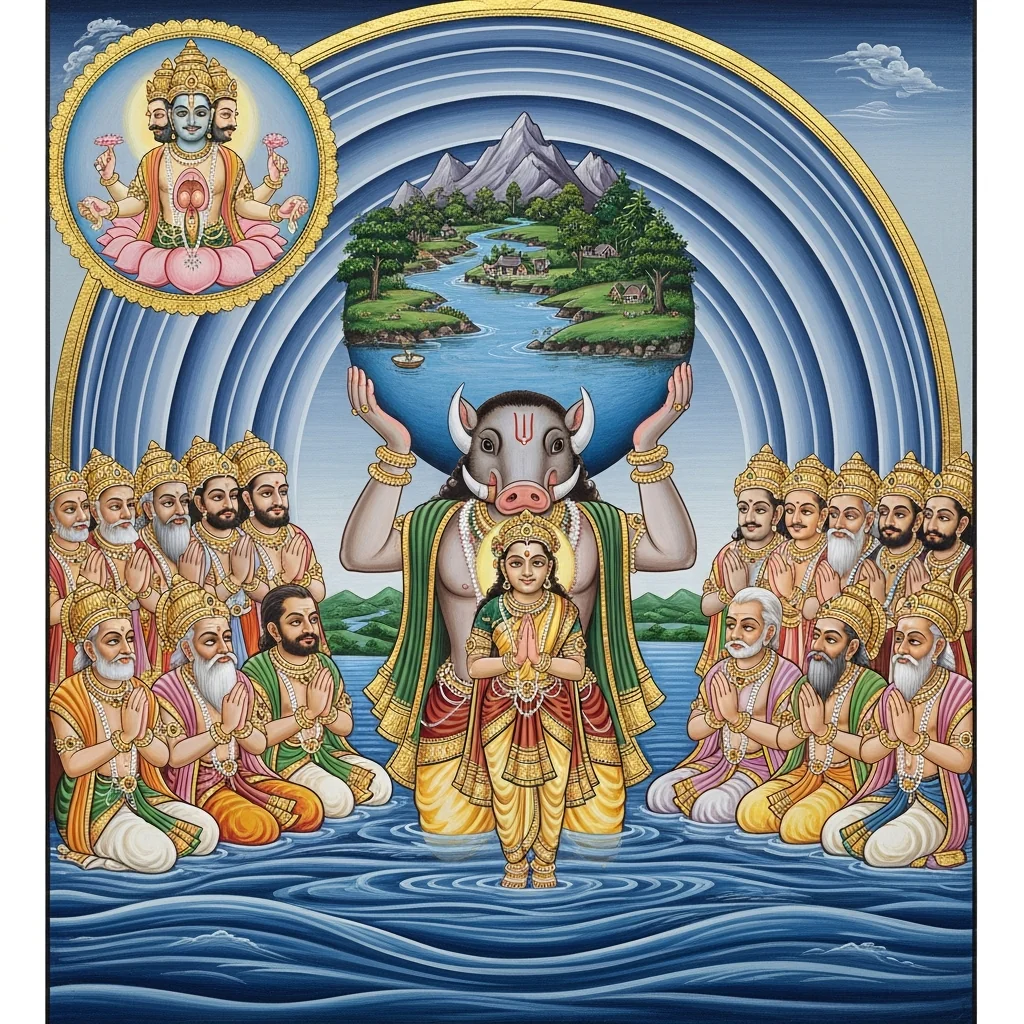
This adhyāya unfolds as a theological dialogue in which Bharadvāja recounts how Viṣṇu, taking the Varāha (Boar) form, recovers and raises the Earth (Vasumatī) after the cosmic inundation. Realizing that without Earth no being can bear the burden of creatures, the Lord finds her submerged in the nether realms and assumes a yajña-maya Varāha body, with Vedic meters, sacred fires, and ritual implements symbolically mapped upon His limbs. Varāha plunges into the waters, dispels darkness, subdues the abyss, and lifts Earth upon His tusk amid the sages’ praises; the ocean’s tumult is portrayed as auspicious sound and offering-like imagery. Arjuna then asks how Earth endures during pralaya and what supports her beneath the seven pātālas, and Bharadvāja explains Purāṇic measures of time (nāḍikā, day, month, year), the yuga–manvantara framework, and the succession of Manus in the Śvetavarāha kalpa. The chapter further describes pralaya: drought and heat, then years of rain and a world-flood; Brahmā rests in yoganidrā upon the lotus from Viṣṇu’s navel, and creation begins anew by divine command. Finally, it localizes the avatāra memory: in this kalpa Viṣṇu appeared as the White Varāha, later came to Veṅkaṭācala and dwelt near Svāmipuṣkariṇī; at Brahmā’s request He resumes a divine form and becomes difficult to perceive directly, prompting Arjuna to ask how humans may reach Him through devotion and the hearing of sacred narration.
Adhyaya 37
शंखराजवृत्तान्तः — King Śaṅkha’s Devotion and the Veṅkaṭācala Darśana-Path
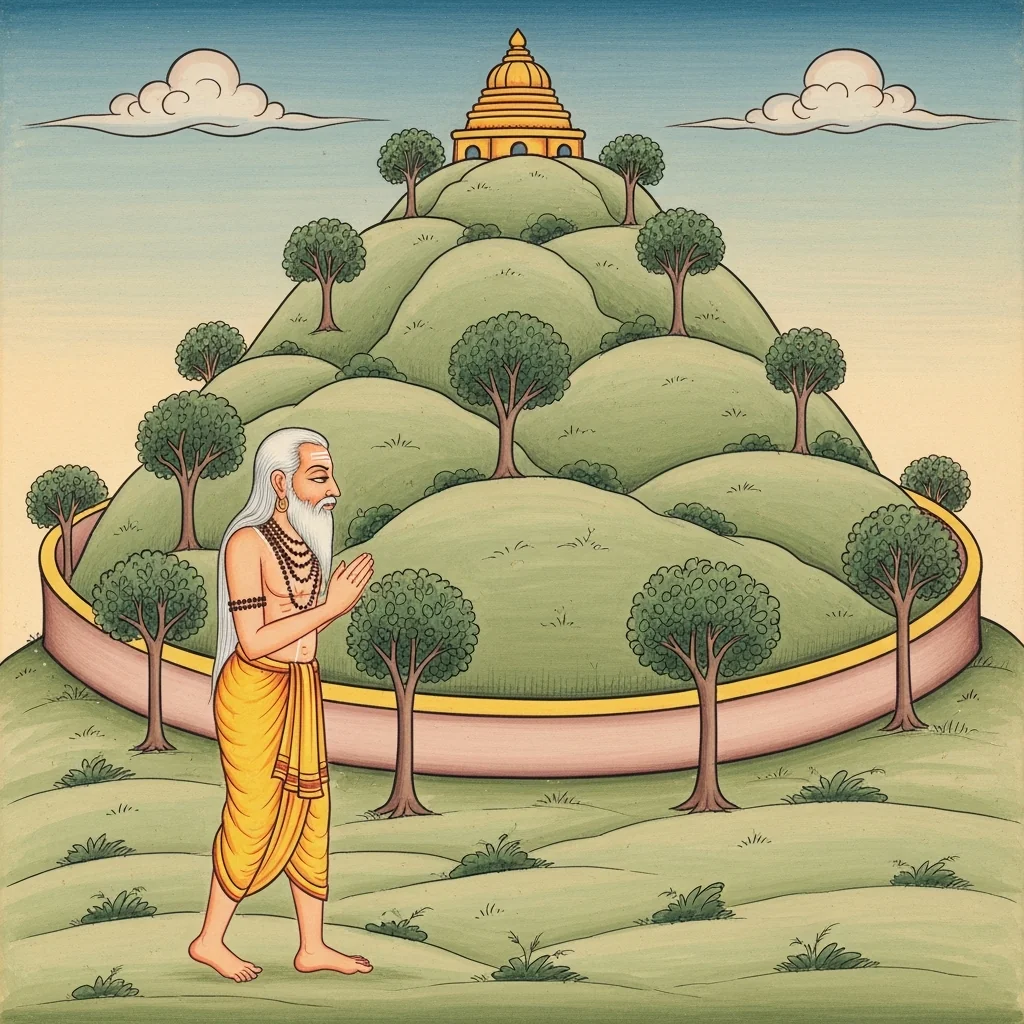
Chapter 37, as narrated by Bhāradvāja, presents King Śaṅkha of the Haihaya line as an ideal royal devotee. He practices exclusive devotion to Viṣṇu through constant remembrance, japa, pūjā, and attentive listening to Vaiṣṇava Purāṇic accounts, along with gifts, vows, and great sacrifices performed with proper dakṣiṇā. Yet he grieves that he has not attained Viṣṇu’s direct darśana, taking the delay as the remnant of past obscurations. Keśava then speaks as an unseen voice, declaring Veṅkaṭanāma-adri to be a uniquely beloved abode and setting a term: after sustained tapas there, the Lord will become visible. Śaṅkha installs his son Vajra in governance, journeys to Nārāyaṇagiri, encounters Swāmi-puṣkariṇī, and establishes an ascetic dwelling on its bank. In parallel, Agastya arrives by Brahmā’s command, circumambulates the mountain, visits tīrthas including Skandadhārā, and worships Govinda, yet initially remains without vision. Deva-linked figures—Bṛhaspati, Uśanas, and the Vasu Rājoparicara—convey the directive that Govinda will reveal himself on Veṅkaṭa to both Agastya and Śaṅkha, granting collective darśana to the assembled beings. The chapter closes with Agastya and companions admiring the mountain’s auspicious ecology and reaching Swāmi-puṣkariṇī’s shore, where Śaṅkha receives them with ritual honor and shared kīrtana-centered devotion.
Adhyaya 38
अगस्त्य-शङ्खतपःप्रसादः, सौम्यरूपप्रादुर्भावः, सुवर्णमुखरी-माहात्म्यम् (Agastya & Śaṅkha’s tapas—divine grace, the gentle epiphany, and Suvarṇamukharī’s sanctity)
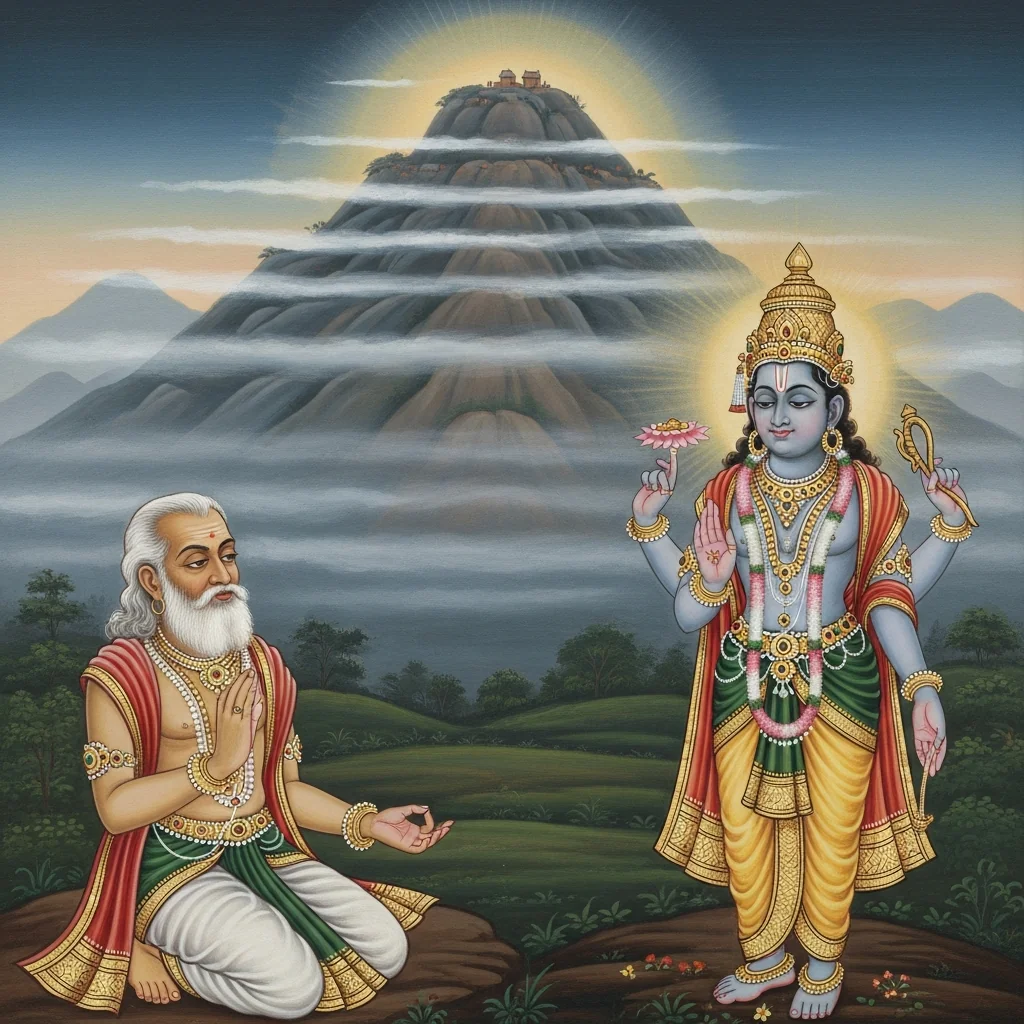
Bharadvāja relates that devotees absorbed in worship of Jagannātha spend their days in hymns and rites; on the third night they behold, in an auspicious dream, four-armed Puruṣottama bearing conch, discus, and mace. After ritual bathing in Svāmipuṣkariṇī and completing morning observances, they resume worship, whereupon an extraordinary radiance appears—like a cosmic concentration of light. A formidable theophany is perceived, and Brahmā with other deities arrives to praise Nārāyaṇa’s transcendence; out of fear they request a śānta, peaceful form. The Lord assents, reappearing in a gentle, pleasing form upon a jeweled vimāna, and offers boons to Agastya. Agastya declares his austerities fulfilled and asks for unwavering devotion, and that the river Suvarṇamukharī near the Lord’s mountain become a sin-destroying tīrtha, granting bhukti and mukti to those who bathe and then behold the Lord at Veṅkaṭa. Śrī Bhagavān grants this, proclaims His permanent presence on the Vaikuṇṭha-named hill at Agastya’s request, and enumerates merits for pilgrims and even for those who remember Him from anywhere. He then bestows upon King Śaṅkha an exalted posthumous destiny and withdraws. Bharadvāja concludes with a phalaśruti praising Veṅkaṭādri, Svāmipuṣkariṇī, and the salvific power of hearing and remembering this māhātmya.
Adhyaya 39
अञ्जनातपःप्रकारः (Añjanā’s Mode of Austerity and the Vāyu-Boons at Veṅkaṭācala)
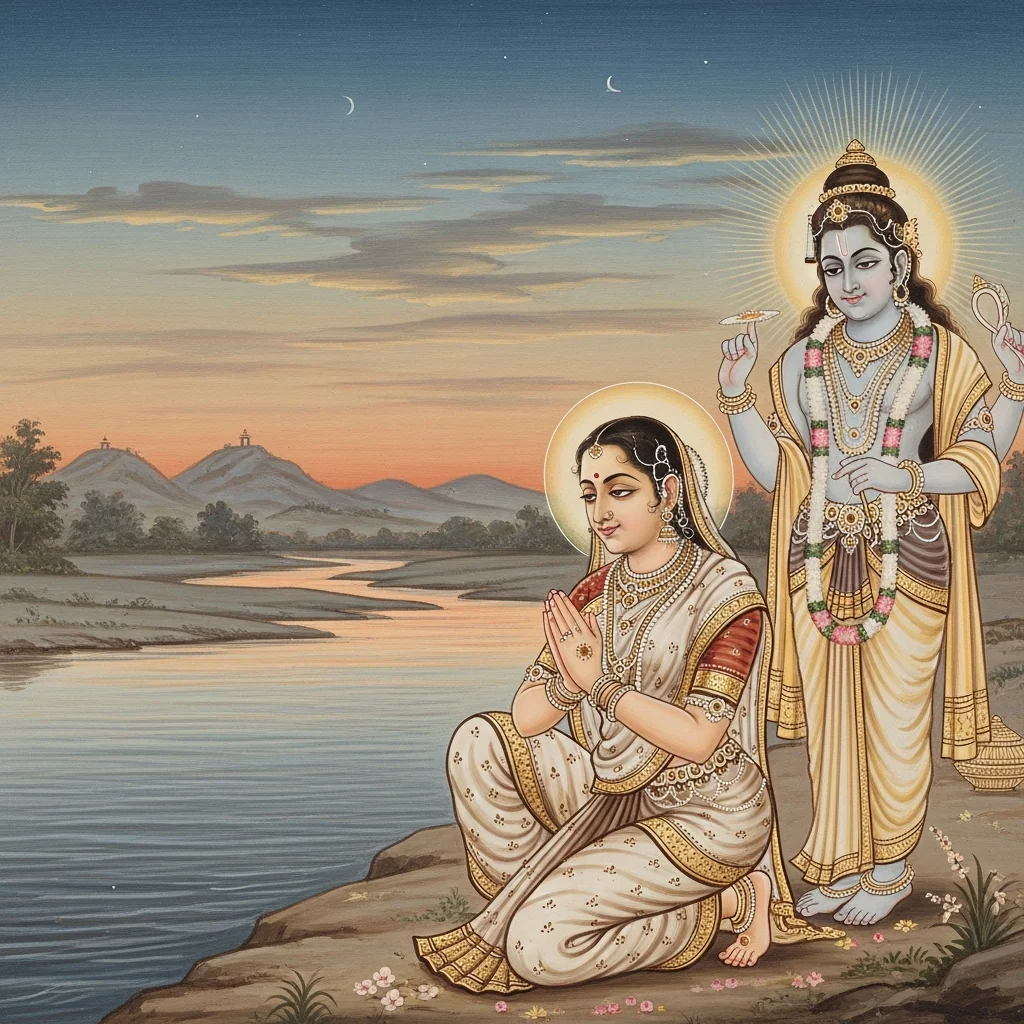
This chapter, narrated by Sūta in dialogue form, begins with Añjanā grieving over childlessness when the sage Matanga approaches and asks her purpose. She recalls an earlier boon Śiva granted her father Keśarī: though limited in his present birth, he would have a renowned daughter, and her son would bring him joy. Añjanā then recounts the many devotional and ethical observances she has performed for progeny—seasonal and monthly vratas, ritual bathing and charity, circumambulation and salutations, śālagrāma-related offerings, and varied forms of dāna—yet without obtaining a son, she turns to tapas. Matanga gives a precise sacred itinerary: south to Ghānācala and Brahmatīrtha, east to the Suvarṇamukharī, north toward Vṛṣabhācala and Svāmipuṣkariṇī; she must bathe, honor Varāha and Veṅkaṭeśa, proceed to the tīrtha Viyadgaṅgā amid auspicious trees, and perform directed austerity to Vāyu. Añjanā follows, intensifying her ascetic discipline from fruit and water to harsher restraint; after a thousand years Vāyu manifests at an astrologically marked auspicious time, offers a boon, and—when she asks for a son—declares himself her son and promises fame. The chapter closes with gods, sages, and divine consorts gathering to witness her extraordinary tapas, affirming that disciplined practice at rightly indicated tīrthas draws forth transformative divine response.
Adhyaya 40
अञ्जनावरलब्ध्य्-आकाशगङ्गास्नानकालनिर्णय-करणीयदानप्रशंसा (Añjanā’s Boon; Determination of the Proper Time for Ākāśagaṅgā Bath; Praise of Prescribed Gifts)
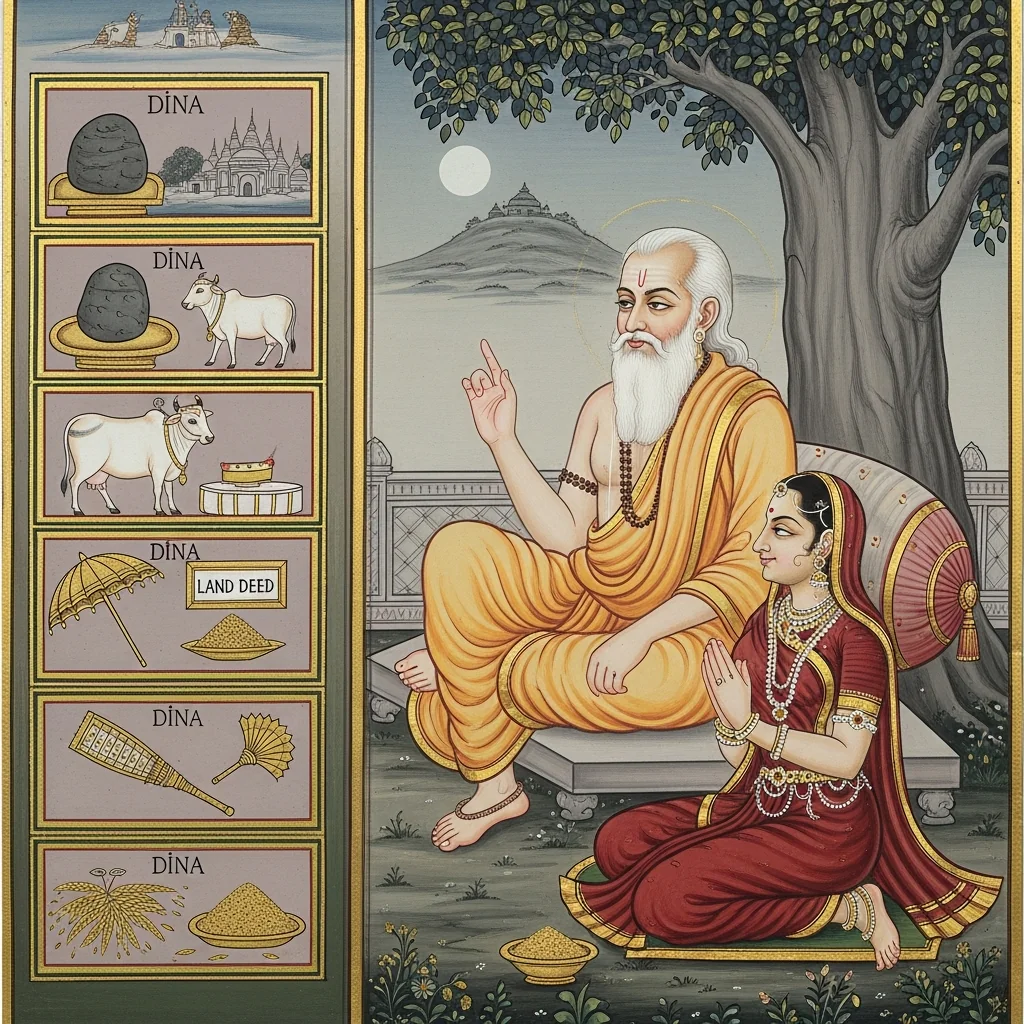
This chapter presents ritual and ethical instruction through dialogue. Sūta describes how Añjanā, accompanied by her husband, meets Brahmā and other deities; with their assent, Vyāsa is authorized as the chief teacher. Vyāsa addresses Añjanā for the “benefit of all,” connecting Matanga Ṛṣi’s earlier words to her destiny: her son will be born only after intense austerities at Veṅkaṭa. The chapter then lays down a kāla-nirṇaya (determination of the proper time) for bathing in the Ākāśagaṅgā/Veṅkaṭa tīrtha complex. On Añjanā’s “manifest day” (pratyakṣa-divasa), the Gaṅgā and other tīrthas are said to converge, with special emphasis on the sanctity of Swāmi Puṣkariṇī. A particular calendrical conjunction is noted (full-moon day, linked with Meṣa and Pūṣan, with a nakṣatra reference), and its merit is likened to bathing for a long period at all Gaṅgā-adjacent holy places. The discourse turns to prescribed dāna at Veṅkaṭādri: gifts of food and cloth are praised, and śrāddha for one’s father is singled out as especially weighty. A graded catalogue of gifts—gold, śālagrāma, cows, land, giving a maiden in marriage, water-shelter, sesame, grain, perfumes and flowers, umbrellas and fans, betel, and more—is mapped to rising fruits: heavenly enjoyment, sovereignty, brahminhood with scriptural mastery, and finally liberation through the grace of Cakrapāṇi (Viṣṇu). The closing phalaśruti declares that regular hearing or recitation purifies sins, grants Viṣṇuloka, and extends benefit to one’s descendants.
FAQs about Venkatachala Mahatmya
It presents Veṅkaṭācala as a sanctified mountain where divine presence is localized through mythic etiologies, with Varāha and Śrīnivāsa narratives establishing the site’s ritual authority.
The section typically frames pilgrimage merit through disciplined worship, mantra-japa, and place-based devotion, promising both prosperity-oriented outcomes and liberation-oriented benefits depending on intent and observance.
Key legends include Varāha’s relationship with Dharaṇī (Bhūdevī), the establishment and secrecy of a potent Varāha mantra, and anticipatory questions about Śrīnivāsa’s arrival and enduring presence on Veṅkaṭa.