Adhyaya 35
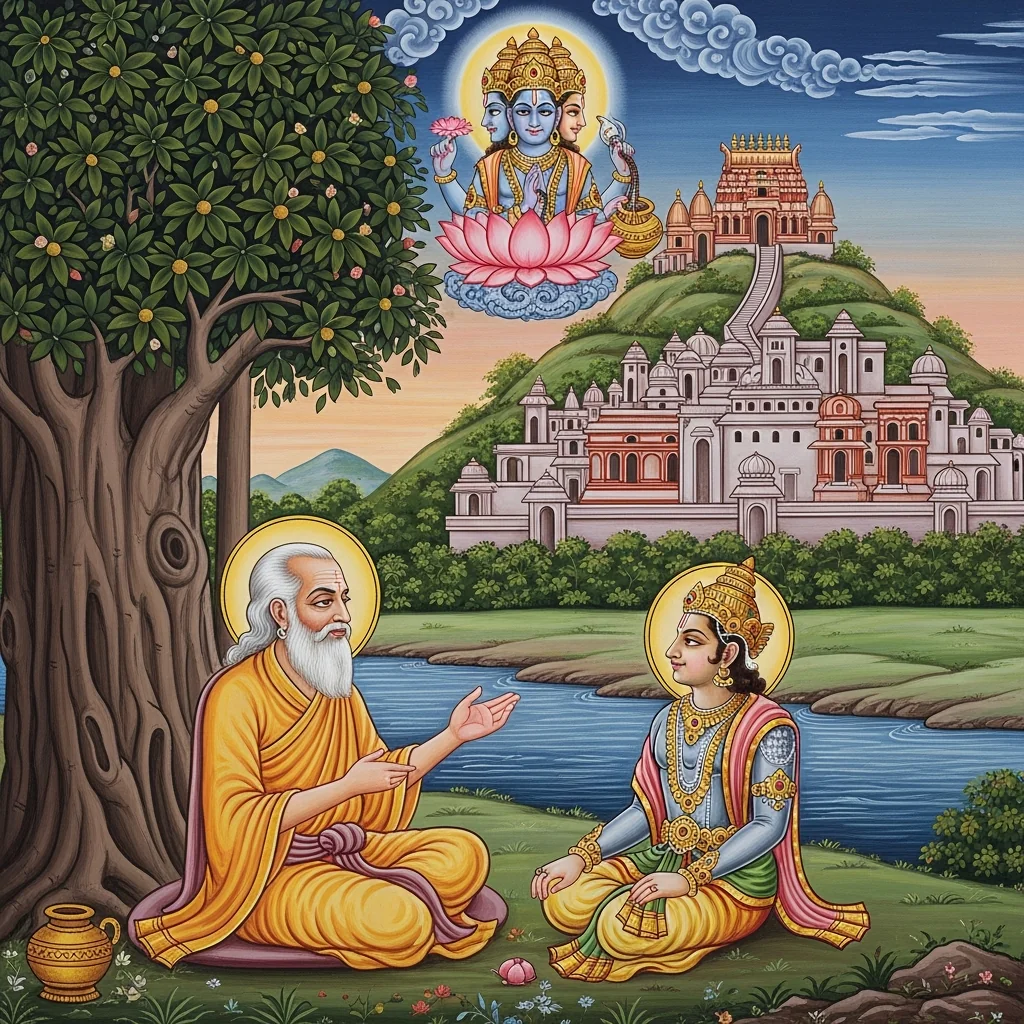
Chapter 35 unfolds in three coordinated movements. (1) Tīrtha-topography: Bhāradvāja describes the Suvarṇamukharī joining the sacred Kalyā river, praising the confluence as supremely purifying. Bathing there is said to grant the great fruits of major sacrifices and to lessen even grave defilements—sins of the brahmahatyā type—through the sangama’s sanctity and abhiṣeka-linked purification. (2) Mountain theology as sacred place: the narration turns to Veṅkaṭācala, its location and eminence, hailed as an “asylum of all tīrthas” and as Varāha-kṣetra. Viṣṇu, Acyuta, is said to dwell there with Śrī, while siddhas, gandharvas, sages, and humans attend upon the Lord. Remembrance of the Lord of Veṅkaṭādri is presented as removing adversity and leading toward an imperishable state. (3) Doctrinal exposition: prompted by Arjuna’s questions about divine manifestation and the bestowal of bhukti and mukti, Bhāradvāja expounds Nārāyaṇa’s supremacy, names and equivalences, the fourfold emanational scheme, mantra-centered discipline, and a cosmogonic outline—deities and cosmic principles arising from the divine body, periodic dissolution and yoganidrā, Brahmā’s re-emergence, and the Lord’s assumption of forms to restore dharma. The chapter thus unites pilgrimage ethics, devotional soteriology, and Purāṇic metaphysics into a single instruction.
Shlokas
No shlokas available for this adhyaya yet.