सामान्यतो नरकगतिवर्णनम् (General Description of the Course of Hell / Naraka-gati)
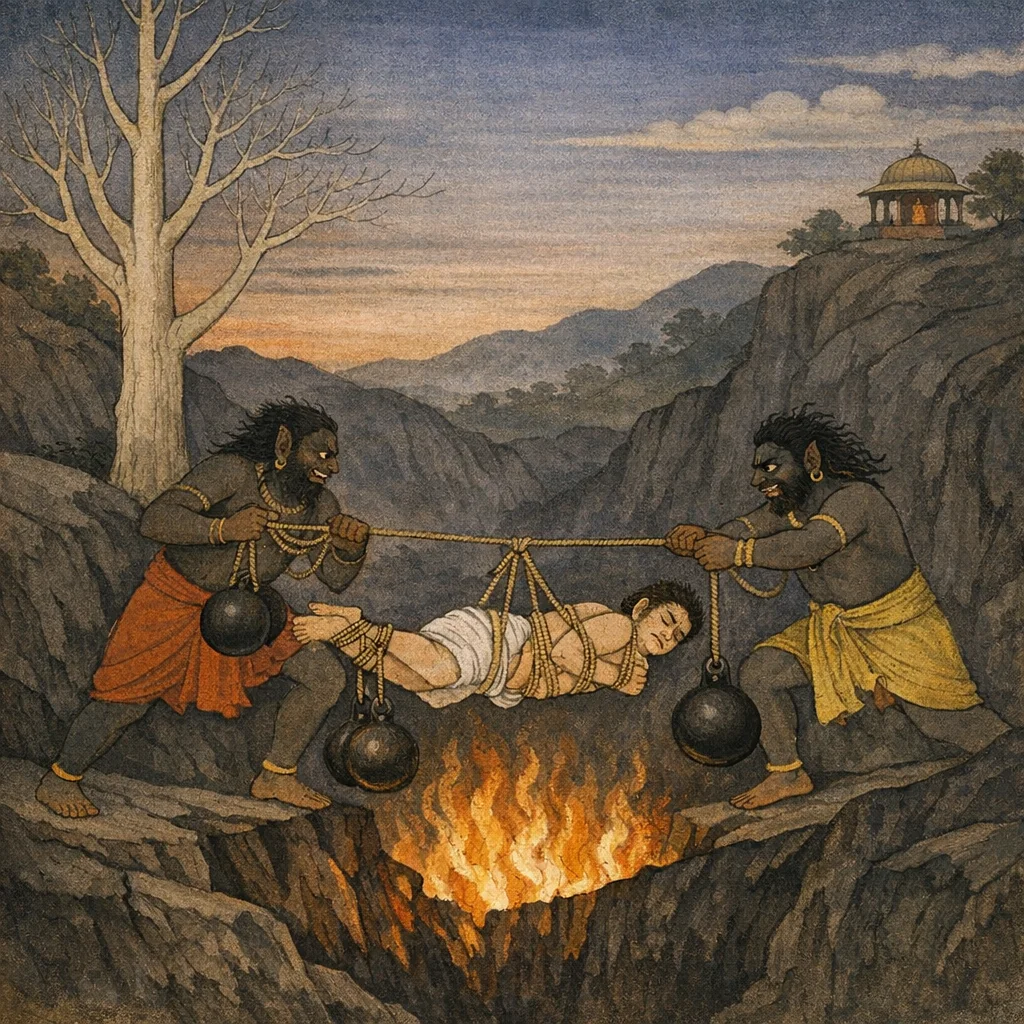
Adhyāya 9, taught as a didactic discourse by Sanatkumāra, gives a general account of naraka-gati—the course into hell—where sinners undergo post-mortem punishments proportionate to their deeds. The verses portray a sequence of torments: they are “cooked” and “dried” in hell-fires like metal refined in flame; bound and hung from great trees by Yama’s attendants, violently swung until unconscious, and weighed down with heavy iron loads tied to the feet. The chapter stresses karma-kṣaya: suffering is not random but a means by which impurity is exhausted and karmic residue is completed. Its inner purpose is ethical and liberative—these vivid naraka images are meant to awaken vairāgya and turn one toward dharma and Śaiva purification, cutting off the chain of pāpa and its ripening into experience.
Shlokas
Verse 1
सनत्कुमार उवाच । एषु पापाः प्रपच्यंते शोष्यंते नरकाग्निषु । यातनाभिर्विचित्राभिरास्वकर्म्मक्षयाद्भृशम्
Sanatkumāra said: “In these hellish states, sins are thoroughly cooked and burned away in the fires of Naraka; by many kinds of severe torments they are greatly dried up, until one’s own karmas are exhausted.”
Verse 2
स्वमलप्रक्षयाद्यद्वदग्नौ धास्यंति धातवः । तत्र पापक्षयात्पापा नराः कर्मानुरूपतः
Just as metals, when placed in fire, are purified as their own impurities are burned away, so too sinful people, when their sins are exhausted, are dealt with according to the exact measure of their deeds.
Verse 3
सुगाढं हस्तयोर्बद्ध्वा ततश्शृंखलया नराः । महावृक्षाग्रशाखासु लम्ब्यन्ते यमकिंकरैः
Binding men tightly by both hands and then fastening them with chains, the servants of Yama hang them from the topmost branches of great trees.
Verse 4
ततस्ते सर्वयत्नेन क्षिप्ता दोलंति किंकरैः । दोलंतश्चातिवेगेन विसंज्ञा यांति योजनम्
Then those servants, exerting themselves with all their might, hurled them onto the swing. As they were swung with tremendous speed, they lost consciousness and were carried for a yojana’s distance.
Verse 5
अंतरिक्षस्थितानां च लोहभारशतं पुनः । पादयोर्बध्यते तेषां यमदूतैर्महाबलैः
And for those who are suspended in mid-air, the mighty messengers of Yama again bind to their feet a hundred heavy loads of iron.
Verse 6
तेन भारेण महता प्रभृशं ताडिता नराः । ध्यायंति स्वानि कर्माणि तूष्णीं तिष्ठन्ति निश्चलाः
Struck hard by that immense burden, men turn inward to contemplate their own deeds; they stand silent and unmoving—overpowered by the weight of their karma.
Verse 7
ततोंऽकुशैरग्निवर्णैर्लोह दण्डैश्च दारुणैः । हन्यंते किंकरैघोरैस्समन्तात्पापकर्म्मिणः
Then, on every side, the sinners—those engaged in evil deeds—are struck by the dreadful attendants, using fire-hued goads and harsh iron rods.
Verse 8
ततः क्षारेण दीप्तेन वह्नेरपि विशेषतः । समंततः प्रलिप्यंते तीवेण तु पुनः पुनः
Then, with caustic alkali made blazing—especially with the aid of fire—they are repeatedly smeared all around with that intense substance.
Verse 9
इति श्रीशिवमहापुराणे पञ्चम्यामुमासंहितायां सामान्यतो नरकगतिवर्णनंनाम नवमोऽध्यायः
Thus, in the Śrī Śiva Mahāpurāṇa, in the Fifth Book—the Umāsaṃhitā—ends the ninth chapter, entitled “A General Description of the Course of Hell.”
Verse 10
वृताकवत्प्रपच्यंते तप्तलोहकटाहकैः । विष्ठापूर्णे तथा कूपे कृमीणां निचये पुनः
They are cooked like brinjals in cauldrons of red‑hot iron; and again they are hurled into a pit filled with filth, swarming with masses of worms.
Verse 11
मेदोऽसृक्पूयपूर्णायां वाप्यां क्षिप्यंति ते पुनः । भक्ष्यंते कृमिभिस्तीक्ष्णैर्लोंहतुंडैश्च वायसैः
Again they are cast into a pond filled with fat, blood, and pus; there they are devoured by fierce, sharp worms and by crows with iron-like beaks.
Verse 12
श्वभिर्द्दंशैर्वृकैर्व्याघ्रैर्रौद्रैश्च विकृताननैः । पच्यंते मत्स्यवच्चापि प्रदीप्तांगारराशिषु
They are tormented by fierce dogs, biting beasts, wolves and tigers with dreadful, distorted faces; and they are also roasted like fish upon heaps of blazing embers.
Verse 13
भिन्नाः शूलैस्तु तीक्ष्णैश्च नराः पापेन कर्म्मणा । तैलयन्त्रेषु चाक्रम्य घोरैः कर्म्मभिरात्मनः
Men, by reason of their sinful deeds, are pierced by sharp spears; and, driven into dreadful oil-press machines, they are crushed—these horrors arising from their own terrible actions.
Verse 14
तिला इव प्रपीड्यंते चक्राख्ये जनपिंडकाः । भ्रज्यंते चातपे तप्ते लोहभाण्डेष्वनेकधा
In the place called Cakra, masses of people are crushed as though they were sesame seeds; and in the blazing heat of the sun they are fried in many ways within red-hot iron vessels.
Verse 15
तैलपूर्णकटाहेषु सुतप्तेषु पुनःपुनः । बहुधा पच्यते जिह्वा प्रपीड्योरसि पादयोः
Again and again, in cauldrons filled with oil and heated to a fierce glow, the tongue is cooked in many ways, while the feet are pressed hard upon the chest.
Verse 16
यातनाश्च महत्योऽत्र शरीरस्याति सर्वतः । निश्शेषनरकेष्वेवं क्रमंति क्रमशो नराः
Here, terrible torments assail the body from every side. Thus, men pass on step by step through all the hells without exception.
Verse 17
नरकेषु च सर्वेषु विचित्रा यमयातना । याम्यैश्च दीयते व्यास सर्वांगेषु सुकष्टदा
In all the hells, O Vyāsa, manifold torments of Yama are inflicted by Yama’s attendants, causing intense suffering in every limb of the body.
Verse 18
ज्वलदंगारमादाय मुखमापूर्य्य ताड्यते । ततः क्षारेण दीप्तेन ताम्रेण च पुनःपुनः
Taking a burning coal, the mouth is stuffed and struck; thereafter, again and again, it is scorched with blazing alkali and with heated copper.
Verse 19
घृतेनात्यन्ततप्तेन तदा तैलेन तन्मुखम् । इतस्ततः पीडयित्वा भृशमापूर्य्य हन्यते
Then his face is struck after being forcefully pressed from this side and that, first with extremely heated ghee and then with oil—filled and inflamed intensely, he is tormented.
Verse 20
विष्ठाभिः कृमिभिश्चापि पूर्यमाणाः क्वचित्क्वचित् । परिष्वजंति चात्युग्रां प्रदीप्तां लोहशाल्मलीम्
In some places, they are stuffed with filth and worms; and elsewhere, they are forced to embrace a fiercely dreadful, blazing iron śālmalī tree.
Verse 21
हन्यंते पृष्ठदेशे च पुनर्दीप्तैर्महाघनैः । दन्तुरेणादिकंठेन क्रकचेन बलीसया
They are struck again and again upon the back with blazing, heavy clubs, and are further tormented by a jagged saw with a serrated edge and a thick, hardened blade.
Verse 22
शिरःप्रभृति पीड्यंते घोरैः कर्मभिरात्मजैः । खाद्यंते च स्वमांसानि पीयते शोणितं स्वकम्
From the head onward they are tormented by their own dreadful deeds; their very flesh is eaten and their own blood is made to be drunk—thus do the bonds of karma ripen into suffering when the soul turns away from Śiva, the Lord of liberation.
Verse 23
अन्नं पानं न दत्तं यैस्सर्वदा स्वात्मपोषकैः । इक्षुवत्ते प्रपीड्यंते जर्जरीकृत्य मुद्गरैः
Those who, ever intent only on feeding themselves, do not give food and drink (to others)—they are crushed like sugarcane, pounded with mallets until they are smashed to pieces.
Verse 24
असितालवने घोरे छिद्यन्ते खण्डशस्ततः । सूचीभिर्भिन्नसर्वाङ्गास्तप्तशूलाग्ररोपिताः
In the dreadful forest called Asitāla, they are cut into pieces. Their entire bodies are pierced with needles, and they are impaled upon the blazing tips of heated tridents.
Verse 25
संचाल्यमाना बहुशः क्लिश्यंते न म्रियन्ति च । तथा च तच्छरीराणि सुखदुःखसहानि च
Though they are driven about again and again, they undergo much suffering, yet they do not truly die; and those bodies too endure—able to bear both pleasure and pain.
Verse 26
देहादुत्पाट्य मांसानि भिद्यंते स्वैश्च मुद्गरैः । दंतुराकृतिभिर्र्घोरैर्यमदूतैर्बलोत्कटैः
Tearing the flesh from the body, the fearsome messengers of Yama—of jagged, tusked appearance and overpowering strength—crush it with their own mallets.
Verse 27
निरुच्छ्वासे निरुछ्वासास्तिष्ठंति नरके चिरम् । उत्ताड्यंते तथोछ्वासे वालुकासदने नराः
In the hell called Nirucchvāsa, they remain for a long time, deprived of breath. Likewise, in the hell called Ucchvāsa, those beings are struck and tormented in a dwelling of burning sand.
Verse 28
रौरवे रोदमानाश्च पीड्यंते विविधै वधैः । महारौरवपीडाभिर्महांतोऽपि रुदंति च
In Raurava (hell), the wailing beings are tormented by many kinds of slayings and punishments. Under the agonies of Mahāraurava, even the mighty cry out in grief.
Verse 29
पत्सु वक्त्रे गुदे मुंडे नेत्रयोश्चैव मस्तके । निहन्यंते घनैस्तीक्ष्णैस्सुतप्तैर्लोह शंकुभिः
In the feet, the mouth, the anus, the shaven head, the eyes, and even the crown of the head, they are struck again and again with heavy, sharp iron spikes heated until red-hot.
Verse 30
सुतप्तावालुकायां तु प्रयोज्यंते मुहुर्मुहुः । जंतुपंके भृशं तप्ते क्षिप्ताः क्रन्दंति विस्वरम्
They are made to lie again and again upon sand heated red-hot; and, when cast into a fiercely burning mire swarming with worms, they cry out in a broken, discordant voice.
Verse 31
कुंभीपाकेषु च तथा तप्ततैलेषु वै मुने । पापिनः कूरकर्म्माणोऽसह्येषु सर्वथा पुनः
O sage, sinners of cruel deeds are cast again and again into the hell called Kumbhīpāka, and likewise into cauldrons of scalding oil, wholly subjected to unbearable torments.
Verse 32
लालाभक्षेषु पापास्ते पात्यंते दुःखदेषु वै । नानास्थानेषु पच्यंते नरकेषु पुनःपुनः
Those sinners are cast into the hells where saliva is their food—truly places that yield only misery—and there, in many regions, they are repeatedly tormented, as though “cooked” again and again.
Verse 33
सूचीमुखे महाक्लेशे नरके पात्यते नरः । पापी पुण्यविहीनश्च ताड्यते यमकिंकरैः
A sinner, bereft of merit, is cast into the needle-mouthed hell of great torment called Sūcīmukha, and is struck and punished by the attendants of Yama.
Verse 34
लौहकुम्भे विनिःक्षिप्ताः श्वसन्तश्च शनैःशनैः । महाग्निना प्रपच्यंते स्वपापैरेव मानवाः
Cast into an iron cauldron, breathing only little by little, human beings are thoroughly cooked by a great fire—by their own sins alone.
Verse 35
दृढं रज्ज्वादिभिर्बद्ध्वा प्रपीड्यंते शिलासु च । क्षिप्यंते चान्धकूपेषु दश्यंते भ्रमरैर्भृशम्
Bound tightly with ropes and the like, they are crushed upon stones; they are thrown into dark pits as well, and are severely bitten by swarms of bees.
Verse 36
कृमिभिर्भिन्नसर्वांगाश्शतशो जर्जरीकृताः । सुतीक्ष्णक्षारकूपेषु क्षिप्यंते तदनंतरम्
Their limbs are split apart by worms and, in hundreds of ways, reduced to a shattered condition; thereafter they are hurled into wells filled with exceedingly caustic alkali.
Verse 37
महाज्वालेऽत्र नरके पापाः क्रन्दंति दुःखिताः । इतश्चेतश्च धावंति दह्यमानास्तदर्चिषा
In this hell of mighty flames, sinners—overwhelmed by suffering—wail aloud. Burning in that very blaze, they run about here and there in terror and pain.
Verse 38
पृष्ठे चानीय तुण्डाभ्यां विन्यस्त स्कंधयोजिते । तयोर्मध्येन वाकृष्य बाहुपृष्ठेन गाढतः
Bringing him onto its back with its two tusks, placing him securely upon the joined shoulders, it then pulled him in between (them) and held him fast, pressing him tightly with the backs of its arms.
Verse 39
बद्ध्वा परस्परं सर्वे सुभृशं पापरज्जुभिः । बद्धपिंडास्तु दृश्यंते महा ज्वाले तु यातनाः
Bound tightly to one another with the ropes of sin, all of them are seen as tied-up lumps; in the great blaze, the torments are endured.
Verse 40
रज्जुभिर्वेष्टिताश्चैव प्रलिप्ताः कर्द्दमेन च । करीषतुषवह्नौ च पच्यंते न म्रियंति च
Even when they are tightly bound with ropes and smeared all over with mud, and even when they are heated in a fire of cow-dung cakes and husks, they are only scorched—yet they do not die.
Verse 41
सुतीक्ष्णं चरितास्ते हि कर्कशासु शिलासु च । आस्फाल्य शतशः पापाः पच्यंते तृणवत्ततः
Indeed, by walking upon very sharp and rough stones, and by striking (the body/limbs) again and again, hundreds of sins are thereby ‘cooked’—burned away—like dry grass. From that (austerity), impurities are quickly exhausted.
Verse 42
शरीराभ्यंतरगतैः प्रभूतैः कृमिभिर्नराः । भक्ष्यंते तीक्ष्णवदनैरात्मदेहक्षयाद्भृशम्
By countless worms that enter and dwell within the body, human beings are fiercely devoured with sharp mouths, bringing severe wasting and destruction of one’s own embodied condition. This is the misery of the bound soul (paśu) caught in the noose of impurity (pāśa), until it turns toward Lord Śiva, the liberating Lord (Pati).
Verse 43
कृमीणां निचये क्षिप्ताः पूयमांसास्थिराशिषु । तिष्ठंत्युद्विग्नहृदयाः पर्वताभ्यां निपीडिताः
Cast into swarms of worms, amid heaps of pus, flesh, and bones, they remain there with terrified hearts, crushed between two mountains.
Verse 44
तप्तेन वज्रलेपेन शरीरमनुलिप्यते । अधोमुखोर्ध्वपादाश्च तातप्यंते स्म वह्निना
Their bodies are smeared with scalding, adamantine paste; and, hung upside down with their feet raised, they are scorched by fire.
Verse 45
वदनांतः प्रविन्यस्तां सुप्रतप्तामयोगदाम् । ते खादन्ति पराधीनास्तैस्ताड्यंते समुद्गरैः
With their mouths forced open, a thoroughly heated iron bridle is thrust inside. Helpless and under another’s control, they are made to bite it, and are struck with heavy mallets.
Verse 46
इत्थं व्यास कुकर्म्माणो नरकेषु पचंति हि । वर्णयामि विवर्णत्वं तेषां तत्त्वाय कर्म्मिणाम्
Thus, O Vyāsa, those who commit evil deeds do indeed burn in the hells. I shall describe, in accordance with the truth, the dreadful state of those doers of such karma.
Frequently Asked Questions
Rather than a single mythic episode, the chapter advances a theological-ethical argument: naraka experiences follow karmic proportionality (karmānurūpataḥ) and function as pāpa-kṣaya (exhaustion of sin), illustrated through standardized punitive scenes administered by Yama’s attendants.
The imagery encodes a pedagogy of moral causality: fire and cutting signify ‘refinement’ and ‘disintegration’ of karmic impurity, while binding, suspension, and weights symbolize the constraining force of one’s own actions. The intended rahasya is practical—generate fear-informed discernment (viveka) and detachment (vairāgya) that turns the agent toward purification and Śaiva sādhanā.
This chapter is not centered on a particular Śiva/Umā manifestation; its focus is moral cosmology (naraka-gati) and karmic mechanics. The Śaiva orientation is implicit: the descriptions serve as a negative-theology prompt steering conduct toward purity and liberation under Śiva-tattva rather than iconographic revelation.