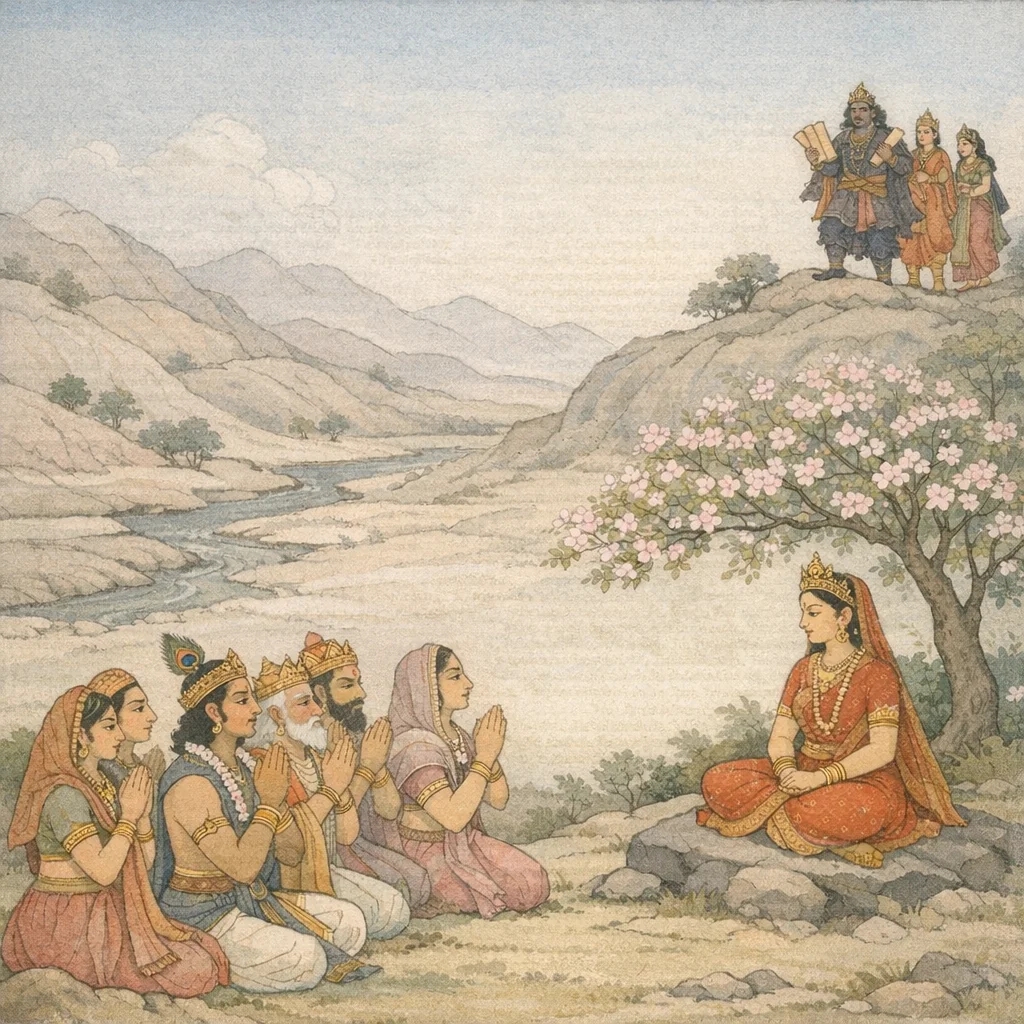
Durgama’s Seizure of the Vedas and the Gods’ Refuge in Yogamāyā (दुर्गमकृतवेदनाशः—योगमायाशरणगमनम्)
Framed as the ṛṣis’ inquiry to Sūta, this chapter asks for deeper explanation of Devī Durgā’s extraordinary account and its underlying tattva. Sūta introduces the asura Durgama, son of Ruru, who—by Brahmā’s boon—gains exceptional control over the Vedas as the four śrutis. With power “invincible to the gods,” he unleashes ominous portents and unsettles the worlds. When the Vedas are seized, ritual action (kriyā) collapses, brāhmaṇas decline in conduct, and dharmic life is inverted. Nature mirrors the breakdown: sacrifice and giving cease; a hundred-year drought arises; famine and thirst afflict all beings; rivers, oceans, wells, and ponds dry up; vegetation withers. Seeing the suffering born of Durgama’s arrogance and the systemic ruin, the gods take refuge in Mahēśvarī as Yogamāyā, praying that she protect creation and withdraw wrath before total dissolution. The chapter thus affirms a Śaiva-Śākta teaching: Vedic continuity, ritual efficacy, and cosmic stability depend on Devī, Śiva’s operative power, as the guardian of the worlds.
Shlokas
Verse 1
मुनय ऊचुः । श्रोतुकामा वयं सर्वे दुर्गाचरितमन्वहम् । अपरं च महाप्राज्ञ तत्त्वं वर्णय नोऽद्भुतम्
The sages said: “We all wish to hear, in full, the sacred account of Durgā’s deeds. And further, O greatly wise one, describe to us the wondrous truth (tattva) as well.”
Verse 2
शृण्वतान्त्वन्मुखाम्भोजात्कथा नाना सुधोपमाः । न तृप्यति मनोऽस्माकं सूत सर्वार्थवित्तम
As we listen to the many nectar-like sacred accounts flowing from the lotus of your mouth, our minds do not become satisfied, O Sūta—O knower of the essence of all meanings.
Verse 3
सूत उवाच । दुर्गमः प्रथितो नाम्ना रुरुपुत्रो महाबलः । ब्रह्मणो वरदानेन चतस्रोऽलभत श्रुतीः
Sūta said: There was a mighty one named Durgama, famed in the world as the son of Ruru. By the boon granted by Brahmā, he obtained the four Vedas.
Verse 4
देवाजेयबलं चापि संप्राप्य जगतीतले । करोति स्म बहूत्पातान्दिवि देवाश्चकम्पिरे
Having obtained a power that even the devas could not conquer, he came upon the surface of the earth and began to cause many ominous portents; and in heaven itself the gods trembled.
Verse 5
सर्वा नष्टेषु वेदेषु क्रिया नष्टा बभूव ह । ब्राह्मणाश्च दुराचारा बभूबुस्ससुरास्तदा
When all the Vedas were lost, the sacred rites too fell into ruin. Then even the brāhmaṇas turned to corrupt conduct, and at that time their disposition became like that of asuras.
Verse 6
न दानं न तपोऽत्युग्रं न यागो हवनं न हि । अनावृष्टिस्ततो जाता पृथिव्यां शतवार्षिकी
There was neither charity nor severe austerity; neither sacrifice nor oblations into the fire. Therefore, upon the earth, a drought arose that lasted for a hundred years.
Verse 7
हाहाकारो महानासीत्त्रिषु लोकेषु दुःखिताः । अभवंश्च जनास्सर्वे क्षुत्तृड्भ्यां पीडिता भृशम्
A great cry of distress arose in the three worlds, and all beings became sorrowful. All people grew faint, severely afflicted by hunger and thirst.
Verse 8
सरितः सागराश्चैव वापीकूपसरांसि च । निर्जला अभवन्सर्वे संशुष्का वृक्षवीरुधः
Rivers and oceans, as well as ponds, wells, and lakes—all became devoid of water; and the trees and creepers were completely dried up.
Verse 9
ततो दृष्ट्वा मदाद्दुःखं प्रजानां दीनचेतसाम् । त्रिदशाश्शरणं याता योगमायां महेश्वरीम्
Then, seeing the sorrow of the people—whose hearts were cast down—caused by intoxication (of pride and excess), the gods sought refuge in Yogamāyā, the great Goddess (Maheśvarī).
Verse 10
देवा ऊचुः । रक्षरक्ष महामाये स्वकीयास्सकलाः प्रजाः । कोपं संहर नूनन्त्वं लोका नंक्ष्यंति वान्यथा
The Devas said: “Protect, protect, O Mahāmāyā, all Your own creatures. Surely withdraw Your wrath; otherwise the worlds will perish.”
Verse 11
कथा शुंभोहतो दैत्यो निशुंभश्च महाबलः । धूम्राक्षश्चण्डमुण्डौ च रक्तबीजो महाबलः
The account tells how the demon Śumbha was slain—and also the mighty Niśumbha; likewise Dhūmrākṣa, Caṇḍa and Muṇḍa, and the immensely powerful Raktabīja.
Verse 12
स मधुः कैटभो दैत्यो महिषासुर एव च । तथैवामुं कृपासिन्धो दीनबन्धो जहि द्रुतम्
He is Madhu and Kaiṭabha, that Daitya, and also Mahiṣāsura. In the same way, destroy this one too—O ocean of compassion, O friend of the distressed—quickly.
Verse 13
अपराधो भवत्येव बालकानां पदे पदे । सहते को जनो लोके केवलं मातरं विना
Children inevitably commit faults at every step. Who in this world can truly endure them—except a mother alone?
Verse 14
यदायदाभवद्दुःख देवानां ब्रह्मणान्तथा । तदातदावतीर्याशु कुरुषे सुखिनो जनान्
Whenever suffering arose for the gods and for the Brahmās as well, then—at those very times—you swiftly descended into manifestation and made all beings happy and at ease.
Verse 15
इति विक्लवितन्तेषां समाकर्ण्य कृपामयी । अनन्ताक्षमयं रूपन्दर्शयामास साम्प्रतम्
Hearing the distressed words of those devotees, the Compassionate One immediately revealed a form filled with innumerable eyes.
Verse 16
धनुर्बाणौ तथा पद्म नानामूलफलानि च । चतुर्भिर्दधती हस्तैः प्रसन्नमुखपङ्कजा
With four hands she held a bow and arrows, a lotus, and various roots and fruits; her lotus-like face was serene, radiant with gracious joy.
Verse 17
ततो दृष्ट्वा प्रजास्तप्ताः करुणापूरितेक्षणा । रुरोद नव घस्राणि नव रात्रीस्समाकुला
Then, seeing the people scorched by suffering, her eyes filled with compassion, she wept—overwhelmed—for nine days and nine nights.
Verse 18
मोचयामास दृष्टिभ्यो वारिधाराः सहस्रशः । ताभिः प्रतर्प्पिता लोका औषध्यः सकला अपि
From his very gaze he released thousands of streams of water; by those waters the worlds were refreshed and nourished, and all medicinal herbs and plants as well.
Verse 19
अगाधतोयास्सरितो बभूवुः सागरा अपि । रुरुहुर्धरणीपृष्ठे शाकमूलफलानि च
Rivers grew deep with abundant waters, and even the oceans swelled. Upon the face of the earth, vegetables, roots, and fruits sprang forth and flourished.
Verse 20
विततार करस्थानि सुमनोभ्यः फलानि च । गोभ्यस्तृणानि रम्याणि तथान्येभ्यो यथार्हतः
From what she held in her hands, she distributed fruits to the noble-minded; to the cows she gave delightful grass, and to the others as well—each according to what was proper for them.
Verse 21
सन्तुष्टा अभवन्सर्वे सदैव द्विजमानुषाः । ततो जगाद सा देवी किमन्यत्करवाणि वः
All the brahmins and the other people became fully content and remained satisfied. Then that Goddess said, “What else shall I do for you?”
Verse 22
समेत्योचुस्तदा देवा भवत्या तोषिता जनाः । वेदान्देहि कृपां कृत्वा दुर्गमेण समाहृताम्
Then the gods, assembling together, spoke: “O Goddess, we are pleased by you. Out of compassion, please grant us the Vedas that were gathered away by Durgama.”
Verse 23
तथास्त्विति प्रभाष्याह यातयात निजालयम् । वितरिष्यामि वो वेदानचिरेणैव कालतः
Saying, “So be it,” she spoke: “Go, go now to your own dwelling. In a short time, I shall bestow the Vedas upon you.”
Verse 24
ततः प्रमुदिता देवास्स्वं स्वं धाम समाययुः । सुप्रणम्य जगद्योनिं फुल्लेन्दीवरलोचनाम्
Then the Devas, filled with joy, returned each to their own celestial abodes, after bowing down with deep reverence to the Mother of the worlds, she whose eyes were like fully blossomed blue lotuses.
Verse 25
ततः कोलाहलो जातो दिवि भूम्यन्तरिक्षके । तच्छ्रुत्वा रौरवः सद्यो न्यरुणत्सर्वतः पुरीम्
Then a great uproar arose in heaven, on earth, and in the mid‑region of the sky. Hearing that tumult, Raurava at once surrounded the city on all sides.
Verse 26
ततस्तेजोमयं चक्रं विधाय परितः शिवा । रक्षणार्थं देवतानां स्वयं तस्माद्बहिर्गता
Then Śivā (Pārvatī) fashioned a radiant, fiery circle all around as a protective enclosure; and, for the safeguarding of the gods, she herself stepped outside it.
Verse 27
ततः समभवयुद्धं देव्या दैत्यस्य चोभयोः । ववृषुः समरे बाणान्निशितान्कंकटच्छिदः
Then a battle arose between the Goddess and the Daitya. In that combat, both sides showered sharp arrows in the fray—keen missiles that could pierce even armour.
Verse 28
एतस्मिन्नंतरे तस्याः शरीराद्रम्यमूर्त्तयः । काली तारा च्छिन्नमस्ता श्रीविद्या भुवनेश्वरी
Meanwhile, from her body there manifested auspicious and captivating divine forms—Kālī, Tārā, Chinnamastā, Śrīvidyā (Tripurasundarī), and Bhuvaneśvarī.
Verse 29
भैरवी बगला धूम्र श्रीमत्त्रिपुरसुदरी । मातंगी च महाविद्या निर्गता दश सायुधाः
Bhairavī, Bagalā, Dhūmrā, the splendid Tripurasundarī, and Mātaṅgī—these great Vidyās emerged, ten in number, each bearing her own weaponry.
Verse 30
असंख्यातास्ततो जाता मातरो दिव्यमूर्त्तयः । चन्द्रलेखाधरास्सर्वास्सर्वा विद्युतत्समप्रभाः
Then there arose countless Mothers of divine form; all bore the crescent-moon mark, and all shone with a radiance like lightning.
Verse 31
ततो मातृगणैर्युद्धं प्रावर्तत भयंकरम् । रौरवीयं हतन्ताभिर्दलमक्षौहिणीशतम्
Then a terrifying battle broke out with the Hosts of the Mothers (Mātṛgaṇas). By their slaughter, they destroyed the Rauravīya force—an army measuring a hundred akṣauhiṇīs.
Verse 32
जघान सा तदा दैत्यं दुर्गमं शूलधारया । पपात धरणीपृष्ठे खातमूलद्रुमो यथा
Then she struck down the demon Durgama with her trident. He fell upon the surface of the earth, like a tree whose roots have been cut and dug out.
Verse 33
इत्थं हत्वा तदा दैत्यं दुर्गमासुरनाम कम् । आदाय चतुरो वेदान्ददौ देवेभ्य ईश्वरी
Thus, having slain that demon named Durgamāsura, the Goddess—Supreme Lady—recovered the four Vedas and bestowed them back upon the gods.
Verse 34
देवा ऊचुः । अस्मदर्थं त्वया रूपमनन्ताक्षिमयं धृतम् । मुनयः कीर्तयिष्यन्ति शताक्षीन्त्वामतोऽम्बिके
The Devas said: “For our sake you have assumed this form made of countless eyes. Therefore, O Ambikā, the sages will henceforth celebrate you as Śatākṣī—the Hundred‑Eyed Goddess.”
Verse 35
आत्मदेहसमुद्भूतैः शाकैर्लोका मृता यतः । शाकंभरीति विख्यातन्तत्ते नाम भविष्यति
Because the worlds, when struck by death, were sustained by the vegetables that arose from your own body, you shall become renowned by the name Śākambharī—“She who bears and nourishes with greens.”
Verse 36
दुर्गमाख्यो महादैत्यो हतो यस्मात्ततः शिवे । दुर्गां भगवतीं भद्रां व्याहरिष्यंति मानवाः
O Śiva, since the great demon named Durgama was slain (by the Goddess), therefore human beings will henceforth invoke that auspicious, blessed Bhagavatī as “Durgā.”
Verse 37
योगनिद्रे नमस्तुभ्यं नमस्तेऽस्तु महाबले । नमो ज्ञानप्रदे तुभ्यं विश्वमात्रे नमो नमः
Salutations to You, O Yogic Sleep (Yoga-nidrā). Salutations to You, O Great Power. Salutations to You, the bestower of true knowledge. Homage again and again to You, the Mother of the universe.
Verse 38
तत्त्वमस्यादिवाक्यैर्या बोध्यते परमेश्वरी । अनन्तकोटिब्रह्माण्डनायिकायै नमो नमः
Salutations again and again to that Supreme Goddess, Parameśvarī, who is realized through great Upaniṣadic declarations such as “Tat tvam asi,” and who is the sovereign Lady of endless crores of universes.
Verse 39
वाङ्मनःकायदुष्प्रापां सूर्यचन्द्राग्निलोचनाम् । स्तोतुं न शक्नुमो मातस्त्व त्प्रभावाबुधा वयम्
O Mother, whose true nature is beyond the reach of speech, mind, and body—You whose eyes are the Sun, the Moon, and Fire—we, of limited understanding, are not able to praise Your greatness.
Verse 40
मादृशानमरान्दृष्ट्वा कः कुर्यादीदृशीन्दयाम् । वर्जयित्वा सुरेशानीं शताक्षी मातरं विना
Seeing gods like us in such distress, who could show compassion of this kind? None could have done so, save Sureśānī—Śatākṣī, the Mother.
Verse 41
त्रिलोकी नाभिभूयेत बाधाभिश्च निरन्तरम् । एवं कार्यस्त्वया यत्नोऽस्माकं वैरिविनाशनम्
“Let not the three worlds be ceaselessly overwhelmed by afflictions. Therefore strive, so that our enemies may be destroyed.”
Verse 42
देव्युवाच । वत्सान्दृष्ट्वा यथा गावो व्यग्रा धावन्ति सत्वरम् । तथैव भवतो दृष्ट्वा धावामि व्याकुला सती
The Goddess said: “As cows, on seeing their calves, run swiftly in eager agitation, so too, on seeing you, I—Sati—run toward you, distressed with longing.”
Verse 43
मम युष्मानपश्यन्त्या पश्यन्त्या बालकानिव । अपि प्राणान्प्रयच्छन्त्याः क्षण एको युगायते
For me, when I do not see you, even a single moment stretches into an age; but when I see you—like a mother gazing upon her little children—even if I were to give up my very life-breath, that moment feels fulfilled.
Verse 44
कापि चिन्ता न कर्त्तव्या युष्माभिर्भ क्तिशालिभिः । भवत्यां मयि तिष्ठन्त्यां संहरन्त्यां निजापदः
You devotees, rich in bhakti, should not entertain any anxiety at all. While I remain present and stand with you, I will withdraw and dissolve your own calamities.
Verse 45
यथा पूर्वं हता दैत्या हनिष्यामि तथाऽसुरान् । संशयो नात्र कर्त्तव्यस्सत्यंसत्यं ब्रवीम्यहम्
“Just as the Daityas were slain before, so too shall I slay these Asuras. No doubt should be entertained here—I speak the truth, the truth alone.”
Verse 46
यदा शुंभो निशुंभश्चापरौ दैत्यौ भविष्यतः । तदाहं नन्दभार्यायां यशोदायां यशोमयी
“When the two other demons, Śumbha and Niśumbha, arise, then I—glorious in nature—shall manifest in Yaśodā, the wife of Nanda.”
Verse 47
योनिजं रूपमास्थाय जनिष्ये गोपगोकुले । हनिष्याम्यसुरौ तन्मां व्याहरिष्यन्ति नन्दजाम्
Assuming a womb-born form, I shall be born among the gopas in the cattle-settlement. I shall slay those two asuras; then people will proclaim me as Nanda’s daughter.
Verse 48
भ्रामरं रूपमास्थाय वधिष्याम्यरुणं यतः । भ्रामरीति च मां लोके कीर्तयिष्यन्ति मानवाः
Assuming the form of a bee-swarm, I shall slay Aruṇa; therefore people in this world will celebrate me by the name “Bhrāmarī.”
Verse 49
कृत्वा भीमं पुना रूपं रक्षांस्यत्स्याम्यहं यदा । भीमा देवीति विख्यातं तन्मे नाम भविष्यति
“When I again assume a formidable form and become the slayer of the rākṣasas, then my name shall be renowned as ‘Bhīmā Devī.’”
Verse 50
इति श्रीशिवमहापुराणे पञ्चम्यामुमासंहितायां शताक्ष्याद्यवतारवर्णनं नाम पंचाशत्तमोऽध्यायः
Thus, in the Śrī Śiva Mahāpurāṇa, in the fifth book, the Umāsaṃhitā, ends the fiftieth chapter entitled “The Description of the Incarnations beginning with Śatākṣī.”
Verse 51
या शताक्षी स्मृता देवी सैव शाकंभरी मता । सैव प्रकीर्तिता दुर्गा व्यक्तिरेकैव त्रिष्वपि
That Goddess who is remembered as Śatākṣī is indeed regarded as Śākaṃbharī; she is also celebrated as Durgā. In all these three, the manifested reality is one and the same.
Verse 52
न शताक्षीसमा काचिद्दयालुर्भुवि देवता । दृष्ट्वाऽरुदत्प्रजास्तप्ता या नवाहं महेश्वरी
On earth there is no deity as compassionate as Śatākṣī. Seeing beings afflicted and scorched by suffering, that great Goddess wept—she who is none other than I, Maheśvarī.
Frequently Asked Questions
The mythic event is Durgama’s acquisition and effective ‘removal’/capture of the four Vedas through Brahmā’s boon, producing a systemic breakdown: without śruti, ritual action collapses, dharmic conduct degrades, and nature itself enters drought and famine. The theological argument is that cosmic order is not autonomous; it is sustained by revealed knowledge (Veda) and its ritual enactment, which are ultimately protected by Devī as Yogamāyā under Śiva’s sovereignty.
The ‘loss of the Vedas’ functions as a symbol for epistemic occlusion: when authoritative knowledge is seized by adharma, kriyā becomes impossible and society loses its calibrating norms. The hundred-year drought externalizes an inner deficit—absence of yajña/discipline—showing a feedback loop where spiritual disorder manifests as ecological disorder. ‘Refuge in Yogamāyā’ encodes a Śaiva-Śākta rahasya: restoration requires alignment with the divine operative power that reopens access to right knowledge and right action.
The chapter highlights Devī as Yogamāyā Mahēśvarī—the protective, world-sustaining power approached by the devas for rescue. Rather than emphasizing a localized iconographic form, the text stresses her functional manifestation as the cosmic agency capable of reversing Veda-loss, withdrawing destructive momentum, and re-establishing dharma through Śiva-Śakti governance.