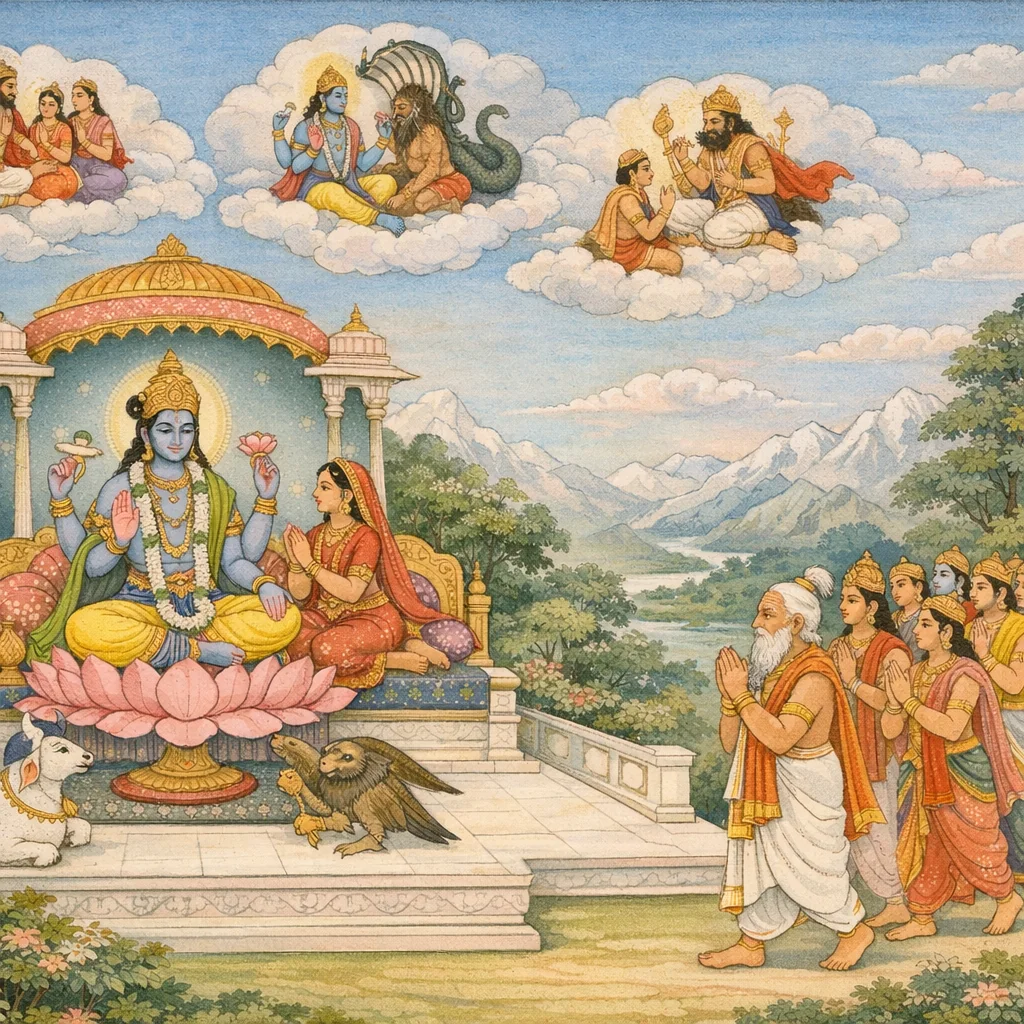
देवाः वैकुण्ठगमनम् तथा विष्णोः अवतारस्तुतिः | Devas Go to Vaikuṇṭha and Praise Viṣṇu’s Avatāras
Adhyāya 16 begins with Sanatkumāra describing a renewed asuric advance that terrifies the devas; shaken, they flee together to Vaikuṇṭha with Prajāpati placed at the front. There the devas, with Prajāpati and allied hosts, bow and offer a formal stuti to Viṣṇu as Hṛṣīkeśa/Madhusūdana, explicitly invoked as the destroyer of the daityas. The hymn recalls the saving works of His avatāras: Matsya (protecting and recovering the Vedas at pralaya), Kūrma (supporting Mandara in the churning of the ocean), Varāha (uplifting and sustaining the earth), Vāmana/Upendra (subduing Bali through a brāhmaṇa guise and measured strides), Paraśurāma (ending oppressive kṣatriya power), Rāma (slayer of Rāvaṇa and exemplar of maryādā), and Kṛṣṇa (the hidden wisdom of the Paramātman, līlā, and play centered on Rādhā). In crisis, remembrance of divine deeds becomes both petition and proof of protection, preparing the ground for deliverance from the returning daitya threat.
Shlokas
Verse 1
सनत्कुमार उवाच । पुनर्दैत्यं समायांतं दृष्ट्वा देवास्सवासवाः । भयात्प्रकंपितास्सर्वे सहैवादुद्रुवुर्द्रुतम्
Sanatkumāra said: Seeing the demon advance once again, the gods—together with Vāsava (Indra)—were all shaken with fear and immediately fled in haste.
Verse 2
वैकुंठं प्रययुस्सर्वे पुरस्कृत्य प्रजापतिम् । तुष्टुवुस्ते सुरा नत्वा सप्रजापतयोऽखिलाः
Then all of them set out for Vaikuṇṭha, placing Prajāpati at their head. Bowing down, all the gods—together with the Prajāpatis—praised the Lord there with reverent devotion.
Verse 3
देवा ऊचुः । हृषीकेश महाबाहो भगवन् मधुसूदन । नमस्ते देवदेवेश सर्वदैत्यविनाशक
The Devas said: “O Hṛṣīkeśa, mighty-armed Lord, O Bhagavān Madhusūdana—salutations to You, O Lord of the gods, the destroyer of all demons.”
Verse 4
मत्स्यरूपाय ते विष्णो वेदान्नीतवते नमः । सत्यव्रतेन सद्राज्ञा प्रलयाब्धिविहारिणे
Salutations to You, O Viṣṇu, who assumed the form of a Fish and rescued the Vedas; salutations to You who, together with the righteous king Satyavrata, moved upon the ocean of dissolution (pralaya).
Verse 5
कुर्वाणानां सुराणां च मथनायोद्यमं भृशम् । बिभ्रते मंदरगिरिं कूर्मरूपाय ते नमः
Salutations to You, who—assuming the form of the Tortoise (Kūrma)—bore Mount Mandara while the gods, striving intensely, undertook the churning of the ocean.
Verse 6
नमस्ते भगवन्नाथ क्रतवे सूकरात्मने । वसुंधरां जनाधारां मूद्धतो बिभ्रते नमः
Salutations to You, O Blessed Lord and Master, who for the sake of the sacred rite (restoring the worlds) assumed the form of the Boar (Varāha). Salutations to You who bear upon Your head the Earth, the support of all beings.
Verse 7
वामनाय नमस्तुभ्यमुपेन्द्राख्याय विष्णवे । विप्ररूपेण दैत्येन्द्रं बलिं छलयते विभो
Salutations to You, Vāmana—Viṣṇu renowned as Upendra. O all-pervading Lord, assuming the form of a brāhmaṇa, You outwitted Bali, sovereign of the Dānavas.
Verse 8
नमः परशुरामाय क्षत्रनिःक्षत्रकारिणे । मातुर्हितकृते तुभ्यं कुपितायासतां द्रुहे
Salutations to Paraśurāma, the exterminator of the kṣatriyas. Salutations to You who became wrathful for the welfare of Your mother, the foe of the wicked.
Verse 9
रामाय लोकरामाय मर्यादापुरुषाय ते । रावणांतकरायाशु सीतायाः पतये नमः
Salutations to You, Rāma—delight of the worlds, the Man of righteous restraint (maryādā). Salutations to You, swift destroyer of Rāvaṇa, the lord and husband of Sītā.
Verse 10
नमस्ते ज्ञानगूढाय कृष्णाय परमात्मन । राधाविहारशीलाय नानालीलाकराय च
Salutations to You—Kṛṣṇa, the Supreme Self—whose true knowledge lies deeply hidden; who delights in sportive union with Rādhā, and who manifests countless divine līlās.
Verse 11
नमस्ते गूढदेहाय वेदनिंदाकराय च । योगाचार्याय जैनाय वौद्धरूपाय मापते
Salutations to You whose true body is hidden; salutations also to You who, in a veiling guise, bring about the censure of the Vedas. Salutations to You as the teacher of Yoga; to You appearing as the Jaina; and to You who assume the form of the Buddha—O Lord.
Verse 12
नमस्ते कल्किरूपाय म्लेच्छानामंतकारिणे । अनन्तशक्तिरूपाय सद्धर्मस्थापनाय च
Salutations to You who manifest as Kalki, the destroyer of the mlecchas; salutations to You whose form is boundless power; and salutations to You who re-establish the true Dharma.
Verse 13
नमस्ते कपिलरूपाय देवहूत्यै महात्मने । वदते सांख्ययोगं च सांख्याचार्याय वै प्रभो
Salutations to You, O Lord, in the form of Kapila—great-souled son of Devahūti—who expounded the discipline of Sāṃkhya and Yoga, and who is indeed the revered teacher of Sāṃkhya.
Verse 14
नमः परमहंसाय ज्ञानं संवदते परम् । विधात्रे ज्ञानरूपाय येनात्मा संप्रसीदति
Salutations to the Supreme Paramahaṃsa, who proclaims the highest wisdom. Salutations to the Ordainer, whose very form is Knowledge—by whom the individual self becomes perfectly serene and illumined.
Verse 15
वेदव्यासाय वेदानां विभागं कुर्वते नमः । हिताय सर्वलोकानां पुराणरचनाय च
Salutations to Vedavyāsa, who arranged the division of the Vedas; and salutations to him who composed the Purāṇas for the welfare of all worlds.
Verse 16
इति श्रीशिवमहापुराणे द्वितीयायां रुद्रसंहितायां पञ्चमे युद्धखंडे देवयुद्धवर्णनं नाम षोडशोऽध्यायः
Thus ends the sixteenth chapter, called “The Description of the Battle of the Devas,” in the fifth section (Yuddha-khaṇḍa) of the second division, the Rudra Saṃhitā, of the Śrī Śiva Mahāpurāṇa.
Verse 17
आर्तिहंत्रे स्वदासानां सुखदाय शुभाय च । पीताम्बराय हरये तार्क्ष्ययानाय ते नमः । सर्वक्रियायैककर्त्रे शरण्याय नमोनमः
Salutations to You—the remover of the afflictions of Your own servants, the giver of happiness and auspiciousness; to Hari clad in yellow garments, who rides upon Tārkṣya (Garuḍa). Salutations again and again to the sole doer of all actions, the refuge of those who seek protection.
Verse 18
दैत्यसंतापितामर्त्य दुःखादिध्वंसवज्रक । शेषतल्पशयायार्कचन्द्रनेत्राय ते नमः
Salutations to You—the thunderbolt that destroys the sorrow and afflictions of mortals tormented by demons; to You who repose upon the serpent-bed (Śeṣa), and whose eyes are the Sun and the Moon.
Verse 19
कृपासिन्धो रमानाथ पाहि नश्शरणागतान् । जलंधरेण देवाश्च स्वर्गात्सर्वे निराकृताः
O ocean of compassion, O Lord of Ramā (Śrī Viṣṇu), protect us who have taken refuge in You. By Jalandhara, all the gods have been driven out from heaven.
Verse 20
सूर्यो निस्सारितः स्थानाच्चन्द्रो वह्निस्तथैव च । पातालान्नागराजश्च धर्मराजो निराकृतः
The Sun was driven out from his station; the Moon and Fire likewise. From the netherworlds of Pātāla the king of serpents was cast out, and even Yama, the Lord of Dharma (Dharmarāja), was repelled.
Verse 21
विचरंति यथा मर्त्याश्शोभंते नैव ते सुराः । शरणं ते वयं प्राप्ता वधस्तस्य विचिंत्यताम्
The gods no longer shine; they wander like mortals. We have come to You for refuge—please decree that he be slain.
Verse 22
सनत्कुमार उवाच । इति दीनवचश्श्रुत्वा देवानां मधुसूदनः । जगाद करुणासिन्धुर्मे घनिर्ह्रादया गिरा
Sanatkumāra said: Hearing the gods’ pitiable words, Madhusūdana (Viṣṇu)—an ocean of compassion—spoke to me in a deep, thunder-resonant voice.
Verse 23
विष्णुरुवाच । भयं त्यजत हे देवा गमिष्याम्यहमाहवम् । जलंधरेण दैत्येन करिष्यामि पराक्रमम्
Viṣṇu said: “Cast off your fear, O gods. I shall go to the battlefield; against the asura Jalandhara I will display my valor in combat.”
Verse 24
इत्युक्त्वा सहसोत्थाय दैत्यारिः खिन्नमानसः । आरोहद्गरुडं वेगात्कृपया भक्तवत्सलः
Having said this, the enemy of the demons rose at once, his mind weighed down with concern. That Lord, tender to devotees, moved by compassion, swiftly mounted Garuḍa.
Verse 25
गच्छन्तं वल्लभं दृष्ट्वा देवैस्सार्द्धं समुद्रजा । सांजलिर्बाष्पनयना लक्ष्मीर्वचनमब्रवीत्
Seeing her beloved departing together with the gods, Lakṣmī—born of the Ocean—stood with folded hands, her eyes filled with tears, and spoke these words.
Verse 26
लक्ष्म्युवाच । अहं ते वल्लभा नाथ भक्ता यदि च सर्वदा । तत्कथं ते मम भ्राता युद्धे वध्यः कृपानिधे
Lakṣmī said: “O Lord, if I am always your beloved and devoted (bhaktā), then how is it that my brother is to be slain in this battle, O treasure-house of compassion?”
Verse 27
विष्णुरुवाच । जलंधरेण दैत्येन करिष्यामि पराक्रमम् । तैस्संस्तुतो गमिष्यामि युद्धाय त्वरितान्वितः
Viṣṇu said: “I shall display my valor against the asura Jalandhara. Praised and encouraged by them, I will swiftly proceed to the battle.”
Verse 28
रुद्रांशसंभवत्वाच्च ब्रह्मणो वचनादपि । प्रीत्या च तव नैवायं मम वध्यो जलंधरः
Because Jalandhara is born from a portion of Rudra, and also because of Brahmā’s declaration—and out of affection for you—this Jalandhara is not to be slain by me.
Verse 29
सनत्कुमार उवाच । इत्युक्त्वा गरुडारूढश्शंखचक्रगदासिभृत् । विष्णुर्वेगाद्ययौ योद्धुं देवैश्शक्रादिभिस्सह
Sanatkumāra said: Having spoken thus, Viṣṇu—mounted upon Garuḍa and bearing the conch, discus, mace, and sword—swiftly went forth to engage in battle, accompanied by the gods, with Indra and the rest.
Verse 30
द्रुतं स प्राप तत्रैव यत्र दैत्यो जलंधरः । कुर्वन् सिंहरवं देवैर्ज्वलद्भिर्विष्णुतेजसा
Swiftly he reached that very place where the demon Jalandhara was. There he raised a lion-like roar, while the gods—blazing with the splendour of Viṣṇu—stood aflame with divine power.
Verse 31
अथारुणानुजजवपक्षवातप्रपीडिताः । वात्याविवर्तिता दैत्या बभ्रमुः खे यथा घनाः
Then the Daityas, battered by the wind raised by the swift wings of Aruṇa’s younger brother, were whirled about by that tempest and wandered helplessly in the sky—like clouds driven in circles.
Verse 32
ततो जलंधरो दृष्ट्वा दैत्यान् वात्याप्रपीडितान् । उद्धृत्य वचनं क्रोधाद्द्रुतं विष्णुं समभ्यगात्
Then Jalandhara, seeing the Daityas tormented by the whirlwind, sprang up in fury; and, driven by anger, he swiftly went forth to confront Viṣṇu.
Verse 33
एतस्मिन्नंतरे देवाश्चक्रुर्युद्धं प्रहर्षिताः । तेजसा च हरेः पुष्टा महाबलसमन्विताः
Meanwhile, the gods—filled with joy—entered into battle. Strengthened by the radiance of Hari (Viṣṇu) and endowed with great might, they fought with renewed power.
Verse 34
युद्धोद्यतं समालोक्य देवसैन्यमुपस्थितम् । दैत्यानाज्ञापयामास समरे चातिदुर्मदान्
Seeing the army of the gods assembled and ready for battle, he commanded the Daityas—exceedingly arrogant in war—to engage in the conflict.
Verse 35
जलंधर उवाच । भोभो दैत्यवरा यूयं युद्धं कुरुत दुस्तरम् । शक्राद्यैरमरैरद्य प्रबलैः कातरैस्सदा
Jalandhara said: “Ho! Ho! O foremost among the Daityas—wage today a fierce and difficult battle against Śakra (Indra) and the other Devas, who, though powerful, are ever fearful within.”
Verse 36
मौर्यास्तु लक्षसंख्याता धौम्रा हि शतसंख्यकाः । असुराः कोटिसंख्याताः कालकेयास्तथैव च
“The Mauryas were numbered in lakhs, the Dhūmras in hundreds; the Asuras were counted in crores, and so too the Kālakeyas.”
Verse 37
कालकानां दौर्हृदानां कंकानां लक्षसंख्यया । अन्येऽपि स्वबलैर्युक्ता विनिर्यांतु ममाज्ञया
“Let the Kālakās, the Daurhṛdas, and the Kaṅkas—numbering in hundreds of thousands—march forth. Let the others too, equipped with their own forces, sally out by my command.”
Verse 38
सर्वे सज्जा विनिर्यात बहुसेनाभिसंयुताः । नानाशस्त्रास्त्रसंयुक्ता निर्भयाः गतसंशयाः
All of them set forth, fully prepared and accompanied by many divisions of troops. Equipped with various weapons and missiles, they advanced fearlessly, their doubts completely dispelled.
Verse 39
भोभो शुंभनिशुंभौ च देवान्समरकातरान् । क्षणेन सुमहावीर्यौ तुच्छान्नाशयतं युवाम्
“Ho! Ho! O Śumbha and Niśumbha—these gods are frightened in battle. You two, possessed of great might, should in a moment destroy these insignificant ones.”
Verse 40
सनत्कुमार उवाच । दैत्या जलंधराज्ञप्ता इत्थं युद्धविशारदाः । युयुधुस्ते सुरास्सर्वे चतुरंगबलान्विताः
Sanatkumāra said: Thus the Daityas—commanded by King Jalandhara and skilled in the art of war—fought; and all the Devas too engaged in battle, equipped with the fourfold divisions of an army.
Verse 41
गदाभिस्तीक्ष्णबाणैश्च शूलपट्टिशतोमरैः । केचित्परशुशूलैश्च निजघ्नुस्ते परस्परम्
Some struck one another with maces and razor-sharp arrows; others fought with spears, swords, and javelins; and still others slew each other with axes and tridents—thus they battled among themselves.
Verse 42
नानायुधैश्च परैस्तत्र निजघ्नुस्ते बलान्विता । देवास्तथा महावीरा हृषीकेशबलान्विताः । युयुधुस्तीक्ष्णबाणाश्च क्षिपंतस्सिंहवद्रवाः
There, empowered with strength, the gods—mighty heroes, fortified by the power of Hṛṣīkeśa (Viṣṇu)—struck down the opposing forces with many kinds of weapons. They fought on, hurling sharp arrows, roaring like lions as they pressed into battle.
Verse 43
केचिद्बाणैस्तु तीक्ष्णैश्च केचिन्मुसलतोमरैः । केचित्परशुशूलैश्च निजघ्नुस्ते परस्परम्
Some struck one another with sharp arrows; some with clubs and javelins; and others with axes and tridents—thus those warriors battered each other in mutual combat.
Verse 44
इत्थं सुराणां दैत्यानां संग्रामस्समभून्महान् । अत्युल्बणो मुनीनां हि सिद्धानां भय कारकः
Thus, between the Devas and the Daityas there arose a great battle—exceedingly fierce—indeed becoming a cause of fear even to the sages and the Siddhas.
Frequently Asked Questions
A renewed daitya advance triggers the devas’ flight and their collective appeal at Vaikuṇṭha, expressed through an avatāra-centered hymn to Viṣṇu.
The chapter models śaraṇāgati: when power fails, remembrance (smaraṇa) and praise (stuti) become the efficacious means to re-align with cosmic sovereignty and invite protection.
Matsya, Kūrma, Varāha, Vāmana (Upendra), Paraśurāma, Rāma, and Kṛṣṇa—each cited for a specific dharma-restoring function.