भक्तिभेदाः—ज्ञानप्रधानभक्तेः प्रशंसा (Grades of Devotees and the Praise of Knowledge-Centered Devotion)
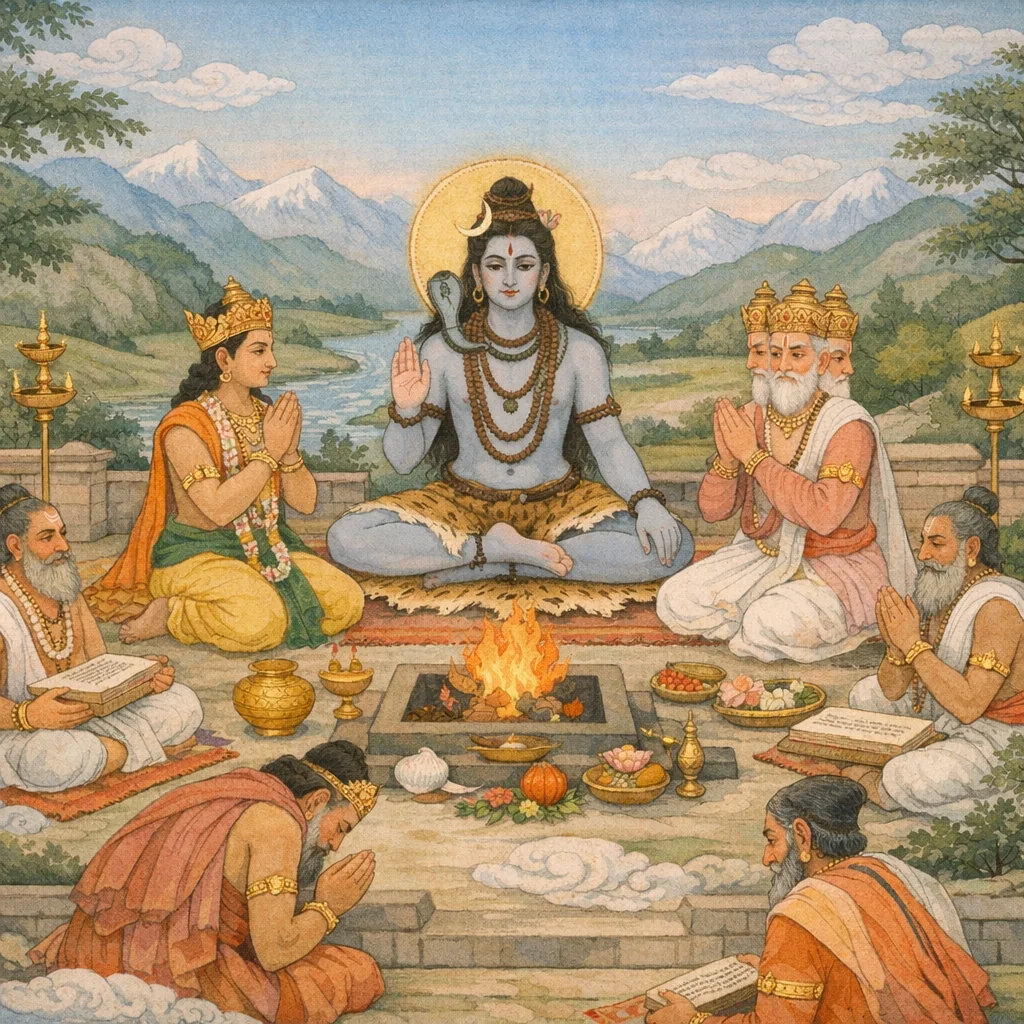
This chapter concludes the Satīkhaṇḍa’s treatment of the aftermath of Dakṣa’s yajña by turning from narrative to explicit doctrine. Brahmā says Mahādeva is pleased when praised by Rameśa (Viṣṇu), Brahmā, and the assembled devas and ṛṣis. Śaṃbhu, casting a compassionate glance on all, addresses Dakṣa: though the independent Lord of the universe, he freely chooses to be “dependent on devotees.” Śiva then classifies worshippers into four—ārta (the distressed), jijñāsu (the seeker of knowledge), arthārthī (the seeker of benefits), and jñānī (the knower)—ranking them upward and declaring the jñānī the best and dearest, for such a one accords with Śiva’s own nature. The teaching stresses that Śiva is attained through jñāna and self-realization as taught in Vedānta śruti; those without knowledge strive with limited understanding. It also criticizes mere externals—Veda-recitation, sacrifice, gifts, and austerity—when done as karma-bound acts, for these alone cannot grant Śiva-realization. Thus the yajña-destruction is reframed as a lesson against ritualism and a positive path to liberation through knowledge-illumined devotion.
Shlokas
Verse 1
ब्रह्मोवाच । इति स्तुतो रमेशेन मया चैव सुरर्षिभिः । तथान्यैश्च महादेवः प्रसन्नस्संबभूव ह
Brahmā said: “Thus praised by Rameśa (Viṣṇu), by me, by the divine sages, and by others as well, Mahādeva indeed became gracious, pleased, and well-disposed.”
Verse 2
श्रीः । समाप्तोयं रुद्रसंहितान्तर्गतसतीखण्डो द्वितीयः
Śrī—auspiciousness. Thus ends the second section, the Satī-khaṇḍa, contained within the Rudra-saṃhitā.
Verse 3
महादेव उवाच । शृणु दक्ष प्रवक्ष्यामि प्रसन्नोस्मि प्रजापते । भक्ताधीनः सदाहं वै स्वतंत्रोप्यखिलेश्वरः
Mahādeva said: “Listen, O Dakṣa; I shall speak, for I am pleased, O Prajāpati, Lord of creatures. Though I am the independent Lord of all, I am ever governed by the bhakti of My devotees.”
Verse 4
चतुर्विधा भजंते मां जनाः सुकृतिनस्सदा । उत्तरोत्तरतः श्रेष्ठास्तेषां दक्षप्रजापते
O Dakṣa Prajāpati, the virtuous ever worship Me in four ways; and among those four, each succeeding kind is superior to the one before.
Verse 5
आर्तो जिज्ञासुरर्थार्थी ज्ञानी चैव चतुर्थकः । पूर्वे त्रयश्च सामान्याश्चतुर्थो हि विशिष्यते
The distressed, the seeker of knowledge, the seeker of worldly gain, and the true knower—these are the four. The first three are of a common kind, but the fourth, the genuine knower, is indeed distinguished as superior.
Verse 6
तत्र ज्ञानी प्रियतर ममरूपञ्च स स्मृतः । तस्मात्प्रियतरो नान्यः सत्यं सत्यं वदाम्यहम्
There, the jñānī—the knower of Truth—is the dearest, and is remembered as My very form. Therefore none is dearer than the jñānī; truth, truth, thus do I declare.
Verse 7
ज्ञानगम्योहमात्मज्ञो वेदांतश्रुतिपारगैः । विना ज्ञानेन मां प्राप्तुं यतन्ते चाल्पबुद्धयः
“I am attainable through true knowledge; I am the Knower of the Self, realized by those who have crossed to the far shore of the Upaniṣadic Vedānta. Yet without knowledge, the small-minded strive to reach Me in vain.”
Verse 8
न वेदैश्च न यज्ञैश्च न दानैस्तपसा क्वचित् । न शक्नुवंति मां प्राप्तुं मूढाः कर्मवशा नरा
Not by the Vedas, nor by sacrifices, nor by gifts, nor by austerities alone can they ever attain Me. Deluded men, driven by the compulsion of karma, are not able to reach Me.
Verse 9
केवलं कर्म्मणा त्वं स्म संसारं तर्तुमिच्छसि । अत एवाभवं रुष्टो यज्ञविध्वंसकारकः
You seek to cross the cycle of saṃsāra by action alone. Therefore I grew wrathful and became the destroyer of the sacrifice (yajña).
Verse 10
इतः प्रभृति भो दक्ष मत्वा मां परमेश्वरम् । बुद्ध्या ज्ञानपरो भूत्वा कुरु कर्म समाहितः
From this time onward, O Daksha, know Me as Parameśvara, the Supreme Lord. Through discernment, be devoted to true knowledge, and perform your duties with a collected and steady mind.
Verse 11
अन्यच्च शृणु सद्बुद्ध्या वचनं मे प्रजापते । वच्मि गुह्यं धर्महेतोः सगुणत्वेप्यहं तव
And hear yet another word of Mine with clear and noble understanding, O Prajāpati. For the sake of Dharma I shall tell you a secret—though I manifest with attributes (saguṇa), I remain ever yours.
Verse 12
अहं ब्रह्मा च विष्णुश्च जगतः कारणं परम् । आत्मेश्वर उपद्रष्टा स्वयंदृगविशेषणः
“I—together with Brahmā and Viṣṇu—(appear as) the supreme causal principle of the universe. I am the Lord of the Self, the inner Witness who observes, self‑luminous in awareness, distinguished as the One who sees by His own light.”
Verse 13
आत्ममायां समाविश्य सोहं गुणमयीं मुने । सृजन्रक्षन्हरन्विश्वं दधे संज्ञाः क्रियोचिताः
O sage, entering His own Māyā—made of the guṇas—the Supreme Lord assumes the functional names suited to action, as He creates, protects, and withdraws the universe.
Verse 14
अद्वितीये परे तस्मिन् ब्रह्मण्यात्मनि केवले । अज्ञः पश्यति भेदेन भूतानि ब्रह्मचेश्वरम्
In that supreme, non-dual Reality—pure Brahman, the one Self alone—the ignorant, through the notion of difference, perceives beings, Brahman, and even the Lord (Īśvara) as separate.
Verse 15
शिरः करादिस्वांगेषु कुरुते न यथा पुमान् । पारक्यशेमुषीं क्वापि भूतेष्वेवं हि मत्परः
Just as a man does not regard his own head, hands, and other limbs as belonging to another, so the one wholly devoted to Me never entertains separateness, never taking any being as truly ‘other’.
Verse 16
सर्वभूतात्मनामेकभावनां यो न पश्यति । त्रिसुराणां भिदां दक्ष स शांतिमधिगच्छति
O Dakṣa, one who beholds the single, unified Presence of the Self within all beings—and harbors no division even among the three gods—attains true peace.
Verse 17
यः करोति त्रिदेवेषु भेदबुद्धिं नराधमः । नरके स वसेन्नूनं यावदाचन्द्रतारकम्
That lowest of men who entertains a divisive notion among the three gods (Brahmā, Viṣṇu, and Śiva) shall surely dwell in hell for as long as the moon and stars endure.
Verse 18
मत्परः पूजयेद्देवान् सर्वानपि विचक्षणः । स ज्ञानं लभते येन मुक्तिर्भवति शाश्वती
A discerning devotee, intent on Me, may worship all the gods; by that he attains the true knowledge through which everlasting liberation arises.
Verse 19
विधिभक्तिं विना नैव भक्तिर्भवति वैष्णवी । विष्णुभक्तिं विना मे न भक्तिः क्वापि प्रजायते
Without devotion to Vidhī (Brahmā), devotion to Viṣṇu does not truly arise. And without devotion to Viṣṇu, devotion to Me (Śiva) is not born anywhere at all.
Verse 20
इत्युक्त्वा शंकरस्स्वामी सर्वेषां परमेश्वरः । सर्वेषां शृण्वतां तत्रोवाच वाणीं कृपाकरः
Having spoken thus, Śaṅkara—the Lord, the Supreme God of all—then, while everyone listened there, the compassionate One addressed them with his words.
Verse 21
हरिभक्तो हि मां निन्देत्तथा शैवोभवे द्यदि । तयोः शापा भवेयुस्ते तत्त्वप्राप्तिर्भवेन्न हि
If a devotee of Hari (Viṣṇu) were to disparage Me, or if a devotee of Śiva were to become one who disparages Hari, then the curses they incur would indeed take effect; for such a person, realization of the supreme Truth does not arise.
Verse 22
ब्रह्मोवाच । इत्याकर्ण्य महेशस्य वचनं सुखकारकम् । जहृषुस्सकलास्तत्र सुरमुन्यादयो मुने
Brahmā said: Having thus heard the bliss-bestowing words of Maheśa (Mahādeva), all who were present there—devas, sages, and others—rejoiced, O muni.
Verse 23
दक्षोभवन्महाप्रीत्या शिवभक्तिरतस्तदा । सकुटुम्बस्सुराद्यास्ते शिवं मत्वाखिलेश्वरम्
Then Dakṣa, filled with great joy, became devoted in bhakti to Śiva; and the gods and others too—along with their families—regarded Śiva as the Lord of all.
Verse 24
यथा येन कृता शंभोः संस्तुतिः परमात्मनः । तथा तस्मै वरो दत्तश्शंभुना तुष्टचेतसा
In whatever manner anyone offered praise to Śambhu—the Supreme Self—exactly in that manner Śambhu, whose heart was pleased, granted that person a boon.
Verse 25
ज्ञप्तः शिवेनाशु दक्षः शिवभक्तः प्रसन्नधीः । यज्ञं चकार संपूर्णं शिवानुग्रहतो मुने
Thus instructed by Lord Śiva, Dakṣa quickly became a devotee of Śiva, his mind serene; and, O muni, by Śiva’s grace he performed the sacrifice (yajña) in full, bringing it to proper completion.
Verse 26
ददौ भागान्सुरेभ्यो हि पूर्णभागं शिवाय सः । दानं ददौ द्विजेभ्यश्च प्राप्तः शंभोरनुग्रहः
He distributed the allotted portions to the gods, and he assigned the full share to Śiva. He also gave gifts to the twice-born; thus he obtained the gracious favor of Śambhu (Lord Śiva).
Verse 27
अथो देवस्य सुमहत्तत्कर्म विधिपूर्वकम् । दक्षः समाप्य विधिवत्सहर्त्विग्भिः प्रजापतिः
Thereupon Prajāpati Dakṣa, together with the officiating priests, duly completed that great rite performed for the Deva, strictly in accordance with the prescribed procedure.
Verse 28
एवं दक्षमखः पूर्णोभवत्तत्र मुनीश्वरः । शंकरस्य प्रसादेन परब्रह्मस्वरूपिणः
Thus, O lord among sages, Dakṣa’s sacrificial rite was brought to completion there—by the gracious favor of Śaṅkara, whose very nature is the Supreme Brahman.
Verse 29
अथ देवर्षयस्सर्वे शंसंतश्शांकरं यशः । स्वधामानि ययुस्तु ष्टाः परेपि सुखतस्तदा
Then all the divine sages, praising the glory of Śaṅkara (Lord Śiva), departed—contented—to their own celestial abodes; and even others too went away happily at that time.
Verse 30
अहं विष्णुश्च सुप्रीतावपि स्वंस्वं परं मुदा । गायन्तौ सुयशश्शंभोः सर्वमंगलदं सदा
Even though Viṣṇu and I are each delighted in our own supreme status, we continually sing, with joy, the noble fame of Śambhu—whose glory is ever the giver of all auspiciousness.
Verse 31
दक्ष संमानितः प्रीत्या महादेवोपि सद्गतिः । कैलासं स ययौ शैलं सुप्रीतस्सगणो निजम्
Thus honored with affection by Dakṣa, Mahādeva—ever established in the highest auspicious course—departed; and, pleased along with His gaṇas, returned to His own mountain abode, Kailāsa.
Verse 32
आगत्य स्वगिरिं शंभुस्सस्मार स्वप्रियां सतीम् । गणेभ्यः कथयामास प्रधानेभ्यश्च तत्कथाम्
Having returned to His own mountain abode, Śambhu remembered His beloved Satī. Then He related that very account to His gaṇas—especially to their foremost leaders.
Verse 33
कालं निनाय विज्ञानी बहु तच्चरितं वदन् । लौकिकीं गतिमाश्रित्य दर्शयन् कामितां प्रभुः
The all-knowing Lord passed the time, speaking at length of those deeds; and, taking on an ordinary worldly manner, He revealed the course that was desired.
Verse 34
नानीतिकारकः स्वामी परब्रह्म सतां गतिः । तस्य मोहः क्व वा शोकः क्व विकारः परो मुने
The Lord is not a doer bound by righteous or unrighteous action; He is the Supreme Brahman, the final refuge of the wise. O best of sages, where could delusion be for Him, where sorrow—how could any modification or change exist in Him?
Verse 35
अहं विष्णुश्च जानीवस्तद्भेदं न कदाचन । केपरे मुनयो देवा मनुषाद्याश्च योगिनः
I and Viṣṇu have known this, and never at any time have we perceived any real difference (in the Supreme). What then need be said of other sages, gods, human beings, and yogins?
Verse 36
महिमा शांकरोनंतो दुर्विज्ञेयो मनीषिभिः । भक्तज्ञातश्च सद्भक्त्या तत्प्रसादाद्विना श्रमम्
The glory of Śaṅkara is endless and difficult to comprehend even for the wisest. Yet it becomes known to devotees through true devotion (bhakti); by His grace it is realized effortlessly, without strain.
Verse 37
एकोपि न विकारो हि शिवस्य परमात्मनः । संदर्शयति लोकेभ्यः कृत्वा तां तादृशीं गतिम्
In truth, in Śiva—the Supreme Self—not even the slightest change arises. Yet, assuming a corresponding state, He makes it manifest to the worlds, revealing it for their understanding.
Verse 38
यत्पठित्वा च संश्रुत्य सर्वलोकसुधीर्मुने । लभते सद्गतिं दिब्यामिहापि सुखमुत्तमम्
O wise sage, whoever reads this and also listens to it with faith becomes truly discerning among all people; he attains a divine and auspicious passage, and even here in this world he gains the highest happiness.
Verse 39
इत्थं दाक्षायणी हित्वा निजदेहं सती पुनः । जज्ञे हिमवतः पत्न्यां मेनायामिति विश्रुतम्
Thus Satī, Dakṣa’s daughter, having relinquished her own body, was born again—renowned in tradition—as the daughter of Menā, the wife of Himavān, lord of the Himalayas.
Verse 40
पुनः कृत्वा तपस्तत्र शिवं वव्रे पतिं च सा । गौरी भूत्वार्द्धवामांगी लीलाश्चक्रेद्भुताश्शिवा
Having again performed austerities there, she chose Śiva alone as her husband. Becoming Gaurī—the left half of Śiva as Ardhanārīśvara—that auspicious Goddess enacted wondrous divine līlā.
Verse 41
इत्थं सतीचरित्रं ते वर्णितं परमाद्भुतम् । भुक्तिमुक्तिप्रदं दिव्यं सर्वकामप्रदायकम्
Thus, this supremely wondrous account of Satī has been narrated to you—divine in nature—bestowing both worldly fulfillment (bhukti) and liberation (mukti), and granting the accomplishment of all worthy desires.
Verse 42
इदमाख्यानमनघं पवित्रं परपावनम् । स्वर्ग्यं यशस्यमायुष्यं पुत्रपौत्रफलप्रदम्
This spotless sacred narrative is purifying and supremely sanctifying. It bestows heavenly merit, fame, long life, and the fruits of sons and grandsons.
Verse 43
इति श्रीशिवमहापुराणे द्वितीयायां रुद्रसंहितायां द्वितीये सतीखंडे दक्षय ज्ञानुसंधानवर्णनं नाम त्रिचत्वारिंशोऽध्यायः
Thus, in the Śrī Śiva Mahāpurāṇa—within the Second Saṃhitā, the Rudra Saṃhitā—ends the forty-third chapter of the second section, the Satī Khaṇḍa, entitled “The Account of Dakṣa’s Inquiry and the Investigation into Knowledge.”
Verse 44
यः पठेत्पाठयेद्वापि समाख्यानमिदं शुभम् । सोपि भुक्त्वाखिलान् भोगानंते मोक्षमवाप्नुयात्
Whoever reads this auspicious sacred account—or causes it to be read—after enjoying all rightful enjoyments, will in the end attain moksha, liberation.
Frequently Asked Questions
The chapter functions as a doctrinal conclusion to the Dakṣa-yajña episode: after praises by Brahmā, Viṣṇu (Rameśa), devas, and ṛṣis, Śiva turns to Dakṣa and explains why he opposed karma-bound sacrifice and what constitutes true approach to him.
It encodes a hierarchy of spiritual motivations and asserts that realization (ātma-jñāna) is the decisive means of attaining Śiva; devotion is validated, but its highest form is knowledge-suffused devotion (jñānī-bhakti).
Not a form-list chapter; the emphasis is on Śiva’s functional modes: (1) compassionate teacher (kṛpā-dṛṣṭi, instruction to Dakṣa) and (2) akhileśvara who nonetheless adopts bhaktādhīnatā—revealing transcendence plus immanence in devotional relation.