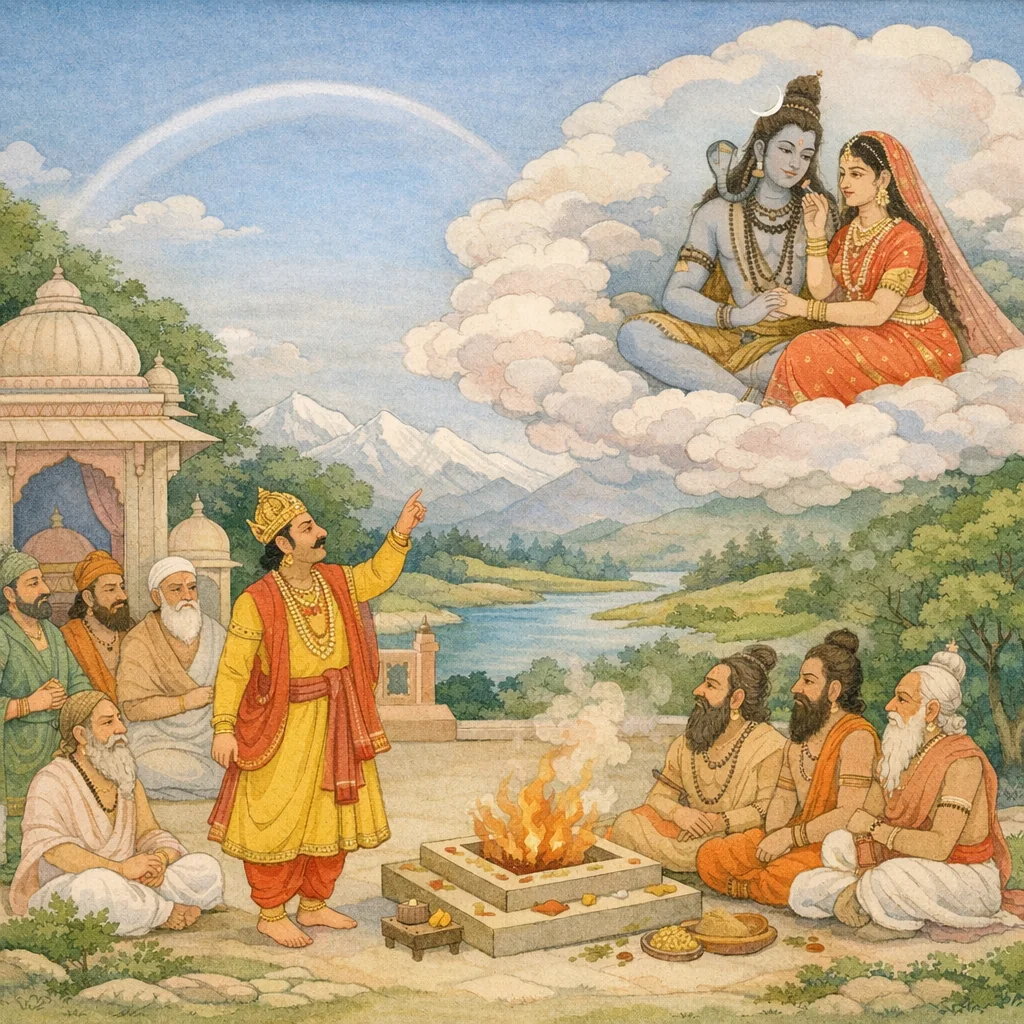
नभोवाणी-दक्ष-निन्दा तथा सती-माहात्म्य-प्रतिपादनम् / The Celestial Voice Rebukes Dakṣa and Proclaims Satī’s Greatness
Adhyāya 31 continues the Dakṣa-yajña narrative. Brahmā relates that, as the sacrifice proceeds, a bodiless celestial proclamation (nabho/vyoma-vāṇī) addresses Dakṣa before the assembled devas and others. The voice rebukes Dakṣa’s misconduct and hypocrisy, declaring his deeds spiritually ruinous and born of deluded understanding. It notes his refusal to heed authoritative counsel—especially guidance associated with Dadhīci and the Śaiva standpoint—and that even after a brāhmaṇa departs the rite having uttered a severe curse, Dakṣa’s mind remains uncorrected. The proclamation then turns from censure to doctrine: Satī is proclaimed eternally worthy of worship, the auspicious Mother of the three worlds, Śaṅkara’s other half (ardhāṅga-bhāginī), and a giver of prosperity, protection, desired boons, fame, and ultimately bhukti and mukti. The chapter thus delivers an unambiguous moral-ritual verdict on Dakṣa’s disrespect and exalts Satī as Māheśvarī, whose honor is integral to cosmic auspiciousness and the proper performance of dharma and sacrifice.
Shlokas
Verse 1
ब्रह्मोवाच । एतस्मिन्नन्तरे तत्र नभोवाणी मुनीश्वर । अवोचच्छृण्वतां दक्षसुरादीनां यथार्थतः
Brahmā said: “O lord among sages, at that very moment a celestial voice was heard there, speaking the truth plainly, while Dakṣa, the gods, and the others listened.”
Verse 2
व्योमवाण्युवाच । रे रे दक्ष दुराचार दंभाचारपरायण । किं कृतं ते महामूढ कर्म चानर्थकारकम्
Vyomavāṇī said: “Hey, hey Dakṣa—evil in conduct, devoted to hypocritical show! O great fool, what have you done? This deed of yours is truly a maker of calamity.”
Verse 3
न कृतं शैवराजस्य दधीचेर्वचनस्य हि । प्रमाणं तत्कृते मूढ सर्वानंदकरं शुभम्
O deluded one, you have not accepted as authoritative the words of Dadhīci concerning the king devoted to Śiva. That teaching is a sacred proof—auspicious and the bestower of joy for all.
Verse 4
निर्गतस्ते मखाद्विप्रः शापं दत्त्वा सुदुस्सहम् । ततोपि बुद्धं किंचिन्नो त्वया मूढेन चेतसि
The brāhmaṇa has departed from your sacrifice after uttering a most unbearable curse. Yet even then you have understood nothing at all—your mind remains deluded.
Verse 5
ततः कृतः कथं नो वै स्वपुत्र्यास्त्वादरः परः । समागतायास्सत्याश्च मंगलाया गृहं स्वतः
“Then how could we fail to show the highest honour to our own daughter? Satī herself has come here of her own accord, to this auspicious house.”
Verse 6
सतीभवौ नार्चितौ हि किमिदं ज्ञानदुर्बल । ब्रह्मपुत्र इति वृथा गर्वितोसि विमोहितः
O weak one in true understanding—why have you not worshipped Śiva and Satī? Deluded as you are, you swell with empty pride merely because you are called ‘Brahmā’s son.’
Verse 7
सा सत्येव सदाराध्या सर्वा पापफलप्रदा । त्रिलोकमाता कल्याणी शंकरार्द्धांगभागिनी
She—Satī herself—is ever worthy of worship. She bestows in full the fruits that cleanse away sin. She is the auspicious Mother of the three worlds, Kalyāṇī, and the one who shares half the body of Śaṅkara.
Verse 8
सा सत्येवार्चिता नित्यं सर्वसौभाग्यदायिनी । माहेश्वरी स्वभक्तानां सर्वमंगलदायिनी
The Goddess Satyā, ever worshipped, bestows all auspicious fortune. As Māheśvarī, she grants every blessing and well-being to her own devotees.
Verse 9
सा सत्येवार्चिता नित्यं संसारभयनाशिनी । मनोभीष्टप्रदा दैवी सर्वोपद्रवहारिणी
When that Goddess is worshipped with truthfulness and sincerity, she ever destroys the fear of saṃsāra; she grants the heart’s desired aims and, being divine, removes every kind of calamity and obstacle.
Verse 10
सा सत्येवार्चिता नित्यं कीर्तिसंपत्प्रदायिनी । परमा परमेशानी भुक्तिमुक्तिप्रदायिनी
That Supreme Goddess—Satī herself—when worshipped daily with truthfulness, bestows fame and prosperity. She is the highest, the sovereign Lady of the Supreme Lord, and the giver of both worldly enjoyment (bhukti) and final liberation (mukti).
Verse 11
सा सत्येव जगद्धात्री जगद्रक्षणकारिणी । अनादिशक्तिः कल्पान्ते जगत्संहारकारिणी
She indeed is Satī—the sustainer of the worlds and the protector of the universe. She is the beginningless Power (Śakti), and at the end of an aeon she becomes the agent of the world’s dissolution.
Verse 12
सा सत्येव जगन्माता विष्णु माताविलासिनी । ब्रह्मेन्द्रचन्द्रवह्न्यर्कदेवादिजननी स्मृता
She indeed is Satī—the Mother of the universe—who, in her divine play (līlā), appears as the mother of Viṣṇu; and she is remembered as the progenitrix of Brahmā, Indra, the Moon, Fire, the Sun, and the other gods.
Verse 13
सा सत्येव तपोधर्मदातादिफलदायिनी । शंभुशक्तिर्महादेवी दुष्टहंत्री परात्परा
She alone is Truth embodied, bestowing the fruits of austerity, dharma, and sacred giving. As Śambhu’s own Śakti, she is Mahādevī—slayer of the wicked—supreme beyond the supreme.
Verse 14
ईदृग्विधा सती देवी यस्य पत्नी सदा प्रिया । तस्यै भागो न दत्तस्ते मूढेन कुविचारिणा
“Satī Devī—so virtuous and exalted—was ever the beloved wife of Śiva. Yet to her no sacrificial share was given by you, O Dakṣa, in your folly and perverse judgment.”
Verse 15
शंभुर्हि परमेशानस्सर्वस्वामी परात्परः । विष्णुब्रह्मादिसंसेव्यः सर्वकल्याणकारकः
Indeed, Śambhu is the Supreme Lord (Parameśāna), the universal Master, higher than the highest; even Viṣṇu, Brahmā, and the other gods worship Him, and He is the cause of all auspiciousness.
Verse 16
तप्यते हि तपः सिद्धैरेतद्दर्शनकांक्षिभिः । युज्यते योगिभिर्योगैरेतद्दर्शनकांक्षिभिः
Indeed, accomplished adepts perform austerities—yearning for the darśana, the sacred vision of Him; and yogins engage in yogic disciplines—yearning for the vision of Him alone.
Verse 17
अनंतधनधान्यानां यागादीनां तथैव च । दर्शनं शंकरस्यैव महत्फलमुदाहृतम्
Even compared with endless wealth and grain, and with sacrifices (yajña) and other rites, the mere darśana—the holy vision—of Śaṅkara alone is declared to yield the greatest fruit.
Verse 18
शिव एव जगद्धाता सर्वविद्यापतिः प्रभुः । आदिविद्यावरस्वामी सर्वमंगलमंगलः
Śiva alone is the Sustainer of the universe, the sovereign Lord and master of all knowledge. He is the supreme ruler of the primordial, highest wisdom, and He is the auspiciousness within all that is auspicious.
Verse 19
तच्छक्तेर्न कृतो यस्मात्सत्करोद्य त्वया खल । अतएवाऽध्वरस्यास्य विनाशो हि भविष्यति
Because today, O wicked one, you have not shown due honor to that Divine Power (Śiva-Śakti), therefore the destruction of this sacrifice is surely going to occur.
Verse 20
अमंगलं भवत्येव पूजार्हाणामपूजया । पूज्यमाना च नासौ हि यतः पूज्यतमा शिवा
Inauspiciousness surely arises when those who are worthy of worship are not honoured. And she is not truly “being worshipped” even when worship is offered—because Śivā (the Supreme Goddess, consort of Śiva) is the most worthy of worship.
Verse 21
सहस्रेणापि शिरसां शेषो यत्पादजं रजः । वहत्यहरहः प्रीत्या तस्य शक्तिः शिवा सती
Even Śeṣa, with his thousand heads, lovingly bears day after day the dust that has arisen from her feet. Such is Satī—the auspicious Śivā—who is the very Śakti of that Lord Śiva.
Verse 22
यत्पादपद्ममनिशं ध्यात्वा संपूज्य सादरम् । विष्णुविष्णुत्वमापन्नस्तस्य शंभोः प्रिया सती
By continually meditating upon and reverently worshipping the lotus-feet of Śambhu (Lord Śiva), Viṣṇu attained his own full state as Viṣṇu; and Satī is the beloved consort of that very Śambhu.
Verse 23
यत्पादपद्ममनिशं ध्यात्वा संपूज्य सादरम् । ब्रह्मा ब्रह्मत्वमापन्नस्तस्य शंभोः प्रिया सती
By constantly meditating upon and reverently worshipping that lotus of feet, Brahmā attained the state of Brahmāhood; and Satī is the beloved of that Śambhu (Lord Śiva).
Verse 24
यत्पादपद्ममनिशं ध्यात्वा संपूज्य सादरम् । इन्द्रादयो लोकपालाः प्रापुस्स्वं स्वं परं पदम्
Having ceaselessly meditated on and reverently worshipped His lotus-feet, Indra and the other guardians of the worlds attained—each in due measure—their own supreme state, by the grace that arises from devoted Śiva-worship.
Verse 25
जगत्पिता शिवश्शक्तिर्जगन्माता च सा सती । सत्कृतौ न त्वया मूढ कथं श्रेयो भविष्यति
Śiva is the Father of the universe, and Śakti—she who is Satī—is the Mother of the universe. O deluded one, if you do not honor them with due reverence, how will true welfare and auspiciousness ever arise for you?
Verse 26
दौर्भाग्यं त्वयि संक्रांतं संक्रांतास्त्वयि चापदः । यौ चानाराधितौ भक्त्या भवानीशंकरौ च तौ
Misfortune has fallen upon you, and calamities too have come upon you—because you have not worshipped with devotion that divine pair: Bhavānī (the Mother) and Śaṅkara (Śiva).
Verse 27
अनभ्यर्च्य शिवं शंभुं कल्याणं प्राप्नुयामिति । किमस्ति गर्वो दुर्वारस्स गर्वोद्य विनश्यति
“Can anyone attain auspicious welfare without first worshipping Śiva, Śambhu? What invincible pride can there be? That pride, rising up, is destroyed even today.”
Verse 28
सर्वेशविमुखो भूत्वा देवेष्वेतेषु कस्तव । करिष्यति सहायं तं न ते पश्यामि सर्वथा
Having turned away from Sarveśa (Lord Śiva), who among these devas will truly be your ally? I do not see anyone at all who can render you real help.
Verse 29
यदि देवाः करिष्यंति साहाय्यमधुना तव । तदा नाशं समाप्स्यंति शलभा इव वह्निना
If the gods now render you assistance, then they will surely meet destruction—like moths rushing into a fire.
Verse 30
ज्वलत्वद्य मुखं ते वै यज्ञध्वंसो भवत्वति । सहायास्तव यावंतस्ते ज्वलंत्वद्य सत्वरम्
May your face blaze this very day; let the sacrifice be ruined indeed. And all those allies of yours—however many there are—may they too burn at once, this very day.
Verse 31
अमराणां च सर्वेषां शपथोऽमंगलाय ते । करिष्यंत्यद्य साहाय्यं यदेतस्य दुरात्मनः
And for your misfortune, the oath of all the immortals (the Devas) will stand: today they will indeed render assistance to this wicked-souled one.
Verse 32
निर्गच्छंत्वमरास्स्वोकमेतदध्वरमंडपात् । अन्यथा भवतो नाशो भविष्यत्यद्य सर्वथा
Let the devas depart at once to their own abode from this sacrificial pavilion. Otherwise, your complete destruction will surely take place today.
Verse 33
निर्गच्छंत्वपरे सर्वे मुनिनागादयो मखात् । अन्यथा भवतां नाशो भविष्यत्यद्य सर्वथा
Let all the others—sages, nāgas, and the rest—depart this sacrificial ground at once. Otherwise, your destruction will surely come today, in every way.
Verse 34
निर्गच्छ त्वं हरे शीघ्रमेतदध्वरमंडपात् । अन्यथा भवतो नाशो भविष्यत्यद्य सर्वथा
O Hari, depart at once from this sacrificial pavilion. Otherwise, your ruin will surely come today, in every way.
Verse 35
निर्गच्छ त्वं विधे शीघ्रमेतदध्वरमंडपात् । अन्यथा भवतो नाशो भविष्यत्यद्य सर्वथा
“O Vidhi (Brahmā), leave this sacrificial pavilion at once. Otherwise, your ruin will surely come about today, without fail.”
Verse 36
ब्रह्मोवाच । इत्युक्त्वाध्वरशालायामखिलायां सुसंस्थितान् । व्यरमत्सा नभोवाणी सर्वकल्याणकारिणी
Brahmā said: Having spoken thus, the heavenly voice—bestower of every auspicious good—fell silent, while all those assembled remained properly seated throughout the sacrificial hall.
Verse 37
तच्छ्रुत्वा व्योमवचनं सर्वे हर्यादयस्सुराः । अकार्षुर्विस्मयं तात मुनयश्च तथा परे
Hearing that proclamation from the sky, all the gods—beginning with Hari—were struck with wonder; and so too were the sages and the others, O dear one.
Verse 51
इति श्रीशिवमहापुराणे द्वितीयायां रुद्रसंहितायां द्वितीये सतीखंडे सत्युपाख्याने नभोवाणीवर्णनं नामैकत्रिंशोऽध्यायः
Thus, in the Śrī Śiva Mahāpurāṇa—within the Second Book, the Rudra Saṃhitā, in the second division known as the Satī Khaṇḍa, in the narrative of Satī—ends the thirty-first chapter, entitled “The Description of the Heavenly Voice.”
Frequently Asked Questions
A celestial voice (vyoma-/nabho-vāṇī) publicly rebukes Dakṣa during the sacrificial context, marking divine disapproval of his anti-Śiva stance and his neglect of Satī.
The passage encodes a Śaiva hermeneutic: yajña without devotion and right cognition becomes anarthakāraka (productive of harm), while honoring Satī–Śiva restores auspicious order and spiritual fruition.
Satī is presented as māheśvarī, trilokamātā, sarvamaṅgala-dāyinī, saṃsāra-bhaya-nāśinī, and bhukti-mukti-pradāyinī—functions that define her as both protective cosmic power and liberating divine presence.