दुर्गोपवीत-रचना तथा शिवामलङ्कारोत्सवः | The Making of the Durgopavīta and Pārvatī’s Auspicious Adornment Festival
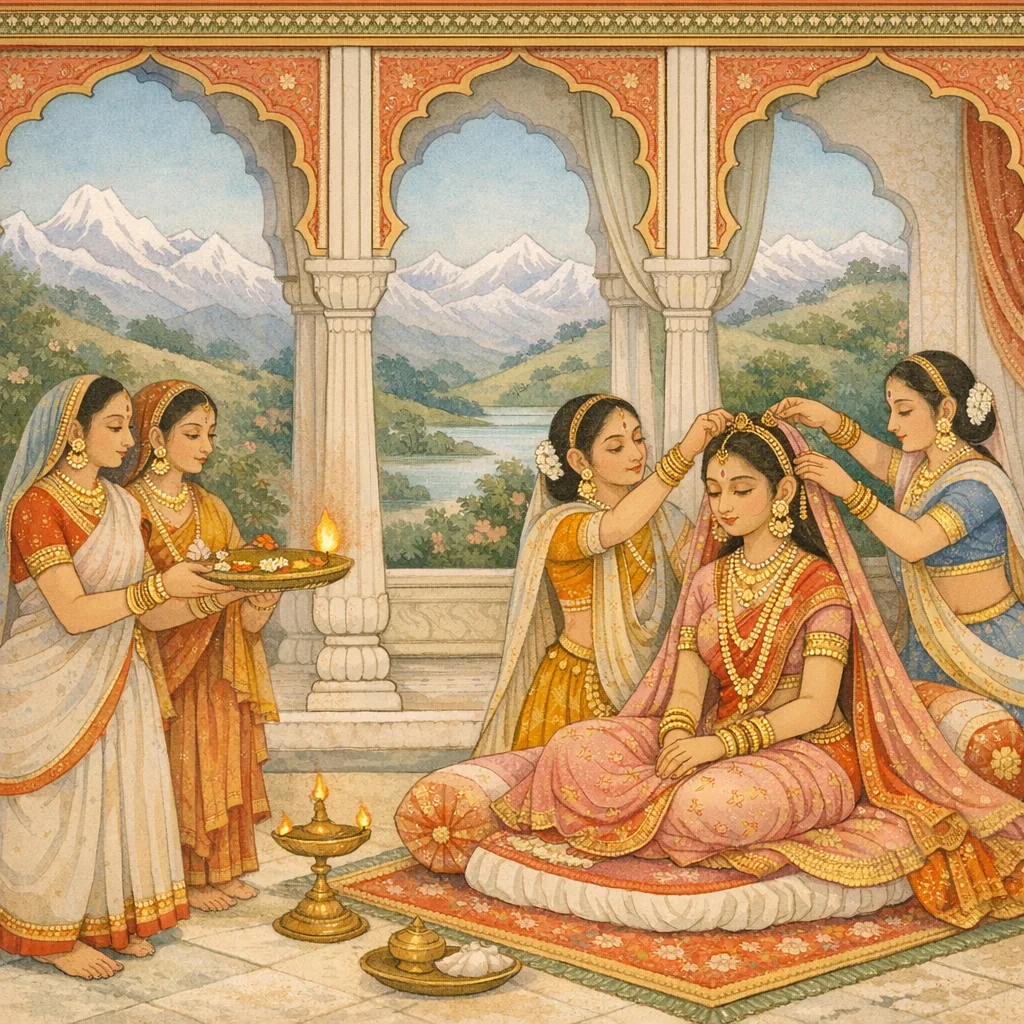
Adhyāya 47 recounts the auspicious preparations for Pārvatī (Śivā) and her adornment festival. Brahmā tells how Himālaya joyfully commissions a Durgopavīta (sacred thread/amulet-like rite-object) with Vedic and Śiva mantras, blending Vedic orthopraxy with Śaiva liturgy. At his request, deities led by Viṣṇu and attending sages enter the inner chambers as witnesses, establishing a formal ritual setting. After proper conduct per śruti and bhāva-ācāra, Pārvatī is adorned with ornaments said to be Śiva’s gifts, affirming divine sanction. She is bathed, decorated, honored with nīrājana (lamp āratī) by companions and Brahmin women, and dressed in fine unworn garments and jeweled attire (kaṃcukī, necklaces, golden bangles). The chapter stresses that amid outward splendor she remains inwardly in dhyāna on Śiva, uniting inner devotion with outer rite. The celebration then widens into communal joy through abundant dāna and music (gīta-vādya), linking the micro-sequence (purification → adornment → āratī → contemplation) to the larger social utsava of auspiciousness.
Shlokas
Verse 1
ब्रह्मोवाच । ततः शैलवरः सोपि प्रीत्या दुर्गोपवीतकम् । कारयामास सोत्साहं वेदमन्त्रैश्शिवस्य च
Brahmā said: Then that foremost of mountains too, with loving delight, eagerly had the sacred thread-ceremony of Durgā performed, accompanied by Vedic mantras and also by the mantras of Śiva.
Verse 2
अथ विष्ण्वादयो देवा मुनयस्सकुतू हलम् । हिमाचलप्रार्थनया विवेशान्तर्गृहं गिरेः
Then Viṣṇu and the other gods, along with the sages—filled with eager curiosity—at Himācala’s earnest request entered the inner residence of the Mountain King.
Verse 3
श्रुत्याचारं भवाचारं विधाय च यथार्थतः । शिवामलंकृतां चक्रुश्शिवदत्तविभूषणैः
Having duly performed the prescribed observances in accordance with the Vedas and proper worldly customs, they then adorned Śivā (Pārvatī) fittingly with ornaments bestowed by Lord Śiva.
Verse 4
प्रथमं स्नापयित्वा तां भूषयित्वाथ सर्वशः । नीराजिता सखीभिश्च विप्रपत्नीभिरेव च
First they bathed her and then adorned her in every way. Thereafter, her friends and the wives of the brāhmaṇas performed the auspicious ārati for her.
Verse 5
अहताम्बरयुग्मेन शोभिता वरवर्णिनी । विरराज महाशैलदुहिता शङ्करप्रिया
Adorned with a pair of spotless garments, the splendid, radiant Lady shone forth—she, the daughter of the great mountain, beloved of Śaṅkara.
Verse 6
कंचुकी परमा दिव्या नानारत्नान्विताद्भुता । विधृता च तया देव्या विलसन्त्याधिकं मुने
O sage, the supreme divine bodice—wondrous and adorned with many kinds of jewels—was worn by that Goddess; and as she shone forth, it appeared even more splendid.
Verse 7
सा बभार तथा हारं दिव्यरत्नसमन्वितम् । वलयानि महार्हाणि शुद्धचामीकराणि च
She then wore a necklace set with radiant divine gems, and also put on precious bangles made of pure gold.
Verse 8
स्थिता तत्रैव सुभगा ध्यायन्ती मनसा शिवम् । शुशुभेति महाशैलकन्यका त्रिजगत्प्रसूः
Remaining there itself, the auspicious maiden—daughter of the great mountain and destined to become the Mother of the three worlds—meditated upon Lord Śiva in her mind; and thus she shone with a special radiance.
Verse 9
तदोत्सवो महानासीदुभयत्र मुदा वहः । दानं बभूव विविधं ब्राह्मणेभ्यो विवर्णितम्
That festival became exceedingly grand, and on both sides there was a flowing tide of joy. Many kinds of gifts were then distributed to the brāhmaṇas, in the manner prescribed and duly described by tradition.
Verse 10
अन्येषां द्रव्यदानं च बभूव विविधम्महत् । गीतवाद्यविनोदश्च तत्रोत्सवपुरस्सरम्
There, many others offered abundant and varied gifts of wealth; and delight in song and instrumental music also arose, with a grand festival leading the proceedings.
Verse 11
अथ विष्णुरहं धाता शक्राद्या अमरास्तथा । मुनयश्च महाप्रीत्या निखिलास्सोत्सवा मुदा
Then Viṣṇu, I (Brahmā) the Creator, Indra and the other gods, and the sages as well—everyone, filled with great affection, rejoiced and celebrated in delight.
Verse 12
सुप्रणम्य शिवां भक्त्या स्मृत्वा शिवपदाम्बुजम् । सम्प्राप्य हिमगिर्य्याज्ञां स्वं स्वं स्थाने समाश्रिताः
Having bowed deeply to Śivā (Pārvatī) with devotion, and remembering the lotus-feet of Lord Śiva, they received the command of Himagiri and then each withdrew to his or her own proper place.
Verse 13
एतस्मिन्नन्तरे तत्र ज्योतिःशास्त्र विशारदः । हिमवन्तं गिरीन्द्रं तं गर्गो वाक्यमभाषत
Just then, in that very moment, Garga—skilled in the science of astrology—addressed Himavān, the lord of mountains, and spoke to him.
Verse 14
गर्ग उवाच । हिमाचल धराधीश स्वामिन् कालीपतिः प्रभो । पाणिग्रहार्थं शंभुं चानय त्वं निजमंदिरम्
Garga said: “O Himācala, lord of the mountains, O sovereign master—O glorious lord, the destined husband of Kālī—bring Śambhu to your own palace for the purpose of the rite of taking the hand (marriage).”}]}
Verse 15
ब्रह्मोवाच । अथ तं समयं ज्ञात्वा कन्यादानोचितं गिरिः । निवेदितं च गर्गेण मुसुदेऽतीव चेतसि
Brahmā said: Then, knowing that the proper time had come to give the maiden in marriage, King Giri—his heart deeply stirred—received the message conveyed by the sage Garga.
Verse 16
महीधरान्द्विजांश्चैव परानपि तदा गिरिः । प्रेषयामास सुप्रीत्या शिवानयनकाम्यया
Then the Mountain-king (Himālaya), rejoicing, dispatched the great mountains, the twice-born brāhmaṇas, and other eminent persons as well—moved by affectionate eagerness to bring Lord Śiva, the bridegroom, into his presence.
Verse 17
ते पर्वता द्विजाश्चैव सर्वमंगलपाणयः । संजग्मुस्सोत्सवाः प्रीत्या यत्र देवो महेश्वरः
Those mountains, and the twice-born sages as well, bearing in their hands every auspicious offering, went forth joyfully—celebrating with love—to the place where Lord Maheśvara (Śiva) was present.
Verse 18
तदा वादित्रघोषेण ब्रह्मघोषेण भूयसा । महोत्साहोऽभवत्तत्र गीतनृत्यान्वितेन हि
Then, amid the resounding music of instruments and the even louder chanting of Vedic hymns, a great surge of joyous zeal arose there—accompanied indeed by singing and dancing.
Verse 19
श्रुत्वा वादित्रनिर्घोषं सर्वे शंकरसेवकाः । उत्थितास्त्वैकपद्येन सदेवर्षिगणा मुदा
Hearing the resounding clamor of the musical instruments, all the attendants devoted to Śaṅkara—together with the hosts of sages and divine seers—rose up at once in a single movement, filled with joy.
Verse 20
परस्परं समूचुस्ते हर्षनिर्भरमानसाः । अत्रागच्छंति गिरयश्शिवानयनकाम्यया
Their minds overflowing with joy, they spoke to one another: “The mountains are coming here, driven by the desire to behold Lord Śiva.”
Verse 21
पाणिग्रहणकालो हि नूनं सद्यस्समागतः । महद्भाग्यं हि सर्वेषां संप्राप्तमहि मन्महे
Surely, the time for the hand-taking (the marriage rite) has now arrived. We deem that great good fortune has come upon everyone present, for this auspicious moment has been attained.
Verse 22
धन्या वयं विशेषेण विवाहं शिवयोर्ध्रुवम् । द्रक्ष्यामः परमप्रीत्या जगतां मंगलालयम्
Blessed indeed are we—most especially—surely we shall behold with supreme joy the wedding of Śiva and (Pārvatī), that very abode and source of auspiciousness for all the worlds.
Verse 23
ब्रह्मोवाच । एवं यावदभूत्तेषां संवादस्तत्र चादरात् । तावत्सर्वे समायाताः पर्वतेंद्रस्य मंत्रिणः
Brahmā said: As their reverent conversation continued there, at that very time all the ministers of the Lord of the Mountains arrived together.
Verse 24
ते गत्वा प्रार्थयांचक्रुश्शिव विष्ण्वादिकानपि । कन्यादानोचितः कालो वर्तते गम्यतामिति
Having gone there, they entreated even Śiva, Viṣṇu, and the other divine ones: “The proper time for the maiden’s gift in marriage has arrived; therefore, please proceed to the ceremony.”
Verse 25
ते तच्छ्रुत्वा सुरास्सर्वे मुने विष्ण्वादयोऽखिलाः । मुमुदुश्चेतसातीव जयेत्यूचुर्गिरिं द्रुतम्
O sage, hearing those words, all the gods—Viṣṇu and the others—were filled with great joy in their hearts. Crying “Victory!”, they quickly addressed the Mountain (Himālaya).
Verse 26
शिवोऽपि मुमुदेऽतीव कालीप्रापणलालसः । गुप्तं चकार तच्चिह्नं मनस्येवाद्भुताकृतिः
Śiva too rejoiced exceedingly, eager to attain Kāli; and that wondrous-formed Lord concealed that sign in secret, as though within His own mind.
Verse 27
अथ स्नानं कृतन्तेन मङ्गलद्रव्यसंयुतम् । शूलिना सुप्रसन्नेन लोकानुग्रहकारिणा
Then the supremely gracious Lord Śiva—the Trident-bearer, ever intent on blessing the worlds—performed the sacred bath, accompanied by auspicious ritual substances.
Verse 28
स्नातस्सुवाससा युक्तस्सर्वैस्तैः परिवारितः । आरोपितो वृषस्कन्धे लोकपालैस्सुसेवितः
Having bathed and being clad in fine garments, he was surrounded by all of them. The Lokapālas then reverently attended him and seated him upon the back of the Bull, Vṛṣa, the sacred bearer of Lord Śiva.
Verse 29
पुरस्कृत्य प्रभुं सर्वे जग्मुर्हिमगिरेर्गृहम् । वाद्यानि वादयन्तश्च कृतवन्तः कुतूहलम्
Placing the Lord at the forefront, they all proceeded to the home of Himālaya; sounding musical instruments, they created an atmosphere of eager celebration and wonder.
Verse 30
हिमागप्रेषिता विप्रास्तथा ते पर्वतोत्तमाः । शम्भोरग्रचरा ह्यासन्कुतूहलसमन्विताः
O brāhmaṇas, sent forth by Himālaya, those foremost among the mountains went ahead before Śambhu, filled with eager curiosity.
Verse 31
बभौ छत्रेण महता ध्रियमाणो हि मूर्द्धनि । चामरैर्वीज्यमानोऽसौ सविता नो महेश्वरः
Our Lord Maheśvara shone forth like the Sun—his head held beneath a great royal parasol, while he was fanned with cāmara whisks, radiant in sovereign splendor.
Verse 32
अहं विष्णुस्तथा चेन्द्रो लोकपाला स्तथैव च । अग्रगाः स्मातिशोभन्ते श्रिया परमया श्रिताः
“I, Viṣṇu, and Indra, as well as the guardians of the worlds, all stand in the foremost rank, shining—supported and adorned by the supreme splendor (śrī) that we have taken refuge in.”
Verse 33
ततश्शङ्खाश्च भेर्य्यश्च पटहानकगोमुखाः । पुनः पुनरवाद्यन्त वादित्राणि महोत्सवे
Then conches and kettledrums, along with drums, small tambour-like instruments, and the gomukha horn were sounded again and again as the great festival proceeded.
Verse 34
तथैव गायकास्सर्वे जगुः परममङ्गलम् । नर्तक्यो ननृतुस्सर्वा नानातालसमन्विताः
Likewise, all the singers sang supremely auspicious hymns, and all the dancing women danced in harmony with many different rhythms and beats.
Verse 35
एभिस्समेतो जगदेकबन्धुर्ययौ तदानीं परमेशवर्चसा । सुसेव्यमानस्सकलैस्सुरेश्वरैर्विकीर्यमाणः कुसुमैश्च हर्षितैः
Accompanied by them, the One Friend of the whole world then went forth, radiant with the splendor of the Supreme Lord (Parameśvara)—reverently attended by all the lords of the gods, and joyfully showered with scattered flowers.
Verse 36
सम्पूजितस्तदा शम्भुः प्रविष्टो यज्ञमण्डपम् । संस्तूयमानो बह्वीभिः स्तुतिभिः परमेश्वरः
Then Śambhu—duly worshipped—entered the sacrificial pavilion (yajña-maṇḍapa). The Supreme Lord, Parameśvara, was being praised with many hymns of adoration.
Verse 37
वृषादुत्तारयामासुर्महेशम्पर्वतोत्तमाः । निन्युर्गृहान्तरम्प्रीत्या महोत्सवपुरस्सरम्
Then the foremost of mountains helped Maheśa dismount from the bull, and with loving joy they led Him into the inner chambers, preceded by a grand festival.
Verse 38
हिमालयोऽपि सम्प्राप्तं सदेवगणमीश्वरम् । प्रणम्य विधिवद्भक्त्या नीराजनमथाकरोत्
Himālaya too, approaching the Lord who had come with the hosts of gods, bowed down in due form; then, with devoted reverence according to proper rite, he performed the nīrājana (ārati) to Īśvara.
Verse 39
सर्वान्सुरान्मुनीनन्यान्प्रणम्य समहोत्सवः । सम्मानमकरोत्तेषां प्रशंसन्स्वविधिम्मुदा
Bowing to all the gods and to the other sages, he—filled with the joy of the great festival—honoured them all, and with gladness praised the propriety of his own rite and observance.
Verse 40
सोऽगस्साच्युतमीशानं सुपाद्यार्घ्यपुरस्सरम् । सदेवमुख्यवर्गं च निनाय स्वालयान्तरम्
Then Agastya, having duly offered the excellent rites of welcome—beginning with water for washing the feet and the arghya—led Īśāna (Lord Śiva), along with Acyuta (Viṣṇu) and the foremost hosts of the gods, into the inner part of his own abode.
Verse 41
प्राङ्गणे स्थापयामास रत्नसिंहासनेषु तान् । सर्वान्विष्णु च मामीशं विशिष्टांश्च विशेषतः
In the courtyard he seated them upon jeweled thrones—placing all of them there, and in particular seating Viṣṇu and me, O Lord, with special honor among the distinguished.
Verse 42
सखीभिर्मेनया प्रीत्या ब्राह्मणस्त्रीभिरेव च । अन्याभिश्च पुरन्धीभिश्चक्रे नीराजनम्मुदा
With affection, accompanied by her friends and by Menā, as well as by the wives of brāhmaṇas and other noble women, she joyfully performed the auspicious nīrājana—ārati.
Verse 43
पुरोधसा कृत्यविदा शंकराय महात्मने । मधुपर्कादिकं यद्यत्कृत्यं तत्तत्कृतं मुदा
Then the family priest, skilled in the rites, joyfully performed for the great-souled Śaṅkara all the ceremonial duties that were proper—beginning with the offering of madhuparka and the other acts of honorable reception.
Verse 44
मया स नोदितस्तत्र पुरोधाः कृतवांस्तदा । सुमंगलं च यत्कर्म प्रस्तावसदृशम्मुने
O sage, at that time I urged him there, and the family priest then joyfully carried out the auspicious rite, performing the sacred act exactly as the occasion required.
Verse 45
अन्तर्वेद्यां महाप्रीत्या सम्प्रविश्य हिमाद्रिणा । यत्र सा पार्वती कन्या सर्वाभरणभूषिता
With great joy, Himālaya entered the inner sacrificial enclosure, where the maiden Pārvatī stood, adorned with every ornament.
Verse 46
वेदिकोपरि तन्वंगी संस्थिता सुविराजिता । तत्र नीतो मद्दादेवो विष्णुना च मया सह
The slender-limbed Goddess was seated upon the altar, shining with great splendor. Then, along with me, Lord Viṣṇu led the divine Lord Śiva to that very place.
Verse 47
इति श्रीशिवमहापुराणे द्वितीयायां रुद्रसंहितायां तृतीये पार्वतीखण्डे शिव हिमगिरिगृहाभ्यन्तरगमनोत्सववर्णनं नाम सप्तचत्वारिंशोऽध्यायः
Thus, in the Śrī Śiva Mahāpurāṇa—within the Second book, the Rudra Saṃhitā; in its Third section, the Pārvatī-khaṇḍa—ends the forty-seventh chapter entitled “The Description of the Festival of Śiva’s Entry into the Inner Palace of Himagiri.”
Verse 48
तत्रोपविष्टो गर्गश्च यत्रास्ति घटिकालयम् । यावच्छेषा घटी तावत्कृतम्प्रणवभाषणम्
There, the sage Garga sat down at the place where a water-clock was kept. For as long as one ghaṭī remained, he continued the utterance of the Praṇava (Om).
Verse 49
पुण्याहम्प्रवदन्गर्गस्समाध्रेऽञ्जलिम्मुदा । पार्व्वत्यक्षतपूर्णं च ववृषे च शिवोपरि
Proclaiming “pūṇyāha,” the auspicious benediction, the sage Garga—joyfully offering reverent folded hands—showered upon Lord Śiva the unbroken rice (akṣata) that had been filled and sanctified by Pārvatī.
Verse 50
तया सम्पूजितो रुद्रो दध्यक्षतकुशाम्बुभिः । परमोदाढ्यया तत्र पार्वत्या रुचिरास्यया
There, Rudra was duly worshipped by radiant-faced Pārvatī with curd, unbroken grains of rice, kuśa grass, and sanctified water—she being supremely steadfast and devoted in her observance.
Verse 51
विलोकयन्ती तं शम्भुं यस्यार्थे परमन्तपः । कृतम्पुरा महाप्रीत्या विरराज शिवाति सा
Gazing upon Śambhu—for whose sake the supremely austere one had formerly performed intense tapas—she shone with great joy, truly becoming “Śivā,” the auspicious consort of Śiva.
Verse 52
मया मुने तदोक्तस्तु गर्गादिमुनिभिश्च सः । समानर्च शिवां शम्भुर्लौकिकाचारसंरतः
O sage, this was indeed spoken by me, and it was affirmed by sages such as Garga. Thereafter Śambhu, devoted to proper worldly conduct, worshipped Śivā with due reverence.
Verse 53
एवं परस्परं तौ वै पार्व्वतीपरमेश्वरौ । अर्चयन्तौ तदानीञ्च शुशुभाते जगन्मयौ
Thus, at that time, Pārvatī and Parameśvara worshipped one another in mutual reverence and shone forth in splendor, for they were the very embodiment of the universe.
Verse 54
त्रैलोक्यलक्ष्म्या संवीतौ निरीक्षन्तौ परस्परम् । तदा नीराजितौ लक्ष्म्यादिभिस्स्त्रीभिर्विशेषतः
Clad in the splendor of the prosperity of the three worlds, the two gazed upon one another. Then, in a special manner, Lakṣmī and other celestial ladies ceremonially honored them with ārati.
Verse 55
तथा परा वै द्विजयोषितश्च नीराजयामासुरथो पुरस्त्रियः । शिवाञ्च शम्भुञ्च विलोकयन्त्योऽवापुर्म्मुदन्तास्सकला महोत्सवम्
Likewise, the women of the twice-born and the women of the city performed ārati before them. Gazing upon Śivā and Śambhu, all were delighted and attained the full joy of that great festival.
Frequently Asked Questions
The chapter centers on the formal ceremonial preparation of Pārvatī—construction/commissioning of a Durgopavīta with Vedic and Śaiva mantras, her ritual bathing and adornment, nīrājana by women attendants, and the public utsava marked by gifts and music.
Adornment functions as ritual sacralization: Śiva-given ornaments signify divine authorization, while nīrājana publicly seals auspiciousness and protection; together they externalize inner śakti while the text insists on sustained dhyāna on Śiva as the true center.
The ideal is the union of inner devotion and outer rite: Pārvatī remains mentally absorbed in Śiva amid ceremonial splendor, while dharma is completed through communal celebration—dāna to Brahmins/others and musical festivities as sanctioned expressions of joy.