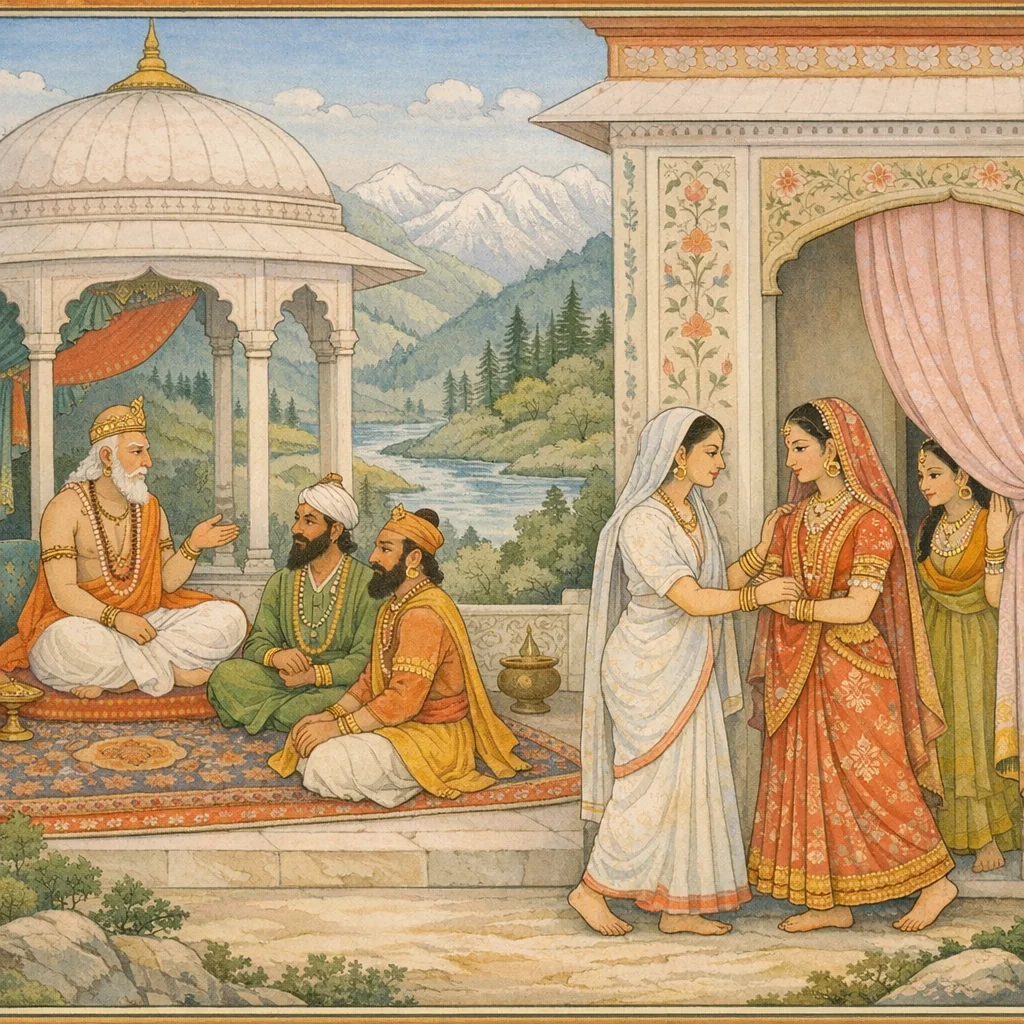
हिमालयस्य निर्णयः — शिवाय पार्वत्याः प्रदाने (Himālaya’s Resolution to Give Pārvatī to Śiva)
Adhyāya 36 portrays a deliberative council in Himālaya’s realm after Vasiṣṭha’s instruction. Brahmā narrates that Himālaya, astonished, convenes the mountain-lords (Meru, Sahya, Gandhamādana, Mandara, Maināka, Vindhya, and others) and asks what should be done in light of Vasiṣṭha’s words. They reply decisively that no further hesitation is needed: by a higher purpose the matter is already settled—Pārvatī (Girijā) has arisen for devakārya and should be given to Śiva, the bearer and fulfiller of Śiva’s intent. Thus the decision is framed as demanded by dharma and cosmic order, not merely by family concerns. Hearing this, Himālaya is greatly pleased, and an inner joy stirs in Girijā’s heart. Arundhatī then counsels Menā with multiple arguments and exemplary itihāsa narratives, removing doubt and bringing the household into accord with the sages’ verdict. Menā, now clear-minded, honors Arundhatī and the guests with hospitality and accepts the course, readying the way for the next ritual and social steps toward the divine marriage.
Shlokas
Verse 1
ब्रह्मोवाच । वसिष्ठस्य वचः श्रुत्वा सगणोपि हिमालयः । विस्मितो भार्य्यया शैलानुवाच स गिरीश्वरः
Brahmā said: Having heard the words of Vasiṣṭha, Himālaya—along with his attendants—became astonished. Then that lord of mountains spoke to his wife, Menā.
Verse 2
हिमालय उवाच । हे मेरो गिरिराट् सह्य गन्धमादन मन्दर । मैनाक विन्ध्य शैलेन्द्रास्सर्वे शृणुत मद्वचः
Himālaya said: “O Meru, O king of mountains; O Sahya, Gandhamādana, and Mandara; O Maināka and Vindhya—O best of mountains, all of you, listen to my words.”
Verse 3
वसिष्ठो हि वदत्येवं किं मे कार्य्यं विचार्य्यते । यथा तथा च शंसध्वं निर्णीय मनसाखिलम्
Thus Vasiṣṭha spoke: “Why should my duty be deliberated over? Decide everything fully in your minds, and then instruct me—whatever you deem proper.”
Verse 4
ब्रह्मोवाच । तच्छुत्वा वचनं तस्य सुमेरुप्रमुखाश्च ते । प्रोचुर्हिमालयं प्रीत्या सुनिर्णीय महीधराः
Brahmā said: Hearing his words, those great mountains—headed by Sumeru—after due deliberation, joyfully addressed Himālaya.
Verse 5
शैला ऊचुः । अधुना किं विमर्शेन कृतं कार्य्यं तथैव हि । उत्पन्नेयं महाभाग देवकार्यार्थमेव हि
The Mountain-lords said: “What use is deliberation now? The deed has already been done. O greatly fortunate one, this daughter has indeed been born solely for the work of the gods.”
Verse 6
प्रदातव्या शिवायेति शिवस्यार्थेवतारिणी । अनयाराधितो रुद्रो रुद्रेण यदि भाषिता
“She should be bestowed with the mantra ‘(Om) Śivāya’—for she is the very embodiment that conveys Śiva’s purpose. If Rudra is worshipped through her, it is as though Rudra Himself has spoken and affirmed this truth.”
Verse 7
ब्रह्मोवाच । एतच्छ्रुत्वा वचस्तेषाम्मेर्वादीनां हिमाचलः । सुप्रसन्नतरोभूद्वै जहास गिरिजा हृदि
Brahmā said: Hearing these words of Meru and the others, Himācala (Himālaya) became even more delighted; and within her heart Girijā (Pārvatī) smiled.
Verse 8
अरुन्धती च तां मेनां बोधयामास कारणात् । नानावाक्यसमूहेनेतिहासैर्विविधैरपि
For good reason, Arundhatī then instructed Menā, awakening her understanding—using many kinds of statements and also various illustrative accounts from sacred history.
Verse 9
अथ सा मेनका शैलपत्नी बुद्ध्वा प्रसन्नधीः । मुनीनरुन्धतीं शैलं भोजयित्वा बुभोज च
Then Menakā, the wife of Himālaya, understanding the situation with a pleased and tranquil mind, first fed the sages—along with Arundhatī—and Śaila (Himālaya), and then she herself partook of the meal.
Verse 10
अथ शैलवरो ज्ञानी सुसंसेव्य मुनींश्च ताम् । उवाच साञ्जलिः प्रीत्या प्रसन्नात्मागतभ्रमः
Then Śailavara, the wise one, having duly served those sages and her, spoke with folded hands in loving joy—his mind serene and his delusion dispelled.
Verse 11
हिमाचल उवाच । सप्तर्षयो महाभागा वचः शृणुत मामकम् । विस्मयो मे गतस्सर्वश्शिवयोश्चरितं श्रुतम्
Himācala said: “O noble Saptarṣis, listen to my words. All my amazement has arisen upon hearing the sacred account of Śiva and His consort.”
Verse 12
मदीयं च शरीरम्वै पत्नी मेना सुतास्सुता । ऋद्धिस्सिद्धिश्च चान्यद्वै शिवस्यैव न चान्यथा
“Indeed, even my own body is (as it were) His; my wife Menā and my granddaughter as well. Prosperity (Ṛddhi), accomplishment (Siddhi), and whatever else exists are truly of Śiva alone—never otherwise.”
Verse 13
ब्रह्मोवाच । इत्युक्त्वा स तदा पुत्रीं दृष्ट्वा तत्सादरं च ताम् । भूषयित्वा तदङ्गानि ऋष्युत्संगे न्यवेशयेत्
Brahmā said: Having spoken thus, he then looked at his daughter with respectful affection. After adorning her limbs, he placed her upon the lap of the sage.
Verse 14
उवाच च पुनः प्रीत्या शैलराज ऋषींस्तदा । अयं भागो मया तस्मै दातव्य इति निश्चितम्
Then the king of mountains, Himālaya, delighted, again addressed the sages: “This share has been firmly determined by me to be given to Him.”
Verse 15
ऋषय ऊचुः । शंकरो भिक्षुकस्तेथ स्वयं दाता भवान् गिरे । भैक्ष्यञ्च पार्वती देवी किमतः परमुत्तमम्
The sages said: “O Mountain-king, there Śaṅkara Himself is the mendicant, and you are the giver with your own hands. And Devī Pārvatī too is the one who receives alms—what could be more supremely auspicious than this?”
Verse 16
हिमवन् शिखराणान्ते यद्धेतोस्सदृशी गतिः । धन्यस्त्वं सर्वशैलानामधिपस्सर्वतो वरः
O Himavān, at the far end of your mountain-peaks you have attained a destiny befitting your cause and purpose. Blessed are you—sovereign of all mountains—everywhere the most excellent.
Verse 17
ब्रह्मोवाच । एवमुक्त्वा तु कन्यायै मुनयो विमलाशयाः । आशिषं दत्तवन्तस्ते शिवाय सुखदा भव
Brahmā said: Having spoken thus to the maiden, those sages of pure intention bestowed a blessing upon her: “Be one who brings happiness to Śiva.”
Verse 18
स्पृष्ट्वा करेण तां तत्र कल्याणं ते भविष्यति । शुक्लपक्षे यथा चन्द्रो वर्द्धन्तां त्वद्गुणास्तथा
Having touched her there with your hand, auspiciousness shall surely come to you. As the moon waxes in the bright fortnight, so may your virtues likewise increase.
Verse 19
इत्युक्त्वा मुनयस्सर्वे दत्त्वा ते गिरये मुदा । पुष्पाणि फलयुक्तानि प्रत्ययं चक्रिरे तदा
Having spoken thus, all the sages joyfully offered that mountain flowers accompanied by fruits; and at that time they established a sure sign of trust and assent, confirming their resolve.
Verse 20
अरुन्धती तदा तत्र मेनां सा सुसुखी मुदा । गुणैश्च लोभयामास शिवस्य परमा सती
Then, there, Arundhatī—joyful and at ease—gladdened Menā; and by speaking of Śiva’s virtues she drew Menā’s heart toward Him, for Arundhatī was a woman of supreme chastity and devotion.
Verse 21
हरिद्राकुंकुमैश्शैलश्मश्रूणि प्रत्यमार्जयत् । लौकिकाचारमाधाय मंगलायनमुत्तमम्
With turmeric and vermilion, she gently wiped and cleansed the dust-laden rocky surfaces; and, observing proper worldly custom, she performed the most auspicious rite that leads to blessedness.
Verse 22
ततश्च ते चतुर्थेह्नि संधार्य्य लग्नमुत्तमम् । परस्परं च सन्तुष्य संजग्मुश्शिवसन्निधिम्
Then, on the fourth day, having fixed upon the most auspicious moment, and being mutually pleased and in harmony, they went into the presence of Lord Śiva.
Verse 23
तत्र गत्वा शिवं नत्वा स्तुत्वा विवि धसूक्तिभिः । ऊचुः सर्वे वसिष्ठाद्या मुनयः परमेश्वरम्
Having gone there, bowing to Śiva and praising Him with many well-composed hymns, all the sages—beginning with Vasiṣṭha—then addressed the Supreme Lord.
Verse 24
ऋषय ऊचुः । देवदेव महादेव परमेश महाप्रभो । शृण्वस्मद्वचनं प्रीत्या यत्कृतं सेवकैस्तव
The sages said: “O God of gods, O Mahādeva, O Supreme Lord, O Great Master—please listen with gracious delight to our words, to what has been done by your attendants.”
Verse 25
बोधितो गिरिराजश्च मेना विविधसूक्तिभिः । सेतिहासं महेशान प्रबुद्धोसौ न संशयः
O Maheśāna, Girirāja and Menā were instructed with many well-chosen words, together with the traditional sacred history; he has indeed been awakened to understanding—of this there is no doubt.
Verse 26
वाक्यदत्ता गिरीन्द्रेण पार्वती ते हि नान्यथा । उद्वाहाय प्रगच्छ त्वं गणैर्देवैश्च संयुतः
‘Pārvatī has been promised to you by Girīndra (Himālaya) by his pledged word—there is no doubt of it. Therefore, go forth for the wedding, accompanied by your gaṇas and joined by the gods.’
Verse 27
गच्छ शीघ्रं महादेव हिमाचलगृहं प्रभो । विवाहय यथा रीतिः पार्वतीमात्मजन्मने
“Go quickly, O Mahādeva, O Lord, to the home of Himācala. In accordance with proper custom, solemnize the marriage of Pārvatī for the sake of your own divine manifestation (incarnation).”
Verse 28
ब्रह्मोवाच । तच्छ्रुत्वा वचनं तेषां लौकिकाचारतत्परः । प्रहृष्टात्मा महेशानः प्रहस्येदमुवाच सः
Brahmā said: Having heard their words, Maheśāna—devoted to the proper conduct of the world—became inwardly delighted; and, smiling, he spoke these words.
Verse 29
महेश उवाच । विवाहो हि महाभागा न दृष्टो न श्रुतो मया । यथा पुरा भवद्भिस्तद्विधिः प्रोच्यो विशेषतः
Maheśa said: “O most fortunate one, I have neither seen nor even heard of such a marriage. Therefore, describe to me in detail the particular rite for it—just as it was formerly laid down by you.”
Verse 30
ब्रह्मोवाच । तदाकर्ण्य महेशस्य लौकिकं वचनं शुभम् । प्रत्यूचुः प्रहसन्तस्ते देवदेवं सदाशिवम्
Brahmā said: Hearing Mahēśa’s auspicious, worldly-sounding words, they replied—smiling—to Sadāśiva, the God of gods.
Verse 31
ऋषय ऊचुः । विष्णुमाहूय वै शीघ्रं ससमाजं विशेषतः । ब्रह्माणं ससुतं प्रीत्या तथा देवं शतक्रतुम्
The sages said: “They swiftly summoned Lord Viṣṇu—especially together with his full assembly—and, with delight, they also called Brahmā along with his son, and likewise the god Śatakratu (Indra).”
Verse 32
तथा ऋषिगणान्सर्वान् यक्षगन्धर्वकिन्नरान् । सिद्धान् विद्याधरांश्चैव तथा चैवाप्सरोगणान्
Likewise, he also assembled all the hosts of sages, the Yakṣas, Gandharvas and Kinnaras, the Siddhas and Vidyādharas, and also the multitudes of Apsarās.
Verse 33
एतांश्चान्यान्प्रभो सर्वानानय स्वेह सादरम् । सर्वं संसाधयिष्यन्ति त्वत्कार्य्यं ते न संशयः
O Lord, bring all these and the others here into your own presence with due honor. They will accomplish your entire purpose—of this there is no doubt.
Verse 34
ब्रह्मोवाच । इत्युक्त्वा सप्त ऋषयस्तदाज्ञां प्राप्य ते मुदा । स्वधाम प्रययुस्सर्वे शंसन्तः शङ्करीं गतिम्
Brahmā said: Having spoken thus, the seven sages—having received her command with joy—departed, all returning to their own abodes, while proclaiming the blessed course that leads to Śaṅkarī (the Divine Mother).
Verse 36
इति श्रीशिवमहापुराणे द्वितीयायां रुद्रसंहितायां तृतीये पार्वतीखंडे सप्तऋषिवचनं नाम षट्त्रिंशोऽध्यायः
Thus ends the thirty-sixth chapter, entitled “The Utterance of the Seven Sages,” in the Pārvatī-khaṇḍa (third section) of the Rudra-saṃhitā (second division) of the glorious Śiva Mahāpurāṇa.
Frequently Asked Questions
A council and resolution: Himālaya, after hearing Vasiṣṭha, consults the mountain-kings and receives a firm directive that Pārvatī should be given to Śiva as part of devakārya; Menā’s hesitation is then resolved by Arundhatī’s instruction.
The episode encodes Śiva–Śakti teleology: Pārvatī’s life is read as purposeful manifestation for cosmic restoration, and the family’s consent becomes a dharmic ratification of a metaphysical necessity.
Rudra/Śiva is invoked as the cosmic beneficiary and telos of the event, while Girijā/Pārvatī is presented as the divinely purposed embodiment of śakti; sage-authority (Vasiṣṭha, Arundhatī) functions as the manifest channel of dharma.