शिवध्यानपूजनवर्णनम् (Description of Śiva Meditation and Worship)
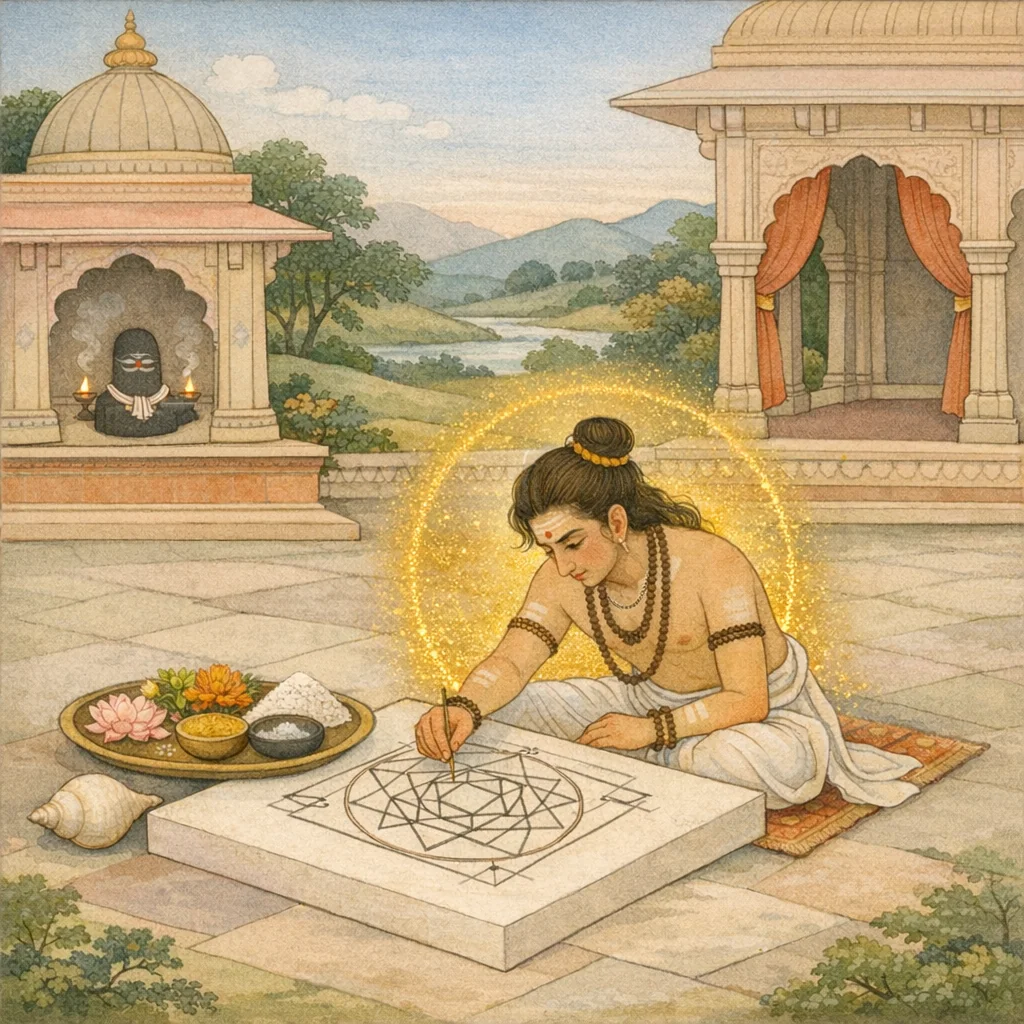
Adhyāya 7 explains Śiva-dhyāna and pūjā as a precise, symbolic ritual sequence rather than a mythic tale. Īśvara’s instruction guides the worshipper to establish and consecrate the setting: a square maṇḍala (caturasra) is drawn; the praṇava “Oṃ” is used for invocation and repeated arcanā; and the śaṅkha (conch) and arghya-pātra (offering vessel) are installed and filled with purified water scented with candana and other fragrances. The chapter lists standard Śaiva pūjā materials—kuśa tips, akṣata, grains (yava, vrīhi), tila, ghee, siddhārtha, flowers, and bhasma. It then introduces layered sacred geometry (square, half-moon, triangle, hexagon, circle) that places a cosmological diagram into the worship space. Mantric elements include Sadyojāta and other ṣaḍaṅga-related mantras, protective varmaṇa (“armor”), and avaguṇṭhana (veiling/protection) through the astra-mantra. Mudrās such as dhenumudrā and śaṅkhamudrā act as ritual seals for purification, protection, and the controlled transmission of mantric power. Overall, the chapter encodes an esoteric discipline: purifying substances, steadying attention, and transforming space into a Śiva-centered field of presence through mantra, geometry, and gesture.
Shlokas
Verse 1
ईश्वर उवाच । स्ववामे चतुरस्रं तु मण्डलं परिकल्पयेत् । ओमित्यभ्यर्च्य तस्मिंस्तु शंखमस्त्रोपशोभितम्
Īśvara said: “On one’s left side, one should arrange a square maṇḍala. Having worshipped it with the syllable ‘Oṃ’, one should place there a conch (śaṅkha), adorned and empowered with the protective weapon-mantras (astra).”
Verse 2
स्थाप्य साधारकं तं तु प्रणवेनार्चयेत्ततः । आपूर्य्य शुद्धतोयेन चन्दनादिसुगंधिना
Having installed that sādhāraka, the pedestal-support for worship, one should then adore it with the Praṇava (Oṁ). Thereafter it should be filled with pure water, made fragrant with sandalwood and other perfumes.
Verse 3
अभ्यर्च्य गन्धपुष्पाद्यैः प्रणवेन च सप्तधा । अभिमंत्र्य ततस्तस्मिन्धेनुमुद्रां प्रदर्शयेत्
After duly worshipping with fragrant substances, flowers, and the like, and performing the rite sevenfold with the Praṇava (Oṁ), one should then sanctify it by mantra (abhimantra). Thereafter, in that very worship, one should display the Dhenumudrā, the “cow” hand-gesture, as a ritual seal.
Verse 4
शंखमुद्रां च पुरतश्चतुरस्रं प्रकल्पयेत् । तदन्तरेर्द्धचन्द्रं च त्रिकोणं च तदन्तरे
One should first form the śaṅkha-mudrā, the conch-like hand-gesture, in front, and then mentally arrange a square. Within that, one should place a half-moon; and within that again, one should place a triangle.
Verse 5
षट्कोणं वृत्तमेवेदं मण्डलं परिकल्पयेत् । अभ्यर्च्य गंधपुष्पाद्यैः प्रणवेनाथ मध्यतः
One should ritually fashion this maṇḍala as a circle marked with a six-pointed form. Having worshipped it with sandal-paste, flowers, and the like, one should then, at its center, adore (Śiva) with the Praṇava—“Oṁ”.
Verse 6
साधारमर्घ्यपात्रं च स्थाप्य गंधादिनार्चयेत् । आपूर्य्य शुद्धतोयेन तस्मिन्पात्रे विनिःक्षिपेत्
Having placed the common arghya-vessel, one should worship it with sandalpaste and the like; then, filling it with pure water, one should place the prescribed offering/substance into that vessel.
Verse 7
इति श्रीशिवमहापुराणे षष्ठ्यां कैलाशसंहितायां शिवध्यानपूजनवर्णनं नाम सप्तमोऽध्यायः
Thus, in the Śrī Śiva Mahāpurāṇa, in the sixth book known as the Kailāsa-saṃhitā, ends the seventh chapter entitled “The Description of Meditation upon Śiva and His Worship.”
Verse 8
सद्योजातादिभिर्मंत्रैः षडंगैः प्रणवेन च । अभ्यर्च्य गंधपुष्पाद्यैरभिमंत्र्य च वर्मणा
Having worshipped (Śiva) with the mantras beginning with Sadyajāta, together with the six-limbed (ṣaḍ-aṅga) mantras and the Praṇava (Oṃ), one should offer fragrances, flowers, and the like, and then consecrate by reciting the protective “Varman” (armor) mantra.
Verse 9
अवगुंण्ठ्यास्त्रमंत्रेण संरक्षार्थं प्रदर्शयेत् । धेनुमुद्रां च तेनैव प्रोक्षयेदस्त्रमंत्रतः
For the sake of protection, one should display the Avaguṇṭhya (veiling) gesture with the Astra-mantra. Then, using that same mantra, one should show the Dhenu-mudrā and sprinkle consecrated water upon the worship materials or the place by means of the Astra-mantra.
Verse 10
स्वात्मानं गंधपुष्पादिपूजोपकरणान्यपि । पद्मस्येशानदिक्पद्मं प्रणवोच्चारपूर्वकम्
First, uttering the Praṇava (Oṁ), one should consecrate one’s own self and the worship-offerings such as fragrance and flowers; then sanctify the lotus-seat, especially the lotus aligned with the Īśāna (northeast) direction.
Verse 11
गुर्वासनाय नम इत्यासनं परिकल्पयेत् । गुरोर्मूर्तिं च तत्रैव कल्प येदुपदेशतः
Uttering, “Salutations to the Guru’s seat,” one should duly arrange a seat (āsana). And in that very place, one should also install the Guru’s form, in accordance with the Guru’s instruction (upadeśa).
Verse 12
प्रणवं गुं गुरुभ्योन्ते नमः प्रोच्यापि देशिकम् । समावाह्य ततो ध्यायेद्दक्षिणाभिमुखं स्थितम्
Having uttered the Praṇava (Oṁ) and the syllable “guṃ”, and then saying “namaḥ” at the end in reverence to the gurus, one should invoke the spiritual preceptor (deśika). Thereafter, one should meditate upon him as seated facing the south.
Verse 13
सुप्रसन्नमुखं सौम्यं शुद्धस्फटिकनिर्मलम् । वरदाभयहस्तं च द्विनेत्रं शिवविग्रहम्
He beheld the embodied form of Śiva—whose face was exceedingly gracious and serene, whose radiance was pure and crystal-clear, who held his hands in the gestures of granting boons and dispelling fear, and who appeared as the two‑eyed auspicious Lord.
Verse 14
एवं ध्यात्वा यजेद्गन्धपुष्पादिभिरनुक्रमात् । पद्मस्य नैरृते पद्मे गणपत्यासनोपरि
Having thus meditated, one should then worship in due order with fragrance, flowers, and the like—placing the offering upon the seat of Gaṇapati, on the lotus situated in the south‑western direction of the lotus-diagram.
Verse 15
मूर्तिम्प्रकल्प्य तत्रैव गणानां त्वेति मंत्रतः । समावाह्य ततो देवं ध्यायेदेका ग्रमानसः
Fashioning an image (for worship) right there, and by the mantra beginning with “gaṇānāṁ tv…”, one should then invoke the Divine Lord into it. Thereafter, with the mind made one-pointed, one should meditate upon that Deva (Śiva).
Verse 16
रक्तवर्णं महाकायं सर्वाभरणभूषितम् । पाशांकुशेष्टदशनान्दधानङ्करपङ्कजैः
He was red-hued, of mighty form, adorned with every ornament; and with lotus-like hands he bore the pāśa, the noose, and the aṅkuśa, the goad, displaying prominent tusks.
Verse 17
गजाननम्प्रभुं सर्वविघ्नौघघ्नमुपासितुः । एवन्ध्यात्वा यजेद्गन्धपुष्पाद्यैरुपचारकैः
One should take refuge in and worship Lord Gajānana, the sovereign who destroys the multitude of all obstacles. Having thus meditated upon him, one should perform worship with offerings of fragrance, flowers, and other ritual services.
Verse 18
कदलीनारिकेलाम्रफललड्डुकपूर्वकम् । नैवेद्यं च समर्प्याथ नमस्कुर्याद्गजाननम्
First offering naivedya—bananas, coconuts, mangoes, fruits, and laddus—one should then bow in reverence to Gajānana, Lord Gaṇeśa.
Verse 19
पद्मस्य वायुदिक्पद्मे संकल्प्य स्कान्दमासनम् । स्कन्दमूर्तिम्प्रकल्प्याथ स्कन्दमावाहयेद्बुधः
Upon the lotus-seat set in the direction of Vāyu, the wise should establish in the mind the seat of Skanda; then, having fashioned the icon of Skanda, he should invoke Lord Skanda to abide within it.
Verse 20
उच्चार्य्य स्कन्दगायत्रीं ध्यायेदथ कुमारकम् । उद्यदादित्यसंकाशं मयूरवरवाहनम्
Having recited the Skanda Gāyatrī, one should meditate upon the divine Youth, Kumāra (Skanda)—radiant like the rising sun and mounted upon the excellent peacock.
Verse 21
चतुर्भुजमुदाराङ्गं मुकुटादिविभूषितम् । वरदाभयहस्तं च शक्तिकुक्कुटधारिणम्
He was four-armed, with a noble and magnificent body, adorned with a crown and other ornaments—one hand granting boons (varada), another bestowing fearlessness (abhaya), and bearing a spear (śakti) and a rooster-emblem as his insignia.
Verse 22
एवन्ध्यात्वाऽथ गंधाद्यैरुपचारैरनुक्रमात् । संपूज्य पूर्वद्वारस्य दक्षशाखामुपाश्रितम्
Thus, having first meditated, one should then worship in proper sequence with offerings such as sandal-paste and the rest; and, having fully honored that which abides by the southern branch at the eastern doorway.
Verse 23
अन्तःपुराधिपं साक्षान्नन्दिनं सम्यगर्चयेत् । चामीकराचलप्रख्यं सर्वाभरणभूषितम्
Then one should properly worship Nandin himself—the lord of Śiva’s inner abode—who shines like a mountain of gold and is adorned with every kind of ornament.
Verse 24
बालेन्दुमुकुटं सौम्यं त्रिनेत्रं च चतुर्भुजम् । दीप्तशूलमृगीटंकहेमवेत्रधरं विभुम्
He is the all-pervading Lord—gentle and auspicious—wearing the crescent moon as His crown, bearing three eyes and four arms; holding a blazing trident, marked with the emblem of the deer, and carrying a golden staff.
Verse 25
चन्द्रबिम्बाभवदनं हरिवक्त्रमथापि वा । उत्तरस्यान्तथा तस्य भार्यां च मरुतां सुताम्
Her face was like the orb of the moon—or even like the countenance of Hari. In the northern quarter, she became the wife of him who abides there, the daughter born of the Maruts.
Verse 26
सुयशां सुव्रतामम्बापादमण्डनतत्पराम् । संपूज्य विधिवद्गन्धपुष्पाद्यैरुपचारकैः
Having duly worshipped Suyaśā—virtuous and of excellent vows, ever intent on adorning the feet of the Divine Mother—according to proper rite, with offerings such as fragrant unguents, flowers, and the other customary services.
Verse 27
ततस्संप्रोक्षयेत्पद्मं सास्त्रशं खोदबिन्दुभिः । कल्पयेदासनं पश्चादाधारादि यथाक्रमात्
Then, in accordance with the injunctions of the śāstras, one should sprinkle and purify the lotus (maṇḍala/seat) with consecrated drops of water. Thereafter, one should arrange the divine seat, beginning with the supporting base (ādhāra) and the rest, in their proper order.
Verse 28
आधारशक्तिं कल्याणीं श्यामां ध्यायेदधो भुवि । तस्याः पुरस्तादुत्कंठमनन्तं कुंडलाकृतिम्
One should meditate, below on the earth-plane, upon Ādhāra-Śakti, the auspicious Support-Power, dark-hued and benevolent. Before Her, one should contemplate Ananta, the Endless One, with raised hoods, coiled in the form of a ring.
Verse 29
धवलं पंचफणिनं लेलिहानमिवाम्बरम् । तस्योपर्यासनं भद्रं कंठीरवचतुष्पदम्
That five-hooded serpent was white, as though it were licking the sky; and upon it was placed an auspicious seat—a four-footed lion-throne—befitting the Lord’s majesty.
Verse 30
धर्मो ज्ञानं च वैराग्यमैश्वर्यं च पदानि वै । आग्नेयादिश्वेतपीतरक्तश्यामानि वर्णतः
Dharma, spiritual knowledge, dispassion (vairāgya), and divine lordship (aiśvarya)—these indeed are the four states. In appearance they are colored, in order from the fire-quarter onward: white, yellow, red, and dark (black).
Verse 31
अधर्मादीनि पूर्वादीन्युत्तरां तान्यनुक्रमात् । राजावर्तमणिप्रख्यान्यस्य गात्राणि भावयेत्
Beginning with Adharma in the eastern direction and proceeding in order up to the northern quarter, one should meditate upon those limbs of the Lord—of that divine form—which shine like the rājāvarta gem.
Verse 32
अधोर्द्ध्वच्छदनं पश्चात्कंदं नालं च कण्टकान् । दलादिकं कर्णिकाञ्च विभाव्य क्रमशोऽर्चयेत्
Thereafter one should meditate upon and worship in due order: the lower and upper coverings; then the bulb, the stalk, and the thorns; and next the petals and other parts together with the pericarp (kārṇikā), offering reverence step by step.
Verse 33
दलेषु सिद्धयश्चाष्टौ केसरेषु च शक्तिकाः । रुद्रा वामादयस्त्वष्टौ पूर्वादिपरितः क्रमात्
In the petals are the eight Siddhis, and in the filaments (kesara) abide the divine Śaktis. Around them, in due order beginning from the east and onward, are the eight Rudras—starting with Vāmā and the others.
Verse 34
कर्णिकायां च वैराग्यं बीजेषु नव शक्तयः । वामाद्या एव पूर्वादि तदन्तश्च मनोन्मनी
In the central pericarp (kārṇikā) is established vairāgya, dispassion. In the seed-syllables (bīja) abide the nine Śaktis—beginning with Vāmā, arranged in order from the eastern direction onward; and at their culmination is Manonmanī, the transcendent Śakti that lifts the mind beyond mind.
Verse 35
कन्दे शिवात्मको धर्मो नाले ज्ञानं शिवाश्रयम् । कर्णिकोपरि वाह्नेयं मंडलं सौरमैन्दवम्
In the bulb (kanda) is Dharma whose very essence is Śiva; in the stalk (nāla) is Knowledge resting in Śiva. Above the pericarp are the sacred circles (maṇḍalas)—of Fire, of the Sun, and of the Moon.
Verse 36
आत्मविद्या शिवाख्यं च तत्त्वत्रयमतः परम् । सर्वासनोपरि सुखं विचित्रकुसुमोज्ज्वलम्
Beyond the triad of tattvas stands the principle known as Śiva, the very Self‑knowledge (ātma‑vidyā). Above all seats, it is the blissful supreme seat, radiant with wondrous flowers.
Verse 37
परव्योमावकाशाख्यं विद्ययातीव भास्वरम् । परिकल्प्यासनं मूर्त्तेः पुष्पविन्यास पूर्वकम्
By the power of contemplative knowledge, one should envision the supremely radiant expanse called the “space of the highest sky” (para‑vyoma). Then, arranging a seat for the Lord’s sacred form, one should first prepare it with a proper placement and offering of flowers.
Verse 38
आधारशक्तिमारभ्य शुद्धविद्यासनावधि । ओंकारादिचतुर्थ्यंतं नाममन्त्रं नमोन्तकम्
Beginning from Ādhāra‑Śakti and extending up to the seat of Śuddha‑vidyā, the Name‑mantra is to be contemplated: starting with Oṃ, proceeding up to the fourth syllable, and concluding with the word “namaḥ.”
Verse 39
उच्चार्य पूजयेद्विद्वान्सर्वत्रैवं विधिक्रमः । अङ्गवक्त्रकलाभेदात्पंचब्रह्माणि पूर्ववत्
Having recited the prescribed mantras, the learned worshipper should perform the worship. In all cases this is the ordained sequence of the rite. And, according to the distinctions of limbs, faces, and divine energies (kalās), the Five Brahmas are to be applied and worshipped just as previously stated.
Verse 40
विन्यसेत्क्रमशो मूर्त्तौ तत्तन्मुद्राविचक्षणः । आवाहयेत्ततो देवं पुष्पाञ्जलिपुटस्थितः
One who is skilled in the appropriate ritual mudrās should place them in due order upon the sacred form (mūrti). Then, holding a cupped handful of flowers in reverent offering, he should invoke (āvāhana) the Deva—Lord Śiva—into that form for worship.
Verse 41
सद्योजातम्प्रपद्यामीत्यारभ्योमन्तमुच्चरन् । आधारोत्थितनादं तु द्वादशग्रन्धिभेदतः
Beginning with the mantra, “I take refuge in Sadyojāta,” and reciting it, one should then contemplate the inner sound (nāda) rising from the foundational support (ādhāra). That nāda is experienced as it pierces and differentiates the twelve knots (granthis).
Verse 42
ब्रह्मरन्धांतमुच्चार्य ध्यायेदोंकारगोचरम् । शुद्धस्फटिकसंकाशं देवं निष्कलमक्षरम्
Having uttered the sacred sound up to the Brahma-randhra (the cranial aperture), one should meditate upon the Lord apprehended through Oṃ—shining like pure crystal—the divine, partless, imperishable Reality.
Verse 43
कारणं सर्वलोकानां सर्वलोकमयं परम् । अन्तर्बहिः स्थितं व्याप्य ह्यणोरल्पं महत्तमम्
He is the supreme Cause of all worlds, the Transcendent Reality that is present as all the worlds. Abiding within and without, He pervades everything—subtler than the subtlest atom, yet the greatest of the great.
Verse 44
भक्तानामप्रयत्नेन दृश्यमीश्वरमव्ययम् । ब्रह्मेन्द्रविष्णुरुद्राद्यैरपि देवैरगोचरम्
To His devotees, the imperishable Lord is beheld effortlessly; yet even to the gods—Brahmā, Indra, Viṣṇu, Rudra and the rest—He remains beyond the reach of perception.
Verse 45
वेदसारञ्च विद्वद्भिरगोचरमिति श्रुतम् । आविर्मध्यान्तरहितं भेषजं भवरोगिणाम्
It is heard from the learned that He is the very essence of the Vedas, yet beyond the reach of ordinary cognition. He is manifest—yet without middle or end—and He is the medicine for those afflicted by the disease of worldly becoming (saṃsāra).
Verse 46
समाहितेन मनसा ध्यात्वैवं परमेश्वरम् । आवाहनं स्थापनं च सन्निरोधं निरीक्षणम्
With the mind fully collected and steady, having thus meditated upon the Supreme Lord, Parameśvara, one should perform the rites of āvāhana (invocation) and sthāpana (establishing Him upon the seat or sacred emblem), followed by sannirodha (inner restraint) and nirīkṣaṇa (attentive contemplation).
Verse 47
नमस्कारं च कुर्वीत बध्वा मुद्राः पृथक्पृथक् । ध्यायेत्सदाशिवं साक्षाद्देवं सकलनिष्कलम्
Having formed the various mudrās one by one, one should offer reverent salutations (namaskāra) and meditate directly upon Sadāśiva—the Divine Lord who is both with form (sakala) and beyond all form (niṣkala).
Verse 48
शुद्धस्फटिकसंकाशं प्रसन्नं शीतलद्युतिम् । विद्युद्वलयसंकाशं जटामुकुटभूषितम्
He appeared like pure crystal—serene and gracious, radiating a cool, soothing splendor; adorned with a crown of jata (matted locks), resplendent like a circle of lightning.
Verse 49
शार्दूलचर्मवसनं किंचित्स्मितमुखाम्बुजम् । रक्तपद्मदलप्रख्यपाणिपादतलाधरम्
He wore a tiger-skin as his garment; his lotus-like face bore a gentle smile. The palms of his hands, the soles of his feet, and his lips gleamed like red lotus petals—radiant with auspicious beauty.
Verse 50
सर्वलक्षणसम्पन्नं सर्वाभरणभूषितम् । दिव्या युधकरैर्युक्तं दिव्यगन्धानुलेपनम्
He was endowed with every auspicious mark and adorned with all ornaments; in his hands were celestial weapons, and he was anointed with divine, fragrant unguents.
Verse 51
पञ्चवक्त्रन्दशभुजञ्चन्द्रखण्डशिखामणिम् । अस्य पूर्वमुखं सौम्यं बालार्कसदृशप्रभम्
He is five-faced and ten-armed, adorned with the crest-jewel of the crescent moon. Of these faces, His eastern face is gentle and auspicious, shining with the radiance of the newly risen sun—revealing for the devotee’s contemplation the compassionate, manifest (saguṇa) form of Śiva.
Verse 52
त्रिलोचनारविन्दाढ्यं बालेन्दुकृतशेखरम् । दक्षिणं नीलजीमूतसमानरुचिरप्रभम्
On the right stood the Lord: His lotus-like three eyes shone forth; He wore the young crescent moon as the jewel upon His crest, and His lovely radiance resembled a dark-blue raincloud.
Verse 53
भ्रुकुटीकुटिलं घोरं रक्तवृत्तत्रिलोचनम् । दंष्ट्रा करालं दुष्प्रेक्ष्यं स्फुरिताधरपल्लवम्
His brow was knotted into a terrifying frown; His three eyes were round and blood-red. With fearsome protruding fangs, hard to behold, and lips quivering, He stood forth as an awe-inspiring, formidable manifestation of the Lord.
Verse 54
उत्तरं विद्रुमप्रख्यं नीलालकविभूषितम् । सद्विलासन्त्रिनयनं चन्द्रार्द्धकृतशेखरम्
His northern side shone like coral, adorned with dark-blue curling locks. Ever playful in grace, He bore three eyes, and the crescent moon formed His diadem.
Verse 55
पश्चिमम्पूर्णचन्द्राभं लोचनत्रितयोज्ज्वलम् । चन्द्रलेखाधरं सौम्यं मन्दस्मितमनोहरम्
Facing west, He shone like the full moon, radiant with three brilliant eyes. Bearing the mark of the crescent moon, gentle and serene, He captivated the heart with a soft, enchanting smile.
Verse 56
पञ्चमं स्फटिकप्रख्यमिन्दुरेखासमुज्ज्वलम् । अतीवसौम्यमुत्फुल्ललोचनत्रितयोज्ज्वलम्
The fifth form shone like crystal, radiant with the gleam of the crescent-moon line; supremely gentle and auspicious, it blazed with the splendor of three wide-open eyes.
Verse 57
दक्षिणे शूलपरशुवज्रखड्गानलोज्ज्वलम्
On the right side, (He is seen) blazing forth—bearing the trident, the axe, the thunderbolt, the sword, and fire—radiant with irresistible power.
Verse 58
पूर्व्वे पिनाकनाराचघण्टा पाशांकुशोज्ज्वलम् । निवृत्त्याजानुपर्य्यंतमानाभि च प्रतिष्ठया
On the eastern side, shining with the bow Pināka, arrows, a bell, a noose, and an elephant-goad—one should place (the divine form/arrangement), beginning from Nivṛtti up to the knees, and from there up to the navel with Pratiṣṭhā.
Verse 59
आकण्ठं विद्यया तद्वदाललाटं तु शान्तया । तदूर्ध्वं शान्त्यतीताख्यकलया परया तथा
Up to the throat, one should contemplate the Lord’s presence through Vidyā; likewise, at the forehead through Śānti. Above that, one should meditate through the supreme Power (Kalā) called Śāntyatītā, which transcends even peace.
Verse 60
पञ्चाध्वव्यापिनं तस्मात्कलापञ्चकविग्रहम् । ईशानमुकुटं देवम्पुरुषाख्यम्पुरातनम्
Therefore, He is the Deity who pervades the fivefold paths (pañcādhvā), manifest as a body constituted of the five kalās; crowned with Īśāna, the ancient Lord known as Puruṣa.
Verse 61
अघोरहृदयं तद्वद्वामगुह्यं महेश्वरम् । सद्योजातं च तन्मूर्तिमष्टत्रिंशत्कलामयम्
Likewise, he should contemplate Aghora as the Heart, and Vāma as the Hidden Mystery of Mahēśvara; and also Sadyojāta—this very form of the Lord—constituted of thirty‑eight divine kalās (energies/parts).
Verse 62
मातृकामयमीशानम्पञ्चब्रह्ममयन्तथा । ओंकाराख्यमयं चैव हंसन्यासमयन्तथा
He should contemplate Īśāna (Śiva) as pervading the mātṛkā, the matrix of letters; as the very essence of the Five Brahmans; as identical with the sacred syllable Oṃ; and likewise as present in the haṃsa-nyāsa, the inner placement of the breath‑mantra.
Verse 63
पञ्चाक्षरमयन्देवं षडक्षरमयन्तथा । अङ्गषट्कमयञ्चैव जातिषट्कसमन्वितम्
That Deity is of the nature of the five‑syllabled mantra, and likewise of the six‑syllabled mantra. He is also constituted of the sixfold limbs of mantra‑worship and is endowed with the sixfold classifications (jātis), in accordance with the Śaiva revelation.
Verse 64
एवन्ध्यात्वाथ मद्वामभागे त्वां च मनोन्मनीम् । गौरी मिमाय मन्त्रेण प्रणवाद्येन भक्तितः
Having thus meditated, Gaurī—devoutly—fashioned you, the state of Manonmanī, upon my left side, by a mantra that begins with the Pranava (Oṃ).
Verse 65
आवाह्य पूर्ववत्कुर्यान्नमस्कारांतमी श्वरि । ध्यायेत्ततस्त्वां देवेशि समाहितमना मुनिः
Having invoked you as before, O Īśvarī, he should perform the worship up to the concluding prostration. Thereafter, O Devī, Lady of the gods, the sage—his mind fully collected—should meditate upon you.
Verse 66
प्रफुल्लोत्पलपत्राभां विस्तीर्णायतलोचनाम् । पूर्णचन्द्राभवदनान्नील कुंचितमूर्द्धजाम्
Her eyes were wide and long like the petals of a fully blossomed blue lotus; her face shone like the full moon, and her hair was dark and softly curled.
Verse 67
नीलोत्पलदलप्रख्याञ्चन्द्रार्धकृतशेखराम् । अतिवृत्तघनोत्तुंगस्निग्धपीनपयोधराम्
She shone with the hue of a blue lotus petal, her crest adorned with the crescent moon; and her breasts were lofty and full—dense, glossy, and beautifully rounded.
Verse 68
तनुमध्याम्पृथुश्रोणीम्पीतसूक्ष्मतराम्बराम् । सर्वाभरणसम्पन्नां ललाटतिलकोज्ज्वलाम्
She was slender-waisted and broad-hipped, clad in a very fine yellow garment; adorned with every ornament, she shone with a radiant tilaka upon her forehead.
Verse 69
विचित्रपुष्पसंकीर्णकेशपाशोपशोभिताम् । सर्वतोऽनुगुणाकारां किंचिल्लज्जानताननाम्
Her tresses were adorned with clusters of many-colored flowers; her form was graceful and well-proportioned in every way, and her face was slightly lowered in modesty.
Verse 70
हेमारविन्दं विलसद्दधानां दक्षिणे करे । चण्डवच्चामरं हस्तं न्यस्यासीनां सुखासने
She sat at ease upon a comfortable seat—her right hand beautifully holding a golden lotus, while the other hand, resting like that of a dignified attendant, bore a ceremonial fly-whisk (chamara).
Verse 71
एवम्मान्त्वां च देवेशि ध्यात्वा नियतमानसः । स्नापयेच्छंखतोयेन प्रणवप्रोक्षणक्रमात्
Thus, O Goddess: having understood this and meditating with a disciplined mind, one should bathe (Śiva’s sacred emblem) with water from a conch, following the prescribed sprinkling rite accompanied by the Praṇava, “Oṁ”.
Verse 72
भवे भवे नातिभव इति पाद्यम्प्रकल्पयेत् । वामाय नम इत्युक्त्वा दद्यादाचमनीयकम्
Reciting, “In birth after birth, may I not be overwhelmed by worldly becoming,” one should offer the pādya, the water for the feet. Then, uttering “Obeisance to Vāmā,” one should offer the ācamanīya, the water for ritual sipping.
Verse 73
ज्येष्ठाय नम इत्युक्त्वा शुभ्रवस्त्रम्प्रकल्पयेत् । श्रेष्ठाय नम इत्युक्त्वा दद्याद्यज्ञोपवीतकम्
Reciting, “Obeisance to Jyeṣṭha (the Eldest, Lord Śiva),” one should arrange a pure white garment as an offering. Reciting, “Obeisance to Śreṣṭha (the Most Excellent),” one should then offer the yajñopavīta, the sacred thread.
Verse 74
रुद्राय नम इत्युक्त्वा पुनराचमनीयकम् । कालाय नम इत्युक्त्वा गन्धन्दद्यात्सुसंस्कृतम्
Having uttered, “Homage to Rudra,” one should again perform ācamanā, the purifying ritual sip. Then, uttering, “Homage to Kāla,” one should offer well-prepared and sanctified sandal-paste, the fragrant unguent, in worship.
Verse 75
कलाविकरणाय नमोऽक्षतं च परिकल्पयेत् । बलविकरणाय नम इति पुष्पाणि दापयेत्
With the mantra “Obeisance to the Revealer of the divine kalā (sacred arts),” one should duly offer unbroken rice-grains. Then, with the mantra “Obeisance to the Revealer of strength,” one should present flowers.
Verse 76
बलाय नम इत्युक्त्वा धूपन्दद्यात्प्र यत्नतः । बलप्रमथनायेति सुदीपं चैव दापयेत्
Having uttered, “Obeisance to Bala,” one should carefully offer incense. Then, reciting, “(Obeisance) to the Subduer of Bala,” one should also have a bright lamp lit as an offering.
Verse 77
ब्रह्मभिश्च षडंगैश्च ततो मातृकया सह । प्रणवेन शिवेनैव शक्तियुक्तेन च क्रमात्
Then, in proper sequence, one should perform the consecrating nyāsa with the Brahma-mantras and the six auxiliaries (ṣaḍaṅga); thereafter with the Mātṛkā, the matrix of letters; and then with Praṇava (Oṁ) and with Śiva—always conjoined with Śakti—step by step.
Verse 78
मुद्राः प्रदर्शयेन्मह्यन्तुभ्यञ्च वरवर्णिनि । मयि प्रकल्पयेत्पूर्वमुपचारांस्ततस्त्वयि
“O fair and excellent lady, first let him show the mudrās, the ritual hand-gestures, to Me and to you; then let him first arrange the offerings of worship (upacāras) for Me, and thereafter for you.”
Verse 79
यदा त्वयि प्रकुर्वीत स्त्रीलिंगं योजयेत्तदा । इयानेव हि भेदोऽस्ति नान्यः पार्वति कश्चन
When a word or expression is formed with reference to you, O Pārvatī, the feminine gender is applied; this alone is the difference—there is no other distinction at all, O Pārvatī.
Verse 80
एवन्ध्यानम्पूजनं च कृत्वा सम्यग्विधानतः । ममावरणपूजां च प्रारभेत विचक्षणः
Thus, having duly performed meditation and worship according to the proper injunctions, the wise devotee should then begin the āvaraṇa-pūjā—my worship through the attendant circles and coverings of the sacred maṇḍala.
Frequently Asked Questions
It teaches a step-by-step Śaiva worship protocol: constructing a maṇḍala, installing vessels (śaṅkha/arghya-pātra), performing praṇava-based arcanā, adding prescribed substances, and applying mantras and mudrās to consecrate, protect, and finalize the rite.
The sequence of square/ardhacandra/triangle/hexagon/circle functions as a cosmogram that orders space into a Śiva-field; mudrās (dhenumudrā, śaṅkhamudrā) act as embodied ‘seals’ that stabilize intention, mark transitions in the rite, and ritually secure purity and protection.
The chapter foregrounds Īśvara as the instructing authority and invokes Sadyojāta and related ṣaḍaṅga-associated mantra-elements, alongside protective layers (varmaṇa, astra-mantra, avaguṇṭhana) that express Śiva’s safeguarding and consecratory power in ritual form.