Śiva-Pūjākramaḥ — The Procedural Order of Shiva Worship (Pañcāvaraṇa & Upacāras)
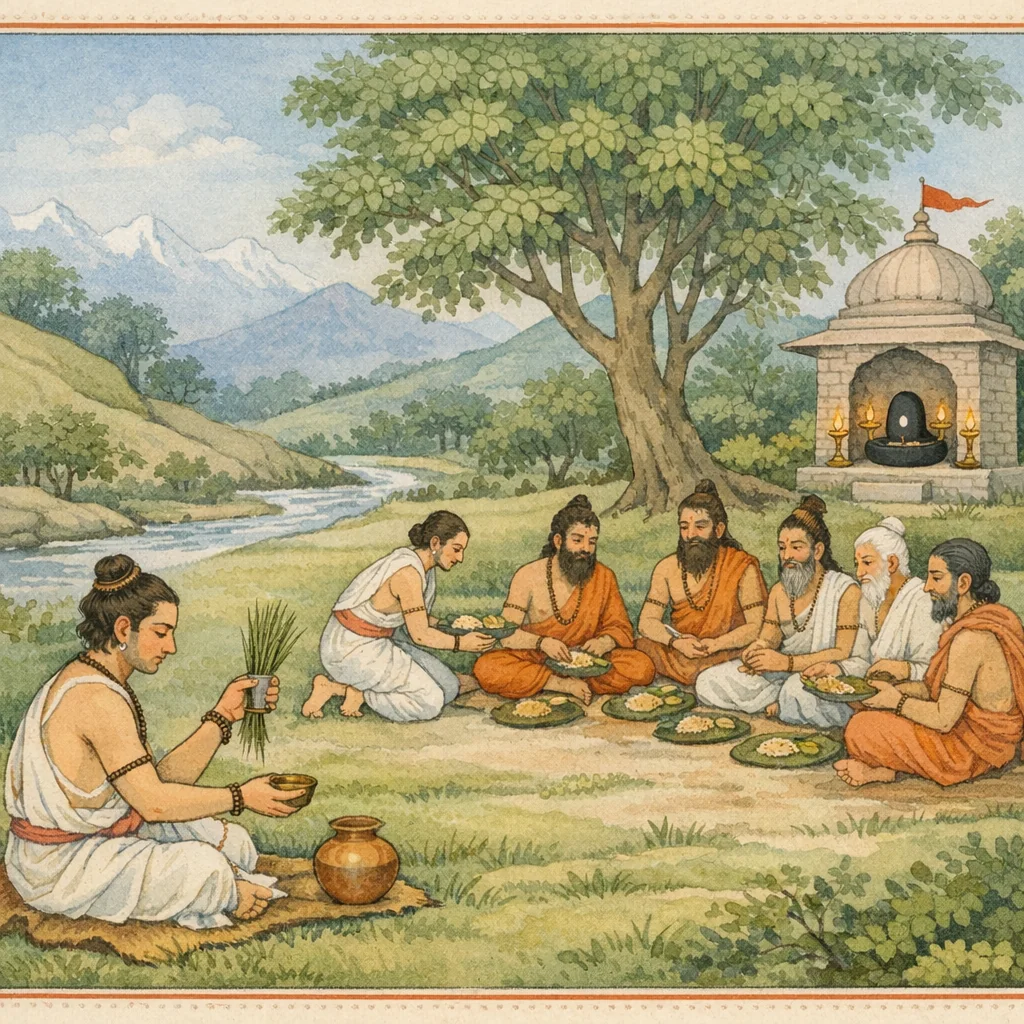
Adhyāya 23 is a procedural teaching in dialogue form, where Subrahmaṇya sets out the regulated order of Shaiva worship and devotional hospitality. It begins with temporal discipline—rising on the twelfth day, morning bath, and completion of daily rites—then turns to social-ritual ethics: inviting Shiva-devotees, ascetics, and Shiva-beloved Brāhmaṇas, and feeding them at midday with clean, auspicious foods. The focus then shifts to the worship space: performing pūjā before Parameśvara through the pañcāvaraṇa method, with restraint of body and speech (prāṇāyāma, vāg-yama). A formal saṃkalpa is made with reference to the guru, followed by touching darbha, self-purification (washing feet, ācamana), and seating the invitees facing east and adorned with bhasma. The chapter stresses hierarchical contemplation—Sadāśiva and a graded guru-lineage—before detailing the standard upacāras: āsana, āvāhana, arghya, pādya, ācamana, vastra, gandha, akṣata, flower offerings with praṇava-led names, then dhūpa and dīpa, ending with a completion statement and prostration. Overall it codifies a Shaiva liturgical micro-grammar of hospitality, purity, mantra, and offering-sequence as alignment with Parameśvara.
Shlokas
Verse 1
सुब्रह्मण्य उवाच । द्वादशाहे समुत्थाय प्रातः स्नात्वा कृताह्निकः । शिवभक्तान्यतीन्वापि ब्राह्मणान्वा शिवप्रियान्
Subrahmaṇya said: “On the twelfth day, rising early in the morning, after bathing and completing the prescribed daily rites, one should reverently approach and honor Śiva’s devotees—whether ascetics devoted to Him or Brāhmaṇas dear to Śiva.”
Verse 2
विमन्त्र्य तान्समाहूय मध्याह्न चाप्लुताञ्छुचीन् । विधिवद्भोजयेद्भक्त्या स्वाद्वन्नैर्विविधैश्शुभैः
Having respectfully invited them and gathered them together, at midday—when they are bathed and purified—one should, in proper ritual manner, feed them with devotion, offering many kinds of auspicious and delicious foods.
Verse 3
सन्निधौ परमेशस्य पंचावरणमार्गतः । पूजयेत्तस्य संस्थाप्य प्राणानायम्य वाग्यतः
In the very presence of Parameśvara, one should worship Him by following the method of the five enclosures; having duly installed (the deity/Śiva-liṅga) and restrained the breath, one should discipline speech and then perform the worship.
Verse 4
महासंकल्पमार्गेण संकल्प्यास्मद्गुरोरिह । पूजां करिष्य इत्युक्त्वा ततो दर्भानुस्पपृशेत्
Following the procedure of the great saṅkalpa, one should here, before our revered guru, make the solemn resolve: “I shall perform the worship.” Having thus declared, one should then touch the sacred darbha grass in accordance with the rite.
Verse 5
पादौ प्रक्षाल्य चाचम्य स्वयं कर्ता च वाग्यतः । स्थापयेदासने तान्वै प्राङ्मुखान्भस्मभूषितान्
Having washed his feet and performed ācamana, the worshipper himself—restrained in speech—should seat them upon their āsanas, facing east, adorned with bhasma, the sacred ash.
Verse 6
सदाशिवादिक्रमतो ध्यायेदष्टौ च तत्र तान् । परया सम्भावनयेतरानपि मुने द्विजान् । परमेष्ठिगुरुं ध्यायेत्सांबबुद्ध्या स्वनामतः । गुरुश्च परमन्तस्मात्परापरगुरुं ततः
Beginning with Sadāśiva in proper order, one should meditate upon those eight preceptors. And, O sage, one should also reverently contemplate the other twice-born teachers with the highest regard. One should meditate on the supreme Guru—known by one’s own tradition and name—understanding him as Sāmbā, Śiva united with Śakti. After that, one should meditate on the highest Guru, and then on the parāpara Guru, both transcendent and immanent.
Verse 7
इदमासनमित्युक्त्वा चासनानि प्रकल्पयेत् । प्रणवादिद्वितीयांते स्वस्य नाम समुच्चरन्
Saying, “This is the seat (āsana),” one should duly arrange the seats. Then, beginning with the Praṇava (Om) and ending with the second part, one should utter one’s own name in the prescribed manner.
Verse 8
आवाहयामि नम इत्यावाह्यार्घोदकेन तु । पाद्यमाचमनं चार्घ्यं वस्त्रगन्धाक्षतानपि
Reciting, “I invoke You; reverence to You,” one should invite Śiva with arghya-water. Then one should offer water for washing the feet, water for sipping (ācamana), arghya again, and also cloth, fragrance, and unbroken rice-grains (akṣata).
Verse 9
दत्त्वा पुष्पैरलंकृत्य प्रणवाद्यष्टनामभिः । सचतुर्थौंनमोऽन्तैश्च सुगन्धकुसुमैस्ततः
Then, having offered flowers and adorned the sacred emblem, one should worship with eight names that begin with the Praṇava “Oṃ”. Thereafter, with fragrant blossoms, one should utter each name in the dative (fourth case) and end it with “namaḥ”, as a rite of reverent surrender to Lord Śiva.
Verse 10
धूपदीपौ हि दत्त्वा च सकलाराधनं कृतम् । सम्पूर्णमस्त्विति प्रोच्य नमस्कुर्यात्समुत्थितः
Having offered incense and the lamp, one has thereby completed the entire act of worship. Rising up, one should declare, “May this worship be complete,” and then bow in reverence.
Verse 11
पात्राणि कदलीपत्राण्यास्तीर्याद्भिविशोध्य च । शुद्धान्नपायसापूपसूपव्यञ्जनपूर्वकम्
Having spread banana leaves as plates and duly purified them, one should first arrange pure cooked rice, rice-pudding (pāyasa), sweet cakes, soups, and accompanying dishes—preparing the sacred offering for worship of Lord Śiva in a clean and orderly manner.
Verse 12
दत्त्वा पदार्थान्कदलीनालिकेरगुडान्वितान् । पात्रासनानि च पृथग्दद्यात्सम्प्रोच्य च क्रमात्
Having offered the prepared items—together with bananas, coconut, and jaggery—one should then, in due order and with proper words of invitation, give separate vessels and seats (āsana) to each recipient.
Verse 13
परिषिच्य च सम्प्रोक्ष्य विष्णोर्हव्यमिति ब्रुवन् । रक्षस्वेति करस्पर्शं कारयित्वा समुत्थितः
Having poured the sanctifying water and then duly sprinkled it, uttering, “This is the oblation for Viṣṇu,” and causing the protective rite of hand-touch to be performed with the words “Protect (me/us),” he then rose up.
Verse 14
आपोशनं समर्प्याथ प्रार्थयेत्तानिदम्प्रति । सदाशिवादयः प्रीता वरदाश्च भवन्तु मे
Then, having duly offered the āpośana (the ritual sipping/offering of water), one should pray to them with this intention: “May Sadāśiva and the divine ones beginning with Him be pleased, and may they become bestowers of boons to me.”
Verse 15
ये देवा इति च ततो जप्त्वेदं साक्षतं त्यजेत् । नमस्कृत्य समुत्थाय सर्वत्रामृतमस्त्विति
Then, having recited the mantra beginning with “ye devāḥ”, one should offer and set aside the sanctified rice-grains. Having bowed down and risen, one should declare: “May there be immortality—nectar-like auspiciousness—everywhere.”
Verse 16
उक्त्वा प्रसाद्य च जपन्गणानांत्वेत्युप क्रमात् । वेदादीन् रुद्रचमकौ रुद्रसूक्तं च पंच च
Having spoken thus and having sought the grace of the Gaṇas, he then began—step by step—to recite: “gaṇānāṃ tvā…”, the Vedas and allied sacred texts, the Rudra and the Camaka hymns, and also the Rudra-sūkta, along with the five principal prayers.
Verse 17
ब्रह्माणि भोजनान्ते तु यावन्मन्त्रांश्च साक्षतान् । दत्त्वोत्तरापोशनं च हस्तांघ्रिमुखशोधनम्
After the meal, one should recite the prescribed mantras pertaining to Brahmāṇī, with akṣata (unbroken rice) as witness. Then one should perform uttarāpośana, the concluding sipping of water, and cleanse the hands, feet, and mouth.
Verse 18
कृत्वा चान्तान्स्वासनेषु स्थापयित्वा यथासुखम् । शुद्धोदकम्प्रदायाथ कर्प्पूरादि यथोदितम्
Having duly completed the preliminaries and seating them comfortably upon their respective āsanas, he should first offer pure water; thereafter he should present camphor and the other items, exactly as enjoined.
Verse 19
मुखवासं दक्षिणां च पादुकासनपत्रकम् । व्यजनं फलकान्दण्डं वैणवं च प्रदाय तान्
He then offered the face-cloth (mukhavāsa) and the dakṣiṇā (honorarium), together with sandals, a seat and a leaf-plate; and also a fan, a staff made of phalaka reed, and a bamboo implement—presenting all these as reverential gifts.
Verse 20
प्रदक्षिणनमस्कारैस्संतोष्याशिषमा वहेत । पुनः प्रणम्य सम्प्रार्थ्य गुरुभक्तिमचंचलाम्
Having pleased the Guru with pradakṣiṇā (circumambulation) and reverential prostrations, one should receive his blessing. Then, bowing again, one should earnestly request unwavering devotion to the Guru.
Verse 21
सदाशिवादयः प्रीता गच्छन्तु च यथासुखम् । इत्युद्वास्य द्वारदेशावधि सम्यगनुव्रजन्
Having thus taken leave with due reverence, he said: “May Sadāśiva and the others, being pleased, depart in comfort as they wish.” Then, after giving them the proper formal dismissal, he duly accompanied them up to the very gateway.
Verse 22
निरुद्धस्तः परावृत्य द्वास्थैर्विप्रैश्च बन्धुभिः । दीनानाथैश्च सहितो भुक्त्वा तिष्ठेद्यथासुखम्
Thus restrained, he turned back, accompanied by the gatekeepers, the brāhmaṇas, his kinsmen, and the helpless and unprotected. Having taken food, he then stayed there at ease, as it pleased him.
Verse 23
विकृतं न भवेत्क्वापि सत्यं सत्यं पुनः पुनः । प्रत्यब्दमेव कुर्वाणो गुर्वाराधनमुत्तमम् । इह भुक्त्वा महाभोगाञ्छिवलोकमवाप्नुयात्
Let truth never be distorted in any way—truth, truth again and again. One who performs this excellent worship of the Guru every year, after enjoying great prosperities here in this world, attains the realm of Śiva.
Verse 24
सूत उवाच । एवं कृतानुग्रहमात्मशिष्यं श्रीवामदेवं मुनिवर्य्यमुक्त्वा । प्रसन्नधीर्ज्ञानिवरो महात्मा कृत्वा परानुग्रहमाशु देवः
Sūta said: Having thus bestowed grace upon his own disciple, the venerable sage Śrī Vāmadeva, the great-souled Deva—best among the knowers, serene in intellect—quickly proceeded to confer grace upon others as well.
Verse 25
यन्नैमिषारण्यमुनीश्वराणां प्रोक्तं पुरा व्यासमुनीश्वरेण । तस्मादसावादिगुरुर्भवांस्तु द्वितीय आर्य्यो भुवने प्रसिद्धः
That which was formerly taught to the eminent sages in Naimiṣāraṇya by the great sage Vyāsa—therefore he is renowned as the primal Guru; and you, O noble one, are famous in the world as the second venerable teacher.
Verse 26
श्रुत्वा मुनीन्द्रो भवतो मुखाज्जात्सनत्कुमारः शिवभक्तिपूर्णः । व्यासाय वक्ता स च शैववर्य्यश्शुकाय वक्ता भविता च पूर्णः
Having heard it from your own mouth, Sanatkumāra—the foremost sage, filled with devotion to Śiva—became the teacher who would expound it to Vyāsa; and that eminent Śaiva, in turn, would become the complete narrator to Śuka.
Verse 27
प्रत्येकं मुनिशार्दूलं शिष्यवर्गचतुष्टयम् । वेदाध्ययनसंवृत्तं धर्मस्थापनपूर्वकम्
Each great sage, O tiger among munis, had a band of four disciples—well-trained through Vedic study—whose foremost aim was the establishment of dharma.
Verse 28
वैशम्पायन एव स्यात्पैलो जैमिनिरेव च । सुमन्तुश्चेति चत्वारो व्यासशिष्या महौजसः
Vaiśampāyana was one; Paila and Jaimini were likewise. And Sumantu too—these four were the mighty, radiant disciples of Vyāsa.
Verse 29
अगस्त्यश्च पुलस्त्यश्च पुलहः क्रतुरेव च । तव शिष्या महात्मानो वामदेव महामुने
Agastya, Pulastya, Pulaha, and Kratu as well—these great-souled ones are your disciples, O Vāmadeva, great sage.
Verse 30
सनकश्च सनन्दश्च सनातनमुनिस्ततः । सनत्सुजात इत्येते योगिवर्याः शिवप्रियाः
Sanaka, Sanandana, then the sage Sanātana, and Sanatsujāta—these foremost among yogins are beloved of Lord Śiva.
Verse 31
सनत्कुमारशिष्यास्ते सर्ववेदार्थवित्तमाः । गुरुश्च परमश्चैव परात्परगुरुस्ततः । परमेष्ठिगुरुश्चैते पूज्यास्स्युश्शुकयोगिनः
They are disciples of Sanatkumāra, the foremost knowers of the true purport of all the Vedas. Among them are those revered as the Guru, the Supreme Guru, the Guru beyond the supreme, and the Guru of the Highest Lord. These stainless yogins are indeed worthy of worship.
Verse 32
इदं प्रणवविज्ञानं स्थितं वर्गचतुष्टये । सर्वोत्कृष्टनिदानं च काश्यां सन्मुक्तिकारणम्
This knowledge of the Praṇava (Oṃ) is established through the fourfold classes of sounds. It is the most excellent means of realization, and in Kāśī it becomes the true cause of liberation for the virtuous seeker.
Verse 33
एतन्मण्डलमद्भुतं परशिवाधिष्ठान रूपं सदावेदान्तार्थविचारपूर्णमतिभिः पूज्यं यतीन्द्रैः परम् । वेदादिप्रविभागकल्पितमहाकाशादिनाप्यावृतन्त्वत्संतोषकरं तथास्तु जगतां श्रेयस्करं श्रीप्रदम्
This wondrous maṇḍala is the very seat-form (adhiṣṭhāna) of Paramaśiva. It is supremely worshipful to the foremost renunciants whose intellects are ever fulfilled by inquiry into the meaning of Vedānta. Though encompassed by the great expanse (mahākāśa) and other categories conceived through the divisions of the Vedas, may it indeed be pleasing to You; and may it become for the worlds a source of true welfare, and a bestower of auspicious prosperity.
Verse 34
इदं रहस्यम्परमं शिवोदितं वेदान्तसिद्धातविनिश्चितम्परम् । मत्तश्श्रुतं यद्भवता ततो मुने भवन्मतम्प्राज्ञतमा वदंति
This supreme secret, proclaimed by Lord Śiva and firmly ascertained by the established conclusions of Vedānta, has been heard by you from me. Therefore, O sage, the wisest declare your understanding to be the most discerning.
Verse 35
तस्मादनेनैव पथा गतश्शिवं शिवोहमस्मीति शिवो भवेद्यतिः । पितामहादिप्रविभागमुक्तये नद्यो यथासिन्धुमिमाः प्रयान्ति
Therefore, by proceeding on this very path, the renunciate reaches Śiva; realizing, “I am Śiva,” he becomes established in Śiva. To be freed from all differentiations such as ‘Brahmā and the rest’, beings flow into the One, just as these rivers enter the ocean.
Verse 36
श्रीसूत उवाच । एवम्मुनीश्वरायैतदुपदिश्य सुरेश्वरः । संस्मृत्य चरणाम्भोजे पित्रो स्सर्व्वसुरार्चिते
Śrī Sūta said: Thus, having instructed the lordly sage in this manner, the Lord of the Devas then remembered (bowed within his mind to) the lotus-feet of his two fathers—feet that are worshipped by all the gods.
Verse 37
कैलासशिखरम्प्राप कुमारश्शिखरावृतम् । राजितम्परमाश्चर्य्यदिव्यज्ञानप्रदो गुरुः
The Guru—bestower of wondrous divine knowledge—reached the summit of Kailāsa, a peak encircled by the Kumāras, shining in supreme and marvelous splendor.
Verse 38
वामदेवोऽपि सच्छिष्यैस्संवृतश्शिखिवाहनम् । सम्प्रणम्य जगामाशु कैलासम्परमाद्भुतम्
Vāmadeva too—surrounded by his virtuous disciples—bowed in full reverence to Śikhivāhana and quickly set out for the supremely wondrous Mount Kailāsa.
Verse 39
गत्वा कैलासशिखरम्प्राप्येशनिकटम्मुनिः । ददर्श मोक्षदम्मायानाशञ्चरणमीशयोः
Having gone to the summit of Kailāsa and drawing near to the Lord, the sage beheld the feet of the Divine Couple—those feet that bestow liberation and destroy māyā (bondage-born delusion).
Verse 40
भक्त्या चार्पितसर्वांगो विस्मृत्य स्वकलेवरम् । पपात सन्निधौ भूयो भूयो नत्वा समु त्थितः
With devotion he offered his entire being, forgetting even his own body; again and again he fell down in prostration in that sacred Presence, and again and again, having bowed, he rose up.
Verse 41
ततो बहुविधैः स्तोत्रैर्वेदागमरसोत्कटैः । तुष्टाव परमेशानं सांबिकं ससुतं मुनिः
Thereupon, the sage praised Parameśāna—Lord Śiva—together with Ambikā (Pārvatī) and their son, using many kinds of hymns rich with the essence of the Vedas and the Āgamas.
Verse 42
निधाय चरणत्म्भोजन्देव देव्योस्स्वमूर्द्धनि । पूर्णानुग्रहमासाद्य तत्रैव न्यवसत्सुखम्
Placing His lotus-feet upon the head of the Goddess, the Lord—having bestowed complete grace—remained there itself, abiding in bliss.
Verse 43
भवन्तोऽपि विदित्वैवम्प्रणवार्थम्महेश्वरम् । वेदगुह्यं च सर्वस्वन्तार कम्ब्रह्म मुक्तिदम्
You too, having thus understood Maheśvara as the very meaning of Praṇava (Oṁ)—the secret essence of the Vedas, the all-in-all—know Him as that Tāraka Brahman who ferries beings across and bestows liberation.
Verse 44
अत्रैव सुखमासीनाः श्रीविश्वेश्वरपादयोः । सायुज्यरूपामतुलाम्भजध्वम्मुक्तिमुत्तमाम्
Sitting here itself in ease at the holy feet of Śrī Viśveśvara (Lord Śiva), partake of the incomparable, highest liberation—of the nature of sāyujya (intimate union with Śiva).
Verse 45
अहं गुरुपदाम्भोजसेवायै बादराश्रमम् । गमिष्ये भवताम्भूयस्सत्सम्भाषणमस्तु मे
To render service at the lotus-feet of my Guru, I shall depart for the Bādara hermitage. May I again be blessed with noble conversation with you all.
Frequently Asked Questions
A stepwise Shiva worship protocol: timed observance (twelfth-day rising, bath, daily rites), invitation and feeding of Shiva-bhaktas/Brāhmaṇas at midday, then pañcāvaraṇa-based pūjā with saṃkalpa, darbha-touch, purification (pādaprakṣālana, ācamana), āsana/āvāhana and successive offerings (arghya, pādya, ācamana, vastra, gandha, akṣata, puṣpa), followed by dhūpa-dīpa and a formal completion statement with namaskāra.
They function as a ritual technology of interiorization: pañcāvaraṇa organizes sacred attention in concentric layers around Parameśvara; prāṇāyāma stabilizes the body-mind as a fit vessel for mantra and offering; vāg-yama disciplines speech so that naming and invocation remain precise, reducing ritual to a controlled semiotic act aimed at alignment with Shiva-tattva.
Parameśvara and Sadāśiva are explicitly foregrounded: Parameśvara as the immediate presence before whom worship is performed, and Sadāśiva as the apex reference in the contemplative sequence (Sadāśivādi-krama), reinforcing a theology where liturgy is anchored in the supreme form of Shiva.