Ekādaśāhna-vidhiḥ (The Rite Prescribed for the Eleventh Day): Maṇḍala-racanā, Āvāhana, Mudrā, and Ativāhika-devatā Pūjā
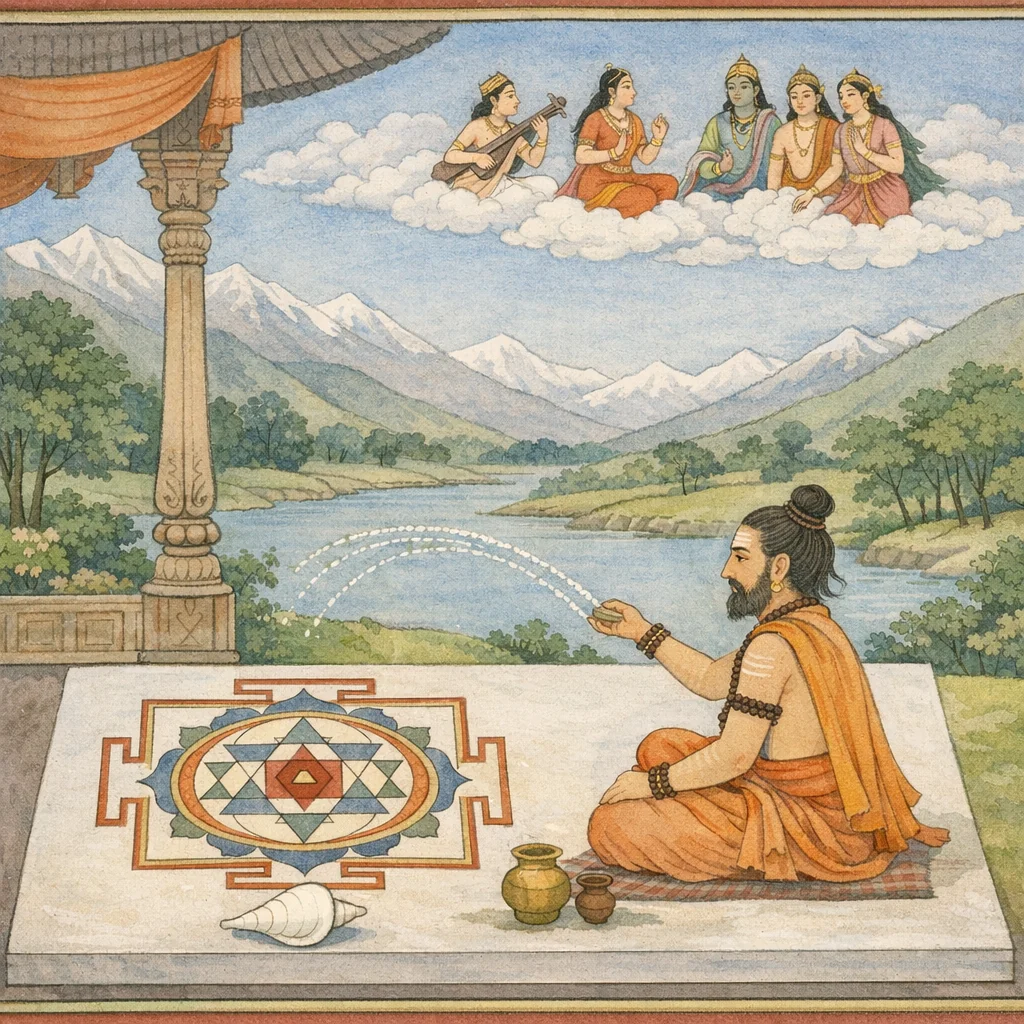
This chapter presents Subrahmaṇya’s instruction for the eleventh-day rite (ekādaśa-ahna). It begins with preparing the ritual ground: cleaning and plastering the vedī area, performing puṇyāha-vācana, and sprinkling/consacrating the directions in order from west to east. The practitioner then constructs north-facing maṇḍalas, measures a central square, and arranges graded geometric forms—bindu, triangle, hexagon, and circle—forming an installation diagram, with a śaṅkha placed in front. After prāṇāyāma and saṅkalpa, five “ativāhika” deities (ritual-mediating/transportive divinities) are worshipped. The text details the use of darbha grass, prescribed movements and standing, placing flowers in the maṇḍalas as pīṭhas, performing āvāhana with mantra (e.g., oṃ hrīṃ), and displaying installation mudrās. It concludes with visualization cues: aṅga-nyāsa and attributes such as pāśa, aṅkuśa, the abhaya hand and boon-giving hand, with red-hued color and garment descriptions, emphasizing precise image-based ritual practice rather than mythic narrative.
Shlokas
Verse 1
सुब्रह्मण्य उवाच । एकादशेह्नि सम्प्राप्ते यो विधिस्समुदाहृतः । तं वक्ष्ये मुनिशार्दूल यतीनां स्नेहतस्तव
Subrahmaṇya said: “O tiger among sages, when the eleventh day arrives, the prescribed rite that has been taught for it—I shall now explain that to you, out of affection for you and for the ascetics.”
Verse 2
सम्मार्ज्य वेदीमालिप्य कृत्वा पुण्याहवाचनम् । प्रोक्ष्य पश्चिममारभ्य पूर्वान्तम्पञ्च च क्रमात्
Having swept the altar and smeared the vedi, and having performed the auspicious proclamation (puṇyāha-vācana), one should then sprinkle it with sanctified water—beginning from the western side and proceeding in due order through the five directions (zones) up to the eastern end.
Verse 3
मण्डलान्युत्तराशास्यः कुर्यात्स्वयमवस्थितः । प्रादेशमात्रं संकल्प्य चतुरस्रं च मध्यतः
Facing north and remaining steady in his own place, the worshipper should himself draw the ritual maṇḍalas. Having determined a measure of one span, he should form a square at the center.
Verse 4
बिन्दुत्रिकोणषट्कोणवृत्ताकाराणि च क्रमात् । शंखं च पुरतस्थाप्य पूजोक्तक्रममार्गतः
In due sequence, one should arrange the forms of the bindu (point), triangle, hexagon, and circle; and placing a conch in front, one should proceed according to the order and method prescribed for worship.
Verse 5
प्राणानायम्य संकल्प्य पूजयित्वा सुरेश्वरी । देवताः पञ्च पूर्वोक्ता अतिवाहिकरूपिणीः
O Goddess of the Devas, having regulated the life-breath and formed the sacred resolve (saṅkalpa), one should worship the five deities mentioned earlier, who are in the form of subtle carriers (ativāhikas) that convey the worshipper’s offering and inner intention.
Verse 6
संत्यज्योत्तरतो दर्भान् यश्च संस्पृशते ततः । पश्चिमादि समारभ्य षडुत्थासनमार्गतः
One should discard the darbha-grass placed to the north; and if one has touched it thereafter, purification should be performed beginning from the west, proceeding according to the sixfold method of rising from the seat and resettling upon it.
Verse 7
मण्डलानि च तेष्वन्तः पुष्पाण्याधाय पीठवत् । ॐ ह्री मित्युक्त्वाग्निरूपान्तामतिवाहिकदेवताम्
He should fashion the ritual maṇḍalas, and within them place flowers as though establishing a sacred seat (pīṭha). Then, uttering the mantra “Oṃ hrīṃ,” he should invoke the subtle carrying deity (ativāhikā devatā), whose culmination is the form of fire, so that the offering and the worship are conveyed to Śiva in due order.
Verse 8
आवाहयामि नम इत्यन्तं सर्वत्र भावयेत् । दर्शयेत्स्थापनाद्यास्तु मुद्राः प्रत्येकमादरात्
At every step one should inwardly contemplate (the Lord), beginning with “I invoke (You)” and concluding with “namaḥ.” And with reverence, one should display each prescribed hand-gesture—starting from the mudrā of establishing (the deity) and the others—one by one.
Verse 9
ह्रांह्रीमित्यादिना कुर्य्यादासामंगानि च क्रमात् । पाशांकुशाभयाभीष्टपाणिचन्द्रोपलप्रभाः
Beginning with the seed-syllables “hrāṃ, hrīṃ” and the rest, one should perform, in due order, the nyāsa upon Her limbs. She is radiant like moonstone, and in Her hands are the noose and goad, the gesture of fearlessness, and the boon that grants the desired aim.
Verse 10
रक्तांगुलीयकच्छायरञ्जिताखिलदिङ्मुखा । रक्ताम्बरधराः कारपदपंकजशोभिताः
The faces of all the directions were suffused with crimson by the radiance of their red finger-ornaments. Clad in red garments, they were adorned with lotus-like hands, shining with auspicious beauty.
Verse 11
त्रिनेत्रोल्लासिवदनपूर्णचन्द्रमनोहराः । माणिक्य मुकुटोद्भासिचन्द्रलेखावतंसिताः
Their faces shone with the splendor of the three eyes, captivating like the full moon. Adorned with radiant ruby crowns, they were further graced with the crescent-moon ornament upon their head.
Verse 12
कुण्डलामृष्टगण्डाश्च पीनोन्नतपयोधराः । हारकेयूरकटककांचीदाममनोहराः
Their cheeks were beautified by earrings, and their bosoms were full and uplifted. They were captivating with necklaces, armlets, bracelets, girdles, and ornamental waist-chains—delightful in the radiant splendor of their adornment.
Verse 13
तनुमध्याः पृथुश्रोण्यो रक्तदिव्याम्बरावृताः । माणिक्यमयमंजीरसिंजत्पदसरोरुहाः । पादांगुलीयकश्रोणीर्मंजुलातिमनोहराः
They were slender-waisted and broad-hipped, clad in radiant red celestial garments. Their lotus-like feet tinkled with anklets made of rubies, and their toe-ornaments made them exceedingly lovely and captivating.
Verse 14
अनुग्रहेण मूर्तेन शिववत्किं नु साध्यते । तस्माच्छक्त्यात्ममूर्तेन सर्वं साध्यं महेशवत्
When divine grace stands present in embodied form, what indeed cannot be accomplished—as though by Śiva Himself? Therefore, taking refuge in that form whose very essence is Śakti, everything becomes attainable, just as through Maheśvara.
Verse 15
सर्वानुग्रहकर्त्रैव स्वीकृताः पंचमूर्तय । सर्वकार्य्यकरा दिव्याः परानुग्रहतत्पराः
Those five divine forms were accepted precisely as the bestowers of grace upon all. They accomplish every sacred purpose and remain wholly intent on granting supreme compassion to others.
Verse 16
एवं ध्यात्वा तु ताः सर्वा अनुग्रहपराश्शिवाः । पादयोः पाद्यमेतासां दद्याच्छंखोदबिन्दुभिः
Having thus meditated upon all those Śivās intent on bestowing grace, one should then offer water for washing their feet—pādya—at their feet, using drops of water poured from a conch.
Verse 17
हस्तेष्वाचमनीयं च मौलिष्वर्घ्यं प्रदापयेत् । शंखोद बिन्दुभिस्तासां स्नानकर्म च भावयेत्
He should place the ācamanīya (sipping-water) into their hands and offer arghya upon their heads; and with drops of water poured from a conch, he should inwardly envision and thus complete their ritual bathing.
Verse 18
रक्ताम्बराणि दिव्यानि सोत्तरीयाणि दापयेत् । मुकुटादीन्यनर्घ्याणि दद्यादाभरणानि च
One should offer divine red garments along with an upper cloth; and one should also present priceless ornaments—such as crowns and the like.
Verse 19
सुवासितं च श्रीखण्डमक्षतांश्चातिशोभनान् । सुरभीणि मनोज्ञानि कुसुमानि च दापयेत्
One should offer well-fragranced śrīkhaṇḍa sandalwood-paste and exceedingly beautiful akṣata (unbroken rice-grains); and also sweet-scented, delightful flowers, as auspicious offerings in the worship of the Lord.
Verse 20
धूपं च परमामोदं साज्यवर्ति च दीपकम् । सर्वं समर्पयामीति प्रणवं ह्रीमुपक्रमात्
Offer incense of the finest fragrance, and a lamp with a wick soaked in ghee. Thinking, “I offer all this to Śiva,” one should begin with the Praṇava “Oṁ” and with “Hrīṁ” as the initiating seed-syllable.
Verse 21
नमोऽन्तंचततोदद्यात्पायस्तमधुनाप्लुतम् । साज्यशर्करयापूपकदलीगुडपूरितम्
After completing the worship with the utterance “Namo…,” one should offer sweet milk-rice (pāyasa) soaked in honey, together with ghee and sugar, and also cakes and bananas well filled with jaggery, as a devotional naivedya to the Lord.
Verse 22
इति श्रीशिवमहापुराणे षष्ठ्यां कैलाससंहितायां यतीनामेकादशाहकृत्यवर्णनन्नाम द्वाविंशोऽध्यायः
Thus ends the twenty-second chapter, called “The description of the eleven-day rites of ascetics,” in the sixth section of the Śrī Śiva Mahāpurāṇa, within the Kailāsa-saṃhitā.
Verse 23
ॐ ह्रीमिति समुच्चार्य्य नैवेद्यं वह्निजायया । पानीयं नम इत्युक्त्वा परम्प्रेम्णा समर्पयेत्
Uttering the mantra “Om Hrīm,” one should lovingly offer the naivedya, the consecrated food prepared by Agni’s wife; and saying “Namaḥ,” one should then present water with supreme devotion.
Verse 24
तत उद्वासयेत्प्रीत्या पूर्वतो मुनिसत्तम । स्थलं विशोध्य गंडूषाचमनार्घ्याणि दापयेत्
Then, O best of sages, he should lovingly perform the udvāsana, the respectful dismissal, facing east; having purified the place, he should offer rinsing-water for the mouth, ācamanīya water for ritual sipping, and arghya, the water-offering of honor.
Verse 25
तांबूलं धूप दीपौ च प्रदक्षिणनमस्कृती । विधाय प्रार्थयेदेताश्शिरस्यंजलिमादधत्
Having offered tāmbūla (betel), incense, and a lamp, and having performed circumambulation and reverent prostration, one should then pray—placing the joined palms upon the head—in humble surrender before Lord Śiva.
Verse 26
श्रीमातरस्सुप्रसन्ना यतिं शिवपदैषिणम् । रक्षणीय म्प्रब्रुवन्तु परमेशपदाब्जयोः
May the glorious Mothers (the Divine Mother-powers), being exceedingly gracious, declare that this renunciate (yati)—who seeks the state of Śiva—must be protected, for he has taken refuge at the lotus-feet of the Supreme Lord.
Verse 27
इति संप्रार्थ्य तास्सर्वा विसृज्य च यथागतम् । तासाम्प्रसादमुद्धृत्य कन्यकाभ्यः प्रदापयेत
Thus, having duly entreated all of them and then dismissing them to depart as they had come, one should take up their consecrated grace (prasāda) and distribute it to the maidens.
Verse 28
गोभ्यो वा जलमध्ये वा निक्षिपेन्नान्यथा क्वचित् । अत्रैव पार्वणं कुर्य्यान्नैकोद्दिष्टं यतेः क्वचित्
He should consign it only to the cows or into water—never anywhere else. In that very manner he should perform the pārvana rite; for an ascetic (yati), the ekoddiṣṭa offering is not to be done at any time.
Verse 29
अत्रायं पार्वणश्राद्धे नियमः प्रोच्यते मया । तं शृणुष्व मुनिश्रेष्ठ येन श्रेयो भवेत्ततः
Here I shall proclaim the proper rule for the Pārvaṇa-śrāddha. Listen to it, O best of sages, for from it shall arise thereafter the highest good and spiritual welfare.
Verse 30
कर्ता स्नात्वा धृतप्राण उपवीती समाहितः । सपवित्रकरस्त्वस्यां पुण्यतिथ्यामिति ब्रुवन्
The officiant, having bathed, restraining the vital breath, wearing the sacred thread (upavīta) and composed in mind, with his hand purified by the pavitra ring, should perform the rite on this meritorious tithi, uttering: “On this holy lunar day.”
Verse 31
करिष्ये पार्वणं श्राद्धमिति संकल्प्य चोत्तरे । दद्याद्दर्भानुत्तमांश्च ह्यासनार्थं जलं स्पृशेत्
Facing north, one should make the resolve, “I shall perform the Pārvaṇa-śrāddha.” Then one should place excellent darbha-grass as seats, and touch water for purification and readiness to begin the rite.
Verse 32
तत्रोपवेशयेद्भक्त्या साभ्यंगं कृतमज्जनान् । आहूय चतुरो विप्राञ्छिवभक्तान्दृढव्रतान्
Then, with devotion, he should seat them there—those who have been bathed after being anointed with oil—and, summoning four Brahmins who are steadfast in vows and devoted to Lord Śiva, he should proceed with the rite.
Verse 33
विश्वेदेवार्थं भवता प्रसादः क्रियतामिति । आत्मने भवता पश्चादन्तरात्मन इत्यपि
“For the sake of all the gods, may Your Grace be bestowed,”—so it was prayed. And then again it was said, “May it be for Your own Self; indeed, You are the Inner Self (antarātman) of all.”
Verse 34
परमात्मन इत्येवं प्रोच्य प्रार्थ्यं च तान्यतिः । श्रद्धया चरणन्तेषां कुर्य्याद्याथार्थ्यमादरात्
Having thus declared them to be of the Supreme Self (Paramātman), the ascetic should also enjoin what is to be sought. With faith and reverent care, he should set forth the true purport for those who have taken refuge at the Lord’s feet.
Verse 35
पादौ प्रक्षाल्य तेषान्तु प्राङ्मुखानुपवेश्य च । गन्धादिभिरलंकृत्य भोजयेच्च शिवा ग्रतः
After washing their feet, one should seat them facing east; then, having honored them with fragrances and similar offerings, one should feed them in the presence of Śivā (Pārvatī).
Verse 36
गोमयेनोपलिप्यात्र दर्भान्प्रागग्रकल्पितान् । आस्तीर्य्य संयतप्राणः पिण्डानां च प्रदानकम्
There, having plastered the place with cow-dung and having spread out darbha grass arranged with their tips pointing east, he should, with controlled breath and a composed mind, proceed to the offering of the piṇḍas (ritual rice-balls).
Verse 37
करिष्य इति संकल्प्य मण्डलत्रयमर्च्य च । आत्मानमन्तरात्मानं परमात्मनमप्यतः
Resolving within himself, “I shall perform this worship,” and having duly worshipped the three sacred maṇḍalas, he should thereafter worship and contemplate the self, the inner Self, and also the Supreme Self—recognizing their ordered relation in Śiva.
Verse 38
चतुर्थ्यन्तं वदन्पश्चादिमं पिण्डमितीरयन् । ददामीति च सम्प्रोच्य दद्यात्पिण्डान्स्वभक्तितः
Then, after reciting up to the fourth invocatory formula, uttering “this piṇḍa,” and clearly saying “I give (it),” one should offer the piṇḍas with one’s own devotion.
Verse 39
कुशोदकं ततो दद्याद्यथाविधिविधानतः । तत उत्थाप्य वै कुर्य्यात्प्रदक्षिणनमस्कृती
Then, in accordance with the prescribed rule, one should offer water sanctified with kuśa grass. Thereafter, rising from the act of worship, one should perform circumambulation and make reverential prostrations.
Verse 40
ततो दत्त्वा ब्राह्मणेभ्यो दक्षिणां च यथाविधि । नारायणबलिं कुर्य्यात्तस्मिन्नेव स्थले दिने
Then, having duly given the prescribed honorarium (dakṣiṇā) to the brāhmaṇas according to rule, one should perform the Nārāyaṇa-bali rite on that very day and in that same place.
Verse 41
रक्षार्थमेव सर्वत्र विष्णोः पूजाविधिः स्मृतः । कुर्य्याद्विष्णोर्महापूजां पायसान्नं निवेदयेत्
For the sake of protection alone, the procedure for worship of Viṣṇu is prescribed everywhere. One should perform Viṣṇu’s great worship and offer him sweet rice cooked in milk as the food-offering.
Verse 42
द्वादशाथ समाहूय ब्राह्मणान्वेदपारगान् । केशवादिभिरभ्यर्च्य गन्धपुष्पाक्षतादिभिः
Then, having summoned twelve Brāhmaṇas well-versed in the Vedas, he honored and worshipped them—addressing them with reverent epithets such as “Keśava”—and offered fragrances, flowers, unbroken rice (akṣata), and other auspicious articles.
Verse 43
उपानच्छत्रवस्त्रादि दत्त्वा तेभ्यो यथाविधि । सन्तोषयेन्महाभक्त्या विविधैर्वच नैश्शुभैः
Having duly given them footwear, umbrellas, garments, and the like according to prescribed rule, one should, with great devotion, gladden them with many auspicious and gracious words.
Verse 44
आस्तीर्य्य दर्भान्पूर्वाग्रान्भूस्स्वाहा च भुवस्सुवः । प्रणवादि प्रोच्य भूमौ पायसान्नं बलिं हरेत्
Spreading kuśa-grass (darbha) with its tips facing east, and uttering “bhūḥ svāhā, bhuvaḥ, suvaḥ,” then beginning with the praṇava “Oṁ,” one should place on the ground a bali-offering consisting of sweet rice (pāyasa).
Verse 45
एकादशाह सुविधिर्मया प्रोक्तो मुनीश्वर । द्वादशाहविधिं वक्ष्ये शृणुष्वादरतो द्विज
O lord among sages, I have explained to you the proper observance of the eleven-day rite. Now I shall describe the procedure for the twelve-day observance—listen with reverent attention, O twice-born one.
Frequently Asked Questions
It teaches an ekādaśāhna-vidhi: preparing the vedī, performing puṇyāha-vācana, consecrating directions by sprinkling (prokṣaṇa), constructing graded maṇḍalas (square center with bindu/triangle/hexagon/circle forms), placing the śaṅkha, then proceeding through prāṇāyāma, saṅkalpa, āvāhana–sthāpana, and mudrā display for deity installation and worship.
The sequence functions as a ritual-cognitive ladder: the bindu marks concentrated presence, the triangle and hexagon structure emanation and containment, and the circle indicates wholeness/completion. In practice, these shapes stabilize visualization and delineate ‘seats’ (pīṭhas) for invoked powers, translating metaphysical order into spatial liturgy.
The emphasis is on a set of five ‘ativāhika’ deities (ritual-mediating powers) invoked and installed within the maṇḍala framework, along with addressed divine presence (Sureśvarī) and iconographic visualization via mantras and mudrās (attributes such as pāśa, aṅkuśa, abhaya, and boon-bestowing hands).