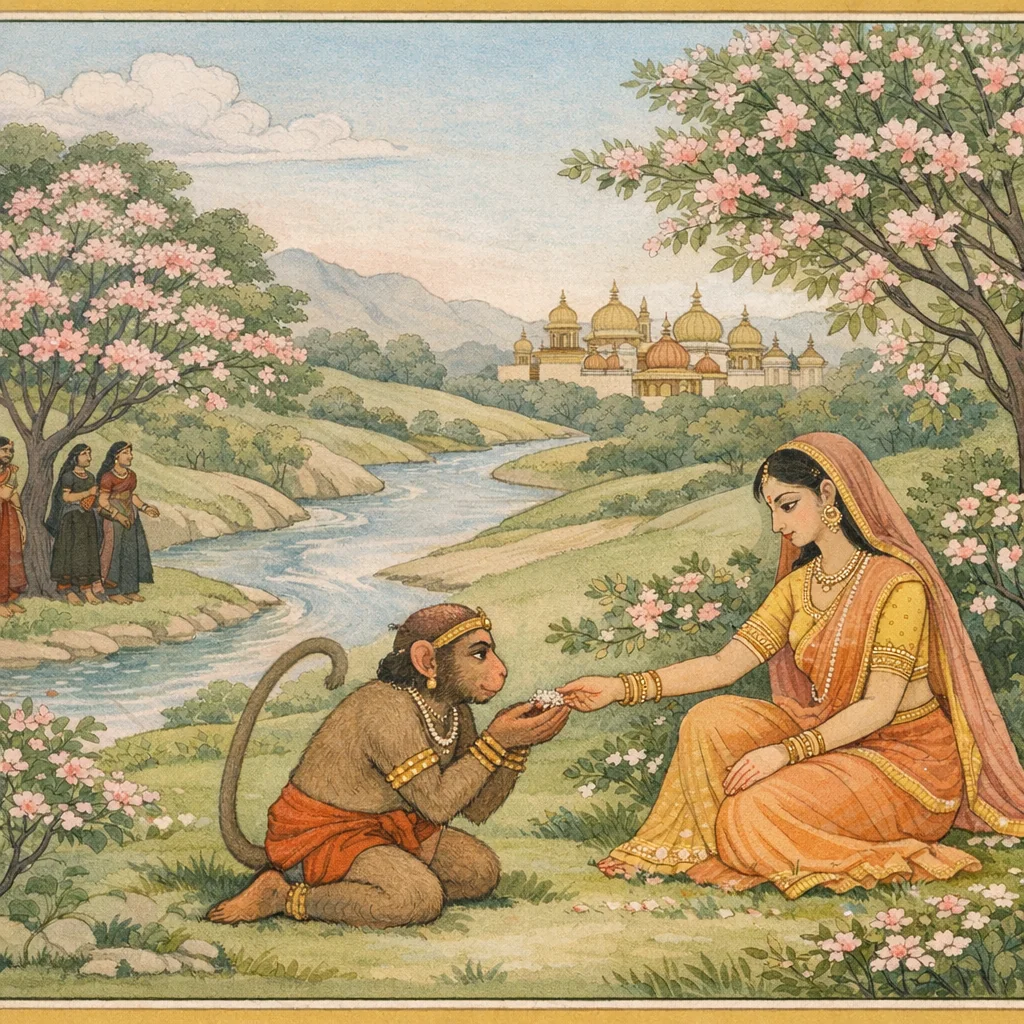
Sarga 38
अभिज्ञानप्रदानम् — The Token of Recognition (Chūḍāmaṇi) and the Crow Episode Recalled
सुन्दरकाण्ड
In Sarga 38, the rescue mission’s verification is strengthened. Hanuman, satisfied by Sita’s words and modest propriety, notes practical constraints and asks for an abhijñāna—a token of recognition—so that Rama may be certain Hanuman truly met her. Sita offers memory as authentication, recounting a private, situation-specific incident at Siddhāśrama near Citrakūṭa and the Mandākinī: a crow (later known as Indra’s son) repeatedly wounded her. Rama awoke, invoked the Brahmāstra through a darbha blade, and the crow fled across the three worlds until it finally sought refuge (śaraṇāgati) in Rama. In compassionate judgment, Rama spared its life, blinding its right eye as expiation. Sita turns the episode into grief and moral pressure: if Rama could unleash the Brahmāstra for a mere crow, why does her abductor remain unpunished? Hanuman consoles her, affirms Rama and Lakshmana’s sorrow, foretells Lanka’s destruction, and asks for messages. He receives the auspicious chūḍāmaṇi as the definitive token, reverently circumambulates, accepts the jewel, and prepares to return—body departing, mind aligned with Rama’s cause.
Shlokas
Verse 1
ततस्स कपिशार्दूलस्तेन वाक्येन तोषितः।सीतामुवाच तच्छृत्वा वाक्यं वाक्यविशारदः।।5.38.1।।
Then the tiger among monkeys—skilled in speech—pleased by her words, after hearing them, spoke to Sītā.
Verse 2
युक्तरूपं त्वया देवि भाषितं शुभदर्शने।सदृशं स्त्रीस्वभावस्य साध्वीनां विनयस्य च।।5.38.2।।
O queen of auspicious appearance, what you have spoken is fitting, in harmony with a woman’s nature and with the modesty of virtuous women.
Verse 3
स्त्रीत्वं न तु समर्थं हि सागरं व्यतिवर्तितुम्।मामधिष्ठाय विस्तीर्णं शतयोजनमायतम्।।5.38.3।।
Then the mighty-armed one—best among the discerning—his eyes narrowed and rolling with anger, formed a stern resolve against that crow.
Verse 4
द्वितीयं कारणं यच्च ब्रवीषि विनयान्विते।रामादन्यस्य नार्हामि संस्पर्शमिति जानकि ।।5.38.4।।एतत्ते सदृशं देवि पत्न्यास्तस्य महात्मनः।का ह्यन्या त्वामृते देवि ब्रूयाद्वचनमीदृशम्।।5.38.5।।
And the second reason you state, O gentle lady—“Except for Rāma I ought not accept another’s touch,” O Jānakī—this is fitting for you, the wife of that great-souled man. For who else, O queen, other than you, could speak such words?
Verse 5
द्वितीयं कारणं यच्च ब्रवीषि विनयान्विते।रामादन्यस्य नार्हामि संस्पर्शमिति जानकि ।।5.38.4।।एतत्ते सदृशं देवि पत्न्यास्तस्य महात्मनः।का ह्यन्या त्वामृते देवि ब्रूयाद्वचनमीदृशम्।।5.38.5।।
And the second reason you state, O gentle lady—“Except for Rāma I ought not accept another’s touch,” O Jānakī—this is fitting for you, the wife of that great-souled man. For who else, O queen, other than you, could speak such words?
Verse 6
श्रोष्यते चैव काकुत्स्थ: सर्वं निरवशेषतः।चेष्टितं यत्त्वया देवि भाषितं मम चाग्रतः।।5.38.6।।
O queen, Rāma of the Kakutstha line will hear from me—leaving nothing out—everything you have done and everything you have spoken in my presence.
Verse 7
कारणैर्बहुभिर्देवि रामप्रियचिकीर्षया।स्नेहप्रस्कन्नमनसा मयैतत्समुदीरितम्।।5.38.7।।
O queen, for many reasons—and wishing to do what is dear to Rāma—these words have I spoken, with a mind suffused with affection.
Verse 8
लङ्काया दुष्प्रवेशत्वाद्दुस्तरत्वान्महोदधेः।सामर्थ्यादात्मनश्चैव मयैतत्समुदीरितम्।।5.38.8।।
Because Laṅkā is hard to enter and the great ocean hard to cross, and because I have the strength to do so, I have spoken this proposal.
Verse 9
इच्छामि त्वां समानेतुमद्यैव रघुबन्धुना।गुरुस्नेहेन भक्त्या च नान्यथैतदुदाहृतम्।।5.38.9।।
I wish to bring you back this very day to the kinsman of the Raghu line; out of deep love for my lord and devotion have I spoken this—without any other motive.
Verse 10
यदि नोत्सहसे यातुं मया सार्थमनिन्दिते।अभिज्ञानं प्रयच्छ त्वं जानीयाद्राघवो हि यत्।।5.38.10।।
O blameless lady, if you do not wish to go with me, then grant a token of recognition, so that Rāghava may know for certain that I have met you.
Verse 11
एवमुक्ता हनुमता सीता सुरसुतोपमा।उवाच वचनं मन्दं बाष्पप्रग्रथिताक्षरम्।।5.38.11।।इदं श्रेष्ठमभिज्ञानं ब्रूयास्त्वं तु मम प्रियम्।
Thus addressed by Hanumān, Sītā—like a daughter of the gods—spoke softly, her words broken by tears: “Tell my beloved: this is the best token of recognition.”
Verse 12
शैलस्य चित्रकूटस्य पादे पूर्वोत्तरे पुरा।।5.38.12।।तापसाश्रमवासिन्याः प्राज्यमूलफलोदके।तस्मिन्सिद्धाश्रमे देशे मन्दाकिन्या विदूरतः।।5.38.13।।तस्योपवनषण्डेषु नानापुष्पसुगन्धिषु।विहृत्य सलिले क्लिन्ना ममाङ्के समुपाविशमः।।5.38.14।।
Formerly, at the northeastern foot of Mount Citrakūṭa, in that land of Siddhāśrama near the Mandākinī—abounding in roots, fruits, and water—you and I wandered through its garden-groves fragrant with many flowers; and after sporting in the water, I, drenched, sat upon your lap.
Verse 13
शैलस्य चित्रकूटस्य पादे पूर्वोत्तरे पुरा।।5.38.12।।तापसाश्रमवासिन्याः प्राज्यमूलफलोदके।तस्मिन्सिद्धाश्रमे देशे मन्दाकिन्या विदूरतः।।5.38.13।।तस्योपवनषण्डेषु नानापुष्पसुगन्धिषु।विहृत्य सलिले क्लिन्ना ममाङ्के समुपाविशमः।।5.38.14।।
Long ago we lived in the region called Siddhāśrama, a hermitage of ascetics, rich in roots, fruits, and water, and situated not far from the river Mandākinī.
Verse 14
शैलस्य चित्रकूटस्य पादे पूर्वोत्तरे पुरा।।5.38.12।।तापसाश्रमवासिन्याः प्राज्यमूलफलोदके।तस्मिन्सिद्धाश्रमे देशे मन्दाकिन्या विदूरतः।।5.38.13।।तस्योपवनषण्डेषु नानापुष्पसुगन्धिषु।विहृत्य सलिले क्लिन्ना ममाङ्के समुपाविशमः।।5.38.14।।
In those garden-groves fragrant with many kinds of flowers, after playing in the water and becoming wet, you sat down upon my lap.
Verse 15
ततो मांससमायुक्तो वायसः पर्यतुण्डयत्।तमहं लोष्टमुद्यम्य वारयामिस्म वायसम्।।5.38.15।।
Then a crow, craving flesh, began to peck at me; and I, lifting a clod of earth, tried to drive that crow away.
Verse 16
दारयन्स च मां काकस्तत्त्रैव परिलीयते।न चाप्युपारमन्मांसाद्भक्षार्थि बलिभोजनः।।5.38.16।।
That crow kept tearing at me and lingered right there; hungry for food, an eater of offerings, it would not stop seeking flesh.
Verse 17
उत्कर्षन्त्यां च रशनां क्रुद्धायां मयि पक्षिणि।स्रस्यमाने च वसने ततो दृष्टा त्वया ह्यहम्।।5.38.17।।
As I angrily pulled up my waist-string while my garment was slipping because of that bird, then you saw me.
Verse 18
त्वयाऽपहसिता चाहं क्रुद्धा संलज्जिता तदा।भक्षगृध्नेन काकेन दारिता त्वामुपागता।।5.38.18।।
You laughed at me then; I became angry and ashamed. Torn by that food-greedy crow, I came to you for refuge.
Verse 19
आसीनस्य च ते श्रान्ता पुनरुत्सङ्गमाविशम्।क्रुध्यन्ती च प्रहृष्टेन त्वयाऽहं परिसान्त्विता।।5.38.19।।
As you sat there, exhausted, I again settled on your lap; and though I was still angry, you—glad at heart—soothed me completely.
Verse 20
बाष्पपूर्णमुखी मन्दं चक्षुषी परिमार्जती।लक्षिताऽहं त्वया नाथ वायसेन प्रकोपिता।।5.38.20।।
O lord, when the crow had provoked me and my face was full of tears, you noticed me as I gently wiped my eyes.
Verse 21
परिश्रमात्प्रसुप्ता च राघवाङ्केऽप्यहं चिरम्।पर्यायेण प्रसुप्तश्च ममाङ्के भरताग्रजः।।5.38.21।।
O queen of auspicious appearance, what you have spoken is fitting, in harmony with a woman’s nature and with the modesty of virtuous women.
Verse 22
स तत्र पुनरेवाथ वायसस्समुपागमत्।ततस्सुप्तप्रबुद्धां मां रामस्याङ्कात्समुत्थिताम्।।5.38.22।।वायसस्सहसागम्य विददार स्तनान्तरे।पुनः पुनरथोत्पत्य विददार स मां भृशम्।।5.38.23।।
Then that crow returned there again. And when I had awakened from sleep and risen from Rama’s lap, it came back toward me once more.
Verse 23
स तत्र पुनरेवाथ वायसस्समुपागमत्।ततस्सुप्तप्रबुद्धां मां रामस्याङ्कात्समुत्थिताम्।।5.38.22।।वायसस्सहसागम्य विददार स्तनान्तरे।पुनः पुनरथोत्पत्य विददार स मां भृशम्।।5.38.23।।
The crow suddenly flew in and tore me between the breasts; rising again and again, it kept rending me severely.
Verse 24
ततस्समुक्षितो रामो मुक्तैश्शोणितबिन्दुभिः। वायसेन ततस्तेन बलवत्क्लिश्यमानया।।5.38.24।। स मया बोधितश्श्रीमान्सुखसुप्तः परन्तपः।
Then Rama was splashed by drops of blood that had fallen. As I was being cruelly tormented by that crow, I awakened him—Rama, illustrious, who had been sleeping peacefully, the scorcher of foes.
Verse 25
स मां दृष्ट्वा महाबाहुर्वितुन्नां स्तनयोस्तदा।।5.38.25।।आशीविष इव क्रुद्धश्वसन्वाक्यमभाषत।
Seeing me then, wounded at the breasts, the mighty-armed one flared up in wrath like a hissing serpent and, breathing hard, spoke.
Verse 26
केन ते नागनासोरु विक्षतं वै स्तनान्तरम्।।5.38.26।।कः क्रीडति सरोषेण पञ्चवक्त्रेण भोगिना।
“By whom, O woman of elephant-like thighs, has your bosom been wounded? Who is playing so recklessly with an enraged, five-hooded serpent?”
Verse 27
वीक्षमाणस्ततस्तं वै वायसं समुदैक्षत।।5.38.27।।नखैस्सरुधिरैस्तीक्ष्णैर्मामेवाभिमुखं स्थितम्।
Then, looking about, he saw that crow standing before me, facing me, with sharp claws stained with blood.
Verse 28
पुत्त्रः किल स शक्रस्य वायसः पततां वरः।।5.38.28।।धरान्तरगतश्शीघ्रं पवनस्य गतौ समः।
That crow, it is said, was the son of Śakra (Indra), the finest among birds; swift in movement, it could traverse great distances, matching the Wind in speed.
Verse 29
ततस्तस्मिन्महाबाहुः कोपसंवर्तितेक्षणः।।5.38.29।।वायसे कृतवान्क्रूरां मतिं मतिमतां वरः।
Then the mighty-armed one—best among the discerning—his eyes narrowed and rolling with anger, formed a stern resolve against that crow.
Verse 30
स दर्भं संस्तराद्गृह्य ब्राह्मेणास्त्रेण योजयत्।।5.38.30।।स दीप्त इव कालाग्निर्जज्वालाभिमुखो द्विजम्।
Taking a blade of darbha grass from his mat, he empowered it with the Brahmā-weapon; blazing like the fire of death, it flared forth, aimed at the bird.
Verse 31
स तं प्रदीप्तं चिक्षेप दर्भं तं वायसं प्रति।।5.38.31।।ततस्तं वायसं दर्भस्सोम्बरेऽनुजगाम ह।
He hurled that blazing darbha toward the crow; and then the darbha pursued the crow through the sky.
Verse 32
अनुसृष्टस्तदा काको जगाम विविधां गतिम्।।5.38.32।।लोककाम इमं लोकं सर्वं वै विचचार ह।
Then the crow, pursued, fled in many directions; longing to find refuge, it wandered through this entire world.
Verse 33
स पित्रा च परित्यक्तस्सुरैश्च समहर्षिभिः।।5.38.33।।त्रीन्लोकान्सम्परिक्रम्य तमेव शरणं गतः।
Rejected even by his own father, and by the gods along with the great seers, he circled the three worlds—then returned to him alone as refuge.
Verse 34
स तं निपतितं भूमौ शरण्यश्शरणागतम्।।5.38.34।।वधार्हमपि काकुत्स्थ: कृपया पर्यपालयत्।
But Kakutstha—protector of those who seek refuge—saw him fallen on the ground as a supplicant, and though he deserved death, preserved him out of compassion.
Verse 35
परिद्यूनं विषण्णं च स तमायान्तमब्रवीत्।।5.38.35।।मोघं कर्तुं न शक्यं तु ब्राह्ममस्त्रं तदुच्यताम्।
Seeing him return distressed and dejected, Rāma said: “The Brahmā-weapon cannot be made futile; therefore, tell what must be done.”
Verse 36
हिनस्तु दक्षिणाक्षि त्वच्छर इत्यथ सोऽब्रवीत्।।5.38.36।।ततस्तस्याक्षि काकस्य हिनस्ति स्म स दक्षिणम्।दत्त्वा स दक्षिणं नेत्रं प्राणेभ्यः परिरक्षितः।।5.38.37।।
Then he said, “Let your arrow destroy my right eye.” Thereupon Rāma struck the crow’s right eye; offering that right eye, the crow’s life was spared.
Verse 37
हिनस्तु दक्षिणाक्षि त्वच्छर इत्यथ सोऽब्रवीत्।।5.38.36।।ततस्तस्याक्षि काकस्य हिनस्ति स्म स दक्षिणम्।दत्त्वा स दक्षिणं नेत्रं प्राणेभ्यः परिरक्षितः।।5.38.37।।
Then he said, “Let your arrow destroy my right eye.” Thereupon Rāma struck the crow’s right eye; offering that right eye, the crow’s life was spared.
Verse 38
स रामाय नमस्कृत्य राज्ञे दशरथाय च।विसृष्टस्तेन वीरेण प्रतिपेदे स्वमालयम्।।5.38.38।।
Having paid homage to Rāma and to King Daśaratha, and being released by that hero, the crow returned to his own abode.
Verse 39
मत्कृते काकमात्रे तु ब्रह्मास्त्रं समुदीरितम्।कस्माद्यो मां हरेत्त्वत्तः क्षमसे तं महीपते।।5.38.39।।
For my sake you once loosed the Brahmā-weapon even against a mere crow; then why, O lord of the earth, do you tolerate the one who has abducted me from you?
Verse 40
स कुरुष्व महोत्साहः कृपां मयि नरर्षभ।त्वया नाथवती नाथ ह्यनाथा इव दृश्यते।।5.38.40।।
Therefore, O great-spirited bull among men, show compassion to me. Though you are my lord and protector, I—having refuge in you—appear as if without protection.
Verse 41
आनृशंस्यं परो धर्मस्तवत्त्त ऐव मया श्रुतः।जानामि त्वां महावीर्यं महोत्साहं महाबलम्।।5.38.41।।अपारपारमक्षोभ्यं गाम्भीर्यात्सागरोपमम्।भर्तारं ससमुद्राया धरण्या वासवोपमम्।।5.38.42।।
From you alone I have heard that compassion (ānṛśaṃsya) is the highest dharma. I know you to be of great valor, great energy, and great strength.
Verse 42
आनृशंस्यं परो धर्मस्तवत्त्त ऐव मया श्रुतः।जानामि त्वां महावीर्यं महोत्साहं महाबलम्।।5.38.41।।अपारपारमक्षोभ्यं गाम्भीर्यात्सागरोपमम्।भर्तारं ससमुद्राया धरण्या वासवोपमम्।।5.38.42।।
Boundless on both shores, unshakable, and deep like the ocean—thus I know him. He is the lord of the earth together with its seas, comparable to Vāsava (Indra).
Verse 43
एवमस्त्रविदां श्रेष्ठस्सत्यवान्बलवानपि।किमर्थमस्त्रं रक्षस्सु न योजयसि राघव।।5.38.43।।
Though you are foremost among those who know weapons, truthful and strong, why, O Rāghava, do you not employ your weapons against the rākṣasas?
Verse 44
न नागा नाऽपि गन्धर्वा नासुरा न मरुद्गणाः।रामस्य समरे वेगं शक्ताः प्रतिसमाधितुं।।5.38.44।।
Neither nāgas, nor gandharvas, nor asuras, nor even the hosts of the Maruts can, in battle, withstand and turn back the rushing force of Rāma.
Verse 45
तस्य वीर्यवतः कश्चिद्यद्यस्ति मयि सम्भ्रमः।किमर्थं न शरैस्तीक्ष्णै: क्षयं नयति राक्षसान्।।5.38.45।।
If that mighty one feels even a little anxiety on my account, why does he not, with sharp arrows, bring the rākṣasas to destruction?
Verse 46
भ्रातुरादेशमादाय लक्ष्मणो वा परन्तपः।कस्य हेतोर्न मां वीरः परित्राति महाबलः।।5.38.46।।
Or why does the mighty hero Lakṣmaṇa—scorcher of foes—not come to rescue me, taking up his brother’s command?
Verse 47
यदि तौ पुरुषव्याघ्रौ वाय्वग्निसमतेजसौ।सुराणामपि दुर्धर्षौ किमर्थं मामुपेक्षतः।।5.38.47।।
If those two tigers among men blaze with the power of wind and fire, and are unassailable even to the gods—why then do they neglect me?
Verse 48
ममैव दुष्कृतं किञ्चिन्महदस्ति न संशयः।समर्थावपि तौ यन्मां नावेक्षेते परन्तपौ।।5.38.48।।
Surely some great wrongdoing of mine exists—there is no doubt—since, though capable, those two scorchers of foes do not look to my deliverance.
Verse 49
वैदेह्या वचनं श्रुत्वा करुणं साश्रुभाषितम्।अथाब्रवीन्महातेजा हनुमान्मारुतात्मजः।।5.38.49।।
Hearing Vaidehī’s compassionate words, spoken through tears, Hanumān—the radiant son of the Wind—then replied.
Verse 50
त्वच्छोकविमुखो रामो देवि सत्येन ते शपे।रामे दुःखाभिपन्ने च लक्ष्मणः परितप्यते।।5.38.50।।
O divine lady, I swear to you by truth: Rāma is not indifferent to your sorrow. And since Rāma is overwhelmed by grief, even Lakṣmaṇa is tormented and laments.
Verse 51
कथञ्चिद्भवती दृष्टा न कालः परिदेवितुम्।इमं मुहूर्तं दुःखानां द्रक्ष्यस्यन्तमनिन्दिते।।5.38.51।।
Only with great difficulty have I found you; this is no time for lamentation. O blameless one, in this very moment you shall see the end of your sorrows.
Verse 52
तावुभौ पुरुषव्याघ्रौ राजपुत्रौ महाबलौ।त्वद्दर्शनकृतोत्साहौ लङ्कां भस्मीकरिष्यतः।।5.38.52।।
Those two mighty princes—tigers among men—made resolute by the longing to see you, will reduce Laṅkā to ashes.
Verse 53
हत्त्वा च समरे क्रूरं रावणं सहबान्धवम्।राघवस्त्वां विशालाक्षि नेष्यति स्वां पुरीं प्रति।।5.38.53।।
Having slain the cruel Rāvaṇa in battle, together with his kinsmen, Rāghava will lead you, O large-eyed one, back toward his own city.
Verse 54
ब्रूहि यद्राघवो वाच्यो लक्ष्मणश्च महाबलः।सुग्रीवो वापि तेजस्वी हरयोऽपि समागताः।।5.38.54।।
Tell me what message should be conveyed—to Rāghava and mighty Lakṣmaṇa, to the radiant Sugrīva as well, and even to the assembled Vānara hosts.
Verse 55
इत्युक्तवति तस्मिंस्तु सीता सुरसुतोपमा।उवाच शोकसन्तप्ता हनुमन्तं प्लवङ्गमम्।।5.38.55।।
When he had spoken thus, Sītā—like the daughter of a god—afflicted by grief, spoke to Hanumān, the Vānara.
Verse 56
कौसल्या लोकभर्तारं सुषुवे यं मनस्विनी।तं ममार्थे सुखं पृच्छ शिरसा चाभिवादय।।5.38.56।।
On my behalf, bow your head and offer salutations; ask after the welfare of him whom noble Kauśalyā bore—the sustainer of the world.
Verse 57
स्रजश्च सर्वरत्नानि प्रिया याश्च वराङ्गनाः।ऐश्वर्यं च विशालायां पृथिव्यामपि दुर्लभम्।।5.38.57।।पितरं मातरं चैव सम्मान्याभिप्रसाद्य च।अनुप्रव्रजितो रामं सुमित्रा येन सुप्रजाः।।5.38.58।।
Garlands and every kind of jewel, beloved women, and even sovereignty—hard to attain upon this vast earth—he set all of these aside.
Verse 58
स्रजश्च सर्वरत्नानि प्रिया याश्च वराङ्गनाः।ऐश्वर्यं च विशालायां पृथिव्यामपि दुर्लभम्।।5.38.57।।पितरं मातरं चैव सम्मान्याभिप्रसाद्य च।अनुप्रव्रजितो रामं सुमित्रा येन सुप्रजाः।।5.38.58।।
Garlands and every kind of jewel, beloved women, and even sovereignty—hard to attain upon this vast earth—he set all of these aside.
Verse 59
आनुकूल्येन धर्मात्मा त्यक्त्वा सुखमनुत्तमम्।अनुगच्छति काकुत्स्थं भ्रातरं पालयन्वने।।5.38.59।।
The righteous one, grounded in Dharma, renouncing unsurpassed comforts, follows Kakutstha in devoted loyalty—serving and protecting his brother in the forest.
Verse 60
सिंहस्कन्धो महाबाहुर्मनस्वी प्रियदर्शिनः।पितृवद्वर्तते रामे मातृवन्मां समाचरन्।।5.38.60।।
Lakṣmaṇa—lion-shouldered, strong-armed, high-minded, and fair to behold—serves Rāma as one would a father, and treats me as one would one’s own mother.
Verse 61
ह्रियमाणां तदा वीरो न तु मां वेद लक्ष्मणः।वृद्धोपसेवी लक्ष्मीवान् शक्तो न बहुभाषिता।।5.38.61।।राजपुत्रः प्रियः श्रेष्ठः सदृशः श्वशुरस्य मे।
When I was being carried away, the heroic Lakṣmaṇa did not know it. He serves the elders, is rich in virtues, capable, and sparing of speech—a dear and foremost prince, resembling my father-in-law in character.
Verse 62
ममः प्रियतरो नित्यं भ्राता रामस्य लक्ष्मणः।।5.38.62।।नियुक्तो धुरि यस्यां तु तामुद्वहति वीर्यवान्।
Lakṣmaṇa, Rāma’s brother, is ever especially dear to me. Whatever burden of duty is laid upon him, that heroic one bears it and fulfills it through.
Verse 63
यं दृष्ट्वा राघवो नैव वृत्तमार्यमनुस्मरेत्।।5.38.63।।स ममार्थाय कुशलं वक्तव्यो वचनान्मम।
Seeing him, Rāghava did not feel the lack of his noble father’s support. For my sake, convey to Lakṣmaṇa my words and ask after his welfare.
Verse 64
मृदुर्नित्यं शुचिर्दक्षः प्रियो रामस्य लक्ष्मणः।।5.38.64।।यथा हि वानरश्रेष्ठ दुःखक्षयकरो भवेत्।त्वमस्मिन्कार्यनिर्योगे प्रमाणं हरिसत्तमः।।5.38.65।।
Lakṣmaṇa is ever gentle, pure, capable, and dear to Rāma. Therefore, O best of Vānaras, act so that he may become the remover of my suffering. In this undertaking, O foremost of monkeys, you are the decisive authority.
Verse 65
मृदुर्नित्यं शुचिर्दक्षः प्रियो रामस्य लक्ष्मणः।।5.38.64।।यथा हि वानरश्रेष्ठ दुःखक्षयकरो भवेत्।त्वमस्मिन्कार्यनिर्योगे प्रमाणं हरिसत्तमः।।5.38.65।।
By your efforts, Rāghava will direct all his striving toward me. Say this to my lord, heroic Rāma, again and again.
Verse 66
राघवस्त्वत्समारम्भान्मयि यत्नपरो भवेत्।इदं ब्रूयाश्च मे नाथं शूरं रामं पुनः पुनः।।5.38.66।।
By your efforts, Rāghava will direct all his striving toward me. Say this to my lord, heroic Rāma, again and again.
Verse 67
जीवितं धारयिष्यामि मासं दशरथात्मज।ऊर्ध्वं मासान्न जीवेयं सत्येनाहं ब्रवीमि ते।।5.38.67।।
O son of Daśaratha, I will sustain my life for one month. Beyond that month I shall not live—this I tell you in truth.
Verse 68
रावणेनोपरुद्धां मां निकृत्य पापकर्मणा।त्रातुमर्हसि वीर त्वं पातालादिव कौशिकीम्।।5.38.68।।
Imprisoned by Rāvaṇa, that sinner in deed—deceived, wronged, and humiliated—O hero, it is fitting that you rescue me, as Kauśikī was rescued from the depths of Pātāla.
Verse 69
ततो वस्त्रगतं मुक्त्वा दिव्यं चूडामणिं शुभम्।प्रदेयो राघवायेति सीता हनुमते ददौ।।5.38.69।।
Then Sita untied from her garment the auspicious, divine crest-jewel and gave it to Hanuman, saying, “It is to be delivered to Raghava (Rama).”
Verse 70
प्रतिगृह्य ततो वीरो मणिरत्नमनुत्तमम्।अङ्गुल्या योजयामास न ह्यस्य प्राभवद्भुजः।।5.38.70।।
Then the hero, having received that unsurpassed jewel, set it upon his finger—for it did not fit upon his arm.
Verse 71
मणिरत्नं कपिवरः प्रतिगृह्याभिवाद्य च।सीतां प्रदक्षिणं कृत्वा प्रणतः पार्व्शतः स्थितः।।5.38.71।।
The best of the monkeys, having received the jewel and saluted Sita, circumambulated her in reverence and stood humbly at her side.
Verse 72
हर्षेण महता युक्तः सीतादर्शनजेन सः।हृदयेन गतो रामं शरीरेण तु विष्ठितः।।5.38.72।।
Filled with great joy born of seeing Sita, he remained there in body, yet in his heart he had already gone to Rama.
Verse 73
मणिवरमुपगृह्य तं महार्हं जनकनृपात्मजया धृतं प्रभावात्।गिरिरिव पवनावधूतमुक्तः सुखितमनाः प्रतिसङ्क्रमं प्रपेदे।।5.38.73।।
Having taken that precious, radiant jewel once worn by Janaka’s daughter, Hanuman—his mind made glad—set out to depart, like a mountain loosed after being struck and shaken by the wind.
Frequently Asked Questions
The pivotal action is the establishment of reliable proof (abhijñāna) without violating Sita’s boundaries: Hanuman requests a token rather than forcing a risky extraction, and Sita authorizes the mission by giving the chūḍāmaṇi and a privately verifiable memory.
The sarga teaches that power must be disciplined by dharma: Rama’s Brahmāstra is not made “vain,” yet its outcome is tempered by compassion toward a refuge-seeker; simultaneously, Sita’s appeal shows that compassion should not become indulgence toward grave adharma.
Citrakūṭa and the Mandākinī anchor the recalled shared-life geography, while Siddhāśrama functions as a culturally charged hermitage setting—linking ascetic space, intimate domestic memory, and the evidentiary logic used to authenticate Hanuman’s report to Rama.