Sarga 1
श्रीमद्रामायणकथासङ्क्षेपः / The Ramayana in Synopsis (Narada’s Summary to Valmiki)
बालकाण्ड
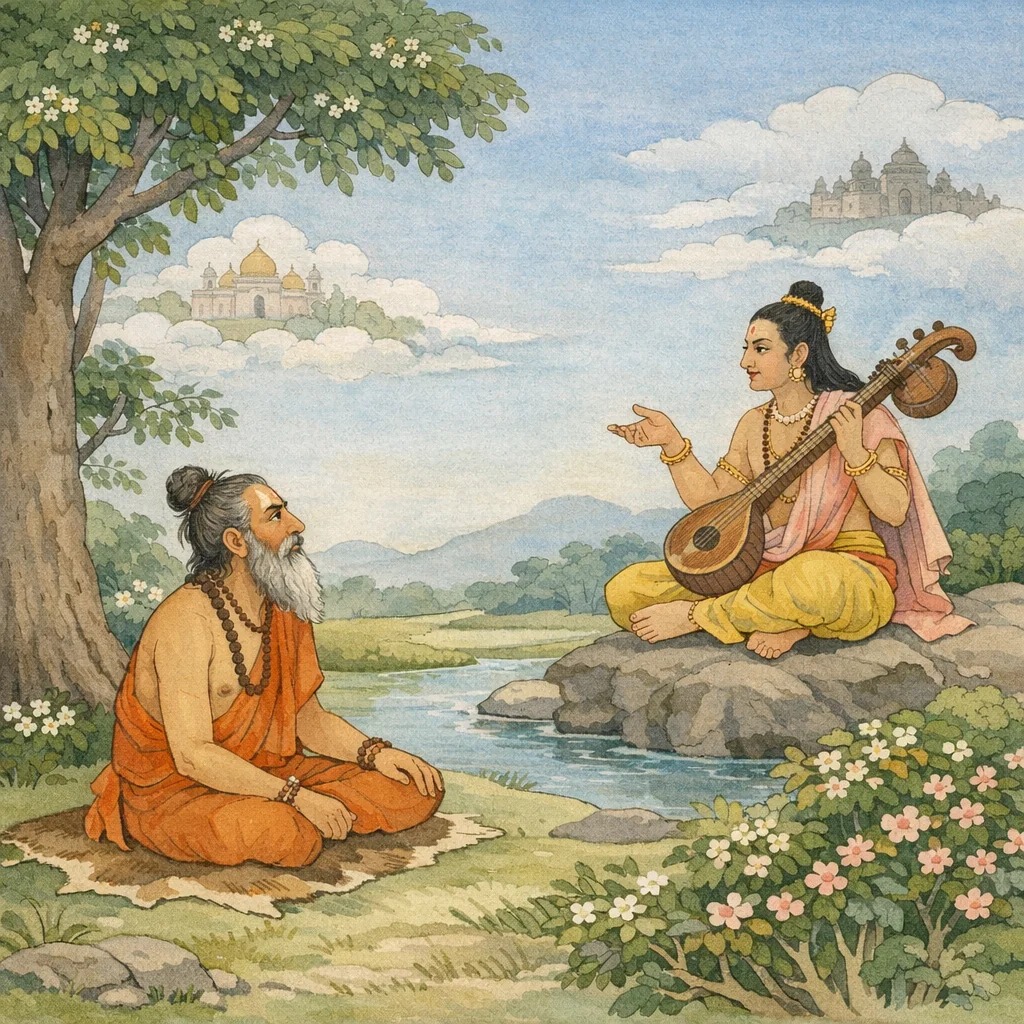
Sarga 1 serves as a programmatic prologue. Vālmīki, the rishi devoted to tapas and svādhyāya, asks Nārada whether there exists an ideal human being who embodies complete virtue—truthfulness, gratitude, self-restraint, courage, and benevolence. Nārada replies that such a person is Śrī Rāma of the Ikṣvāku lineage, and he presents the entire Rāmāyaṇa as a structured synopsis. He recounts Rāma’s exemplary qualities; Daśaratha’s wish to install him as heir; Kaikeyī’s boons that bring about exile; and Lakṣmaṇa and Sītā accompanying him. He notes the crossings and forest dwellings, Daśaratha’s death, and Bharata’s refusal of kingship, ruling in Rāma’s name with the sandals as royal proxy. In the Daṇḍaka episode, Rāma aids the sages, slays Virādha, and receives divine weapons from Agastya. Then follow Śūrpaṇakhā’s episode and the Janasthāna campaign; Rāvaṇa’s plot with Mārīca and Sītā’s abduction; Jatāyu’s death and rites; Kabandha’s guidance to Śabarī; and the alliance with Sugrīva through Hanumān, leading to Vāli’s death and the vānara search. Hanumān leaps the ocean, finds Sītā, and returns; Nala builds the sea-bridge, Laṅkā is conquered, Rāvaṇa is slain, Sītā bears witness before Agni, and Vibhīṣaṇa is crowned. Rāma returns to Ayodhyā and establishes Rāma-rājya. The sarga closes with a phalaśruti: recitation grants learning, prosperity, and great puṇya to people of all social conditions.
Shlokas
Verse 1
तपस्स्वाध्यायनिरतं तपस्वी वाग्विदां वरम् ।नारदं परिपप्रच्छ वाल्मीकिर्मुनिपुङ्गवम् ।।।।
Vālmīki, foremost among sages, questioned Nārada—the ascetic ever devoted to austerity and Vedic study, the best among the eloquent and the learned.
Verse 2
कोन्वस्मिन्साम्प्रतं लोके गुणवान्कश्च वीर्यवान् ।धर्मज्ञश्च कृतज्ञश्च सत्यवाक्यो दृढव्रत:।।।।
Who indeed, in this world today, is endowed with excellence and valor—who knows dharma, is grateful, speaks truth, and is firm in his vows?
Verse 3
चारित्रेण च को युक्तस्सर्वभूतेषु को हित: ।विद्वान्क: कस्समर्थश्च कश्चैकप्रियदर्शन: ।।।।
Who is that person endowed with noble conduct, who seeks the good of all beings—who is truly learned and capable, and whose very presence is pleasing to all?
Verse 4
आत्मवान्को जितक्रोधो द्युतिमान्कोऽनसूयक: ।कस्य बिभ्यति देवाश्च जातरोषस्य संयुगे ।।।।
Who is self-possessed? Who has conquered anger? Who is radiant and free from envy? And whose wrath, once aroused in battle, makes even the gods afraid?
Verse 5
एतदिच्छाम्यहं श्रोतुं परं कौतूहलं हि मे ।महर्षे त्वं समर्थोऽसि ज्ञातुमेवंविधं नरम् ।।।।
This I wish to hear; indeed my curiosity is great. O great seer, you are able to know a man endowed with such qualities.
Verse 6
श्रुत्वा चैतत्ित्रलोकज्ञो वाल्मीकेर्नारदो वच: ।श्रूयतामिति चामन्त्त्र्य प्रहृष्टो वाक्यमब्रवीत् ।।।।
Having heard Vālmīki’s words, Nārada—knower of the three worlds—invited him, saying, “Let it be heard,” and, delighted, began to speak.
Verse 7
बहवो दुर्लभाश्चैव ये त्वया कीर्तिता गुणा: ।मुने वक्ष्याम्यहं बुद्ध्वा तैर्युक्तश्श्रूयतान्नर: ।।।।
O sage, the many virtues you have spoken of are indeed rare among men. Having discerned one endowed with them, I shall tell you of that man—listen.
Verse 8
इक्ष्वाकुवंशप्रभवो रामो नाम जनैश्श्रुत: ।नियतात्मा महावीर्यो द्युतिमान्धृतिमान् वशी ।।।।
Born in the line of Ikṣvāku, he is famed among people by the name Rāma—self-controlled, of mighty valor, radiant, steadfast, and master of his senses.
Verse 9
बुद्धिमान्नीतिमान्वाग्मी श्रीमान् शत्रुनिबर्हण: ।विपुलांसो महाबाहु: कम्बुग्रीवो महाहनु: ।।।।
He (Rāma) is profoundly intelligent and grounded in righteous governance; eloquent and radiant with auspicious fortune; a destroyer of enemies. Broad-shouldered and mighty-armed, he bears a conch-like neck and a strong, prominent jaw.
Verse 10
महोरस्को महेष्वासो गूढजत्रुररिन्दमः ।आजानुबाहुस्सुशिरास्सुललाटस्सुविक्रमः ।।।।
Broad-chested, wielder of the great bow, with well-knit collarbones, a subduer of foes; his arms reached to his knees, his head was noble, his forehead graceful, and his valor outstanding.
Verse 11
समस्समविभक्ताङ्गस्स्निग्धवर्ण: प्रतापवान् ।पीनवक्षा विशालाक्षो लक्ष्मीवान् शुभलक्षणः ।। ।।
Neither too tall nor too short, with well-proportioned limbs and a radiant complexion, he was powerful; broad-chested, large-eyed, endowed with splendor, and marked by auspicious signs.
Verse 12
धर्मज्ञस्सत्यसन्धश्च प्रजानां च हिते रतः ।यशस्वी ज्ञानसम्पन्नश्शुचिर्वश्यस्समाधिमान् ।।।।
He knew dharma, was steadfast in truth, and was devoted to the welfare of his people; renowned, wise, pure, receptive to rightful guidance, and ever inwardly collected in purpose.
Verse 13
प्रजापतिसमश्श्रीमान् धाता रिपुनिषूदनः ।रक्षिता जीवलोकस्य धर्मस्य परिरक्षिता ।।।।
Splendid like Prajāpati, a sustainer and a destroyer of hostile forces, he was a guardian of living beings and a steadfast protector of dharma itself.
Verse 14
रक्षिता स्वस्य धर्मस्य स्वजनस्य च रक्षिता ।वेदवेदाङ्गतत्त्वज्ञो धनुर्वेदे च निष्ठितः ।।।।
He safeguarded his own royal dharma and protected his people; he knew the true import of the Vedas and their Vedāṅgas, and was firmly accomplished in Dhanurveda, the science of archery and warfare.
Verse 15
सर्वशास्त्रार्थतत्त्वज्ञस्स्मृतिमान्प्रतिभानवान् ।सर्वलोकप्रियस्साधुरदीनात्मा विचक्षणः ।।।।
He knew the true purport of all śāstras, possessed unfailing memory and keen insight; beloved of all, virtuous and courteous, unshaken in spirit, and discerning in action.
Verse 16
सर्वदाभिगतस्सद्भिस्समुद्र इव सिन्धुभिः ।आर्यस्सर्वसमश्चैव सदैकप्रियदर्शनः ।।।।
Ever approachable to the good—like the ocean to the rivers—he was noble, even-minded toward all, and ever of a pleasing and gracious appearance.
Verse 17
स च सर्वगुणोपेत: कौसल्यानन्दवर्धन: ।समुद्र इव गाम्भीर्ये धैर्येण हिमवानिव ।।।।
And he—endowed with every virtue, increasing Kauśalyā’s joy—was like the ocean in depth, and like Himavān in steadfast courage.
Verse 18
विष्णुना सदृशो वीर्ये सोमवत्प्रियदर्शनः ।कालाग्निसदृशः क्रोधे क्षमया पृथिवीसमः ।।।।धनदेन समस्त्यागे सत्ये धर्म इवापरः ।
In prowess he was like Viṣṇu; in pleasing appearance, like the moon. In anger, like the fire of dissolution; in patience, equal to the earth. In generosity, like Dhanada (Kubera); and in truth, like Dharma himself made manifest.
Verse 19
तमेवं गुणसम्पन्नं रामं सत्यपराक्रमम् ।।।।ज्येष्ठं श्रेष्ठगुणैर्युक्तं प्रियं दशरथस्सुतम् ।प्रकृतीनां हितैर्युक्तं प्रकृतिप्रियकाम्यया ।।।।यौवराज्येन संयोक्तुमैच्छत्प्रीत्या महीपति: ।
Seeing Rāma thus endowed with virtues—his valor grounded in truth—eldest, furnished with the finest qualities, and dear as Daśaratha’s son; devoted to the welfare of the people and eager for what pleases them, the lord of the earth, out of affection, desired to appoint him as heir-apparent.
Verse 20
तमेवं गुणसम्पन्नं रामं सत्यपराक्रमम् ।।1.1.19।।ज्येष्ठं श्रेष्ठगुणैर्युक्तं प्रियं दशरथस्सुतम् । प्रकृतीनां हितैर्युक्तं प्रकृतिप्रियकाम्यया ।।1.1.20।।यौवराज्येन संयोक्तुमैच्छत्प्रीत्या महीपति: ।
Seeing Rāma thus endowed with virtues—his valor grounded in truth—eldest, furnished with the finest qualities, and dear as Daśaratha’s son; devoted to the welfare of the people and eager for what pleases them, the lord of the earth, out of affection, desired to appoint him as heir-apparent.
Verse 21
तस्याभिषेकसम्भारान्दृष्ट्वा भार्याऽथ कैकयी ।।।।पूर्वं दत्तवरा देवी वरमेनमयाचत ।विवासनं च रामस्य भरतस्याभिषेचनम् ।।।।
Then, seeing the preparations for his consecration, Kaikeyī—the queen who had earlier been granted boons—asked that boon of him: Rāma’s banishment, and Bharata’s coronation.
Verse 22
तस्याभिषेकसम्भारान्दृष्ट्वा भार्याऽथ कैकयी ।।1.1.21।।पूर्वं दत्तवरा देवी वरमेनमयाचत । विवासनं च रामस्य भरतस्याभिषेचनम् ।।1.1.22।।
Then, seeing the preparations for his consecration, Kaikeyī—the queen who had earlier been granted boons—asked that boon of him: Rāma’s banishment, and Bharata’s coronation.
Verse 23
स सत्यवचनाद्राजा धर्मपाशेन संयत: ।विवासयामास सुतं रामं दशरथ: प्रियम् ।।।।
King Daśaratha, bound to the truth of his word and restrained by the bond of dharma, sent his beloved son Rāma into exile.
Verse 24
स जगाम वनं वीर: प्रतिज्ञामनुपालयन्।पितुर्वचननिर्देशात्कैकेय्या: प्रियकारणात् ।।।।
That heroic one went to the forest, upholding his pledge—at his father’s command and to fulfill what Kaikeyī desired.
Verse 25
तं व्रजन्तं प्रियो भ्राता लक्ष्मणोऽनुजगाम ह ।स्नेहाद्विनयसम्पन्नस्सुमित्रानन्दवर्धन: ।।।।भ्रातरं दयितो भ्रातुस्सौभ्रात्रमनुदर्शयन् ।
As he departed, his dear brother Lakṣmaṇa followed him—moved by affection, endowed with humility, increasing Sumitrā’s joy—showing his beloved brother the fullness of fraternal devotion.
Verse 26
रामस्य दयिता भार्या नित्यं प्राणसमा हिता ।।।।जनकस्य कुले जाता देवमायेव निर्मिता ।सर्वलक्षणसम्पन्ना नारीणामुत्तमा वधू: ।।।।सीताप्यनुगता रामं शशिनं रोहिणी यथा ।
Sītā—Rāma’s beloved wife, ever as dear as his very breath and ever devoted to his welfare—was born in King Janaka’s lineage, as though fashioned by divine artistry. Endowed with every auspicious mark, the foremost among women and daughter-in-law of Daśaratha’s house, she followed Rāma as Rohiṇī follows the Moon.
Verse 27
रामस्य दयिता भार्या नित्यं प्राणसमा हिता ।।1.1.26।।जनकस्य कुले जाता देवमायेव निर्मिता ।सर्वलक्षणसम्पन्ना नारीणामुत्तमा वधू: ।।1.1.27।।सीताप्यनुगता रामं शशिनं रोहिणी यथा ।
Born in King Janaka’s lineage, as though wrought by divine artistry, she was endowed with every auspicious sign—the foremost among women, and the bride who entered the house of Daśaratha.
Verse 28
पौरैरनुगतो दूरं पित्रा दशरथेन च ।।।।शृङ्गिबेरपुरे सूतं गङ्गाकूले व्यसर्जयत् ।गुहमासाद्य धर्मात्मा निषादाधिपतिं प्रियम् ।।।।गुहेन सहितो रामो लक्ष्मणेन च सीतया ।
Followed far by the citizens and by his father Daśaratha, Rāma, upon reaching Śṛṅgiberapura on the bank of the sacred Gaṅgā, sent the charioteer back.
Verse 29
पौरैरनुगतो दूरं पित्रा दशरथेन च ।।1.1.28।।शृङ्गिबेरपुरे सूतं गङ्गाकूले व्यसर्जयत् । गुहमासाद्य धर्मात्मा निषादाधिपतिं प्रियम् ।।1.1.29।।गुहेन सहितो रामो लक्ष्मणेन च सीतया ।
The righteous-souled Rāma approached his dear friend Guha, lord of the Niṣādas; and with Guha, with Lakṣmaṇa, and with Sītā, he went onward together.
Verse 30
ते वनेन वनं गत्वा नदीस्तीर्त्वा बहूदका: ।।।।चित्रकूटमनुप्राप्य भरद्वाजस्य शासनात् ।रम्यमावसथं कृत्वा रममाणा वने त्रय: ।।।।देवगन्धर्वसङ्काशास्तत्र ते न्यवसन् सुखम् ।
Passing from forest to forest and crossing many deep, water-filled rivers, they reached Citrakūṭa, in accordance with the guidance of sage Bharadvāja.
Verse 31
ते वनेन वनं गत्वा नदीस्तीर्त्वा बहूदका: ।।1.1.30।।चित्रकूटमनुप्राप्य भरद्वाजस्य शासनात् ।रम्यमावसथं कृत्वा रममाणा वने त्रय: ।।1.1.31।।देवगन्धर्वसङ्काशास्तत्र ते न्यवसन् सुखम् ।
There they built a lovely dwelling; and the three, delighting in the forest, lived there happily—radiant like devas and gandharvas.
Verse 32
चित्रकूटं गते रामे पुत्रशोकातुरस्तथा ।।।।राजा दशरथस्स्वर्गं जगाम विलपन्सुतम् ।
When Rāma had gone to Citrakūṭa, King Daśaratha—stricken with grief for his son—lamenting him, departed to heaven.
Verse 33
मृते तु तस्मिन्भरतो वसिष्ठप्रमुखैर्द्विजै: ।। ।।नियुज्यमानो राज्याय नैच्छद्राज्यं महाबल:।
When he (Daśaratha) had died, mighty Bharata—though urged by Vasiṣṭha and other brahmins to assume the kingship—did not desire the kingdom.
Verse 34
स जगाम वनं वीरो रामपादप्रसादक: ।। ।।
That heroic Bharata went to the forest, intent on winning the grace of Rāma’s feet.
Verse 35
गत्वा तु सुमहात्मानं रामं सत्यपराक्रमम् ।अयाचद्भ्रातरं राममार्यभावपुरस्कृत: ।।।।त्वमेव राजा धर्मज्ञ इति रामं वचोऽब्रवीत् ।
Having gone to Rāma—high-souled and whose valor was grounded in truth—Bharata, placing reverence in the forefront, implored his brother. Addressing Rāma, he said: “You alone, knower of dharma, should be king.”
Verse 36
रामोऽपि परमोदारस्सुमुखस्सुमहायशा: ।न चैच्छत्पितुरादेशाद्राज्यं रामो महाबल: ।।।।
Yet Rāma—supremely generous, gracious in countenance, and greatly renowned—did not desire the kingdom, for he was bound by his father’s command.
Verse 37
पादुके चास्य राज्याय न्यासं दत्वा पुन:पुन: ।निवर्तयामास ततो भरतं भरताग्रज: ।।।।
Then Rāma, Bharata’s elder brother, gave him his sandals as a sacred trust and token of royal authority for governance, and again and again urged Bharata to return to the capital.
Verse 38
स काममनवाप्यैव रामपादावुपस्पृशन् ।।।।नन्दिग्रामेऽकरोद्राज्यं रामागमनकाङ्क्षया ।
Thus, without fulfilling his wish to bring Rāma back, Bharata reverently touched Rāma’s sandals and administered the kingdom from Nandigrāma, longing for Rāma’s return.
Verse 39
गते तु भरते श्रीमान् सत्यसन्धो जितेन्द्रिय: ।।।।रामस्तु पुनरालक्ष्य नागरस्य जनस्य च ।तत्रागमनमेकाग्रो दण्डकान्प्रविवेश ह ।।।।
When Bharata had departed, Rāma—radiant, steadfast in truth, and master of his senses—again perceived that the townspeople and others would come there; single-minded in keeping his vow, he entered the Daṇḍaka forest.
Verse 40
गते तु भरते श्रीमान् सत्यसन्धो जितेन्द्रिय: ।।1.1.39।।रामस्तु पुनरालक्ष्य नागरस्य जनस्य च । तत्रागमनमेकाग्रो दण्डकान्प्रविवेश ह ।।1.1.40।।
When Bharata had departed, Rāma—radiant, steadfast in truth, and master of his senses—again perceived that the townspeople and others would come there; single-minded in keeping his vow, he entered the Daṇḍaka forest.
Verse 41
प्रविश्य तु महारण्यं रामो राजीवलोचनः ।विराधं राक्षसं हत्वा शरभङ्गं ददर्श ह ।।।।सुतीक्ष्णं चाप्यगस्त्यं च अगस्त्यभ्रातरं तथा ।
Entering the great wilderness, lotus-eyed Rāma slew the rākṣasa Virādha, and then beheld the sage Śarabhaṅga, as well as Sutīkṣṇa, Agastya, and Agastya’s brother.
Verse 42
अगस्त्यवचनाच्चैव जग्राहैन्द्रं शरासनम् ।।।।खड्गं च परमप्रीतस्तूणी चाक्षयसायकौ ।
And at Agastya’s instruction, Rāma—greatly pleased—accepted the bow bestowed by Indra, along with a sword and quivers filled with inexhaustible arrows.
Verse 43
वसतस्तस्य रामस्य वने वनचरैस्सह ।ऋषयोऽभ्यागमन्सर्वे वधायासुररक्षसाम् ।।।।
While Rāma was dwelling in the forest together with the forest-dwellers, all the sages approached him, seeking the destruction of the asuras and the rākṣasas.
Verse 44
स तेषां प्रतिशुश्राव राक्षसानां तथा वने ।।।।प्रतिज्ञातश्च रामेण वधस्संयति रक्षसाम् ।ऋषीणामग्निकल्पानां दण्डकारण्यवासिनाम् ।।।।
There in the forest, troubled by the rākṣasas, Rāma heard the sages’ appeal and gave his assent.
Verse 45
स तेषां प्रतिशुश्राव राक्षसानां तथा वने ।।1.1.44।। प्रतिज्ञातश्च रामेण वधस्संयति रक्षसाम् ।ऋषीणामग्निकल्पानां दण्डकारण्यवासिनाम् ।।1.1.45।।
And Rāma promised those sages, radiant as fire and dwelling in Daṇḍakāraṇya, that he would slay the rākṣasas in battle.
Verse 46
तेन तत्रैव वसता जनस्थाननिवासिनी ।विरूपिता शूर्पणखा राक्षसी कामरूपिणी ।।।।
While he was dwelling there, Śūrpaṇakhā—the shape-shifting rākṣasī who lived in Jana-sthāna—was disfigured as a consequence of her aggression.
Verse 47
ततश्शूर्पणखावाक्यादुद्युक्तान्सर्वराक्षसान् ।खरं त्रिशिरसं चैव दूषणं चैव राक्षसम् ।।।।निजघान वने रामस्तेषां चैव पदानुगान् ।
Thereafter, provoked by Śūrpaṇakhā’s words, the rākṣasas rose for battle; in that forest Rāma struck down Khara, Triśiras, Dūṣaṇa, and their followers.
Verse 48
वने तस्मिन्निवसता जनस्थाननिवासिनाम् ।।।।रक्षसां निहतान्यासन्सहस्राणि चतुर्दश ।
While he lived in that forest, fourteen thousand rākṣasas—inhabitants of Jana-sthāna—were slain.
Verse 49
ततो ज्ञातिवधं श्रुत्वा रावणः क्रोधमूर्छितः ।।।।सहायं वरयामास मारीचं नाम राक्षसम् ।
Then, hearing of the slaughter of his kin, Rāvaṇa, overcome by anger, sought the aid of the rākṣasa named Mārīca.
Verse 50
वार्यमाणस्सुबहुशो मारीचेन स रावणः ।।।।न विरोधो बलवता क्षमो रावण तेन ते ।
Though Mārīca repeatedly warned him, saying, “O Rāvaṇa, hostility with that mighty one is not fitting for you,” Rāvaṇa would not be restrained.
Verse 51
अनादृत्य तु तद्वाक्यं रावण: कालचोदित: ।।।।जगाम सह मारीचस्तस्याश्रमपदं तदा ।
But disregarding those words, Rāvaṇa—driven on by fate—set out then with Mārīca toward Rāma’s hermitage.
Verse 52
तेन मायाविना दूरमपवाह्य नृपात्मजौ ।।।।जहार भार्यां रामस्य गृध्रं हत्वा जटायुषम् ।
By his deceitful stratagem he lured the two princes far away; then he abducted Rāma’s wife, and after slaying the vulture Jaṭāyu, fled with her.
Verse 53
गृध्रं च निहतं दृष्ट्वा हृतां श्रुत्वा च मैथिलीम् ।।।।राघवश्शोकसन्तप्तो विललापाकुलेन्द्रिय: ।
Seeing the vulture struck down, and hearing that Maithilī had been abducted, Rāghava—burning with grief—lamented, his senses thrown into turmoil.
Verse 54
ततस्तेनैव शोकेन गृध्रं दग्ध्वा जटायुषम् ।।।।मार्गमाणो वने सीतां राक्षसं सन्ददर्श ह ।कबन्धन्नाम रूपेण विकृतं घोरदर्शनम् ।।।।
Then, overwhelmed by that very sorrow, he consigned the vulture Jaṭāyu to the flames; and while searching for Sītā in the forest, he came upon a rākṣasa.
Verse 55
ततस्तेनैव शोकेन गृध्रं दग्ध्वा जटायुषम् ।।1.1.54।।मार्गमाणो वने सीतां राक्षसं सन्ददर्श ह ।कबन्धन्नाम रूपेण विकृतं घोरदर्शनम् ।।1.1.55।।
He was named Kabandha—deformed in form and dreadful to behold.
Verse 56
तं निहत्य महाबाहुर्ददाह स्वर्गतश्च स: ।स चास्य कथयामास शबरीं धर्मचारिणीम् ।।।।श्रमणीं धर्मनिपुणामभिगच्छेति राघव । 1151
Mighty-armed Rāma slew him and consigned him to the flames; and as Kabandha departed for heaven, he told Rāma: “O Rāghava, go to Śabarī—the female ascetic, devoted to dharma and skilled in its practice.”
Verse 57
सोऽभ्यगच्छन्महातेजाश्शबरीं शत्रुसूदन: ।।।।शबर्या पूजितस्सम्यग्रामो दशरथात्मज: ।
Then the radiant slayer of foes—Rāma, Daśaratha’s son—approached Śabarī, and she duly honored him with reverent worship.
Verse 58
पम्पातीरे हनुमता सङ्गतो वानरेण ह ।।।।हनुमद्वचनाच्चैव सुग्रीवेण समागत: ।
On the bank of Pampā, he met the monkey Hanumān; and on Hanumān’s counsel, he also met Sugrīva.
Verse 59
सुग्रीवाय च तत्सर्वं शंसद्रामो महाबल: ।।।।आदितस्तद्यथावृत्तं सीतायाश्च विशेषत: ।
Mighty Rāma recounted everything to Sugrīva from the very beginning—especially all that had happened concerning Sītā.
Verse 60
सुग्रीवश्चापि तत्सर्वं श्रुत्वा रामस्य वानर: ।।।।चकार सख्यं रामेण प्रीतश्चैवाग्निसाक्षिकम् ।
Sugrīva the monkey, having heard all that Rāma recounted, rejoiced and entered into friendship with Rāma, sealing a pact with Agni as witness.
Verse 61
ततो वानरराजेन वैरानुकथनं प्रति ।।।।रामायावेदितं सर्वं प्रणयाद्दु:खितेन च ।
Thereafter the king of the vānara, sorrowful yet bound by affection, told Rāma the entire account of his enmity with Vālī.
Verse 62
प्रतिज्ञातं च रामेण तदा वालिवधं प्रति ।।।।वालिनश्च बलं तत्र कथयामास वानर: ।
Then Rāma vowed that he would slay Vālī; and thereupon Sugrīva described Vālī’s strength and prowess.
Verse 63
सुग्रीवश्शङ्कितश्चासीन्नित्यं वीर्येण राघवे ।।।।राघवप्रत्ययार्थं तु दुन्दुभे: कायमुत्तमम् ।दर्शयामास सुग्रीवो महापर्वतसन्निभम् ।।।।
Sugrīva remained ever doubtful of Rāghava’s prowess; therefore, to provide proof and establish confidence, he showed Rāma Dundubhi’s splendid body, vast as a great mountain.
Verse 64
सुग्रीवश्शङ्कितश्चासीन्नित्यं वीर्येण राघवे ।।1.1.63।।राघवप्रत्ययार्थं तु दुन्दुभे: कायमुत्तमम् ।दर्शयामास सुग्रीवो महापर्वतसन्निभम् ।।1.1.64।।
Sugrīva, still uncertain of Rāma’s might, showed him Dundubhi’s mighty body, vast as a mountain, so that Rāma might be fully convinced and prepared.
Verse 65
उत्स्मयित्वा महाबाहु: प्रेक्ष्य चास्थि महाबल: ।पादाङ्गुष्ठेन चिक्षेप सम्पूर्णं दशयोजनम् ।।।।
Smiling, the mighty, strong-armed Rāma glanced at the bones and, with his great toe, flicked them away—hurling them a full ten yojanas.
Verse 66
बिभेद च पुनस्सालान्सप्तैकेन महेषुणा ।गिरिं रसातलं चैव जनयन्प्रत्ययं तथा ।।।।
And again, to inspire full confidence, with a single mighty arrow he pierced seven śāla trees—along with a mountain, even down to Rasātala.
Verse 67
तत: प्रीतमनास्तेन विश्वस्तस्स महाकपि: ।किष्किन्धां रामसहितो जगाम च गुहां तदा ।।।।
Thereafter, delighted by that deed and now convinced, the great monkey went with Rāma to Kiṣkindhā, the cave-like stronghold.
Verse 68
ततोऽगर्जद्धरिवर: सुग्रीवो हेमपिङ्गल: ।तेन नादेन महता निर्जगाम हरीश्वर: ।।।।
Then Sugrīva, best among monkeys and golden-tawny in hue, roared aloud; and at that mighty sound the lord of the monkeys, Vāli, came out.
Verse 69
अनुमान्य तदा तारां सुग्रीवेण समागत: ।निजघान च तत्रैनं शरेणैकेन राघव: ।।।।
Then, after reassuring Tārā, Vāli engaged with Sugrīva; and there Rāghava struck him down with a single arrow.
Verse 70
ततस्सुग्रीववचनाद्धत्वा वालिनमाहवे ।सुग्रीवमेव तद्राज्ये राघव: प्रत्यपादयत् ।।।।
Thereafter, at Sugrīva’s request, Rāghava slew Vāli in battle and established Sugrīva himself as king in that realm.
Verse 71
स च सर्वान्समानीय वानरान्वानरर्षभ: ।दिश: प्रस्थापयामास दिदृक्षुर्जनकात्मजाम् ।।।।
And Sugrīva, foremost among the Vānara leaders, assembled all the Vānara hosts and dispatched them in every direction, eager to find Sītā, Janaka’s daughter.
Verse 72
ततो गृध्रस्य वचनात्सम्पातेर्हनुमान्बली।शतयोजनविस्तीर्णं पुप्लुवे लवणार्णवम्।।।।
Then, heeding the counsel of the vulture Sampāti, the mighty Hanumān leapt across the salt ocean, vast as a hundred yojanas.
Verse 73
तत्र लङ्कां समासाद्य पुरीं रावणपालिताम् ।ददर्श सीतां ध्यायन्तीमशोकवनिकां गताम् ।।।।
There, having reached Laṅkā, the city ruled by Rāvaṇa, he beheld Sītā—gone into the Aśoka grove—absorbed in contemplation (of Rāma).
Verse 74
निवेदयित्वाऽऽभिज्ञानं प्रवृत्तिं च निवेद्य च ।समाश्वास्य च वैदेहीं मर्दयामास तोरणम् ।।।।
Having presented the token of recognition and fully reported the account, and having consoled Vaidehī, he crushed the toraṇa, the gateway-arch (of the grove).
Verse 75
पञ्च सेनाग्रगान्हत्वा सप्तमन्त्रिसुतानपि ।शूरमक्षं च निष्पिष्य ग्रहणं समुपागमत् ।।।।
After slaying five frontline commanders and also the seven sons of the ministers, and crushing the valiant Akṣa, he then submitted to capture.
Verse 76
अस्त्रेणोन्मुक्तमात्मानं ज्ञात्वा पैतामहाद्वरात् ।मर्षयन्राक्षसान्वीरो यन्त्रिणस्तान्यदृच्छया ।।।।ततो दग्ध्वा पुरीं लङ्कामृते सीतां च मैथिलीम् ।रामाय प्रियमाख्यातुं पुनरायान्महाकपि: ।।।।
Knowing himself to be released from the weapon’s binding by virtue of Brahmā’s supreme boon, the heroic one endured the rope-bound Rākṣasas as it suited his purpose. Then, having burned the city of Laṅkā—spare Sītā the Maithilī—the great monkey returned to report the welcome news to Rāma.
Verse 77
अस्त्रेणोन्मुक्तमात्मानं ज्ञात्वा पैतामहाद्वरात् ।मर्षयन्राक्षसान्वीरो यन्त्रिणस्तान्यदृच्छया ।।1.1.76।। ततो दग्ध्वा पुरीं लङ्कामृते सीतां च मैथिलीम् ।रामाय प्रियमाख्यातुं पुनरायान्महाकपि: ।।1.1.77।।
Knowing himself to be released from the weapon’s binding by virtue of Brahmā’s supreme boon, the heroic one endured the rope-bound Rākṣasas as it suited his purpose. Then, having burned the city of Laṅkā—spare Sītā the Maithilī—the great monkey returned to report the welcome news to Rāma.
Verse 78
सोऽधिगम्य महात्मानं कृत्वा रामं प्रदक्षिणम् ।न्यवेदयदमेयात्मा दृष्टा सीतेति तत्त्वत: ।।।।
Having reached the great-souled Rāma and circumambulated him in reverence, the boundlessly capable one reported truthfully: “Sītā has been seen.”
Verse 79
ततस्सुग्रीवसहितो गत्वा तीरं महोदधे: ।समुद्रं क्षोभयामास शरैरादित्यसन्निभै: ।।।।
Then Rāma, together with Sugrīva, reached the shore of the great ocean and stirred the Sea-god with arrows blazing like the sun.
Verse 80
दर्शयामास चात्मानं समुद्रस्सरितां पति: ।समुद्रवचनाच्चैव नलं सेतुमकारयत् ।।।।
Samudra, lord of rivers, revealed himself in his own form; and, heeding Samudra’s counsel, Rāma had Nala build the bridge.
Verse 81
तेन गत्वा पुरीं लङ्कां हत्वा रावणमाहवे ।राम: सीतामनुप्राप्य परां व्रीडामुपागमत् ।।।।
Crossing by that bridge and reaching the city of Laṅkā, Rāma slew Rāvaṇa in battle; having recovered Sītā, he was seized by profound shame.
Verse 82
तामुवाच ततो राम: परुषं जनसंसदि ।अमृष्यमाणा सा सीता विवेश ज्वलनं सती ।।।।
Then, in the assembly of men, Rāma spoke harshly concerning her; unable to endure those words, Sītā—steadfast in chastity—entered the blazing fire.
Verse 83
ततोऽग्निवचनात्सीतां ज्ञात्वा विगतकल्मषाम् ।बभौ रामस्सम्प्रहृष्ट: पूजितस्सर्वदैवतै: ।।।।
Thereafter, through Agni’s testimony, knowing Sītā to be free from all taint, Rāma shone with joy; and he was honored by all the gods.
Verse 84
कर्मणा तेन महता त्रैलोक्यं सचराचरम् ।सदेवर्षिगणं तुष्टं राघवस्य महात्मन: ।।।।
By that great deed of the noble Rāghava, the three worlds—with all beings moving and unmoving, together with hosts of devas and sages—were wholly pleased.
Verse 85
अभिषिच्य च लङ्कायां राक्षसेन्द्रं विभीषणम् ।कृतकृत्यस्तदा रामो विज्वर: प्रमुमोद ह ।।।।
And after consecrating Vibhīṣaṇa in Laṅkā as king of the rākṣasas, Rāma—his purpose fulfilled and free from anguish—rejoiced greatly.
Verse 86
देवताभ्यो वरं प्राप्य समुत्थाप्य च वानरान् ।अयोध्यां प्रस्थितो राम: पुष्पकेण सुहृद्वृत: ।।।।
Having obtained a boon from the devas and revived the vānaras, Rāma set out for Ayodhyā, accompanied by friends, in the Puṣpaka chariot.
Verse 87
भरद्वाजाश्रमं गत्वा रामस्सत्यपराक्रम: ।भरतस्यान्तिकं रामो हनूमन्तं व्यसर्जयत् ।।।।
Going to Bharadvāja’s hermitage, Rāma—whose valor stands firm in truth—sent Hanumān to Bharata’s presence as his messenger.
Verse 88
पुनराख्यायिकां जल्पन्सुग्रीवसहितश्च स: ।पुष्पकं तत्समारुह्य नन्दिग्रामं ययौ तदा ।।।।
Then, accompanied by Sugrīva and conversing as they recalled the events again, he mounted that Puṣpaka and proceeded to Nandigrāma.
Verse 89
नन्दिग्रामे जटां हित्वा भ्रातृभिस्सहितोऽनघ: ।रामस्सीतामनुप्राप्य राज्यं पुनरवाप्तवान् ।।।।
In Nandigrāma, the sinless Rāma—together with his brothers—cast off his matted locks; and, having regained Sītā, he recovered his kingdom once more.
Verse 90
प्रहृष्टमुदितो लोकस्तुष्ट: पुष्टस्सुधार्मिक: ।निरामयो ह्यरोगश्च दुर्भिक्षभयवर्जित: ।।।।
In Rāma’s realm the people were joyful and uplifted, content and strengthened, firmly established in righteousness; free from suffering and disease, and untouched by the fear of famine.
Verse 91
न पुत्रमरणं किञ्चिद्द्रक्ष्यन्ति पुरुषा: क्वचित् ।नार्यश्चाविधवा नित्यं भविष्यन्ति पतिव्रता: ।।।।
Nowhere would men witness even the death of their sons; and women would not become widows—ever steadfast in marital fidelity.
Verse 92
न चाग्निजं भयं किञ्चिन्नाप्सु मज्जन्ति जन्तव: ।न वातजं भयं किञ्चिन्नापि ज्वरकृतं तथा ।।।।न चापि क्षुद्भयं तत्र न तस्करभयं तथा ।
In that realm there was no fear arising from fire; beings did not drown in the waters. There was no fear from violent winds, nor from fever; likewise no fear of hunger, and no fear of thieves.
Verse 93
नगराणि च राष्ट्राणि धनधान्ययुतानि च ।।।।नित्यं प्रमुदितास्सर्वे यथा कृतयुगे तथा ।
Cities and countryside alike were filled with wealth and grain; all people were ever glad, as though it were the Kṛta Yuga, the Golden Age.
Verse 94
अश्वमेधशतैरिष्ट्वा तथा बहुसुवर्णकै: ।।।।गवां कोट्ययुतं दत्वा ब्रह्मलोकं प्रयास्यति ।असंख्येयं धनं दत्वा ब्राह्मणेभ्यो महायशा: ।।।।
The greatly renowned Rāma, having performed hundreds of Aśvamedha rites and many gold-bestowing sacrifices, and having gifted vast multitudes of cows and immeasurable wealth to the brāhmaṇas, will depart to Brahmaloka.
Verse 95
अश्वमेधशतैरिष्ट्वा तथा बहुसुवर्णकै: ।।1.1.94।।गवां कोट्ययुतं दत्वा ब्रह्मलोकं प्रयास्यति ।असंख्येयं धनं दत्वा ब्राह्मणेभ्यो महायशा: ।।1.1.95।।
The greatly renowned one, having given immeasurable wealth to the brāhmaṇas, thus proceeds toward the dharmic culmination of his life.
Verse 96
राजवंशान्शतगुणान्स्थापयिष्यति राघव: ।चातुर्वर्ण्यं च लोकेऽस्मिन् स्वे स्वे धर्मे नियोक्ष्यति ।।।।
Rāghava will establish royal lineages a hundredfold, and in this world he will set the four varṇas to abide in their own respective duties.
Verse 97
दशवर्षसहस्राणि दशवर्षशतानि च ।रामो राज्यमुपासित्वा ब्रह्मलोकं प्रयास्यति ।। ।।
Rāma, having ruled the kingdom for ten thousand years and a further thousand, will depart to Brahmaloka.
Verse 98
इदं पवित्रं पापघ्नं पुण्यं वेदैश्च सम्मितम् ।य: पठेद्रामचरितं सर्वपापै: प्रमुच्यते ।।।।
This account of Rāma is holy and purifying, a destroyer of sin and a bestower of merit—worthy to stand alongside the Vedas. Whoever recites the deeds of Rāma is freed from all sins.
Verse 99
एतदाख्यानमायुष्यं पठन्रामायणं नर: ।सपुत्रपौत्रस्सगण: प्रेत्य स्वर्गे महीयते ।। ।।
This sacred narrative—the Rāmāyaṇa—bestows long life upon the one who reads it. After death, he is honored in heaven, together with his sons, grandsons, and all his household and companions.
Verse 100
पठन्द्विजो वागृषभत्वमीयात्स्यात्क्षत्रियो भूमिपतित्वमीयात् ।वणिग्जन: पण्यफलत्वमीयात्जनश्च शूद्रोऽपि महत्वमीयात् ।।।।
By reciting this, a brāhmaṇa attains excellence in learning and speech; a kṣatriya attains lordship over the land; a vaiśya gains the fruits of trade; and even a śūdra attains greatness.
Verse 101
He knew dharma, was steadfast in truth, and was devoted to the welfare of his people; renowned, wise, pure, receptive to rightful guidance, and ever inwardly collected in purpose.
Frequently Asked Questions
The sarga frames an ethical inquiry rather than a single dilemma: Vālmīki asks whether a human exemplar can embody a complete set of virtues (guṇa-sampad) in the present world. Nārada answers by presenting Rāma as the integrative model of dharma in action—truth-keeping, kingship-as-protection, and restraint under adversity.
The upadeśa is that ethical excellence is not abstract: it is validated through narrative causality—vows, consequences, and public welfare. The synopsis teaches that dharma is sustained by satya (truth), niyama (self-governance), and lokasaṅgraha (holding society together), making the epic a normative map for conduct.
Key landmarks are presented as a route-map of the epic: Ayodhyā’s succession crisis; Śṛṅgibērapura and the Gaṅgā crossing with Guha; Citrakūṭa and Bharadvāja’s hermitage; Daṇḍakāraṇya and Janasthāna; Pampā and Kiṣkindhā; the ocean crossing to Laṅkā and the Aśoka grove; and the return via Puṣpaka to Nandigrāma and Ayodhyā.