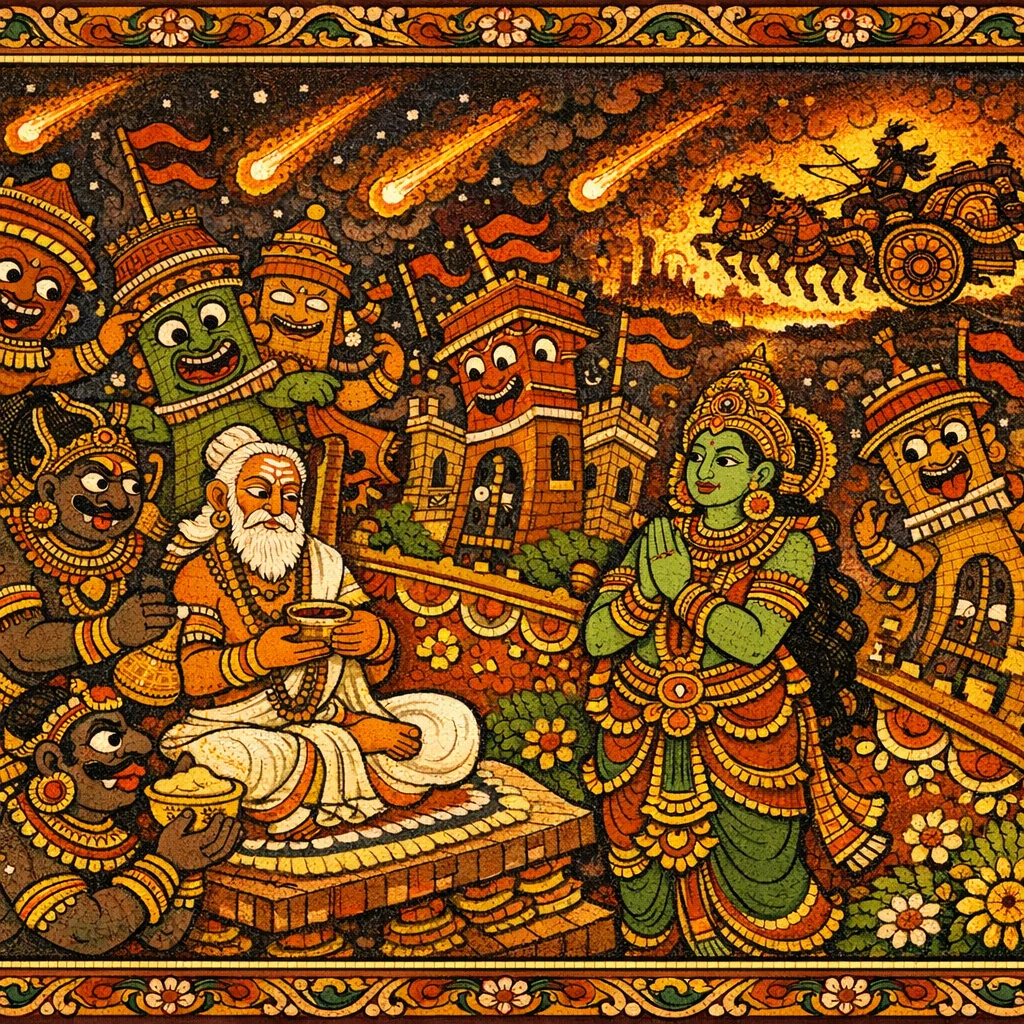
Adhyaya 134: Omens in Tripura and the Nārada–Maya Dialogue on Dharma, Adharma, and Refuge in Śiva
त्रिपुरे उत्पातलक्षणं नारदमायासंवादः
Speaker: Sūta, Nārada, Maya (Dānava leader)
Sūta describes how the divine forces gather and Nārada swiftly arrives in Tripura, where the Dānavas honor him with formal hospitality and offerings. Asked by Maya to explain the city’s unprecedented omens, Nārada defines dharma as that which upholds and leads to auspicious ends, warning that turning to adharma brings certain ruin; the omens foretell the Dānavas’ destruction for supporting harm against the gods. He proclaims Rudra’s imminent coming to destroy Tripura and urges Maya to take refuge in Mahēśvara (Śiva). After Nārada departs, Maya outwardly rallies the Dānavas to fight and man the ramparts, yet inwardly worships Śiva and seeks surrender; Śiva grants him the boon of fearlessness.
Key Concepts
Shlokas in Adhyaya 134
Verse 1
*सूत उवाच पूज्यमाने रथे तस्मिंल् लोकैर्देवे रथे स्थिते प्रमथेषु नदत्सूग्रं प्रवदत्सु च साध्विति //
Sūta said: When that chariot was being worshipped by the people, and the god was seated upon the chariot, the Pramathas roared loudly and cried out, “Well done! Well done!”
Verse 2
ईश्वरस्वरघोषेण नर्दमाने महावृषे जयत्सु विप्रेषु तथा गर्जत्सु तुरगेषु च //
As the great bull roared aloud with a lordly, thunder-like cry, the brahmins raised shouts of victory, and the horses too neighed and bellowed.
Verse 3
रणाङ्गणात्समुत्पत्य देवर्षिर्नारदः प्रभुः कान्त्या चन्द्रोपमस्तूर्णं त्रिपुरं पुरमागतः //
Rising up from the battlefield, the divine seer Nārada—mighty and radiant like the moon—swiftly came to the city called Tripura.
Verse 4
औत्पातिकं तु दैत्यानां त्रिपुरे वर्तते ध्रुवम् नारदश्चात्र भगवान् प्रादुर्भूतस्तपोधनः //
In Tripura, a sure portent of calamity has arisen for the Daityas; and there the venerable sage Nārada, rich in austerity, has also manifested.
Verse 5
आगतं जलदाभासं समेताः सर्वदानवाः उत्तस्थुर्नारदं दृष्ट्वा अभिवादनवादिनः //
When they saw Nārada arrive, radiant like a mass of rain-clouds, all the assembled Dānavas rose and greeted him with words of reverence.
Verse 6
तमर्घ्येण च पाद्येन मधुपर्केण चेश्वराः नारदं पूजयामासुर् ब्रह्माणमिव वासवः //
With arghya (a respectful offering), with pādya (water for washing the feet), and with madhuparka (the honey-mixture offered in welcome), the divine lords honored Nārada, just as the Vasus honor Brahmā.
Verse 7
तेषां स पूजां पूजार्हः प्रतिगृह्य तपोधनः नारदः सुखमासीनः काञ्चने परमासने //
Nārada, the ascetic treasure and worthy of all honor, accepted their offerings of reverence and then sat at ease upon a splendid, supreme golden seat.
Verse 8
मयस्तु सुखमासीने नारदे नारदोद्भवे यथार्हं दानवैः सार्धम् आसीनो दानवाधिपः //
But Maya, lord of the Dānavas, sat at ease; and, O Nārada—born of Nārada—the Dānava ruler sat together with the Dānavas in accordance with due propriety.
Verse 9
आसीनं नारदं प्रेक्ष्य मयस्त्वथ महासुरः अब्रवीद्वचनं तुष्टो हृष्टरोमाननेक्षणः //
Seeing Nārada seated, Maya—the great Asura—then, pleased, with hair standing on end in rapture and eyes bright with delight, spoke words to him.
Verse 10
औत्पातिकं पुरे ऽस्माकं यथा नान्यत्र कुत्रचित् वर्तते वर्तमानज्ञ वद त्वं हि च नारद //
“In our city extraordinary portents are occurring, such as are found nowhere else. O knower of what is happening in the present, speak—tell me truly, O Nārada.”
Verse 11
दृश्यन्ते भयदाः स्वप्ना भज्यन्ते च ध्वजाः परम् विना च वायुना केतुः पतते च तथा भुवि //
Frightening dreams are seen; banners and standards are utterly broken; and even without any wind, a ketu (comet/meteor) falls down upon the earth—these are supreme portents of fear.
Verse 12
अट्टालकाश्च नृत्यन्ते सपताकाः सगोपुराः हिंस हिंसेति श्रूयन्ते गिरश्च भयदाः पुरे //
In the city, the watchtowers seem to “dance,” and the bannered gateways—the gopuras—tremble; and terrifying cries are heard, “Violence! violence!”, voices that spread fear throughout the town.
Verse 13
नाहं बिभेमि देवानां सेन्द्राणामपि नारद मुक्त्वैकं वरदं स्थाणुं भक्ताभयकरं हरम् //
O Nārada, I do not fear the gods—even with Indra among them—except for that one boon-giving Sthāṇu, Hara, who grants fearlessness to his devotees.
Verse 14
भगवन्नास्त्यविदितम् उत्पातेषु तवानघ अनागतमतीतं च भवाञ्जानाति तत्त्वतः //
O Blessed Lord, O sinless one—nothing concerning portents (utpāta) is unknown to you. You know, in truth, both what is yet to come and what has already passed.
Verse 15
तदेतन्नो भयस्थानम् उत्पाताभिनिवेदितम् कथयस्व मुनिश्रेष्ठ प्रपन्नस्य तु नारद //
Therefore, O best of sages, please explain to us this cause of fear that has been indicated by ominous portents; to one who has sought refuge, O Nārada, declare it.
Verse 16
इत्युक्तो नारदस्तेन मयेनामयवर्जितः //
Thus addressed by Maya, Nārada became free from illness and affliction.
Verse 17
*नारद उवाच शृणु दानव तत्त्वेन भवन्त्यौत्पातिका यथा धर्मेति धारणे धातुर् माहात्म्ये चैव पठ्यते धारणाच्च महत्त्वेन धर्म एष निरुच्यते //
Nārada said: Listen, O Dānava—how portentous events (autpātika) truly arise in their essential nature. The word “dharma” is read as deriving from the verbal root *dhṛ* in the sense of “supporting/holding,” and it is also taught in the sense of “greatness.” Therefore, because it upholds and because of its greatness, this is what is called “dharma.”
Verse 18
स इष्टप्रापको धर्म आचार्यैरुपदिश्यते इतरश्चानिष्टफल आचार्यैर्नोपदिश्यते //
That dharma which leads to the attainment of the desired goal is taught by the teachers; but that other course, which yields undesirable results, is not taught by the teachers.
Verse 19
उत्पथान्मार्गमागच्छेन् मार्गाच्चेव विमार्गताम् विनाशस्तस्य निर्देश्य इति वेदविदो विदुः //
One should come back to the true path from a wrong course; but if one abandons the right path and turns to a perverse way, the learned in the Veda declare that his ruin is certain and inevitable.
Verse 20
त्वमधर्मरथारूढः सहैभिर्मत्तदानवैः अपकारिषु देवानां कुरुषे त्वं सहायताम् //
Mounted upon the chariot of unrighteousness, together with these intoxicated Dānavas, you are offering aid to those who do harm to the gods.
Verse 21
तदेतान्येवमादीनि उत्पातावेदितानि च वैनाशिकानि दृश्यन्ते दानवानां तथैव च //
Such and similar phenomena are proclaimed as portents (utpātas), and they are seen as signs that foretell destruction—so too in the case of the Dānavas.
Verse 22
एष रुद्रः समास्थाय महालोकमयं रथम् आयाति त्रिपुरं हन्तुं मय त्वामसुरानपि //
Behold—Rudra, having mounted a chariot fashioned from the great worlds, advances to destroy Tripura, and to slay you asuras as well—O Maya.
Verse 23
स त्वं महौजसं नित्यं प्रपद्यस्व महेश्वरम् यास्यसे सह पुत्रेण दानवैः सह मानद //
Therefore, you should always take refuge in Mahēśvara, the ever-mighty Lord. Then, O giver of honor, you will depart together with your son, in the company of the Dānavas.
Verse 24
इत्येवमावेद्य भयं दानवोपस्थितं महत् दानवानां पुनर्देवो देवेशपदमागतः //
Having thus reported the great fear brought on by the Dānavas, the god (Indra) once again attained the station of Lord of the Gods, in spite of the Dānavas.
Verse 25
नारदे तु मुनौ याते मयो दानवनायकः शूरसंमतमित्येवं दानवानाह दानवः //
When the sage Nārada had departed, Maya—the leader of the Dānavas—then addressed the Dānavas, speaking words that were approved by the brave.
Verse 26
शूराः स्थ जातपुत्राः स्थ कृतकृत्याः स्थ दानवाः युध्यध्वं दैवतैः सार्धं कर्तव्यं चापि नो भयम् //
O Dānavas, you are heroes; you have begotten sons; you are men who have accomplished your aims. Fight together with the gods—this is your duty, and for us there is no fear.
Verse 27
जित्वा वयं भविष्यामः सर्वे ऽमरसभासदः देवांश्च सेन्द्रकान्हत्वा लोकान्भोक्ष्यामहे ऽसुराः //
“Having conquered, we shall all become members of the assembly of the Immortals; and after slaying the gods together with Indra, we Asuras shall enjoy, rule, and possess the worlds.”
Verse 28
अट्टालकेषु च तथा तिष्ठध्वं शस्त्रपाणयः दंशिता युद्धसज्जाश्च तिष्ठध्वं प्रोद्यतायुधाः //
“Likewise, take your positions upon the ramparts and watchtowers, weapons in hand. Fully armored and ready for battle, stand firm with your weapons raised and prepared.”
Verse 29
पुराणि त्रीणि चैतानि यथास्थानेषु दानवाः तिष्ठध्वं लङ्घनीयानि भविष्यन्ति पुराणि च //
“These three Purāṇas—O Dānavas—remain stationed in your proper places. Yet, in time, even the Purāṇas will be overstepped, transgressed, or ignored.”
Verse 30
नमोगतास्तथा शूरा देवता विदिता हि वः ताः प्रयत्नेन वार्याश्च विदार्याश्चैव सायकैः //
“Those heroes too have been subdued (or brought under control). The deities are indeed known to you; therefore, with careful effort you should restrain them—and, if necessary, drive them back by piercing them with missiles.”
Verse 31
इति दनुतनयान्मयस्तथोक्त्वा सुरगणवारणवारणे वचांसि युवतिजनविषण्णमानसं तत् त्रिपुरपुरं सहसा विवेश राजा //
“Thus speaking to the sons of Danu, Mayā uttered words able to ward off the hosts of the gods; then the king, his mind heavy with the sorrow of the womenfolk, suddenly entered that city of Tripura.”
Verse 32
अथ रजतविशुद्धभावभावो भवमभिपूज्य दिगम्बरं सुगीर्भिः शरणमुपजगाम देवदेवं मदनार्यन्धकयज्ञदेहघातम् //
Then, with a disposition as pure as refined silver, he worshipped Bhava—Śiva, the sky-clad one—with well-chosen words, and sought refuge in the God of gods: the slayer of Madana, of the noble Andhaka, and of the sacrificial body (of Dakṣa).
Verse 33
मयमभयपदैषिणं प्रपन्नं न किल बुबोध तृतीयदीप्तनेत्रः तदभिमतमदात्ततः शशाङ्की स च किल निर्भय एव दानवो ऽभूत् //
When Maya, seeking the station of fearlessness, approached in surrender, the three-eyed Lord (Śiva) did not recognize him; then the Moon-crested One granted him the boon he desired, and that Dānava indeed became fearless.
Frequently Asked Questions
The chapter teaches that ominous portents (utpātas) are not random; they signal ethical collapse and impending ruin when a community rides the ‘chariot of adharma.’ Nārada defines dharma as that which upholds and leads to desired, auspicious ends, and warns that turning from the right path ensures destruction. The practical instruction is to abandon adharma and take refuge (śaraṇāgati) in Mahēśvara—shown by Maya ultimately seeking Śiva and receiving fearlessness.
This adhyāya is primarily Dharma-focused: the meaning of dharma/adharma, consequences of deviating from the righteous path, and the interpretation of utpātas as signs of downfall. It also belongs to the mythic Tripura-dahana cycle (Śiva/Rudra’s approach to destroy Tripura). It does not present Vāstu measurements or genealogical lists, though it uses civic imagery (ramparts, watchtowers, gateways) to describe the city’s ominous disturbances.