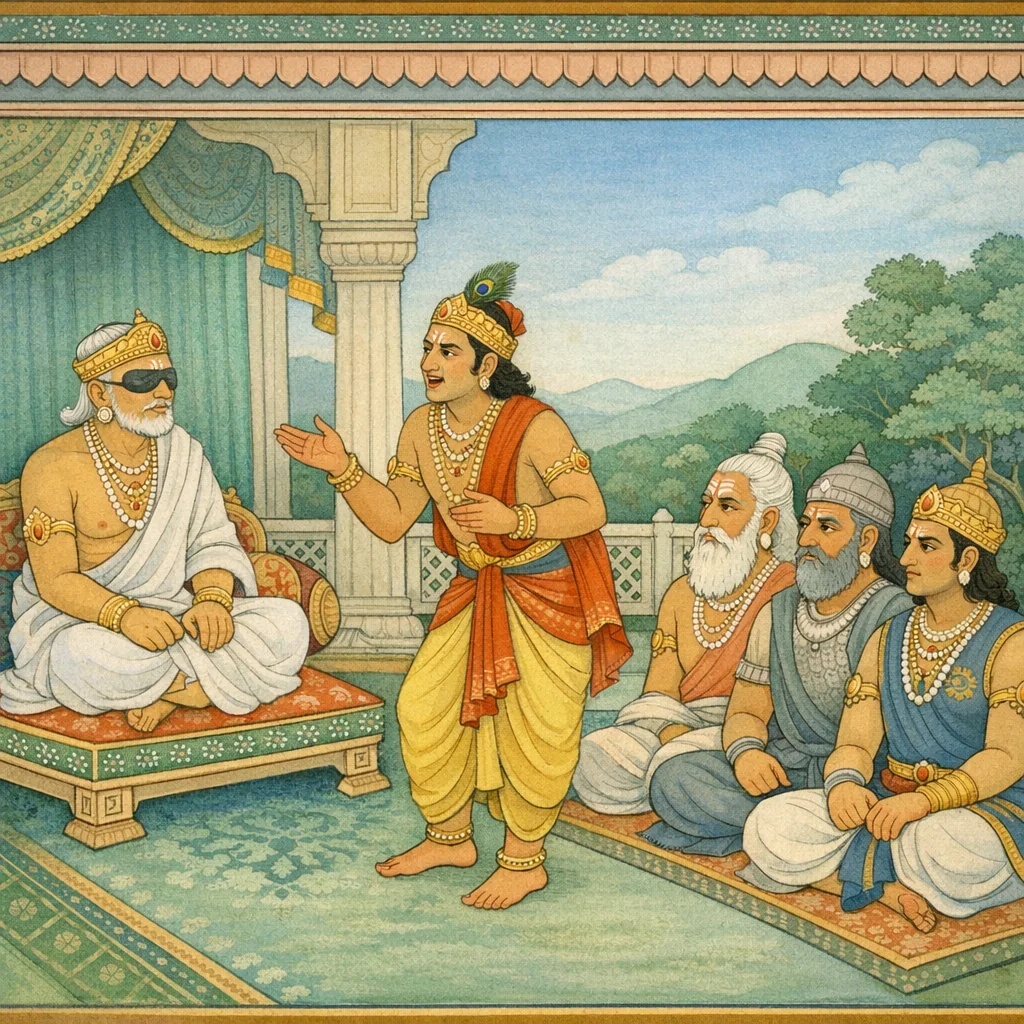
Adhyaya 54
उद्योगपर्व — अध्याय ५४: दुर्योधनस्य धृतराष्ट्रं प्रति बलप्रशंसन-युक्तः आश्वासनवादः (Duryodhana’s Reassurance and Force-Praise to Dhritarashtra)
Upa-parva: Udyoga Parva — Court-Counsel and Force-Assessment Episode (Chapter 54 Context)
Chapter 54 presents Duryodhana’s extended address to Dhṛtarāṣṭra in a counsel context. He opens by discouraging fear and portraying the Kuru position as militarily secure. He recalls the Pāṇḍavas’ support network—Kṛṣṇa and allied kings—yet reframes it as insufficient against Kuru stalwarts. The speech enumerates and praises principal commanders (Bhīṣma, Droṇa, Kṛpa, Aśvatthāman, Karṇa, Śalya, Jayadratha, and others), invoking their origins, prowess, and prior feats as deterrent proof. Duryodhana emphasizes numerical advantage (akṣauhiṇī counts) and claims that the opposing side is weakened, politically isolated, and dependent. He also introduces a personal boast centered on mace-combat superiority and the anticipated neutralization of Bhīma, followed by confidence that Arjuna can be contained by multiple chariot-warriors. The chapter closes with Vaiśaṃpāyana’s narration that, after speaking thus, Duryodhana again questions Saṃjaya, indicating ongoing strategic deliberation.
Chapter Arc: धृतराष्ट्र के समक्ष दुर्योधन निर्भयता का आवरण ओढ़कर अपने पक्ष की ‘अपराजेयता’ का घोष करता है—पाण्डवों के वनवास से लेकर आज तक की अपनी ‘नीति’ को विजय-गाथा की तरह सुनाते हुए। → वह स्मरण कराता है कि पाण्डवों को वन में भेजे जाने के समय भी अनेक राजा उनके साथ हो गए थे, फिर भी कौरव-बल की धुरी नहीं डिगी; अब कृष्ण के आगमन को वह ‘कौरव-विनाश की योजना’ बताकर सभा में भय और क्रोध दोनों को उकसाता है, और साथ ही अपने महाबली रक्षकों—भीष्म, द्रोण, कृप, अश्वत्थामा, कर्ण, भूरिश्रवा, शल्य, जयद्रथ आदि—की सूची गिनाकर आत्मविश्वास को हथियार बनाता है। → दुर्योधन का चरम तर्क यह है कि भीष्म को कोई मार ही नहीं सकता—शान्तनु के वरदान का स्मरण कराकर वह भीष्म को ‘अवध्य’ ठहराता है; फिर द्रोण, कृप और अश्वत्थामा की उत्पत्ति-कथाओं और अस्त्र-विद्या का बखान कर कौरव-सेना को देवैरपि सुदुःसह बताता है, मानो कृष्ण की कूटनीति भी इन दीवारों से टकराकर टूट जाएगी। → अध्याय का निष्कर्ष दुर्योधन की मानसिक विजय-घोषणा है: प्रणिपात या पलायन नहीं, प्रतिरोध ही नीति—कृष्ण की शान्ति-यात्रा को वह शत्रु-चाल मानकर युद्ध-तैयारी को ही एकमात्र उत्तर ठहराता है। → कृष्ण की वास्तविक वाणी और धृतराष्ट्र-सभा की प्रतिक्रिया अभी शेष है—क्या यह अहंकार शान्ति को रोक देगा, या किसी क्षण विवेक का द्वार खुलेगा?
Shlokas
Verse 1
अपन बछ। ] अति्शशाड< पञ्चपज्चाशत्तमो< ध्याय: धृतराष्ट्रको हर 2 देते हुए दुर्योधनद्वारा अपने उत्कर्ष और [के अपकर्षका वर्णन दुर्योधन उवाच न भेतव्यं महाराज न शोच्या भवता वयम् | समर्था: सम पराज्जेतुं बलिन: समरे विभो,दुर्योधन बोला--महाराज! आप डरें नहीं; आपके द्वारा हमलोग शोक करनेयोग्य नहीं हैं। प्रभो! हम बलवान् और शक्तिशाली हैं तथा समरभूमिमें शत्रुओंको जीतनेकी शक्ति रखते हैं
Duryodhana said: “O great king, do not be afraid. We are not a cause for grief to you. O mighty lord, we are strong and capable—able to defeat our enemies on the battlefield.”
Verse 2
वने प्रव्राजितान् पार्थान् यदा55यान्मधुसूदन: । महता बलचक्रेण परराष्ट्रावमर्दिना,पाण्डवोंको जब हमने वनमें भेज दिया, उस समय शत्रुओंके राष्ट्रोंकी धूलमें मिला देनेवाले विशाल सैन्यसमूहके साथ श्रीकृष्ण यहाँ आये थे। उनके साथ केकयराजकुमार, धृष्टकेतु, ट्रुपदपुत्र धृष्टद्युम्म तथा और भी बहुत-से नरेश, जो पाण्डवोंके अनुयायी हैं, यहाँतक पधारे थे
Duryodhana said: “When we had driven the sons of Pṛthā into exile in the forest, then Madhusūdana (Kṛṣṇa) came here, accompanied by a vast, wheel-like host of troops—an army able to grind the kingdoms of enemies into dust.”
Verse 3
केकया धष्टकेतुश्न धृष्द्युम्नश्न॒ पार्षत: । राजानश्षान्वयु: पार्थान् बहवो<न्येडनुयायिन:,पाण्डवोंको जब हमने वनमें भेज दिया, उस समय शत्रुओंके राष्ट्रोंकी धूलमें मिला देनेवाले विशाल सैन्यसमूहके साथ श्रीकृष्ण यहाँ आये थे। उनके साथ केकयराजकुमार, धृष्टकेतु, ट्रुपदपुत्र धृष्टद्युम्म तथा और भी बहुत-से नरेश, जो पाण्डवोंके अनुयायी हैं, यहाँतक पधारे थे
Duryodhana said: “The princes of Kekaya—Dhṛṣṭaketu—and Dhṛṣṭadyumna, the son of Pārṣata (Drupada), along with many other kings who follow the Pārthas, have joined the Pāṇḍavas. When we sent the Pāṇḍavas into the forest, Kṛṣṇa came here with a vast host able to grind enemy realms into dust; and these allies came with him as well.”
Verse 4
इन्द्रप्रस्थस्य चादूरात् समाजम्मुर्महारथा: । व्यगर्हयंश्ष संगम्य भवन्तं कुरुभि: सह,वे सभी महारथी इन्द्रप्रथथ्के निकटतक आये और परस्पर मिलकर समस्त कौरवोंसहित आपकी निन्दा करने लगे
Not far from Indraprastha, the great chariot-warriors assembled. Gathering together, they began to censure you—along with the Kauravas.
Verse 5
ते युधिष्ठिरमासीनमजि नै: प्रतिवासितम् | कृष्णप्रधाना: संहत्य पर्युपासन्त भारत,भारत! वे नरेश श्रीकृष्णकी प्रधानतामें संगठित हो वनमें विराजमान मृगचर्मधारी युधिष्ठिरके समीप जाकर बैठे और सगे-सम्बन्धियोंसहित आपका मूलोच्छेद कर डालनेकी इच्छा रखकर कहने लगे--'धृतराष्ट्रके हाथसे राज्यको लौटा लेना ही कर्तव्य है”
Duryodhana said: “Those kings, with Kṛṣṇa as their chief, gathered together and approached Yudhiṣṭhira, who was living in the forest, seated there in ascetic guise. Sitting near him, they spoke with the resolve to uproot you along with your kinsmen, declaring: ‘It is our duty to take back the kingdom from Dhṛtarāṣṭra’s hand.’”
Verse 6
प्रत्यादानं च राज्यस्य कार्यमूचुर्नराधिपा: । भवतः: सानुबन्धस्य समुच्छेदं चिकीर्षव:,भारत! वे नरेश श्रीकृष्णकी प्रधानतामें संगठित हो वनमें विराजमान मृगचर्मधारी युधिष्ठिरके समीप जाकर बैठे और सगे-सम्बन्धियोंसहित आपका मूलोच्छेद कर डालनेकी इच्छा रखकर कहने लगे--'धृतराष्ट्रके हाथसे राज्यको लौटा लेना ही कर्तव्य है”
Duryodhana said: “Those kings declared that the proper course is to take back the kingdom. O Bhārata, desiring to annihilate you together with your allies and supporters, they spoke thus.”
Verse 7
श्र॒त्वा चैवं मयोक्तास्तु भीष्मद्रोणकृपास्तदा । ज्ञातिक्षयभयाद् राजन् भीतेन भरतर्षभ
Duryodhana said: “When Bhīṣma, Droṇa, and Kṛpa heard what I had said, O King—O bull among the Bharatas—they were then seized by fear, for they foresaw the ruin of their own kinsmen.”
Verse 8
न ते स्थास्यन्ति समये पाण्डवा इति मे मतिः । समुच्छेदं हि नः कृत्स्नं वासुदेवश्चिकीर्षति
Duryodhana said: “In my judgment, the Pāṇḍavas will not keep to that agreed time. For Vāsudeva intends to bring about our complete destruction.”
Verse 9
भरतश्रेष्ठ) उनके इस निश्चयको सुनकर मैंने कुटुम्बीजनोंके वधकी आशंकासे भयभीत हो भीष्म, द्रोण और कृपाचार्यसे इस प्रकार निवेदन किया--“तात! मुझे ऐसा प्रतीत होता है कि पाण्डवलोग अपनी प्रतिज्ञापर स्थिर नहीं रहेंगे; क्योंकि वसुदेवनन्दन श्रीकृष्ण हम सब लोगोंका पूर्णतः विनाश कर डालना चाहते हैं ।। ऋते च विदुरात् सर्वे यूयं वध्या मता मम । धृतराष्ट्रस्तु धर्मज्ञो न वध्य: कुरुसत्तम:,“केवल विदुरजीको छोड़कर आप सब लोग मार डालनेके योग्य समझे गये हैं, यह बात मुझे मालूम हुई है। कुरुश्रेष्ठ धृतराष्ट्र धर्मज्ञ हैं, यह सोचकर उनका भी वध नहीं किया जायगा
O best of the Bharatas, hearing of that resolve, I—alarmed at the prospect of slaughter among our own kinsmen—approached Bhīṣma, Droṇa, and Kṛpa and submitted: “Father, it seems to me the Pāṇḍavas will not remain firm in their pledge, for Kṛṣṇa, the son of Vasudeva, wishes to bring about the complete destruction of all of us. Except for Vidura, all of you have been judged—so I have learned—as fit to be slain. But Dhṛtarāṣṭra, being a knower of dharma, should not be killed, O best of the Kurus.”
Verse 10
समुच्छेद च कृत्स्नं नः कृत्वा तात जनार्दन: । एकराज्यं कुरूणां सम चिकीर्षति युधिष्ठिरे
Duryodhana says: “O dear one, Janārdana (Kṛṣṇa) intends to annihilate us completely and then establish a single, undivided sovereignty over the Kurus for Yudhiṣṭhira.”
Verse 11
“तात! श्रीकृष्ण हमारा सर्वनाश करके कौरवोंका एक राज्य बनाकर उसे युधिष्ठिरको सौंपना चाहते हैं ।। तत्र किं प्राप्तकालं न: प्रणिपात: पलायनम् । प्राणान् वा सम्परित्यज्य प्रतियुध्यामहे परान्,'ऐसी अवस्थामें इस समय हमारा कया कर्तव्य है? हम उनके चरणोंपर गिरें, पीठ दिखाकर भाग जायाँ अथवा प्राणोंका मोह छोड़कर शत्रुओंका सामना करें
Duryodhana says: “Father, Krishna wishes to bring about our total ruin—reducing the Kauravas to a single kingdom and then handing even that over to Yudhishthira. In such a situation, what is the right course for us now: to fall at their feet in submission, to turn our backs and flee, or, casting aside attachment to life, to stand and fight the enemy?”
Verse 12
प्रतियुद्धे तु नियत: स्यादस्माकं पराजय: । युधिष्ठिरस्य सर्वे हि पार्थिवा वशवर्तिन:,“उनके साथ युद्ध होनेपर हमारी पराजय निश्चित है; क्योंकि इस समय समस्त भूपाल राजा युधिष्ठिरके अधीन हैं। इस राज्यमें रहनेवाले सब लोग हमसे घृणा करते हैं। हमारे मित्र भी कुपित हो गये हैं। सम्पूर्ण नरेश और आत्मीयजन सभी हमें धिक्कार रहे हैं
Duryodhana said: “If it comes to open battle, our defeat is certain; for at present all the kings are under Yudhiṣṭhira’s sway.”
Verse 13
विरक्तराष्ट्रश्न वयं मित्राणि कुपितानि नः । धिककृताः: पार्थिवै: सर्वे: स्वजनेन च सर्वश:,“उनके साथ युद्ध होनेपर हमारी पराजय निश्चित है; क्योंकि इस समय समस्त भूपाल राजा युधिष्ठिरके अधीन हैं। इस राज्यमें रहनेवाले सब लोग हमसे घृणा करते हैं। हमारे मित्र भी कुपित हो गये हैं। सम्पूर्ण नरेश और आत्मीयजन सभी हमें धिक्कार रहे हैं
Duryodhana lamented: “The kingdom has turned away from us; our allies are angered. All the kings—and even our own kinsmen—openly condemn and revile us on every side.”
Verse 14
प्रणिपाते न दोषो5स्ति सन्धिर्न: शाश्वती: समा: । पितरं त्वेव शोचामि प्रज्ञानेत्र जनाधिपम्,(मैं समझता हूँ.) इस समय नतमस्तक हो जानेमें कोई दोष नहीं है। इससे हमलोगोंमें सदाके लिये शान्ति हो जायगी, केवल अपने प्रज्ञाचक्षु पिता महाराज धृतराष्ट्रके लिये ही मुझे शोक हो रहा है
Duryodhana said: “There is no fault in bowing down at this moment. By doing so, a lasting peace for many years can be secured between us. Yet I grieve only for my father—the lord of men, Dhṛtarāṣṭra—whose ‘eye’ is wisdom.”
Verse 15
मत्कृते दुःखमापन्नं क्लेशं प्राप्तमनन्तकम् । कृतं हि तव पुत्रैश्न परेषामवरो धनम् । मत्प्रियार्थ पुरैवैतद् विदितं ते नरोत्तम
Duryodhana said: “For my sake you have fallen into sorrow and have met with endless hardship. Indeed, through your sons the wealth of others has been diminished and brought low. All this, O best of men, was known to you from the very beginning, undertaken to please me.”
Verse 16
उन्होंने मेरे लिये अनन्त क्लेश और दुःख सहन किये हैं।' नरश्रेष्ठ पिताजी! आपके पुत्रों तथा मेरे भाइयोंने केवल मेरी प्रसन्नताके लिये शत्रुओंको सदा ही सताया है; ये सब बातें आप पहलेसे ही जानते हैं ।। ते राज्ञो धृतराष्ट्रस्य सामात्यस्य महारथा: । वैरं प्रतिकरिष्यन्ति कुलोच्छेदेन पाण्डवा:,“इसलिये वे महारथी पाण्डव मन्त्रियोंसहित महाराज धृतराष्ट्रके कुलका समूलोच्छेद करके अपने वैरका बदला लेंगे”
Duryodhana said: “For my sake they have borne endless hardship and sorrow. O revered father, best of men, your sons—my brothers—have continually harassed our enemies only to please me; you already know all this. Therefore those great chariot-warriors, the Pāṇḍavas, together with their ministers, will repay their enmity by uprooting the entire line of King Dhṛtarāṣṭra.”
Verse 17
ततो द्रोणो<ब्रवीद् भीष्म: कृपो द्रौणिश्न भारत । मत्वा मां महतीं चिन्तामास्थितं व्यथितेन्द्रियम्,भारत! मेरी यह बात सुनकर आचार्य द्रोण, पितामह भीष्म, कृपाचार्य तथा अश्व॒त्थामाने मुझे बड़ी भारी चिन्तामें पड़कर सम्पूर्ण इन्द्रियोंसे व्यथित हुआ जान आश्वासन देते हुए कहा--'परंतप! यदि शत्रुपक्षेके लोग हमसे द्रोह रखते हैं तो तुम्हें डरना नहीं चाहिये। शत्रुलोग युद्धमें उपस्थित होनेपर हमें जीतनेमें असमर्थ हैं
Then Droṇa spoke, and Bhīṣma, and Kṛpa, and Droṇa’s son Aśvatthāman, O Bhārata. Seeing that I had fallen into great anxiety and that my senses were shaken, they reassured me: “O scorcher of foes, even if the men of the enemy side bear hostility toward us, you should not be afraid. When they come to battle, the enemy will be unable to defeat us.”
Verse 18
अभिद्र॒ग्धा: परे चेन्नो न भेतव्यं परंतप । असमर्था: परे जेतुमस्मान् युधि समास्थितान्,भारत! मेरी यह बात सुनकर आचार्य द्रोण, पितामह भीष्म, कृपाचार्य तथा अश्व॒त्थामाने मुझे बड़ी भारी चिन्तामें पड़कर सम्पूर्ण इन्द्रियोंसे व्यथित हुआ जान आश्वासन देते हुए कहा--'परंतप! यदि शत्रुपक्षेके लोग हमसे द्रोह रखते हैं तो तुम्हें डरना नहीं चाहिये। शत्रुलोग युद्धमें उपस्थित होनेपर हमें जीतनेमें असमर्थ हैं
Duryodhana said: “If the opposing side bears malice toward us, you, O scorcher of foes, should not be afraid. Those enemies are not capable of defeating us when we stand arrayed in battle, O Bhārata.”
Verse 19
एकैकश: समर्था: स्मो विजेतु सर्वपार्थिवान् । आगच्छन्तु विनेष्यामो दर्पमेषां शितै: शरै:,“हममेंसे एक-एक वीर भी समस्त राजाओंको जीतनेकी शक्ति रखता है। शत्रुलोग आवें तो सही, हम अपने पैने बाणोंसे उनका घमंड चूर-चूर कर देंगे”
Duryodhana declared with swagger: “Each one of us is capable of conquering all the kings. Let the enemies come—by our sharp arrows we shall crush their pride to dust.”
Verse 20
पुरैकेन हि भीष्मेण विजिता: सर्वपार्थिवा: । मृते पितर्यतिक्रुद्धो रथेनेकेन भारत,भारत! पहलेकी बात है, अपने पिता शान्तनुकी मृत्युके पश्चात् भीष्मजीने किसी समय अत्यन्त क्रोधमें भरकर एकमात्र रथकी सहायतासे अकेले ही सब राजाओंको जीत लिया था
Duryodhana said: “In former times, Bhīṣma alone conquered all the kings. After his father had died, inflamed with fierce anger, he accomplished it with a single chariot, O Bhārata.”
Verse 21
जघान सुबहूंस्तेषां संरब्ध: कुरुसत्तम: । ततस्ते शरणं जम्मुर्देवव्रतमिमं भयात्,रोषमें भरे हुए कुरुश्रेष्ठ भीष्मने जब उनमेंसे बहुत-से राजाओंको मार डाला, तब वे डरके मारे पुनः इन्हीं देवव्रत (भीष्म)-की शरणमें आये
Enraged, the best of the Kurus (Bhīṣma) struck down many among them. Then those kings, terrified, went again for refuge to this Devavrata (Bhīṣma).
Verse 22
स भीष्म: सुसमर्थोडयमस्माभि: सहितो रणे । परान् विजेतुं तस्मात् ते व्येतु भीर्भरतर्षभ,भरतश्रेष्ठ! वे ही पूर्ण सामर्थ्यशाली भीष्म युद्धमें शत्रुओंको जीतनेके लिये हमारे साथ हैं; अत: आपका भय दूर हो जाना चाहिये
Duryodhana said: “This Bhīṣma is fully capable, and he stands with us in battle to conquer our foes. Therefore, O bull among the Bharatas, let your fear be dispelled.”
Verse 23
इत्येषां निश्चयो ह्वासीत् तत्कालेडमिततेजसाम् । पुरा परेषां पृथिवी कृत्स्ना$$सीद् वशवर्तिनी,इन अमिततेजस्वी भीष्म आदिने उसी समय युद्धमें हमारा साथ देनेका दृढ़ निश्चय कर लिया था। पहले यह सारी पृथ्वी हमारे शत्रुओंके काबूमें थी, किंतु अब हमारे हाथमें आ गयी है। हमारे ये शत्रु अब हमें युद्धमें जीतनेकी शक्ति नहीं रखते। सहायकोंके अभावमें पाण्डव पंख कटे हुए पक्षीके समान असहाय एवं पराक्रमशून्य हो गये हैं
Duryodhana said: “Thus, at that time, those men of immeasurable prowess formed a firm resolve (to stand with us). Formerly, this entire earth lay under the control of our opponents; but now it has come into our hands.”
Verse 24
अस्मान् पुनरमी नाद्य समर्था जेतुमाहवे । छिन्नपक्षा: परे हाद्य वीर्यहीनाश्ष पाण्डवा:,इन अमिततेजस्वी भीष्म आदिने उसी समय युद्धमें हमारा साथ देनेका दृढ़ निश्चय कर लिया था। पहले यह सारी पृथ्वी हमारे शत्रुओंके काबूमें थी, किंतु अब हमारे हाथमें आ गयी है। हमारे ये शत्रु अब हमें युद्धमें जीतनेकी शक्ति नहीं रखते। सहायकोंके अभावमें पाण्डव पंख कटे हुए पक्षीके समान असहाय एवं पराक्रमशून्य हो गये हैं
Duryodhana said: “These men are no longer capable, today, of defeating us in battle. The Pāṇḍavas have become like birds with their wings cut off—bereft of support, helpless, and drained of martial power.”
Verse 25
अस्मत्संस्था च पृथिवी वर्तते भरतर्षभ । एकार्था: सुखदु:खेषु समानीताश्च पार्थिवा:,भरतश्रेष्ठ] इस समय यह पृथ्वी हमारे अधिकारमें है। हमने जिन राजाओंको यहाँ बुलाया है, ये सब सुख और दु:खमें भी हमारे साथ एक-सा प्रयोजन रखते हैं--हमारे सुख- दुःखको अपना ही सुख-दुःख मानते हैं
“O bull among the Bharatas, at this time the earth stands under our rule. The kings we have summoned here are of one purpose with us in joy and in sorrow—they take our happiness and our suffering as their own.”
Verse 26
अप्यन्निं प्रविशेयुस्ते समुद्र वा परंतप । मदर्थ पार्थिवा: सर्वे तद् विद्धि कुरुसत्तम,शत्रुओंको संताप देनेवाले कुरुश्रेष्ठ! निश्चित मानिये, ये सब समागत नरेश मेरे लिये जलती आगममें भी प्रवेश कर सकते हैं और समुद्रमें भी कूद सकते हैं
Duryodhana said: “O scorcher of foes, O best of the Kurus—know this for certain: all these assembled kings, for my sake, would even enter blazing fire or leap into the sea.”
Verse 27
उन्मत्तमिव चापि त्वां प्रहसन्तीह दुःखितम् | विलपन्तं बहुविधं भीत॑ परविकत्थने,इतनेपर भी आप शत्रुओंकी मिथ्या प्रशंसा सुनकर पागल-से हो उठे हैं और दुःखी एवं भयभीत होकर नाना प्रकारसे विलाप कर रहे हैं। यह सब देखकर ये राजालोग यहाँ हँस रहे हैं
Duryodhana said: “Here they are laughing at you as though you were mad—seeing you distressed, frightened, and lamenting in many ways, merely because you have been listening to exaggerated talk and empty boasting about the enemy. Your loss of composure has become a spectacle before these kings.”
Verse 28
एषां होकैकशो राज्ञां समर्थ: पाण्डवान् प्रति । आत्मानं मन्यते सर्वो व्येतु ते भयमागतम्,इन राजाओंमेंसे प्रत्येक अपने-आपको पाण्डवोंके साथ युद्ध करनेमें समर्थ मानता है; अत: आपके मनमें जो भय आ गया है, वह निकल जाना चाहिये
Duryodhana said: “Each one of these kings, taken individually, considers himself capable of facing the Pāṇḍavas in battle. Therefore, let the fear that has arisen in your mind be dispelled.”
Verse 29
जेतुं समग्रां सेनां मे वासवो5पि न शकक््नुयात् । हन्तुक्षय्यरूपेयं ब्रद्म॒णो5पि स्वयम्भुवः
Duryodhana said: “Even Vāsava (Indra) would not be able to conquer my entire army. This host is of a nature that brings about destruction; even Svayambhū Brahmā would not be able to slay it.”
Verse 30
मेरी सम्पूर्ण सेनाको इन्द्र भी नहीं जीत सकते। स्वयम्भू ब्रह्माजी भी इसका नाश नहीं कर सकते ।। युधिष्ठिर: पुरं हित्वा पञ्च ग्रामान् स याचति । भीतो हि मामकात् सैन्यात् प्रभावाच्चैव मे विभो,प्रभो! युधिष्ठिर तो मेरी सेना तथा प्रभावसे इतने डर गये हैं कि राजधानी या नगर लेनेकी बात छोड़कर अब पाँच गाँव माँगने लगे हैं
Duryodhana said: “Even Indra cannot conquer my entire army; even the Self-born Brahmā cannot destroy it. Yudhiṣṭhira, abandoning the demand for the city, now begs for five villages. For he is afraid—afraid of my forces and of my power. Thus, leaving aside talk of taking the capital, he has come to asking only for five villages.”
Verse 31
समर्थ मन्यसे यच्च कुन्तीपुत्रं वृकोदरम् । तन्मिथ्या न हि मे कृत्स्नं प्रभावं वेत्सि भारत,भारत! आप जो कुन्तीकुमार भीमको बहुत शक्तिशाली मान रहे हैं, वह भी मिथ्या ही है; क्योंकि आप मेरे प्रभावको पूर्णरूपसे नहीं जानते हैं
Duryodhana said: “If you think Kuntī’s son Vṛkodara (Bhīma) is truly formidable, that judgment is mistaken. For you do not yet know the full extent of my power, O Bhārata.”
Verse 32
मत्समो हि गदायुद्धे पृथिव्यां नास्ति कश्नन । नासीत् ककश्चिदतिक्रान्तो भविता न च कश्नन,गदायुद्धमें मेरी समानता करनेवाला इस पृथ्वीपर न तो कोई है, न भूतकालमें कोई हुआ था और न भविष्यमें ही कोई होगा
In mace-fighting, there is none on this earth equal to me. None in the past has surpassed me, and none in the future shall surpass me.
Verse 33
युक्तो दुःखोषितश्चाहं विद्यापारगतस्तथा । तस्मान्न भीमान्नान्येभ्यो भयं मे विद्यते क्वचित्,गदायुद्धका मेरा अभ्यास बहुत अच्छा है। मैंने गुरुके समीप क्लेशसहनपूर्वक रहकर अस्त्रविद्या सीखी है और उसमें मैं पारंगत हो गया हूँ। अत: भीमसेनसे या दूसरे योद्धाओंसे मुझे कभी कोई भय नहीं है
I have been disciplined and trained through hardship, and I have mastered the science of weapons. Therefore I have no fear at any time—neither of Bhīma nor of any other warrior.
Verse 34
दुर्योधनसमो नास्ति गदायामिति निश्चय: । संकर्षणस्य भद्रें ते यत् तदैेनमुपावसम्,आपका कल्याण हो। बलरामजीका भी यही निश्चय है कि गदायुद्धमें दुर्योधनके समान दूसरा कोई नहीं है। यह बात उन्होंने उस समय कही थी, जब मैं उनके पास रहकर गदाकी शिक्षा ले रहा था
It is a settled conviction that in the art of the mace there is none equal to Duryodhana. May you fare well; Saṅkarṣaṇa (Balarāma) too held this very conviction—he said so when I lived near him and received instruction in the mace.
Verse 35
युद्धे संकर्षणसमो बलेनाभ्यधिको भुवि । गदाप्रहारं भीमो मे न जातु विषहेद् युधि,मैं युद्धमें बलरामजीके समान हूँ और बलमें इस भूतलपर सबसे बढ़कर हूँ। युद्धमें भीमसेन मेरी गदाका प्रहार कभी नहीं सह सकते
In battle I am the equal of Saṅkarṣaṇa (Balarāma), and in sheer strength I surpass all upon this earth. In combat, Bhīmasena would never be able to endure the blow of my mace.
Verse 36
एकं प्रहारं यं दद्यां भीमाय रुषितो नृप । स एवैनं नयेद् घोर: क्षिप्रं वैवस्वतक्षयम्,महाराज! मैं रोषमें भरकर भीमसेनपर गदाका जो एक बार प्रहार करूँगा, वह अत्यन्त भयंकर एक ही आघात उन्हें शीघ्र ही यमलोक पहुँचा देगा
O king, if, in anger, I were to deliver even a single blow to Bhīma, that one strike—terrible in its force—would swiftly send him to the abode of Vaivasvata (Yama).
Verse 37
इच्छेयं च गदाहस्तं राजन द्रष्टं वृकोदरम् । सुचिरं प्रार्थितो होष मम नित्यं मनोरथ:
Duryodhana said: “O King, I wish to see Vṛkodara with mace in hand. For a long time this has been my constant desire—ever prayed for and cherished in my heart.”
Verse 38
राजन! मैं चाहता हूँ कि युद्धमें गदा हाथमें लिये हुए भीमसेनको अपने सामने देखूँ। मैंने दीर्घकालसे अपने मनमें सदा इसी मनोरथके सिद्ध होनेकी इच्छा रखी है ।। गदया निहतो हाजौ मया पार्थो वृकोदर: । विशीर्णगात्र: पृथिवीं परासु: प्रपतिष्यति,युद्धमें मेरी गदासे आहत हुए कुन्तीपुत्र भीमसेनका शरीर छिन्न-भिन्न हो जायगा और वे प्राणशून्य होकर पृथ्वीपर पड़ जायँगे
Duryodhana said: “O King, I long to see Bhīmasena—Vṛkodara—standing before me in battle with his mace in hand. For a long time I have cherished this single desire in my heart, hoping to see it fulfilled. Today, struck down by my mace, that son of Pṛthā, Vṛkodara, will have his limbs shattered and, bereft of life, will fall upon the earth.”
Verse 39
गदाप्रहाराभिहतो हिमवानपि पर्वत: । सकृन्मया विदीर्येत गिरि: शतसहस्रधा,यदि मैं एक बार अपनी गदाका आघात कर दूँ तो हिमालय पर्वत भी लाखों टुकड़ोंमें विदीर्ण हो जायगा
Duryodhana said: “Even the Himālaya—though a mountain—if struck by the blow of a mace, could be shattered by me with a single strike into hundreds of thousands of fragments.”
Verse 40
स चाप्येतद् विजानाति वासुदेवार्जुनौ तथा । दुर्योधनसमो नास्ति गदायामिति निश्चय:,भीमसेन भी इस बातको जानते हैं। श्रीकृष्ण और अर्जुनको भी यह ज्ञात है। यह निश्चित है कि गदायुद्धमें दुर्योधनके समान दूसरा कोई नहीं है
Duryodhana declares that Bhīmasena knows this well, and so do Vāsudeva (Kṛṣṇa) and Arjuna: it is his settled conviction that in mace-fighting there is no one equal to Duryodhana.
Verse 41
तत् ते वृकोदरमयं भयं व्येतु महाहवे । व्यपनेष्याम्यहं होनं मा राजन् विमना भव,अतः राजन! भीमसेनसे जो आपको भय हो रहा है, वह दूर हो जाना चाहिये। मैं महायुद्धमें उन्हें मार गिराऊँगा। इसलिये आप मनमें खेद न करें
Duryodhana said: “O King, let that fear of yours—arising from Bhīma (Vṛkodara)—be dispelled in the great battle. I shall remove it completely; do not let your mind sink into dejection.”
Verse 42
तस्मिन् मया हते क्षिप्रमर्जुनं बहवो रथा: । तुल्यरूपा विशिष्ट श्ष क्षेप्स्पन्ति भरतर्षभ,भरतमश्रेष्ठ! मेरे द्वारा भीमसेनके मारे जानेपर (हमारे पक्षके) बहुत-से रथी जो अर्जुनके समान या उनसे भी बढ़कर हैं, उनके ऊपर शीतघ्रतापूर्वक बाणोंकी वर्षा करने लगेंगे
Duryodhana said: “Once I have slain him, many chariot-warriors on our side—equal to Arjuna in prowess, or even superior—will swiftly shower Arjuna with volleys of arrows, O bull among the Bharatas.”
Verse 43
भीष्मो द्रोण: कृपो द्रौणि: कर्णो भूरिश्रवास्तथा । प्राग्ज्योतिषाधिप: शल्य: सिन्धुराजो जयद्रथ:
Duryodhana said: “Bhīṣma, Droṇa, Kṛpa, Droṇa’s son (Aśvatthāman), Karṇa, and Bhūriśravas as well; Śalya, the lord of Prāgjyotiṣa; and Jayadratha, the king of Sindhu—these are the foremost among my supporters.”
Verse 44
समग्रा पार्थिवी सेना पार्थमेक॑ं धनंजयम्
Duryodhana declares that the entire host of earthly kings stands arrayed against a single man—Pārtha, Dhanañjaya (Arjuna).
Verse 45
कस्मादशक्ता निर्जेतुमिति हेतुर्न विद्यते । राजाओंकी समस्त सेना एकमात्र अर्जुनको परास्त करनेमें असमर्थ कैसे होगी? इसके लिये कोई कारण नहीं है | ४४ इ || शयव्रातैस्तु भीष्मेण शतशो निचितोडवश:
Duryodhana said: “There is no valid reason why we should be unable to defeat him. How could the combined army of so many kings be incapable of overcoming Arjuna alone? There is no cause for such helplessness.”
Verse 46
द्रोणद्रौणिकृपैश्वैव गन्ता पार्थो यमक्षयम् । भीष्म, द्रोणाचार्य, अश्वत्थामा तथा कृपाचार्यके चलाये हुए सैकड़ों बाण-समूहोंसे विद्ध होकर कुन्तीपुत्र अर्जुनको विवशतापूर्वक यमलोकमें जाना पड़ेगा ।। पितामहो<पि गाड़ेय: शान्तनोरधि भारत
Duryodhana declares, with boastful certainty, that Arjuna (Pārtha) will be forced to go to Yama’s realm—struck down by volleys of arrows loosed by Droṇa, Aśvatthāmā (Drauṇi), and Kṛpa.
Verse 47
न हन्ता विद्यते चापि राजन् भीष्मस्य कश्नन
Duryodhana said: “O King, there exists no slayer of Bhīṣma—no one at all.”
Verse 48
पित्रा ह्ुक्त: प्रसन्नेन नाकामस्त्वं मरिष्यसि | राजन! भीष्मजीको मारनेवाला तो कोई है ही नहीं; क्योंकि उनके पिताने प्रसन्न होकर उन्हें यह वरदान दिया है कि तुम अपनी इच्छाके बिना नहीं मरोगे ।। ४७ ह ।। ब्रह्मर्षेश्न भरद्वाजाद् द्रोणो द्रोण्यामजायत
“His father, pleased with him, granted this boon: ‘You shall not die against your own will.’ Therefore no one can slay Bhīṣma.”
Verse 49
कृपश्चाचार्यमुख्यो5यं महर्षेगौॉतमादपि
Duryodhana said: “This Kṛpa, foremost among teachers, is even more venerable than the great sage Gautama.”
Verse 50
अयोनिजास्त्रयो होते पिता माता च मातुलः,महाराज! अभश्वृत्थामाके ये पिता, माता और मामा तीनों ही अयोनिज हैं। अश्वत्थामा भी शूरवीर एवं मेरे पक्षमें स्थित हैं। राजन! ये सभी योद्धा देवताओंके समान पराक्रमी एवं महारथी हैं
Duryodhana said: “O great king, three of my foremost supporters—father, mother, and maternal uncle—are of extraordinary (non-womb) origin. And Aśvatthāmā too is a proven hero who stands on my side. O king, all these warriors are as mighty as the gods, great chariot-fighters.”
Verse 51
अश्वत्थाम्नो महाराज स च शूर: स्थितो मम । सर्व एते महाराज देवकल्पा महारथा:,महाराज! अभश्वृत्थामाके ये पिता, माता और मामा तीनों ही अयोनिज हैं। अश्वत्थामा भी शूरवीर एवं मेरे पक्षमें स्थित हैं। राजन! ये सभी योद्धा देवताओंके समान पराक्रमी एवं महारथी हैं
Duryodhana said: “O great king, Aśvatthāman too is a hero and stands on my side. Indeed, O king, all these warriors are like the gods in prowess—great chariot-fighters.”
Verse 52
शक्रस्यापि व्यथां कुर्यु: संयुगे भरतर्षभ । नैतेषामर्जुन: शक्त एकैकं प्रति वीक्षितुम्,भरतश्रेष्ठ! ये चारों वीर युद्धमें देवराज इन्द्रको भी पीड़ा दे सकते हैं। अर्जुन तो इनमेंसे किसी एककी ओर भी आँख उठाकर देख नहीं सकते
Duryodhana said: “O bull among the Bharatas, in battle these warriors could inflict anguish even upon Śakra (Indra) himself. Arjuna is not capable of even lifting his gaze to face any one of them, O best of the Bharatas.”
Verse 53
सहितास्तु नरव्याप्रा हनिष्यन्ति धनंजयम् | भीष्मद्रोणकृपाणां च तुल्य: कर्णो मतो मम,ये नरश्रेष्ठ जब एक साथ होकर युद्ध करेंगे, तब अर्जुनको अवश्य मार डालेंगे। भीष्म, द्रोण और कृप--इन तीनोंके समान पराक्रमी तो अकेला कर्ण ही है, यह मेरी मान्यता है
Duryodhana declares that when his foremost warriors act together in battle, they will surely slay Dhanañjaya (Arjuna). He further asserts his conviction that Karṇa alone is equal in prowess to Bhīṣma, Droṇa, and Kṛpa.
Verse 54
इस प्रकार श्रीमहाभारत उद्योगपर्वके अन्तर्गत यानसंधिपर्वमें संजयवाक्यविषयक चौवनवाँ अध्याय पूरा हुआ,अनुज्ञातश्न रामेण मत्समो5डसीति भारत । कुण्डले रुचिरे चास्तां कर्णस्य सहजे शुभे भारत! परशुरामजीने कर्णको (शिक्षा देनेके पश्चात् घर लौटनेकी) आज्ञा देते हुए यह कहा था कि तुम (अस्त्र-शस्त्रोंके ज्ञानमें) मेरे समान हो। इसके सिवा कर्णको जन्मके साथ ही दो सुन्दर और कल्याणकारी कुण्डल प्राप्त हुए थे
Sañjaya said: “O Bhārata, after instructing Karṇa, Rāma (Paraśurāma) granted him leave to depart, declaring, ‘You are equal to me (in the knowledge of weapons).’ Moreover, Karṇa possessed from birth two radiant, auspicious earrings.”
Verse 55
ते शच्यर्थ महेन्द्रेण याचित: स परंतप: । अमोघया महाराज शकक््त्या परमभीमया,परंतु देवराज इन्द्रने शत्रुओंको संताप देनेवाले वीरवर कर्णसे शचीके लिये वे दोनों कुण्डल माँग लिये। महाराज! कर्णने बदलेमें अत्यन्त भयंकर एवं अमोघ शक्ति लेकर वे कुण्डल दिये थे इति श्रीमहाभारते उद्योगपर्वणि यानसंधिपर्वणि दुर्योधनवाक्ये पञ्चपज्चाशत्तमो<ध्याय:
Duryodhana said: “For Śacī’s sake, Mahendra (Indra) begged that enemy-scorching hero, Karṇa, for his pair of earrings. O King, Karṇa gave up those earrings in exchange for an unfailing, exceedingly dreadful spear-weapon.”
Verse 56
तस्य शकक््त्योपगूढस्य कस्माज्जीवेद् धनंजय: । विजयो मे ध्रुवं राजन् फलं पाणाविवाहितम्,इस प्रकार उस अमोघ शक्तिसे सुरक्षित कर्णके सामने युद्धके लिये आकर अर्जुन कैसे जीवित रह सकते हैं? राजन! हाथपर रखे हुए फलकी भाँति विजयकी प्राप्ति तो मुझे अवश्य ही होगी
“When Karṇa is guarded by that unfailing spear-weapon, how could Dhanañjaya (Arjuna) survive if he comes to fight before him? O King, victory will surely be mine—like a fruit already placed upon the palm of my hand.”
Verse 57
अभिव्यक्तः परेषां च कृत्स्नो भुवि पराजय: । अह्वा होकेन भीष्मो<यं प्रयुतं हन्ति भारत,भारत! इस पृथ्वीपर मेरे शत्रुओंकी पूर्णतः पराजय तो इसीसे स्पष्ट है कि ये पितामह भीष्म प्रतिदिन दस हजार विपक्षी योद्धाओंका संहार करेंगे
Duryodhana declares that the utter defeat of his enemies upon the earth is already plain: by the very call to battle, this grandsire Bhīṣma will slay ten thousand opposing warriors each day.
Verse 58
तत्समाश्न महेष्वासा द्रोणद्रौणिकृपा अपि । संशप्तकानां वृन्दानि क्षत्रियाणां परंतप
Duryodhana said: “There, those great bowmen—Droṇa, Droṇa’s son (Aśvatthāmā), and Kṛpa as well—will take their positions; and the companies of the Saṁśaptaka Kṣatriyas, scorcher of foes, will also be arrayed.”
Verse 59
अर्जुनं वयमस्मान् वा निहन्यात् कपिकेतन: । त॑ चालमिति मन्यन्ते सव्यसाचिवधे धृता:
Duryodhana said: “Either Arjuna might slay us, or we might slay him—the warrior whose banner bears the ape. Yet those who are resolved upon killing Savyasācin think, ‘That is enough.’”
Verse 60
पार्थिवा: स भवांस्तेभ्यो हकस्माद् व्यथते कथम् | परंतप! द्रोणाचार्य, अश्वत्थामा और कृपाचार्य भी उन्हींके समान महाधनुर्धर हैं। इनके सिवा 'संशप्तक” नामक क्षत्रियोंके समूह भी मेरे ही पक्षमें हैं; जो यह कहते हैं कि या तो हमलोग अर्जुनको मार डालेंगे या कपिध्वज अर्जुन ही हमें मार डालेंगे, तभी हमारे उनके युद्धकी समाप्ति होगी। वे सब नरेश अर्जुनके वधका दृढ़ निश्चय कर चुके हैं और उसके लिये अपनेको पर्याप्त समझते हैं। ऐसी दशामें आप उन पाण्डवोंसे भयभीत हो अकस्मात् व्यथित क्यों हो उठते हैं? || ५८-५९ ह ।। भीमसेने च निहते को<न्यो युध्येत भारत
Duryodhana said: “O king, why do you suddenly lose heart before those rulers? O scorcher of foes! Droṇa, Aśvatthāmā, and Kṛpa are mighty bowmen equal to them. Besides these, the band of Kṣatriyas called the Saṁśaptakas stands on my side—men who have sworn that either they will slay Arjuna, or Arjuna of the monkey-banner will slay them; only then will their combat end. Those kings have firmly resolved upon Arjuna’s death and deem themselves fully sufficient for it. In such a situation, why do you, frightened of the Pāṇḍavas, become abruptly distressed?”
Verse 61
परेषां तन्ममाचक्ष्व यदि वेत्थ परंतप । शत्रुओंको संताप देनेवाले भरतनन्दन! अर्जुन और भीमसेनके मारे जानेपर शत्रुओंके दलमें दूसरा कौन ऐसा वीर है, जो युद्ध कर सकेगा? यदि आप किसीको जानते हों तो बताइये ।। ६० इ |। पज्च ते भ्रातर: सर्वे धृष्टद्युम्नो5थ सात्यकि:
Duryodhana said: “Tell me about the others—if you truly know, O scorcher of foes. All five of your brothers are there, and also Dhṛṣṭadyumna and Sātyaki. If Arjuna and Bhīmasena were slain, who among the enemy host would still be a warrior capable of sustaining the fight?”
Verse 62
परेषां सप्त ये राजन् योधा: सारं बल॑ मतम् | राजन! पाँचों भाई पाण्डव, धृष्टद्युम्म और सात्यकि--ये कुल सात योद्धा ही शत्रु- पक्षके सारभूत बल माने जाते हैं ।। ६१ ई ।। अस्माकं तु विशिष्टा ये भीष्मद्रोणकृपादय:
O King, among the enemy there are seven warriors regarded as the very essence and core strength of their host. But on our side stand distinguished champions—Bhīṣma, Droṇa, Kṛpa, and others—whose presence defines our superior force.
Verse 63
द्रौणिवैंकर्तन: कर्ण: सोमदत्तो5थ बाह्विक:ः । प्राग्ज्योतिषाधिप: शल्य आवन्त्यौ च जयद्रथ:
Duryodhana said: “Drauṇi (Aśvatthāman), Vaikartana Karṇa, Somadatta, and Bāhlīka; Śalya; the lord of Prāgjyotiṣa (Bhagadatta); the two princes of Avanti; and Jayadratha—these are the foremost on our side.” In this moment he gathers his war-counsel by naming mighty allies, showing how he leans on martial power and political coalitions as the ethical crisis of fratricidal war draws near.
Verse 64
दुःशासनो दुर्मुखश्न दुःसहश्न विशाम्पते । श्रुतायुश्रित्रसेनश्व॒ पुरुमित्रो विविंशति:
Duryodhana said: “O lord of the people, there are Duḥśāsana, Durmukha, and Duḥsaha; also Śrutāyu, Śrutrasena, Purumitra, and Vivimśati.” (He is enumerating notable Kaurava warriors and allies, asserting his side’s strength as part of his political and ethical stance of refusing concession.)
Verse 65
शलो भूरिश्रवाश्वैव विकर्णश्र॒ तवात्मज: । प्रजानाथ! हमलोगोंके पक्षमें जो विशिष्ट योद्धा हैं, उनकी संख्या अधिक है; यथा-- भीष्म, द्रोणाचार्य, कृपाचार्य आदि, अश्वत्थामा, वैकर्तन कर्ण, सोमदत्त, बाह्लिक, प्राग्ज्योतिषनरेश भगदत्त, शल्य, अवन्तीके दोनों राजकुमार विन्द और अनुविन्द, जयद्रथ, दुःशासन, दुर्मुख, दुःसह, श्रुतायु, चित्रसेन, पुरुमित्र, विविंशति, शल, भूरिश्रवा तथा आपका पुत्र विकर्ण। (इस प्रकार अपने पक्षके प्रमुख वीरोंकी संख्या शत्रुओंके प्रमुख वीरोंसे तीन गुनी अधिक है) || ६२--६४ ह ।। अक्षौहिण्यो हि मे राजन् दशैका च समाहता: । न्यूना: परेषां सप्तैव कस्मान्मे स्थात् पराजय:,महाराज! अपने यहाँ ग्यारह अक्षौहिणी सेनाएँ संगृहीत हो गयी हैं, परंतु शत्रुओंके पक्षमें हमसे बहुत कम कुल सात अक्षौहिणी सेनाएँ हैं; फिर मेरी पराजय कैसे हो सकती है?
Duryodhana said: “O lord of the people, on our side the distinguished warriors are more numerous: Bhīṣma, Droṇācārya, Kṛpācārya, and others; Aśvatthāman, Vaikartana Karṇa, Somadatta, Bāhlīka, Bhagadatta the king of Prāgjyotiṣa, Śalya, the two princes of Avanti—Vinda and Anuvinda—Jayadratha, Duḥśāsana, Durmukha, Duḥsaha, Śrutāyu, Citrasena, Purumitra, Vivimśati, Śala, Bhūriśravā, and your son Vikarna. (Thus our chief heroes are three times the enemy’s.) O King, I have assembled eleven full akṣauhiṇīs of troops; the enemy has only seven, far fewer than ours. How, then, could defeat ever come to me?”
Verse 66
बलं त्रिगुणतो हीनं योध्यं प्राह बृहस्पति: । परेभ्यस्त्रिगुणा चेयं मम राजन्ननीकिनी,राजन! बृहस्पतिका कथन है कि शत्रुओंकी सेना अपनेसे एक तिहाई भी कम हो तो उसके साथ अवश्य युद्ध करना चाहिये। परंतु मेरी यह सेना तो शत्रुओंकी अपेक्षा चार अक्षौहिणी अधिक है, इसलिये यह अन्तर मेरी सम्पूर्ण सेनाकी एक तिहाईसे भी अधिक है
Duryodhana said: “Bṛhaspati has declared that one should give battle when the enemy’s force is less by a third. But, O King, this army of mine is threefold compared to the enemy’s; therefore our advantage is more than a third of my entire host.”
Verse 67
गुणहीन परेषां च बहु पश्यामि भारत । गुणोदयं बहुगुणमात्मनश्न विशाम्पते,भारत! प्रजानाथ! मैं देख रहा हूँ कि शत्रुओंका बल हमारी अपेक्षा अनेक प्रकारसे गुणहीन (न्यूनतम) है, परंतु मेरा अपना बल सब प्रकारसे बहुत अधिक एवं गुणशाली है
Duryodhana said: “O Bhārata, I clearly see that the strength of our opponents is, in many respects, deficient in excellence; whereas my own power is abundant, rising with many advantages and qualities, O lord of the people.”
Verse 68
एतत् सर्व समाज्ञाय बलाग्रयं मम भारत । न्यूनतां पाण्डवानां च न मोहं गन्तुमरहसि,भरतनन्दन! इन सभी दृष्टियोंसे मेरा बल अधिक है और पाण्डवोंका बहुत कम है, यह जानकर आप व्याकुल एवं अधीर न हों
Duryodhana said: “O Bhārata, having understood all this—that my army is superior and that the Pāṇḍavas’ strength is comparatively small—you should not give way to confusion or sink into anxious hesitation, O joy of the Bharata line.”
Verse 69
इत्युक्त्वा संजयं भूय: पर्यपृच्छत भारत । विवित्सु: प्राप्तकालानि ज्ञात्वा परपुरंजय:,जनमेजय! ऐसा कहकर शत्रुनगरविजयी दुर्योधनने शत्रुओंकी स्थिति जान लेनेके पश्चात् समयोचित कर्तव्योंकी जानकारीके लिये पुनः संजयसे प्रश्न किया
Having said this, Duryodhana again questioned Sañjaya, O Bhārata. Eager to know what actions were timely and appropriate, the conqueror of enemy cities sought further clarity after ascertaining the situation of his foes.
Verse 436
एकैक एपषां शक्तस्तु हन्तुं भारत पाण्डवान् । समेतास्तु क्षणेनैतान् नेष्यन्ति यमसादनम् । भारत! भीष्म, द्रोण, कृप, अश्वत्थामा, कर्ण, भूरिश्रवा, प्राग्ज्योतिषनरेश भगदत्त, मद्रराज शल्य तथा सिन्धुराज जयद्रथ--इनमेंसे एक-एक वीर समस्त पाण्डवोंको मारनेकी शक्ति रखता है। यदि ये सब एक साथ मिल जाय॑ँ तो क्षणभरमें उन सबको यमलोक पहुँचा देंगे
Duryodhana said: “O Bhārata, each one among these warriors is capable of slaying the Pāṇḍavas. But if they unite, they will in a mere moment send them to the abode of Yama.”
Verse 466
ब्रह्मर्षिसदृशो जज्ञे देवैरपि सुदुःसह:ः । भरतनन्दन! हमारे पितामह गंगापुत्र भीष्मजी तो अपने पिता शान्तनुसे भी बढ़कर पराक्रमी हैं। ये ब्रह्मर्षियोंके समान प्रभावसे सम्पन्न होकर उत्पन्न हुए हैं। इनका वेग देवताओंके लिये भी अत्यन्त दुःसह है
Duryodhana declares that Bhīṣma, the Gaṅgā-born grandsire of the Bharatas, is mightier in valor even than his father Śāntanu. Born with the splendor of a brahmarṣi, Bhīṣma’s force is so overwhelming that even the gods would find it hard to endure.
Verse 486
द्रोणाज्जज्ञे महाराज द्रौणिश्न परमास्त्रवित् । दूसरे वीर आचार्य द्रोण हैं, जो ब्रह्मर्षि भरद्वाजके वीर्यसे कलशमें उत्पन्न हुए हैं। महाराज! इन्हीं आचार्य द्रोणसे वीर अश्वत्थामाकी उत्पत्ति हुई है, जो अस्त्र-विद्याके बहुत बड़े पण्डित हैं
Duryodhana said: “O King, from Droṇa was born Droṇi (Aśvatthāmā), a supreme knower of weapons. Droṇa himself is the heroic preceptor, sprung from the potency of the brahmarṣi Bharadvāja; and from that teacher Droṇa came forth the valiant Aśvatthāmā, renowned as a great master of martial lore.”
Verse 496
शरस्तम्बोद्धव: श्रीमानवध्य इति मे मतिः । आचार्यामें प्रधान कृप भी महर्षि गौतमके अंशसे सरकण्डोंके समूहमें उत्पन्न हुए हैं। ये श्रीमान् आचार्यपाद अवध्य हैं, ऐसा मेरा विश्वास है
Duryodhana declares that the illustrious Kripa—born from a clump of reeds and descended from the line of the sage Gautama—is, in his judgment, inviolable and cannot be slain. By affirming his teacher’s invincibility, Duryodhana seeks moral and strategic reassurance on the eve of conflict, grounding his confidence in revered lineage and the sanctity attached to a Brahmin-warrior preceptor.
Frequently Asked Questions
The tension lies between preserving dynastic power through uncompromising posture and acknowledging the moral-legal claims of restitution; the chapter documents how strategic confidence can be used to defer or deny conciliatory obligations.
The chapter is a case study in persuasive statecraft: enumerating assets, narrating past achievements, and controlling perceptions can stabilize a political coalition, though such rhetoric may also obscure risks and ethical accountability.
No explicit phalaśruti is presented here; the meta-level function is historiographical—recording counsel, claims, and strategic reasoning as part of the epic’s analysis of causality and responsibility.