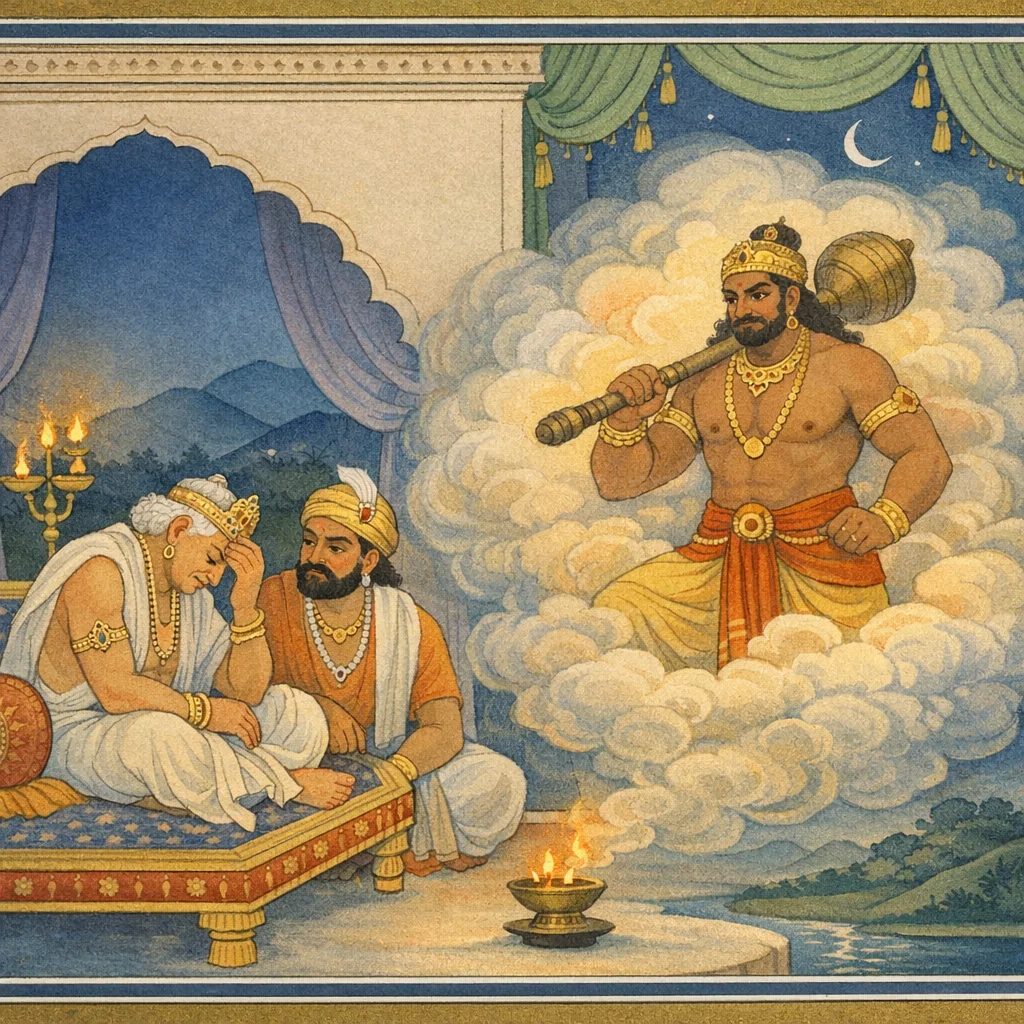
Adhyaya 50
Udyoga-parva Adhyāya 50 — Dhṛtarāṣṭra’s Appraisal of Bhīmasena (भीमसेनभयवर्णनम्)
Upa-parva: Sañjaya–Dhṛtarāṣṭra Saṃvāda (War-Anxiety and Strategic Appraisal Unit)
Dhṛtarāṣṭra addresses Sañjaya with a concentrated assessment of Bhīma as the principal destabilizing force against the Kuru side. He frames Bhīma as uniquely formidable in physical power, speed, and relentless temperament, repeatedly employing animal and cosmic metaphors (lion among herds, fire in dry season, Indra-like force, Brahma-daṇḍa imagery) to convey inevitability and scale. The king reports insomnia, fear, and anticipatory grief, noting that no warrior in his host seems capable of withstanding Bhīma in open engagement. He recalls earlier episodes that demonstrate Bhīma’s capacity (including the Jarāsandha episode with Vāsudeva’s assistance) as evidence of strategic precedent. The chapter then pivots from descriptive threat analysis to ethical lament: attachment to sons, wealth, and lineage intensifies suffering; knowledge does not necessarily mitigate grief; and the Kuru calamity is traced to the gambling-origin injustice and the momentum of time (kāla) that is difficult to escape. The discourse closes with a bleak forecast of large-scale loss and the ruler’s helpless anticipation of familial collapse.
Chapter Arc: धृतराष्ट्र संजय से कहता है कि जिन वीरों के नाम उसने सुने, वे सब उत्साही हैं—पर उन सबके बीच उसका मन एक ही नाम पर अटक जाता है: भीमसेन। → राजा स्वीकार करता है कि उसे अपने पुत्रों की सेना से अधिक भय क्रुद्ध, अमर्षशील वृकोदर से है। वह बताता है कि रात-रात भर जागता है, लंबी गरम साँसें छोड़ता है—सिंह से डरे पशु की तरह। उसे अपनी सेना में कोई ऐसा नहीं दिखता जो युद्ध में भीम का वेग सह सके। → धृतराष्ट्र भीम के पूर्व पराक्रमों को गिनाकर अपने भय को प्रमाणित करता है—वासुदेव की सहायता से जरासंध-वध, यक्ष-राक्षसों का संहार, और गदा-हस्त भीम का वह रूप जो प्रचंड अग्नि की तरह (वायु से प्रेरित ज्वाला-सा) अर्जुन के साथ मिलकर उसकी संतानों की सेना को भस्म कर देगा। → भय का निष्कर्ष स्पष्ट हो जाता है: धृतराष्ट्र के लिए सबसे बड़ा ‘लाभ’ यही है कि वह भीम के विषय में समाचार सुनता रहे—क्योंकि उसी में उसे अपने पुत्रों के विनाश का निश्चित संकेत दिखता है। → धृतराष्ट्र संजय से आग्रह करता है कि अमर्षी भीमसेन का समाचार सुनाए—मानो अगला क्षण ही यह बताने वाला हो कि यह भय केवल कल्पना है या निकट आती अनिवार्य नियति।
Shlokas
Verse 1
धृतराष्ट्र बोले--संजय! तुमने जिन लोगोंके नाम बताये हैं, ये सभी बड़े उत्साही वीर हैं। इनमें भी जितने लोग वहाँ एकत्र हुए हैं, वे सब एक ओर और भीमसेन एक ओर
Dhritarashtra said: “Sanjaya, all those men whose names you have recounted are mighty heroes, full of ardor. Yet however many have assembled there—let them all stand on one side, and Bhimasena alone on the other.”
Verse 2
भीमसेनाद्धि मे भूयो भयं संजायते महत् | क्रुद्धादमर्षणात् तात व्याप्रादिव महारुरो:,तात! मुझे क्रोधमें भरे हुए अमर्षशील भीमसेनसे बड़ा डर लगता है; ठीक उसी तरह, जैसे महान् मृगको किसी व्याप्रसे सदा भय बना रहता है
Dhritarashtra said: “It is Bhimasena, above all, who fills me with the greatest fear. When he is enraged—unyielding and intolerant of insult—my dread of him is like the constant fear a great beast has of a tiger.”
Verse 3
जागर्मि रात्रयः सर्वा दीर्घमुष्णं च नि:श्वसन् । भीतो वृकोदरात् तात सिंहात् पशुरिवापर:,वत्स! सिंहसे डरे हुए दूसरे पशुकी भाँति मैं भीमसेनसे भयभीत हो रातभर गर्म-गर्म लंबी साँसें खींचता हुआ जागता रहता हूँ
Dhritarashtra said: “I lie awake through all the nights, breathing long, hot sighs. Dear son, frightened of Vrikodara, I am like some other beast terrified of a lion.”
Verse 4
न हि तस्य महाबाहो: शक्रप्रतिमतेजस: । सैन्येडस्मिन् प्रतिपश्यामि य एन॑ विषहेद् युधि,महाबाहु भीम इन्द्रके समान तेजस्वी है। मैं अपनी सेनामें किसीको भी ऐसा नहीं देखता, जो भीमका सामना कर सके--युद्धमें इसके वेगको सह सके
Dhritarashtra said: “O mighty-armed one, Bhima’s splendor is like Indra’s. In this army of mine I do not see anyone who could stand against him in battle—anyone able to endure his onrush in war.”
Verse 5
अमर्षणश्न कौन्तेयो दृढ्वैरश्न॒ पाण्डव: । अनर्महासी सोन्मादस्तिर्यक्प्रेक्षी महास्वन:,कुन्तीकुमार पाण्डुपुत्र भीम असहनशील तथा वैरको दृढ़तापूर्वक पकड़े रखनेवाला है। उसकी की हुई हँसी भी हँसीके लिये नहीं होती, वह उसे सत्य कर दिखाता है। उसका स्वभाव उद्धत है। वह टेढ़ी निगाहसे देखता और बड़े जोरसे गर्जना करता है
Dhritarashtra said: “That son of Kuntī among the Pāṇḍavas is intolerant of affronts and holds fast to a firm enmity. His laughter is not mere jest—he makes it come true. Proud and impetuous by nature, he looks askance and roars with a mighty voice.”
Verse 6
महावेगो महोत्साहो महाबाहुर्महाबल: । मन्दानां मम पुत्राणां युद्धेनानतं करिष्यति,वह महान् वेगशाली, अत्यन्त उत्साही, विशाल-बाहु और महाबली है। वह युद्ध करके मेरे मन्दबुद्धि पुत्रोंकोी अवश्य मार डालेगा
Dhṛtarāṣṭra said: “He is of tremendous speed and irresistible drive—high-spirited, broad-armed, and exceedingly strong. By engaging in war, he will surely bring my dull-witted sons to their end.”
Verse 7
ऊरुग्राहगृहीतानां गदां बिभ्रद् वृकोदर: । कुरूणामृषभो युद्धे दण्डपाणिरिवान्तक:,मेरे पुत्र भी बड़े दुराग्रही हैं, अतः हाथमें गदा लिये कुरुश्रेष्ठ वृकोदर भीम दण्डपाणि यमराजकी भाँति युद्धमें इनका निश्चय ही वध कर डालेगा
Dhṛtarāṣṭra said: “Vṛkodara Bhīma, the bull among the Kurus, bearing his mace, will in battle surely strike down my sons—caught fast in his thigh-grip—like Yama (Death) himself holding the rod of punishment.”
Verse 8
अष्टास््रिमायसीं घोरां गदां काउ्चनभूषणाम् । मनसाहहं प्रपश्यामि ब्रह्मुदण्डमिवोद्यतम्,मैं मनकी आँखोंसे देख रहा हूँ, भीमसेनकी स्वर्णभूषित भयंकर गदा, जो लोहेकी बनी हुई और आठ कोनोंसे युक्त है, ब्रह्मदण्डके समान उठी हुई है
Dhṛtarāṣṭra said: “In my mind’s eye I behold Bhīmasena’s dreadful mace—made of iron, eight-cornered, and adorned with gold—raised aloft like the rod of Brahmā, as though poised to mete out inexorable punishment.”
Verse 9
यथा मृगाणां यूथेषु सिंहो जातबलभ्चरेत् मामकेषु तथा भीमो बलेषु विचरिष्यति,जैसे बलवान सिंह मृगोंके यूथोंमें निःशंक विचरण करता है, उसी प्रकार भीमसेन मेरी विशाल वाहिनियोंमें बेखटके विचरेगा
Dhṛtarāṣṭra said: “Just as a lion, newly come into its strength, roams fearlessly among herds of deer, so will Bhīma move unhindered through my own great armies.”
Verse 10
सर्वेषां मम पुत्राणां स एक: क्रूरविक्रम: । बह्नाशी विप्रतीपश्च बाल्येडपि रभस: सदा,बाल्यकालमें भी मेरे सब पुत्रोंमें एकमात्र वह भीमसेन ही क्रूर पराक्रमी, बहुत अधिक खानेवाला, सबके प्रतिकूल चलनेवाला तथा सदा अत्यन्त वेगशाली था
Dhṛtarāṣṭra said: “Among all my sons, that one—Bhīmasena alone—was of fierce prowess: a great eater, contrary in conduct, and always impetuous, even from childhood.”
Verse 11
उद्वेपते मे हृदयं ये मे दुर्योधनादय: । बाल्ये5पि तेन युध्यन्तो वारणेनेव मर्दिता:,उसकी याद आते ही मेरा हृदय काँपने लगता है। मेरे दुर्योधन आदि पुत्र बचपनमें भी जब उसके साथ खेल-कूदमें लड़ते थे, तब वह गजराजकी भाँति इन सबको मसल देता था
Dhṛtarāṣṭra said: “My heart trembles when I think of him. Even in childhood, whenever my sons—Duryodhana and the rest—quarreled and wrestled with him in play, he would crush and overpower them like a mighty elephant.”
Verse 12
तस्य वीर्येण संक्लिष्टा नित्यमेव सुता मम । स एव हेतुर्भेदस्य भीमो भीमपराक्रम:,मेरे पुत्र उसके बल-पराक्रमसे सदा ही कष्टमें पड़े रहते थे। भयंकर पराक्रमी भीमसेन ही इस फ़ूटकी जड़ है
Dhṛtarāṣṭra said: “Because of his prowess, my sons were continually afflicted. That very Bhīma—terrible in valor—has been the cause and root of this rupture.”
Verse 13
ग्रसमानमनीकानि नरवारणवाजिनाम् । पश्यामीवाग्रतो भीम॑ क्रोधमूर्च्छितमाहवे,मुझे अपने सामने दीख-सा रहा है कि भीमसेन युद्धमें क्रोधसे मूर्च्छित हो मनुष्य, हाथी और घोड़ोंकी (समस्त) सेनाओंको कालका ग्रास बनाता जा रहा है
Dhṛtarāṣṭra said: “It is as though I see Bhīma right before me—frenzied and overwhelmed by wrath in the midst of battle—devouring the battle-formations of men, elephants, and horses, making entire armies the prey of Death.”
Verse 14
अस्त्रे द्रोणार्जुनसमं वायुवेगसमं जवे । महेश्वरसमं क्रोधे को हन्याद् भीममाहवे,वह अस्त्रविद्यामें द्रोणाचार्य तथा अर्जुनके समान है, वेगमें वायुकी समानता करता है एवं क्रोधमें महेश्वरके तुल्य है। ऐसे भीमको युद्धमें कौन मार सकता है?
Dhṛtarāṣṭra said: “In mastery of weapons he is the equal of Droṇa and Arjuna; in speed he matches the wind; and in wrath he is comparable to Maheśvara. Who, then, could slay Bhīma in battle?”
Verse 15
संजयाचक्ष्व मे शूरं भीमसेनममर्षणम् । अतिलाभं तु मन्ये5हं यत् तेन रिपुधातिना
Dhṛtarāṣṭra said: “Sañjaya, describe to me that hero Bhīmasena, the intolerant and unyielding one. I consider it an extraordinary gain that he has been slain by that destroyer of enemies.”
Verse 16
येन भीमबला यक्षा राक्षसाश्न पुरा हता:
Dhṛtarāṣṭra said: “By him, in former times, mighty Yakṣas and Rākṣasas were slain.”
Verse 17
न स जातु वशे तस्थौ मम बाल्येडपि संजय
Dhṛtarāṣṭra said: “Sañjaya, even in his childhood he never, at any time, remained under my control.”
Verse 18
कि पुनर्मम दुष्पुत्रै: क्लिष्ट: सम्प्रति पाण्डव: । संजय! पाण्डुकुमार भीमसेन बचपनमें भी कभी मेरे वशमें नहीं रहा; फिर जब मेरे दुष्ट पुत्रोंने उसे बार-बार कष्ट दिया है, तब वह इस समय मेरे वशमें कैसे हो सकता है? ।। १७ ६ || निष्ठरो रोषणो>त्यर्थ भज्येतापि न संनमेत् । तिर्यक्प्रेक्षी संहतभ्रू: कथथं शाम्येद् वृकोदर:,वह क्रूर और क्रोधी है। टूट भले ही जाय, पर झुक नहीं सकेगा। सदा टेढ़ी निगाहसे ही देखता है। उसकी भौंहें क्रोधके कारण परस्पर गुँथी रहती हैं। ऐसा भीमसेन कैसे शान्त हो सकेगा?
Dhṛtarāṣṭra said: “How could the Pāṇḍava now be under my control, when he has been tormented by my wicked sons? Sañjaya, Bhīmasena, the son of Pāṇḍu, was never truly within my sway even in childhood; and after being repeatedly oppressed by my sons, how could he submit to me now? He is harsh and exceedingly wrathful—he may break, but he will not bend. With a sideways, piercing gaze and brows knit tight in anger, how could Vṛkodara ever be pacified?”
Verse 19
शूरस्तथाप्रतिबलो गौरस्ताल इवोन्नतः । प्रमाणतो भीमसेन: प्रादेशेनाधिको<र्जुनात्,गोरे रंगका वह शूरवीर भीमसेन ताड़के समान ऊँचा है। ऊँचाईमें वह अर्जुनसे एक बित्ता अधिक है, बलमें उसकी समता करनेवाला दूसरा कोई नहीं है
Dhṛtarāṣṭra said: “Bhīmasena is a hero, and his strength is without equal; fair in complexion, he stands tall like a palmyra tree. In stature he surpasses Arjuna by a prādeśa (a handspan).”
Verse 20
जवेन वाजिनोडत्येति बलेनात्येति कुज्जरान् | अव्यक्तजल्पी मध्वक्षो मध्यम: पाण्डवो बली,वह स्पष्ट नहीं बोलता। उसकी आँखें सदा मधुके समान पिंगलवर्णकी दिखायी देती हैं। वह महाबली मध्यम पाण्डव अपने वेगसे घोड़ोंको भी लाँच सकता है और बलसे हाथियोंको भी पराजित कर सकता है
Dhṛtarāṣṭra said: “By sheer speed he can outstrip horses, and by sheer strength he can overcome elephants. The middle Pāṇḍava—mighty in power—speaks indistinctly, and his eyes appear honey-colored.”
Verse 21
मैंने बाल्यकालमें ही व्यासजीके मुखसे पहले इस पाण्डुपुत्रके अद्भुत रूप और पराक्रमका यथार्थ वर्णन सुना था
Dhṛtarāṣṭra said: “Even in my childhood, I had already heard from the mouth of Vyāsa a truthful account of this son of Pāṇḍu—his wondrous form and his heroic prowess.”
Verse 22
आयसेन स दण्डेन रथान् नागान् नरान् हयान् | हनिष्यति रणे क्रुद्धो रौद्र: क्रूरपराक्रम:,निष्ठर पराक्रम प्रकट करनेवाला यह भयंकर भीमसेन समरभूमिमें कुपित होकर लौहदंडसे मेरे रथों, हाथियों, पैदल मनुष्यों और घोड़ोंका भी संहार कर डालेगा
Dhṛtarāṣṭra said: “In battle, when enraged, that dreadful Bhīmasena—fierce in valor—will strike with an iron club and slaughter my chariots, elephants, foot-soldiers, and horses.”
Verse 23
इति बाल्ये श्रुतः पूर्व मया व्यासमुखात् पुरा । रूपतो वीर्यतश्चैव याथातथ्येन पाण्डव:,अमर्षी नित्यसंरब्धो भीम: प्रहरतां वर: । मया तात प्रतीपानि कुर्वन् पूर्व विमानित: तात संजय! सदा क्रोधमें भरा रहनेवाला अमर्षशील भीमसेन प्रहार करनेवाले योद्धाओंमें सबसे श्रेष्ठ है। मेरे पुत्रोंक प्रतिकूल आचरण करते समय मैंने पहले कई बार उसका अपमान किया है
Dhṛtarāṣṭra said: “Thus, long ago in my childhood I heard from the mouth of Vyāsa the true account of the Pāṇḍava—his form and his strength as they really are. Bhīma, intolerant of insult and ever quick to anger, is the foremost among those who strike in battle. And I, dear Sañjaya, when he acted against my sons, had earlier humiliated him many times.”
Verse 24
निष्कर्णामायसी स्थूलां सुपार्श्वा काउ्चनीं गदाम् | शतघ्नीं शतनिर्हादां कथं शक्ष्यन्ति मे सुता:,उसकी लोहेकी गदा सीधी, मोटी, सुन्दर पार्श्चभागवाली और सुवर्णसे विभूषित है, वह शत-शत वज्रपातके समान बड़े जोरसे आवाज करती और एक ही चोटमें सैकड़ोंको मार डालती है। मेरे बेटे उसका आघात कैसे सह सकेंगे?
Dhṛtarāṣṭra said: “How will my sons be able to withstand that mace—iron, solid and heavy, well-balanced at the sides, and adorned with gold—whose crash resounds like repeated thunderbolts and which, with a single blow, can strike down hundreds?”
Verse 25
अपारमप्लवागाध॑ समुद्र शरवेगिनम् । भीमसेनमयं दुर्ग तात मन्दास्तितीर्षव:,तात! भीमसेन एक दुर्गम अपार समुद्र है, इसे पार करनेके लिये न तो कोई नौका है और न इसकी कहीं थाह ही है; बाण ही इसका वेग है, तो भी मेरे मूर्ख पुत्र इस भीमसेनमय दुर्गम समुद्रको पार करना चाहते हैं
Dhṛtarāṣṭra said: “My son! Bhīmasena is an unbounded, perilous ocean, hard to cross—there is no boat to bear one over it, nor any place where its depth can be found; arrows are its rushing force. Yet my foolish sons still wish to cross that formidable sea made of Bhīmasena.”
Verse 26
क्रोशतो मे न शृण्वन्ति बाला: पण्डितमानिन: । विषम न हि मन्यन्ते प्रपातं मधुदर्शिन:,मैं चीखता-चिल्लाता रह जाता हूँ, परंतु अपनेको पण्डित समझनेवाले ये मूर्ख पुत्र मेरी बात नहीं सुनते हैं। ये केवल वृक्षकी ऊँची शाखामें लगे हुए शहदको देखते हैं, वहाँसे गिरनेका जो भयानक खटका है, उसकी ओर इनका ध्यान नहीं है
Dhṛtarāṣṭra said: “Though I cry out, my sons—mere children who fancy themselves wise—do not listen to me. They see only the honey high on the tree, but they do not reckon with the perilous fall that awaits.”
Verse 27
संयुगं ये गमिष्यन्ति नररूपेण मृत्युना । नियतं चोदिता धात्रा सिंहेनेव महामृगा:,जैसे महान् मृग सिंहसे भिड़ जाय, उसी प्रकार जो लोग उस मनुष्यरूपी यमराजके साथ लड़नेके लिये युद्धभूमिमें उतरेंगे, उन्हें विधाताने ही मृत्युके लिये प्रेरित करके भेजा है, ऐसा मानना चाहिये
Dhṛtarāṣṭra said: “Those who will go to battle against Death appearing in human form—like great beasts rushing to grapple with a lion—should be understood as having been impelled by the Ordainer himself toward a fixed end, namely death.”
Verse 28
शैक्यां तात चतुष्किष्कुं पडस्रिममितौजसम् । प्रहितां दुःखसंस्पर्शा कथं शक्ष्यन्ति मे सुता:,तात संजय! भीमसेनकी गदा छींकेपर रखनेयोग्य, चार हाथ लंबी और छ: कोणोंसे विभूषित है। उस अत्यन्त तेजस्विनी गदाका स्पर्श भी दुःखदायक है। जब भीम उसे मेरे पुत्रोंपर चलायेगा, तब वे उसका आघात कैसे सह सकेंगे?
Dhṛtarāṣṭra said: “Dear son Sañjaya, Bhīmasena’s iron mace is four cubits long, six-edged, and of immeasurable might. Even its touch is painful. When Bhīma hurls it against my sons, how will they be able to endure its crushing blows?”
Verse 29
गदां भ्रामयतस्तस्य भिन्दतो हस्तिमस्तकान् । सृक्किणी लेलिहानस्य बाष्पमुत्सूजतो मुहुः,भीमसेन जब क्रोधजनित आँसू बहाता और बारंबार अपने ओएष्ठप्रान्तको चाटता हुआ गदा घुमा-घुमाकर हाथियोंके मस्तक विदीर्ण करने लगेगा, सामने भयंकर गर्जना करनेवाले गजराजोंको लक्ष्य करके उनकी ओर दौड़ेगा, प्रतिकूल दिशाकी ओर भागनेवाले मदोन्मत्त हाथियोंकी गर्जनाके उत्तरमें स्वयं भी सिंहनाद करेगा और मेरे रथियोंकी सेनाओंमें घुसकर श्रेष्ठ वीरोंको चुन-चुनकर मारने लगेगा, उस समय अग्निके समान प्रज्वलित होनेवाले भीमके हाथसे मेरे पुत्र कैसे जीवित बचेंगे?
Dhṛtarāṣṭra said: “When Bhīmasena, whirling his mace, begins to split the heads of elephants; when, licking the corners of his mouth, he repeatedly sheds tears born of wrath—how will my sons survive his hand, blazing like fire? In that hour, as he rushes toward the terrifyingly trumpeting lordly elephants and roars back like a lion in answer to the bellowing of maddened elephants fleeing in confusion, and as he breaks into my chariot-warriors’ ranks to strike down chosen champions one by one—what refuge will remain for my sons?”
Verse 30
उद्दिश्य नागान् पतत: कुर्वतो भैरवान् रवान् । प्रतीपं पततो मत्तान् कुज्जरान् प्रतिगर्जतः,भीमसेन जब क्रोधजनित आँसू बहाता और बारंबार अपने ओएष्ठप्रान्तको चाटता हुआ गदा घुमा-घुमाकर हाथियोंके मस्तक विदीर्ण करने लगेगा, सामने भयंकर गर्जना करनेवाले गजराजोंको लक्ष्य करके उनकी ओर दौड़ेगा, प्रतिकूल दिशाकी ओर भागनेवाले मदोन्मत्त हाथियोंकी गर्जनाके उत्तरमें स्वयं भी सिंहनाद करेगा और मेरे रथियोंकी सेनाओंमें घुसकर श्रेष्ठ वीरोंको चुन-चुनकर मारने लगेगा, उस समय अग्निके समान प्रज्वलित होनेवाले भीमके हाथसे मेरे पुत्र कैसे जीवित बचेंगे?
Dhṛtarāṣṭra said: “When Bhīmasena, roaring terribly, rushes straight at the elephants; when he charges the intoxicated tuskers that flee in the opposite direction and answers their trumpeting with his own thunderous challenge—then, blazing like fire as he breaks into my chariot-warriors’ ranks and begins to strike down chosen heroes one by one, how will my sons remain alive at his hands?”
Verse 31
विगाहा रथमार्गेषु वरानुद्दिश्य निघ्नतः । अग्ने: प्रज्वलितस्येव अपि मुच्येत मे प्रजा,भीमसेन जब क्रोधजनित आँसू बहाता और बारंबार अपने ओएष्ठप्रान्तको चाटता हुआ गदा घुमा-घुमाकर हाथियोंके मस्तक विदीर्ण करने लगेगा, सामने भयंकर गर्जना करनेवाले गजराजोंको लक्ष्य करके उनकी ओर दौड़ेगा, प्रतिकूल दिशाकी ओर भागनेवाले मदोन्मत्त हाथियोंकी गर्जनाके उत्तरमें स्वयं भी सिंहनाद करेगा और मेरे रथियोंकी सेनाओंमें घुसकर श्रेष्ठ वीरोंको चुन-चुनकर मारने लगेगा, उस समय अग्निके समान प्रज्वलित होनेवाले भीमके हाथसे मेरे पुत्र कैसे जीवित बचेंगे?
Dhṛtarāṣṭra said: “When Bhīma, blazing like fire, plunges into the lanes of chariots and, singling out the foremost warriors, strikes them down, how could my sons—my people—escape from his hand?”
Verse 32
वीथीं कुर्वन् महाबाहुद्रावयन् मम वाहिनीम् । नृत्यन्निव गदापाणियगान्तं दर्शयिष्यति,महाबाहु भीम मेरी सेनामें घुसकर अपने रथके लिये रास्ता बनाता, मेरी विशाल वाहिनीको खदेड़ता और हाथमें गदा लिये नृत्य-सा करता हुआ जब आगे बढ़ेगा, तब प्रलयकालका दृश्य उपस्थित कर देगा
Dhṛtarāṣṭra said: “That mighty-armed one will carve a path through the ranks, driving my army into flight. Whirling forward as if in a dance, mace in hand, he will make the battlefield appear like the very end-time of the world.”
Verse 33
प्रभिन्न इव मातड्: प्रभञ्जन् पुष्पितान् द्रुमान् प्रवेक्ष्यति रणे सेनां पुत्राणां मे वृकोदर:,जैसे मदकी धारा बहानेवाला मतवाला हाथी फूले हुए वृक्षोंको तोड़ता हुआ आगे बढ़ता है, उसी प्रकार भीमसेन समरभ्ूमिमें मेरे पुत्रोंकी सेनाके भीतर प्रवेश करेगा
“Vṛkodara Bhīma will enter the battle and plunge into my sons’ army, like a musth-maddened elephant crashing forward, breaking flowering trees as it goes.”
Verse 34
कुर्वन् रथान् विपुरुषान् विसारथिहयध्वजान् । आरुज न् पुरुषव्याप्रो रथिन: सादिनस्तथा,संजय! वह पुरुषसिंह भीम रथोंको रथी, सारथि, अश्व तथा ध्वजाओंसे शून्य कर देगा एवं रथियों और घुड़सवारोंके अंग-भंग कर डालेगा। जैसे गंगाजीका बढ़ता हुआ वेग जलमय प्रदेशमें स्थित हुए नाना प्रकारके तटवर्ती वृक्षोंको गिराकर नष्ट कर देता है, उसी प्रकार भीम युद्धभूमिमें आकर मेरे पुत्रोंकी सेनाका संहार कर डालेगा
Dhṛtarāṣṭra said: “O Sañjaya, that mighty man Bhīma, exerting himself in battle, will render the chariots bereft of warriors—stripped of charioteer, horses, and banner—and he will shatter the limbs and strength of both chariot-fighters and horsemen. As the swelling current of the Gaṅgā, surging through a water-filled tract, uproots and destroys many kinds of trees along the banks, so will Bhīma, entering the battlefield, bring about the destruction of my sons’ army.”
Verse 35
गड्जावेग इवानूपांस्तीरजान् विविधान् टद्रुमान् | प्रभड्क्ष्यति रणे सेनां पुत्राणां मम संजय,संजय! वह पुरुषसिंह भीम रथोंको रथी, सारथि, अश्व तथा ध्वजाओंसे शून्य कर देगा एवं रथियों और घुड़सवारोंके अंग-भंग कर डालेगा। जैसे गंगाजीका बढ़ता हुआ वेग जलमय प्रदेशमें स्थित हुए नाना प्रकारके तटवर्ती वृक्षोंको गिराकर नष्ट कर देता है, उसी प्रकार भीम युद्धभूमिमें आकर मेरे पुत्रोंकी सेनाका संहार कर डालेगा
Dhṛtarāṣṭra said: “Sañjaya, Sañjaya! In battle that lion among men, Bhīma, will shatter the army of my sons. He will leave their chariots stripped—bereft of charioteers, horses, and banners—and he will break the limbs and fighting power of the chariot-warriors and horsemen. Just as the surging force of the Gaṅgā, swelling across a watery lowland, uproots and destroys the many kinds of trees along the banks, so will Bhīma come onto the battlefield and bring my sons’ host to ruin.”
Verse 36
दिशो नूनं गमिष्यन्ति भीमसेनभयार्दिता: । मम पुत्राश्न भृत्याश्न राजानश्वैव संजय,संजय! निश्चय ही भीमसेनके भयसे पीड़ित हो मेरे पुत्र, सेवक तथा सहायक नरेश विभिन्न दिशाओंमें भाग जायँगे
Dhṛtarāṣṭra said: “Surely, Sañjaya, driven by fear of Bhīmasena, my sons—together with their attendants and allied kings—will scatter and flee to the various directions. Indeed, oppressed by dread of Bhīma, they will not stand their ground.”
Verse 37
येन राजा महावीर्य: प्रविश्यान्त:पुरं पुरा । वासुदेवसहायेन जरासंधो निपातितः,परम बुद्धिमान् और बलवान् महाबली मगधराज जरासंधने यह सारी पृथिवी अपने वशमें करके इसे पीड़ा देना प्रारम्भ किया था, परंतु भीमसेनने भगवान् श्रीकृष्णके साथ उसके अन्तः:पुरमें जाकर उस महापराक्रमी नरेशको मार गिराया
Dhṛtarāṣṭra said: “By whose aid, long ago, that mighty king (Bhīmasena) entered Jarāsandha’s inner palace and, with Vāsudeva as his support, struck down Jarāsandha. (I recall this deed as a measure of their power and resolve.)”
Verse 38
कृत्स्नेयं पृथिवी देवी जरासंधेन धीमता । मागधेन्द्रेण बलिना वशे कृत्वा प्रतापिता,परम बुद्धिमान् और बलवान् महाबली मगधराज जरासंधने यह सारी पृथिवी अपने वशमें करके इसे पीड़ा देना प्रारम्भ किया था, परंतु भीमसेनने भगवान् श्रीकृष्णके साथ उसके अन्तः:पुरमें जाकर उस महापराक्रमी नरेशको मार गिराया
Dhṛtarāṣṭra said: “The whole earth, as it were a goddess, was brought under the control of the wise and mighty lord of Magadha, Jarāsandha, and was made to suffer under his oppression. Yet Bhīmasena, accompanied by Lord Śrī Kṛṣṇa, entered his inner palace and struck down that highly valorous king. The passage contrasts tyrannical domination with the righteous removal of a violent oppressor, presenting strength as ethically justified only when aligned with dharma.”
Verse 39
भीष्मप्रतापात् कुरवो नयेनान्धकवृष्णय: । यज्ञ तस्य वशे जग्मु: केवलं दैवमेव तत्,भीष्मजीके प्रतापसे कुरुवंशी और नीतिबलसे अंधक-वृष्णिवंशके लोग जो जरासंधके वशमें नहीं पड़े, वह केवल दैवयोग था
Dhṛtarāṣṭra said: “By Bhīṣma’s prowess and by the Kurus’ statesmanship, the Andhakas and Vṛṣṇis did not come under his control; that outcome was due solely to destiny.”
Verse 40
स गत्वा पाण्डुपुत्रेण तरसा बाहुशालिना । अनायुधेन वीरेण निहत: कि ततो5धिकम्,परंतु अपनी भुजाओंसे सुशोभित होनेवाले वीर पाण्डुपुत्र भीमने वेगपूर्वक वहाँ जाकर बिना किसी अस्त्र-शस्त्रके ही उस जरासंधको यमलोक पहुँचा दिया, इससे बढ़कर पराक्रम और क्या होगा?
Dhṛtarāṣṭra said: “That Jarāsandha was swiftly approached and slain by the heroic son of Pāṇḍu—Bhīma—whose arms were his ornament. Unarmed and relying on sheer strength, he sent him to the realm of Yama. What greater feat of valor could there be than this?”
Verse 41
दीर्घकालसमासक्तं विषमाशीविषो यथा । स मोक्ष्यति रणे तेज: पुत्रेषु मम संजय,संजय! जैसे विषधर सर्प बहुत दिनोंसे संचित किये हुए विषको किसीपर उगलता है, उसी प्रकार भीमसेन भी दीर्घकालसे संचित अपने तेजको रणभूमिमें मेरे पुत्रोंपर छोड़ेगा
Dhṛtarāṣṭra said: “Sañjaya, as a venomous serpent disgorges the poison it has long stored, so will Bhīmasena, in battle, unleash upon my sons the pent-up force he has amassed over a long time.”
Verse 42
महेन्द्र इव वज्ेण दानवान् देवसत्तम: । भीमसेनो गदापाणि: सूदयिष्यति मे सुतान्,जैसे देवश्रेष्ठ इन्द्र वज़से दानवोंका संहार करते हैं, उसी प्रकार हाथमें गदा लिये भीमसेन मेरे पुत्रोंका संहार कर डालेगा
Dhṛtarāṣṭra said: “Like Mahendra—Indra, foremost of the gods—who with his thunderbolt destroys the Dānavas, so will Bhīmasena, mace in hand, slay my sons.”
Verse 43
अविषदह्ा[मनावार्य तीव्रवेगपराक्रमम् । पश्यामीवातिताम्राक्षमापतन्तं वृकोदरम्,उसका आक्रमण दुःसह है। उसकी गतिको कोई रोक नहीं सकता। उसका वेग और पराक्रम तीव्र है। मैं प्रत्यक्ष देख-सा रहा हूँ कि वह भीम क्रोधसे अत्यन्त लाल आँखें किये इधर ही दौड़ा आ रहा है
His onslaught is unbearable; none can check his advance. His speed and prowess are fierce and swift. I seem to see him before my very eyes—Vṛkodara, Bhīma—his eyes crimson with wrath, charging straight toward this place.
Verse 44
अगदस्याप्यधनुषो विरथस्य विवर्मण: । बाहुभ्यां युद्धयमानस्य कस्तिष्ठेदग्रत: पुमान्,यदि वह गदा, धनुष, रथ और कवचको छोड़कर केवल दोनों भुजाओंसे युद्ध करे तो भी उसके सामने कौन पुरुष ठहर सकता है?
Even if he were without mace, without bow, without chariot, and without armor—fighting only with his two arms—what man could stand before him?
Verse 45
भीष्मो द्रोणश्न विप्रोडयं कृप: शारद्वतस्तथा । जानन्त्येते यथैवाहं वीर्यज्ञस्तस्य धीमत:,उस बुद्धिमान् भीमके बल और पराक्रमको जैसे मैं जानता हूँ, उसी प्रकार ये भीष्म, विप्रवर द्रोणाचार्य तथा शरद्वानके पुत्र कृप भी जानते हैं
Bhīṣma, the Brahmin Droṇa, and Kṛpa, the son of Śaradvat—these men too know, just as I do, the strength and prowess of that wise hero, Bhīma.
Verse 46
आर्यव्रतं तु जानन्त: संगरान्तं विधित्सव: । सेनामुखेषु स्थास्यन्ति मामकानां नरर्षभा:,तथापि ये नरश्रेष्ठ शिष्ट पुरुषोंके व्रतको जानते हैं, इसलिये युद्धमें प्राणत्याग करनेकी इच्छासे मेरे पुत्रोंकी सेनाके अग्रभागमें डटे रहेंगे
Dhṛtarāṣṭra said: “Those bull-like men, knowing the noble code of conduct and longing to meet their end in battle, will stand firm at the very front of my sons’ army.”
Verse 47
बलीय: सर्वतो दिष्टं पुरुषस्थ विशेषत: । पश्यन्नपि जयं तेषां न नियच्छामि यत् सुतान्,पुरुषका भाग्य ही सबसे विशेष प्रबल है, क्योंकि मैं पाण्डवोंकी विजय समझकर भी अपने पुत्रोंको रोक नहीं पाता हूँ
Dhṛtarāṣṭra said: “Fate is stronger than everything—especially when it is lodged within a man’s own will and character. Even though I can foresee their victory, I am unable to restrain my sons.”
Verse 48
ते पुराणं महेष्वासा मार्गमैन्द्रं समास्थिता: । त्यक्ष्यन्ति तुमुले प्राणान् रक्षन्त: पार्थिवं यश:,धृतराष्ट्रकी सभामें संजय पाण्डवोंका सन्देश सुना रहे हैं है जलन हू "60 >ट्र । भीमसेनका बल बखानते हुए धृतराष्ट्रका विलाप वे महाधनुर्धर भीष्म आदि पुरातन स्वर्गीय मार्गका आश्रय ले पार्थिव यशकी रक्षा करते हुए घमासान युद्धमें अपने प्राण त्याग देंगे
Those ancient heroes, mighty bowmen, having taken refuge in the age-old path that leads to Indra’s heaven, will, in the tumult of battle, relinquish their lives—seeking to preserve the kingly honor and renown.
Verse 49
यथैषां मामकास्तात तथैषां पाण्डवा अपि | पौत्रा भीष्मस्य शिष्याश्च द्रोणस्प च कृपस्थ च,तात! इनके लिये जैसे मेरे पुत्र हैं, वैसे ही पाण्डव भी हैं। दोनों ही भीष्मके पौत्र तथा द्रोण और कृपके शिष्य हैं
Dhṛtarāṣṭra said: “Dear one, just as these are my own sons, so too are the Pāṇḍavas theirs. Both sides are Bhīṣma’s grandsons and disciples of Droṇa and Kṛpa.”
Verse 50
यदस्मदाश्रयं किंचिद् दत्तमिष्टं च संजय । तस्यापचितिमार्यत्वात् कर्तार: स्थविरास्त्रय:,संजय! भीष्म, द्रोण और कृपाचार्य--ये तीनों वृद्ध श्रेष्ठ पुरुष हैं; अतः हमारे आश्रयमें रहकर इन्होंने जो कुछ भी दान-यज्ञ आदि किया है, ये उसका बदला चुकायेंगे (युद्धमें दुर्योधनका ही साथ देंगे)
Dhṛtarāṣṭra said: “O Saṃjaya, whatever has been given or ritually offered by those who depend upon our house—out of noble conduct and a sense of propriety, three venerable elders will repay that obligation.”
Verse 51
आददानस्य शत्त्र हि क्षत्रधर्म परीप्सत: | निधन क्षत्रियस्थाजौ वरमेवाहुरुत्तमम्,जो अस्त्र-शस्त्र धारण करके क्षात्रधर्मकी रक्षा करना चाहता है, उस क्षत्रियके लिये संग्राममें होनेवाली मृत्युको ही श्रेष्ठ एवं उत्तम माना गया है इति श्रीमहाभारते उद्योगपर्वणि यानसंधिपर्वणि धृतराष्ट्रवाक्ये एकपज्चाशत्तमो5ध्याय:
Dhṛtarāṣṭra said: “For a kṣatriya who takes up weapons and seeks to uphold the warrior’s dharma, death on the battlefield is declared to be the best and most excellent end.”
Verse 52
स वै शोचामि सर्वान् वै ये युयुत्सन्ति पाण्डवै: । विक्रुष्टं विदुरेणादौ तदेतद् भयमागतम्,जो लोग पाण्डवोंसे युद्ध करना चाहते हैं, उन सबके लिये मुझे बड़ा शोक हो रहा है। विदुरने पहले ही उच्चस्वरसे जिसकी घोषणा की थी, वही यह भय आज आ पहुँचा है
Dhṛtarāṣṭra said: “I grieve for all those who are eager to fight against the Pāṇḍavas. The very danger that Vidura had earlier proclaimed aloud has now come upon us.”
Verse 53
न तु मन्ये विघाताय ज्ञानं दुःखस्य संजय । भवत्यतिबलं होतज्ज्ञानस्थाप्युपघातकम्,संजय! मुझे तो ऐसा मालूम होता है कि ज्ञान दुःखका नाश नहीं कर सकता, अपितु प्रबल दुःख ही ज्ञानका भी नाश करनेवाला बन जाता है
Dhṛtarāṣṭra said: “I do not think, Sañjaya, that knowledge can destroy sorrow. Rather, when grief becomes exceedingly powerful, it turns into a force that can even strike down and overwhelm one’s settled understanding.”
Verse 54
ऋषयो हापि निर्मुक्ता: पश्यन्तो लोकसंग्रहान् सुखैर्भवन्ति सुखिनस्तथा दुःखेन दु:खिता:,जीवन्मुक्त महर्षि भी लोकव्यवहारकी ओर दृष्टि रखकर सुखके साधनोंसे सुखी और दुःखसे दुःखी होते हैं
Dhṛtarāṣṭra said: “Even sages who are liberated, while observing and upholding the order of the world for the common good, appear to share in its conditions—becoming glad through causes of happiness and pained through suffering.”
Verse 55
कि पुनर्मोहमासक्तस्तत्र तत्र सहस्रधा । पुत्रेषु राज्यदारेषु पौत्रेष्वपि च बन्धुषु,फिर जो पुत्र, राज्य, पत्नी, पौत्र तथा बन्धु-बान्धवोंमें जहाँ-तहाँ सहस्रों प्रकारसे मोहवश आसक्त हो रहा है, उसकी तो बात ही क्या है?
“What then need be said of one who, driven by delusion, becomes attached in countless ways—here and there—to sons, to kingship, to wife, to grandsons, and even to kinsmen?”
Verse 56
संशये तु महत्यस्मिन् कि नु मे क्षममुत्तरम् । विनाशं होव पश्यामि कुरूणामनुचिन्तयन्,इस महान् संकटके विषयमें मैं क्या उचित प्रतीकार कर सकता हूँ? मुझे तो बार-बार विचार करनेपर कौरवोंका विनाश ही दिखायी पड़ता है
In this great uncertainty, what response can I rightly make? As I reflect again and again, I seem to see only the destruction of the Kurus.
Verse 57
द्यूतप्रमुखमा भाति कुरूणां व्यसनं महत् । मन्देनैश्वर्यकामेन लोभात् पापमिदं कृतम्,द्यूतक्रीड़ा आदिकी घटनाएँ ही कौरवोंपर भारी विपत्ति लानेका कारण प्रतीत होती हैं। ऐश्वर्यकी इच्छा रखनेवाले मूर्ख दुर्योधनने लोभवश यह पाप किया है
Dhṛtarāṣṭra said: “The great calamity of the Kurus seems to have begun with gambling. This sin was committed out of greed by the foolish Duryodhana, driven by a craving for sovereignty and power.”
Verse 58
मन्ये पर्यायधर्मो5यं कालस्यात्यन्तगामिन: । चक्रे प्रधिरिवासक्तो नास्थ शक््यं पलायितुम्,मैं समझता हूँ कि अत्यन्त तीव्र गतिसे चलनेवाले कालका ही यह क्रमशः प्राप्त होनेवाला नियम है। इस कालचक्रमें उसकी नेमिके समान मैं जुड़ा हुआ हूँ, अतः मेरे लिये इससे दूर भागना सम्भव नहीं है
Dhṛtarāṣṭra said: “I think this is the inevitable, recurring law of Time, which moves with irresistible speed. Like the rim fixed to a turning wheel, I am bound to this cycle; therefore it is not possible for me to flee from it.”
Verse 59
किंनु कुर्या कथं कुर्या क्व नु गच्छामि संजय । एते नश्यन्ति कुरवो मन्दा: कालवशं गता:,संजय! क्या करूँ, कैसे करूँ और कहाँ चला जाऊँ? ये मूर्ख कौरव कालके वशीभूत होकर नष्ट होना चाहते हैं
Dhṛtarāṣṭra said: “What indeed should I do—how should I act, and where should I go, Sañjaya? These foolish Kurus, having fallen under the sway of Time, are rushing toward destruction.”
Verse 60
अवशोऊहं तदा तात पुत्राणां निहते शते । श्रोष्यामि निनदं स्त्रीणां कथं मां मरणं स्पृशेत्,तात! मेरे सौ पुत्र यदि युद्धमें मारे गये, तब विवश होकर मैं इनकी अनाथ स्त्रियोंका करुण क्रन्दन सुनूँगा। हाय! मेरी मृत्यु किस प्रकार हो सकती है?
Dhṛtarāṣṭra said: “Dear one, if my hundred sons are slain, then helplessly I shall have to hear the wailing of their widowed women. In such a state, how could death even come to me?”
Verse 61
यथा निदाघे ज्वलन: समिद्धो दहेत् कक्ष वायुना चोद्यमान: | गदाहस्त: पाण्डवो वै तथैव हन्ता मदीयान् सहितोअर्जुनेन,जैसे गर्मीमें प्रजजलित हुई अग्नि हवाका सहारा पाकर घास-फूस एवं जंगलको भी जलाकर भस्म कर देती है, उसी प्रकार अर्जुनसहित पाण्डुनन्दन भीम गदा हाथमें लेकर मेरे सब पुत्रोंको मार डालेगा
Dhṛtarāṣṭra said: “Just as, in the heat of summer, a blazing fire—fanned and driven by the wind—burns up dry brushwood, so too will the Pāṇḍava Bhīma, mace in hand, accompanied by Arjuna, become the slayer of my sons.”
Verse 156
तदैव न हता: सर्वे पुत्रा मम मनस्विना । संजय! मुझे अमर्षमें भरे हुए शूरवीर भीमसेनका समाचार सुनाओ। मैं तो यही सबसे बड़ा लाभ मानता हूँ कि उस शत्रुधाती मनस्वी वीरने (जब द्यूतक्रीड़ा हो रही थी) उसी समय मेरे सब पुत्रोंको नहीं मार डाला
Dhṛtarāṣṭra said: “At that very time, my sons were not all slain by that high-spirited hero. Sañjaya, tell me news of the mighty warrior Bhīmasena, who is filled with indignation. Indeed, I count it the greatest of gains that the resolute, enemy-slaying hero did not, even while the dice-game was going on, kill all my sons then and there.”
Verse 166
कथं तस्य रणे वेग॑ मानुष: प्रसहिष्यति । जिसने पूर्वकालमें भयंकर बलशाली यक्षों तथा राक्षसोंका वध किया है, युद्धमें उसका वेग कोई मनुष्य कैसे सह सकेगा?
Dhṛtarāṣṭra said: “How could any mere man withstand his onrush in battle? He is the one who in former times slew fearsome, mighty Yakṣas and Rākṣasas; who, then, among humans could endure his martial speed and force?”
Frequently Asked Questions
The dilemma is the ruler’s responsibility to prevent foreseeable harm versus his attachment-driven inability to restrain his faction; he recognizes the likely devastation yet cannot effectively redirect policy.
Foreknowledge alone does not dissolve suffering; when coupled with attachment and inaction, it can intensify distress. Ethical governance requires timely restraint, not merely accurate perception.
No formal phalaśruti appears; the chapter’s meta-level function is diagnostic—linking present fear to prior injustice (dyūta-origin wrongdoing) and to kāla’s momentum, situating the discourse as reflective causality within the epic.