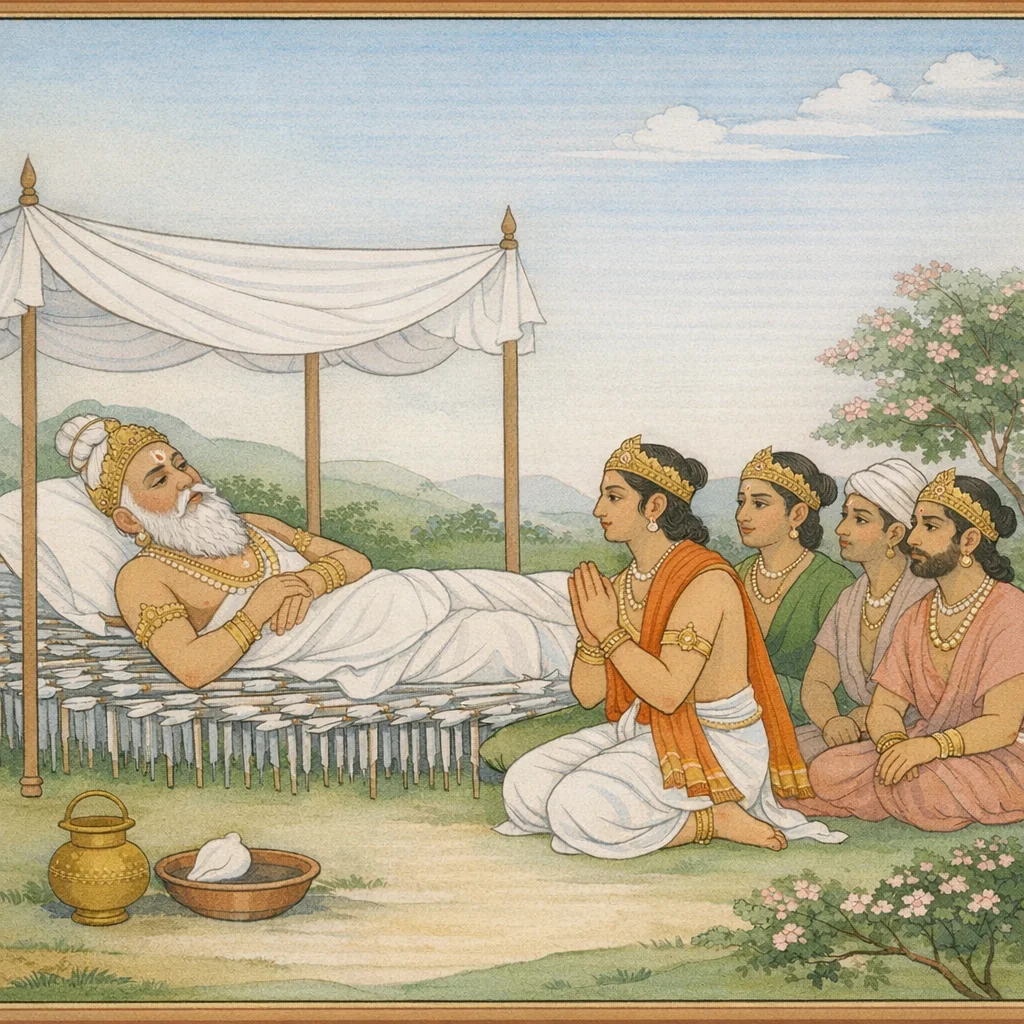
Adhyaya 195
मनु-उपदेशः — भूत-उत्पत्ति, इन्द्रिय-निवृत्ति, तथा पर-स्वभाव-विवेकः (Manu’s Instruction on Elemental Origination, Sense-Withdrawal, and Discrimination of the Supreme Nature)
Upa-parva: Mokṣadharma (Liberation Teachings) — Elemental Cosmology and the Inner Witness (Contextual Unit for Adhyāya 195)
This chapter presents Manu’s compact metaphysical exposition. It begins with a cosmogonic sequence: from the imperishable (akṣara) arises space (kha), then wind (vāyu), fire/light (jyotis/tejas), water (jalam), and earth (jagatī), from which the manifest world proceeds. The discourse then contrasts beings that ‘return’ to elemental dissolution with those oriented to the ‘parama’ attainment, introducing a soteriological distinction grounded in cognition and practice. The ‘parama’ is described apophatically—neither hot nor cold, neither taste nor smell nor form—indicating a principle beyond sensory predicates. A functional psychology follows: skin, tongue, nose, ear, and eye grasp touch, taste, smell, sound, and form, yet the untrained do not grasp what is beyond. By withdrawing each sense from its object, one ‘sees’ one’s own nature. Causality is analyzed via kāraṇa and upāya: that by which actions are initiated and accomplished is termed the cause/means; the supreme cause is portrayed as pervasive and efficacious. Karma and knowledge are linked: auspicious/inauspicious action conditions embodied experience. Multiple analogies (lamp and illumination; ministers reporting to a king; flames/winds/rays/waters moving; fire latent in wood revealed by friction; dream and subtle transition) illustrate how senses are partial, how subtle continuity proceeds via liṅga (subtle body), and how the witness ‘sees’ the senses though they do not see it. The chapter closes by mapping senses to elements (ear–space, nose–earth, form/vision–fire, taste/sweat–water, touch–wind), placing manas and buddhi as coordinators of sensory and moral life.
Chapter Arc: युधिष्ठिर पितामह भीष्म से पूछते हैं—शास्त्रों में ‘अध्यात्म’ नाम से जिस ज्ञान का विचार किया गया है, वह वास्तव में क्या है और कैसा है? → भीष्म अध्यात्म का विवेचन आरम्भ करते हैं: पंचमहाभूतों से देह-रचना, जीव का उस वैषम्य को न देख पाना, इन्द्रियों-मन-बुद्धि की देख-रेख, और त्रिगुण (सत्त्व-रज-तम) के प्रभाव से बुद्धि का सुख-दुःख-मोह में डोलना—इन सबके बीच आत्मतत्त्व की पहचान कठिन प्रतीत होती है। → त्रिगुणों के अधीन बुद्धि इन्द्रियों को प्रवृत्त करती है; पर जो पुरुष धर्म-अर्थ-काम (त्रिवर्ग) को ठीक-ठीक जानकर भी आसक्ति से रहित, मन से तत्त्व का अन्वेषण करता है, वही ‘तत्त्वदर्शी’ होकर उद्वेग से परे हो जाता है—यहीं अध्यात्म-ज्ञान का निर्णायक संकेत प्रकट होता है। → भीष्म निष्कर्ष देते हैं कि अध्यात्म-ज्ञान देह-इन्द्रिय-गुणों के खेल को पहचानकर, बुद्धि के सुख-दुःख-मोह से ऊपर उठते हुए आत्मस्वरूप की ओर स्थिर होना है; बाह्य आचरण (जैसे भोजन से पूर्व शुद्धि) भी मन की सजगता और संयम का सहचर है। → अगले अध्यायों में त्रिगुणों के सूक्ष्म भेद, बुद्धि-जीव-परमात्मा के सम्बन्ध और मोक्षमार्ग की अधिक विशद पद्धति का विस्तार होने का संकेत।
Shlokas
Verse 1
7-2 ड-ऑ का - तात्पर्य यह कि भोजनके लिये जाते समय तत्काल हाथ, पैर और मुँह धोने चाहिये। बहुत पहलेके धोये हों, तो भी उस समय धो लेना आवश्यक है। चतुन॑वर्त्याधेकशततमो< ध्याय: अध्यात्मज्ञानका निरूपण युधिछिर उवाच अध्यात्म नाम यदिदं पुरुषस्येह चिन्त्यते । यदध्यात्मं यथा चैतत् तन्मे ब्रूहि पितामह
Yudhiṣṭhira said: “Grandfather, please tell me what is meant here by ‘adhyātma’—that inner reality which is contemplated in relation to a person—and explain what it truly is and how it is to be understood.”
Verse 2
युधिष्ठिरने पूछा--पितामह! शास्त्रोंमें मनुष्यके लिये अध्यात्मके नामसे जिसका विचार किया जाता है, वह अध्यात्मज्ञान क्या है और कैसा है? यह मुझे बताइये ।। कुतः सृष्टमिदं विश्व ब्रह्मन् स्थावरजज्भमम् | प्रलये कथमभ्येति तन्मे वक्तुमिहाहसि,ब्रह्म! इस चराचर जगत्की सृष्टि किससे हुई है और प्रलयकालमें इसका लय किस प्रकार होता है; इस विषयका मुझसे वर्णन कीजिये
Yudhishthira said: “Grandfather, in the scriptures there is a teaching for human beings spoken of under the name ‘adhyātma’. What, truly, is that spiritual knowledge, and what is its nature? Tell me, I pray. O Brahmin, from what has this entire universe—both the immovable and the moving—been created? And at the time of dissolution, how does it return to its source? You are fit to explain this to me.”
Verse 3
भीष्म उवाच अध्यात्ममिति मां पार्थ यदेतदनुपृच्छसि । तद् व्याख्यास्यामि ते तात श्रेयस्करतमं सुखम्,भीष्मजीने कहा--तात! कुन्तीनन्दन! तुम जिस अध्यात्मज्ञानके विषयमें पूछ रहे हो, उसकी व्याख्या मैं तुम्हारे लिये करता हूँ; वह परम कल्याणकारी और सुखस्वरूप है
Bhishma said: “My son, O son of Pritha! Since you ask about the knowledge called adhyātma, I shall explain it to you. It is supremely beneficial, and it is of the very nature of bliss.”
Verse 4
सृष्टिप्रलयसंयुक्तमाचार्य : परिदर्शितम् । यज्ज्ञात्वा पुरुषो लोके प्रीतिं सौख्यं च विन्दति । फललाभश्न तस्य स्यात् सर्वभूतहितं च तत्,आचार्योने सृष्टि और प्रलयकी व्याख्याके साथ अध्यात्मज्ञानका विवेचन किया है, जिसे जानकर मनुष्य इस संसारमें सुख और प्रसन्नताका भागी होता है। उसे अभीष्ट फलकी प्राप्ति भी होती है। वह अध्यात्मज्ञान समस्त प्राणियोंके लिये हितकर है
Bhishma said: “The teacher has set forth this teaching together with an account of creation and dissolution. Knowing it, a person in this world attains joy and well-being. He also gains the desired fruit; and that spiritual knowledge is beneficial to all beings.”
Verse 5
पृथिवी वायुराकाशमापो ज्योतिश्न॒ पठचमम् । महाभूतानि भूतानां सर्वेषां प्रभवाप्ययौ,पृथ्वी, वायु, आकाश, जल और अग्नि--ये पाँच महाभूत सम्पूर्ण प्राणियोंकी उत्पत्ति और प्रलयके स्थान हैं
Bhishma said: “Earth, wind, space, water, and fire as the fifth—these are the five great elements. For all living beings, they are the ground of arising and the place of dissolution.”
Verse 6
यतः: सृष्टानि तत्रैव तानि यान्ति पुनः पुनः । महाभूतानि भूतेभ्य: सागरस्योर्मयो यथा,जैसे लहरें समुद्रसे प्रकट होकर फिर उसीमें लीन हो जाती हैं, उसी प्रकार ये पाँच महाभूत भी जिस परमात्मासे उत्पन्न हुए हैं, उसीमें सब प्राणियोंके सहित बारंबार लीन होते हैं
Bhishma said: “From that very source from which they are created, into that same source they return again and again. Just as waves arise from the ocean and dissolve back into it, so too the five great elements—together with all living beings—repeatedly merge back into the Supreme from whom they have arisen.”
Verse 7
प्रसार्य च यथाड्रनि कूर्म: संहरते पुन: । तहद् भूतानि भूतात्मा सृष्टानि हरते पुन:,जैसे कछुआ अपने अंगोंको फैलाकर पुन: समेट लेता है, उसी प्रकार सम्पूर्ण भूतोंके आत्मा परब्रह्म परमेश्वर अपने रचे हुए सम्पूर्ण भूतोंको फैलाकर फिर अपने भीतर ही समेट लेते हैं
Bhishma said: “Just as a tortoise extends its limbs and then draws them back again, so too the Supreme Self—the inner Self of all beings—projects the created beings outward and, in due course, withdraws them back into Himself.”
Verse 8
महाभूतानि पज्चैव सर्वभूतेषु भूतकृत् । अकरोत् तेषु वैषम्यं तत्तु जीवो न पश्यति,सम्पूर्ण भूतोंकी सृष्टि करनेवाले परमात्माने सब प्राणियोंके शरीरोंमें पाँच ही महाभूतोंको स्थापित किया है; परंतु उनमें विषमता कर दी है--किसी महाभूतके अंशको अधिक और किसीके अंशको कम करके रखा है। उस वैषम्यको साधारण जीव नहीं देख पाता
Bhishma said: “The Creator of beings has placed the same five great elements within the bodies of all creatures. Yet He has arranged them with unequal proportions—making one element more prominent in some and less in others. This subtle imbalance is not perceived by the ordinary individual soul.”
Verse 9
शब्द: श्रोत्रं तथा खानि त्रयमाकाशयोनिजम् । वायो: स्पर्शस्तथा चेष्टा त्वक् चैव त्रितयं स्मृतम्,शब्दगुण, श्रोत्र इन्द्रिय और शरीरके सम्पूर्ण छिद्र--ये तीन आकाशके कार्य हैं। स्पर्श, चेष्टा और त्वगिन्द्रिय--ये तीन वायुके कार्य माने गये हैं
Bhishma said: “Sound, the organ of hearing, and the bodily apertures—these three are said to arise from ether (ākāśa). From wind (vāyu) are known three: touch, movement/activity, and the organ of touch (skin).”
Verse 10
रूप॑ चक्षुस्तथा पाकस्त्रिविधं तेज उच्यते । रस: क्लेदश्न जिह्दा च त्रयो जलगुणा: स्मृता:,रूप, नेत्र और परिपाक--ये तीन तेजके कार्य बताये जाते हैं। रस, जिह्ना तथा क्लेद (गीलापन)--ये तीन जलके गुण अर्थात् कार्य माने गये हैं
Bhīṣma explains that the functions attributable to fire (tejas) are three: visible form, the faculty of sight, and digestion (cooking/assimilation). Likewise, the functions attributable to water are three: taste, moisture, and the tongue.
Verse 11
घ्रेयं प्राणं शरीरं च एते भूमिगुणास्त्रय: । महाभूतानि पज्चैव षष्ठं च मन उच्यते,गन्ध, प्राणेन्द्रिय और शरीर--ये तीन भूमिके गुण अर्थात् कार्य हैं। इस प्रकार इस शरीरमें पाँच महाभूत और छठा मन है; ऐसा बताया जाता है
Bhishma said: “Smell, the vital breath (prāṇa), and the body—these three are described as the qualities (i.e., effects) of earth. Thus, within this embodied being there are the five great elements, and as the sixth, the mind (manas) is spoken of.”
Verse 12
इन्द्रियाणि मनश्लैव विज्ञानान्यस्थ भारत । सप्तमी बुद्धिरित्याहु: क्षेत्रज्ञ: पुनरष्टम:
Bhīṣma said: “O Bhārata, the sense-faculties, the mind, and the modes of cognition are counted as eight. They say that buddhi (the discerning intellect) is the seventh, and the kṣetrajña—the knower of the field, the witnessing Self—is again the eighth.”
Verse 13
भरतनन्दन! श्रोत्र आदि पाँच इन्द्रियाँ और मन--ये जीवात्माको विषयोंका ज्ञान करानेवाले हैं। शरीरमें इन छः के अतिरिक्त सातवीं बुद्धि और आठवाँ क्षेत्रज्ञ है ।। चक्षुरालोचनायैव संशयं कुरुते मन: । बुद्धिरध्यवसानाय क्षेत्रज्ञ: साक्षिवत् स्थित:,इन्द्रियाँ विषयोंको ग्रहण कराती हैं। मन संकल्प-विकल्प करता है। बुद्धि निश्चय करानेवाली है और क्षेत्रज्ञ (आत्मा) साक्षीकी भाँति स्थित रहता है
Bhishma said: “O scion of Bharata, the five senses beginning with hearing, together with the mind—these are the instruments by which the individual self comes to know objects. Within the body, beyond these six, there is a seventh, the intellect (buddhi), and an eighth, the Knower of the Field (kṣetrajña), the Self. The eye serves for perception; the mind raises doubt and alternatives; the intellect brings decisive ascertainment; and the Knower of the Field abides like a witness.”
Verse 14
ऊर्ध्व पादतलाभ्यां यदर्वाक्चोर्ध्व॑ च पश्यति । एतेन सर्वमेवेदं विद्धयभिव्याप्तमन्तरम्,दोनों पैरोंके तलोंसे लेकर ऊपरतक जो शरीर स्थित है, उसे जो साक्षीभूत चेतन ऊपर- नीचे सब ओरसे देखता है, वह इस सारे शरीरके भीतर और बाहर सब जगह व्याप्त है। इस बातको तुम अच्छी तरह समझ लो
Bhīṣma said: “From the soles of the feet upward, whatever is constituted as the body is beheld in every direction, above and below, by the witnessing consciousness. Know well, therefore, that this entire embodied field is pervaded throughout, within and without, by that inner witness.”
Verse 15
पुरुषैरिन्द्रियाणीह वेदितव्यानि कृत्स्नश: । तमो रजश्न सत्त्वं च तेडपि भावास्तदाश्रिता:,सभी मनुष्योंको अपनी इन्द्रियों (और मन-बुद्धि) की देख-भाल करके उनके विषयमें पूरी जानकारी रखनी चाहिये; क्योंकि सत्त्व, रज और तम--ये तीनों गुण उन्हींका आश्रय लेकर रहते हैं
Bhishma said: “In this world, people should thoroughly understand and carefully oversee their senses (and the inner faculties that guide them). For the three qualities—tamas, rajas, and sattva—operate by taking support in those very instruments.”
Verse 16
एतां बुद्ध्वा नरो बुद्ध्या भूतानामागतिं गतिम् । समवेक्ष्य शनैश्वैव लभते शममुत्तमम्,मनुष्य अपनी बुद्धिके बलसे इन सबको और जीवोंके आवागमनकी अवस्थाको जानकर शनै:-शनै: उसपर विचार करनेसे उत्तम शान्ति पा जाता है
Bhīṣma said: “Having understood, through the power of his own discernment, the coming and going—the courses of transmigrating beings—a person who steadily contemplates this, little by little, attains the highest peace.”
Verse 17
गुणैनेनीयते बुद्धिर्बुद्धेरेवेन्द्रियाण्पपि । मन:षष्ठानि सर्वाणि तदभावे कुतो गुणा:
Bhishma said: The intellect (buddhi) is guided by the qualities (guṇas); and the senses too follow the intellect, with the mind (manas) as the sixth. When that governing principle is absent, from where could any qualities arise at all?
Verse 18
तम आदि गुण बुद्धिको बारंबार विषयोंकी ओर ले जाते हैं; तथा बुद्धिके साथ-साथ मनसहित पाँचों इन्द्रियोंकोी और उनकी समस्त वृत्तियोंको भी ले जाते हैं। उस बुद्धिके अभावमें गुण कैसे रह सकते हैं? ।। इति तन्मयमेवैतत् सर्व स्थावरजड्भमम् | प्रलीयते चोद्धवति तस्मान्निर्दिश्यते तथा
Bhishma said: Thus, this entire world—everything unmoving and moving—exists as a manifestation of That alone. It dissolves back into it, and it arises again from it; therefore it is described in this manner, to show that all phenomena depend upon that underlying principle.
Verse 19
यह चराचर जगत् बुद्धिके उदय होनेपर ही उत्पन्न होता है और उसके लयके साथ ही लीन हो जाता है; इसलिये यह सारा प्रपंच बुद्धिमय ही है; अतएव श्रुतिने सबकी बुद्धिरूपताका ही निर्देश किया है ।। येन पश्यति तच्चक्षु: शृणोति श्रोत्रमुच्यते । जिप्रति प्राणमित्याहू रसं जानाति जिह्दया,बुद्धि जिसके द्वारा देखती है, उसे नेत्र और जिसके द्वारा सुनती है, उसे श्रोत्र कहते हैं। इसी प्रकार जिससे वह सूँघती है, उसे प्राण कहा गया है, वही जिहद्ठाके द्वारा रसका अनुभव करती है
Bhishma said: This moving and unmoving world is born only when the intellect (buddhi) arises, and with its subsiding it is dissolved. Therefore this whole expanse is made of buddhi; thus the śruti points to the buddhi-nature of all. That by which awareness sees is called the eye; that by which it hears is called the ear. Likewise, that by which it smells is termed prāṇa (the vital breath), and by the tongue it knows taste. So the so‑called senses are not independent powers, but names for the functions through which the inner intelligence apprehends the world.
Verse 20
त्वचा स्पर्शयते स्पर्श बुद्धिर्विक्रियतेड्सकृत् । येन प्रार्थयते किज्चित् तदा भवति तनमन:,बुद्धि त्वचासे स्पर्शका बोध प्राप्त करती है। इस प्रकार वह बारंबार विकारको प्राप्त होती रहती है। वह जिस करणके द्वारा जिसका अनुभव करना चाहती है, मन उसीका रूप धारण कर लेता है
Bhishma said: Through the skin the intellect apprehends touch, and thus it is again and again subject to modification. And by whatever instrument it seeks to experience something, at that very time the mind (manas) takes on the form of that object.
Verse 21
अधिष्ठानानि बुद्धेर्हि पृथगर्थानि पञ्चधा । इन्द्रियाणीति यान्याहुस्तान्यदृश्योडधितिष्ठति,भिन्न-भिन्न विषयोंको ग्रहण करनेके लिये जो बुद्धिके पाँच अधिष्ठान हैं, उन्हींको पाँच इन्द्रियाँ कहते हैं। अदृश्य जीवात्मा उन सबका अधिष्ठाता (प्रेरक) है
Bhishma said: “The five distinct bases of the intellect—each directed toward its own object—are what are called the five sense-faculties. The unseen self (jīva/ātman) presides over them all as their inner governor and impelling power.”
Verse 22
पुरुषे तिष्ठती बुद्धिस्त्रिषु भावेषु वर्तते । कदाचिल्लभते प्रीतिं कदाचिदनुशोचति
Bhīṣma said: When the intellect abides in the person—the embodied self—it moves among the three states of experience. At one time it attains joy and satisfaction; at another it falls into sorrow and lamentation. Thus the mind’s responses fluctuate with conditions, and steadiness is to be sought through discernment rather than dependence on changing moods.
Verse 23
एवं नराणां मनसि त्रिषु भावेष्ववस्थिता,इस प्रकार वह मनुष्योंके मनके भीतर तीन भावोंमें अवस्थित है, यह भावात्मिका बुद्धि (समाधि-अवस्थामें) सुख, दुःख और मोह--इन तीनों भावोंको लाँघ जाती है। ठीक उसी तरह जैसे सरिताओंका स्वामी समुद्र उत्ताल तरंगोंसे संयुक्त हो अपनी विशाल तटभूमिको भी कभी-कभी लाँघ जाता है
Bhishma said: Thus, within the human mind it abides as three dispositions. Yet that very disposition-shaped intellect, when it enters the state of deep concentration, oversteps these three—pleasure, pain, and delusion. It is like the ocean, lord of rivers: joined with towering waves, it sometimes surges beyond even its vast shoreline.
Verse 24
सेयं भावात्मिका भावांस्त्रीनेतानतिवर्तते । सरितां सागरो भर्ता महावेलामिवोर्मिमान्,इस प्रकार वह मनुष्योंके मनके भीतर तीन भावोंमें अवस्थित है, यह भावात्मिका बुद्धि (समाधि-अवस्थामें) सुख, दुःख और मोह--इन तीनों भावोंको लाँघ जाती है। ठीक उसी तरह जैसे सरिताओंका स्वामी समुद्र उत्ताल तरंगोंसे संयुक्त हो अपनी विशाल तटभूमिको भी कभी-कभी लाँघ जाता है
Bhishma said: This intellect, whose very nature is constituted of mental states, nevertheless transcends these three states. Just as the ocean—the lord and support of rivers—though filled with surging waves, at times oversteps its great shoreline, so too in deep absorption the mind-born intelligence rises beyond pleasure, pain, and delusion.
Verse 25
अतिभावगता बुद्धिर्भावे मनसि वर्तते । प्रवर्तमानं तु रजस्तद्भावमनुवर्तते,उपर्युक्त भावोंको लाँघ जानेपर भी बुद्धि भावात्मक मनमें सूक्ष्मरूपसे स्थित रहती है। तत्पश्चात् समाधिसे उत्थानके समय प्रवृत्त्यात्मक रजोगुण बुद्धिभावका अनुसरण करता है
Bhishma said: Even after one has transcended the grosser states of feeling, the intellect that has entered into those states continues to abide subtly within the mind as a disposition. Then, when one rises from deep absorption, the activating force of rajas (restless energy) begins to operate and follows that same mental disposition—showing how latent impressions can reassert themselves unless fully mastered.
Verse 26
इन्द्रियाणि हि सर्वाणि प्रवर्तयति सा तदा । ततः सत्त्वं तमोभाव: प्रीतियोगात् प्रवर्तते,उस समय रजोगुणसे युक्त हुई बुद्धि सारी इन्द्रियोंको प्रवृत्तिमें लगा देती है। तदनन्तर विषयोंके सम्बन्धसे प्रीतिरूप सत्त्वगुण प्रकट होता है। उसके बाद पुरुषके आसक्ति आदि दोषोंसे तमोमय भावका उदय होता है
Bhishma said: When the intellect becomes joined to rajas, it sets all the senses into outward activity. From contact with objects, a pleasing attachment arises and the quality of sattva manifests as delight. Thereafter, through the person’s faults such as clinging and infatuation, a tamasic condition—marked by dullness and obscuration—comes to prevail.
Verse 27
प्रीति: सत्त्वं रज: शोकस्तमो मोहस्तु ते त्रय: । ये ये च भावा लोके5स्मिन् सर्वेष्वेतेषु वै त्रिषु,प्रसन्नता या हर्ष सत्त्वगगुणका कार्य है, शोक रजोगुणरूप है और मोह तमोगुणरूप। इस संसारमें जो-जो भाव हैं, वे सब इन्हीं तीनोंके अन्तर्गत हैं
Bhishma said: Love or delight belongs to sattva; grief is of rajas; and delusion is of tamas—these are the three. Whatever mental states arise in this world, all of them are contained within these three. Therefore one should understand emotions not as ultimate truths, but as movements of the guṇas, and cultivate clarity (sattva) to live in accordance with dharma.
Verse 28
इति बुद्धिगति: सर्वा व्याख्याता तव भारत | इन्द्रियाणि च सर्वाणि विजेतव्यानि धीमता
Bhīṣma said: “Thus, O Bhārata, the entire course and functioning of the intellect has been explained to you. Now, by one who is truly wise, all the senses must be conquered (brought under mastery).”
Verse 29
भारत! इस प्रकार मैंने तुम्हारे समक्ष बुद्धिकी सम्पूर्ण गतिका विशद विवेचन किया है। बुद्धिमान पुरुषको चाहिये कि वह अपनी सम्पूर्ण इन्द्रियोंको काबूमें रखे ।। सत्त्वं रजस्तमश्नैव प्राणिनां संश्रिता: सदा । त्रिविधा वेदना चैव सर्वसच्त्वेषु दृश्यते
O Bhārata, in this manner I have clearly set forth before you the entire course and functioning of the intellect. A wise person should keep all the senses under control. For in living beings, sattva, rajas, and tamas are always present as their abiding qualities, and accordingly a threefold experience of feeling and affliction is seen in all creatures.
Verse 30
सुखस्पर्श: सत्त्वगुणो दुःखस्पर्शो रजोगुण: । तमोगुणेन संयुक्ती भवतो5व्यावहारिकौ,सत्त्गगुण सुखकी अनुभूति करानेवाला है, रजोगुण दुःखकी प्राप्ति कराता है और जब वे दोनों तमोगुण (मोह)-से संयुक्त होते हैं, तब व्यवहारके विषय नहीं रह जाते
Bhishma said: The quality of sattva is that which brings the touch and experience of happiness; the quality of rajas is that which brings the touch and experience of sorrow. But when these two are conjoined with tamas—delusion and darkness—they cease to be fit guides for practical conduct, for the mind then loses clarity and right discernment. Thus, one should recognize how the guṇas shape experience and, through discrimination, avoid letting tamas distort one’s pursuit of well-being and duty.
Verse 31
तत्र यत् प्रीतिसंयुक्ते काये मनसि वा भवेत् | वर्तते सात्त्विको भाव इत्याचक्षीत तत् तथा,जब शरीर या मनमें किसी प्रकारसे भी प्रसन्नताका भाव हो, तब यह कहना चाहिये कि सात्विक भावका उदय हुआ है
Bhishma said: Wherever a feeling of gladness arises—whether in the body or in the mind—when it is accompanied by genuine affection and contentment, one should recognize and declare that state to be the manifestation of sattva (the lucid, wholesome quality).
Verse 32
अथ यद् दुःखसंयुक्तमप्रीतिकरमात्मन: । प्रवृत्त रज इत्येव तन्न संरभ्य चिन्तयेत्,जब अपने मनमें दुःखसे युक्त अप्रसन्न्ताका भाव जाग्रत् हो, तब यह समझना चाहिये कि रजोगुणकी प्रवृत्ति हुई है। अतः उस दुःखको पाकर मनमें चिन्ता न करे (क्योंकि चिन्तासे दुःख और बढ़ता है)
Bhīṣma said: Whenever a state arises within the mind that is bound up with sorrow and brings inner displeasure, one should recognize it simply as the activation of rajas (the passion-driven quality). Therefore, on encountering that sorrow, one should not agitate the mind with anxious brooding, for worry only makes suffering grow.
Verse 33
अथ यन्मोहसंयुक्तमव्यक्तविषयं भवेत् | अप्रतर्क्यमविज्ञेयं तमस्तदुपधारयेत्,जब मनमें कोई मोहयुक्त भाव पैदा हो और किसी भी इन्द्रियका विषय स्पष्ट जान न पड़े, उसके विषयमें कोई तर्क भी काम न करे और वह किसी तरह समझमें न आवे, तब यही निश्चय करना चाहिये कि तमोगुणकी वृद्धि हुई है
Bhishma said: When a state of mind arises that is entangled in delusion—where the object is indistinct, reasoning fails to reach it, and it cannot be clearly understood—one should recognize this as the ascendancy of tamas (the quality of darkness and inertia).
Verse 34
प्रहर्ष: प्रीतिरानन्द: सुखं संशान्तचित्तता । कथंचिदभिवर्तन्त इत्येते साक््चिका गुणा:,जब मनमें किसी प्रकार भी अत्यन्त हर्ष, प्रेम, आनन्द, सुख और शान्तिका अनुभव हो रहा हो, तब इन गुणोंको सात््विक समझना चाहिये
Bhishma said: When, in the mind, there arises—by whatever cause—an intense uplift of spirit, affectionate joy, deep gladness, happiness, and a settled tranquility of consciousness, these are to be recognized as sāttvika qualities. In ethical terms, such inner states indicate the predominance of clarity and harmony, and they serve as signs of a mind aligned with dharma rather than driven by agitation or delusion.
Verse 35
अतुष्टि: परितापश्च शोको लोभस्तथाक्षमा | लिज्रानि रजसस्तानि दृश्यन्ते हेत्वहेतुभि:,जिस समय किसी कारणसे या बिना कारण ही असंतोष, शोक, संताप, लोभ और असहनशीलताके भाव दिखायी दें तो उन्हें रजोगुणका चिह्न जानना चाहिये
Bhishma said: When, whether for some reason or even without any apparent cause, one is seen to display dissatisfaction, inner torment, grief, greed, and intolerance, these should be understood as the marks of rajas (the passionate, agitating quality).
Verse 36
अवमानस्तथा मोह: प्रमाद: स्वप्रतन्द्रिता । कथंचिदभिवर्तन्ते विविधास्तामसा गुणा:,इसी प्रकार जब अपमान, मोह, प्रमाद, स्वप्न, निद्रा और आलस्य आदि दोष किसी तरह भी घेरते हों तो उन्हें तमोगुणके ही विविध रूप समझे
Bhīṣma said: Disrespect and humiliation, delusion, heedlessness, and one’s own drowsy inertia—when such faults, in whatever manner, come to surround a person, they should be understood as the many manifestations of tamas (the dark, obstructive quality). Ethically, the teaching is to recognize these states not as harmless moods but as tamasic forces that cloud judgment and weaken self-governance, thereby undermining right conduct.
Verse 37
दूरगं बहुधागामि प्रार्थनासंशयात्मकम् । मन: सुनियतं यस्य स सुखी प्रेत्य चेह च,जिसका दूरतक दौड़ लगानेवाला और अनेक विषयोंकी ओर जानेवाला कामनायुक्त संशयात्मक मन अच्छी तरह वशमें हो जाता है, वह मनुष्य इहलोकमें तथा मरनेके बाद परलोकमें भी सुखी होता है
Bhishma said: The person whose mind—restless, running far, wandering toward many objects, driven by craving and riddled with doubt—has been firmly restrained and well-governed, becomes happy in this very life and also after death in the next world.
Verse 38
सत्त्वक्षेत्रज््योरेतदन्तरं पश्य सूक्ष्मयो: । सृजते तु गुणानेक एको न सृजते गुणान्,बुद्धि और आत्मा--ये दोनों ही सूक्ष्म तत्त्व हैं तथापि इनमें बड़ा भारी अन्तर है। तुम इस अन्तरपर दृष्टिपात करो। इनमें बुद्धि तो गुणोंकी सृष्टि करती है और आत्मा गुणोंकी सृष्टिसे अलग रहता है
Bhishma said: “Observe carefully the subtle distinction between the mind-nature (sattva) and the knower of the field (kṣetrajña). Though both are subtle principles, there is a great difference between them: the one gives rise to the manifold qualities (guṇas), while the single Self does not produce qualities and remains apart from their production.”
Verse 39
मशकोदुम्बरौ वापि सम्प्रयुक्तो यथा सदा । अन्योन्यमेतौ ख्यातां च सम्प्रयोगस्तथा तयो:,जैसे गूलरका फल और उसके भीतर रहनेवाले कीड़े एक साथ रहते हुए भी एक- दूसरेसे अलग हैं, उसी प्रकार बुद्धि और आत्मा दोनोंका एक साथ रहना और भिन्न-भिन्न होना समझना चाहिये
Bhishma said: “Just as a gnat and an udumbara (cluster-fig) are always found in close association, yet are known to be distinct from one another, so too should one understand the relation of intellect (buddhi) and the Self (ātman): they abide together in conjunction, and yet they are different.”
Verse 40
पृथग्भूतौ प्रकृत्या तौ सम्प्रयुक्तौ च सर्वदा । यथा मत्स्यो जलं॑ चैव सम्प्रयुक्तो तथैव तौ,ये दोनों स््वभावसे ही अलग-अलग हैं तो भी सदा एक-दूसरेसे मिले रहते हैं। ठीक वैसे ही, जैसे मछली और जल एक-दूसरेसे पृथक् होकर भी परस्पर संयुक्त रहते हैं। यही स्थिति बुद्धि और आत्माकी भी है
Bhīṣma explains that though the two are distinct by their very nature, they remain perpetually conjoined. Just as a fish and water are different entities yet inseparably associated in lived reality, so too are the self (ātman) and the inner instrument such as intellect (buddhi): distinct in essence, yet functioning together in embodied experience.
Verse 41
न गुणा विदुरात्मानं स गुणान् वेत्ति सर्वश: । परिद्रष्टा गुणानां तु संसृष्टान्मन्यते तथा,सत्त्व आदि गुण जड होनेके कारण आत्माको नहीं जानते; किंतु आत्मा चेतन है, इसलिये वह गुणोंको सब प्रकारसे जानता है। यद्यपि आत्मा गुणोंका साक्षी है, अत: उनसे सर्वथा भिन्न है तो भी वह अपनेको उन गुणोंसे संयुक्त मानता है
Bhishma said: The material qualities do not know the Self; but the Self knows the qualities in every way. Yet, though the Self is the witness of the qualities and therefore wholly distinct from them, it still comes to regard itself as mixed and entangled with those qualities.
Verse 42
इन्द्रियैस्तु प्रदीपार्थ कुरुते बुद्धिसप्तमै: । निर्विचेष्टेरजानद्धिः परमात्मा प्रदीपवत्,जैसे घड़ेमें रखा हुआ दीपक घड़ेके छेदोंसे अपना प्रकाश फैलाकर वस्तुओंका ज्ञान कराता है, उसी प्रकार परमात्मा शरीरके भीतर स्थित होकर चेष्टा और ज्ञानसे शून्य इन्द्रियों तथा मन-बुद्धि इन सातोंके द्वारा सम्पूर्ण पदार्थोका अनुभव कराता है
Bhīṣma said: The Supreme Self, though itself actionless and not a knower in the manner of the instruments, makes the senses serve as a lamp for illumination through the sevenfold apparatus—mind and intellect along with the senses. Like a lamp placed inside a pot that spreads its light through the pot’s openings and thereby enables the recognition of objects, so the Paramātman, abiding within the body, enables the experience and apprehension of all things by means of these otherwise inert faculties.
Verse 43
सृजते हि गुणान् सच्चं क्षेत्रज्ञ: परिपश्यति । सम्प्रयोगस्तयोरेष सत्त्वक्षेत्रज्ञयोर्ध्रुव:,बुद्धि गुणोंकी सृष्टि करती है और आत्मा साक्षी बनकर देखता रहता है। उन बुद्धि और आत्माका यह संयोग अनादि है
Bhishma said: It is indeed the inner instrument (sattva/buddhi) that produces the modes and their activities, while the Knower of the Field (the Self) simply witnesses them with clear awareness. The conjunction of these two—the witnessing Self and the mode-bearing mind—is fixed and beginningless; from it arises the lived experience of agency and moral consequence, even though the Self itself remains a detached seer.
Verse 44
आश्रयो नास्ति सत्त्वस्य क्षेत्रज्ञस्य च कश्षन | सत्त्वं मनः संसृजते न गुणान् वै कदाचन,बुद्धिका परमात्माके सिवा दूसरा कोई आश्रय नहीं है और क्षेत्रज्षका भी कोई दूसरा आश्रय नहीं है। बुद्धि मनसे ही घनिष्ठ सम्बन्ध रखती है। गुणोंके साथ उसका साक्षात् सम्पर्क कदापि नहीं होता
Bhīṣma said: For the inner being (sattva) there is no external support, and for the knower of the field (kṣetrajña) there is likewise no other refuge. The mind fashions and projects the states of sattva, but it never truly comes into direct contact with the guṇas. The teaching underscores inward self-reliance: liberation is not gained by clinging to outer props, but by discerning the witness-self apart from mental constructions and the play of qualities.
Verse 45
रश्मीस्तेषां स मनसा यदा सम्यड्नियच्छति । तदा प्रकाशते<स्यात्मा घटे दीपो ज्वलन्निव,जब जीव बुद्धिरूपी सारथि और मनरूपी बागडोर-द्वारा इन्द्रियरूपी अश्वोंकी लगाम अच्छी तरह काबूमें रखता है तब घड़ेमें रखे हुए प्रजजलित दीपकके समान अपने भीतर ही उसका आत्मा प्रकाशित होने लगता है
Bhishma said: When a person, by means of the mind, properly restrains the reins of the senses, then the Self within him shines forth—like a lamp burning steadily inside a pot. The teaching emphasizes inner discipline: ethical mastery begins with governing the senses through a well-directed mind, and from that restraint arises clear self-illumination rather than outward display.
Verse 46
त्यक्त्वा यः प्राकृतं कर्म नित्यमात्मरतिर्मुनि: । सर्वभूतात्मभूस्तस्मात् स गच्छेदुत्तमां गतिम्,जो सांसारिक कर्मोंका परित्याग करके सदा अपने-आपमें ही अनुरक्त रहता है, वह मननशील मुनि सम्पूर्ण भूतोंका आत्मा होकर परम गतिको प्राप्त होता है
Bhishma said: The contemplative sage who abandons merely worldly, instinct-driven action and remains constantly delighted in the Self becomes, as it were, the very Self of all beings; therefore he attains the highest destination. The ethical thrust is that liberation is reached not by compulsive worldly striving, but by inner renunciation, steady self-abidance, and universal identification that dissolves selfishness.
Verse 47
यथा वारिचर: पक्षी सलिलेन न लिप्यते । एवमेव कृतप्रज्ञो भूतेषु परिवर्तते,जैसे जलचर पक्षी जलसे लिप्त नहीं होता, उसी प्रकार विशुद्धबुद्धि ज्ञानी पुरुष निर्लिप्त रहकर ही सम्पूर्ण भूतोंमें विचरता है
Bhīṣma said: Just as a water-dwelling bird moves through water yet is not smeared or weighed down by it, so too a person of accomplished wisdom moves among all beings without inner attachment—acting in the world while remaining unstained by it.
Verse 48
एवं स्वभावमेवैतत् स्वबुद्धया विहरेन्नर: । अशोचचन्नप्रहृष्यंश्व समो विगतमत्सर:,यह आत्मतत्त्व ऐसा ही निर्लिप्त एवं शुद्ध-बुद्धिस्वरूप है--ऐसा अपनी बुद्धिके द्वारा निश्चय करके ज्ञानी पुरुष हर्ष, शोक और मात्सर्य-दोषसे रहित हो सर्वत्र समानभाव रखते हुए विचरे
Such indeed is its very nature. Let a person, by one’s own understanding, determine that the true Self is unstained and of pure intelligence; then let one move through the world with equal-mindedness everywhere—neither grieving nor exulting, free from envy.
Verse 49
स्वभावयुकत्या युक्तस्तु स नित्यं सृजते गुणान् । ऊर्णनाभिर्य था सूत्र विज्ञेयास्तन्तुवद् गुणा:,आत्मा अपने स्वरूपमें स्थित रहकर ही सदा गुणोंकी सृष्टि करता है। ठीक उसी तरह, जैसे मकड़ी अपने स्वरूपमें स्थित रहती हुई ही जाला बनाती है। मकड़ीके जालेके ही समान समस्त गुणोंकी सत्ता समझनी चाहिये
Bhīṣma said: Established in its own inherent nature and power, the Self continually brings forth the qualities (guṇas). Just as a spider, remaining what it is, spins out its thread and web from itself, so should the guṇas be understood—like strands issuing forth, dependent on the Self yet not altering its essential being.
Verse 50
प्रध्वस्ता न निवर्तन्ते निवृत्तिनोपलभ्यते । प्रत्यक्षेण परोक्षं तदनुमानेन सिध्यति,आत्मसाक्षात् हो जानेपर गुण नष्ट हो जाते हैं तो भी सर्वथा निवृत्त नहीं होते हैं; क्योंकि उनकी निवृत्ति प्रत्यक्ष नहीं देखी जाती है। जो परोक्ष वस्तु है उसकी सिद्धि अनुमानसे होती है। एक श्रेणीके विद्वानोंका ऐसा ही निश्चय है। दूसरे लोग यह मानते हैं कि गुणोंकी सर्वथा निवृत्ति हो जाती है। इन दोनों मतोंपर भलीभाँति विचार करके अपनी बुद्धिके अनुसार यथार्थ वस्तुका निश्चय करना चाहिये
Bhīṣma explains that even when the qualities (guṇas) appear to be destroyed after realization of the Self, they do not wholly cease, because their complete cessation is not directly perceived. What lies beyond direct perception is established by inference. Thus, some scholars hold this view, while others maintain that the guṇas end absolutely; one should weigh both positions carefully and decide the truth through sound understanding.
Verse 51
एवमेके< ध्यवस्यन्ति निवृत्तिरिति चापरे | उभयं सम्प्रधार्यतद् व्यवस्येत यथामति,आत्मसाक्षात् हो जानेपर गुण नष्ट हो जाते हैं तो भी सर्वथा निवृत्त नहीं होते हैं; क्योंकि उनकी निवृत्ति प्रत्यक्ष नहीं देखी जाती है। जो परोक्ष वस्तु है उसकी सिद्धि अनुमानसे होती है। एक श्रेणीके विद्वानोंका ऐसा ही निश्चय है। दूसरे लोग यह मानते हैं कि गुणोंकी सर्वथा निवृत्ति हो जाती है। इन दोनों मतोंपर भलीभाँति विचार करके अपनी बुद्धिके अनुसार यथार्थ वस्तुका निश्चय करना चाहिये
Bhīṣma said: “Thus, some thinkers reach the conclusion that there is ‘cessation’ (nivṛtti), while others maintain a different view. Having carefully weighed both positions, one should decide the truth according to one’s own discernment.”
Verse 52
इतीमं॑ हृदयग्रन्थिं बुद्धिभेदमयं दृढम् । विमुच्य सुखमासीत न शोचेच्छिन्नसंशय:,बुद्धिके द्वारा कल्पित हुआ जो भेद है, वही --हृदयकी सुदृढ़ गाँठ है। उसे खोलकर संशयरहित हो ज्ञानवान् पुरुष सुखसे रहे, कदापि शोक न करे
Thus, this firm knot of the heart—made of the mind’s own manufactured divisions—should be untied. Having released it, the wise person should dwell in ease; with doubt cut away, he does not grieve.
Verse 53
मलिनाः: प्राप्तुयु: शुद्धि यथा पूर्णा नदीं नरा: । अवगाहा सुविद्धांसो विद्धि ज्ञानमिदं तथा,जैसे मैले शरीरवाले मनुष्य जलसे भरी हुई नदीमें नहा-धोकर साफ-सुथरे हो जाते हैं, उसी प्रकार इस ज्ञानमयी नदीमें अवगाहन करके मलिनचित्त मनुष्य भी शुद्ध एवं ज्ञानसम्पन्न हो जाते हैं--ऐसा जानो
Bhishma said: Just as men whose bodies are soiled attain cleanliness by bathing in a river full of water, so too should you understand this: by immersing oneself in this river of knowledge, even those with a tainted mind become purified and endowed with true understanding.
Verse 54
महानद्या हि पारज्ञस्तप्यते न तदन्यथा । न तु तप्यति तत्त्वज्ञ: फले ज्ञाते तरत्युत,किसी महानदीके पारको जाननेवाला पुरुष केवल जाननेमात्रसे कृतकृत्य नहीं होता; जबतक वह नौका आदिके द्वारा वहाँ पहुँच न जाय, तबतक वह चिन्तासे संतप्त ही रहता है। परंतु तत्त्वज्ञ पुरुष ज्ञानमात्रसे ही संसार-सागरसे पार हो जाता है; उसे संताप नहीं होता। क्योंकि यह ज्ञान स्वयं ही पुलस्वरूप है
Bhishma said: “A man who merely knows the ford of a great river is not thereby fulfilled; until he actually reaches the far bank by a boat or other means, he remains troubled with anxiety. But the knower of reality crosses the ocean of worldly existence by knowledge itself; he does not burn with distress, for that knowledge is itself a bridge.”
Verse 55
एवं ये विदुराध्यात्मं केवल ज्ञानमुत्तमम्,जो मनुष्य बुद्धिसे जीवोंके इस आवागमनपर शनै:-शनै: विचार करके उस विशुद्ध एवं उत्तम आध्यात्मिक ज्ञानको प्राप्त कर लेता है, वह परम शान्ति पाता है
Bhishma said: Those who truly understand the inner Self—pure, unsurpassed knowledge—and who, using their intellect, steadily reflect on the coming and going of living beings in this cycle of transmigration, gradually attain that stainless and highest spiritual wisdom. Having attained it, they reach supreme peace.
Verse 56
एतां बुद्ध्वा नर: सर्वा भूतानामागतिं गतिम् | अवेक्ष्य च शनैर्बुद्धया लभते शमनं तत:,जो मनुष्य बुद्धिसे जीवोंके इस आवागमनपर शनै:-शनै: विचार करके उस विशुद्ध एवं उत्तम आध्यात्मिक ज्ञानको प्राप्त कर लेता है, वह परम शान्ति पाता है
Bhishma said: Having understood this—how all beings come and go, their recurring course of arrival and departure—a person who then examines it steadily, little by little, with clear discernment attains true pacification thereafter, the supreme peace born of purified spiritual knowledge.
Verse 57
त्रिवर्गो यस्य विदित: प्रेक्ष्य यश्चन विमुडचति । अन्विष्य मनसा युक्तस्तत्त्वदर्शी निरुत्सुक:,जिसे धर्म, अर्थ और काम--इन तीनोंका ठीक-ठीक ज्ञान है, जो खूब सोच-समझकर उनका परित्याग कर चुका है और जिसने मनके द्वारा आत्मतत्त्वका अनुसंधान करके योगयुक्त हो आत्मासे भिन्न वस्तुके लिये उत्सुकताका त्याग कर दिया है, वही तत्त्वदर्शी है
Bhishma said: He alone is a true seer of reality who clearly understands the three aims of life—dharma, artha, and kāma—who, after careful reflection, is not deluded by them, and who, having searched for the Self with the mind and become disciplined in yoga, has abandoned restless craving for what is other than the Self.
Verse 58
न चात्मा शक््यते द्रष्टमिन्द्रियैश्न विभागश: । तत्र तत्र विसृष्टैश्न दुर्वार्यश्षाकृतात्मभि:,जिन्होंने अपने मनको वशमें नहीं किया है, वे भिन्न-भिन्न विषयोंकी ओर प्रेरित हुई दुर्निवार्य इन्द्रियोंद्वारा आत्माका साक्षात्कार नहीं कर सकते
Bhīṣma said: The Self cannot be directly perceived by the senses, nor can it be grasped as something divisible into parts. Those who have not mastered their own mind—whose senses are irresistibly driven outward toward one object after another—are unable to realize the Self.
Verse 59
एतद् बुद्ध्वा भवेद् बुद्धः किमन्यद् बुद्धलक्षणम् । विज्ञाय तद्धि मन्यन्ते कृतकृत्या मनीषिण:,यह जानकर मनुष्य ज्ञानी हो जाता है। ज्ञानीका इसके सिवा और क्या लक्षण है? क्योंकि मनीषी पुरुष उस परमात्मतत्त्वो जानकर ही अपनेको कृतकृत्य मानते हैं
Bhishma said: “Knowing this, a person becomes truly wise—what other mark of wisdom could there be? For the discerning hold themselves to have fulfilled life’s purpose precisely by realizing that supreme truth.”
Verse 60
न भवति विदुषां ततो भयं यदविदुषां सुमहद् भयं भवेत् | न हि गतिरधिकास्ति कस्यचित् सति हि गुणे प्रवदन्त्यतुल्यताम्,अज्ञानियोंके लिये जो महान् भयका स्थान है, उसी संसारसे ज्ञानी पुरुषोंको भय नहीं होता। ज्ञान होनेपर सबको एक-सी ही गति (मुक्ति) प्राप्त होती है। किसीको उत्कृष्ट या निकृष्ट गति नहीं मिलती; क्योंकि गुणोंका सम्बन्ध रहनेपर ही उनके तारतम्यके अनुसार प्राप्त होनेवाली गतिमें भी असमानता बतायी जाती है (ज्ञानीका गुणोंसे सम्बन्ध नहीं रहता)
Bhishma said: That very realm of worldly existence which becomes a great cause of fear for the ignorant does not inspire fear in the wise. For no one has a higher or lower final course than another: when qualities (guṇas) still cling to a person, people speak of unequal destinies in accordance with those qualities; but for the knower, whose bond with the guṇas has ceased, such gradations do not apply.
Verse 61
य: करोत्यनभिसंधिपूर्वक॑ तच्च निर्णुदति यत्पुराकृतम् । नाप्रियं तदुभयं कुतः प्रियं तस्य तज्जनयतीह सर्वतः,जो निष्काम भावसे कर्म करता है, उसका वह कर्म पहलेके किये हुए समस्त कर्म- संस्कारोंका नाश कर देता है। पूर्वजन्म और इस जन्मके किये हुए वे दोनों प्रकारके कर्म उस पुरुषके लिये न तो अप्रिय फल उत्पन्न करते हैं और न तो प्रिय फलके ही जनक होते हैं (क्योंकि कर्तापनके अभिमान और फलकी आसक्तिसे शून्य होनेके कारण उनका उन कर्मोसे सम्बन्ध नहीं रह जाता)
Bhishma said: “When a person acts without ulterior motive—without calculating for reward—such action drives out the residue of what was done before. For that person, the two kinds of past deeds (from earlier life and from this life) no longer generate either painful results, and much less pleasant ones; for everywhere here, those deeds cease to produce binding consequences for one who is free from possessive doership and attachment to outcomes.”
Verse 62
लोकमातुरमसूयते जन- स्तस्य तज्जनयतीह सर्वत:,जो काम, क्रोध आदि दुर्व्यसनोंसे आतुर रहता है, उसे विचारवान् पुरुष थिक्कारते हैं। उसके निन्दनीय कर्म उस आतुर मानवको सभी योनियों (पशु-पक्षी आदिके शरीरों)-में जन्म दिलाता है
Bhishma said: People censure the afflicted—those who remain tormented by vices such as desire and anger. Here, their blameworthy deeds become the cause that drives the distressed person into birth in every direction, that is, into many kinds of wombs and forms of life, including animals and birds.
Verse 63
लोक आतुरजनान् विराविण- स्तत्तदेव बहु पश्य शोचत: । तत्र पश्य कुशलानशोचतो ये विदुस्तदुभयं पदं सताम्,लोकमें भोगासक्तिके कारण आतुर रहनेवाले लोग स्त्री, पुत्र आदिके नाश होनेपर उनके लिये बहुत शोक करते और फूट-फ़ूटकर रोते हैं। तुम उनकी इस दुर्दशाको देख लो। साथ ही जो सारासार-विवेकमें कुशल हैं और सत्पुरुषोंको प्राप्त होनेवाले दो प्रकारके पदको अर्थात् सगुण-उपासना और निर्गुण-उपासनाके फलको जानते हैं, वे कभी शोक नहीं करते। उनकी अवस्थापर भी दृष्टिपात कर लो (फिर तुम्हें अपने लिये जो हितकर दिखायी दे, उसी पथका आश्रय लो)
Bhishma said: In this world, look closely at the distressed—how, when faced with such losses, they grieve greatly and cry out in lamentation. Then observe the discerning, skilled in judging what is essential and what is not: knowing the two noble attainments open to the good, they do not grieve. Consider both conditions, and then choose for yourself the path that truly leads to welfare.
Verse 193
इस प्रकार श्रीमह्ााभारत शान्तिपर्वके अन्तर्गत मोक्षधर्मपर्वमें भीष्म-युधिष्टिरसंवादके प्रयंगमें आचारविधिविषयक एक सौ तिरानबेवाँ अध्याय पूरा हुआ
Thus, in the Śrī Mahābhārata, within the Śānti Parva—specifically in the Mokṣa-dharma section—this concludes the one hundred and ninety-third chapter on the rules of right conduct, spoken in the context of the dialogue between Bhīṣma and Yudhiṣṭhira. The narrative marks a formal closure of the teaching unit on disciplined ethical practice as part of the broader pursuit of peace and liberation.
Verse 194
इति श्रीमहाभारते शान्तिपर्वणि मोक्षधर्मपर्वणि अध्यात्मक थने चतुर्नवत्यधिकशततमो<ध्याय:
Thus ends the one hundred and ninety-fourth chapter in the Mokṣa-dharma section of the Śānti Parva of the Śrī Mahābhārata, in the portion concerned with the inner self (adhyātma).
Verse 293
सात्त्विकी राजसी चैव तामसी चेति भारत । भारत! सत्त्व, रज और तम--ये तीन गुण सदा ही प्राणियोंमें स्थित रहते हैं और इनके कारण उन सब जीवोंमें सात्विकी, राजसी और तामसी--यह तीन प्रकारकी अनुभूति देखी जाती है
Bhishma said: “O Bharata, experience in living beings is of three kinds—sattvic, rajasic, and tamasic. Indeed, O descendant of Bharata, the three qualities—sattva, rajas, and tamas—abide continually in all creatures; and because of them, one observes these three distinct modes of perception and response in every being.”
Verse 2236
न सुखेन न दुःखेन कदाचिदपि वर्तते । जीवात्माके आश्रित रहकर बुद्धि (सुख, दुःख और मोह) तीन भावोंमें स्थित होती है। वह कभी तो प्रसन्नताका अनुभव करती है, कभी शोकमें डूबी रहती है और कभी सुख और दुःख दोनोंके अनुभवसे रहित मोहाच्छन्न हो जाती है
Bhīṣma says: The inner self is not, in its own nature, conditioned by pleasure or by pain at any time. Rather, when the intellect abides in the embodied self, it appears in three modes—pleasure, sorrow, and delusion: sometimes it tastes gladness, sometimes it sinks into grief, and sometimes, veiled by bewilderment, it becomes insensible to both pleasure and pain.
Frequently Asked Questions
It is characterized as beyond sensory attributes (taste, smell, sound, form, touch) and beyond ordinary predicates (hot/cold, sharp/mild), functioning as the witnessing ground that apprehends the senses rather than being apprehended by them.
The chapter implies a method of withdrawing each sense from its object (rasa, gandha, śabda, sparśa, rūpa) so that cognition can stabilize and disclose one’s ‘svabhāva’ beyond sensory dependence.
Yes: by distinguishing elemental dissolution from ‘parama’ attainment, and by describing the subtle continuity (liṅga) alongside the witness, it frames cosmology as a support for liberation-oriented discrimination rather than as mere physical description.