Adhyaya 89
Chapter 89: Bhīma dispatched to protect Ghaṭotkaca amid escalating engagements
Upa-parva: Bhīṣma-vadha Parva (contextual war-episode unit within Bhīṣma Parva)
Sañjaya reports a concentrated battlefield development: a rākṣasa combatant presses toward Duryodhana, prompting Kaurava forces to converge with heavy bows and a surrounding arrow-barrage. The rākṣasa, though struck, surges upward and emits a formidable roar that carries across directions, becoming an acoustic signal of intensified combat. Hearing this, Yudhiṣṭhira infers a serious engagement involving Dhārtarāṣṭra mahārathas; he also notes Bhīṣma’s anger toward the Pāñcālas and Arjuna’s defensive fighting on their behalf, identifying simultaneous operational pressures. He instructs Bhīma (Vṛkodara) to move quickly and protect Haiḍimba (Ghaṭotkaca), now at high risk. Bhīma advances with a lion-like shout; several Kaurava fighters pursue, while allied forces—Abhimanyu, the Draupadeyas, and others—form a protective ring around Ghaṭotkaca with elephants and chariots. The scene expands into dispersed, close-quarters engagements: mixed arms collide, dust obscures recognition, and the narration emphasizes the chaotic mechanics of battle—noise, disorientation, and the grim material consequences—while concluding that the Dhārtarāṣṭra host is largely checked and turned back in that phase.
Chapter Arc: घमासान संग्राम के बीच भीष्म शिखण्डी को आते देख क्षणभर में उसका धनुष काट देते हैं—मानो यह संकेत हो कि आज का युद्ध केवल शस्त्रों का नहीं, मर्यादा और संकल्प का भी है। → युद्ध का कोलाहल बढ़ते ही शान्तनुनन्दन भीष्म सीधे युधिष्ठिर की ओर बढ़ते हैं। पाण्डव-पक्ष के रथ, हाथी, घोड़े काँप उठते हैं; सबको लगता है मानो युधिष्ठिर मृत्यु के मुख में जा रहे हों। व्यूह टूटते हैं, पर क्षत्रिय एक-दूसरे को ललकार कर व्यक्तिगत द्वन्द्वों में उतर आते हैं। → क्रोध से भरे युधिष्ठिर भीष्म पर विषधर सर्प-सा नाराच छोड़ते हैं, पर महारथी भीष्म क्षुरप्र से उसे काट देते हैं और दबाव बनाए रखते हैं। साथ ही, भीष्म शिखण्डी को ‘स्त्रीत्व’ का स्मरण कर अनादरपूर्वक उपेक्षित करते हुए आगे बढ़ते हैं—यह उपेक्षा स्वयं एक तीखा प्रहार बन जाती है। → सृंजय-गण भीष्म के पराक्रम से हर्षित होकर शंख-नाद और सिंहनाद करते हैं। दिन भर की टक्कर के बाद दोनों सेनाएँ थककर रात्रि में विश्राम को जाती हैं; हाथी-घोड़ों से भरी वह रात युद्ध-भूमि को एक विचित्र, देखने योग्य शान्ति देती है। → रात्रि की शान्ति के भीतर अगले दिन का अनिवार्य प्रचण्ड उभार छिपा है—भीष्म का दबदबा बना रहता है, और पाण्डवों के लिए मार्ग और कठिन होने का संकेत मिलता है।
Shlokas
Verse 1
[दाक्षिणात्य अधिक पाठके तीन श्लोक मिलाकर कुल ४३ श्लोक हैं।] - भीष्मपितामहने शिखण्डीको अपने ऊपर प्रहार करनेके लिये आया देखकर ही उसके धनुषको काट दिया था, उसके शरीरपर कोई प्रहार नहीं किया। अत: कोई दोष नहीं है। षडशीतितमो<्ध्याय: भीष्म और युधिष्ठिरका युद्ध, धृष्टद्युम्न और सात्यकिके साथ विन्द और अनुविन्दका संग्राम, द्रोण आदिका पराक्रम और सातवें दिनके युद्धकी समाप्ति संजय उवाच विरथं तं समासाद्य चित्रसेनं यशस्विनम् । रथमारोपयामास विकर्णस्तनयस्तव,संजय कहते हैं--राजन्! रथहीन हुए अपने यशस्वी भाई चित्रसेनके पास जाकर आपके पुत्र विकर्णने उसे अपने रथपर चढ़ा लिया
Sanjaya said: O King, your son Vikarna went up to his illustrious brother Chitrasena, left without a chariot, and lifted him onto his own chariot.
Verse 2
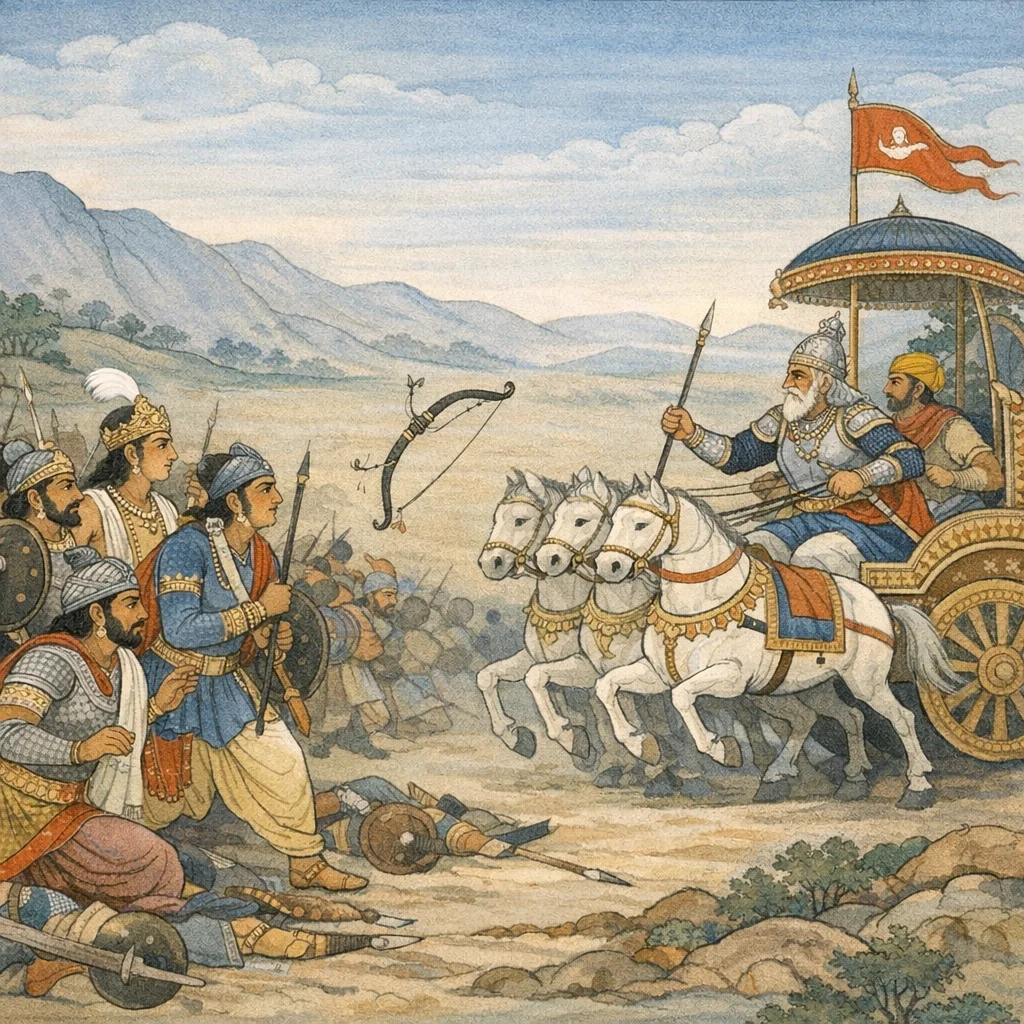
तस्मिंस्तथा वर्तमाने तुमुले संकुले भूशम् । भीष्म: शान्तनवस्तूर्ण युधिष्ठिरमुपाद्रवत्,जब इस प्रकार भयंकर और घमासान युद्ध होने लगा, उसी समय शान्तनुनन्दन भीष्मने तुरंत ही राजा युधिष्ठिरपर धावा किया
Sanjaya said: As the battle raged—terrible, confused, and tumultuous—Bhishma, the son of Shantanu, swiftly charged straight at King Yudhishthira.
Verse 3
ततः सरथनागाश्वा: समकम्पन्त सूंजया: । मृत्योरास्यमनुप्राप्तं मेनिरे च युधिष्ठिरम्,यह देख सूंजयवीर रथ, हाथी और घोड़ोंसहित काँप उठे। उन्होंने युधिष्ठिरको मौतके मुखमें पड़ा हुआ ही समझा
Then the Sṛñjayas, with their chariots, elephants, and horses, began to tremble. They thought Yudhishthira had fallen into the very jaws of death.
Verse 4
युधिष्ठटिरो5पि कौरव्यो यमाभ्यां सहित: प्रभु: । महेष्वासं नरव्याप्र॑ भीष्मं शान्तनवं ययौ,कुरुनन्दन राजा युधिष्ठिर भी नकुल और सहदेवके साथ महाथनुर्धर पुरुषसिंह शान्तनुनन्दन भीष्मका सामना करनेके लिये आगे बढ़े
Sañjaya said: Yudhiṣṭhira too—the lordly Kaurava—accompanied by the two sons of Yamā (Nakula and Sahadeva), advanced toward Bhīṣma, Śāntanu’s son, that tiger among men and mighty archer, to confront him in battle. The scene underscores the grave duty of kings in war: even the righteous must step forward when dharma requires resistance to adharma, though the opponent is a revered elder.
Verse 5
तत: शरसहस्राणि प्रमुड्चन् पाण्डवो युधि । भीष्म॑ं संछादयामास यथा मेघो दिवाकरम्,जैसे मेघ सूर्यको ढक लेता है, उसी प्रकार युद्धस्थलमें हजारों बाणोंकी वर्षा करते हुए पाण्डुपुत्र युधिष्ठिरने भीष्मको आच्छादित कर दिया
Sañjaya said: Then, in the midst of battle, the Pāṇḍava—releasing thousands of arrows—covered Bhīṣma over, just as a cloud veils the sun. The image underscores the fierce momentum of righteous war: even the most venerable elder-warrior can be momentarily obscured when duty and combat press forward without hesitation.
Verse 6
तेन सम्यक् प्रणीतानि शरजालानि मारिष । प्रतिजग्राह गाड़ेयः शतशो5थ सहस्रश:,आर्य! उनके द्वारा अच्छी तरह चलाये हुए सैकड़ों और हजारों बाणोंके समूहको गंगानन्दन भीष्मने ग्रहण कर लिया (अपने बाणोंद्वारा विफल कर दिया)
Sanjaya said: O venerable one, the Gangā-born Bhīṣma received—indeed, neutralized—those volleys of arrows, well-directed by his opponent, in hundreds and then in thousands, meeting them with his own shafts and rendering them ineffective. The scene underscores the disciplined mastery of arms in war, where skill is restrained by duty and directed toward the demands of the battlefield rather than personal rage.
Verse 7
तथैव शरजालानि भीष्मेणास्तानि मारिष | आकाशे समदृश्यन्त खगमानां व्रजा इव,आर्य! इसी प्रकार भीष्मके चलाये हुए बाणसमूह भी आकाशमें पक्षियोंके झुंडके समान दिखायी देने लगे
Sañjaya said: “So too, O dear one, the nets of arrows discharged by Bhīṣma appeared in the sky like flocks of birds in flight.”
Verse 8
निमेषार्थेन कौन्तेयं भीष्म: शान्तनवो युधि । अदृश्यं समरे चक्रे शरजालेन भागश:,शान्तनुनन्दन भीष्मने युद्धस्थलमें आधे निमेषमें ही पृथक्ू-पृथक् बाणोंका जाल-सा बिछाकर कुन्तीनन्दन युधिष्ठिरको अदृश्य कर दिया
Sañjaya said: In the space of a mere blink, Bhīṣma, son of Śāntanu, on the battlefield, made Kuntī’s son (Yudhiṣṭhira) vanish from sight in the fight—covering him, as it were, with a net of arrows cast in distinct, separating volleys. The scene underscores the terrifying efficiency of martial skill when wielded in war, where even the righteous can be overwhelmed by sheer force and technique.
Verse 9
ततो युधिषछिरो राजा कौरव्यस्य महात्मन: । नाराचं प्रेषयामास क्रुद्ध आशीविषोपमम्
Sañjaya said: Then King Yudhiṣṭhira, angered, launched a nārāca arrow at the great-souled Kaurava, like a venomous serpent in its deadly rush.
Verse 10
तब क्रोधमें भरे हुए राजा युधिष्ठिरने कुरुवंशी महात्मा भीष्मपर विषधर सर्पके समान नाराचका प्रहार किया ।। असप्प्राप्तं ततस्तं तु क्षुरप्रेण महारथ: । चिच्छेद समरे राजन् भीष्मस्तस्य धनुश्ष्युतम्,राजन! परंतु महारथी भीष्मने युधिष्ठिरके धनुषसे छूटे हुए उस नाराचको अपने पास पहुँचनेसे पहले ही समरभूमिमें एक क्षुरप्रद्वारा काट गिराया
Sañjaya said: Then King Yudhiṣṭhira, filled with anger, hurled at Bhīṣma—the great-souled foremost of the Kurus—a nārāca arrow, like a venom-bearing serpent. But before that shaft, loosed from Yudhiṣṭhira’s bow, could reach him, the great chariot-warrior Bhīṣma, O King, cut it down in battle with a razor-headed arrow.
Verse 11
त॑ तु छित्त्वा रणे भीष्मो नाराचं कालसम्मितम् | निजघ्ने कौरवेन्द्रस्य हयान् काड्चनभूषणान्,इस प्रकार रणभूमिमें कालके समान भयंकर उस नाराचको काटकर भीष्मने कौरवराज युधिष्ठिरके सुवर्णाभूषणोंसे युक्त घोड़ोंको मार डाला
Sañjaya said: In the thick of battle, Bhīṣma cut down that arrow—terrible as Death itself—and then struck down the horses of the Kuru king (Yudhiṣṭhira), horses adorned with golden ornaments.
Verse 12
(हताश्वे तु रथे तिष्ठन् शक्ति चिक्षेप धर्मराट् । तामापतन्ती सहसा कालपाशोपमां शिताम् ।। चिच्छेद समरे भीष्म: शरै: संनतपर्वभि: ।।) घोड़ोंके मारे जानेपर भी उसी रथमें खड़े हुए धर्मराज युधिष्ठिरने भीष्मपर शक्ति चलायी। कालपाशके समान तीखी एवं भयंकर उस शक्तिको सहसा अपनी ओर आती देख भीष्मने झुकी हुई गाँठवाले बाणोंद्वारा उसे रणभूमिमें काट गिराया। हताश्चृं तु रथं त्यक्त्वा धर्मपुत्रो युधिष्ठिर: । आरुरोह रथं तूर्ण नकुलस्य महात्मन:,तदनन्तर जिसके घोड़े मारे गये थे, उस रथको त्यागकर धर्मपुत्र युधिष्ठिर तुरंत ही महामना नकुलके रथपर आरूढ़ हो गये
When his horses had been slain, King Yudhiṣṭhira still stood firm upon his chariot and hurled a spear (śakti) at Bhīṣma. Seeing that weapon—keen-edged and dreadful like the noose of Death—rushing toward him, Bhīṣma cut it down in battle with arrows whose joints were bent. Then, abandoning the chariot whose horses were killed, Dharma’s son Yudhiṣṭhira swiftly mounted the chariot of the noble Nakula.
Verse 13
यमावपि हि संक्रुद्ध: समासाद्य रणे तदा | शरै: संछादयामास भीष्म: परपुरंजय:,उस समय रणक्षेत्रमें नकुल और सहदेवको पाकर शत्रुनगरीपर विजय पानेवाले भीष्मने अत्यन्त कुपित हो उन्हें बाणोंसे आच्छादित कर दिया
Sañjaya said: Then, in the thick of battle, Bhīṣma—conqueror of enemy strongholds—became enraged and, having closed in upon the twin brothers Nakula and Sahadeva, covered them with a shower of arrows.
Verse 14
तौ तु दृष्टवा महाराज भीष्मबाणप्रपीडितौ । जगाम परमां चिन्तां भीष्मस्य वधकाडुक्षया,महाराज! नकुल और सहदेवको भीष्मके बाणोंसे अत्यन्त पीड़ित देख युधिष्ठिर अपने मनमें भीष्मके वधकी इच्छा लेकर गहन विचार करने लगे
Sanjaya said: O King, seeing Nakula and Sahadeva grievously afflicted by Bhishma’s arrows, Yudhishthira was seized by profound anxiety; with the desire to bring about Bhishma’s fall, he began to deliberate deeply.
Verse 15
ततो युधिष्छिरो वश्यान् राज्ञस्तानू समचोदयत् । भीष्मं शान्तनवं सर्वे निहतेति सुहृदूगणान्,तदनन्तर युधिष्ठटिरने अपने वशवर्ती नरेशों तथा सुहृद्गणोंको यह आदेश दिया कि सब लोग मिलकर शान्तनुनन्दन भीष्मको मार डालो
Then Yudhishthira urged the kings under his command and instructed his well-wishers: “All of you together—strike down Bhishma, the son of Shantanu.”
Verse 16
ततस्ते पार्थिवा: सर्वे श्र॒ुत्वा पार्थस्य भाषितम् । महता रथवंशेन परिवद्रु: पितामहम्,तब कुन्तीपुत्र युधिष्ठिका यह कथन सुनकर समस्त राजाओंने विशाल रथसमूहके द्वारा पितामह भीष्मको चारों ओरसे घेर लिया
Sanjaya said: Then all those kings, having heard the words spoken by Pārtha, surrounded the Grandsire Bhishma on every side with a vast array of chariots.
Verse 17
स समन्तात् परिवृत: पिता देवव्रतस्तव । चिक्रीड धनुषा राजन् पातयानो महारथान्,राजन्! सब ओरसे घिरे हुए आपके ताऊ देवव्रत सब महारथियोंको धराशायी करते हुए अपने धनुषके द्वारा क्रीड़ा करने लगे
Sanjaya said: Surrounded on all sides, your grandsire Devavrata (Bhishma) began to sport with his bow, O King, striking down the great chariot-warriors.
Verse 18
त॑ चरन्तं रणे पार्था ददृशु: कौरवं युधि । मृगमध्यं प्रविश्येव यथा सिंहशिशुं वने,जैसे सिंहका बच्चा वनके भीतर मृगोंके झुंडमें घुसकर खेल कर रहा हो, उसी प्रकार कुन्तीकुमारोंने युद्धमें विचरते हुए कुरुवंशी भीष्मको वहाँ देखा
Sanjaya said: The sons of Pṛthā beheld Bhishma of the Kuru line moving about in the thick of battle. He seemed like a young lion entering the midst of a herd of deer in the forest—fearless and at ease—so did the Pāṇḍavas see him ranging through the fight.
Verse 19
तर्जयानं रणे वीरांस्त्रासयानं च सायकै: । दृष्टवा त्रेसुर्महाराज सिंहं मृगगणा इव,महाराज! वे रणभूमिमें वीरोंको डाँटते और बाणोंके द्वारा उन्हें त्रास देते थे। जैसे मृगोंके समूह सिंहको देखकर डर जाते हैं, उसी प्रकार सब राजा भीष्मको देखकर भयभीत हो गये
Sañjaya said: O King, as he rebuked the warriors in battle and terrified them with his arrows, the kings, on seeing him, grew afraid—just as herds of deer tremble at the sight of a lion.
Verse 20
रणे भारतसिंहस्य ददृशु: क्षत्रिया गतिम् । अग्नेर्वायुसहायस्य यथा कक्ष॑ दिधक्षत:,जैसे वायुकी सहायतासे घास-फूसको जलानेकी इच्छावाली अग्नि अत्यन्त प्रज्वलित हो उठती है, उसी प्रकार भरतवंशके सिंह भीष्मके स्वरूपको रफणक्षेत्रमें क्षत्रियोंने अत्यन्त तेजस्वी देखा
In battle, the kṣatriyas beheld the bearing of Bhīṣma, the lion of Bharata’s line—blazing with splendor, like fire aided by the wind as it flares up to consume the dry grass and brush.
Verse 21
शिरांसि रथिनां भीष्म: पातयामास संयुगे । तालेभ्य: परिपक्वानि फलानि कुशलो नर:,भीष्म उस युद्धस्थलमें रथियोंके मस्तक काट-काटकर उसी प्रकार गिराने लगे, जैसे कोई कुशल मनुष्य ताड़के वृक्षोंसे पके हुए फलोंको गिरा रहा हो
Sañjaya said: In the thick of battle, Bhīṣma kept striking down the heads of the chariot-warriors, making them fall as effortlessly as a skilled man knocks ripe fruits from palm trees.
Verse 22
पतद्धिश्न महाराज शिरोभिर्धरणीतले । बभूव तुमुल: शब्द: पततामश्मनामिव,महाराज! भूतलपर पटापट गिरते हुए मस्तकोंका आकाशसे पृथ्वीपर पड़नेवाले पत्थरोंके समान भयंकर शब्द हो रहा था
Sañjaya said: O great king, as heads fell upon the surface of the earth, a tumultuous roar arose—like the crashing of stones dropping down.
Verse 23
तस्मिन् सुतुमुले युद्धे वर्तमाने भयानके । सर्वेषामेव सैन्यानामासीद् व्यतिकरो महान्,उस भयानक तुमुल युद्धके होते समय सभी सेनाओंका आपसमें भारी संघर्ष हो गया
Sañjaya said: As that dreadful battle raged on—fierce and utterly tumultuous—a great intermingling and clash arose among all the armies, as formations broke and warriors surged into one another in the chaos of war.
Verse 24
भिन्नेषु तेषु व्यूहेषु क्षत्रिया इतरेतरम् । एकमेकं समाहूय युद्धायैवावतस्थिरे,उन सबका व्यूह भंग हो जानेपर भी सम्पूर्ण क्षत्रिय परस्पर एक-एकको ललकारते हुए युद्धके लिये डटे ही रहे
Sañjaya said: Even after their battle-formations had been shattered, the kṣatriya warriors did not withdraw. Challenging one another one by one, they stood their ground, resolved solely upon combat.
Verse 25
शिखण्डी तु समासाद्य भरतानां पितामहम् | अभिदुद्राव वेगेन तिष्ठ तिछेति चाब्रवीत्,शिखण्डी भरतवंशके पितामह भीष्मके पास पहुँचकर उनकी ओर बड़े वेगसे दौड़ा और बोला--'खड़ा रह, खड़ा रह”
Sañjaya said: Then Shikhandi, having come up to Bhishma—the grandsire of the Bharatas—charged at him with great speed and cried out, “Stand! Stand!”
Verse 26
अनादृत्य ततो भीष्मस्तं शिखण्डिनमाहवे । प्रययौ सूंजयान क्रुद्धः स्त्रीत्वं चिन्त्य शिखण्डिन:,किंतु भीष्मने शिखण्डीके स्त्रीत्वका चिन्तन करके युद्धमें उसकी अवहेलना कर दी और सूंजयवंशी क्षत्रियोंपर क्रोधपूर्वक आक्रमण किया
Sañjaya said: Then Bhīṣma, disregarding Śikhaṇḍin on the battlefield—reflecting on Śikhaṇḍin’s womanhood—advanced in anger and attacked the Sūñjaya warriors.
Verse 27
सृंजयास्तु ततो दृष्ट्वा हृष्टं भीष्मं महारणे । सिंहनादांश्व विविधांश्वक्रु: शड्खविमिश्रितान्,तब सूंजयगण उस महायुद्धमें हर्ष और उत्साहसे भरे हुए भीष्मको देखकर शंखध्वनिके साथ नाना प्रकारसे सिंहनाद करने लगे
Sañjaya said: Then, seeing Bhīṣma exultant in that great battle, the Sṛñjayas raised many kinds of lion-roars, mingled with the blare of conches.
Verse 28
ततः प्रववृते युद्ध व्यतिषक्तरथद्विपम् | पश्चिमां दिशमासाद्य स्थिते सवितरि प्रभो,प्रभो! जब सूर्य पश्चिम दिशामें ढलने लगे, उस समय युद्धका रूप और भी भयंकर हो गया। रथ-से-रथ और हाथी-से-हाथी भिड़ गये
Sañjaya said: Then the battle surged anew, with chariots locked against chariots and elephants entangled with elephants. As the Sun reached the western quarter and began to set, O lord, the fighting grew even more dreadful.
Verse 29
धृष्टद्युम्नो5थ पाज्चाल्य: सात्यकिश्न महारथ: । पीडयन्तौ भृशं सैन्यं शक्तितोमरवृष्टिभि:,पांचालराजकुमार धृष्टद्युम्मन तथा महारथी सात्यकि--ये दोनों शक्ति और तोमरोंकी वर्षसे कौरव-सेनाको अत्यन्त पीड़ा देने लगे
Sanjaya said: Then Dhṛṣṭadyumna, the Pāñcāla prince, and Sātyaki, that great chariot-warrior, began to grievously harass the Kaurava host, showering it with volleys of spears and javelins. In the moral atmosphere of the war, their prowess appears as disciplined martial duty—force employed with focused intent amid the larger struggle over rightful order.
Verse 30
शस्त्रैश्न बहुभी राजन् जध्नतुस्तावकान् रणे । ते हन्यमाना: समरे तावका भरतर्षभ,राजन! उन दोनोंने युद्धमें अनेक प्रकारके अस्त्र-शस्त्रोंद्वारा आपके सैनिकोंका संहार करना आरम्भ किया। भरतश्रेष्ठ) उनके द्वारा समरमें मारे जाते हुए आपके सैनिक युद्धविषयक श्रेष्ठ बुद्धिका सहारा लेकर ही संग्राम छोड़कर भाग नहीं रहे थे। आपके योद्धा भी रफक्षेत्रमें पूर्ण उत्ताहके साथ शत्रुओंका संहार करते थे
Sanjaya said: O King, with many kinds of weapons those two began to cut down your troops in battle. Yet, even as they were being slain in the fight, your warriors, O bull among the Bharatas, did not abandon the field and flee; relying on their finest battle-wisdom and discipline, they stood their ground. And your fighters too, with full ardor on the battlefield, struck down the enemy.
Verse 31
आर्या युद्धे मतिं कृत्वा न त्यजन्ति सम संयुगम् यथोत्साहं तु समरे निजघ्नुस्तावका रणे,राजन! उन दोनोंने युद्धमें अनेक प्रकारके अस्त्र-शस्त्रोंद्वारा आपके सैनिकोंका संहार करना आरम्भ किया। भरतश्रेष्ठ) उनके द्वारा समरमें मारे जाते हुए आपके सैनिक युद्धविषयक श्रेष्ठ बुद्धिका सहारा लेकर ही संग्राम छोड़कर भाग नहीं रहे थे। आपके योद्धा भी रफक्षेत्रमें पूर्ण उत्ताहके साथ शत्रुओंका संहार करते थे
Sañjaya said: “Noble warriors, having fixed their resolve for battle, do not abandon the equal contest. Yet, O King, in that fight your men were being struck down in the field according to the attackers’ full ardor. Even as they fell, your soldiers did not flee the combat; relying on their finest war-trained judgment, they held their ground, while your champions too, with complete zeal on the battlefield, kept slaying the enemy.”
Verse 32
तत्राक्रन्दो महानासीत् तावकानां महात्मनाम् | वध्यतां समरे राजन् पार्षतेन महात्मना,राजन! महामना धृष्टद्युम्न समरांगणमें जब आपके योद्धाओंका वध कर रहे थे, उस समय उन महामनस्वी वीरोंका आर्तक्रन्दन बड़े जोरसे सुनायी देता था
Sañjaya said: “There, O King, a great cry of anguish arose among your high-souled warriors, as they were being cut down in battle by the great-souled son of Pṛṣata (Dhṛṣṭadyumna).”
Verse 33
त॑ श्रुत्वा निनदं घोरं तावकानां महारथौ | विन्दानुविन्दावावन्त्यौ पार्षतं प्रत्युपस्थितौ,आपके सैनिकोंका वह घोर आर्तनाद सुनकर अवन्तीके राजकुमार विन्द और अनुविन्द धृष्टद्यम्मनका सामना करनेके लिये उपस्थित हुए
Sanjaya said: Hearing that dreadful roar of lamentation among your troops, the two great chariot-warriors—Vindā and Anuvindā, princes of Avanti—came forward to confront the son of Pṛṣata (Dhṛṣṭadyumna). The scene underscores how, amid the moral chaos of war, elite warriors respond to the cries of their side by stepping into direct combat, driven by loyalty and martial duty.
Verse 34
तौ तस्य तुरगान् हत्वा त्वरमाणौ महारथौ । छादयामासतुरुभौ शरवर्षेण पार्षतम्
Sañjaya said: Those two swift great chariot-warriors, having slain his horses, then covered Pārṣata with a rain of arrows, pressing the attack in the ruthless momentum of battle.
Verse 35
उन दोनों महारथियोंने बड़ी उतावलीके साथ धृष्टद्युम्नके घोड़ोंको मारकर उन्हें भी अपने बाणोंकी वर्षासे ढक दिया ।। अवलप्लुत्याथ पाज्चाल्यो रथात् तूर्ण महाबल: । आरुरोह रथं तूर्ण सात्यकेस्तु महात्मन:,तब महाबली धृष्टद्युम्न तुरंत ही अपने रथसे कूदकर महामना सात्यकिके रथपर शीघ्रतापूर्वक चढ़ गये
Sañjaya said: The two great chariot-warriors, acting with urgent speed, slew the horses of Dhrishtadyumna and then smothered him under a dense shower of arrows. Seeing his chariot disabled, the mighty son of Panchala leapt down at once and swiftly mounted the chariot of the high-souled Satyaki.
Verse 36
ततो युधिष्ठिरो राजा महत्या सेनया वृतः । आवन्त्यौ समरे क्रुद्धावभ्ययात् स परंतपौ,तदनन्तर विशाल सेनासे घिरे हुए राजा युधिष्ठिरने शत्रुओंको तपानेवाले और क्रोधमें भरे हुए विन्द-अनुविन्दपर आक्रमण किया
Then King Yudhiṣṭhira, surrounded by a great host, advanced in battle against the two Avanti princes—Vindā and Anuvindā—both enraged and renowned as tormentors of their foes.
Verse 37
तथैव तव पुत्रो5पि सर्वोद्योगेन मारिष । विन्दानुविन्दौ समरे परिवार्यावतस्थिवान्,आर्य! इसी प्रकार आपका पुत्र दुर्योधन भी सम्पूर्ण उद्योगसे समरभूमिमें विन्द और अनुविन्दकी रक्षाके लिये उन्हें सब ओरसे घेरकर खड़ा हो गया
Sañjaya said: “In the same way, your son too—O venerable sir—exerting himself with every effort, stood on the battlefield surrounding Vindā and Anuvindā on all sides, intent on protecting them.”
Verse 38
अर्जुनश्वापि संक्रुद्धः क्षत्रियान् क्षत्रियर्षभ: । अयोधयत संग्रामे वज़्रपाणिरिवासुरान्,क्षत्रियशिरोमणि अर्जुन भी अत्यन्त कुपित होकर क्षत्रियोंके साथ संग्रामभूमिमें उसी प्रकार युद्ध करने लगे, जैसे वज्रधारी इन्द्र असुरोंके साथ करते हैं
Sañjaya said: Arjuna too, inflamed with righteous fury, that bull among kṣatriyas, fought the kṣatriya warriors on the battlefield—just as Indra, wielder of the thunderbolt, battles the asuras.
Verse 39
द्रोणस्तु समरे क्रुद्धः पुत्रस्य प्रियकृत् तव । व्यधमत् सर्वपज्चालांस्तूलराशिमिवानल:,आपके पुत्रका प्रिय करनेवाले द्रोणाचार्य भी युद्धमें कुपित होकर समस्त पांचालोंका विनाश करने लगे, मानो आग रूईके ढेरको जला रही हो
Sañjaya said: Drona, enraged in the thick of battle and intent on doing what was dear to your son, began to crush the entire host of the Pañcālas—like fire consuming a heap of cotton.
Verse 40
दुर्योधनपुरोगास्तु पुत्रास्तव विशाम्पते । परिवार्य रणे भीष्म युयुधु: पाण्डवै: सह,प्रजानाथ! आपके दुर्योधन आदि पुत्र रणक्षेत्रमें भीष्मको घेरकर पाण्डवोंके साथ युद्ध करने लगे
Sañjaya said: O lord of the people, your sons—led by Duryodhana—surrounded Bhīṣma on the battlefield and engaged in combat together with the Pāṇḍavas.
Verse 41
ततो दुर्योधनो राजा लोहितायति भास्करे । अब्रवीत् तावकान् सर्वास्त्वरध्वमिति भारत,भारत! तदनन्तर जब सूर्यदेवपर संध्याकी लाली छाने लगी, तब राजा दुर्योधनने आपके सभी योद्धाओंसे कहा--जल्दी करो
Then, as the sun began to redden toward twilight, King Duryodhana addressed all the warriors of your side: “Make haste, O Bhārata.”
Verse 42
युध्यतां तु तथा तेषां कुर्वतां कर्म दुष्करम् । अस्तं गिरिमथारूढे अप्रकाशति भास्करे,फिर तो वे सब योद्धा वेगसे युद्ध करते हुए दुष्कर पराक्रम प्रकट करने लगे। उसी समय सूर्य अस्ताचलको चले गये और उनका प्रकाश लुप्त हो गया। इस प्रकार संध्या होते- होते क्षणभरमें रक्तके प्रवाहसे परिपूर्ण भयानक नदी बह चली और उसके तटपर गीदड़ोंकी भीड़ जमा हो गयी
Sañjaya said: As those warriors fought on in that manner, displaying feats of arduous valor, the Sun mounted the mountain of setting and ceased to shine. With daylight withdrawn and evening closing in, the battlefield’s horror deepened—blood began to flow like a dreadful river, and along its banks gathered packs of jackals, drawn by the carnage.
Verse 43
प्रावर्तत नदी घोरा शोणितौघतरड्रिणी । गोमायुगणसंकीर्णा क्षणेन क्षणदामुखे,फिर तो वे सब योद्धा वेगसे युद्ध करते हुए दुष्कर पराक्रम प्रकट करने लगे। उसी समय सूर्य अस्ताचलको चले गये और उनका प्रकाश लुप्त हो गया। इस प्रकार संध्या होते- होते क्षणभरमें रक्तके प्रवाहसे परिपूर्ण भयानक नदी बह चली और उसके तटपर गीदड़ोंकी भीड़ जमा हो गयी
Sañjaya said: In an instant, a dreadful river began to flow—its torrent made of blood—roaring and rushing onward. Along its banks gathered packs of jackals, drawn to the carnage.
Verse 44
शिवाभिरशिवाभ्ि श्व रुवद्धिरभैरवं रवम् । घोरमायोधन जज्ञे भूतसंघै: समाकुलम्,भैरव रव फैलानेवाली अमंगलमयी सियारिनों तथा भूतगणोंसे व्याप्त होकर वह युद्धका मैदान अत्यन्त भयानक हो गया
Sañjaya said: Filled with packs of jackals—portents of ill—and with hosts of spirits, the battlefield became dreadful, resounding with terrifying, ominous cries. The scene signals a moral darkness settling over the combat: war, driven by adharma and rage, is accompanied by inauspicious signs that foreshadow ruin and suffering.
Verse 45
राक्षसाश्ष पिशाचाश्न तथान्ये पिशिताशिन: । समन्ततो व्यदृश्यन्त शतशो5थ सहस्रश:,चारों ओर राक्षस, पिशाच तथा अन्य मांसाहारी जन्तु सैकड़ों और हजारोंकी संख्यामें दिखायी देने लगे
Sañjaya said: “All around, rākṣasas and piśācas, and other flesh-eating beings, began to appear—by the hundreds and then by the thousands.” The vision signals the war’s descent into a fearful, adharma-tinged atmosphere, where violence seems to summon ominous forces and portents.
Verse 46
अर्जुनो5थ सुभशर्मादीन् राज्ञस्तान् सपदानुगान् | विजित्य पृतनामध्ये ययौ स्वशिबिरं प्रति
Sañjaya said: Then Arjuna, having defeated those kings beginning with Subhaśarman along with their followers on the very battlefield, set out from the midst of the fighting host and returned toward his own camp.
Verse 47
तदनन्तर अर्जुन राजा दुर्योधनके पीछे चलनेवाले सुशर्मा आदिको सेनामें पराजित करके अपने शिविरको चले गये ।। युधिष्ठिरो5पि कौरव्यो भ्रातृभ्यां सहितस्तथा । ययौ स्वशिबिरं राजा निशायां सेनया वृत:,तथा सेनासे घिरे हुए कुरुकुलनन्दन राजा युधिष्ठिर भी दोनों भाई नकुल-सहदेवके साथ रातमें अपने शिविरमें पधारे
Sañjaya said: Thereafter King Arjuna, having routed in battle Susharma and the others who were following behind Duryodhana, returned to his own camp. King Yudhiṣṭhira too—the Kuru prince—accompanied by his brothers (Nakula and Sahadeva) and surrounded by his forces, went by night to his own camp.
Verse 48
भीमसेनो<पि राजेन्द्र दुर्योधनमुखान् रथान् । अवजित्य तत: संख्ये ययौ स्वशिबिरं प्रति,राजेन्द्र! तब भीमसेन भी दुर्योधन आदि रथियोंको युद्धमें जीतकर अपने शिविरको लौट गये
Sañjaya said: O king, Bhimasena too, having overcome in battle the chariot-warriors led by Duryodhana, then withdrew from the fighting and returned to his own camp.
Verse 49
दुर्योधनो5पि नृपति: परिवार्य महारणे । भीष्म॑ शान्तनवं तूर्ण प्रयात: शिबिरं प्रति,राजा दुर्योधन भी महायुद्धमें शान्तनुनन्दन भीष्मको घेरकर तुरंत ही अपने शिविरको लौट गया
Sañjaya said: Even King Duryodhana, having surrounded Bhīṣma—the son of Śāntanu—amid the great battle, quickly withdrew and returned toward his own camp.
Verse 50
दोणो द्रौणि: कृप: शल्य: कृतवर्मा च सात्वत: । परिवार्य चमूं सर्वा प्रययु: शिबिरं प्रति,द्रोणाचार्य, अश्वत्थामा, कृपाचार्य, शल्य तथा यदुवंशी कृतवर्मा--ये सारी सेनाको घेरकर अपने शिविरकी ओर चल दिये
Sañjaya said: Droṇa, Droṇa’s son Aśvatthāmā, Kṛpa, Śalya, and Kṛtavarmā of the Sātvata line, having formed a protective encirclement around the entire host, set out toward their own camp.
Verse 51
तथैव सात्यकी राजन धृष्टय्रुम्नश्न पार्षत: । परिवार्य रणे योधान् ययतु: शिबिरं प्रति,राजन! इसी प्रकार सात्यकि और ट्रुपदकुमार धृष्टद्युम्न भी युद्धमें अपने योद्धाओंको घेरकर शिविरकी ओर प्रस्थित हुए
Sañjaya said: “In the same manner, O King, Sātyaki and Dhṛṣṭadyumna, the son of Pārṣata (Drupada), having surrounded their warriors on the battlefield, set out toward the camp.”
Verse 52
एवमेते महाराज तावका: पाण्डवै: सह । पर्यवर्तन्त सहिता निशाकाले परंतप,शत्रुओंको संताप देनेवाले महाराज! इस प्रकार रातके समय आपके योद्धा पाण्डवोंके साथ अपने-अपने शिविरमें लौट आये
Sañjaya said: “O great king, scorcher of foes, thus your warriors, having encountered the Pāṇḍavas, withdrew together in the night and returned each to his own camp.”
Verse 53
ततः स्वशिबिरं गत्वा पाण्डवा: कुरवस्तथा । न्यवसन्त महाराज पूजयन्त: परस्परम्,महाराज! तत्पश्चात् पाण्डव तथा कौरव अपने शिविरमें जाकर आपसमें एक-दूसरेकी प्रशंसा करते हुए विश्राम करने लगे
Sañjaya said: Then, having gone back to their respective camps, the Pāṇḍavas and the Kurus likewise settled down to rest, O King, honoring one another with words of praise.
Verse 54
रक्षां कृत्वा ततः शूरान्यस्य गुल्मान् यथाविधि । अपनीय च शल्यानि स्नात्वा च विविधैर्जलै:,तदनन्तर उभय पक्षके शूरवीरोंने सब ओर सैनिक गुल्मोंको- नियुक्त करके विधिपूर्वक अपने-अपने शिविरोंकी रक्षाकी व्यवस्था की। फिर अपने शरीरसे बाणोंको निकालकर भाँति-भाँतिके जलसे स्नान करके स्वस्तिवाचन करानेके अनन्तर बन्दीजनोंके मुखसे अपनी स्तुति सुनते हुए वे सभी यशस्वी वीर गीत और वाद्योंके शब्दोंसे क्रीड़ा-विनोद करने लगे
Sanjaya said: Thereafter, having duly secured their respective camps by posting brave warriors in detachments on every side, they drew out the shafts lodged in their bodies and bathed with waters of many kinds. When auspicious rites and blessings for their welfare had been recited, those famed heroes—listening as bards sang their praises—passed the time in recreation amid songs and the sound of instruments.
Verse 55
कृतस्वस्त्ययना: सर्वे संस्तूयन्तश्न वन्दिभि: । गीतवादित्रशब्देन व्यक्रीडन्त यशस्विन:,तदनन्तर उभय पक्षके शूरवीरोंने सब ओर सैनिक गुल्मोंको- नियुक्त करके विधिपूर्वक अपने-अपने शिविरोंकी रक्षाकी व्यवस्था की। फिर अपने शरीरसे बाणोंको निकालकर भाँति-भाँतिके जलसे स्नान करके स्वस्तिवाचन करानेके अनन्तर बन्दीजनोंके मुखसे अपनी स्तुति सुनते हुए वे सभी यशस्वी वीर गीत और वाद्योंके शब्दोंसे क्रीड़ा-विनोद करने लगे
Sanjaya said: When the auspicious rites and benedictions had been duly performed for them all, and as bards sang their praises, those renowned warriors gave themselves over to recreation amid the sounds of songs and musical instruments. The scene reveals the camp’s wartime rhythm: even on the eve of violence, it returns to ritual order, public honor, and enjoyment held in check by dharma.
Verse 56
मुहूर्तादिव तत् सर्वमभवत् स्वर्गसंनिभम् । न हि युद्धकथां कांचित् तत्राकुर्वन् महारथा:,दो घड़ीतक वहाँका सब कुछ स्वर्गसदृश जान पड़ा। उस समय वहाँ महारथियोंने युद्धकी कोई बातचीत नहीं की
Sanjaya said: “Within a short while, everything there appeared as if it were heaven itself. At that time, the great chariot-warriors did not engage in any talk of war.”
Verse 57
ते प्रसुप्ते बले तत्र परिश्रान्तजने नृप । हस्त्यश्वबहुले रात्रौ प्रेक्षणीये बभूवतु:,नरेश्वर! जिनमें हाथी और घोड़ोंकी अधिकता थी, उन दोनों पक्षकी सेनाओंमें सब लोग परिश्रमसे चूर-चूर हो रहे थे। रातके समय जब दोनों सेनाएँ सो गयीं, उस समय वे देखनेयोग्य हो गयीं
Sanjaya said: “O king, in both armies—abounding in elephants and horses—the men were utterly worn down by toil. At night, when the two forces had fallen asleep, the scene became a sight worth beholding.”
Verse 85
इस प्रकार श्रीमह्याभारत भीष्मपर्वके अन्तर्गत भीष्मवधपर्वरमें सातवें दिनके युद्धरे सम्बन्ध रखनेवाला पचासीवाँ अध्याय पूरा हुआ
Sanjaya said: Thus, in the revered Mahābhārata, within the Bhīṣma Parva—specifically in the section concerning the fall of Bhīṣma—the eighty-fifth chapter, relating to the events of the seventh day of the war, is concluded.
Verse 86
इति श्रीमहाभारते भीष्मपर्वणि भीष्मवधपर्वणि सप्तमदिवसयुद्धावहारे षडशीतितमो<ध्याय:
Thus, in the Śrī Mahābhārata, within the Bhīṣma Parva, in the section concerning Bhīṣma’s fall, in the account of the battle on the seventh day, the eighty-sixth chapter comes to an end. This closing colophon sets the tale within the war’s ethical frame: fate and duty (dharma) unfolding toward the climactic descent of Bhīṣma, while marking the day-by-day course of the Kurukṣetra conflict.
Frequently Asked Questions
A triage dilemma under simultaneous threats: Yudhiṣṭhira must allocate Bhīma to protect a vulnerable key ally (Ghaṭotkaca) while other fronts remain active, balancing protection, urgency, and limited attention.
Effective leadership is shown as inference-based decision-making: interpreting signals (sound, troop movement), identifying the highest-risk node, and acting quickly to prevent local danger from becoming systemic loss.
No explicit phalaśruti appears in this chapter; its meta-level function is descriptive and diagnostic—illustrating fog-of-war conditions and how dharma is operationalized through protective action and disciplined response.