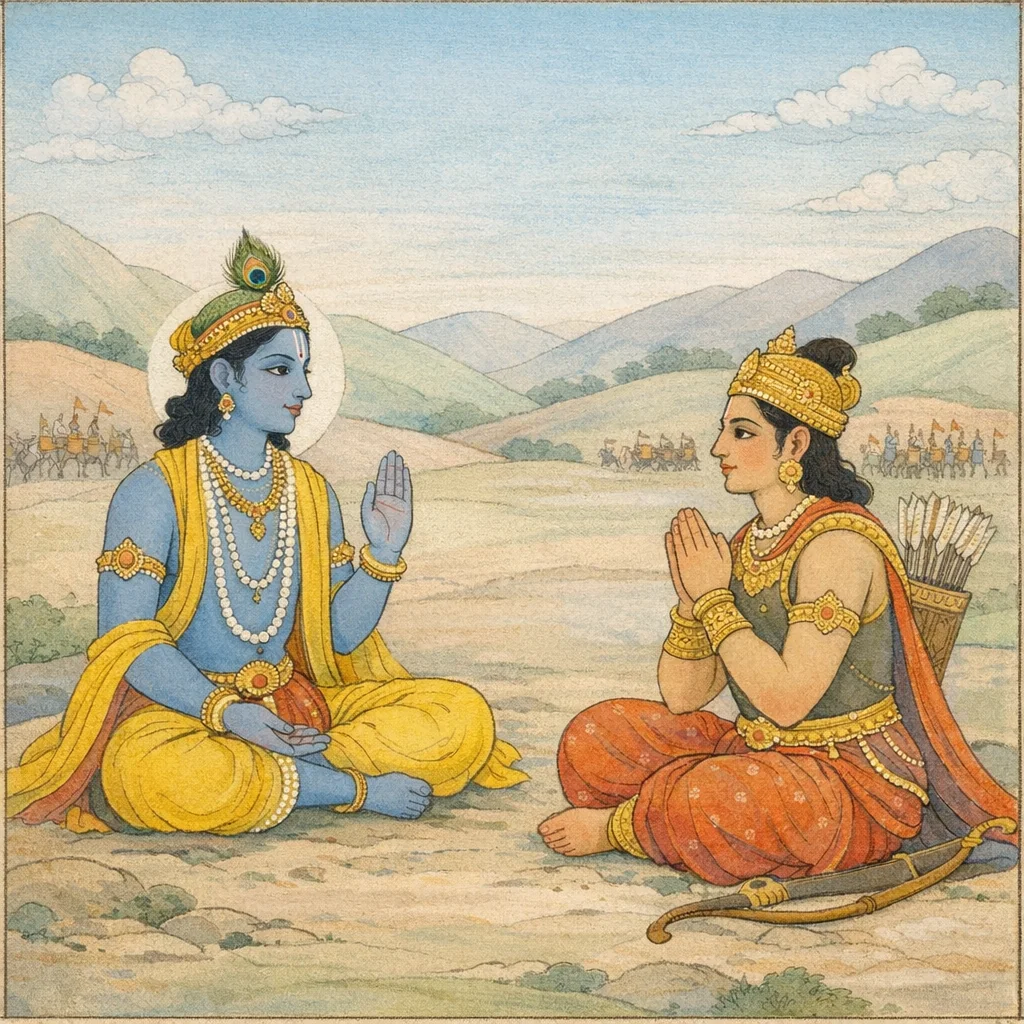
Adhyaya 46
भीष्मविक्रमदर्शनं तथा क्रौञ्चारुणव्यूहविधानम् | Bhīṣma’s Ascendancy and the Organization of the Krauñcāruṇa Formation
Upa-parva: Vyūha-nirmāṇa (Pāṇḍava-vyūha-prastāva) — Krauñcāruṇa-vyūha Context
Saṃjaya reports that after an initial withdrawal of troops, Bhīṣma renews combat intensity, producing visible pressure on the Pāṇḍava forces. Yudhiṣṭhira approaches Kṛṣṇa in distress, describing Bhīṣma as an overwhelming tactical force and expressing fear of coalition attrition; he momentarily contemplates withdrawal to the forest as an ethical escape from further losses. He also critiques the limited effectiveness of straightforward heroism (even Bhīma’s) against entrenched masters of arms (Bhīṣma and Droṇa) and asks for decisive guidance. Kṛṣṇa responds by discouraging despair, enumerating allies and reaffirming the coalition’s readiness; he points to Dhṛṣṭadyumna’s command and signals Śikhaṇḍin’s instrumental role in Bhīṣma’s downfall. Yudhiṣṭhira then instructs Dhṛṣṭadyumna to counter with the Krauñcāruṇa-vyūha, attributed to Bṛhaspati’s tradition, and the text details its structure—head, wings, neck, rear—along with banners, troop distributions, and regional contingents assembling for engagement at sunrise.
Chapter Arc: धृतराष्ट्र के सम्मुख संजय गीता-उपदेश के रहस्य को छेड़ते हैं—मन की शुद्धि, आहार-विचार, और कर्म की शुद्धता का सूत्र खोलते हुए, जैसे युद्धभूमि के कोलाहल के बीच आत्मा का दीपक जल उठे। → कृष्ण अर्जुन को संन्यास और त्याग का भेद बताते हैं: कुछ मनीषी कर्म को दोषयुक्त मानकर त्याज्य कहते हैं, तो कुछ यज्ञ-दान-तप को अ-त्याज्य बताते हैं। फिर कर्म-सिद्धि के ‘पाँच कारण’ (अधिष्ठान आदि) रखकर यह तनाव बढ़ाते हैं कि कर्म होता दिखता है, पर कर्ता कौन है? इसी बीच बुद्धि के तीन रूप—तामसी, राजसी, सात्त्विकी—का निर्णय-क्षेत्र खुलता है, जहाँ अधर्म को धर्म मान लेने वाली तामसी बुद्धि सबसे बड़ा संकट बनती है। → परम गुह्य वचन का शिखर: कर्म-फल-त्याग, बुद्धि की शुद्धि, और स्वभावज कर्म (वैश्य का कृषि-गोरक्षा-वाणिज्य, शूद्र की परिचर्या) के विधान के साथ कृष्ण यह भी उद्घोष करते हैं कि जो इस परम रहस्य को भक्तों में कहेगा और भक्ति को परम बनाकर बोलेगा, वह निश्चय ही मुझे प्राप्त होगा—ज्ञान का फल स्वयं भक्ति बनकर प्रकट होता है। → संजय धृतराष्ट्र से कहता है कि केशव-अर्जुन का यह पुण्य, अद्भुत, रहस्ययुक्त संवाद स्मरण कर-कर के वह बार-बार हर्षित होता है; उपदेश की महिमा स्वयं कथावाचक के हृदय में आनंद बनकर स्थिर हो जाती है। → संजय अब धृतराष्ट्र के सामने विजय की निश्चितता की ओर संकेत करता है—उपदेश का निष्कर्ष युद्ध के परिणाम की छाया बनकर अगले प्रसंग की देहरी पर खड़ा है।
Shlokas
Verse 1
२)। अन्त:करणकी शुद्धिसे ही विचार
Arjuna said: O mighty-armed one! O Hṛṣīkeśa, slayer of Keśin! I wish to understand clearly the true principle of renunciation (saṃnyāsa) and also of relinquishment (tyāga)—as distinct from one another. In the ethical tension of the battlefield, Arjuna asks for a precise distinction between abandoning action and abandoning attachment to the fruits of action, seeking a rule of life that preserves dharma while purifying intention.
Verse 2
श्रीभगवानुवाच काम्यानां कर्मणां न्यासं संनन््यासं कवयो विदु: । सर्वकर्मफलत्यागं प्राहुस्त्यागं विचक्षणा:
The Blessed Lord said: The wise understand renunciation (saṁnyāsa) as the laying aside of actions undertaken for personal desire. But the discerning declare true relinquishment (tyāga) to be the abandonment of the fruits of all actions. In ethical terms, the teaching shifts the focus from merely stopping certain deeds to purifying intention—acting as duty requires while releasing possessiveness over outcomes.
Verse 3
२ ।। त्याज्यं दोषवदित्येके कर्म प्राहुर्मनीषिण: । यज्ञदानतपःकर्म न त्याज्यमिति चापरे
Arjuna said: “Some thoughtful authorities declare that action should be abandoned because it is tainted with fault; yet others maintain that acts of sacrifice, giving, and austerity are not to be renounced.”
Verse 4
सम्बन्ध-- इस प्रकार संन्यास और त्यागके विषयोंगें विद्वानोंके भिन्न-भिन्न मत बतलाकर अब भगवान् त्यागके विषयमें अपना निश्चय बतलाना आरम्भ करते हैं-- निश्चयं शृणु मे तत्र त्यागे भरतसत्तम | त्यागो हि पुरुषव्याप्र त्रिविध: सम्प्रकीर्तित:
Hear now my settled conclusion regarding renunciation (tyāga), O best of the Bharatas. For, O tiger among men, renunciation is declared to be of three kinds—sāttvika, rājasa, and tāmasa.
Verse 5
यज्ञदानतप:कर्म न त्याज्यं कार्यमेव तत् । यज्ञो दानं तपश्चैव पावनानि मनीषिणाम्"
Acts of sacrifice, charity, and austerity are not to be abandoned; they must indeed be performed. For sacrifice, charity, and austerity are purifying practices for the wise.
Verse 6
एतान्यपि तु कर्माणि सड़ूं त्यक्त्वा फलानि च | कर्तव्यानीति मे पार्थ निश्चितं मतमुत्तमम्
Therefore, O Partha, even these acts—sacrifice, charity, and austerity—should be performed, but with attachment abandoned and the fruits relinquished. This is my firmly settled and highest judgment.
Verse 7
सम्बन्ध-- अब तीन “लोकोंगें क्रमसे उपर्युक्त तीन प्रकारके त्यायोंके लक्षण बतलाते हैं नियतस्य तु संन्यास: कर्मणो नोपपद्यते । मोहात् तस्य परित्यागस्तामस: परिकीर्तित:
But renouncing one’s obligatory duties is not proper. When a person abandons such prescribed action out of delusion (moha), that abandonment is declared to be a tāmasic form of renunciation.
Verse 8
दुःखमित्येव यत् कर्म कायक्लेशभयात् त्यजेत् | स कृत्वा राजसं त्यागं नैव त्यागफलं लभेत्
Arjuna said: If a person, thinking that all action is nothing but suffering, abandons the duties that ought to be done out of fear of bodily hardship, then having performed a rajasic kind of renunciation, he does not obtain the true fruit of renunciation at all.
Verse 9
कार्यमित्येव यत् कर्म नियतं क्रियते<र्जुन । सड्ूूं त्यक्त्वा फलं चैव स त्याग: सात््विको मत:
Arjuna, when a prescribed duty is performed solely because it ought to be done—abandoning attachment and also relinquishing claim to its results—such renunciation is regarded as sāttvic.
Verse 10
सम्बन्ध-- उपर्युक्त प्रकारसे सात्विक त्याग करनेवाले पुरुषका निषिद्ध और काम्यकर्मोको स्वरूपसे छोड़नेगें और कर्तव्यकमोंके करनेमें कैया भाव रहता है
Arjuna said: The true renouncer neither hates an unwholesome act nor clings to a wholesome one. Immersed in clarity (sattva), discerning and free from doubt, such a person is the genuine practitioner of renunciation.
Verse 11
न हि देहभूता शक्यं त्यक्तुं कर्माण्यशेषत: । यस्तु कर्मफलत्यागी स त्यागीत्यभिधीयते
For one who is embodied, it is not possible to abandon all actions entirely. Therefore, the person who renounces the fruits of action is truly called a renouncer—so it is said.
Verse 12
अनिष्टमिष्टं मिश्र॑ च त्रिविध॑ कर्मण: फलम् । भवत्यत्यागिनां प्रेत्य न तु संन्यासिनां क्वचित्
Arjuna said: For those who do not relinquish the fruits of action, the result of karma after death is inevitably threefold—unpleasant, pleasant, or mixed. But for those who have renounced the fruits (and thus stand in true renunciation), no such karmic result accrues at any time.
Verse 13
सम्बन्ध-- पहले शलोकमें अर्जुनने संन्यास और त्यागका तत्त्व अलग-अलग जाननेकी इच्छा प्रकट की थी। उसका उत्तर देते हुए भगवान्ने दूसरे और तीसरे *लोकोर्में इस विषयपर विद्वानोंके भिन्न-भिन्न मत बतलाकर अपने मतके अनुसार चौथे शलोकसे बारहवें #लोकतक त्यागका यानी कर्मयोगका तत्त्व भलीभॉति समझाया: अब संनन््यासका यानी सांख्ययोगका तत्त्व समझानेके लिये पहले सांख्य-सिद्धान्तके अनुसार कर्मोकी सिद्धिगें पॉच हेतु बतलाते हैं-- पञ्चैतानि महाबाहो कारणानि निबोध मे । सांख्ये कृतान्तेः प्रोक्तानि सिद्धये सर्वकर्मणाम्रँ
The Blessed Lord said: “O mighty-armed one, understand from Me these five causal factors. In the Sāṅkhya’s settled conclusion they are declared as the means by which every action comes to completion.”
Verse 14
हे महाबाहो! सम्पूर्ण कर्मोकी सिद्धिके ये पाँच हेतु कर्मोंका अन्त करनेके लिये उपाय बतलानेवाले सांख्य-शास्त्रमें कहे गये हैं, उनको तू मुझसे भलीभाँति जान ।।
Arjuna said: “O mighty-armed one, please explain to me clearly the five factors that the Sāṅkhya teaching declares as the means by which actions reach completion. In the accomplishment of any deed there are: the basis or seat (the body and its situation), the agent (the doer), the various instruments (senses, mind, and tools), the many distinct efforts and movements, and—fifth—destiny or the divine factor. Knowing these, one should act responsibly without pride, and without blaming oneself or others as the sole cause.”
Verse 15
शरीरवाड्मनोभिर्यत् कर्म प्रारभते नर: । न्याय्यं*) वा विपरीतं* वा पज्चैते तस्य हेतव:
Arjuna said: Whatever action a person undertakes through body, speech, or mind—whether it is rightful or contrary to righteousness—there are five causes that stand behind it.
Verse 16
१५ |। सम्बन्ध-- इस प्रकार यांख्ययोगके |सिद्धान्तसे समस्त कर्मोकी सिद्धिके अधिष्ठानादि पॉच कारणोंका निरूपण करके अब
Even when this is so—when action is understood to rest on its various causal supports—whoever, through an unrefined understanding, looks upon the pure Self alone as the doer in the occurrence of actions, that misguided person does not truly see reality. Ethically, the verse corrects the error of moral agency being falsely imposed on the changeless Self, urging discernment between the field of action and the witnessing consciousness.
Verse 17
इस प्रकार श्रीमह्ााभारत भीष्मपर्वके श्रीमद्भगवद््गीतापव॑किे अन्तर्गत ब्रह्मविद्या और योगशासत्ररूप श्रीमद्भगवद्गीतोपनिषद्: श्रीकृष्णाजुन-संवादमें श्रद्धात्रयविभागयोग नामक सत्रहवाँ अध्याय पूरा हुआ
He in whom there is no egoistic notion—“I am the doer”—and whose understanding is not tainted or attached to worldly objects and actions: even if he were to slay these beings, in truth he neither kills nor becomes bound by sin. The verse frames moral responsibility in terms of inner agency: action performed without ego and without clinging does not generate binding guilt.
Verse 18
सम्बन्ध--इस प्रकार संनन््याय (ज्ञानयोग)-का तत्व समझानेके लिये आत्माके अकतोपपिनका प्रतिपादन करके अब उसके अनुसार कर्मके अंग-प्रत्यंगोंको भलीभाँति समझानेके लिये कर्म-प्रेरणा; कर्म-संग्रह और उनके यात्विक आदि भेदोंका प्रतिपादन करते हैं-- ज्ञानं ज्ञेयं परिज्ञाता त्रिविधा कर्मचोदना । करणं कर्म कर्तेति त्रिविध: कर्मसंग्रह:
Arjuna said: “Knowledge, the object to be known, and the knower—these three are the threefold impulse that sets action in motion. The instrument, the act itself, and the agent—these three are the threefold basis (aggregate) of action.”
Verse 19
ज्ञानं कर्म च कर्ता च त्रिधैव गुणभेदत: । प्रोच्यते गुणसंख्याने यथावच्छृूणु तान्यपि
Arjuna said: “In the teaching that analyzes the guṇas, knowledge, action, and the doer are each described as threefold, distinguished by the guṇas. Please explain those as well, correctly and in due order.”
Verse 20
सर्वभूतेषु येनैके भावमव्ययमीक्षते । अविभक्तं विभक्तेषु तज्ज्ञानं विद्धि साक््चिकम्
Arjuna said: “Know that knowledge to be sāttvika by which one perceives, in all beings, a single imperishable Reality—undivided though appearing among divided forms.”
Verse 21
पृथक्त्वेन तु यज्ज्ञानं नानाभावान् पृथग्विधान् | वेत्ति सर्वेषु भूतेषु तज्ज्ञानं विद्धि राजसम्
Arjuna said: “That knowledge by which one perceives, in all beings, the many distinct states and varieties as separate from one another—know that knowledge to be rājasa.”
Verse 22
यत्तु कृत्स्नवदेकस्मिन् कार्य सक्तमहैतुकम् । अतत्त्वार्थवदल्पं च तत् तामसमुदाह्ृतम्
But that understanding which clings to a single task as though it were the whole, without rational grounds, and which is shallow and contrary to the true nature of things—this is declared to be tamasic (tāmasa).
Verse 23
परंतु जो ज्ञान एक कार्यरूप शरीरमें ही सम्पूर्णके सदूृश आसक्त है तथा जो बिना युक्तिवाला, तात्विक अर्थसे रहित और तुच्छ है, वह तामस कहा गया हैः ।।
A deed is called sāttvika when it is performed as a duty prescribed by śāstra—without attachment, without the ego of doership, free from attraction and aversion alike—and by one who seeks no personal reward. Ethically, it marks right action as disciplined, impartial, and duty-centered, not driven by desire, hatred, or self-interest.
Verse 24
यत्तु कामेप्सुना* कर्म साहंकारेण5 वा पुनः । क्रियते बहुलायासं तद् राजसमुदाह्ृतम्
Arjuna said: But that action which is performed by one who longs for sense-enjoyments, or is done with egoistic self-assertion, and which involves much strain and exertion—such action is declared to be of rajas. Ethically, it is driven by craving and self-display rather than by duty carried out with inner steadiness.
Verse 25
अनुबन्ध॑ क्षयं हिंसामनवेक्ष्य च पौरुषम् मोहादारभ्यते कर्म यत्तत्तामसमुच्यते,जो कर्म परिणाम, हानि, हिंसा और सामर्थ्यको न विचारकर केवल अज्ञानसे आरम्भ किया जाता है, वह तामस कहा जाता हे?
Arjuna said: That action is called tāmasika when, out of delusion, one undertakes it without considering its consequences, the loss it may cause, the violence involved, or one’s own capacity to carry it through. Ethically, it points to heedless, ignorant initiative that ignores harm and responsibility.
Verse 26
#स्ज्िम (2) अअसना २. यद्यपि शास्त्रविधिके त्यागकी बात गीताके सोलहवें अध्यायके तेईसवें श्लोकमें भी कही जा चुकी थी और यहाँ भी कहते हैं; पर इन दोनोंके भावमें बड़ा अन्तर है। वहाँ अवहेलनापूर्वक किये जानेवाले शास्त्रविधिके त्यागका वर्णन है और यहाँ न जाननेके कारण होनेवाले शास्त्रविधिके त्यागका है। उनको तो शास्त्रकी परवा ही नहीं है; अतः वे मनमाने ढंगसे जिस कर्मको अच्छा समझते हैं
Arjuna said: “By your grace, I have gained clarity of purpose from what I have heard here. My doubt is gone; I stand firm. I will act according to your word.”
Verse 27
रागीः कर्मफलप्रेप्सुर्लुब्धोः 3 हिंसात्मको5शुचि:* ५ | हर्षशोकान्वित: कर्ता राजस: परिकीर्तित:
Arjuna said: The doer who is driven by attachment, who craves the fruits of action, who is greedy, whose nature is to harm, who is impure in conduct, and who is entangled in elation and grief—such an agent is declared to be of the rājasa type. Ethically, this describes action propelled by desire and agitation rather than clarity or self-restraint, and it warns that such motivation distorts judgment and leads to suffering for oneself and others.
Verse 28
असुक्त:* प्रकृते:९ स्तब्ध: शठो नैष्कृतिकोडलस: । विषादी दीर्घसूत्री च कर्ता तामस उच्यते
Arjuna said: The doer who is undisciplined and untrained, stubborn and arrogant, deceitful and malicious, lazy and given to grief, and who delays action through procrastination—such an agent is declared to be of tamasic (tāmasika) nature.
Verse 29
सम्बन्ध-- इस प्रकार तत्त्वज्ञानमें सहायक सात्विकभावको ग्रहण करानेके लिये और उसके विरोधी राजस-तामय भावोंका त्याग करानेके लिये कर्म-प्रेरणा और कर्म संग्रहमेंसे ज्ञान
Arjuna said: “O Dhanañjaya, now hear from me, in full and with clear distinctions, the threefold classification—according to the guṇas—of both understanding (buddhi) and steadfast resolve (dhṛti).”
Verse 30
प्रवृत्ति च निवृत्ति च कार्याकार्ये भया भये । बन्ध॑ मोक्ष च या वेत्ति बुद्धि: सा पार्थ सातक््चिकी
Arjuna said: That understanding is sāttvika, O Pārtha, which clearly discerns the path of engagement (pravṛtti) and the path of withdrawal (nivṛtti); what ought to be done and what ought not to be done; what is to be feared and what is not; and what leads to bondage and what leads to liberation (mokṣa).
Verse 31
यया धर्ममधर्म च कार्य चाकार्यमेव च । अयथावत् प्रजानाति बुद्धि: सा पार्थ राजसी
Arjuna said: That intellect by which one fails to discern correctly what is dharma and what is adharma, and likewise what ought to be done and what ought not to be done—such an intellect, O Pārtha, is of the rajasic (rājasa) kind.
Verse 32
अधर्म धर्ममिति या मन्यते तमसा5<वृता | सर्वार्थान् विपरीतांश्व बुद्धि: सा पार्थ तामसी
Arjuna said: That intellect which, being veiled by darkness (tamas), takes what is unrighteous to be righteous, and likewise misconstrues all things in a reversed way—such an intellect, O Pārtha, is called tāmasī (born of tamas).
Verse 33
धृत्या यया धारयते मन:प्राणेन्द्रियक्रिया: । योगेनाव्यभिचारिण्या धृतिः सा पार्थ सात््विकी
O Partha, that steadfastness (dhṛti) by which a person, through the discipline of yoga and unwavering constancy, holds the mind, the vital breath (prāṇa), and the activities of the senses firmly under control—that steadfastness is sāttvika.
Verse 34
यया तु धर्मकामार्थान् धृत्या धारयते<र्जुन । प्रसड़ेन फलाकाडुक्षी धृति: सा पार्थ राजसी
But, O Partha, that steadfastness by which a person, driven by attachment and craving for results, clings to duty (dharma), gain (artha), and pleasure (kāma)—that steadfastness is rajasic.
Verse 35
यया स्वप्न भयं शोकं विषादं मदमेव च । न विमुज्चति दुर्मेधा धृति:* सा पार्थ तामसी
O Partha, that steadfastness by which a dull-witted person does not let go of sleep, fear, grief, dejection, and even intoxicated delusion—clinging to them instead—is called tamasic resolve.
Verse 36
सम्बन्ध-- इस प्रकार सात्विकी बुद्धि और ध्ृतिका ग्रहण तथा राजसी-तामसीका त्याग करनेके लिये बुद्धि और धृतिके सात्तिक आदि तीन-तीन भेद क्रमसे बतलाकर अब जिसके लिये मनुष्य समस्त कर्म करता है; उस सुखके भी सात्विक, राजस और तामस--इस प्रकार तीन भेद क्रमसे बतलाते हैं-- सुखं तल्विदानीं त्रिविधं शृणु मे भरतर्षभ । अभ्यासाद् रमते यत्र दुःखान्तं च निगच्छति,हे भरतश्रेष्ठ! अब तीन प्रकारके सुखको भी तू मुझसे सुन। जिस सुखमें साधक मनुष्य भजन, ध्यान और सेवादिके अभ्याससे रमण करता है* और जिससे दु:खोंके अन्तको प्राप्त हो जाता है*-- जो ऐसा सुख है, वह आरम्भकालमें यद्यपि विषके तुल्य प्रतीत होता है,* परंतु परिणाममें अमृतके तुल्य है;* इसलिये वह परमात्मविषयक बुद्धिके प्रसादसे उत्पन्न होनेवाला सुख+ सात्त्विक कहा गया है
O best of the Bharatas, now hear from me of the threefold nature of happiness. That happiness in which a disciplined seeker delights through repeated practice, and by which one reaches the end of sorrow—though it seems like poison at the beginning, it becomes like nectar in the end; therefore it is called sāttvika happiness, born of the clarity and grace of right understanding turned toward the Self (Ātman).
Verse 37
यत्तदग्रे विषमिव परिणामे5मृतोपमम् । तत्सुखं सात्त्विकं प्रोक्तमात्मबुद्धिप्रसादजम्
That happiness which at first feels like poison, but in the end becomes like nectar—such happiness is declared to be sāttvika. It arises from the clarity and grace of one’s inner understanding: the purified intellect turned toward the Self (Ātman).
Verse 38
विषयेन्द्रियसंयोगाद् यत्तदग्रेडमृतोपमम् । परिणामे विषमिव तत् सुखं राजसं स्मृतम्
The pleasure born of the senses’ contact with their objects seems like nectar at first, in the very moment of enjoyment; yet in its outcome it turns to poison. Therefore such pleasure is remembered as “rajasic”—driven by passion and attachment, alluring at the start but harmful in the end.
Verse 39
यदग्रे चानुबन्धे च सुखं मोहनमात्मन: । निद्रालस्यप्रमादोत्थं तत्तामसमुदाह्तम्,जो सुख भोगकालमें तथा परिणाममें भी आत्माको मोहित करनेवाला है, वह निद्रा, आलस्य और प्रमादसे उत्पन्न सुखःई तामस कहा गया है
That pleasure which, both at the beginning and in its aftermath, deludes the self—arising from sleep, indolence, and heedlessness—is declared to be tāmasic.
Verse 40
न तदस्ति पृथिव्यां वा दिवि देवेषु वा पुन: । सत्त्वं प्रकृतिजैर्मुक्ते यदेभि: स्यात् त्रिभिर्गुणै:
There is nothing anywhere—on earth, in the heavens, or even among the gods—that exists free from these three qualities born of Nature. All beings, wherever found, are inevitably shaped and bound by the triple strands of the guṇas.
Verse 41
भीष्मपर्वणि तु एकचत्वारिंशो5 ध्याय:
The Blessed Lord explains that social duties are not arbitrary but arise from one’s innate disposition. He tells Arjuna, “O scorcher of foes, the works of Brahmins, Kshatriyas, Vaishyas, and Shudras are apportioned according to the qualities born of their own nature.” In ethical terms, the verse frames dharma as responsibility aligned with character and temperament, preparing the ground for teaching that true renunciation is not abandoning rightful work, but performing it without attachment and with devotion.
Verse 42
शमो5 दमस्तप: 3 शौच क्षान्तिरार्जवमेव" 5 च | ज्ञानं? विज्ञानमास्तिक्यं८ 5 ब्रह्मकर्म स्वभावजम्
Serenity of mind, self-restraint, austerity, purity, forbearance, and straightforwardness; also knowledge, realized discernment, and faith in the sacred order—these are the natural duties that arise from one’s inborn disposition as a brāhmaṇa.
Verse 43
अन्त: करणका निग्रह करना
Arjuna asks about the natural duties that arise from one’s disposition. He describes the Brahmin’s innate work as inner self-restraint, control of the senses, endurance of hardship for the sake of dharma, purity within and without, forgiveness of others’ faults, straightforwardness of mind, senses, and body, faith in the Veda and śāstra, in God and the hereafter, the study and teaching of sacred learning, and direct realization of the Supreme Reality. He then states that the Kshatriya’s innate work is valor, radiance and vigor, steadfastness, skill, not fleeing from battle, generosity, and a lordly sense of responsibility befitting a protector.
Verse 44
कृषिगौरक्ष्यवाणिज्यं वैश्यकर्म स्वभावजम् | परिचर्यात्मकं कर्म शूद्रस्यापि स्वभावजम्
Arjuna said: “Agriculture, cattle-tending, and trade are the natural duties of the Vaiśya, arising from his inborn disposition. Service in the form of attending upon others is likewise the natural duty of the Śūdra, arising from his inborn disposition.”
Verse 45
खेती<, गोपालन” और क्रय-विक्रयरूप सत्य व्यवहार*--ये वैश्यके स्वाभाविक कर्म हैं तथा सब वर्णोकी सेवा करना* शूद्रका भी स्वाभाविक कर्म है ।।
Arjuna said: A person who is devoted to his own allotted duty attains complete perfection. Hear from me how one who remains steadfast in his own work reaches that perfection—namely, the highest fulfillment that culminates in realization of the Divine—without abandoning the responsibilities of his station.
Verse 46
यतः प्रवृत्तिर्भूतानां येन सर्वमिदं ततम् । स्वकर्मणा तमभ्यर्च्य सिद्धि विन्दति मानव:
From that Supreme Lord all beings arise, and by Him this entire world is pervaded. By worshiping Him through one’s own natural work, a person attains the highest perfection.
Verse 47
सम्बन्ध-- पूर्वश्लोकर्में यह बात कही गयी कि मनुष्य अपने स्वाभाविक कमाद्वारा परमेश्वरकी पूजा करके परम सिद्धिको पा लेता है; इसपर यह शंका होती है कि यदि कोई क्षत्रिय अपने युद्धादि क्रूर कर्मोको न करके; ब्राह्मणोंकी भाँति अध्यापनादि शान्तिमय कर्मोसे अपना निर्वाह करके परमात्माको प्राप्त करनेकी चेष्टा करे या इसी तरह कोई वैश्य या शूद्र अपने कर्मोको उच्च वर्णोके कर्मोंसे हीन समझकर उनका त्याग कर दे और अपनेसे ऊँचे वर्णकी वृत्तिसे अपना निर्वाह करके परमात्माको प्राप्त करनेका प्रयत्न करे तो उचित है या नहीं। इसपर दूसरेके धर्मकी अपेक्षा स्वधर्मकों श्रेष्ठ बतलाकर उसके त्यागका निषेध करते हैं-- श्रेयान् स्वधर्मोर्ट विगुण: परधर्मात् स्वनुछितात् । स्वभावनियतं कर्म कुर्वन्नाप्रोति किल्बिषम्
Arjuna said: One’s own duty, even if imperfectly endowed with qualities, is better than another’s duty, even when performed well. For a person who carries out the work fixed by their own nature does not incur moral fault. In the ethical context of the epic, this affirms that abandoning one’s rightful station and responsibilities—out of fear, imitation, or a mistaken sense of superiority/inferiority—creates inner disorder, whereas faithfully doing one’s own role (even with limitations) aligns action with one’s nature and avoids blameworthy transgression.
Verse 48
सहजंएं कर्म कौन्तेय सदोषमपि न त्यजेत् । सर्वारम्भा हि दोषेण धूमेनाग्निरिवावृता:
“O son of Kuntī, one should not abandon the work born of one’s own nature, even if it is flawed; for every undertaking is inevitably veiled by some defect—just as fire is covered by smoke.”
Verse 49
अतएव हे कुन्तीपुत्र! दोषयुक्त होनेपर भी सहज कर्मको” नहीं त्यागना चाहिये; क्योंकि धूएँसे अग्निकी भाँति सभी कर्म किसी-न-किसी दोषसे युक्त हैं* ।।
“Therefore, O son of Kuntī, one should not abandon one’s natural, inborn duty even when it is attended by faults; for every action in this world is inevitably tainted by some defect—just as fire is veiled by smoke. The ethical point is not to flee responsibility because it is imperfect, but to perform one’s rightful work with discernment and steadiness, accepting that purity in action is a matter of inner orientation rather than flawless external conditions.”
Verse 50
सिद्धि प्राप्तो यथा ब्रह्म तथा55प्रोति निबोध मे । समासेनैव कौन्तेय निष्ठा ज्ञानस्य या परा
“Teach me clearly how, having attained perfection, a person reaches Brahman. O son of Kuntī, explain to me in brief that supreme steadfastness in knowledge—the highest culmination of the path of wisdom—by which one attains the state beyond action and arrives at Brahman.”
Verse 51
बुद्धया विशुद्धया युक्तो धृत्या55त्मानं नियम्य च | शब्दादीन् विषयांस्त्यकत्वा रागद्वेषौ व्युदस्य च
“Endowed with a purified intellect, and steadying oneself through firm resolve, one should restrain the self; abandoning sense-objects beginning with sound, and casting away attachment and aversion. Ethically, the verse points to inner discipline as the foundation for right action: mastery over the senses and the pair of likes and dislikes prevents conduct from being driven by craving or hostility, and prepares a person for calm, principled engagement with life’s duties.”
Verse 52
विविक्तसेवी लघ्वाशीः यतवाक्कायमानस: । ध्यानयोगपरो नित्यं वैराग्यं समुपाश्रित:
“One who resorts to solitude, eats lightly, and has disciplined speech, body, and mind—ever devoted to the yoga of meditation and firmly established in dispassion—becomes fit for inner steadiness and spiritual realization. The verse highlights an ethical ideal of self-restraint: withdrawing from distractions, moderating consumption, and cultivating sustained contemplative practice so that desire and aversion lose their hold.”
Verse 53
अहंकार बल दर्प काम॑ क्रोध॑ परिग्रहम् विमुच्य निर्मम: शान्तो ब्रह्म भूयाय कल्पते
Arjuna said: “Having cast off egoism, the pride of strength, arrogance, desire, anger, and possessiveness, becoming free from ‘mine-ness’ and established in inner peace, one becomes fit to abide in Brahman—i.e., to live in the state of Brahman-realization. Ethically, the teaching points to victory over the inner enemies that fuel violence and attachment, so that a person may act without selfish grasping and remain steady in serenity.”
Verse 54
ब्रह्मभूत: प्रसन्नात्मा' न शोचति न काड्क्षति । सम: सर्वेषु भूतेषु मदभक्ति लभते पराम्
Arjuna said: “One who has become established in Brahman, whose inner being is serene, neither grieves nor hankers. Equal toward all beings, such a person attains supreme devotion to Me.”
Verse 55
भक््त्या मामभिजानाति यावान् यश्नास्मि तत्त्वतः । ततो मां तत्त्वतो ज्ञात्वा विशते तदनन्तरम्
Through single-minded devotion, one truly comes to know Me as I am—My real nature and full measure. Having thus known Me in truth, that devotee then enters into Me immediately thereafter, attaining intimate union with the Supreme beyond the turmoil of the battlefield.
Verse 56
सम्बन्ध-- अर्जुनकी जिज्ञासाके अनुसार त्यागका यानी कर्मयोगका और संन्यासका यानी सांख्ययोगका तत्व अलय-अलय समझाकर यहाँतक उस प्रकरणको समाप्त कर दिया; किंतु इस वर्णनमें भगवान्ने यह बात नहीं कही कि दोनोंगेंसे तुम्हारे लिये अमुक साधन कर्तव्य है; अतएव अर्जुनको भक्तिप्रधान कर्मयोग ग्रहण करानेके उद्देश्यसे अब भक्तिप्रधान कर्मयोगकी महिमा कहते हैं-- सर्वकर्माण्यपिः सदा कुर्वाणो मद्बयपाश्रय: । मत्प्रसादादवाप्नोति शाश्व॒तं पदमव्ययम्
Even while continually performing every kind of duty, the practitioner of karma-yoga who takes refuge in Me as the sole support attains—by My grace—the eternal, imperishable supreme state. The ethical emphasis is that action need not be abandoned; when one acts without ego and with devotion, responsibility is fulfilled without bondage, and liberation becomes possible through divine favor.
Verse 57
चेतसा सर्वकर्माणि मयि संन्यस्य मत्पर: । बुद्धियोगमुपश्रित्य मच्चित्त: सततं भव,सब कर्मोंका मनसे मुझमें अर्पण करके» तथा समबुद्धिरूप योगको* अवलम्बन करके मेरे परायण* और निरन्तर मुझमें चित्तवाला हो*
Arjuna said: “Surrendering in your mind all actions to Me, making Me your highest aim, and taking refuge in the yoga of steady discernment, keep your consciousness fixed on Me at all times.”
Verse 58
मच्चित्त: सर्वदुर्गाणि मत्प्रसादात् तरिष्यसि । अथ चेत् त्वमहंकारान्न श्रोष्यसि विनड्क्ष्यसि
With your mind fixed on Me, by My grace you will cross beyond all hardships and perilous obstacles. But if, out of ego, you refuse to heed this counsel, you will come to ruin.
Verse 59
उपर्युक्त प्रकारसे मुझमें चित्तवाला होकर तू मेरी कृपासे समस्त संकटोंको अनायास ही पार कर जायगाः और यदि अहंकारके कारण मेरे वचनोंको न सुनेगा तो नष्ट हो जायगा अर्थात् परमार्थसे भ्रष्ट हो जायगा5 ।।
Arjuna, if—taking refuge in ego—you decide, “I will not fight,” that resolve is futile. Your own inborn nature will compel you into action, drawing you into the very battle you wish to avoid. Refusing one’s rightful duty out of self-will does not free one from action; it only entangles one more deeply in the forces of character and circumstance.
Verse 60
स्वभावजेन कौन्तेयः निबद्धः स्वेन कर्मणा । कर्तु नेच्छसि यन्मोहात् करिष्यस्यवशो5पि तत्
Bound by your own action born of your nature, O son of Kuntī, you will be compelled to do that very deed which, out of delusion, you do not wish to do. The force of your ingrained disposition and past practice will drive you even against your present reluctance—showing that evasion of rightful duty does not free one from responsibility, but entangles one further in confusion.
Verse 61
सम्बन्ध-- पूर्वश्लोकोंनें कर्म करनेगें मनुष्यको स्वभावके अधीन बतलाया गया: इसपर यह शंका हो सकती है कि प्रकृति या स्वभाव जड है; वह किसीको अपने वशमें कैसे कर सकता है; इसलिये भगवान् कहते हैं-- ईश्वर: सर्वभूतानां हृद्देशेडर्जुन तिष्ठति । भ्रामयन् सर्वभूतानि यन्त्रारूढानि मायया
The Lord abides in the heart of every being, O Arjuna. By His māyā He causes all creatures to move and turn about, as though mounted on a machine—indicating that embodied agency operates under an inner divine governance even while moral responsibility for one’s chosen alignment remains central to dharma.
Verse 62
हे अर्जुन! शरीररूप यन्त्रमें आरूढ हुए सम्पूर्ण प्राणियोंको अन्तर्यामी परमेश्वर अपनी मायासे उनके कर्मोंके अनुसार भ्रमण कराता हुआ सब प्राणियोंके हृदयमें स्थित हैः ।।
The Lord, O Arjuna, abides in the heart-region of all beings. By His māyā He causes all creatures—mounted upon the mechanism of the body—to move about, each according to their deeds. Therefore, to be released from the bondage of action and attain supreme peace, take refuge in Him alone with your whole being, O descendant of Bharata; by His grace you will attain the highest peace and the eternal abode.
Verse 63
हे भारत! तू सब प्रकारसे उस परमेश्वरकी ही शरणमें जा5। उस परमात्माकी कृपासे ही तू परम शान्तिको तथा सनातन परम धामको प्राप्त होगा ।।
O descendant of Bharata, take refuge wholly in that Supreme Lord alone. By the grace of that Supreme Self, you will attain the highest peace and reach the eternal, supreme abode. (Context: Having urged Arjuna toward inner surrender to the indwelling Lord, the teaching now moves toward its concluding summary.)
Verse 64
इस प्रकार यह गोपनीयसे भी अति गोपनीय ज्ञान मैंने तुझसे कह दियाः। अब तू इस रहस्ययुक्त ज्ञानको पूर्णतया भलीभाँति विचारकर जैसे चाहता है वैसे ही कर ।।
Thus I have declared to you this knowledge—more secret than what is secret. Reflect on it fully and without remainder; then act as you choose. (In ethical terms, the teaching is not imposed by force: after receiving the highest counsel, the hearer is asked to deliberate carefully and take responsibility for a freely chosen course aligned with dharma.)
Verse 65
सम्पूर्ण गोपनीयोंसे अति गोपनीय मेरे परम रहस्ययुक्त वचनको तू फिर भी सुनरें। तू मेरा अतिशय प्रिय है,* इससे यह परम हितकारक वचन मैं तुझसे कहूँगा ।।
O Arjuna, hear once more My supreme word, the most secret of all secrets, charged with the highest mystery. Because you are deeply dear to Me, I will speak to you what is for your highest good. Let your mind rest in Me; become My devotee; worship Me; bow to Me. By doing so you will surely come to Me—this is My true pledge to you—because you are dear to Me.
Verse 66
सर्वधर्मान् परित्यज्य मामेकं शरणं व्रज । अहं त्वा सर्वपापेभ्यो मोक्षयिष्यामि मा शुच:
Abandon every competing claim of duty and take refuge in Me alone. I will free you from all wrongdoing and its consequences; do not grieve.
Verse 67
सम्पूर्ण धर्मोको अर्थात् सम्पूर्ण कर्तव्यकर्मोंको मुझमें त्यागकर* तू केवल एक मुझ सर्वशक्तिमान्, सर्वाधार परमेश्वरकी ही शरणमें आ जाः। मैं तुझे सम्पूर्ण पापोंसे मुक्त कर दूँगा, तू शोक मत करः ।।
Abandoning all other claims of duty and obligation, take refuge in Me alone—the all-powerful Lord, the support of all. I will release you from every sin; do not grieve. Having thus concluded the teaching of the Gītā, the Lord then turns to its proper transmission: this secret instruction is not to be taught to one without austerity, without devotion, without the desire to listen and serve, or to one who is hostile and fault-finding toward Him.
Verse 68
य इमं परम॑ गुहां मद्धक्तेष्वभिधास्यति । भक्ति मयि परां कृत्वा मामेवैष्यत्यसंशय:
Whoever expounds this supreme secret among My devotees—having established the highest devotion toward Me—will come to Me alone, without doubt.
Verse 69
न च तस्मान्मनुष्येषु कश्निन्मे प्रियकृत्तम: । भविता न च मे तस्मादन्य: प्रियतरो भुवि
Among human beings, there is none who has done what is dearer to Me than he; and on this earth there will never be another who will be more beloved to Me than he.
Verse 70
सम्बन्ध--इस प्रकार उपर्युक्त दो श्लोकोर्में गीताशास्त्रका श्रद्धा-भक्तिपूर्वक भगवद्धक्तोंगें विस्तार करनेका फल और गमाहात्म्य बतलाया: किंतु सभी मनुष्य इस कार्यको नहीं कर सकते
Whoever studies this righteous dialogue between the two of us—this teaching—by that very act I consider Myself worshipped through the sacrifice of knowledge; such is My conviction.
Verse 71
सम्बन्ध-- इस प्रकार गीताशास्त्रके अध्ययनका माहात्म्य बतलाकर
Even a person who cannot undertake a disciplined study of this teaching, but listens to it with faith and without fault-finding, is freed from sin and attains the auspicious realms reached by those who perform righteous deeds.
Verse 72
सम्बन्ध-- इस प्रकार गीताशासत्रके कथन; पठन और श्रवणका माहात्म्य बतलाकर अब भगवान् स्वयं सब कुछ जानते हुए भी अर्जुनकों सचेत करनेके लिये उससे उसकी स्थिति पूछते हैं-- कच्चिदेतच्छुतं पार्थ त्वयैकाग्रेण चेतसा । कच्चिदज्ञानसम्मोह: प्रनष्टस्ते धनंजय
O Partha, have you listened to this with a mind made single-pointed? O Dhananjaya, has the delusion born of ignorance been destroyed in you?
Verse 73
अजुन उवाच नष्टो मोह: स्मृतिर्लब्धा त्वत्प्रसादान्मयाच्युत । स्थितो5स्मि गतसन्देह: करिष्ये वचनं तव
Arjuna said: “O Acyuta, by your grace my delusion has been dispelled and my true recollection has returned. I now stand firm, free from doubt; I will carry out your instruction.”
Verse 74
मोह-नाश नष्टो मोह: स्मृतिर्लब्धा त्वत्प्रसादान्मयाच्युत । स्थितो5स्मि गतसन्देह: करिष्ये वचनं तव ॥। (गीता १८।७३) सम्बन्ध-- इस प्रकार धृतराष्ट्रके प्रश्नानुसार भगवान् श्रीकृष्ण और अर्जुनके संवादरूप गीताशासत्रका वर्णण करके अब उसका उपसंहार करते हुए संजय धुतराष्ट्रके सामने गीताका महत्त्व प्रकट करते हैं-- संजय उवाच इत्यहं वासुदेवस्य पार्थस्य च महात्मन: । संवादमिममश्रौषमद्भुतं रोमहर्षणम्
Arjuna declares to Kṛṣṇa: “My delusion has been destroyed, and through your grace, O Acyuta, I have regained clear remembrance and right understanding. I now stand firm, free from doubt, and I will carry out your instruction.” In the ethical setting of the battlefield, this marks the turning point where inner confusion yields to discernment and committed action aligned with dharma rather than personal fear or attachment.
Verse 75
व्यासप्रसादाच्छुतवानेतद् गुहामहं परम् । योगं योगेश्वरात् कृष्णात् साक्षात् कथयत: स्वयम्
Sanjaya said: By the grace of Vyasa, I have heard this supreme secret—this profound Yoga—directly from Krishna, the Lord of Yoga Himself, as He spoke it in person. The verse underscores that Sanjaya’s report is not hearsay but a divinely granted, faithful witnessing of a sacred teaching delivered amid the moral crisis of war.
Verse 76
राजन संस्मृत्य संस्मृत्य संवादमिममद्भुतम् | केशवार्जुनयो: पुण्यं हृष्यामि च मुहुर्मुह:
Sañjaya said: O King, again and again recalling this wondrous dialogue, the sacred exchange between Keśava and Arjuna, I am filled with joy time after time. In remembering it, the mind turns from the violence of war toward the higher law of dharma and the purifying power of right understanding and devotion.
Verse 77
हे राजन्! भगवान् श्रीकृष्ण और अर्जुनके इस रहस्ययुक्त, कल्याणकारक और अद्धुत संवादको पुन:-पुन: स्मरण करके मैं बार-बार हर्षित होता हूँ्ें ।।
Sanjaya said: O King, as I recall again and again that supremely wondrous form of Hari, a great astonishment arises in me; and time after time I am filled with joy. Remembering repeatedly the secret, welfare-bringing, extraordinary dialogue between Śrī Kṛṣṇa and Arjuna, my heart is uplifted—showing how the vision of the Divine and the teaching of dharma steady the mind even amid the terror of war.
Verse 78
सम्बन्ध--इस प्रकार अपनी स्थितिका वर्णन करते हुए गीताके उपदेशकी और हक 3. रूपकी स्युतिका महत्त्व प्रकट करके; अब संजय धुतराष्ट्रसे की विजयकी निश्चित सम्भावना प्रकट करते हुए इस अध्यायका उपसंहार करते हैं-- यत्र योगेश्वर: कृष्णो यत्र पार्थो धनुर्धर: । तत्र श्रीविजयो भूतिर्धुवा नीतिर्मतिर्मम
Sanjaya said: O King, wherever Krishna, the Lord of Yoga, stands, and wherever Arjuna, the wielder of the bow, stands—there surely abide prosperity, victory, flourishing power, and steadfast right policy. Such is my considered judgment.
Frequently Asked Questions
Yudhiṣṭhira confronts a dharma-saṅkaṭa: whether continued leadership in a destructive campaign is ethically defensible, or whether withdrawal (forest-life and austerity) is preferable when losses appear unavoidable.
The chapter frames despair as a governance failure: ethical intent must be joined to disciplined organization, delegated command, and collective effort; responsibility is discharged through steadiness and appropriate strategy rather than abandonment.
No explicit phalaśruti is stated here; the meta-function is operational and instructional—linking emotional crisis to counsel and then to a formalized vyūha plan within the epic’s war-narrative logic.
Read Mahabharata in the Vedapath app
Scan the QR code to open this directly in the app, with audio, word-by-word meanings, and more.