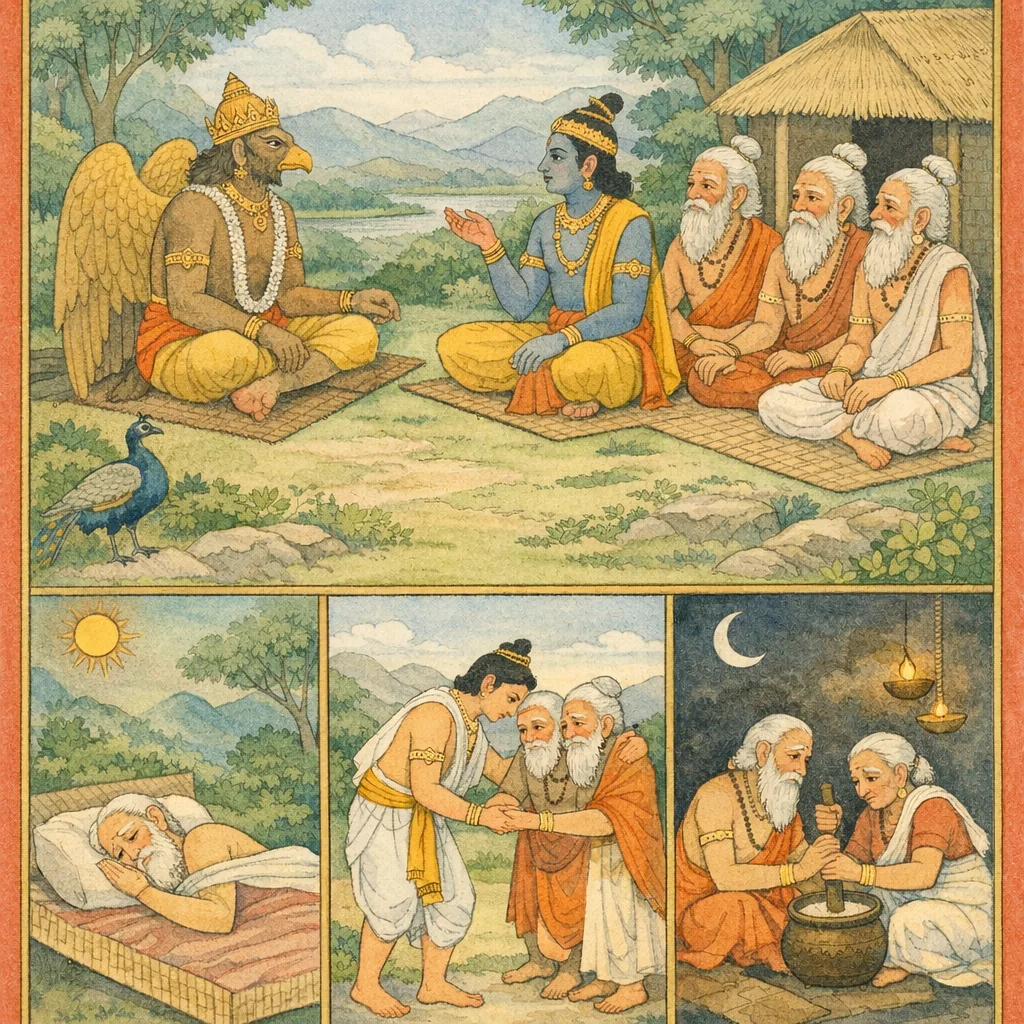
Adhyaya 114
Nīti on Friendship (Mitra), Discretion, Restraint, Health-Regimens, Prosperity (Śrī), and Family Dharma
Sūta teaches Śaunaka that friendship and enmity are not innate but arise from circumstances, yet a true friend is a rare refuge of trust. He urges the safeguarding of harmony by avoiding gambling, misuse of wealth, and secret adultery, and he stresses sense-control and prudent discretion, including keeping one’s faults and mantras concealed. The chapter blends social strategy—measured softness and severity, vigilance even with allies—with moral psychology: protect the mind, for bodily vitality depends upon it. A long nīti-āyus section lists dietary and behavioral cautions (sleep, curd at night, day-sleep, dawn intercourse, hygiene) and auspicious/inauspicious signs (dust, shadows), linking conduct to longevity and to Lakṣmī’s abiding presence. It then turns to progeny and lineage: one virtuous son uplifts a family; education and discipline are given in stages by age; after the father’s death the eldest brother becomes protector. Finally, it warns against theft disguised as charity, offenses against Devas and brāhmaṇas, and declares ingratitude uniquely inexpiable—joining household ethics to karmic consequence and to the mokṣa-oriented value of Hari-nāma.
Shlokas
Verse 1
ऽध्यायः सूत उवाच / न कश्चित्कस्यचिन्मित्रं न कश्चित्कस्यचिद्रिपुः / कारणादेव जायन्ते मित्राणि रिपवस्तथा
Sūta said: No one is inherently anyone’s friend, and no one is inherently anyone’s enemy. Only due to causes and circumstances do friendships arise—and likewise enmities.
Verse 2
शोकत्राणं भयत्राणं प्रीतिविश्वासभाजनम् / केन रत्नांमदं सृष्टं मित्रमित्यक्षरद्वयम्
A friend is a refuge from sorrow, a refuge from fear, and a vessel of love and trust. By whom was this jewel—this two-syllabled word “mitra” (friend)—created?
Verse 3
सकृदुच्चरितं येन हरिरित्यक्षरद्वयम् / बद्धः परिकरस्तेन मोक्षाय गमनं प्रति
For the one who has uttered even once the two-syllabled name “Hari,” the provisions for the journey are secured—toward going to mokṣa (liberation).
Verse 4
न मातरि न दारेषु न सोदर्ये न चात्मजे / विश्वासस्तादृशः पुंसां यादृङ्मित्रे स्वभावजे
A man places such trust neither in his mother, nor in his wife, nor in his own sister, nor even in his son—such as the trust he places in a friend congenial by nature.
Verse 5
यदिच्छेच्छाश्वतीं प्रीतिं त्रीन्दोषान्परिवर्जयेत् / द्युतमर्थप्रयोगञ्च परोक्षे दारदर्शनम्
If one desires lasting harmony and affection, one should avoid three faults: gambling, the wrongful use of wealth, and clandestine association with another’s wife in her husband’s absence.
Verse 6
मात्रा स्वस्त्रा दुहित्रा वा न विविक्तासनो वसेत् / बलवानिन्द्रियग्रामो विद्वांसमपि कर्षति
One should not sit in seclusion with one’s mother, sister, or daughter; for the collective force of the senses is powerful and can drag even a learned person astray.
Verse 7
विपरीतरतिः कामः स्वायतेषु न विद्यते / यथोपायो वधो दण्डस्तथैव ह्यनु वर्तते
Desire that seeks perverse pleasure is not found among the self-controlled. And whatever method is adopted—be it killing or punishment—that very consequence surely follows after.
Verse 8
अपि कल्पानिलस्यैव तुरगस्य महोदधेः / शक्यते प्रसरो बोद्धुं न ह्यरक्तस्ये चतसः
One may be able to comprehend the vast expanse of the aeon-long wind, of a swift horse, or of the great ocean; but the ways of one who is not devoted cannot truly be understood.
Verse 9
क्षणो नास्ति रहो नास्ति न स्ति प्रार्थयिता जनः / तेन शौनक नारीणां सतीत्वमुपजायते
There is not even a moment of privacy, no hidden place, and no one to plead on their behalf; therefore, O Śaunaka, the satītvam—the sacred chastity of women—comes to be established.
Verse 10
एक वै सेवते नित्यमन्यश्चेतपि रोचते / पुरुषाणामलाभेन नारी चैव पतिव्रता
One woman serves her husband constantly, while another may be drawn elsewhere; yet when men are not available, a woman is still regarded as pativratā—devoted to her husband.
Verse 11
जननी यानि कुरुते रहस्यं मदनातुरा / सुतैस्तानि न चिन्त्यानि शीलविप्रतिपत्तिभिः
Whatever secret acts a mother may do when overcome by passion—her sons should not brood over them, nor judge them as lapses of conduct.
Verse 12
पराधीना निद्रा परदृदयकृत्यानुसरणं सदा हेला हास्यं नियतमपि शोकेन रहितम् / पणे न्यस्तः कायो विटजनखुरैर्दारितगलो बहूत्कण्ठवृतिर्जगति गणिक्राया बहुमतः
Her sleep depends on others; she is ever compelled to follow the demands of other people’s hearts. Constantly there is careless laughter and forced mirth, yet it is devoid of true sorrow. Her body is wagered in gambling; her throat is torn by the hooves of lustful men. Living by many “throats” (many patrons), in the world the courtesan is nevertheless considered “highly valued.”
Verse 13
अग्निरापः स्त्रियो मूर्खाः सर्पा राजकुलानि च / नित्यं परोपसेव्यानि सद्यः प्राणहराणि षट्
Fire, water, women, fools, serpents, and royal households—these six should always be approached with caution and with heed to others’ guidance, for they can swiftly become causes of death.
Verse 14
किं चित्रं यदि वेद (शब्द) शास्त्रकुशलो विप्रो भवेत्पण्डितः किं चित्रं यदि दण्डनीतिकुशलो राजा भवेद्धार्मिकः / किं चित्रं यदि रूपयौवनवती साध्वी भवेत्कामिनी तच्चित्रं यदि निर्धनो ऽपि पुरुषः पापं न कुर्यात्क्रचित्
What wonder is it if a brāhmaṇa, skilled in the Vedas and the śāstras of sacred speech, becomes a learned scholar? What wonder if a king, skilled in the science of punishment and governance, becomes righteous in Dharma? What wonder if a chaste woman, endowed with beauty and youth, is also desirous? But this alone is truly wondrous—if even a poor man does not commit sin at any time.
Verse 15
नात्मच्छिद्रं परे दद्याद्विद्याच्छिद्रं परस्य च / गूहेत्कूर्म इवाङ्गानि परभावञ्च लक्षयेत्
One should not disclose one’s own faults to others, yet should discern the faults of others. Like a tortoise drawing in its limbs, one should keep oneself guarded and also observe the intentions and disposition of others.
Verse 16
पातालतलवा सिन्य उच्चप्राकारसंस्थिताः / यदि नो चिकुरोद्भेदाल्लभ्यन्ते कैः स्त्रियो न हि
Even if they are hidden in the nether regions of Pātāla or stationed behind lofty ramparts, if women are not obtained merely by the parting of hair, then by what means, indeed, are women obtained?
Verse 17
समधर्मा हि मर्मज्ञस्तीक्ष्णः स्वजनकण्टकः / न तथा बाधते शत्रुः कृतवैरो बहिः स्थितः
Even one who appears righteous, yet is sharp-tongued and skilled at striking vulnerable points—becoming a thorn within one’s own circle—harms more; an enemy who has declared hostility and stands outside does not afflict one so much.
Verse 18
स पण्डितो यो ह्यनुञ्जयेद्वै मिष्टेन बालं विनियेन शिष्टम् / अर्थेन नारीं तपसा हि देवान्सर्वांश्च लोकांश्च सुसंग्रहेण
Truly wise is the one who wins over a child with sweets, a disciplined student with proper guidance, a woman with material support, the gods (devas) with austerity (tapas)—and all people and worlds through good management and harmonious conduct.
Verse 19
छलेन मित्रं कलुषेण धर्मं परोपतापेन समृद्धिभावनम् / सुखेन विद्यां पुरुषेण नारीं वाञ्छन्ति वै ये न च पण्डितास्ते
Those who seek a friend through deceit, dharma through impurity, prosperity by tormenting others, learning through ease, and a woman through mere manhood—such people are not wise at all.
Verse 20
फलार्थो फलिनं वृक्षं यश्छिन्द्याद्दुर्मतिर्नरः / निष्फलं तस्य वै कार्यां महादोषमवाप्नुयात्
A foolish man who, desiring fruit, cuts down a fruit-bearing tree makes his own purpose fruitless and thereby incurs a great fault (sin).
Verse 21
सधनो हि तपस्वी च दूरतो वै कृतश्रमः / मद्यप स्त्री सतीत्येवं विप्र न श्रद्दधाम्यहम्
O brāhmaṇa, I do not believe these claims—that an ascetic is truly wealthy, that toil can be undone from afar, or that a woman who drinks liquor is ‘chaste’ (satī).
Verse 22
न विश्वसेदविश्वस्ते मित्रस्यापि न विश्वसेत् / कदाचित्कुपितं मित्रं सर्वं गुह्यं प्रकाशयेत्
Do not place trust in one who is untrustworthy; even in a friend, one should not place complete trust. For at some time, an angered friend may reveal every secret.
Verse 23
सर्वभूतेषु विश्वासः सर्वभूतेषु सात्त्विकः / स्वबावमात्मना गूहेदेतत्साधोर्हि लक्षणम्
Trusting all beings and remaining sattvic—pure and benevolent—toward all beings, while keeping one’s own nature restrained within oneself: this indeed is the mark of a true good person (sādhu).
Verse 24
यस्मिन्कस्मिन्कृते कार्ये कर्तारमनुवर्तते / सर्वथा वर्तमानो ऽपि धैर्यबुद्धिन्तु कारयेत्
In whatever task is undertaken, one should follow the guidance of the doer and leader. Even while fully engaged in every way, one should see that the work is carried out with a mind endowed with steadiness and courage.
Verse 25
वृद्धाः स्त्रियो नवं मद्यं शुष्कं मांसं त्रिमूलकम् / रात्रौ दधि दिवा स्वप्नं विद्वान्षट् परिवर्जयेत्
A wise person should avoid these six: association with aged women, freshly prepared liquor, dried meat, the herbal triad (trimūlaka), curd at night, and sleeping during the daytime.
Verse 26
विषं गोष्ठी दरिद्रस्य वृद्धस्य तरुणी विषम् / विषं कुशिक्षिता विद्या अजीर्णे भोजनं विषम्
For a poor man, social company is like poison; for an old man, a young woman is poison. Poorly learned knowledge is poison; and food taken when digestion is impaired is poison.
Verse 27
प्रियं गानमकुण्ठस्य नीचस्योच्चासनं प्रियम् / प्रियं दानं दरिद्रस्य भूनश्चतरुणी प्रिया
To one who is hoarse, singing is dear; to a lowly person, a high seat is dear. To the poor, giving is dear; and to one who is old, a young woman is dear.
Verse 28
अत्यम्बुपानं कठिनाशनञ्च धातुक्षयोवेगविधारणञ्च / दिवाशयो जागरणञ्च रात्रौ षड्भिर्नराणां निवसन्ति रोगाः
Diseases take up residence in people because of six habits: excessive drinking of water, eating heavy and hard-to-digest foods, depletion of the bodily tissues (dhātu), suppression of natural urges, sleeping in the daytime, and staying awake at night.
Verse 29
बालातपश्चाप्यतिमैथुनञ्च श्मशानधूमः करतापनञ्च / रजस्वलावत्क्रनिरीक्षणञ्च सुदीर्घमायुर्ननु कर्षयेच्च
Harsh sun-exposure from childhood, excessive indulgence in intercourse, inhaling the smoke of the cremation-ground, overheating or burning the hands, and gazing upon the genital region of a menstruating woman—these indeed diminish even a very long lifespan.
Verse 30
शुष्कं मांसं स्त्रियो वृद्धा बालार्कस्तरुणं दधि / प्रभाते मैथुनं निद्रा सद्यः प्राणहराणि षट्
Six things are said to destroy life at once: dried meat; intercourse with an aged woman; exposure to the tender morning sun; freshly set curd; intercourse at dawn; and sleeping at dawn.
Verse 31
सद्यः पक्रघृतं द्राक्षा बाला स्त्री क्षीरभोजनम् / उष्णोदकं तरुच्छाया सद्यः प्राणहराणि षट्
Freshly prepared ghee, grapes, a very young girl, indulgence in milk-based foods, hot water, and resting in a tree’s shade—these six are said to destroy life at once (in certain vulnerable conditions).
Verse 32
कूपादकं वटच्छाया नारीणाञ्च पयोधरः / शीतकाले भवेदुष्णमुष्णकाले च शीतलम्
Water drawn from a well, the shade of a banyan tree, and a woman’s breasts: in the cold season they feel warm, and in the hot season they feel cool.
Verse 33
त्रयो बलकराः सद्यो बालाभ्यङ्गसुभोजनम् / त्रयो बलहराः सद्यो ह्यध्वा वे मैथुनं ज्वरः
Three things immediately increase strength: oil-anointing and massage for a child, and wholesome food. Three things immediately drain strength: long travel, intercourse, and fever.
Verse 34
शुष्कं मांसं पयो नित्यं भार्यामित्रैः सहैव तु / न भाक्तव्यं नृपैः सार्धं वियोगं कुरुते क्षणात्
Do not eat dried meat, nor drink milk as a daily habit; and do not dine together with your wife’s friends. Nor should one share a meal with kings, for such association can bring separation in an instant.
Verse 35
कुचेलिन दन्तमलोपधारिणं बह्वाशिनं निष्ठुरवाक्यभाषिणम् / सूर्योदये ह्यस्तमये ऽपि शायिनं विमुञ्चति श्रीरपि चक्रपाणिनम्
Even Śrī—prosperity and good fortune—abandons a man, yes, even one devoted to the Discus-bearing Lord, if he is slovenly in dress, keeps filth upon his teeth, overeats, speaks harshly, and lies down to sleep at sunrise as well as at sunset.
Verse 36
नित्यं छेदस्तृणानं धरणिविलखनं पादयोश्चापमार्ष्टिः दन्तानामप्यशौचं मलिनवसनता रूक्षता मूर्धजानाम् / द्वे सध्ये चापि निद्रा विवसनशयनं ग्रासहासातिरेकः स्वाङ्गे पीठे च वाद्यं निधनमुपनयेत्केशवस्यापि लक्ष्मीम्
Constantly cutting grass, scraping or digging the earth, rubbing the feet, keeping the teeth unclean, wearing soiled clothes, letting the hair become dry and rough; sleeping at the two twilight junctions; lying down naked; excessive laughing while eating; and beating one’s own body or the seat/bed—such habits bring ruin and drive away even the Lakṣmī of Keśava (prosperity departs even from a devotee).
Verse 37
शिरः सुधौतं चरणौ सुमार्जितौ वराङ्गनासेवनमल्पभोजनम् / अनग्नशायित्वमपर्वमैथुनं चिरप्रनष्टां श्रियमानयन्ति षट्
Keeping the head well washed, the feet well cleaned, associating with virtuous women, eating sparingly, sleeping without fire (luxurious heating), and avoiding sexual union on forbidden days—these six practices bring back prosperity that had long been lost.
Verse 38
यस्य कस्य तु पुष्पस्य पाणाडरस्य विशेषतः / शिरसा धार्यमाणस्य ह्यलक्ष्मीः प्रतिहन्यते
By wearing upon one’s head any flower—especially the pāṇāḍara flower—alakṣmī (misfortune) is driven away.
Verse 39
दीपस्य पश्चिमा छाया छाया शय्यासनस्य च / रजकस्य तु यत्तीर्थलक्ष्मीस्तत्र तिष्ठति
The western shadow of a lamp, the shadow of a bed or seat, and whatever belongs to a washerman—there, it is said, abides the auspicious fortune of sacred fords (tīrtha-lakṣmī).
Verse 40
बालातपः प्रेतधूमः स्त्री वृद्धा तरुणं दधि / आयुष्कामो न सेवेत तथा संमार्जनीरजः
One who seeks longevity should avoid the harsh, immature heat of the sun (balātapa), the smoke connected with the dead (pretadhūma), an aged woman, freshly made curd, and likewise the dust raised by sweeping.
Verse 41
गजाश्वरथधान्यानां गवाञ्चैव रजः शुभम् / अशुभं च विजानीयात्खरोष्ट्रजाविकेषु च
Dust associated with elephants, horses, chariots, grains, and cows should be understood as auspicious; but in the case of donkeys, camels, and goats/sheep, it should be known as inauspicious.
Verse 42
गवां रजो धान्यरजः पुत्रस्याङ्गभवं रजः / एतद्रजो महाशस्तं महापातकनाशनम्
The dust from cows, the dust from grains, and the dust that arises from a son’s body—this dust is declared supremely efficacious, a destroyer of even the greatest sins.
Verse 43
अजारजः खररजो यत्तु संमार्जनीरजः / एतद्रजो महापापं महाकिल्बिषकारकम्
The dust from goats, the dust from donkeys, and the dust raised by sweeping—such dust is a great sin, a cause of grievous demerit.
Verse 44
शूर्पवातो नखाग्राम्बु स्नानवस्त्रमृजोदकम् / केशाम्बु मार्जनीरेणुर्हन्ति पुण्यं पुरा कृतम्
The dust raised by winnowing, the water from the tips of the nails, the water used to wash bathing-clothes, the water that cleanses bodily impurities, the water from washing the hair, and the dust from sweeping—these destroy the merit (puṇya) earned before.
Verse 45
विप्रयोर्विप्रवह्न्योश्च दम्पत्योः स्वामिनोस्तथा / अन्तरेण न गन्तव्यं हयस्य वृषभस्य च
One should not pass between two brāhmaṇas, between two sacred fires, between husband and wife, or between oneself and one’s master; likewise, one should not go between a horse and a bull.
Verse 46
स्त्रीषु राजाग्निसर्पेषु स्वाध्याये शत्रुसेवने / भोगास्वादेषु विश्वासं कः प्राज्ञः कर्तुमर्हति
In women, in kings, in fire and snakes, in one’s own sacred study (svādhyāya), in serving an enemy, and in the tastes of sense-pleasure—what wise person would place trust?
Verse 47
न विश्वसेदविश्वस्तं विश्वस्तं विश्वस्तं नातिविश्वसेत् / विश्वासाद्भयमुत्पन्नं मूलादपि निकृन्तति
Do not trust the untrustworthy; and even one who seems trustworthy should not be trusted too much. For fear born of misplaced trust can cut a person down from the very root.
Verse 48
वैरिणा सह सन्धाय विश्वस्तो यदि तिष्ठति / स वृक्षाग्रे प्रसुप्तो हि पतितः प्रतिबुध्यते
If, after making a pact with an enemy, one remains trusting and unguarded, he is like a man asleep atop a tree—he awakens only after he has fallen.
Verse 49
नात्यन्तं मृदुना भाव्यं नात्यन्तं कूरकर्मणा / मृदुनैव मृदुं हन्ति दारुणेनैव दारुणम्
One should not behave with excessive softness, nor act with extreme harshness. The gentle is subdued by gentleness, and the severe is checked by severity.
Verse 50
नात्यन्तं सरलैर्भाव्यं नात्यन्तं मृदुना तथा / सरलास्तत्र छिद्यन्ते कुब्जास्तिष्ठन्ति पादपाः
One should not be excessively straightforward, nor excessively soft and yielding. For in this world the straight trees are cut down, while the crooked trees remain standing.
Verse 51
नमन्ति फलिनो वृक्षा नमन्ति गुणिनो जनाः / शुष्कवृक्षाश्च मूर्खाश्च भिद्यन्ते न नमन्ति च
Fruit-laden trees bend low; so too do people of virtue bow in humility. But dry trees and foolish persons break—yet they do not bend.
Verse 52
अप्रार्थितानि दुः खानि यथैवायान्ति यान्ति च / मार्जार इव लुम्पेत तथा प्रार्थयितार नरः
Unasked-for sorrows come of their own accord and depart as well; but the man who goes about begging for favors or gains is plundered, like a cat.
Verse 53
पूर्वं पश्चाच्चरन्त्यार्ये सदैव बहुसम्पदः / विपरीतमनार्ये च यथेच्छसि तथा चर
For the noble, prosperity ever follows—before and behind. But for the ignoble, it is the opposite. Therefore live as you choose: choose the way of the noble.
Verse 54
षट्कर्णो भिद्यते मन्त्रश्चतुः कर्णश्चधार्यते / द्विकर्णस्य तु मन्त्रस्य ब्रह्माप्यन्त न बुध्यते
A mantra is said to be “broken” when it falls into six ears; it should be safeguarded within four. But a mantra kept only between two ears—held in strict secrecy—even Brahmā cannot fathom the limit of its power.
Verse 55
तया गवा किं क्रियते या न दोग्ध्री न गर्भिणी / कोर्ऽथ पुत्रेण जातेन यो न विद्वान्न धार्मिकः
What use is a cow that neither yields milk nor conceives? Likewise, what use is a son who is born, yet is neither learned nor righteous in dharma?
Verse 56
एकेनापि सुपुत्रेण विद्यायुक्तेन धीमता / कुलं पुरुषसिंहेन चन्द्रेण गगनं यथा
Even a single good son—endowed with learning and wisdom—can uplift and illumine the whole family, just as the moon, a lion among men, lights up the sky.
Verse 57
एकेनापि सुवृक्षेण पुष्पितेन सुगन्धिना / वनं सुवासितं सर्वं सुपुत्रेण कुलं यथा
Even a single excellent tree, in blossom and sweet with fragrance, perfumes an entire forest; likewise, one virtuous son brings honor and goodness to a whole family line.
Verse 58
एको हि गुणवान्पुत्रो निर्गुणेन शतेन किम् / चन्द्रो हन्ति तमांस्येको न च ज्योतिः सहस्रकम्
One virtuous son alone is enough—what use are a hundred sons without virtue? A single moon dispels the darkness; a thousand lamps cannot do the same.
Verse 59
लालयेत्पञ्च वर्षाणि दश वर्षाणि ताडयेत् / प्राप्ते तु षोडशे वर्षे पुत्रं मित्रवदाचरेत्
For five years one should cherish the child; for the next ten years one should discipline him; but when the sixteenth year is reached, one should treat the son as a friend.
Verse 60
जायमानो हरेद्दारान् वर्धमानो हरेद्धनम् / म्रियमाणो हरेत्प्राणान्नास्ति पुत्रसमो रिपुः
At birth he takes away a man’s wife; as he grows he takes away wealth; and at death he takes away life-breath itself—there is no enemy equal to a son.
Verse 61
केचिन्मृगमुखा व्याघ्राः केचिद्व्याघ्रमुखा मृगाः / तत्स्वरूपपहिज्ञाने ह्यविश्वासः पदेपदे
Some are tigers with the faces of deer, and some are deer with the faces of tigers; because their true nature is hard to recognize, distrust arises at every step.
Verse 62
एकः क्षमावतां दोषो द्वितीयो नोपपद्यते / यदेनं क्षमया युक्तमशक्तं मन्यते जनः
Only one ‘fault’ is found in the forgiving; no second fault truly applies—because people, seeing one endowed with forbearance, mistakenly think him weak.
Verse 63
एतदेवानुमन्येत भोगा हि क्षणभङ्गिनः / स्निग्धेषु च विदग्धस्य मतयो वै ह्यनाकुलाः
Accept this as true: worldly enjoyments are indeed momentary and quickly perish. Even amid pleasant and enticing things, the mind of the discerning remains steady and unconfused.
Verse 64
ज्येष्ठः पितृसमो भ्राता मृते पितरि शौनक / सर्वेषां स पिता हि स्यात्सर्वेषामनुपालकः
O Śaunaka, when the father has died, the eldest brother—equal to a father—indeed becomes the father of all, the protector and caretaker of everyone.
Verse 65
कनिष्ठेषु च सर्वेषु समत्वेनानुवर्तते / समापभोगजीवेषु यथैवं तनयेषु च
Among all the younger ones too, one should act with impartiality; and likewise among those who share equal livelihood and enjoyments—so also toward one’s own sons.
Verse 66
बहूनामल्पसाराणां समवायो हि दारुणः / तृणैरावेष्टिता रज्जुस्तया नागो ऽपि बध्यते
The combined force of many, even if each is weak, is indeed formidable; for a rope wrapped with blades of grass can, by that very means, bind even a serpent.
Verse 67
अपहृत्य परस्वं हि यस्तु दानं प्रयच्छति / स दाता नरकं याति यस्यार्थास्तस्य तत्फलम्
Whoever gives charity after stealing another’s wealth—such a ‘donor’ goes to hell; the fruit of that act belongs to the true owner of the wealth.
Verse 68
देवद्रव्यविनाशेन ब्रह्मस्वहरणेन च / कुलान्यकुलतां यान्ति ब्राह्मणातिक्रमेण च
By destroying property dedicated to the Devas, by stealing what belongs to Brahmins, and by transgressing against Brahmins, even noble families fall into disgrace and lose their honored standing.
Verse 69
ब्रह्मघ्ने च सुरापे च चोरे भग्नव्रते तथा / निष्कृतिर्विहिता सद्भिः कृतघ्ने नास्ति निष्कृतिः
For the slayer of a brāhmaṇa, the drinker of intoxicants, the thief, and likewise the breaker of vows, the virtuous have ordained expiations; but for the ungrateful person there is no expiation.
Verse 70
नाश्रन्ति पितरो देवाः क्षुद्रस्य वृषलीपतेः / भार्याजितस्य नाश्रन्ति यस्याश्चोपपतिर्गृहे
The Pitṛs and the Devas do not accept the offerings of a base man ruled by a low woman; nor do they accept those of one dominated by his wife, or of the man in whose house his wife keeps a paramour.
Verse 71
अकृजज्ञमनार्यञ्च दीर्धरोषमनार्जवम् / चतुरो विद्धि चाण्डालाञ्जात्या जायेत पञ्चमः
Know four kinds of people as caṇḍālas: the ungrateful, the ignoble, the long-resentful, and the dishonest. One who is born as a fifth is an outcaste by birth.
Verse 72
नोपेक्षितव्यो दुर्बद्धि शत्रुरल्पो ऽप्यवज्ञया / वह्निरल्पो ऽप्यसंहार्यः कुरुते भस्मसाज्जगत्
Even a small enemy of wicked intelligence should not be neglected out of contempt; even a small fire, if not extinguished, can reduce the world to ashes.
Verse 73
नवे वयसि यः शान्तः स शान्त इति मे मतिः / धातुषु क्षीयमाणेषु शमः कस्य न जायते
In my view, the one who is tranquil while still in the freshness of youth is truly tranquil; for when the bodily constituents begin to decline, in whom does calmness not arise?
Verse 74
पन्थान इव विप्रेन्द्र सर्वसाधारणाः श्रियः / मदीया इति मत्वा वै न हि हर्षयुतो भवेत्
O best of brāhmaṇas, prosperities are common to all, like public roads. Thinking, “This is mine,” one should not become elated.
Verse 75
चित्तायत्तं धातुवश्यं शरीरं चित्ते नष्टे धातवो यान्ति नाशम् / तस्माच्चित्तं सर्वदा रक्षणीयं स्वस्थे चित्ते धातवः सम्भवन्ति
The body, governed by the dhātus, depends upon the mind. When the mind is ruined, the dhātus fall into destruction. Therefore the mind must always be protected; when the mind is healthy, the dhātus thrive.
Frequently Asked Questions
It teaches graded confidentiality: a mantra is said to become ‘broken’ when it spreads to “six ears,” should be preserved within “four ears,” and when kept to “two ears” (strictly private/limited transmission) its potency is portrayed as immeasurable—underscoring mantra-rakṣā (guarding sacred speech) and disciplined transmission.
Prosperity is depicted as leaving even a devotee when habits are degrading—slovenly dress, unclean teeth, overeating, harsh speech, sleeping at sunrise/sunset, and other indisciplines. Conversely, cleanliness (head/feet), virtuous company, moderation in eating, restrained sexuality (avoiding forbidden days), and simpler sleep are listed as practices that restore lost prosperity.
The text states that expiations exist for grave sins (brahma-hatyā, intoxication, theft, vow-breaking), but for the ungrateful person there is no expiation—framing kṛtaghnatā as a foundational breach of dharma that corrodes social and spiritual order at the root.
It proposes a staged approach: cherish the child for five years, discipline for the next ten, and from the sixteenth year relate as a friend—aiming to produce a virtuous, learned son who can uplift the family line.