Adhyaya 29
Bhakti Yoga: The Three Modes of Devotion, Non-Envy, and Time as the Lord
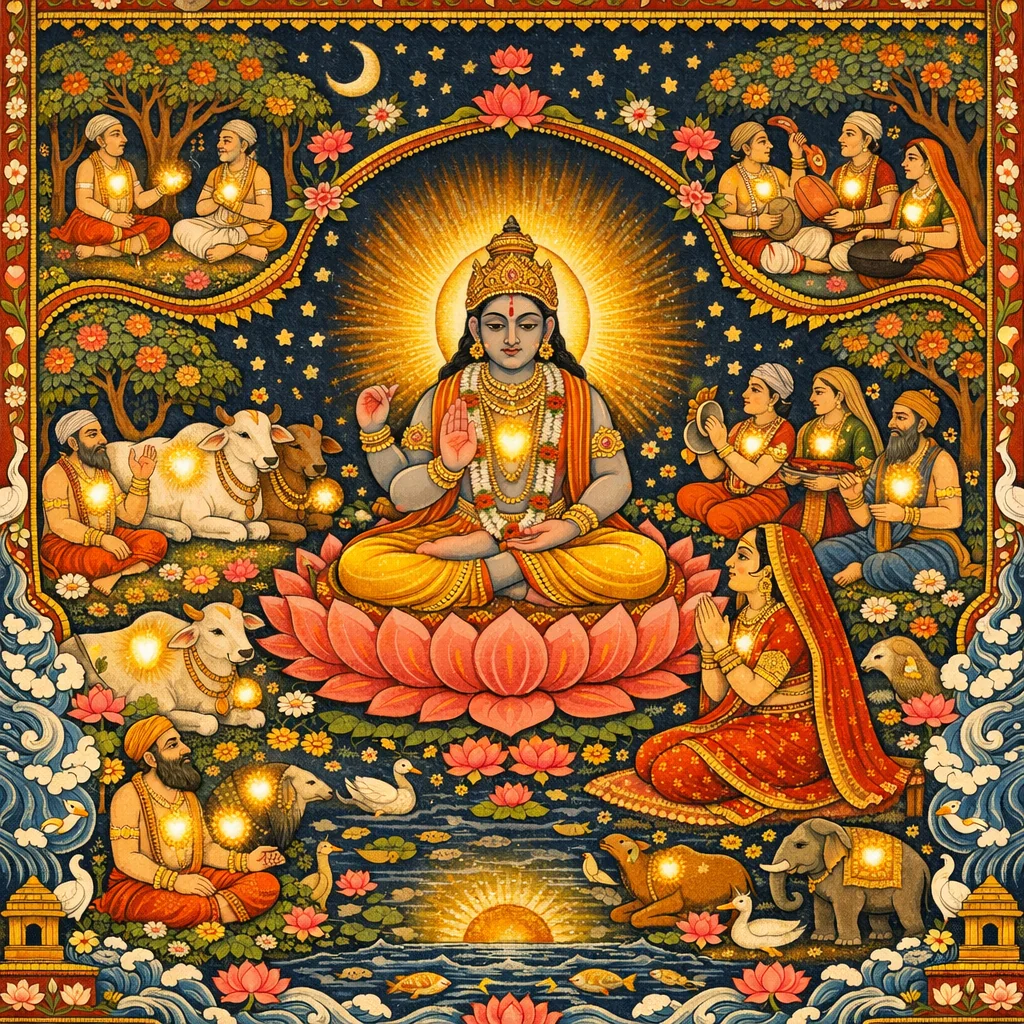
Continuing Kapila’s Sāṅkhya teaching on matter and spirit, Devahūti asks for the decisive path—bhakti-yoga, devotional service—and for instruction on saṁsāra (birth and death) and kāla (eternal time). Maitreya recounts Kapila’s compassionate reply: bhakti appears in grades shaped by the guṇas—tāmasika devotion marked by envy and violence, rājasika devotion driven by enjoyment and prestige, and sāttvika devotion offered to cleanse intoxication with karmic fruits. Kapila then defines śuddha-bhakti as spontaneous, uninterrupted attraction to hearing the Lord’s names and qualities, flowing naturally like the Gaṅgā to the ocean, and notes that a pure devotee rejects even the five kinds of liberation. The chapter moves from temple worship to universal God-vision: Deity worship that fails to recognize Paramātmā in all beings is condemned as imitation; true worship shows non-envious respect and equal vision. Kapila ranks living beings and human excellence, culminating in the pure devotee as the highest. The discourse then widens to cosmology: time is the Lord’s feature, feared by the ignorant, and all cosmic order operates “out of fear” of Him, leading into deeper reflections on kāla and dissolution in later teachings.
Shlokas
Verse 1
देवहूतिरुवाच लक्षणं महदादीनां प्रकृते: पुरुषस्य च । स्वरूपं लक्ष्यतेऽमीषां येन तत्पारमार्थिकम् ॥ १ ॥ यथा साङ्ख्येषु कथितं यन्मूलं तत्प्रचक्षते । भक्तियोगस्य मे मार्गं ब्रूहि विस्तरश: प्रभो ॥ २ ॥
Devahūti said: My Lord, according to Sāṅkhya You have clearly described the symptoms of material nature, beginning with the mahat-tattva, and the characteristics and true form of the puruṣa, the spirit. Now, O Master, please explain to me in detail the path of bhakti-yoga, the supreme conclusion of all philosophies.
Verse 2
देवहूतिरुवाच लक्षणं महदादीनां प्रकृते: पुरुषस्य च । स्वरूपं लक्ष्यतेऽमीषां येन तत्पारमार्थिकम् ॥ १ ॥ यथा साङ्ख्येषु कथितं यन्मूलं तत्प्रचक्षते । भक्तियोगस्य मे मार्गं ब्रूहि विस्तरश: प्रभो ॥ २ ॥
Devahūti said: O Bhagavān, just as Sāṅkhya teaches, You have revealed the symptoms and true nature of prakṛti and of the puruṣa, including the mahat-tattva. Therefore, O Lord, please instruct me in detail in the path of bhakti-yoga, the essence of all śāstra.
Verse 3
विरागो येन पुरुषो भगवन्सर्वतो भवेत् । आचक्ष्व जीवलोकस्य विविधा मम संसृती: ॥ ३ ॥
Devahūti continued: O Bhagavān, please describe in detail the many forms of saṁsāra in the world of living beings—the unbroken course of birth and death—so that by hearing of these miseries one may attain vairāgya, detachment from material activities.
Verse 4
कालस्येश्वररूपस्य परेषां च परस्य ते । स्वरूपं बत कुर्वन्ति यद्धेतो: कुशलं जना: ॥ ४ ॥
Please also describe eternal Time, which is a manifestation of Your form as the Supreme Lord, and by whose influence people in general become engaged in dharmic and pious works.
Verse 5
लोकस्य मिथ्याभिमतेरचक्षुष- श्चिरं प्रसुप्तस्य तमस्यनाश्रये । श्रान्तस्य कर्मस्वनुविद्धया धिया त्वमाविरासी: किल योगभास्कर: ॥ ५ ॥
My Lord, You are like the sun—the yogabhāskara—who illumines the darkness of conditioned life. Because the living beings’ eyes of knowledge are not opened, without Your shelter they sleep for a long time in that tamas; bound in the net of karma and its reactions, they appear greatly fatigued.
Verse 6
मैत्रेय उवाच इति मातुर्वच: श्लक्ष्णं प्रतिनन्द्य महामुनि: । आबभाषे कुरुश्रेष्ठ प्रीतस्तां करुणार्दित: ॥ ६ ॥
Śrī Maitreya said: O best of the Kurus, the great sage Kapila, pleased by the gentle words of His glorious mother and moved by compassion, spoke as follows.
Verse 7
श्रीभगवानुवाच भक्तियोगो बहुविधो मार्गैर्भामिनि भाव्यते । स्वभावगुणमार्गेण पुंसां भावो विभिद्यते ॥ ७ ॥
The Lord (Kapila) said: O noble lady, bhakti-yoga is of many kinds; according to one’s nature and qualities, its paths are conceived in various ways, and by the course of the guṇas the moods of people become differentiated.
Verse 8
अभिसन्धाय यो हिंसां दम्भं मात्सर्यमेव वा । संरम्भी भिन्नदृग्भावं मयि कुर्यात्स तामस: ॥ ८ ॥
Devotional service rendered to Me with intent of violence, hypocrisy, or envy—done in anger and with a separatist outlook—is considered bhakti in the mode of darkness (tamas).
Verse 9
विषयानभिसन्धाय यश ऐश्वर्यमेव वा । अर्चादावर्चयेद्यो मां पृथग्भाव: स राजस: ॥ ९ ॥
Worship of Me in the Deity form (arcā) with a separatist mentality, motivated by sense enjoyment, fame, or opulence, is devotion in the mode of passion (rajas).
Verse 10
कर्मनिर्हारमुद्दिश्य परस्मिन्वा तदर्पणम् । यजेद्यष्टव्यमिति वा पृथग्भाव: स सात्त्विक: ॥ १० ॥
When a devotee worships the Supreme Personality of Godhead to be freed from bondage to karmic results, or to offer those results to Him, with a sense of sacred duty and without a separatist mentality, that devotion is in the mode of goodness (sattva).
Verse 11
मद्गुणश्रुतिमात्रेण मयि सर्वगुहाशये । मनोगतिरविच्छिन्ना यथा गङ्गाम्भसोऽम्बुधौ ॥ ११ ॥ लक्षणं भक्तियोगस्य निर्गुणस्य ह्युदाहृतम् । अहैतुक्यव्यवहिता या भक्ति: पुरुषोत्तमे ॥ १२ ॥
By merely hearing My holy name and qualities—Me who dwells in the heart’s inner cave of all beings—the mind flows toward Me without break, as the waters of the Ganges naturally run to the ocean; this is the mark of nirguṇa bhakti-yoga.
Verse 12
मद्गुणश्रुतिमात्रेण मयि सर्वगुहाशये । मनोगतिरविच्छिन्ना यथा गङ्गाम्भसोऽम्बुधौ ॥ ११ ॥ लक्षणं भक्तियोगस्य निर्गुणस्य ह्युदाहृतम् । अहैतुक्यव्यवहिता या भक्ति: पुरुषोत्तमे ॥ १२ ॥
That devotion to Me, the Puruṣottama, which is causeless (ahaitukī) and unobstructed (avyavahitā), is declared to be the defining mark of nirguṇa bhakti-yoga.
Verse 13
सालोक्यसार्ष्टिसामीप्यसारूप्यैकत्वमप्युत । दीयमानं न गृह्णन्ति विना मत्सेवनं जना: ॥ १३ ॥
A pure devotee accepts no kind of liberation—sālokya, sārṣṭi, sāmīpya, sārūpya, or even ekatva—even if offered, when it is devoid of loving service to Me.
Verse 14
स एव भक्तियोगाख्य आत्यन्तिक उदाहृत: । येनातिव्रज्य त्रिगुणं मद्भावायोपपद्यते ॥ १४ ॥
This indeed is bhakti-yoga, declared to be the ultimate state: by it one surpasses the three guṇas and becomes situated in a transcendental condition akin to Mine.
Verse 15
निषेवितेनानिमित्तेन स्वधर्मेण महीयसा । क्रियायोगेन शस्तेन नातिहिंस्रेण नित्यश: ॥ १५ ॥
A devotee should perform one’s glorious prescribed duty without seeking material profit, and daily practice the śāstra-approved kriyā-yoga of devotion, avoiding excessive violence.
Verse 16
मद्धिष्ण्यदर्शनस्पर्शपूजास्तुत्यभिवन्दनै: । भूतेषु मद्भावनया सत्त्वेनासङ्गमेन च ॥ १६ ॥
A devotee should regularly behold My Deity in the temple, touch My lotus feet, worship Me with proper offerings, and honor Me with prayers, hymns, and obeisance. Situated in goodness and detachment, he should see My presence within all beings and thus regard every living entity as spiritual.
Verse 17
महतां बहुमानेन दीनानामनुकम्पया । मैत्र्या चैवात्मतुल्येषु यमेन नियमेन च ॥ १७ ॥
A pure devotee should offer the highest honor to the spiritual master and the ācāryas, show compassion to the poor, befriend those who are his equals, and perform all duties under yama and niyama, with disciplined regulation and control of the senses.
Verse 18
आध्यात्मिकानुश्रवणान्नामसङ्कीर्तनाच्च मे । आर्जवेनार्यसङ्गेन निरहङ्क्रियया तथा ॥ १८ ॥
A devotee should always hear spiritual topics and spend his time in chanting the Lord’s holy name in saṅkīrtana. His conduct should be straightforward and simple; free from envy and friendly to all, yet he should avoid the company of those who are not spiritually advanced.
Verse 19
मद्धर्मणो गुणैरेतै: परिसंशुद्ध आशय: । पुरुषस्याञ्जसाभ्येति श्रुतमात्रगुणं हि माम् ॥ १९ ॥
When one is endowed with these qualities of My dharma and his inner intention is fully purified, he becomes at once attracted simply by hearing My name or hearing of My transcendental qualities, and thus he comes to Me with ease.
Verse 20
यथा वातरथो घ्राणमावृङ्क्ते गन्ध आशयात् । एवं योगरतं चेत आत्मानमविकारि यत् ॥ २० ॥
As the chariot of the wind carries fragrance from its source and the sense of smell at once catches it, so the mind constantly engaged in bhakti-yoga can apprehend the Paramātmā—unchanging and equally present everywhere.
Verse 21
अहं सर्वेषु भूतेषु भूतात्मावस्थित: सदा । तमवज्ञाय मां मर्त्य: कुरुतेऽर्चाविडम्बनम् ॥ २१ ॥
I am ever present in all beings as the Paramātmā. One who neglects Me everywhere and merely worships the temple Deity performs only an imitation of devotion.
Verse 22
यो मां सर्वेषु भूतेषु सन्तमात्मानमीश्वरम् । हित्वार्चां भजते मौढ्याद्भस्मन्येव जुहोति स: ॥ २२ ॥
One who worships the temple Deity yet does not know Me as the Lord, Paramātmā dwelling in every heart, is in ignorance—like one who pours oblations into ashes.
Verse 23
द्विषत: परकाये मां मानिनो भिन्नदर्शिन: । भूतेषु बद्धवैरस्य न मन: शान्तिमृच्छति ॥ २३ ॥
One may honor Me, yet if he envies and hates the bodies of others and sees separation, he never attains peace of mind, for he is bound in enmity toward living beings.
Verse 24
अहमुच्चावचैर्द्रव्यै: क्रिययोत्पन्नयानघे । नैव तुष्येऽर्चितोऽर्चायां भूतग्रामावमानिन: ॥ २४ ॥
My dear sinless mother, even if one worships Me in the arcā with proper rites and many offerings, if he dishonors the multitude of living beings, I am not pleased.
Verse 25
अर्चादावर्चयेत्तावदीश्वरं मां स्वकर्मकृत् । यावन्न वेद स्वहृदि सर्वभूतेष्ववस्थितम् ॥ २५ ॥
While performing one’s prescribed duties, one should worship Me, the Supreme Lord, in the arcā form until one realizes My presence within one’s own heart and within the hearts of all beings.
Verse 26
आत्मनश्च परस्यापि य: करोत्यन्तरोदरम् । तस्य भिन्नदृशो मृत्युर्विदधे भयमुल्बणम् ॥ २६ ॥
Whoever, by a divisive outlook, makes even the slightest distinction between himself and other living beings—I become for him the blazing fire of death and bring about terrible fear.
Verse 27
अथ मां सर्वभूतेषु भूतात्मानं कृतालयम् । अर्हयेद्दानमानाभ्यां मैत्र्याभिन्नेन चक्षुषा ॥ २७ ॥
Therefore one should worship Me, who dwell in all beings as their very Self, by charity and honor, by friendly conduct, and by seeing all with an undivided vision.
Verse 28
जीवा: श्रेष्ठा ह्यजीवानां तत: प्राणभृत: शुभे । त: सचित्ता: प्रवरास्ततश्चेन्द्रियवृत्तय: ॥ २८ ॥
O blessed mother, living beings are superior to inert matter; among the living, those who manifest life symptoms are higher; higher still are those with developed consciousness, and higher yet are those whose senses are fully active.
Verse 29
तत्रापि स्पर्शवेदिभ्य: प्रवरा रसवेदिन: । तेभ्यो गन्धविद: श्रेष्ठास्तत: शब्दविदो वरा: ॥ २९ ॥
Among beings with developed senses, those endowed with taste are superior to those with only touch; superior to them are those with smell, and higher still are those endowed with hearing.
Verse 30
रूपभेदविदस्तत्र ततश्चोभयतोदत: । तेषां बहुपदा: श्रेष्ठाश्चतुष्पादस्ततो द्विपात् ॥ ३० ॥
Higher than those who merely hear sound are those who can distinguish one form from another; higher still are those with upper and lower rows of teeth; among them, the many-legged are superior; then the four-legged; and higher than all are the two-legged human beings.
Verse 31
ततो वर्णाश्च चत्वारस्तेषां ब्राह्मण उत्तम: । ब्राह्मणेष्वपि वेदज्ञो ह्यर्थज्ञोऽभ्यधिकस्तत: ॥ ३१ ॥
Among human beings, the fourfold social order arranged by qualities and work is best; within it, the brāhmaṇa is foremost. Among brāhmaṇas, the student of the Vedas is superior, and among such students, the one who knows the Vedas’ true purport is the highest.
Verse 32
अर्थज्ञात्संशयच्छेत्ता तत: श्रेयान्स्वकर्मकृत् । मुक्तसङ्गस्ततो भूयानदोग्धा धर्ममात्मन: ॥ ३२ ॥
Better than the brāhmaṇa who knows the Vedas’ purpose is one who can cut away all doubts; better than him is one who strictly performs his own sacred duty. Better still is one freed from all tainted attachment; and higher than all is the pure devotee who renders bhakti-service without seeking reward.
Verse 33
तस्मान्मय्यर्पिताशेषक्रियार्थात्मा निरन्तर: । मय्यर्पितात्मन: पुंसो मयि संन्यस्तकर्मण: । न पश्यामि परं भूतमकर्तु: समदर्शनात् ॥ ३३ ॥
Therefore I see none greater than the person who has no interest apart from Me and thus, without cessation, offers all activities and his entire life to Me—his very self surrendered to Me and his works laid down in Me—abiding as a non-doer with equal vision.
Verse 34
मनसैतानि भूतानि प्रणमेद्बहुमानयन् । ईश्वरो जीवकलया प्रविष्टो भगवानिति ॥ ३४ ॥
Such a perfected devotee offers reverence to every living being, for he is firmly convinced that Bhagavān, the Supreme Lord, has entered each body as Paramātmā, the indwelling controller.
Verse 35
भक्तियोगश्च योगश्च मया मानव्युदीरित: । ययोरेकतरेणैव पुरुष: पुरुषं व्रजेत् ॥ ३५ ॥
My dear mother, O daughter of Manu, I have taught both bhakti-yoga and yoga; by either one alone a person can attain the abode of the Supreme Purusha—especially through devotional service.
Verse 36
एतद्भगवतो रूपं ब्रह्मण: परमात्मन: । परं प्रधानं पुरुषं दैवं कर्मविचेष्टितम् ॥ ३६ ॥
This is the eternal form of Bhagavān, known as Brahman and Paramātmā. He is the supreme, transcendent Puruṣa, and all His activities are wholly spiritual.
Verse 37
रूपभेदास्पदं दिव्यं काल इत्यभिधीयते । भूतानां महदादीनां यतो भिन्नदृशां भयम् ॥ ३७ ॥
The divine principle that underlies the transformations of material forms is called Time (kāla). Those who see only difference in the mahat-tattva and other elements become fearful of that Time.
Verse 38
योऽन्त: प्रविश्य भूतानि भूतैरत्त्यखिलाश्रय: । स विष्ण्वाख्योऽधियज्ञोऽसौ काल: कलयतां प्रभु: ॥ ३८ ॥
Lord Viṣṇu, known as Adhiyajña, enters within all beings, supports everyone, and causes one creature to be destroyed by another. He Himself is kāla, the time factor, and the Lord of all lords.
Verse 39
न चास्य कश्चिद्दयितो न द्वेष्यो न च बान्धव: । आविशत्यप्रमत्तोऽसौ प्रमत्तं जनमन्तकृत् ॥ ३९ ॥
For the Supreme Personality of Godhead no one is especially dear, nor is anyone hated, nor is anyone friend or kinsman. Yet He inspires those who remain mindful of Him, and He brings destruction to those who, in heedlessness, have forgotten Him.
Verse 40
यद्भयाद्वाति वातोऽयं सूर्यस्तपति यद्भयात् । यद्भयाद्वर्षते देवो भगणो भाति यद्भयात् ॥ ४० ॥
Out of reverent fear of Bhagavān the wind blows; out of fear of Him the sun blazes. Out of fear of Him the devas send down rain, and out of fear of Him the hosts of heavenly bodies shine with their splendor.
Verse 41
यद्वनस्पतयो भीता लताश्चौषधिभि: सह । स्वे स्वे कालेऽभिगृह्णन्ति पुष्पाणि च फलानि च ॥ ४१ ॥
Out of awe of the Supreme Personality of Godhead, the trees, creepers, and healing herbs blossom and bear fruit, each in its own season.
Verse 42
स्रवन्ति सरितो भीता नोत्सर्पत्युदधिर्यत: । अग्निरिन्धे सगिरिभिर्भूर्न मज्जति यद्भयात् ॥ ४२ ॥
Out of fear of the Supreme Personality of Godhead, the rivers flow and the ocean never oversteps its bounds. Out of fear of Him alone fire burns, and the earth with its mountains does not sink into the waters of the universe.
Verse 43
नभो ददाति श्वसतां पदं यन्नियमादद: । लोकं स्वदेहं तनुते महान् सप्तभिरावृतम् ॥ ४३ ॥
Under His regulation, the sky grants space wherein the many worlds abide and sustain innumerable living beings. The vast universal body expands with its seven coverings, all under His supreme control.
Verse 44
गुणाभिमानिनो देवा: सर्गादिष्वस्य यद्भयात् । वर्तन्तेऽनुयुगं येषां वश एतच्चराचरम् ॥ ४४ ॥
Out of fear of the Supreme Personality of Godhead, the presiding demigods over the modes of nature perform, age after age, the works of creation, maintenance, and destruction; all that moves and does not move in this material world lies under their governance.
Verse 45
सोऽनन्तोऽन्तकर: कालोऽनादिरादिकृदव्यय: । जनं जनेन जनयन्मारयन्मृत्युनान्तकम् ॥ ४५ ॥
Eternal time, without beginning or end, is the representative of the Supreme Personality of Godhead. It brings one being forth from another to carry on creation, leads the phenomenal world to its end, and finally dissolves the universe by destroying even Yamarāja, the lord of death.
Frequently Asked Questions
Kapila describes (1) tāmasika bhakti as worship colored by envy, pride, violence and anger; (2) rājasika bhakti as Deity worship pursued for enjoyment, fame, and opulence; and (3) sāttvika bhakti as worship where one offers results to the Lord to become free from fruitive intoxication. Beyond all three is śuddha-bhakti—unmotivated, uninterrupted attraction to hearing and glorifying the Lord.
Because worship that honors the Deity while disregarding the Lord’s presence as Paramātmā in every living being is incomplete and rooted in ignorance. Such a practitioner retains a separatist, inimical outlook; therefore the ritual does not truly please the Lord, who is equally situated in all hearts.
It illustrates natural, uninterrupted movement: as the Gaṅgā flows effortlessly toward the ocean, the purified mind flows toward hearing and glorifying the Lord without obstruction from material conditions, motives, or guṇa-based interruptions.
They are sālokya (same planet), sārṣṭi (same opulence), sāmīpya (proximity), sārūpya (similar form), and ekatva (oneness/merging). A pure devotee values loving service itself over any liberated status, accepting only what supports bhakti and refusing liberation as an end in itself.
Kāla is presented as a feature/representation of the Supreme Personality of Godhead that drives transformation, creation, and dissolution. Those who do not recognize time as the Lord’s potency fear it, whereas the wise see it as divine governance under Viṣṇu’s supreme control.