Adhyaya 3
The Appearance of Lord Viṣṇu (Kṛṣṇa) and the Divine Exchange with Yoga-māyā
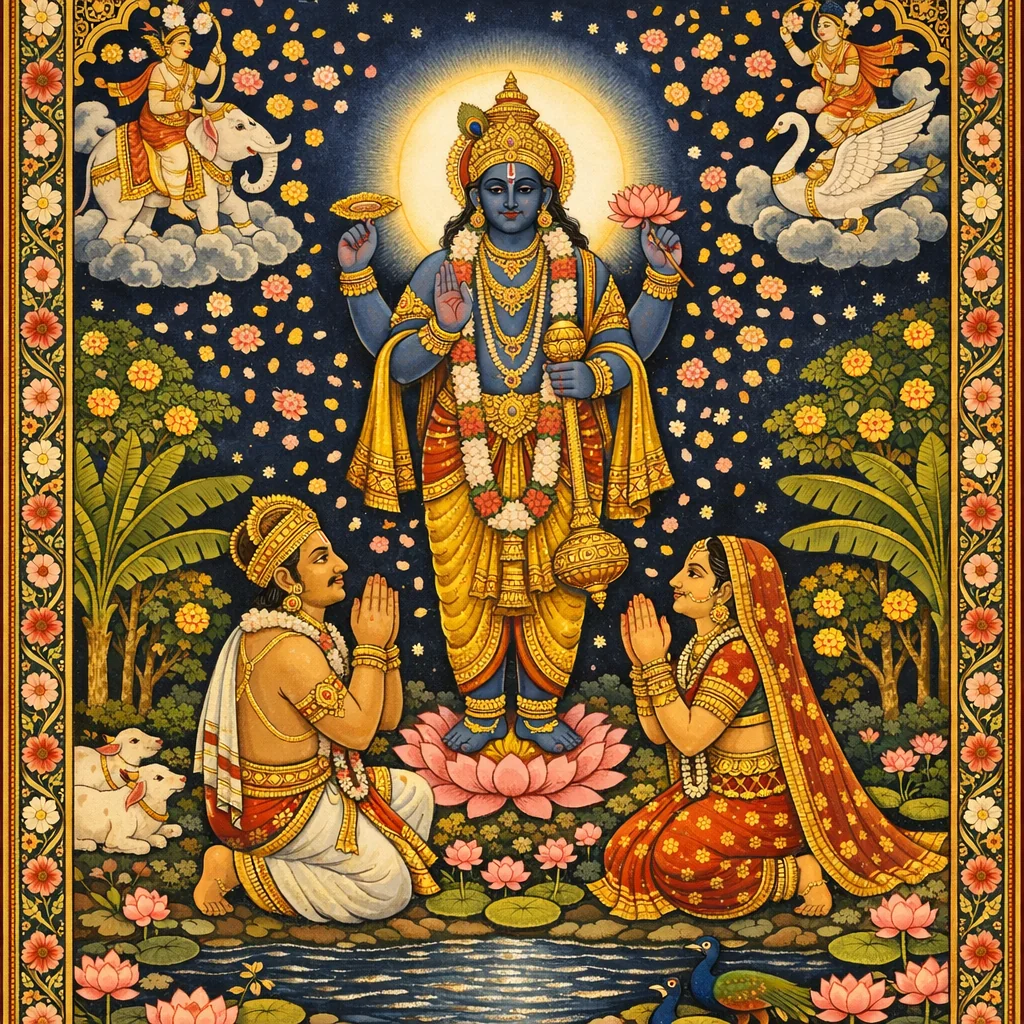
Continuing the Kaṁsa–Devakī–Vasudeva prison narrative, this chapter opens with cosmic auspiciousness at the Lord’s appearance: heaven, the directions, earth, rivers, and sacrificial fires grow calm as celestial beings rejoice. In the depth of night, Viṣṇu manifests from Devakī like the rising full moon, revealing a four-armed form bearing śaṅkha, cakra, gadā, and padma, marked with Śrīvatsa and the Kaustubha jewel. Vasudeva offers learned prayers, affirming the Lord’s transcendence beyond guṇas and senses, beyond the reach of speech and mind (avāṅ-mānasa-gocara). Devakī prays for protection from Kaṁsa and asks Him to conceal His divine form. The Lord recalls their prior births (Pṛśni/Sutapā; Aditi/Kaśyapa), explains His repeated descents, and then transforms into a human infant. Yoga-māyā is born in Nanda’s home; by her power the guards fall asleep, doors open, Ananta shelters Vasudeva, and the Yamunā yields a passage. Vasudeva exchanges the infants, setting the stage for Kaṁsa’s imminent reaction and the unfolding of Vraja-līlā.
Shlokas
Verse 1
श्रीशुक उवाच अथ सर्वगुणोपेत: काल: परमशोभन: । यर्ह्येवाजनजन्मक्षन शान्तर्क्षग्रहतारकम् ॥ १ ॥ दिश: प्रसेदुर्गगनं निर्मलोडुगणोदयम् । मही मङ्गलभूयिष्ठपुरग्रामव्रजाकरा ॥ २ ॥ नद्य: प्रसन्नसलिला ह्रदा जलरुहश्रिय: । द्विजालिकुलसन्नादस्तवका वनराजय: ॥ ३ ॥ ववौ वायु: सुखस्पर्श: पुण्यगन्धवह: शुचि: । अग्नयश्च द्विजातीनां शान्तास्तत्र समिन्धत ॥ ४ ॥ मनांस्यासन् प्रसन्नानि साधूनामसुरद्रुहाम् । जायमानेऽजने तस्मिन् नेदुर्दुन्दुभय: समम् ॥ ५ ॥
Śrī Śuka said: Then came the most splendid, auspicious time for the Lord’s appearance, and the entire universe became filled with goodness, beauty, and peace. The constellation Rohiṇī rose, and stars and planets such as Aśvinī were tranquil; the sun, the moon, and the rest were serene. All directions looked pleasing; the cloudless sky was pure and glittered with stars. The earth—adorned with towns, villages, mines, and the pastures of Vraja—seemed wholly auspicious. Rivers flowed with clear water; lakes and reservoirs shone with the beauty of lotuses and lilies. In forests and verdant plants, birds and swarms of bees sang sweetly. A pure breeze, gentle to the touch and carrying sacred fragrance, began to blow; and the sacrificial fires of the brāhmaṇas burned steadily, undisturbed by the wind. Thus, as the unborn Lord Viṣṇu was about to manifest, the sādhus and brāhmaṇas long harassed by Kaṁsa and the asuras felt peace within their hearts, and celestial kettledrums resounded together from the higher worlds.
Verse 2
श्रीशुक उवाच अथ सर्वगुणोपेत: काल: परमशोभन: । यर्ह्येवाजनजन्मक्षन शान्तर्क्षग्रहतारकम् ॥ १ ॥ दिश: प्रसेदुर्गगनं निर्मलोडुगणोदयम् । मही मङ्गलभूयिष्ठपुरग्रामव्रजाकरा ॥ २ ॥ नद्य: प्रसन्नसलिला ह्रदा जलरुहश्रिय: । द्विजालिकुलसन्नादस्तवका वनराजय: ॥ ३ ॥ ववौ वायु: सुखस्पर्श: पुण्यगन्धवह: शुचि: । अग्नयश्च द्विजातीनां शान्तास्तत्र समिन्धत ॥ ४ ॥ मनांस्यासन् प्रसन्नानि साधूनामसुरद्रुहाम् । जायमानेऽजने तस्मिन् नेदुर्दुन्दुभय: समम् ॥ ५ ॥
Thereafter, at the Lord’s most auspicious hour of manifestation, the whole universe became filled with goodness, beauty, and peace. Rohiṇī and other constellations shone forth, and the sun, moon, planets, and stars were tranquil. The directions appeared pleasing; the cloudless sky glittered with stars. The earth—adorned with towns, villages, mines, and the pastures of Vraja—seemed wholly auspicious.
Verse 3
श्रीशुक उवाच अथ सर्वगुणोपेत: काल: परमशोभन: । यर्ह्येवाजनजन्मक्षन शान्तर्क्षग्रहतारकम् ॥ १ ॥ दिश: प्रसेदुर्गगनं निर्मलोडुगणोदयम् । मही मङ्गलभूयिष्ठपुरग्रामव्रजाकरा ॥ २ ॥ नद्य: प्रसन्नसलिला ह्रदा जलरुहश्रिय: । द्विजालिकुलसन्नादस्तवका वनराजय: ॥ ३ ॥ ववौ वायु: सुखस्पर्श: पुण्यगन्धवह: शुचि: । अग्नयश्च द्विजातीनां शान्तास्तत्र समिन्धत ॥ ४ ॥ मनांस्यासन् प्रसन्नानि साधूनामसुरद्रुहाम् । जायमानेऽजने तस्मिन् नेदुर्दुन्दुभय: समम् ॥ ५ ॥
The rivers flowed with clear, pleasing water, and the lakes and reservoirs—adorned with lilies and lotuses—shone with uncommon beauty. In the flowering, leafy trees and green bowers, cuckoos and other birds sang sweetly, while swarms of bees hummed in melodious chorus.
Verse 4
श्रीशुक उवाच अथ सर्वगुणोपेत: काल: परमशोभन: । यर्ह्येवाजनजन्मक्षन शान्तर्क्षग्रहतारकम् ॥ १ ॥ दिश: प्रसेदुर्गगनं निर्मलोडुगणोदयम् । मही मङ्गलभूयिष्ठपुरग्रामव्रजाकरा ॥ २ ॥ नद्य: प्रसन्नसलिला ह्रदा जलरुहश्रिय: । द्विजालिकुलसन्नादस्तवका वनराजय: ॥ ३ ॥ ववौ वायु: सुखस्पर्श: पुण्यगन्धवह: शुचि: । अग्नयश्च द्विजातीनां शान्तास्तत्र समिन्धत ॥ ४ ॥ मनांस्यासन् प्रसन्नानि साधूनामसुरद्रुहाम् । जायमानेऽजने तस्मिन् नेदुर्दुन्दुभय: समम् ॥ ५ ॥
A pure breeze began to blow—pleasant to the touch and carrying the fragrance of flowers. And when the brāhmaṇas, engaged in sacrifice according to Vedic rule, kindled their fires, those flames burned steadily and calmly, undisturbed by the wind.
Verse 5
श्रीशुक उवाच अथ सर्वगुणोपेत: काल: परमशोभन: । यर्ह्येवाजनजन्मक्षन शान्तर्क्षग्रहतारकम् ॥ १ ॥ दिश: प्रसेदुर्गगनं निर्मलोडुगणोदयम् । मही मङ्गलभूयिष्ठपुरग्रामव्रजाकरा ॥ २ ॥ नद्य: प्रसन्नसलिला ह्रदा जलरुहश्रिय: । द्विजालिकुलसन्नादस्तवका वनराजय: ॥ ३ ॥ ववौ वायु: सुखस्पर्श: पुण्यगन्धवह: शुचि: । अग्नयश्च द्विजातीनां शान्तास्तत्र समिन्धत ॥ ४ ॥ मनांस्यासन् प्रसन्नानि साधूनामसुरद्रुहाम् । जायमानेऽजने तस्मिन् नेदुर्दुन्दुभय: समम् ॥ ५ ॥
Thus, as the birthless Lord Viṣṇu—the Supreme Self—was about to appear, the saints and brāhmaṇas, long harassed by demons like Kaṁsa, felt deep peace within their hearts. At that very moment, celestial kettledrums resounded in unison from the higher worlds.
Verse 6
जगु: किन्नरगन्धर्वास्तुष्टुवु: सिद्धचारणा: । विद्याधर्यश्च ननृतुरप्सरोभि: समं मुदा ॥ ६ ॥
The Kinnaras and Gandharvas sang auspicious songs; the Siddhas and Cāraṇas offered hymns of praise; and the Vidyādharīs, together with the Apsarās, danced in jubilant joy.
Verse 7
मुमुचुर्मुनयो देवा: सुमनांसि मुदान्विता: । मन्दं मन्दं जलधरा जगर्जुरनुसागरम् ॥ ७ ॥ निशीथे तमउद्भूते जायमाने जनार्दने । देवक्यां देवरूपिण्यां विष्णु: सर्वगुहाशय: । आविरासीद् यथा प्राच्यां दिशीन्दुरिव पुष्कल: ॥ ८ ॥
The demigods and great sages, filled with joy, showered flowers, and the clouds gathered and thundered softly like the sound of ocean waves. In the dense darkness of midnight, as Janārdana was being born, Viṣṇu—who dwells in the innermost heart of all—manifested from the heart of Devakī, divine in nature, like the full moon rising on the eastern horizon.
Verse 8
मुमुचुर्मुनयो देवा: सुमनांसि मुदान्विता: । मन्दं मन्दं जलधरा जगर्जुरनुसागरम् ॥ ७ ॥ निशीथे तमउद्भूते जायमाने जनार्दने । देवक्यां देवरूपिण्यां विष्णु: सर्वगुहाशय: । आविरासीद् यथा प्राच्यां दिशीन्दुरिव पुष्कल: ॥ ८ ॥
In the dense darkness of midnight, as Janārdana was being born, Viṣṇu—who dwells in the innermost heart of all—manifested from the heart of Devakī, divine in nature, like the full moon rising in the East. Then the devas and sages showered flowers, and the clouds thundered softly like the ocean.
Verse 9
तमद्भुतं बालकमम्बुजेक्षणं चतुर्भुजं शङ्खगदाद्युदायुधम् । श्रीवत्सलक्ष्मं गलशोभिकौस्तुभं पीताम्बरं सान्द्रपयोदसौभगम् ॥ ९ ॥ महार्हवैदूर्यकिरीटकुण्डल- त्विषा परिष्वक्तसहस्रकुन्तलम् । उद्दामकाञ्च्यङ्गदकङ्कणादिभि- र्विरोचमानं वसुदेव ऐक्षत ॥ १० ॥
Vasudeva then beheld that wondrous newborn child: lotus-eyed, four-armed, holding the śaṅkha, cakra, gadā, and padma. Upon His chest was the mark of Śrīvatsa, and at His neck the radiant Kaustubha gem; clad in yellow, His dark beauty was like a dense raincloud.
Verse 10
तमद्भुतं बालकमम्बुजेक्षणं चतुर्भुजं शङ्खगदाद्युदायुधम् । श्रीवत्सलक्ष्मं गलशोभिकौस्तुभं पीताम्बरं सान्द्रपयोदसौभगम् ॥ ९ ॥ महार्हवैदूर्यकिरीटकुण्डल- त्विषा परिष्वक्तसहस्रकुन्तलम् । उद्दामकाञ्च्यङ्गदकङ्कणादिभि- र्विरोचमानं वसुदेव ऐक्षत ॥ १० ॥
Vasudeva saw that the child’s abundant hair was bathed in the uncommon radiance of a crown and earrings set with precious Vaidūrya gems. Adorned with a splendid belt, armlets, bangles, and other ornaments, the Divine Infant shone brilliantly—wonderful in every way.
Verse 11
स विस्मयोत्फुल्लविलोचनो हरिं सुतं विलोक्यानकदुन्दुभिस्तदा । कृष्णावतारोत्सवसम्भ्रमोऽस्पृशन् मुदा द्विजेभ्योऽयुतमाप्लुतो गवाम् ॥ ११ ॥
When Vasudeva beheld his extraordinary son, Hari, his eyes blossomed with wonder. In the jubilant festival of Kṛṣṇa’s descent, he gathered ten thousand cows within his mind and bestowed them in charity upon the brāhmaṇas.
Verse 12
अथैनमस्तौदवधार्य पूरुषं परं नताङ्ग: कृतधी: कृताञ्जलि: । स्वरोचिषा भारत सूतिकागृहं विरोचयन्तं गतभी: प्रभाववित् ॥ १२ ॥
O Mahārāja Parīkṣit, descendant of Bharata, Vasudeva understood that this child was the Supreme Personality of Godhead, Nārāyaṇa. Certain beyond doubt, he became fearless; bowing with folded hands and a steady, focused mind, he began to offer prayers to the infant, who by His own natural divine effulgence illuminated the house of His birth.
Verse 13
श्रीवसुदेव उवाच विदितोऽसि भवान् साक्षात्पुरुष: प्रकृते: पर: । केवलानुभवानन्दस्वरूप: सर्वबुद्धिदृक् ॥ १३ ॥
Vasudeva said: My Lord, You are the Supreme Purusha, beyond material nature, and You are the indwelling Paramātmā. Your form is pure bliss, realized through transcendental knowledge, and You behold all intelligence; now I understand Your position perfectly.
Verse 14
स एव स्वप्रकृत्येदं सृष्ट्वाग्रे त्रिगुणात्मकम् । तदनु त्वं ह्यप्रविष्ट: प्रविष्ट इव भाव्यसे ॥ १४ ॥
My Lord, You are the same One who, in the beginning, created this world of the three guṇas by Your own external energy. After creation You appear to have entered it, though in truth You have not.
Verse 15
यथेमेऽविकृता भावास्तथा ते विकृतै: सह । नानावीर्या: पृथग्भूता विराजं जनयन्ति हि ॥ १५ ॥ सन्निपत्य समुत्पाद्य दृश्यन्तेऽनुगता इव । प्रागेव विद्यमानत्वान्न तेषामिह सम्भव: ॥ १६ ॥ एवं भवान् बुद्ध्यनुमेयलक्षणै- र्ग्राह्यैर्गुणै: सन्नपि तद्गुणाग्रह: । अनावृतत्वाद् बहिरन्तरं न ते सर्वस्य सर्वात्मन आत्मवस्तुन: ॥ १७ ॥
Just as the undivided mahat-tattva, by transformations of the three guṇas, appears to separate into elements and manifest the cosmic form—seeming to arise when combined, though existing even before creation—so You, though perceived through signs inferred by intelligence and through qualities grasped by the senses, remain untouched by the guṇas. Being the uncovered Ātman of all, for You there is no distinction of outside and inside.
Verse 16
यथेमेऽविकृता भावास्तथा ते विकृतै: सह । नानावीर्या: पृथग्भूता विराजं जनयन्ति हि ॥ १५ ॥ सन्निपत्य समुत्पाद्य दृश्यन्तेऽनुगता इव । प्रागेव विद्यमानत्वान्न तेषामिह सम्भव: ॥ १६ ॥ एवं भवान् बुद्ध्यनुमेयलक्षणै- र्ग्राह्यैर्गुणै: सन्नपि तद्गुणाग्रह: । अनावृतत्वाद् बहिरन्तरं न ते सर्वस्य सर्वात्मन आत्मवस्तुन: ॥ १७ ॥
Just as the undivided mahat-tattva, by transformations of the three guṇas, appears to separate into elements and manifest the cosmic form—seeming to arise when combined, though existing even before creation—so You, though perceived through signs inferred by intelligence and through qualities grasped by the senses, remain untouched by the guṇas. Being the uncovered Ātman of all, for You there is no distinction of outside and inside.
Verse 17
यथेमेऽविकृता भावास्तथा ते विकृतै: सह । नानावीर्या: पृथग्भूता विराजं जनयन्ति हि ॥ १५ ॥ सन्निपत्य समुत्पाद्य दृश्यन्तेऽनुगता इव । प्रागेव विद्यमानत्वान्न तेषामिह सम्भव: ॥ १६ ॥ एवं भवान् बुद्ध्यनुमेयलक्षणै- र्ग्राह्यैर्गुणै: सन्नपि तद्गुणाग्रह: । अनावृतत्वाद् बहिरन्तरं न ते सर्वस्य सर्वात्मन आत्मवस्तुन: ॥ १७ ॥
Just as the total material energy exists before the creation, You existed before entering the womb of Devaki. You are the all-pervading Supersoul, beyond internal and external distinctions.
Verse 18
य आत्मनो दृश्यगुणेषु सन्निति व्यवस्यते स्वव्यतिरेकतोऽबुध: । विनानुवादं न च तन्मनीषितं सम्यग् यतस्त्यक्तमुपाददत् पुमान् ॥ १८ ॥
One who considers his visible body to be independent of the soul is unaware of the truth. Without the soul, the body has no substantial reality.
Verse 19
त्वत्तोऽस्य जन्मस्थितिसंयमान् विभो वदन्त्यनीहादगुणादविक्रियात् । त्वयीश्वरे ब्रह्मणि नो विरुध्यते त्वदाश्रयत्वादुपचर्यते गुणै: ॥ १९ ॥
O Lord, learned scholars say that creation, maintenance, and destruction are performed by You, yet You remain changeless and unaffected by the modes of nature.
Verse 20
स त्वं त्रिलोकस्थितये स्वमायया बिभर्षि शुक्लं खलु वर्णमात्मन: । सर्गाय रक्तं रजसोपबृंहितं कृष्णं च वणन तमसा जनात्यये ॥ २० ॥
My Lord, for maintenance You assume the white color (goodness), for creation the red color (passion), and for annihilation the blackish color (ignorance).
Verse 21
त्वमस्य लोकस्य विभो रिरक्षिषु- र्गृहेऽवतीर्णोऽसि ममाखिलेश्वर । राजन्यसंज्ञासुरकोटियूथपै- र्निर्व्यूह्यमाना निहनिष्यसे चमू: ॥ २१ ॥
O Lord of all, You have appeared in my house to protect this world. You will kill the demons who are disguised as kings and their armies.
Verse 22
अयं त्वसभ्यस्तव जन्म नौ गृहे श्रुत्वाग्रजांस्ते न्यवधीत् सुरेश्वर । स तेऽवतारं पुरुषै: समर्पितं श्रुत्वाधुनैवाभिसरत्युदायुध: ॥ २२ ॥
O my Lord, Lord of the demigods, after hearing the prophecy that You would take birth in our home and kill him, this uncivilized Kaṁsa killed so many of Your elder brothers. As soon as he hears from his lieutenants that You have appeared, he will immediately come with weapons to kill You.
Verse 23
श्रीशुक उवाच अथैनमात्मजं वीक्ष्य महापुरुषलक्षणम् । देवकी तमुपाधावत् कंसाद् भीता सुविस्मिता ॥ २३ ॥
Śukadeva Gosvāmī continued: Thereafter, having seen that her child had all the symptoms of the Supreme Personality of Godhead, Devakī, who was very much afraid of Kaṁsa and unusually astonished, began to offer prayers to the Lord.
Verse 24
श्रीदेवक्युवाच रूपं यत् तत् प्राहुरव्यक्तमाद्यं ब्रह्म ज्योतिर्निर्गुणं निर्विकारम् । सत्तामात्रं निर्विशेषं निरीहं स त्वं साक्षाद् विष्णुरध्यात्मदीप: ॥ २४ ॥
Śrī Devakī said: My dear Lord, there are different Vedas, some of which describe You as unperceivable through words and the mind. Yet You are the origin of the entire cosmic manifestation. You are Brahman, the greatest of everything, full of effulgence like the sun. You have no material cause, You are free from change and deviation, and You have no material desires. Thus the Vedas say that You are the substance. Therefore, my Lord, You are directly the origin of all Vedic statements, and by understanding You, one gradually understands everything. You are different from the light of Brahman and Paramātmā, yet You are not different from them. Everything emanates from You. Indeed, You are the cause of all causes, Lord Viṣṇu, the light of all transcendental knowledge.
Verse 25
नष्टे लोके द्विपरार्धावसाने महाभूतेष्वादिभूतं गतेषु । व्यक्तेऽव्यक्तं कालवेगेन याते भवानेक: शिष्यतेऽशेषसंज्ञ: ॥ २५ ॥
After millions of years, at the time of cosmic annihilation, when everything, manifested and unmanifested, is annihilated by the force of time, the five gross elements enter into the subtle conception, and the manifested categories enter into the unmanifested substance. At that time, You alone remain, and You are known as Ananta Śeṣa-nāga.
Verse 26
योऽयं कालस्तस्य तेऽव्यक्तबन्धो चेष्टामाहुश्चेष्टते येन विश्वम् । निमेषादिर्वत्सरान्तो महीयां- स्तं त्वेशानं क्षेमधाम प्रपद्ये ॥ २६ ॥
O inaugurator of the material energy, this wonderful creation works under the control of powerful time, which is divided into seconds, minutes, hours and years. This element of time, which extends for many millions of years, is but another form of Lord Viṣṇu. For Your pastimes, You act as the controller of time, but You are the reservoir of all good fortune. Let me offer my full surrender unto Your Lordship.
Verse 27
मर्त्यो मृत्युव्यालभीत: पलायन् लोकान् सर्वान्निर्भयं नाध्यगच्छत् । त्वत्पादाब्जं प्राप्य यदृच्छयाद्य सुस्थ: शेते मृत्युरस्मादपैति ॥ २७ ॥
In this mortal world no one has become free from birth, death, old age, and disease; even by fleeing to all realms one finds no fearlessness. But today, O Lord, since You have appeared, death itself flees in fear of You, and the beings who by Your mercy have taken shelter of Your lotus feet rest in complete peace of mind.
Verse 28
स त्वं घोरादुग्रसेनात्मजान्न- स्त्राहि त्रस्तान् भृत्यवित्रासहासि । रूपं चेदं पौरुषं ध्यानधिष्ण्यं मा प्रत्यक्षं मांसदृशां कृषीष्ठा: ॥ २८ ॥
My Lord, You dispel all fear for Your devotees; therefore please save us and protect us from the dreadful terror of Kaṁsa, the son of Ugrasena. This four-armed form of Yours as Viṣṇu is the object of the yogīs’ meditation; kindly do not reveal it to those who see only with material eyes—let it remain hidden.
Verse 29
जन्म ते मय्यसौ पापो मा विद्यान्मधुसूदन । समुद्विजे भवद्धेतो: कंसादहमधीरधी: ॥ २९ ॥
O Madhusūdana, because of Your appearance I grow ever more anxious, fearing Kaṁsa. Therefore, please arrange that the sinful Kaṁsa cannot understand that You have taken birth from my womb.
Verse 30
उपसंहर विश्वात्मन्नदो रूपमलौकिकम् । शङ्खचक्रगदापद्मश्रिया जुष्टं चतुर्भुजम् ॥ ३० ॥
O Soul of the universe, Your transcendental four-armed form—bearing conchshell, disc, club, and lotus and graced by Śrī—is unnatural for this world. Please withdraw this form and become like a natural human child.
Verse 31
विश्वं यदेतत् स्वतनौ निशान्ते यथावकाशं पुरुष: परो भवान् । बिभर्ति सोऽयं मम गर्भगोऽभू- दहो नृलोकस्य विडम्बनं हि तत् ॥ ३१ ॥
At the time of devastation the entire cosmos, with all moving and nonmoving beings, enters Your transcendental body and is held there effortlessly; You are the Supreme Puruṣa. Yet now that same transcendental form has taken birth from my womb—alas, the people of this world will not believe it, and I shall become an object of ridicule.
Verse 32
श्रीभगवानुवाच त्वमेव पूर्वसर्गेऽभू: पृश्नि: स्वायम्भुवे सति । तदायं सुतपा नाम प्रजापतिरकल्मष: ॥ ३२ ॥
The Supreme Lord said: “O chaste mother, in the former creation during the Svāyambhuva manvantara you were known as Pṛśni, and this Vasudeva was then the spotless Prajāpati named Sutapā.”
Verse 33
युवां वै ब्रह्मणादिष्टौ प्रजासर्गे यदा तत: । सन्नियम्येन्द्रियग्रामं तेपाथे परमं तप: ॥ ३३ ॥
When Lord Brahmā ordered you both to create progeny, you first restrained the host of senses and performed the supreme austerity.
Verse 34
वर्षवातातपहिमघर्मकालगुणाननु । सहमानौ श्वासरोधविनिर्धूतमनोमलौ ॥ ३४ ॥ शीर्णपर्णानिलाहारावुपशान्तेन चेतसा । मत्त: कामानभीप्सन्तौ मदाराधनमीहतु: ॥ ३५ ॥
My father and mother, you endured rain, wind, blazing sun, scorching heat, and bitter cold according to the seasons. By prāṇāyāma and the restraint of breath you cleansed the mind of all impurity; living on dry fallen leaves and even on air alone, with tranquil hearts you worshiped Me, longing for a boon from Me.
Verse 35
वर्षवातातपहिमघर्मकालगुणाननु । सहमानौ श्वासरोधविनिर्धूतमनोमलौ ॥ ३४ ॥ शीर्णपर्णानिलाहारावुपशान्तेन चेतसा । मत्त: कामानभीप्सन्तौ मदाराधनमीहतु: ॥ ३५ ॥
My father and mother, you endured rain, wind, blazing sun, scorching heat, and bitter cold according to the seasons. By prāṇāyāma and the restraint of breath you cleansed the mind of all impurity; living on dry fallen leaves and even on air alone, with tranquil hearts you worshiped Me, longing for a boon from Me.
Verse 36
एवं वां तप्यतोस्तीव्रं तप: परमदुष्करम् । दिव्यवर्षसहस्राणि द्वादशेयुर्मदात्मनो: ॥ ३६ ॥
Thus, absorbed in consciousness of Me, you performed exceedingly difficult and intense tapas for twelve thousand celestial years.
Verse 37
तदा वां परितुष्टोऽहममुना वपुषानघे । तपसा श्रद्धया नित्यं भक्त्या च हृदि भावित: ॥ ३७ ॥ प्रादुरासं वरदराड् युवयो: कामदित्सया । व्रियतां वर इत्युक्ते मादृशो वां वृत: सुत: ॥ ३८ ॥
O sinless Devakī, after twelve thousand celestial years in which you constantly contemplated Me within your heart with faith, austerity, and bhakti, I became greatly pleased with you.
Verse 38
तदा वां परितुष्टोऽहममुना वपुषानघे । तपसा श्रद्धया नित्यं भक्त्या च हृदि भावित: ॥ ३७ ॥ प्रादुरासं वरदराड् युवयो: कामदित्सया । व्रियतां वर इत्युक्ते मादृशो वां वृत: सुत: ॥ ३८ ॥
Since I am the supreme giver of boons, I appeared in this very form as Kṛṣṇa to fulfill your desire and said, “Choose a blessing.” Then you asked for a son exactly like Me.
Verse 39
अजुष्टग्राम्यविषयावनपत्यौ च दम्पती । न वव्राथेऽपवगन मे मोहितौ देवमायया ॥ ३९ ॥
Though husband and wife yet always without a child, under the influence of devamāyā you longed to have Me as your son; therefore you never desired liberation from this world.
Verse 40
गते मयि युवां लब्ध्वा वरं मत्सदृशं सुतम् । ग्राम्यान् भोगानभुञ्जाथां युवां प्राप्तमनोरथौ ॥ ४० ॥
After receiving that boon and after I disappeared, you united as husband and wife to obtain a son like Me, and your desire was fulfilled.
Verse 41
अदृष्ट्वान्यतमं लोके शीलौदार्यगुणै: समम् । अहं सुतो वामभवं पृश्निगर्भ इति श्रुत: ॥ ४१ ॥
Finding no one in this world equal to you in simplicity, generosity, and noble qualities, I appeared as your son—celebrated as Pṛśnigarbha, “born from the womb of Pṛśni.”
Verse 42
तयोवान पुनरेवाहमदित्यामास कश्यपात् । उपेन्द्र इति विख्यातो वामनत्वाच्च वामन: ॥ ४२ ॥
In the next age I again appeared from you two—Aditi as My mother and Kaśyapa as My father. I was renowned as Upendra, and because I assumed a dwarf form I was also called Vāmana.
Verse 43
तृतीयेऽस्मिन् भवेऽहं वै तेनैव वपुषाथ वाम् । जातो भूयस्तयोरेव सत्यं मे व्याहृतं सति ॥ ४३ ॥
O supremely chaste mother, I am the same Person, and now for the third time I have appeared from you both as your son. Accept My words as truth.
Verse 44
एतद् वां दर्शितं रूपं प्राग्जन्मस्मरणाय मे । नान्यथा मद्भवं ज्ञानं मर्त्यलिङ्गेन जायते ॥ ४४ ॥
I have shown you this Viṣṇu form only to awaken remembrance of My previous births. Otherwise, if I appeared like an ordinary human infant, you would not believe that Viṣṇu, the Supreme Personality of Godhead, had truly come.
Verse 45
युवां मां पुत्रभावेन ब्रह्मभावेन चासकृत् । चिन्तयन्तौ कृतस्नेहौ यास्येथे मद्गतिं पराम् ॥ ४५ ॥
You both should constantly think of Me with affection as your son, yet always know Me to be the Supreme Personality of Godhead. By such loving, unbroken remembrance, you will attain the highest perfection—returning to the Lord’s own abode.
Verse 46
श्रीशुक उवाच इत्युक्त्वासीद्धरिस्तूष्णीं भगवानात्ममायया । पित्रो: सम्पश्यतो: सद्यो बभूव प्राकृत: शिशु: ॥ ४६ ॥
Śukadeva Gosvāmī said: Having thus instructed His father and mother, the Supreme Lord Hari fell silent. Then, by His internal potency, before their very eyes, He at once became a small human infant.
Verse 47
ततश्च शौरिर्भगवत्प्रचोदित: सुतं समादाय स सूतिकागृहात् । यदा बहिर्गन्तुमियेष तर्ह्यजा या योगमायाजनि नन्दजायया ॥ ४७ ॥
Thereafter, inspired by Bhagavān, Śauri Vasudeva lifted the newborn from the maternity room and was about to go out; at that very moment Yoga-māyā, the Lord’s spiritual potency, was born as the daughter of Yaśodā, the wife of Mahārāja Nanda.
Verse 48
तया हृतप्रत्ययसर्ववृत्तिषु द्वा:स्थेषु पौरेष्वपि शायितेष्वथ । द्वारश्च सर्वा: पिहिता दुरत्यया बृहत्कपाटायसकीलशृङ्खलै: ॥ ४८ ॥ ता: कृष्णवाहे वसुदेव आगते स्वयं व्यवर्यन्त यथा तमो रवे: । ववर्ष पर्जन्य उपांशुगर्जित: शेषोऽन्वगाद् वारि निवारयन् फणै: ॥ ४९ ॥
By the influence of Yoga-māyā, the doorkeepers’ senses were withdrawn and they fell into deep sleep, as did the other residents of the house. All the doors, tightly shut with heavy panels, iron bolts, and iron chains, opened of their own accord when Vasudeva came bearing Kṛṣṇa—just as darkness vanishes at sunrise.
Verse 49
तया हृतप्रत्ययसर्ववृत्तिषु द्वा:स्थेषु पौरेष्वपि शायितेष्वथ । द्वारश्च सर्वा: पिहिता दुरत्यया बृहत्कपाटायसकीलशृङ्खलै: ॥ ४८ ॥ ता: कृष्णवाहे वसुदेव आगते स्वयं व्यवर्यन्त यथा तमो रवे: । ववर्ष पर्जन्य उपांशुगर्जित: शेषोऽन्वगाद् वारि निवारयन् फणै: ॥ ४९ ॥
The clouds above rumbled softly and poured rain. Then Ananta-nāga Śeṣa, an expansion of Bhagavān, followed Vasudeva from the very doorway, spreading his hoods to ward off the rain and to protect Vasudeva and the transcendental Child.
Verse 50
मघोनि वर्षत्यसकृद् यमानुजा गम्भीरतोयौघजवोर्मिफेनिला । भयानकावर्तशताकुला नदी मागन ददौ सिन्धुरिव श्रिय: पते: ॥ ५० ॥
Because of Indra’s ceaseless rain, the Yamunā swelled with deep water, foaming with fierce waves and churning with hundreds of dreadful whirlpools. Yet, just as the ocean once yielded to Śrī Rāmacandra, the Yamunā yielded to Vasudeva and allowed him to cross.
Verse 51
नन्दव्रजं शौरिरुपेत्य तत्र तान् गोपान् प्रसुप्तानुपलभ्य निद्रया । सुतं यशोदाशयने निधाय त- त्सुतामुपादाय पुनर्गृहानगात् ॥ ५१ ॥
Reaching Nanda’s Vraja, Śauri Vasudeva found all the cowherd men fast asleep. He placed his own son upon Yaśodā’s bed, took up her daughter—an expansion of Yoga-māyā—and then returned to his dwelling, the prison house of Kaṁsa.
Verse 52
देवक्या: शयने न्यस्य वसुदेवोऽथ दारिकाम् । प्रतिमुच्य पदोर्लोहमास्ते पूर्ववदावृत: ॥ ५२ ॥
Vasudeva placed the female child on the bed of Devaki, bound his legs with the iron shackles, and thus remained there as before.
Verse 53
यशोदा नन्दपत्नी च जातं परमबुध्यत । न तल्लिङ्गं परिश्रान्ता निद्रयापगतस्मृति: ॥ ५३ ॥
Exhausted by the labor of childbirth, Yashoda was overwhelmed with sleep and unable to understand what kind of child had been born to her.
Frequently Asked Questions
The Bhāgavata depicts the Lord’s advent as a restoration of sattva and dharmic harmony: nature, planets, and ritual fires align because Bhagavān’s appearance is the supreme poṣaṇa—His protective descent that subdues demonic disturbance and signals the re-centering of creation under divine order.
Yoga-māyā is the Lord’s internal spiritual potency that orchestrates līlā by arranging concealment and revelation. Here she causes sleep among guards and residents, enables the prison doors to open, facilitates the safe transfer to Gokula, and manifests as Yaśodā’s daughter to protect Kṛṣṇa’s Vraja advent from Kaṁsa’s detection.
Vasudeva’s prayer explains that the Supreme is all-pervading and not conditioned by material processes; the Lord’s appearance is not a forced entry into matter but a self-manifestation by His own potency. Thus He is perceived as ‘born’ for līlā while remaining untouched by guṇas and beyond ordinary sensory cognition.
The four-armed form establishes unmistakable identity: the child is Nārāyaṇa/Viṣṇu, the Supreme controller. The Lord states He shows this form to remind Devakī and Vasudeva of previous births and to ground their faith; then, for intimate human-like līlā and concealment from Kaṁsa, He adopts the two-armed infant form.
The Lord identifies them as Pṛśni and Sutapā in the Svāyambhuva manvantara (when He appeared as Pṛśnigarbha), and later as Aditi and Kaśyapa (when He appeared as Upendra/Vāmana). This frames Kṛṣṇa’s advent as continuous īśānukathā—divine history across manvantaras.