Adhyaya 13
Brahmā’s Bewilderment and Kṛṣṇa Becoming the Calves and Cowherd Boys (Brahma-vimohana-līlā)
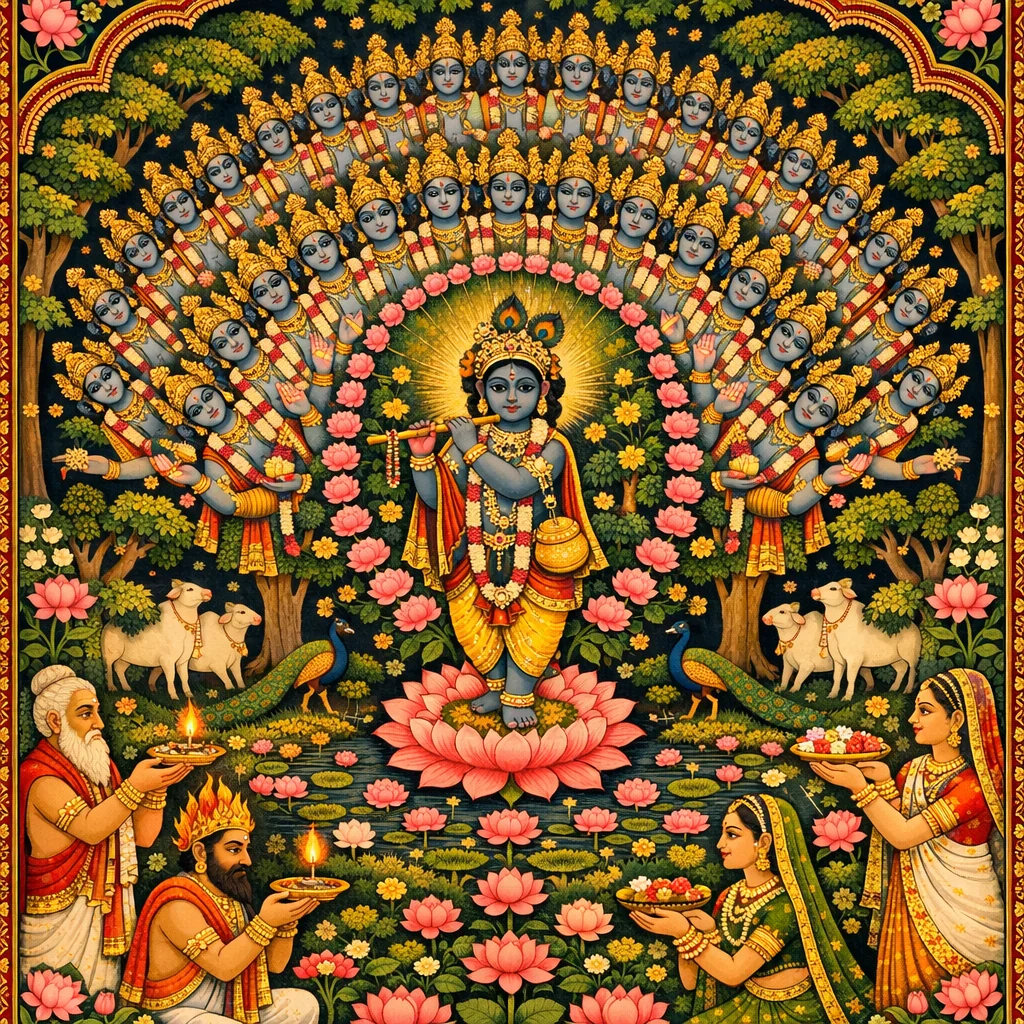
After Aghāsura’s deliverance, Śrī Kṛṣṇa leads the cowherd boys to a lovely riverbank for their forest lunch, and His intimate friendship amazes even the devas. When the calves stray, Kṛṣṇa goes to retrieve them; in His absence Brahmā—awed by Kṛṣṇa’s power yet wishing to test Him—steals both calves and boys and hides them in mystic sleep. Kṛṣṇa returns, understands Brahmā’s deed, and to delight Vraja’s parents and instruct Brahmā, expands Himself into identical calves and cowherd boys, carrying on daily life for a full year. The residents’ affection swells beyond all measure, and Balarāma detects the anomaly, realizing all are Kṛṣṇa’s expansions. When Brahmā returns (thinking only a moment has passed), he sees Kṛṣṇa still playing; his bewilderment peaks as the expansions reveal innumerable four-armed Viṣṇu forms worshiped by all powers, elements, and cosmic principles. Overwhelmed and humbled, Brahmā is subdued; Kṛṣṇa withdraws yoga-māyā, restoring the scene to Kṛṣṇa alone, food in hand, searching—setting the stage for Brahmā’s prayers in the next chapter.
Shlokas
Verse 1
श्रीशुक उवाच साधु पृष्टं महाभाग त्वया भागवतोत्तम । यन्नूतनयसीशस्य शृण्वन्नपि कथां मुहु: ॥ १ ॥
Śrī Śukadeva Gosvāmī said: O most fortunate Parīkṣit, best among the bhāgavatas, you have inquired most rightly, for though you constantly hear the Lord’s pastimes, you perceive them as ever fresh, moment after moment.
Verse 2
सतामयं सारभृतां निसर्गो यदर्थवाणीश्रुतिचेतसामपि । प्रतिक्षणं नव्यवदच्युतस्य यत् स्त्रिया विटानामिव साधुवार्ता ॥ २ ॥
This is the very nature of the saints who have embraced life’s essence: even their speech, hearing, and mind are aimed at Acyuta, Śrī Kṛṣṇa. At every moment they cling to kṛṣṇa-vārtā as ever new, just as worldly people cling to talk of women and sensual pleasure.
Verse 3
शृणुष्वावहितो राजन्नपि गुह्यं वदामि ते । ब्रूयु: स्निग्धस्य शिष्यस्य गुरवो गुह्यमप्युत ॥ ३ ॥
O King, listen with full attention; I shall speak to you this confidential matter. For spiritual masters explain even hidden and difficult truths to a loving, submissive disciple.
Verse 4
तथाघवदनान्मृत्यो रक्षित्वा वत्सपालकान् । सरित्पुलिनमानीय भगवानिदमब्रवीत् ॥ ४ ॥
Then Lord Śrī Kṛṣṇa, having saved the cowherd boys and calves from the mouth of Aghāsura, death personified, brought them to the riverbank and spoke these words.
Verse 5
अहोऽतिरम्यं पुलिनं वयस्या: स्वकेलिसम्पन्मृदुलाच्छबालुकम् । स्फुटत्सरोगन्धहृतालिपत्रिक- ध्वनिप्रतिध्वानलसद्द्रुमाकुलम् ॥ ५ ॥
O friends, see how exceedingly lovely this riverbank is—perfect for our play; its sand is clean and soft. The fragrance of blooming lotuses draws bees and birds, and their humming and chirping echo among the splendid forest trees.
Verse 6
अत्र भोक्तव्यमस्माभिर्दिवारूढं क्षुधार्दिता: । वत्सा: समीपेऽप: पीत्वा चरन्तु शनकैस्तृणम् ॥ ६ ॥
The day is already far advanced and we are hungry; therefore let us eat our lunch here. Let the calves drink water nearby and then slowly wander about, grazing on the grass.
Verse 7
तथेति पाययित्वार्भा वत्सानारुध्य शाद्वले । मुक्त्वा शिक्यानि बुभुजु: समं भगवता मुदा ॥ ७ ॥
Saying, “So be it,” the cowherd boys let the calves drink from the river and then tied them where tender green grass grew. They opened their food baskets and ate with Lord Śrī Kṛṣṇa in joyful transcendental delight.
Verse 8
कृष्णस्य विष्वक् पुरुराजिमण्डलै- रभ्यानना: फुल्लदृशो व्रजार्भका: । सहोपविष्टा विपिने विरेजु- श्छदा यथाम्भोरुहकर्णिकाया: ॥ ८ ॥
In the forest the boys of Vraja sat in lines encircling Kṛṣṇa, their faces turned toward Him and their eyes bright with joy. They shone like the whorl of a lotus surrounded by its petals and leaves.
Verse 9
केचित् पुष्पैर्दलै: केचित्पल्लवैरङ्कुरै: फलै: । शिग्भिस्त्वग्भिर्दृषद्भिश्च बुभुजु: कृतभाजना: ॥ ९ ॥
Among the cowherd boys, some used flowers as plates, some used leaves, tender shoots, sprouts and fruits; some ate from their baskets, some from tree bark, and some from rocks, imagining these to be their dining vessels.
Verse 10
सर्वे मिथो दर्शयन्त: स्वस्वभोज्यरुचिं पृथक् । हसन्तो हासयन्तश्चाभ्यवजह्रु: सहेश्वरा: ॥ १० ॥
All the cowherd boys ate with Kṛṣṇa, showing one another the distinct tastes of the many dishes they had brought from home. Sampling each other’s offerings, they laughed and made one another laugh.
Verse 11
बिभ्रद् वेणुं जठरपटयो: शृङ्गवेत्रे च कक्षे वामे पाणौ मसृणकवलं तत्फलान्यङ्गुलीषु । तिष्ठन् मध्ये स्वपरिसुहृदो हासयन् नर्मभि: स्वै: स्वर्गे लोके मिषति बुभुजे यज्ञभुग् बालकेलि: ॥ ११ ॥
Kṛṣṇa, the yajña-bhuk who accepts food only as yajña offerings, sat among His friends to display His childhood pastimes. His flute was tucked on the right between His waist and tight cloth, and on the left He carried a horn bugle and cow-driving stick. Holding a soft morsel of yogurt and rice, with pieces of fruit between His fingers, He sat like the lotus whorl, looking upon His companions and joking sweetly, making them laugh as He ate—while the denizens of heaven watched in wonder that the Lord of yajña was dining with His friends in the forest.
Verse 12
भारतैवं वत्सपेषु भुञ्जानेष्वच्युतात्मसु । वत्सास्त्वन्तर्वने दूरं विविशुस्तृणलोभिता: ॥ १२ ॥
O Mahārāja Parīkṣit, while the cowherd boys—whose hearts knew only Acyuta—were eating in the forest, the calves, tempted by fresh green grass, wandered far away into the depths of the woods.
Verse 13
तान् दृष्ट्वा भयसन्त्रस्तानूचे कृष्णोऽस्य भीभयम् । मित्राण्याशान्मा विरमतेहानेष्ये वत्सकानहम् ॥ १३ ॥
Seeing His friends frightened, Kṛṣṇa—before whom even fear is afraid—spoke to soothe them: “My friends, do not stop eating. I shall go Myself and bring your calves back here.”
Verse 14
इत्युक्त्वाद्रिदरीकुञ्जगह्वरेष्वात्मवत्सकान् । विचिन्वन्भगवान्कृष्ण: सपाणिकवलो ययौ ॥ १४ ॥
Having said this, the Supreme Lord, Śrī Kṛṣṇa, declared, “I shall go and search for the calves; do not disturb your enjoyment.” Then, with yogurt and rice in His hand, He at once set out, searching through the hills, caves, thickets, and narrow paths to please His cowherd friends.
Verse 15
अम्भोजन्मजनिस्तदन्तरगतो मायार्भकस्येशितु- र्द्रष्टुं मञ्जु महित्वमन्यदपि तद्वत्सानितो वत्सपान् । नीत्वान्यत्र कुरूद्वहान्तरदधात् खेऽवस्थितो य: पुरा दृष्ट्वाघासुरमोक्षणं प्रभवत: प्राप्त: परं विस्मयम् ॥ १५ ॥
O Mahārāja Parīkṣit, Brahmā, born from the lotus and dwelling in the higher worlds of the sky, had previously seen the supremely powerful Śrī Kṛṣṇa kill and deliver Aghāsura and was struck with wonder. Now, wishing to display a trace of his own power and to behold the sweet majesty of Kṛṣṇa in His childhood play, Brahmā—while Kṛṣṇa was away—took the calves and the cowherd boys to another place and hid them. Yet soon he would be entangled, for he was about to witness Kṛṣṇa’s true potency.
Verse 16
ततो वत्सानदृष्ट्वैत्य पुलिनेऽपि च वत्सपान् । उभावपि वने कृष्णो विचिकाय समन्तत: ॥ १६ ॥
Thereafter, unable to find the calves, Kṛṣṇa returned to the riverbank, but there He could not see the cowherd boys either. Thus He began searching for both calves and boys throughout the forest in every direction, as if He did not understand what had happened.
Verse 17
क्वाप्यदृष्ट्वान्तर्विपिने वत्सान्पालांश्च विश्ववित् । सर्वं विधिकृतं कृष्ण: सहसावजगाम ह ॥ १७ ॥
When He could not find the calves or their caretakers, the cowherd boys, anywhere in the forest, Śrī Kṛṣṇa, who knows everything, suddenly understood that this was the work of Lord Brahmā.
Verse 18
तत: कृष्णो मुदं कर्तुं तन्मातृणां च कस्य च । उभयायितमात्मानं चक्रे विश्वकृदीश्वर: ॥ १८ ॥
Thereafter, to bring delight both to Brahmā and to the mothers of the calves and cowherd boys, Śrī Kṛṣṇa—the Lord who creates the entire cosmic manifestation—expanded Himself as those very calves and boys.
Verse 19
यावद् वत्सपवत्सकाल्पकवपुर्यावत् कराङ्घ्र्यादिकं यावद् यष्टिविषाणवेणुदलशिग् यावद् विभूषाम्बरम् । यावच्छीलगुणाभिधाकृतिवयो यावद् विहारादिकं सर्वं विष्णुमयं गिरोऽङ्गवदज: सर्वस्वरूपो बभौ ॥ १९ ॥
In His Vāsudeva feature, Śrī Kṛṣṇa simultaneously expanded Himself into exactly as many calves and cowherd boys as had disappeared—matching their bodies, hands, feet and every limb, their sticks, horns and flutes, their lunch bags, their garments and ornaments arranged in distinct ways, their names, ages, forms, qualities, natures and pastimes. Thus the beautiful Kṛṣṇa made manifest the truth that the entire universe is viṣṇumaya, pervaded by Lord Viṣṇu.
Verse 20
स्वयमात्मात्मगोवत्सान् प्रतिवार्यात्मवत्सपै: । क्रीडन्नात्मविहारैश्च सर्वात्मा प्राविशद् व्रजम् ॥ २० ॥
Thus Śrī Kṛṣṇa made Himself appear as all the calves and cowherd boys, and at the same time as their leader; playing as He always did, the all-pervading Lord entered Vraja, the land of Nanda Mahārāja.
Verse 21
तत्तद्वत्सान्पृथङ्नीत्वा तत्तद्गोष्ठे निवेश्य स: । तत्तदात्माभवद् राजंस्तत्तत्सद्म प्रविष्टवान् ॥ २१ ॥
O King, Kṛṣṇa took each calf separately and placed it in its own cowshed; then, becoming each cowherd boy, He entered each of their homes.
Verse 22
तन्मातरो वेणुरवत्वरोत्थिता उत्थाप्य दोर्भि: परिरभ्य निर्भरम् । स्नेहस्नुतस्तन्यपय:सुधासवं मत्वा परं ब्रह्म सुतानपाययन् ॥ २२ ॥
Hearing the sounds of flutes and horns, the mothers at once rose from their household work. Lifting their sons onto their laps, they embraced them with both arms and began to nurse them with milk that flowed from overwhelming love, as if it were nectar. In truth, in that surge of affection they were feeding the Parabrahman, Śrī Kṛṣṇa, as their own child, and Kṛṣṇa drank from each mother as from a nectarean draught.
Verse 23
ततो नृपोन्मर्दनमज्जलेपना- लङ्काररक्षातिलकाशनादिभि: । संलालित: स्वाचरितै: प्रहर्षयन् सायं गतो यामयमेन माधव: ॥ २३ ॥
Thereafter, O Mahārāja, according to the proper course of His līlā, Mādhava returned in the evening and entered the home of each cowherd boy, behaving exactly as the boys had done before, thus filling their mothers with transcendental delight. The mothers then served Him with oil massage, bathing, sandalwood paste, ornaments, protective mantras, tilaka and food—so they personally cared for Śrī Kṛṣṇa.
Verse 24
गावस्ततो गोष्ठमुपेत्य सत्वरं हुङ्कारघोषै: परिहूतसङ्गतान् । स्वकान् स्वकान् वत्सतरानपाययन् मुहुर्लिहन्त्य: स्रवदौधसं पय: ॥ २४ ॥
Thereafter all the cows hurried into their respective sheds and, with loud mooing, called for their own calves. When the calves came, the mothers licked them again and again and abundantly nursed them with the milk flowing from their udders.
Verse 25
गोगोपीनां मातृतास्मिन्नासीत्स्नेहर्धिकां विना । पुरोवदास्वपि हरेस्तोकता मायया विना ॥ २५ ॥
From the very beginning the gopīs felt motherly affection for Kṛṣṇa, greater even than for their own sons. Formerly they still made some distinction between Kṛṣṇa and their children, but now, by the Lord’s māyā, that distinction vanished.
Verse 26
व्रजौकसां स्वतोकेषु स्नेहवल्ल्याब्दमन्वहम् । शनैर्नि:सीम ववृधे यथा कृष्णे त्वपूर्ववत् ॥ २६ ॥
For one year the residents of Vraja found their affection for their own sons increasing day after day—slowly, yet without limit—just as their love for Kṛṣṇa had been before. For now Kṛṣṇa Himself had become their sons, and thus the growth of that love knew no bound.
Verse 27
इत्थमात्मात्मनात्मानं वत्सपालमिषेण स: । पालयन् वत्सपो वर्षं चिक्रीडे वनगोष्ठयो: ॥ २७ ॥
Thus Lord Śrī Kṛṣṇa, becoming Himself the cowherd boys and the groups of calves, maintained Himself by Himself. Under the pretext of tending the calves, He continued His līlās in Vṛndāvana and in the forest for one full year.
Verse 28
एकदा चारयन् वत्सान्सरामो वनमाविशत् । पञ्चषासु त्रियामासु हायनापूरणीष्वज: ॥ २८ ॥
One day, five or six nights before the year was completed, Śrī Kṛṣṇa—the unborn Lord—while tending the calves, entered the forest together with Balarāma.
Verse 29
ततो विदूराच्चरतो गावो वत्सानुपव्रजम् । गोवर्धनाद्रिशिरसि चरन्त्यो ददृशुस्तृणम् ॥ २९ ॥
Thereafter, while grazing atop Govardhana Hill, the cows looked down from afar for green grass and saw their calves pasturing near Vraja, not very far away.
Verse 30
दृष्ट्वाथ तत्स्नेहवशोऽस्मृतात्मा स गोव्रजोऽत्यात्मपदुर्गमार्ग: । द्विपात्ककुद्ग्रीव उदास्यपुच्छो- ऽगाद्धुङ्कृतैरास्रुपया जवेन ॥ ३० ॥
Seeing their own calves from the top of Govardhana, the cows, overcome by affection, forgot themselves and their keepers. Though the path was rough, they ran in anxious haste as if on only two legs—udders brimming and streaming milk, heads and tails raised, humps swaying with their necks—lowing and tearful until they reached their calves to nurse them.
Verse 31
समेत्य गावोऽधो वत्सान् वत्सवत्योऽप्यपाययन् । गिलन्त्य इव चाङ्गानि लिहन्त्य: स्वौधसं पय: ॥ ३१ ॥
Coming down, the cows met the calves. Though they had newly calved, their affection swelled for the older calves: they let them drink from their udders and then, in anxious love, licked their bodies as if wishing to swallow them.
Verse 32
गोपास्तद्रोधनायासमौघ्यलज्जोरुमन्युना । दुर्गाध्वकृच्छ्रतोऽभ्येत्य गोवत्सैर्ददृशु: सुतान् ॥ ३२ ॥
The cowherd men tried to restrain the cows but could not, and so they felt both shame and anger. With great difficulty they crossed the rough path and came down; yet on seeing their own sons among the cows and calves, they were overwhelmed by deep affection.
Verse 33
तदीक्षणोत्प्रेमरसाप्लुताशया जातानुरागा गतमन्यवोऽर्भकान् । उदुह्य दोर्भि: परिरभ्य मूर्धनि घ्राणैरवापु: परमां मुदं ते ॥ ३३ ॥
At that moment, the cowherd men’s minds were flooded with the nectar of paternal love upon seeing their sons. Affection arose, anger vanished; they lifted the boys in their arms, embraced them, and tasted the highest joy by smelling their heads.
Verse 34
तत: प्रवयसो गोपास्तोकाश्लेषसुनिर्वृता: । कृच्छ्राच्छनैरपगतास्तदनुस्मृत्युदश्रव: ॥ ३४ ॥
Thereafter the elderly cowherd men, filled with bliss from embracing their sons, slowly and with great reluctance released them and returned toward the forest. Yet whenever they remembered their sons, tears began to stream from their eyes.
Verse 35
व्रजस्य राम: प्रेमर्धेर्वीक्ष्यौत्कण्ठ्यमनुक्षणम् । मुक्तस्तनेष्वपत्येष्वप्यहेतुविदचिन्तयत् ॥ ३५ ॥
As affection increased, the cows of Vraja felt constant longing even for calves already grown and no longer nursing. Seeing this attachment, Lord Balarāma could not discern its cause, and thus He began to ponder within Himself.
Verse 36
किमेतदद्भुतमिव वासुदेवेऽखिलात्मनि । व्रजस्य सात्मनस्तोकेष्वपूर्वं प्रेम वर्धते ॥ ३६ ॥
What is this wondrous phenomenon? The love of all the people of Vraja—including My own—toward these boys and calves is increasing as never before, just like our love for Vāsudeva Śrī Kṛṣṇa, the Supersoul of all beings.
Verse 37
केयं वा कुत आयाता दैवी वा नार्युतासुरी । प्रायो मायास्तु मे भर्तुर्नान्या मेऽपि विमोहिनी ॥ ३७ ॥
Who is this mystic power, and from where has she come? Is she divine or demoniac? She must be the māyā of my Master, Lord Śrī Kṛṣṇa—for who else could bewilder even Me?
Verse 38
इति सञ्चिन्त्य दाशार्हो वत्सान्सवयसानपि । सर्वानाचष्ट वैकुण्ठं चक्षुषा वयुनेन स: ॥ ३८ ॥
Thinking in this way, Lord Balarāma, of the Dāśārha line, saw with the eye of transcendental knowledge that all these calves and Kṛṣṇa’s friends—every one of them—were expansions of Śrī Kṛṣṇa’s own form.
Verse 39
नैते सुरेशा ऋषयो न चैते त्वमेव भासीश भिदाश्रयेऽपि । सर्वं पृथक्त्वं निगमात् कथं वदे- त्युक्तेन वृत्तं प्रभुणा बलोऽवैत् ॥ ३९ ॥
Lord Baladeva said: “O supreme controller! These are not great demigods, nor are these calves sages like Nārada. Now I see that You alone are manifesting Yourself in every variety of difference—though one, You exist as the calves and the boys. Please explain this mystery to Me in brief.” Thus requested, Lord Kṛṣṇa explained everything, and Baladeva understood.
Verse 40
तावदेत्यात्मभूरात्ममानेन त्रुट्यनेहसा । पुरोवदाब्दं क्रीडन्तं ददृशे सकलं हरिम् ॥ ४० ॥
When Brahmā returned—by his own measure, after only a moment—he saw that, though by human calculation a full year had passed, Lord Hari (Kṛṣṇa) was still, just as before, playing with the boys and calves, who were His own expansions.
Verse 41
यावन्तो गोकुले बाला: सवत्सा: सर्व एव हि । मायाशये शयाना मे नाद्यापि पुनरुत्थिता: ॥ ४१ ॥
Brahmā thought: “All the boys and calves that were in Gokula I have laid to sleep upon the bed of my mystic potency, and even now they have not yet risen again.”
Verse 42
इत एतेऽत्र कुत्रत्या मन्मायामोहितेतरे । तावन्त एव तत्राब्दं क्रीडन्तो विष्णुना समम् ॥ ४२ ॥
Then where have these come from? They are not the ones bewildered by my mystic power. The same number of boys and calves have been playing with Viṣṇu (Kṛṣṇa) for an entire year. Who are they, and from where did they appear?
Verse 43
एवमेतेषु भेदेषु चिरं ध्यात्वा स आत्मभू: । सत्या: के कतरे नेति ज्ञातुं नेष्टे कथञ्चन ॥ ४३ ॥
Thus Brahmā pondered for a long time over the differences between the two separately existing sets. He tried to discern who was real and who was not, but he could not understand it at all.
Verse 44
एवं सम्मोहयन् विष्णुं विमोहं विश्वमोहनम् । स्वयैव माययाजोऽपि स्वयमेव विमोहित: ॥ ४४ ॥
Thus, desiring to bewilder the all-pervading Śrī Kṛṣṇa-Viṣṇu—who is never bewildered but bewilders the whole universe—Brahmā himself became bewildered by his own māyā.
Verse 45
तम्यां तमोवन्नैहारं खद्योतार्चिरिवाहनि । महतीतरमायैश्यं निहन्त्यात्मनि युञ्जत: ॥ ४५ ॥
Just as the darkness of snow on a pitch-dark night and the light of a glowworm in daylight are of no worth, so the mystic power of an inferior being, used against one of great might, accomplishes nothing; rather, it is diminished.
Verse 46
तावत् सर्वे वत्सपाला: पश्यतोऽजस्य तत्क्षणात् । व्यदृश्यन्त घनश्यामा: पीतकौशेयवासस: ॥ ४६ ॥
Then, as Brahmā looked on, all the calves and the boys who tended them at once appeared with complexions like bluish rainclouds, dressed in yellow silken garments.
Verse 47
चतुर्भुजा: शङ्खचक्रगदाराजीवपाणय: । किरीटिन: कुण्डलिनो हारिणो वनमालिन: ॥ ४७ ॥ श्रीवत्साङ्गददोरत्नकम्बुकङ्कणपाणय: । नूपुरै: कटकैर्भाता: कटिसूत्राङ्गुलीयकै: ॥ ४८ ॥
All those divine forms were four-armed, holding conchshell, disc, mace, and lotus. They wore crowns, earrings, necklaces, and garlands of forest flowers. Upon their chests shone the mark of Śrīvatsa; they bore armlets, the Kaustubha gem at the neck with three conch-like lines, bracelets at the wrists, anklets, sacred waist-belts, and rings—radiant in transcendent beauty.
Verse 48
चतुर्भुजा: शङ्खचक्रगदाराजीवपाणय: । किरीटिन: कुण्डलिनो हारिणो वनमालिन: ॥ ४७ ॥ श्रीवत्साङ्गददोरत्नकम्बुकङ्कणपाणय: । नूपुरै: कटकैर्भाता: कटिसूत्राङ्गुलीयकै: ॥ ४८ ॥
All those divine forms were four-armed, holding conchshell, disc, mace, and lotus. They wore crowns, earrings, necklaces, and garlands of forest flowers. Upon their chests shone the mark of Śrīvatsa; they bore armlets, the Kaustubha gem at the neck with three conch-like lines, bracelets at the wrists, anklets, sacred waist-belts, and rings—radiant in transcendent beauty.
Verse 49
आङ्घ्रिमस्तकमापूर्णास्तुलसीनवदामभि: । कोमलै: सर्वगात्रेषु भूरिपुण्यवदर्पितै: ॥ ४९ ॥
From Their feet up to the crowns of Their heads, every part of Their bodies was fully adorned with soft, fresh garlands of tulasī leaves, offered by devotees worshiping the Lord through the greatest pious acts—hearing and chanting.
Verse 50
चन्द्रिकाविशदस्मेरै: सारुणापाङ्गवीक्षितै: । स्वकार्थानामिव रज:सत्त्वाभ्यां स्रष्टृपालका: ॥ ५० ॥
With pure smiles like the moonlight growing ever brighter, and with sidelong glances from Their reddish eyes, those Viṣṇu forms created and protected the desires of Their own devotees, as if through the modes of passion and goodness.
Verse 51
आत्मादिस्तम्बपर्यन्तैर्मूर्तिमद्भिश्चराचरै: । नृत्यगीताद्यनेकार्है: पृथक्पृथगुपासिता: ॥ ५१ ॥
From four-headed Lord Brahmā down to the tiniest being, all creatures—moving and unmoving—assumed forms and, according to their own capacity, worshiped those viṣṇu-mūrtis in different ways, with offerings such as dancing and singing.
Verse 52
अणिमाद्यैर्महिमभिरजाद्याभिर्विभूतिभि: । चतुर्विंशतिभिस्तत्त्वै: परीता महदादिभि: ॥ ५२ ॥
All the viṣṇu-mūrtis were surrounded by opulences headed by aṇimā-siddhi, by mystic potencies headed by Ajā, and by the twenty-four elements of material creation headed by the mahat-tattva.
Verse 53
कालस्वभावसंस्कारकामकर्मगुणादिभि: । स्वमहिध्वस्तमहिभिर्मूर्तिमद्भिरुपासिता: ॥ ५३ ॥
Then Brahmā saw that kāla (time), svabhāva (one’s nature), saṁskāra (conditioning), kāma (desire), karma (fruitive action) and the guṇas (the modes)—their independence wholly subdued by the Lord’s potency—had also assumed forms and were worshiping those viṣṇu-mūrtis.
Verse 54
सत्यज्ञानानन्तानन्दमात्रैकरसमूर्तय: । अस्पृष्टभूरिमाहात्म्या अपि ह्युपनिषद्दृशाम् ॥ ५४ ॥
All those Viṣṇu forms were eternal and unlimited, of one essence—truth, knowledge, and boundless bliss—beyond the sway of time. Their vast glory could not be touched even by the jñānīs absorbed in the Upaniṣads.
Verse 55
एवं सकृद् ददर्शाज: परब्रह्मात्मनोऽखिलान् । यस्य भासा सर्वमिदं विभाति सचराचरम् ॥ ५५ ॥
Thus Brahmā beheld the Supreme Brahman, by whose energy this entire universe—moving and unmoving—shines forth. At the same time he saw all the calves and boys as expansions of the Lord.
Verse 56
ततोऽतिकुतुकोद्वृत्यस्तिमितैकादशेन्द्रिय: । तद्धाम्नाभूदजस्तूष्णीं पूर्देव्यन्तीव पुत्रिका ॥ ५६ ॥
Then, by the power of the effulgence of those Viṣṇu forms, Brahmā was shaken with wonder; his eleven senses became motionless, and, stunned by transcendental bliss, he fell silent—like a child’s clay doll before the village deity.
Verse 57
इतीरेशेऽतर्क्ये निजमहिमनि स्वप्रमितिके परत्राजातोऽतन्निरसनमुखब्रह्मकमितौ । अनीशेऽपि द्रष्टुं किमिदमिति वा मुह्यति सति चच्छादाजो ज्ञात्वा सपदि परमोऽजाजवनिकाम् ॥ ५७ ॥
The Supreme Brahman is beyond all mental speculation, self-manifest in His own bliss, and transcendent to material energy. He is known by the crest-jewels of the Vedas, the Upaniṣads, which refute irrelevant knowledge. Thus, when the Lord’s glory was revealed through the manifestation of the four-armed Viṣṇu forms, Brahmā, lord of Sarasvatī, became bewildered—thinking, “What is this?”—and could not even see. Understanding Brahmā’s condition, Śrī Kṛṣṇa at once removed the curtain of His yoga-māyā.
Verse 58
ततोऽर्वाक्प्रतिलब्धाक्ष: क: परेतवदुत्थित: । कृच्छ्रादुन्मील्य वै दृष्टीराचष्टेदं सहात्मना ॥ ५८ ॥
Brahmā’s external awareness then returned, and he rose up like a dead man come back to life. With great difficulty he opened his eyes and beheld the universe, along with himself.
Verse 59
सपद्येवाभित: पश्यन् दिशोऽपश्यत्पुर:स्थितम् । वृन्दावनं जनाजीव्यद्रुमाकीर्णं समाप्रियम् ॥ ५९ ॥
Then, looking in all directions, Brahmā at once saw Vṛndāvana before him—filled with trees that sustained the people’s livelihood and were equally delightful in every season.
Verse 60
यत्र नैसर्गदुर्वैरा: सहासन् नृमृगादय: । मित्राणीवाजितावासद्रुतरुट्तर्षकादिकम् ॥ ६० ॥
Vṛndāvana is the Lord’s transcendental abode, where there is no hunger, no anger, and no thirst. Though naturally inimical, human beings and fierce animals live there together in spiritual friendship.
Verse 61
तत्रोद्वहत् पशुपवंशशिशुत्वनाट्यं ब्रह्माद्वयं परमनन्तमगाधबोधम् । वत्सान् सखीनिव पुरा परितो विचिन्व- देकं सपाणिकवलं परमेष्ठ्यचष्ट ॥ ६१ ॥
There Brahmā saw the Absolute Truth—one without a second, perfect in knowledge and unlimited—enacting the līlā of a child among the cowherd folk, standing all alone as before, a morsel of food in His hand, searching everywhere for the calves and His cowherd friends.
Verse 62
दृष्ट्वा त्वरेण निजधोरणतोऽवतीर्य पृथ्व्यां वपु: कनकदण्डमिवाभिपात्य । स्पृष्ट्वा चतुर्मुकुटकोटिभिरङ्घ्रियुग्मं नत्वा मुदश्रुसुजलैरकृताभिषेकम् ॥ ६२ ॥
Seeing this, Brahmā hastily descended from his swan carrier, fell to the earth like a golden rod, and touched Śrī Kṛṣṇa’s lotus feet with the tips of the crowns on his four heads. Bowing down, he bathed those feet with the water of his joyful tears, as if performing an abhiṣeka.
Verse 63
उत्थायोत्थाय कृष्णस्य चिरस्य पादयो: पतन् । आस्ते महित्वं प्राग्दृष्टं स्मृत्वा स्मृत्वा पुन: पुन: ॥ ६३ ॥
For a long time Brahmā rose and fell again and again at Kṛṣṇa’s lotus feet, repeatedly remembering the Lord’s greatness that he had just beheld.
Verse 64
शनैरथोत्थाय विमृज्य लोचने मुकुन्दमुद्वीक्ष्य विनम्रकन्धर: । कृताञ्जलि: प्रश्रयवान् समाहित: सवेपथुर्गद्गदयैलतेलया ॥ ६४ ॥ ज्ञाने प्रयासमुदपास्य नमन्त एव जीवन्ति सन्मुखरितां भवदीयवार्ताम् । स्थाने स्थिता: श्रुतिगतां तनुवाङ्मनोभि- र्ये प्रायशोऽजित जितोऽप्यसि तैस्त्रिलोक्याम् ॥
Then Brahmā rose very slowly, wiped his eyes, and looked up at Mukunda, Lord Kṛṣṇa. With head bowed, palms joined, mind composed and body trembling, he began to offer humble praises in a faltering voice.
Frequently Asked Questions
Brahmā, though a great cosmic administrator, became astonished after Aghāsura’s deliverance and wished to test the childlike cowherd Kṛṣṇa—measuring His power against Brahmā’s own mystic capacity. The Bhāgavata frames this as ūti: Brahmā’s intention to “see” Kṛṣṇa’s greatness becomes the cause of his bewilderment, demonstrating that even the highest created intellect cannot comprehend Bhagavān by experiment, only by surrender.
Kṛṣṇa expands by His own internal potency (yoga-māyā) into exact replicas—names, forms, behaviors, ornaments, and personal traits—while remaining the same Supreme Person. This illustrates samagra-jagad viṣṇumayam (the Lord’s all-pervasiveness) and the principle that His expansions are not products of matter or illusion but direct manifestations of His svarūpa-śakti.
Because the “sons” and “calves” they embraced were actually Kṛṣṇa Himself. Since Kṛṣṇa is the ātmā and āśraya of all beings, contact with Him naturally intensifies love (prema) and vatsalya-rasa. The narrative also shows poṣaṇa: Kṛṣṇa nourishes devotion by arranging deeper attachment within everyday life.
Balarāma detects it within Vraja by observing an unprecedented surge of affection even for older calves and boys, then perceives with transcendental knowledge that all are Kṛṣṇa’s expansions. Brahmā, returning later, becomes confused by two sets (his hidden originals and Kṛṣṇa’s manifested replicas) and is ultimately instructed by the revelation of innumerable viṣṇu-mūrtis.
The revelation discloses Kṛṣṇa’s aiśvarya: the same child in Vraja is the source of Viṣṇu, worshiped by all cosmic principles—time (kāla), nature (svabhāva), desire (kāma), karma, and the guṇas—showing their subordination to Him. It functions as a theological climax: Brahman realization and Upaniṣadic inquiry are surpassed by direct vision of Bhagavān’s personal supremacy.