Adhyaya 6
Brahmā Counsels the Demigods; Journey to Kailāsa; Śiva’s Tranquility and Brahmā’s Praise
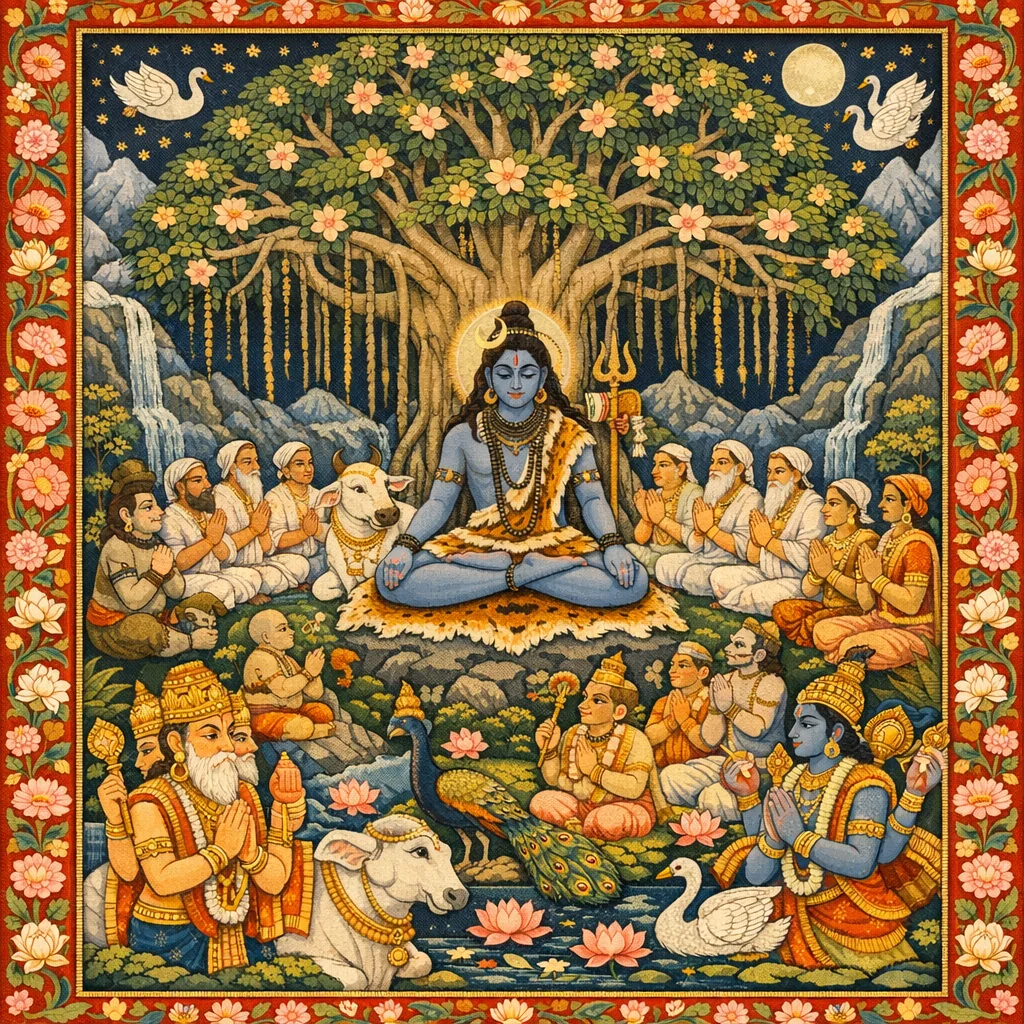
After Dakṣa’s sacrifice (yajña) is ruined, the wounded priests, assembly members, and devas—defeated by Śiva’s gaṇas—approach Brahmā in fear and report what occurred. Brahmā, who with Viṣṇu had foreknown the outcome and therefore did not attend, identifies the cause: blaspheming a great personality makes yajña joyless and fruitless. He urges them to drop all hesitation, surrender at Śiva’s feet, and beg forgiveness, emphasizing Śiva’s immeasurable power and his personal sorrow after Satī’s loss and Dakṣa’s harsh words. Brahmā then leads them to Kailāsa, describing its sacred splendor—forests, rivers, birds, and celestial delights—until they behold Śiva seated in calm yogic composure beneath a vast banyan tree, surrounded by liberated sages. Śiva rises to honor Brahmā, and Brahmā begins a theological praise of Śiva as cosmic controller and the establisher of sacrifice, setting the stage for reconciliation, restoration of limbs and life, and the completion of the interrupted yajña in the next part of the narrative.
Shlokas
Verse 1
मैत्रेय उवाच अथ देवगणा: सर्वे रुद्रानीकै: पराजिता: । शूलपट्टिशनिस्त्रिंशगदापरिघमुद्गरै: ॥ १ ॥ सञ्छिन्नभिन्नसर्वाङ्गा: सर्त्विक्सभ्या भयाकुला: । स्वयम्भुवे नमस्कृत्य कार्त्स्न्येनैतन्न्यवेदयन् ॥ २ ॥
All the priests and other members of the sacrificial assembly and all the demigods, having been defeated by the soldiers of Lord Śiva and injured by weapons like tridents and swords, approached Lord Brahmā with great fear. After offering him obeisances, they began to speak in detail of all the events which had taken place.
Verse 2
मैत्रेय उवाच अथ देवगणा: सर्वे रुद्रानीकै: पराजिता: । शूलपट्टिशनिस्त्रिंशगदापरिघमुद्गरै: ॥ १ ॥ सञ्छिन्नभिन्नसर्वाङ्गा: सर्त्विक्सभ्या भयाकुला: । स्वयम्भुवे नमस्कृत्य कार्त्स्न्येनैतन्न्यवेदयन् ॥ २ ॥
All the priests and other members of the sacrificial assembly and all the demigods, having been defeated by the soldiers of Lord Śiva and injured by weapons like tridents and swords, approached Lord Brahmā with great fear. After offering him obeisances, they began to speak in detail of all the events which had taken place.
Verse 3
उपलभ्य पुरैवैतद्भगवानब्जसम्भव: । नारायणश्च विश्वात्मा न कस्याध्वरमीयतु: ॥ ३ ॥
Brahmā, born of the lotus, and Nārāyaṇa, the Soul of the universe, had already foreknown that such a calamity would arise in Dakṣa’s sacrificial arena; therefore they did not go to that yajña.
Verse 4
तदाकर्ण्य विभु: प्राह तेजीयसि कृतागसि । क्षेमाय तत्र सा भूयान्न प्रायेण बुभूषताम् ॥ ४ ॥
Hearing all that, Lord Brahmā replied: “If you revile a great, radiant person and thus offend his lotus feet, you cannot attain happiness or well-being by performing a sacrifice.”
Verse 5
अथापि यूयं कृतकिल्बिषा भवं ये बर्हिषो भागभाजं परादु: । प्रसादयध्वं परिशुद्धचेतसा क्षिप्रप्रसादं प्रगृहीताङ्घ्रि:पद्मम् ॥ ५ ॥
You have excluded Lord Śiva from his share in the fruits of the sacrifice; thus you have all offended his lotus feet. Yet, with a purified heart, go to him at once—surrender and fall at his lotus feet, for he is swiftly pleased.
Verse 6
आशासाना जीवितमध्वरस्य लोक: सपाल: कुपिते न यस्मिन् । तमाशु देवं प्रियया विहीनं क्षमापयध्वं हृदि विद्धं दुरुक्तै: ॥ ६ ॥
Even the worlds with their rulers—hoping this sacrifice may survive—can be destroyed in an instant if he becomes wrathful. Therefore go at once and beg pardon of the god Śiva, bereft of his beloved wife and wounded at heart by Dakṣa’s harsh words.
Verse 7
नाहं न यज्ञो न च यूयमन्ये ये देहभाजो मुनयश्च तत्त्वम् । विदु: प्रमाणं बलवीर्ययोर्वा यस्यात्मतन्त्रस्य क उपायं विधित्सेत् ॥ ७ ॥
Lord Brahmā said: “Neither I, nor this sacrifice, nor you other devas, nor even the embodied sages know the measure of Lord Śiva’s strength and valor, for he is self-governed. In such a situation, who would dare offend his lotus feet?”
Verse 8
स इत्थमादिश्य सुरानजस्तु तै: समन्वित: पितृभि: सप्रजेशै: । ययौ स्वधिष्ण्यान्निलयं पुरद्विष: कैलासमद्रिप्रवरं प्रियं प्रभो: ॥ ८ ॥
Thus, after instructing the demigods, the Pitās, and the lords of the living beings, Aja (Lord Brahmā) took them with him and departed for the abode of Lord Śiva, the beloved summit of Mount Kailāsa.
Verse 9
जन्मौषधितपोमन्त्रयोगसिद्धैर्नरेतरै: । जुष्टं किन्नरगन्धर्वैरप्सरोभिर्वृतं सदा ॥ ९ ॥
Kailāsa is graced with beings of divine birth, perfected through sacred herbs, austerity, Vedic mantras, and yogic attainment. There dwell Kinnaras and Gandharvas as well, ever accompanied by the lovely Apsarās.
Verse 10
नानामणिमयै: शृङ्गैर्नानाधातुविचित्रितै: । नानाद्रुमलतागुल्मैर्नानामृगगणावृतै: ॥ १० ॥
Kailāsa abounds in peaks that gleam with many jewels and are variegated with diverse minerals. It is encircled by countless trees, vines, and shrubs, and thronged with herds of deer and other wild creatures.
Verse 11
नानामलप्रस्रवणैर्नानाकन्दरसानुभि: । रमणं विहरन्तीनां रमणै: सिद्धयोषिताम् ॥ ११ ॥
There are many pure waterfalls, and within the mountains many lovely caves. In those caves the enchanting wives of the siddhas sport and wander joyfully with their beloved consorts.
Verse 12
मयूरकेकाभिरुतं मदान्धालिविमूर्च्छितम् । प्लावितै रक्तकण्ठानां कूजितैश्च पतत्त्रिणाम् ॥ १२ ॥
On Kailāsa the sweet, rhythmic calls of peacocks ever resound, mingled with the humming of bees intoxicated by nectar. Cuckoos sing continually, and the soft murmur of other birds fills the sacred hill.
Verse 13
आह्वयन्तमिवोद्धस्तैर्द्विजान् कामदुघैर्द्रुमै: । व्रजन्तमिव मातङ्गैर्गृणन्तमिव निर्झरै: ॥ १३ ॥
The tall, straight, wish-fulfilling trees seem to call the sweet-voiced birds; when herds of elephants move through the slopes, it appears as though Mount Kailāsa moves with them; and when the waterfalls roar, it is as if Kailāsa itself is singing.
Verse 14
मन्दारै: पारिजातैश्च सरलैश्चोपशोभितम् । तमालै: शालतालैश्च कोविदारासनार्जुनै: ॥ १४ ॥ चूतै: कदम्बैर्नीपैश्च नागपुन्नागचम्पकै: । पाटलाशोकबकुलै: कुन्दै: कुरबकैरपि ॥ १५ ॥
Mount Kailāsa is adorned with many kinds of trees—mandāra, pārijāta, sarala, tamāla, śāla, tāla, kovidāra, āsana, arjuna, and others—and by their fragrant blossoms the whole mountain shines in sacred beauty.
Verse 15
मन्दारै: पारिजातैश्च सरलैश्चोपशोभितम् । तमालै: शालतालैश्च कोविदारासनार्जुनै: ॥ १४ ॥ चूतै: कदम्बैर्नीपैश्च नागपुन्नागचम्पकै: । पाटलाशोकबकुलै: कुन्दै: कुरबकैरपि ॥ १५ ॥
Kailāsa is adorned on every side with trees such as cūta (mango), kadamba, nīpa, nāga, punnāga, campaka, pāṭalā, aśoka, bakula, kunda, and kurabaka; their fragrant blossoms further enhance the mountain’s splendor.
Verse 16
स्वर्णार्णशतपत्रैश्च वररेणुकजातिभि: । कुब्जकैर्मल्लिकाभिश्च माधवीभिश्च मण्डितम् ॥ १६ ॥
Kailāsa is further adorned with other plants as well—golden lotuses (śatapatra), varareṇukā, jāti, kubjaka, mallikā, and mādhavī—adding to the mountain’s sacred charm.
Verse 17
पनसोदुम्बराश्वत्थप्लक्षन्यग्रोधहिङ्गुभि: । भूर्जैरोषधिभि: पूगै राजपूगैश्च जम्बुभि: ॥ १७ ॥
Mount Kailāsa is also adorned with panasa (jackfruit), udumbara, aśvattha, plakṣa, nyagrodha, trees yielding hiṅgu (asafoetida), bhūrja bark, medicinal herbs, areca palms (pūga), rājapūga, jambū (jamun), and many other such trees.
Verse 18
खर्जूराम्रातकाम्राद्यै: प्रियालमधुकेङ्गुदै: । द्रुमजातिभिरन्यैश्च राजितं वेणुकीचकै: ॥ १८ ॥
There grow date palms, mangoes, ātakāmra and other trees, along with priyāla, madhuka, and iṅguda; and slender bamboos—kīcaka and many kinds besides—adorn the tract of Mount Kailāsa.
Verse 19
कुमुदोत्पलकह्लारशतपत्रवनर्द्धिभि: । नलिनीषु कलं कूजत्खगवृन्दोपशोभितम् ॥ १९ ॥ मृगै: शाखामृगै: क्रोडैर्मृगेन्द्रैर्ऋ क्षशल्यकै: । गवयै: शरभैर्व्याघ्रै रुरुभिर्महिषादिभि: ॥ २० ॥
There is an abundance of lotuses—kumuda, utpala, kahlāra, and śatapatra—and the nalinī ponds are adorned by flocks of birds that murmur sweetly in gentle song.
Verse 20
कुमुदोत्पलकह्लारशतपत्रवनर्द्धिभि: । नलिनीषु कलं कूजत्खगवृन्दोपशोभितम् ॥ १९ ॥ मृगै: शाखामृगै: क्रोडैर्मृगेन्द्रैर्ऋ क्षशल्यकै: । गवयै: शरभैर्व्याघ्रै रुरुभिर्महिषादिभि: ॥ २० ॥
There are deer, tree-dwelling monkeys, boars, lions, bears, śalyaka, wild cattle (gavaya), śarabhā, tigers, small ruru deer, buffalo, and many other creatures—each living fearlessly, delighting in its own way of life.
Verse 21
कर्णान्त्रैकपदाश्वास्यैर्निर्जुष्टं वृकनाभिभि: । कदलीखण्डसंरुद्धनलिनीपुलिनश्रियम् ॥ २१ ॥
There dwell many kinds of deer—karṇāntra, ekapada, aśvāsya, vṛka, and the musk-bearing deer called vṛkanābhi; and the banks of the nalinī ponds shine with beauty, enclosed by dense groves of banana trees.
Verse 22
पर्यस्तं नन्दया सत्या: स्नानपुण्यतरोदया । विलोक्य भूतेशगिरिं विबुधा विस्मयं ययु: ॥ २२ ॥
There is a small lake named Alakanandā, where Satī once bathed, and it is especially auspicious and sanctifying. Beholding the unique beauty of Mount Kailāsa—the mountain of Bhūteśa (Śiva)—all the devas were struck with wonder at its splendid opulence.
Verse 23
ददृशुस्तत्र ते रम्यामलकां नाम वै पुरीम् । वनं सौगन्धिकं चापि यत्र तन्नाम पङ्कजम् ॥ २३ ॥
There the demigods beheld the exquisitely beautiful city called Alakā. They also saw the forest named Saugandhika, so called because it abounded in fragrant lotus flowers.
Verse 24
नन्दा चालकनन्दा च सरितौ बाह्यत: पुर: । तीर्थपादपदाम्भोजरजसातीव पावने ॥ २४ ॥
They also saw the two rivers Nandā and Alakanandā flowing outside the city. Both are supremely purifying, sanctified by the dust of the lotus feet of Śrī Govinda, the Supreme Personality of Godhead.
Verse 25
ययो: सुरस्त्रिय: क्षत्तरवरुह्य स्वधिष्ण्यत: । क्रीडन्ति पुंस: सिञ्चन्त्यो विगाह्य रतिकर्शिता: ॥ २५ ॥
My dear Kṣattā Vidura, celestial maidens descend to those rivers from their abodes in vimānas with their husbands. After amorous enjoyment, they enter the water, sport playfully, and sprinkle their husbands with water.
Verse 26
ययोस्तत्स्नानविभ्रष्टनवकुङ्कुमपिञ्जरम् । वितृषोऽपि पिबन्त्यम्भ: पाययन्तो गजा गजी: ॥ २६ ॥
After the heavenly maidens bathe, fresh kuṅkuma from their bodies tinges the water yellow and fills it with fragrance. Thus elephants come there with their mates to bathe, and even without thirst they drink that water.
Verse 27
तारहेममहारत्नविमानशतसङ्कुलाम् । जुष्टां पुण्यजनस्त्रीभिर्यथा खं सतडिद्घनम् ॥ २७ ॥
The city was crowded with hundreds of vimānas adorned with pearls, gold, and precious jewels. Graced by celestial ladies, the scene resembled the sky filled with clouds, ornamented by occasional flashes of lightning.
Verse 28
हित्वा यक्षेश्वरपुरीं वनं सौगन्धिकं च तत् । द्रुमै: कामदुघैर्हृद्यं चित्रमाल्यफलच्छदै: ॥ २८ ॥
Leaving the city of Yakṣeśvara behind, the demigods passed over the forest called Saugandhika, delightful with wish-fulfilling trees, and adorned with many kinds of flowers, fruits, and pleasing shade.
Verse 29
रक्तकण्ठखगानीकस्वरमण्डितषट्पदम् । कलहंसकुलप्रेष्ठं खरदण्डजलाशयम् ॥ २९ ॥
In that celestial forest, the sweet calls of red-throated birds blended with the humming of bees, and the lakes were adorned with flocks of calling swans and lotuses on sturdy stems.
Verse 30
वनकुञ्जरसङ्घृष्टहरिचन्दनवायुना । अधि पुण्यजनस्त्रीणां मुहुरुन्मथयन्मन: ॥ ३० ॥
Stirred by the breeze fragrant with sandalwood, the forest elephants gathered in restless excitement, and that same wind again and again agitated the hearts of the puṇyajana maidens there.
Verse 31
वैदूर्यकृतसोपाना वाप्य उत्पलमालिनी: । प्राप्तं किम्पुरुषैर्दृष्ट्वा त आराद्ददृशुर्वटम् ॥ ३१ ॥
They saw bathing ghāṭas with stairways fashioned of vaidūrya-maṇi, and waters garlanded with blue lotuses; passing such lakes, the demigods came near and beheld a great banyan tree.
Verse 32
स योजनशतोत्सेध: पादोनविटपायत: । पर्यक्कृताचलच्छायो निर्नीडस्तापवर्जित: ॥ ३२ ॥
That banyan tree rose eight hundred yojanas high, with branches spreading six hundred yojanas; it cast a steady, mountain-like cooling shade, yet there were no birds’ nests and no sound of birds at all.
Verse 33
तस्मिन्महायोगमये मुमुक्षुशरणे सुरा: । ददृशु: शिवमासीनं त्यक्तामर्षमिवान्तकम् ॥ ३३ ॥
The demigods beheld Lord Śiva seated beneath that tree of great yoga, a refuge for those seeking liberation and a bestower of perfection upon yogīs. Grave like eternal Time, he appeared to have cast off all anger.
Verse 34
सनन्दनाद्यैर्महासिद्धै: शान्तै: संशान्तविग्रहम् । उपास्यमानं सख्या च भर्त्रा गुह्यकरक्षसाम् ॥ ३४ ॥
They saw Lord Śiva being worshiped, surrounded by the peaceful mahā-siddhas such as Sanandana and by friends like Kuvera, lord of the Guhyakas and rākṣasas. Śiva’s very form was utterly serene and saintly.
Verse 35
विद्यातपोयोगपथमास्थितं तमधीश्वरम् । चरन्तं विश्वसुहृदं वात्सल्याल्लोकमङ्गलम् ॥ ३५ ॥
The demigods saw Lord Śiva perfected on the path of knowledge, austerity, action, and yoga, as the master of the senses. He was the well-wisher of the whole world, and by his tender affection for all, supremely auspicious.
Verse 36
लिङ्गं च तापसाभीष्टं भस्मदण्डजटाजिनम् । अङ्गेन सन्ध्याभ्ररुचा चन्द्रलेखां च बिभ्रतम् ॥ ३६ ॥
He bore the emblems cherished by ascetics—the sign of the liṅga, sacred ash, staff, matted locks, and deerskin. Smeared with ash, his body shone like an evening cloud, and in his hair he carried the mark of the crescent moon.
Verse 37
उपविष्टं दर्भमय्यां बृस्यां ब्रह्म सनातनम् । नारदाय प्रवोचन्तं पृच्छते शृण्वतां सताम् ॥ ३७ ॥
Seated upon a darbha-grass mat, he spoke of the eternal Brahman. As the saintly listened, he expounded the Supreme Truth—especially in reply to the inquiries of the sage Nārada.
Verse 38
कृत्वोरौ दक्षिणे सव्यं पादपद्मं च जानुनि । बाहुं प्रकोष्ठेऽक्षमालाम् आसीनं तर्कमुद्रया ॥ ३८ ॥
He placed his left lotus foot upon his right thigh and rested his left hand upon his left thigh—this posture is known as vīrāsana. In his right hand he held a rudrākṣa rosary, his fingers formed in tarka-mudrā.
Verse 39
तं ब्रह्मनिर्वाणसमाधिमाश्रितं व्युपाश्रितं गिरिशं योगकक्षाम् । सलोकपाला मुनयो मनूनाम् आद्यं मनुं प्राञ्जलय: प्रणेमु: ॥ ३९ ॥
All the sages and the guardians of the worlds, led by Indra, bowed with folded hands to Girīśa, Lord Śiva. Clad in saffron and absorbed in samādhi, he appeared as the foremost among the sages.
Verse 40
स तूपलभ्यागतमात्मयोनिं सुरासुरेशैरभिवन्दिताङ्घ्रि: । उत्थाय चक्रे शिरसाभिवन्दन- मर्हत्तम: कस्य यथैव विष्णु: ॥ ४० ॥
Though Śiva’s lotus feet were worshiped by both devas and asuras, when he saw Brahmā, the self-born (ātma-yoni), present in the assembly, he at once rose, bowed his head, and touched Brahmā’s lotus feet in reverence—just as Vāmanadeva offered obeisances to Kaśyapa Muni.
Verse 41
तथापरे सिद्धगणा महर्षिभि- र्ये वै समन्तादनु नीललोहितम् । नमस्कृत: प्राह शशाङ्कशेखरं कृतप्रणामं प्रहसन्निवात्मभू: ॥ ४१ ॥
The siddhas and great sages seated around Nīlalohita—Nārada and others—also offered their obeisances to Brahmā. Thus honored, Brahmā, the self-born (Ātmabhū), smiled and began to speak to Śiva, who had already bowed.
Verse 42
ब्रह्मोवाच जाने त्वामीशं विश्वस्य जगतो योनिबीजयो: । शक्ते: शिवस्य च परं यत्तद्ब्रह्म निरन्तरम् ॥ ४२ ॥
Brahmā said: O Lord Śiva, I know you as the controller of the entire universe, as both yoni and bīja—the mother and father of cosmic manifestation—and also as the eternal Supreme Brahman, beyond even Śakti and Śiva. Thus I know you.
Verse 43
त्वमेव भगवन्नेतच्छिवशक्त्यो: स्वरूपयो: । विश्वं सृजसि पास्यत्सि क्रीडन्नूर्णपटो यथा ॥ ४३ ॥
O Bhagavān, You alone, expanding as the forms of Śiva and Śakti, create, sustain, and withdraw this universe—just as a spider playfully spins its web, maintains it, and then winds it up again.
Verse 44
त्वमेव धर्मार्थदुघाभिपत्तये दक्षेण सूत्रेण ससर्जिथाध्वरम् । त्वयैव लोकेऽवसिताश्च सेतवो यान्ब्राह्मणा: श्रद्दधते धृतव्रता: ॥ ४४ ॥
My Lord, through Dakṣa You established the system of yajña, by which the fruits of dharma and artha are obtained. Under Your ordinances the order of varṇa and āśrama is honored; therefore the brāhmaṇas, firm in their vows, follow it with faith.
Verse 45
त्वं कर्मणां मङ्गल मङ्गलानां कर्तु: स्वलोकं तनुषे स्व: परं वा । अमङ्गलानां च तमिस्रमुल्बणं विपर्यय: केन तदेव कस्यचित् ॥ ४५ ॥
O most auspicious Lord, You have ordained heaven, the supreme Vaikuṇṭha worlds, and the Brahman sphere as the destinations of those who perform auspicious deeds. For the wicked You have appointed dreadful hells; yet at times the result appears reversed, and its cause is hard to discern.
Verse 46
न वै सतां त्वच्चरणार्पितात्मनां भूतेषु सर्वेष्वभिपश्यतां तव । भूतानि चात्मन्यपृथग्दिदृक्षतां प्रायेण रोषोऽभिभवेद्यथा पशुम् ॥ ४६ ॥
My Lord, devotees who have offered their very selves at Your lotus feet see You as Paramātmā within every being and thus regard all creatures as non-different in essence. Therefore anger does not overwhelm them like it overwhelms animals devoid of discernment.
Verse 47
पृथग्धिय: कर्मदृशो दुराशया: परोदयेनार्पितहृद्रुजोऽनिशम् । परान् दुरुक्तैर्वितुदन्त्यरुन्तुदा- स्तान्मावधीद्दैववधान्भवद्विध: ॥ ४७ ॥
Those who see with a mind of separation, cling to fruitive action, harbor petty hopes, burn within at others’ prosperity, and torment them with harsh, piercing words have already been slain by Providence. Therefore an exalted one like you need not kill them again.
Verse 48
यस्मिन्यदा पुष्करनाभमायया दुरन्तया स्पृष्टधिय: पृथग्दृश: । कुर्वन्ति तत्र ह्यनुकम्पया कृपां न साधवो दैवबलात्कृते क्रमम् ॥ ४८ ॥
My Lord, when materialistic people—already bewildered by the insurmountable māyā of the Supreme Puskaranābha—sometimes commit offenses, saintly persons, out of compassion, do not take it as grave. Knowing they act under the overpowering force of illusion, they do not display their prowess to retaliate.
Verse 49
भवांस्तु पुंस: परमस्य मायया दुरन्तयास्पृष्टमति: समस्तदृक् । तया हतात्मस्वनुकर्मचेत:- स्वनुग्रहं कर्तुमिहार्हसि प्रभो ॥ ४९ ॥
My Lord, you are never bewildered by the formidable māyā of the Supreme Personality of Godhead; therefore you are all-seeing and all-knowing. Thus, O Prabhu, please bestow your mercy upon those whose hearts are struck down by that māyā and whose minds cling to karma and its fruits.
Verse 50
कुर्वध्वरस्योद्धरणं हतस्य भो: त्वयासमाप्तस्य मनो प्रजापते: । न यत्र भागं तव भागिनो ददु: कुयाजिनो येन मखो निनीयते ॥ ५० ॥
My dear Lord Śiva, you are entitled to a share of the sacrifice and you bestow its result. Because the wicked priests did not offer your portion, you destroyed everything and the yajña remained unfinished. Now please restore what is needed and accept your rightful share.
Verse 51
जीवताद्यजमानोऽयं प्रपद्येताक्षिणी भग: । भृगो: श्मश्रूणि रोहन्तु पूष्णो दन्ताश्च पूर्ववत् ॥ ५१ ॥
My Lord, by your mercy may the sacrificer (Dakṣa) regain his life; may Bhaga regain his eyes; may Bhṛgu’s mustache grow again; and may Pūṣā’s teeth be restored as before.
Verse 52
देवानां भग्नगात्राणामृत्विजां चायुधाश्मभि: । भवतानुगृहीतानामाशु मन्योऽस्त्वनातुरम् ॥ ५२ ॥
O Lord Śiva, may the demigods and the priests whose limbs were broken by the weapons and stones of your followers, by your grace, quickly recover and be free from suffering.
Verse 53
एष ते रुद्र भागोऽस्तु यदुच्छिष्टोऽध्वरस्य वै । यज्ञस्ते रुद्रभागेन कल्पतामद्य यज्ञहन् ॥ ५३ ॥
O Rudra, destroyer of the sacrifice, let this be your portion—the sacred remainder of the offering. By your accepting your share today, may the sacrifice be completed through your grace.
Frequently Asked Questions
The chapter states that Brahmā and Viṣṇu already knew beforehand that the sacrificial arena would become the site of offense and disruption. Their non-attendance underscores that yajña divorced from proper respect for great devotees (and thus from bhakti) is spiritually compromised; participation would not endorse a sacrifice grounded in blasphemy and exclusion.
Brahmā identifies the failure as moral and devotional rather than merely logistical: the assembly blasphemed a mahā-puruṣa (Śiva) and offended his lotus feet, and they also tried to exclude him from the sacrificial share. In Bhāgavata logic, such aparādha nullifies auspiciousness; ritual cannot yield happiness or completion when contempt for the exalted eclipses humility and devotion.
Kailāsa is portrayed as sanctified by Vedic hymns and yogic practice, inhabited by demigod-like residents with mystic powers, along with Kinnaras, Gandharvas, and Apsarās. The implication is that Śiva’s abode is not a realm of mere austerity but a spiritually charged domain where yoga-siddhi, beauty, and sacred sound coexist—supporting Śiva’s role as master of yogīs and benefactor of all beings.
The narrative highlights Śiva’s exemplary humility and adherence to dharma among cosmic administrators. Although supremely worshipable, he models respect for Brahmā’s position in universal governance, demonstrating that true greatness includes humility and proper honor to authority—an implicit corrective to Dakṣa’s pride.
Brahmā uses the spider metaphor to communicate Śiva’s comprehensive agency over manifestation: creation, maintenance, and dissolution occur through his expansions, as a spider projects and withdraws its web. The comparison frames Śiva as deeply involved with cosmic processes while remaining masterful and self-possessed—supporting the chapter’s call that offending such a being is spiritually catastrophic.