Adhyaya 96
Droṇa-parva Adhyāya 96: Sātyaki’s Line-Penetration, Encirclement, and Advance toward Arjuna
Upa-parva: Sātyaki’s Breakthrough and Encirclement Episode (Yuyudhāna-vikrama)
Saṃjaya reports that Yuyudhāna (Sātyaki), having overcome Yavana-Kāmboja groups, drives his chariot through the Kaurava formation toward Arjuna. The text foregrounds his martial appearance—golden armor, banner, and rapid bow-work—using solar and Meru imagery to convey battlefield visibility and morale impact. Kaurava forces surge to intercept; Droṇa’s and Bhoja contingents and other units are described as difficult to cross, yet Sātyaki is said to have ‘forded’ the army like an ocean. A coalition of Kaurava leaders (including Duryodhana, Śakuni, Duḥśāsana, Citraseṇa, Duḥsaha, and others) pursues and then surrounds him in anger. Sātyaki instructs his charioteer to proceed slowly, framing the oncoming host as a wave he will hold back; he demonstrates composure while inflicting heavy losses on infantry, cavalry, chariots, and elephants. The exchange intensifies: Kauravas concentrate arrow volleys on Sātyaki; he counters by wounding multiple leaders, cutting Śakuni’s bow, and striking Duryodhana. A tactical turning point occurs when Sātyaki kills Duryodhana’s charioteer, causing the king’s chariot to be carried away by uncontrolled horses; the Kaurava troops scatter, and Sātyaki advances toward Arjuna’s white-horsed chariot. The chapter closes with the opposing side acknowledging his effectiveness as he both protects his charioteer and extricates himself.
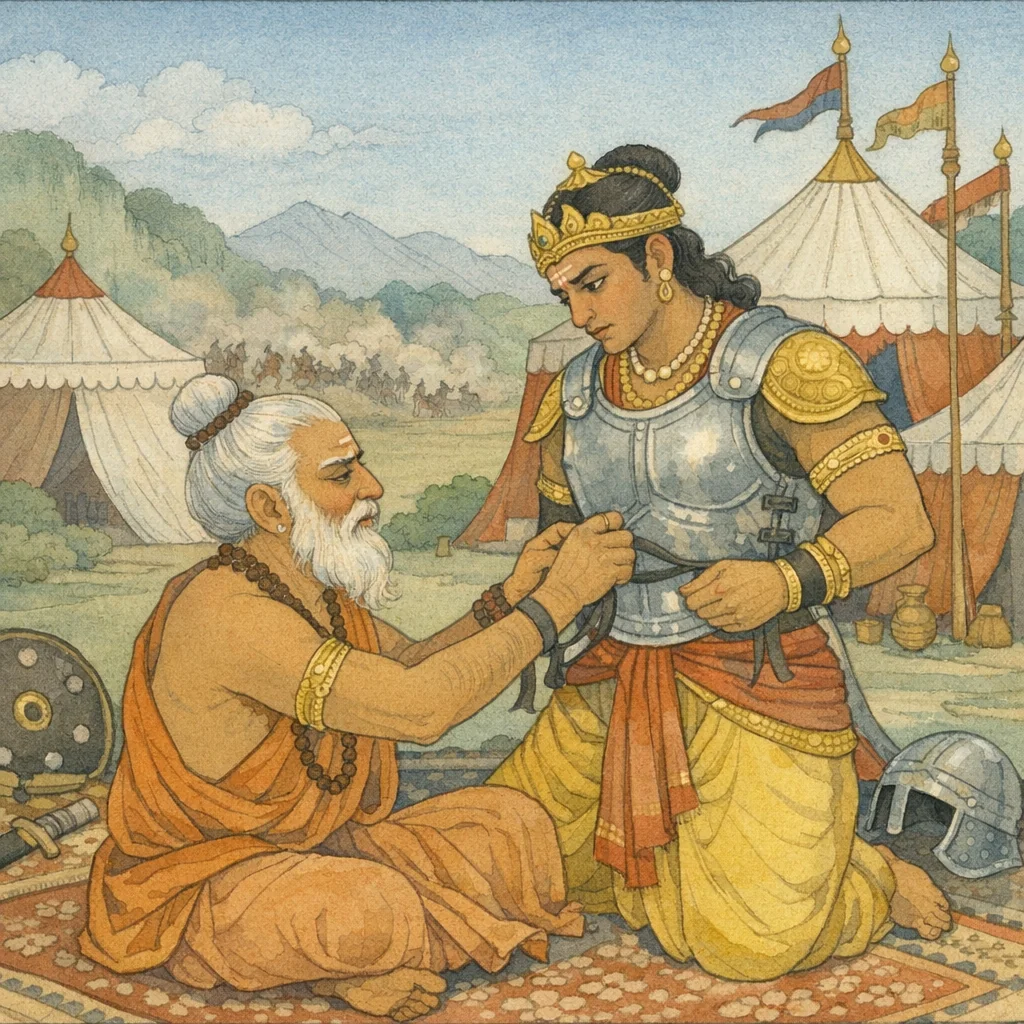
Chapter Arc: सुदक्षिण काम्बोज और विक्रान्त श्रुतायुध के अर्जुन द्वारा मारे जाने से कौरव-सेना में भगदड़ मचती है; अपनी सेना को टूटता देख दुर्योधन व्याकुल होकर द्रोण के पास एक ही रथ से वेगपूर्वक पहुँचता है। → दुर्योधन द्रोण पर उपालम्भ करता है—सेना बिखर रही है, अर्जुन अजेय-सा बढ़ रहा है, और स्वयं दुर्योधन को लगता है कि उसने जयद्रथ को ‘आश्वासन’ देकर अनजाने में मृत्यु के मुख में धकेल दिया; वह द्रोण से तत्काल कोई उपाय, कोई रक्षण, कोई निर्णायक सहायता माँगता है। → द्रोण ‘वरद’ रूप में दुर्योधन के शरीर पर दिव्य कवच बाँधते हैं—ब्रह्मसूत्र से कवच-बंधन का विधान करते हुए उसे वैसा ही बताते हैं जैसा पुराकाल में रणभूमि में विष्णु के लिए ब्रह्मा ने किया था; मंत्र-समेत यह कवच दुर्योधन को युद्ध में निर्भय बनाता है। → कवच से सुरक्षित होकर दुर्योधन पुनः युद्ध-प्रवृत्त होता है और कौरव-पक्ष का मनोबल क्षणिक रूप से सँभलता है; द्रोण की योजना के अनुसार वह ‘वृत्र-चमू’ (भयंकर/अभेद्य व्यूह) की ओर अग्रसर होता है। → कवच-धारी दुर्योधन के पुनः मैदान में उतरते ही प्रश्न उठता है—क्या यह दिव्य रक्षण अर्जुन की प्रचण्ड गति को रोक पाएगा, और क्या जयद्रथ-वध की घड़ी टल सकेगी?
Shlokas
Verse 1
फट शा+ (0) अमन +- चतुर्नवतितमो< ध्याय: 80069 उपालम्भ सुनकर द्रोणाचार्यका उसके शरीरमें दिव्य कवच बाँधकर की अर्जुनके साथ युद्धके लिये जना संजय उवाच ततः प्रविष्टे कौन्तेये सिंधुराजजिघांसया । द्रोणानीकं विनिर्भिद्य भोजानीकं च दुस्तरम्,त्वरन्नेकरथेनैव समेत्य द्रोणमब्रवीत् । संजय कहते हैं--राजन्! तदनन्तर जब कुन्तीकुमार अर्जुन सिन्धुराज जयद्रथका वध करनेकी इच्छासे द्रोणाचार्य और कृतवर्माका दुस्तर सेना-व्यूह भेदन करके आपकी सेनामें प्रविष्ट हो गये और सव्यसाची अर्जुनके हाथसे जब काम्बोजराजकुमार सुदक्षिण तथा पराक्रमी श्रुतायुध मार दिये गये तथा जब सारी सेनाएँ नष्ट-भ्रष्ट होकर चारों ओर भाग खड़ी हुईं, उस समय अपनी सम्पूर्ण सेनामें भगदड़ मची देख आपका पुत्र दुर्योधन बड़ी उतावलीके साथ एकमात्र रथके द्वारा द्रोणाचार्यके पास गया और उनसे मिलकर इस प्रकार बोला--
Sanjaya said: Then, when Arjuna, son of Kunti, had penetrated the Kaurava host with the intent to slay the king of Sindhu (Jayadratha), breaking through Drona’s division and also the formidable division of the Bhojas, Duryodhana—seeing his entire army thrown into confusion—hurried in a single chariot to Drona, met him, and spoke. The verse frames a moral tension: strategic brilliance and personal vows drive the battle forward, while leaders respond to collapsing order with urgent counsel, revealing how ambition and fear can press even great commanders into ethically fraught decisions.
Verse 2
काम्बोजस्य च दायादे हते राजन् सुदक्षिणे । श्रुतायुधे च विक्रान्ते निहते सव्यसाचिना,त्वरन्नेकरथेनैव समेत्य द्रोणमब्रवीत् । संजय कहते हैं--राजन्! तदनन्तर जब कुन्तीकुमार अर्जुन सिन्धुराज जयद्रथका वध करनेकी इच्छासे द्रोणाचार्य और कृतवर्माका दुस्तर सेना-व्यूह भेदन करके आपकी सेनामें प्रविष्ट हो गये और सव्यसाची अर्जुनके हाथसे जब काम्बोजराजकुमार सुदक्षिण तथा पराक्रमी श्रुतायुध मार दिये गये तथा जब सारी सेनाएँ नष्ट-भ्रष्ट होकर चारों ओर भाग खड़ी हुईं, उस समय अपनी सम्पूर्ण सेनामें भगदड़ मची देख आपका पुत्र दुर्योधन बड़ी उतावलीके साथ एकमात्र रथके द्वारा द्रोणाचार्यके पास गया और उनसे मिलकर इस प्रकार बोला--
Sañjaya said: O King, when Sudakṣiṇa, the heir of the Kāmboja line, had been slain, and when the valiant Śrutāyudha too had been killed by Arjuna the ambidextrous, Duryodhana—seeing his forces thrown into panic—hurried on a single chariot to Droṇa, met him, and spoke. The verse underscores how the fall of prominent warriors and the collapse of morale drive leaders into urgent counsel, revealing the ethical pressure of command amid a war where ambition and duty collide.
Verse 3
विप्रद्रुतेष्वनीकेषु विध्वस्तेषु समन््तत: । प्रभग्नं स्वबलं दृष्ट््वा पुत्रस्ते द्रोणम भ्ययात्,त्वरन्नेकरथेनैव समेत्य द्रोणमब्रवीत् । संजय कहते हैं--राजन्! तदनन्तर जब कुन्तीकुमार अर्जुन सिन्धुराज जयद्रथका वध करनेकी इच्छासे द्रोणाचार्य और कृतवर्माका दुस्तर सेना-व्यूह भेदन करके आपकी सेनामें प्रविष्ट हो गये और सव्यसाची अर्जुनके हाथसे जब काम्बोजराजकुमार सुदक्षिण तथा पराक्रमी श्रुतायुध मार दिये गये तथा जब सारी सेनाएँ नष्ट-भ्रष्ट होकर चारों ओर भाग खड़ी हुईं, उस समय अपनी सम्पूर्ण सेनामें भगदड़ मची देख आपका पुत्र दुर्योधन बड़ी उतावलीके साथ एकमात्र रथके द्वारा द्रोणाचार्यके पास गया और उनसे मिलकर इस प्रकार बोला--
Sañjaya said: O King, when the battle-formations had been thrown into confusion and shattered on every side, and when he saw his own forces broken and fleeing, your son hastened to Droṇa. Quickly approaching him in a single chariot, he met Droṇa and spoke to him. The scene underscores the moral pressure of leadership in war: when an army collapses, the commander’s duty is tested, and desperation drives rulers to seek counsel and protection from those they deem their strongest support.
Verse 4
गत: स पुरुषव्याप्र: प्रमथ्यैतां महाचमूम्,त्वरन्नेकरथेनैव समेत्य द्रोणमब्रवीत् । संजय कहते हैं--राजन्! तदनन्तर जब कुन्तीकुमार अर्जुन सिन्धुराज जयद्रथका वध करनेकी इच्छासे द्रोणाचार्य और कृतवर्माका दुस्तर सेना-व्यूह भेदन करके आपकी सेनामें प्रविष्ट हो गये और सव्यसाची अर्जुनके हाथसे जब काम्बोजराजकुमार सुदक्षिण तथा पराक्रमी श्रुतायुध मार दिये गये तथा जब सारी सेनाएँ नष्ट-भ्रष्ट होकर चारों ओर भाग खड़ी हुईं, उस समय अपनी सम्पूर्ण सेनामें भगदड़ मची देख आपका पुत्र दुर्योधन बड़ी उतावलीके साथ एकमात्र रथके द्वारा द्रोणाचार्यके पास गया और उनसे मिलकर इस प्रकार बोला--
Sañjaya said: That tiger among men, having shattered this vast host, hurried on with a single chariot, approached Droṇa, and spoke to him. The verse underscores the battlefield’s sudden reversals—when a force is broken and panic spreads, leaders rush to secure counsel and command, revealing how strategy and responsibility are tested amid the moral pressure of war.
Verse 5
अथ बुद्धया समीक्षस्व किन्नु कार्यमनन्तरम् । अर्जुनस्य विघाताय दारुणे5स्मिन् जनक्षये,त्वरन्नेकरथेनैव समेत्य द्रोणमब्रवीत् । संजय कहते हैं--राजन्! तदनन्तर जब कुन्तीकुमार अर्जुन सिन्धुराज जयद्रथका वध करनेकी इच्छासे द्रोणाचार्य और कृतवर्माका दुस्तर सेना-व्यूह भेदन करके आपकी सेनामें प्रविष्ट हो गये और सव्यसाची अर्जुनके हाथसे जब काम्बोजराजकुमार सुदक्षिण तथा पराक्रमी श्रुतायुध मार दिये गये तथा जब सारी सेनाएँ नष्ट-भ्रष्ट होकर चारों ओर भाग खड़ी हुईं, उस समय अपनी सम्पूर्ण सेनामें भगदड़ मची देख आपका पुत्र दुर्योधन बड़ी उतावलीके साथ एकमात्र रथके द्वारा द्रोणाचार्यके पास गया और उनसे मिलकर इस प्रकार बोला--
Sañjaya said: “Now consider with clear judgment what should be done next. In this dreadful slaughter of men, intent on checking Arjuna, he hurriedly went—alone in a single chariot—to Droṇa, met him, and spoke.”
Verse 6
यथा स पुरुषव्याप्रो न हन्येत जयद्रथ: । तथा विधत्स्व भद्रे ते त्वं हि न: परमा गति:,त्वरन्नेकरथेनैव समेत्य द्रोणमब्रवीत् । संजय कहते हैं--राजन्! तदनन्तर जब कुन्तीकुमार अर्जुन सिन्धुराज जयद्रथका वध करनेकी इच्छासे द्रोणाचार्य और कृतवर्माका दुस्तर सेना-व्यूह भेदन करके आपकी सेनामें प्रविष्ट हो गये और सव्यसाची अर्जुनके हाथसे जब काम्बोजराजकुमार सुदक्षिण तथा पराक्रमी श्रुतायुध मार दिये गये तथा जब सारी सेनाएँ नष्ट-भ्रष्ट होकर चारों ओर भाग खड़ी हुईं, उस समय अपनी सम्पूर्ण सेनामें भगदड़ मची देख आपका पुत्र दुर्योधन बड़ी उतावलीके साथ एकमात्र रथके द्वारा द्रोणाचार्यके पास गया और उनसे मिलकर इस प्रकार बोला--
Sañjaya said: “So arrange it, O noble one, that Jayadratha—that man who has become the very pivot of our cause—may not be slain. You are indeed our highest refuge.” Having thus resolved, Duryodhana, in great haste, drove alone in a single chariot to Droṇa, met him, and spoke these words—seeking protection for Jayadratha and revealing the Kauravas’ dependence on Droṇa’s command in the crisis of battle.
Verse 7
“गुरुदेव! पुरुषसिंह अर्जुन हमारी इस विशाल सेनाको मथकर व्यूहके भीतर चला गया। अब आप अपनी बुद्धिसे यह विचार कीजिये कि इसके बाद अर्जुनके विनाशके लिये क्या करना चाहिये? इस भयंकर नरसंहारमें जिस प्रकार भी पुरुषसिंह जयद्रथ न मारे जायँ, वैसा उपाय कीजिये। आपका कल्याण हो। हमारा सबसे बड़ा सहारा आप ही हैं || ४-- ६।। असौ धनंजयान्निर्हि कोपमारुतचोदित: । सेनाकक्षं दहति मे वहल्नि:ः कक्षमिवोत्थित:,त्वरन्नेकरथेनैव समेत्य द्रोणमब्रवीत् । संजय कहते हैं--राजन्! तदनन्तर जब कुन्तीकुमार अर्जुन सिन्धुराज जयद्रथका वध करनेकी इच्छासे द्रोणाचार्य और कृतवर्माका दुस्तर सेना-व्यूह भेदन करके आपकी सेनामें प्रविष्ट हो गये और सव्यसाची अर्जुनके हाथसे जब काम्बोजराजकुमार सुदक्षिण तथा पराक्रमी श्रुतायुध मार दिये गये तथा जब सारी सेनाएँ नष्ट-भ्रष्ट होकर चारों ओर भाग खड़ी हुईं, उस समय अपनी सम्पूर्ण सेनामें भगदड़ मची देख आपका पुत्र दुर्योधन बड़ी उतावलीके साथ एकमात्र रथके द्वारा द्रोणाचार्यके पास गया और उनसे मिलकर इस प्रकार बोला-- “जैसे सहसा उठा हुआ दावानल सूखे घास-फूँस अथवा जंगलको जलाकर भस्म कर देता है, उसी प्रकार यह धनंजयरूपी अग्नि कोपरूपी प्रचण्ड वायुसे प्रेरित हो मेरे सैन्यरूपी सूखे वनको दग्ध किये देती है
Sañjaya said: O King, that Dhanañjaya (Arjuna), driven onward by the gale of wrath, is burning my army’s defensive ranks like a wildfire that has suddenly risen and consumes dry grassland. Seeing the rout spreading through the host, your son hurried alone in a single chariot to Droṇa, met him, and spoke. The verse frames Arjuna’s fury as a force of nature—an ethical warning about how anger, once unleashed in war, turns disciplined formations into panic and slaughter, compelling leaders to seek counsel for countermeasures.
Verse 8
अकिक्रान्ते हि कौन्तेये भित्त्वा सैन्यं परंतप । जयद्रथस्य गोप्तार: संशयं परमं गता:,त्वरन्नेकरथेनैव समेत्य द्रोणमब्रवीत् । संजय कहते हैं--राजन्! तदनन्तर जब कुन्तीकुमार अर्जुन सिन्धुराज जयद्रथका वध करनेकी इच्छासे द्रोणाचार्य और कृतवर्माका दुस्तर सेना-व्यूह भेदन करके आपकी सेनामें प्रविष्ट हो गये और सव्यसाची अर्जुनके हाथसे जब काम्बोजराजकुमार सुदक्षिण तथा पराक्रमी श्रुतायुध मार दिये गये तथा जब सारी सेनाएँ नष्ट-भ्रष्ट होकर चारों ओर भाग खड़ी हुईं, उस समय अपनी सम्पूर्ण सेनामें भगदड़ मची देख आपका पुत्र दुर्योधन बड़ी उतावलीके साथ एकमात्र रथके द्वारा द्रोणाचार्यके पास गया और उनसे मिलकर इस प्रकार बोला-- 'शत्रुओंको संताप देनेवाले आचार्य! जबसे कुन्तीकुमार अर्जुन आपकी सेनाका व्यूह भेदकर आपको भी लाँघकर आगे चले गये हैं, तबसे जयद्रथकी रक्षा करनेवाले योद्धा महान् संशयमें पड़ गये हैं
Sañjaya said: “O scorcher of foes (Dhṛtarāṣṭra), when Arjuna, son of Kuntī, had pressed forward—having broken through the army—those appointed to guard Jayadratha fell into the deepest doubt. Then Duryodhana, hurrying in a single chariot, went to Droṇa, met him, and spoke.” In context, the verse highlights the moral pressure of command in war: when a vowed objective (Arjuna’s resolve to slay Jayadratha) pierces strategic defenses, protectors waver, and leaders resort to urgent counsel—revealing how fear and uncertainty can destabilize even a well-ordered force.
Verse 9
स्थिरा बुद्धिनरिन्द्राणामासीद् ब्रह्म॒विदां वर । नातिक्रमिष्यति द्रोणं जातु जीवं धनंजय:,त्वरन्नेकरथेनैव समेत्य द्रोणमब्रवीत् । संजय कहते हैं--राजन्! तदनन्तर जब कुन्तीकुमार अर्जुन सिन्धुराज जयद्रथका वध करनेकी इच्छासे द्रोणाचार्य और कृतवर्माका दुस्तर सेना-व्यूह भेदन करके आपकी सेनामें प्रविष्ट हो गये और सव्यसाची अर्जुनके हाथसे जब काम्बोजराजकुमार सुदक्षिण तथा पराक्रमी श्रुतायुध मार दिये गये तथा जब सारी सेनाएँ नष्ट-भ्रष्ट होकर चारों ओर भाग खड़ी हुईं, उस समय अपनी सम्पूर्ण सेनामें भगदड़ मची देख आपका पुत्र दुर्योधन बड़ी उतावलीके साथ एकमात्र रथके द्वारा द्रोणाचार्यके पास गया और उनसे मिलकर इस प्रकार बोला-- “ब्रह्मवेत्ताओंमें श्रेष्ठ गुरुदेव! हमारे पक्षके नरेशोंको यह दृढ़ विश्वास था कि अर्जुन द्रोणाचार्यके जीते-जी उन्हें लाँधघकर सेनाके भीतर नहीं घुस सकेगा
Sañjaya said: “O best of knowers of Brahman, O King! The rulers on our side held a firm conviction: ‘So long as Droṇa lives, Dhanañjaya (Arjuna) will never be able to overstep him and break into the army.’ Yet, hurrying in great agitation, your son went alone in a single chariot to meet Droṇa and addressed him. The passage underscores how confidence in a commander’s prowess becomes a moral and strategic crutch—until the reality of the battlefield shatters it, forcing desperate counsel and urgent appeals to authority.”
Verse 10
योअसौ पार्थो व्यतिक्रान्तो मिषतस्ते महाद्युते । सर्व हाद्यातुरं मन््ये नेदमस्ति बल॑ मम,त्वरन्नेकरथेनैव समेत्य द्रोणमब्रवीत् । संजय कहते हैं--राजन्! तदनन्तर जब कुन्तीकुमार अर्जुन सिन्धुराज जयद्रथका वध करनेकी इच्छासे द्रोणाचार्य और कृतवर्माका दुस्तर सेना-व्यूह भेदन करके आपकी सेनामें प्रविष्ट हो गये और सव्यसाची अर्जुनके हाथसे जब काम्बोजराजकुमार सुदक्षिण तथा पराक्रमी श्रुतायुध मार दिये गये तथा जब सारी सेनाएँ नष्ट-भ्रष्ट होकर चारों ओर भाग खड़ी हुईं, उस समय अपनी सम्पूर्ण सेनामें भगदड़ मची देख आपका पुत्र दुर्योधन बड़ी उतावलीके साथ एकमात्र रथके द्वारा द्रोणाचार्यके पास गया और उनसे मिलकर इस प्रकार बोला-- 'परंतु महातेजस्वी वीर! आपके देखते-देखते वह कुन्तीकुमार अर्जुन आपको लाँघकर जो व्यूहमें घुस गया है, इससे मैं अपनी इस सारी सेनाको व्याकुल और विनष्ट हुई-सी मानता हूँ। अब मेरी इस सेनाका अस्तित्व नहीं रहेगा
Sanjaya said: “O king, O great and radiant one! That Partha (Arjuna) has passed beyond (broken through) while you were looking on. I consider the entire host to be shaken and distressed; my strength seems no longer to exist. Then, hurrying in a single chariot, he went to Drona and spoke to him.” Ethically, the verse highlights the collapse of confidence and command when a key defensive duty (protecting the formation) fails: the king’s side reads Arjuna’s breakthrough not merely as a tactical loss but as a moral and psychological unraveling of the army’s resolve.
Verse 11
जानामि त्वां महाभाग पाण्डवानां हिते रतम् । तथा मुह्यामि च ब्रह्मन् कार्यवत्तां विचिन्तयन्,त्वरन्नेकरथेनैव समेत्य द्रोणमब्रवीत् । संजय कहते हैं--राजन्! तदनन्तर जब कुन्तीकुमार अर्जुन सिन्धुराज जयद्रथका वध करनेकी इच्छासे द्रोणाचार्य और कृतवर्माका दुस्तर सेना-व्यूह भेदन करके आपकी सेनामें प्रविष्ट हो गये और सव्यसाची अर्जुनके हाथसे जब काम्बोजराजकुमार सुदक्षिण तथा पराक्रमी श्रुतायुध मार दिये गये तथा जब सारी सेनाएँ नष्ट-भ्रष्ट होकर चारों ओर भाग खड़ी हुईं, उस समय अपनी सम्पूर्ण सेनामें भगदड़ मची देख आपका पुत्र दुर्योधन बड़ी उतावलीके साथ एकमात्र रथके द्वारा द्रोणाचार्यके पास गया और उनसे मिलकर इस प्रकार बोला-- “ब्रह्मन! महाभाग! मैं यह जानता हूँ कि आप पाण्डवोंके हितमें तत्पर रहनेवाले हैं; इसीलिये अपने कार्यकी गुरुताका विचार करके मोहित हो रहा हूँ
Sanjaya said: “O King, I know you, O greatly fortunate one, to be devoted to the welfare of the Pāṇḍavas. Yet, O Brāhmaṇa, as I reflect on the gravity of what must be done, I am bewildered.” Having hurried to Droṇa with only a single chariot, he met him and spoke thus. (In context, Duryodhana—seeing his forces thrown into panic by Arjuna’s onslaught—rushes to Droṇa and, with anxious reproach, questions the teacher’s commitment and strategy.)
Verse 12
यथाशक्ति च ते ब्रह्मन् वर्तये वृत्तिमुत्तमाम् । प्रीणामि च यथाशक्ति तच्च त्वं नावबुध्यसे,त्वरन्नेकरथेनैव समेत्य द्रोणमब्रवीत् । संजय कहते हैं--राजन्! तदनन्तर जब कुन्तीकुमार अर्जुन सिन्धुराज जयद्रथका वध करनेकी इच्छासे द्रोणाचार्य और कृतवर्माका दुस्तर सेना-व्यूह भेदन करके आपकी सेनामें प्रविष्ट हो गये और सव्यसाची अर्जुनके हाथसे जब काम्बोजराजकुमार सुदक्षिण तथा पराक्रमी श्रुतायुध मार दिये गये तथा जब सारी सेनाएँ नष्ट-भ्रष्ट होकर चारों ओर भाग खड़ी हुईं, उस समय अपनी सम्पूर्ण सेनामें भगदड़ मची देख आपका पुत्र दुर्योधन बड़ी उतावलीके साथ एकमात्र रथके द्वारा द्रोणाचार्यके पास गया और उनसे मिलकर इस प्रकार बोला-- “विप्रवर! मैं यथाशक्ति आपके लिये उत्तम जीविकावृत्तिकी व्यवस्था करता रहता हूँ और अपनी शक्तिभर आपको प्रसन्न रखनेकी चेष्टा करता रहता हूँ; परंतु इन सब बातोंको आप याद नहीं रखते हैं
Sañjaya said: “O King! Then your son, hurrying in great agitation, went alone in a single chariot to Droṇa and addressed him: ‘O best of Brahmins, to the best of my ability I provide you with an excellent livelihood and, as far as I can, I strive to keep you pleased; yet you do not seem to recognize or remember this.’”
Verse 13
अस्मान्न त्वं सदा भक्तानिच्छस्यमितविक्रम । पाण्डवान् सततं प्रीणास्यस्माकं विप्रिये रतान्,त्वरन्नेकरथेनैव समेत्य द्रोणमब्रवीत् । संजय कहते हैं--राजन्! तदनन्तर जब कुन्तीकुमार अर्जुन सिन्धुराज जयद्रथका वध करनेकी इच्छासे द्रोणाचार्य और कृतवर्माका दुस्तर सेना-व्यूह भेदन करके आपकी सेनामें प्रविष्ट हो गये और सव्यसाची अर्जुनके हाथसे जब काम्बोजराजकुमार सुदक्षिण तथा पराक्रमी श्रुतायुध मार दिये गये तथा जब सारी सेनाएँ नष्ट-भ्रष्ट होकर चारों ओर भाग खड़ी हुईं, उस समय अपनी सम्पूर्ण सेनामें भगदड़ मची देख आपका पुत्र दुर्योधन बड़ी उतावलीके साथ एकमात्र रथके द्वारा द्रोणाचार्यके पास गया और उनसे मिलकर इस प्रकार बोला-- “अमितपराक्रमी आचार्य! हम आपके चरणोंमें सदा भक्ति रखते हैं तो भी आप हमें नहीं चाहते हैं और जो सदा हमलोगोंका अप्रिय करनेमें तत्पर रहते हैं, उन पाण्डवोंको आप निरन्तर प्रसन्न रखते हैं
Sanjaya said: “O king, O man of immeasurable prowess! You do not seem to favor us, though we are ever devoted to you; instead you continually gratify the Pāṇḍavas, who are intent on what is displeasing to us.” Having hurried to Droṇa in a single chariot, he met him and spoke these words. (Here Duryodhana’s complaint frames loyalty as a claim upon the teacher’s partiality, revealing the ethical tension between personal allegiance and a preceptor’s duty to act by principle rather than faction.)
Verse 14
अस्मानेवोपजीवंस्त्वमस्माकं विप्रिये रत: । न हायं त्वां विजानामि मधुदिग्धमिव क्षुरम्,त्वरन्नेकरथेनैव समेत्य द्रोणमब्रवीत् । संजय कहते हैं--राजन्! तदनन्तर जब कुन्तीकुमार अर्जुन सिन्धुराज जयद्रथका वध करनेकी इच्छासे द्रोणाचार्य और कृतवर्माका दुस्तर सेना-व्यूह भेदन करके आपकी सेनामें प्रविष्ट हो गये और सव्यसाची अर्जुनके हाथसे जब काम्बोजराजकुमार सुदक्षिण तथा पराक्रमी श्रुतायुध मार दिये गये तथा जब सारी सेनाएँ नष्ट-भ्रष्ट होकर चारों ओर भाग खड़ी हुईं, उस समय अपनी सम्पूर्ण सेनामें भगदड़ मची देख आपका पुत्र दुर्योधन बड़ी उतावलीके साथ एकमात्र रथके द्वारा द्रोणाचार्यके पास गया और उनसे मिलकर इस प्रकार बोला-- “हमसे ही आपकी जीविका चलती है तो भी आप हमारा ही अप्रिय करनेमें संलग्न रहते हैं। मैं नहीं जानता था कि आप शहदमें डुबोये हुए छुरेके समान हैं
Sañjaya said: “O King, then your son, hurrying in a single chariot, went up to Droṇa and spoke: ‘Though you live by our support, you remain intent on what is displeasing to us. I did not know you were like a razor smeared with honey—sweet in appearance, but cutting in effect.’” In ethical tone, the verse exposes Duryodhana’s transactional view of loyalty: he treats patronage as a claim over a teacher’s conduct, and condemns Droṇa as deceptively harmful when Droṇa’s actions do not serve his immediate interest.
Verse 15
नादास्यच्चेद् वरं महां भवान् पाण्डवनिग्रहे । नावारयिष्यं गच्छन्तमहं सिन्धुपतिं गृहान्,त्वरन्नेकरथेनैव समेत्य द्रोणमब्रवीत् । संजय कहते हैं--राजन्! तदनन्तर जब कुन्तीकुमार अर्जुन सिन्धुराज जयद्रथका वध करनेकी इच्छासे द्रोणाचार्य और कृतवर्माका दुस्तर सेना-व्यूह भेदन करके आपकी सेनामें प्रविष्ट हो गये और सव्यसाची अर्जुनके हाथसे जब काम्बोजराजकुमार सुदक्षिण तथा पराक्रमी श्रुतायुध मार दिये गये तथा जब सारी सेनाएँ नष्ट-भ्रष्ट होकर चारों ओर भाग खड़ी हुईं, उस समय अपनी सम्पूर्ण सेनामें भगदड़ मची देख आपका पुत्र दुर्योधन बड़ी उतावलीके साथ एकमात्र रथके द्वारा द्रोणाचार्यके पास गया और उनसे मिलकर इस प्रकार बोला-- “यदि आप मुझे अर्जुनको रोके रखनेका वर न देते तो मैं अपने घरको जाते हुए सिन्धुराज जयद्रथको कभी मना नहीं करता
Sañjaya said: “O King! If you had not granted me that great boon—namely, the restraining of the Pāṇḍavas—then I would never have stopped the lord of Sindhu (Jayadratha) as he was going home. Seeing the rout in his entire army, your son (Duryodhana), in great haste, went alone in a single chariot to Droṇa, met him, and spoke these words.”
Verse 16
मया त्वाशंसमानेन त्वत्तस्त्राणमबुद्धिना । आश्वासित: सिन्धुपतिमोहाद दत्तश्न मृत्यवे,त्वरन्नेकरथेनैव समेत्य द्रोणमब्रवीत् । संजय कहते हैं--राजन्! तदनन्तर जब कुन्तीकुमार अर्जुन सिन्धुराज जयद्रथका वध करनेकी इच्छासे द्रोणाचार्य और कृतवर्माका दुस्तर सेना-व्यूह भेदन करके आपकी सेनामें प्रविष्ट हो गये और सव्यसाची अर्जुनके हाथसे जब काम्बोजराजकुमार सुदक्षिण तथा पराक्रमी श्रुतायुध मार दिये गये तथा जब सारी सेनाएँ नष्ट-भ्रष्ट होकर चारों ओर भाग खड़ी हुईं, उस समय अपनी सम्पूर्ण सेनामें भगदड़ मची देख आपका पुत्र दुर्योधन बड़ी उतावलीके साथ एकमात्र रथके द्वारा द्रोणाचार्यके पास गया और उनसे मिलकर इस प्रकार बोला-- “मुझ मूर्खने आपसे संरक्षण पानेका भरोसा करके सिन्धुराज जयद्रथको समझा- बुझाकर यहीं रोक लिया और इस प्रकार मोहवश मैंने उन्हें मौतके हाथमें सौंप दिया
Sañjaya said: “O King, in my folly, relying on protection from you, I reassured the lord of Sindhu (Jayadratha); and, deluded, I effectively handed him over to death. Then, hurrying in great agitation, your son went alone in a single chariot to Droṇa, met him, and spoke.” Ethically, the verse frames Duryodhana’s act as a culpable misjudgment: confidence in external protection and political reassurance becomes complicity in exposing an ally to fatal danger, underscoring how delusion (moha) and rash counsel in war can turn into moral responsibility for another’s destruction.
Verse 17
यमदंष्टान्तरं प्राप्तो मुच्येतापि हि मानव: । नार्जुनस्य वशं प्राप्तो मुच्येताजी जयद्रथ:,त्वरन्नेकरथेनैव समेत्य द्रोणमब्रवीत् । संजय कहते हैं--राजन्! तदनन्तर जब कुन्तीकुमार अर्जुन सिन्धुराज जयद्रथका वध करनेकी इच्छासे द्रोणाचार्य और कृतवर्माका दुस्तर सेना-व्यूह भेदन करके आपकी सेनामें प्रविष्ट हो गये और सव्यसाची अर्जुनके हाथसे जब काम्बोजराजकुमार सुदक्षिण तथा पराक्रमी श्रुतायुध मार दिये गये तथा जब सारी सेनाएँ नष्ट-भ्रष्ट होकर चारों ओर भाग खड़ी हुईं, उस समय अपनी सम्पूर्ण सेनामें भगदड़ मची देख आपका पुत्र दुर्योधन बड़ी उतावलीके साथ एकमात्र रथके द्वारा द्रोणाचार्यके पास गया और उनसे मिलकर इस प्रकार बोला-- “मनुष्य यमराजकी दाढ़ोंमें पड़कर भले ही बच जाय, परंतु रणभूमिमें अर्जुनके वशमें पड़े हुए जयद्रथके प्राण नहीं बच सकते
Sañjaya said: “O King, a man might perhaps escape even after falling between the fangs of Yama; but Jayadratha, once caught within Arjuna’s power on the battlefield, will not escape with his life.” Then, in great haste, Duryodhana went alone in a single chariot to Droṇa, met him, and spoke these words—pressing the urgency of protecting Jayadratha and exposing the grim moral pressure of war, where fear and duty collide under the shadow of inevitable retribution.
Verse 18
स तथा कुरु शोणाश्व यथा मुच्येत सैन्धव: । मम चार्तप्रलापानां मा क्रुध: पाहि सैन्धवम्,त्वरन्नेकरथेनैव समेत्य द्रोणमब्रवीत् । संजय कहते हैं--राजन्! तदनन्तर जब कुन्तीकुमार अर्जुन सिन्धुराज जयद्रथका वध करनेकी इच्छासे द्रोणाचार्य और कृतवर्माका दुस्तर सेना-व्यूह भेदन करके आपकी सेनामें प्रविष्ट हो गये और सव्यसाची अर्जुनके हाथसे जब काम्बोजराजकुमार सुदक्षिण तथा पराक्रमी श्रुतायुध मार दिये गये तथा जब सारी सेनाएँ नष्ट-भ्रष्ट होकर चारों ओर भाग खड़ी हुईं, उस समय अपनी सम्पूर्ण सेनामें भगदड़ मची देख आपका पुत्र दुर्योधन बड़ी उतावलीके साथ एकमात्र रथके द्वारा द्रोणाचार्यके पास गया और उनसे मिलकर इस प्रकार बोला-- “लाल घोड़ोंवाले आचार्य! आप कोई ऐसा प्रयत्न कीजिये, जिससे सिन्धुराज जयद्रथ मृत्युसे छुटकारा पा सके। मैंने आर्त होनेके कारण जो प्रलाप किये हैं, उनके लिये क्रोध न कीजियेगा; जैसे भी हो, सिन्धुराजकी रक्षा कीजिये”
Sañjaya said: “O Śoṇāśva (teacher with the red horses), act in such a way that the Saindhava (Jayadratha) may be freed (from death). Do not be angry at my distressed outbursts; protect the Saindhava.” Saying this, Duryodhana hurriedly approached Droṇa with only a single chariot and addressed him—revealing how fear for an ally’s fate can drive a king to urgent supplication, even while trying to excuse harsh words spoken in panic.
Verse 19
द्रोण उदाच नाभ्यासूयामि ते वाक्यमश्चत्थाम्नासि मे सम: । सत्यं तु ते प्रवक्ष्यामि तज्जुषस्व विशाम्पते,त्वरन्नेकरथेनैव समेत्य द्रोणमब्रवीत् । संजय कहते हैं--राजन्! तदनन्तर जब कुन्तीकुमार अर्जुन सिन्धुराज जयद्रथका वध करनेकी इच्छासे द्रोणाचार्य और कृतवर्माका दुस्तर सेना-व्यूह भेदन करके आपकी सेनामें प्रविष्ट हो गये और सव्यसाची अर्जुनके हाथसे जब काम्बोजराजकुमार सुदक्षिण तथा पराक्रमी श्रुतायुध मार दिये गये तथा जब सारी सेनाएँ नष्ट-भ्रष्ट होकर चारों ओर भाग खड़ी हुईं, उस समय अपनी सम्पूर्ण सेनामें भगदड़ मची देख आपका पुत्र दुर्योधन बड़ी उतावलीके साथ एकमात्र रथके द्वारा द्रोणाचार्यके पास गया और उनसे मिलकर इस प्रकार बोला-- द्रोणाचार्यने कहा--राजन्! तुमने जो बात कही है, उसके लिये मैं बुरा नहीं मानता; क्योंकि तुम मेरे लिये अश्वत्थामाके समान हो। परंतु जो सच्ची बात है, वह तुम्हें बता रहा हूँ; उसे ध्यान देकर सुनो--
Sanjaya said: Droṇa said, “O king, I do not take offence at your words, for to me you are as dear as Aśvatthāman. Yet I shall tell you what is true—accept it with due attention, O lord of the people.” In haste, coming with only a single chariot, he met Droṇa and spoke to him.
Verse 20
सारथि: प्रवर: कृष्ण: शीघ्राश्नास्य हयोत्तमा: । अल्पं च विवरं कृत्वा तूर्ण याति धनंजय:,त्वरन्नेकरथेनैव समेत्य द्रोणमब्रवीत् । संजय कहते हैं--राजन्! तदनन्तर जब कुन्तीकुमार अर्जुन सिन्धुराज जयद्रथका वध करनेकी इच्छासे द्रोणाचार्य और कृतवर्माका दुस्तर सेना-व्यूह भेदन करके आपकी सेनामें प्रविष्ट हो गये और सव्यसाची अर्जुनके हाथसे जब काम्बोजराजकुमार सुदक्षिण तथा पराक्रमी श्रुतायुध मार दिये गये तथा जब सारी सेनाएँ नष्ट-भ्रष्ट होकर चारों ओर भाग खड़ी हुईं, उस समय अपनी सम्पूर्ण सेनामें भगदड़ मची देख आपका पुत्र दुर्योधन बड़ी उतावलीके साथ एकमात्र रथके द्वारा द्रोणाचार्यके पास गया और उनसे मिलकर इस प्रकार बोला--
Sañjaya said: “O King, Kṛṣṇa—the foremost charioteer—drove the excellent horses with swift control. Dhanañjaya (Arjuna), making only a small opening in the enemy formation, sped forward; and in great haste, Duryodhana came alone in a single chariot to Droṇa and addressed him.”
Verse 21
श्रीकृष्ण अर्जुनके श्रेष्ठ सारथि हैं तथा उनके उत्तम घोड़े भी तेज चलनेवाले हैं। इसलिये थोड़ा-सा भी अवकाश बनाकर अर्जुन तत्काल सेनामें घुस जाते हैं ।। कि न पश्यसि बाणौघान् क्रोशमात्रे किरीटिन: । पश्चाद् रथस्य पतितान क्षिप्तान् शीघ्रं हि गच्छत:,त्वरन्नेकरथेनैव समेत्य द्रोणमब्रवीत् । संजय कहते हैं--राजन्! तदनन्तर जब कुन्तीकुमार अर्जुन सिन्धुराज जयद्रथका वध करनेकी इच्छासे द्रोणाचार्य और कृतवर्माका दुस्तर सेना-व्यूह भेदन करके आपकी सेनामें प्रविष्ट हो गये और सव्यसाची अर्जुनके हाथसे जब काम्बोजराजकुमार सुदक्षिण तथा पराक्रमी श्रुतायुध मार दिये गये तथा जब सारी सेनाएँ नष्ट-भ्रष्ट होकर चारों ओर भाग खड़ी हुईं, उस समय अपनी सम्पूर्ण सेनामें भगदड़ मची देख आपका पुत्र दुर्योधन बड़ी उतावलीके साथ एकमात्र रथके द्वारा द्रोणाचार्यके पास गया और उनसे मिलकर इस प्रकार बोला-- क्या तुम देखते नहीं हो कि मेरे चलाये हुए बाणसमूह शीघ्रगामी अर्जुनके रथके एक कोस पीछे पड़े हैं
Sanjaya said: “Do you not see, O King, that the volleys of arrows shot (by us) are falling a full krośa behind the chariot of the diademed Arjuna, as he speeds on? In great haste, Duryodhana went alone in a single chariot to Droṇa, met him, and spoke thus.” In context, the line underscores the moral pressure of war: Duryodhana measures success by tactical effect and speed, while the narrative highlights how Arjuna’s divinely guided chariot (with Kṛṣṇa as charioteer) makes ordinary countermeasures ineffective—intensifying Duryodhana’s anxiety and his demand for harsher action.
Verse 22
नचाहं शीघ्रयाने5द्य समर्थो वयसान्वित: । सेनामुखे च पार्थानामेतद् बलमुपस्थितम्,त्वरन्नेकरथेनैव समेत्य द्रोणमब्रवीत् । संजय कहते हैं--राजन्! तदनन्तर जब कुन्तीकुमार अर्जुन सिन्धुराज जयद्रथका वध करनेकी इच्छासे द्रोणाचार्य और कृतवर्माका दुस्तर सेना-व्यूह भेदन करके आपकी सेनामें प्रविष्ट हो गये और सव्यसाची अर्जुनके हाथसे जब काम्बोजराजकुमार सुदक्षिण तथा पराक्रमी श्रुतायुध मार दिये गये तथा जब सारी सेनाएँ नष्ट-भ्रष्ट होकर चारों ओर भाग खड़ी हुईं, उस समय अपनी सम्पूर्ण सेनामें भगदड़ मची देख आपका पुत्र दुर्योधन बड़ी उतावलीके साथ एकमात्र रथके द्वारा द्रोणाचार्यके पास गया और उनसे मिलकर इस प्रकार बोला-- मैं बूढ़ा हो गया। अतः अब मैं शीघ्रतापूर्वक रथ चलानेमें असमर्थ हूँ। इधर मेरी सेनाके सामने यह कुन्तीकुमारोंकी भारी सेना उपस्थित है
Sañjaya said: “O King, today I am no longer capable of swift driving, being burdened by age. And here, at the very front, this mighty force of the Pārthas stands arrayed.” Seeing his entire army thrown into panic and flight after Arjuna had broken through the formidable formations and struck down leading warriors, Duryodhana hurried in a single chariot to Droṇa and spoke these words—revealing both the pressure of the moment and the moral strain of a war where fear and urgency begin to govern counsel.
Verse 23
युधिष्ठिरश्न मे ग्राह्मो मिषतां सर्वधन्विनाम् । एवं मया प्रतिज्ञातं क्षत्रमध्ये महाभुज,त्वरन्नेकरथेनैव समेत्य द्रोणमब्रवीत् । संजय कहते हैं--राजन्! तदनन्तर जब कुन्तीकुमार अर्जुन सिन्धुराज जयद्रथका वध करनेकी इच्छासे द्रोणाचार्य और कृतवर्माका दुस्तर सेना-व्यूह भेदन करके आपकी सेनामें प्रविष्ट हो गये और सव्यसाची अर्जुनके हाथसे जब काम्बोजराजकुमार सुदक्षिण तथा पराक्रमी श्रुतायुध मार दिये गये तथा जब सारी सेनाएँ नष्ट-भ्रष्ट होकर चारों ओर भाग खड़ी हुईं, उस समय अपनी सम्पूर्ण सेनामें भगदड़ मची देख आपका पुत्र दुर्योधन बड़ी उतावलीके साथ एकमात्र रथके द्वारा द्रोणाचार्यके पास गया और उनसे मिलकर इस प्रकार बोला-- महाबाहो! मैंने क्षत्रियोंके बीचमें यह प्रतिज्ञा की है कि समस्त धनुर्धरोंके देखते-देखते युधिष्ठिरको कैद कर लूँगा
Sañjaya said: “O King! ‘Yudhiṣṭhira must be seized by me, even while all the bowmen look on.’ Thus had I vowed in the midst of the warriors.” Having seen his army thrown into confusion, your son Duryodhana hurried alone in a single chariot to Droṇa, met him, and spoke these words—pressing his personal oath as a matter of kṣatriya honor amid the moral strain of a collapsing battlefield.
Verse 24
धनंजयेन चोत्सृष्टो वर्तते प्रमुखे नूप । तस्माद् व्यूहमुखं हित्वा नाहं योत्स्यामि फाल्गुनम्,त्वरन्नेकरथेनैव समेत्य द्रोणमब्रवीत् । संजय कहते हैं--राजन्! तदनन्तर जब कुन्तीकुमार अर्जुन सिन्धुराज जयद्रथका वध करनेकी इच्छासे द्रोणाचार्य और कृतवर्माका दुस्तर सेना-व्यूह भेदन करके आपकी सेनामें प्रविष्ट हो गये और सव्यसाची अर्जुनके हाथसे जब काम्बोजराजकुमार सुदक्षिण तथा पराक्रमी श्रुतायुध मार दिये गये तथा जब सारी सेनाएँ नष्ट-भ्रष्ट होकर चारों ओर भाग खड़ी हुईं, उस समय अपनी सम्पूर्ण सेनामें भगदड़ मची देख आपका पुत्र दुर्योधन बड़ी उतावलीके साथ एकमात्र रथके द्वारा द्रोणाचार्यके पास गया और उनसे मिलकर इस प्रकार बोला-- नरेश्वर! इस समय युधिष्छिर अर्जुनसे रहित होकर मेरे सामने खड़े हैं। ऐसी अवस्थामें मैं व्यूहका द्वार छोड़कर अर्जुनके साथ युद्ध करनेके लिये नहीं जाऊँगा
Sañjaya said: “O king, now that Dhanañjaya (Arjuna) has been dispatched to the front, he is engaged there. Therefore I will not abandon the mouth of the battle-formation to go and fight Phālguna (Arjuna).” Saying this, Duryodhana hurried in a single chariot to Droṇa, met him, and spoke. The statement reflects a tactical and ethical posture: Duryodhana frames his choice as guarding the ‘gate’ of the array—prioritizing the immediate duty of holding the formation’s entrance and confronting the Pandava leadership present before him, rather than pursuing personal combat with Arjuna at that moment.
Verse 25
तुल्याभिजनकर्माणं शत्रुमेक॑ सहायवान् । गत्वा योधय मा भैस्त्व॑ त्वं हुस्य जगत: पति:,त्वरन्नेकरथेनैव समेत्य द्रोणमब्रवीत् । संजय कहते हैं--राजन्! तदनन्तर जब कुन्तीकुमार अर्जुन सिन्धुराज जयद्रथका वध करनेकी इच्छासे द्रोणाचार्य और कृतवर्माका दुस्तर सेना-व्यूह भेदन करके आपकी सेनामें प्रविष्ट हो गये और सव्यसाची अर्जुनके हाथसे जब काम्बोजराजकुमार सुदक्षिण तथा पराक्रमी श्रुतायुध मार दिये गये तथा जब सारी सेनाएँ नष्ट-भ्रष्ट होकर चारों ओर भाग खड़ी हुईं, उस समय अपनी सम्पूर्ण सेनामें भगदड़ मची देख आपका पुत्र दुर्योधन बड़ी उतावलीके साथ एकमात्र रथके द्वारा द्रोणाचार्यके पास गया और उनसे मिलकर इस प्रकार बोला-- तुम्हारे शत्रु अर्जुन भी तो तुम्हारे-जैसे ही कुल और पराक्रमसे युक्त हैं। इस समय वे अकेले हैं और तुम सहायकोंसे सम्पन्न हो। (वे राज्यसे च्युत हो गये हैं और तुम) इस सम्पूर्ण जगतके स्वामी हो। अत: डरो मत। जाकर अर्जुनसे युद्ध करो
Sañjaya said: “O King, seeing the enemy—Arjuna—who is of equal nobility of birth and equal prowess in action, yet now standing alone, your son (Duryodhana), confident in having supporters, hurried on a single chariot to meet Droṇa and spoke: ‘Go and fight him. Do not fear. You are the lord of this world (i.e., the sovereign power on our side).’” In ethical tone, the speech reveals a ruler’s anxiety turning into coercive encouragement: Duryodhana frames the contest as a matter of status and power, urging Droṇa to overcome fear and confront Arjuna, even as the wider battle situation is collapsing into panic.
Verse 26
राजा शूर: कृती दक्षो वैरमुत्पाद्य पाण्डवै: । वीर स्वयं प्रयाह्वात्र यत्र पार्थो धनंजय:,त्वरन्नेकरथेनैव समेत्य द्रोणमब्रवीत् । संजय कहते हैं--राजन्! तदनन्तर जब कुन्तीकुमार अर्जुन सिन्धुराज जयद्रथका वध करनेकी इच्छासे द्रोणाचार्य और कृतवर्माका दुस्तर सेना-व्यूह भेदन करके आपकी सेनामें प्रविष्ट हो गये और सव्यसाची अर्जुनके हाथसे जब काम्बोजराजकुमार सुदक्षिण तथा पराक्रमी श्रुतायुध मार दिये गये तथा जब सारी सेनाएँ नष्ट-भ्रष्ट होकर चारों ओर भाग खड़ी हुईं, उस समय अपनी सम्पूर्ण सेनामें भगदड़ मची देख आपका पुत्र दुर्योधन बड़ी उतावलीके साथ एकमात्र रथके द्वारा द्रोणाचार्यके पास गया और उनसे मिलकर इस प्रकार बोला-- तुम राजा, शूरवीर, विद्वान् और युद्धकुशल हो। वीर! तुमने ही पाण्डवोंके साथ वैर बाँधा है। अतः जहाँ कुन्तीकुमार अर्जुन गये हैं, वहाँ उनसे युद्ध करनेके लिये स्वयं ही शीघ्रतापूर्वक जाओ
Sañjaya said: O King, your son Duryodhana—valiant, capable, and skilled—having himself provoked enmity with the Pāṇḍavas, hurried alone in a single chariot to meet Droṇa. Reaching him, he spoke: “You are a king, a hero, wise and expert in war; you yourself have taken up this hostility against the Pāṇḍavas. Therefore go at once, yourself, to fight there where Pārtha Dhanañjaya (Arjuna) has gone.” Ethically, the verse highlights how a leader’s chosen hostility (vaira) binds him to escalating violence, and how urgency and pride can drive decisions that intensify collective destruction rather than restrain it.
Verse 27
दुर्योधन उवाच कथं त्वामप्यतिक्रान्त: सर्वशस्त्रभूृतां बरम् । धनंजयो मया शक््य आचार्य प्रतिबाधितुम्,त्वरन्नेकरथेनैव समेत्य द्रोणमब्रवीत् । संजय कहते हैं--राजन्! तदनन्तर जब कुन्तीकुमार अर्जुन सिन्धुराज जयद्रथका वध करनेकी इच्छासे द्रोणाचार्य और कृतवर्माका दुस्तर सेना-व्यूह भेदन करके आपकी सेनामें प्रविष्ट हो गये और सव्यसाची अर्जुनके हाथसे जब काम्बोजराजकुमार सुदक्षिण तथा पराक्रमी श्रुतायुध मार दिये गये तथा जब सारी सेनाएँ नष्ट-भ्रष्ट होकर चारों ओर भाग खड़ी हुईं, उस समय अपनी सम्पूर्ण सेनामें भगदड़ मची देख आपका पुत्र दुर्योधन बड़ी उतावलीके साथ एकमात्र रथके द्वारा द्रोणाचार्यके पास गया और उनसे मिलकर इस प्रकार बोला--
Sanjaya said: Duryodhana spoke—“How has Dhanañjaya (Arjuna) managed to pass even you, O Teacher, the foremost among all bearers of weapons? How could I possibly check him? In haste, coming alone in a single chariot, he approached Droṇa and addressed him thus.” The passage frames Duryodhana’s anxious appeal as his army reels, highlighting the moral tension of relying on revered elders to uphold a cause under strain.
Verse 28
दुर्योधन बोला--आचार्य! आप सम्पूर्ण शस्त्र-धारियोंमें श्रेष्ठ हैं। जो आपको भी लाँघकर आगे बढ़ गया, वह अर्जुन मेरे द्वारा कैसे रोका जा सकता है? ।। अपि शकक््यो रणे जेतुं वजहस्त: पुरंदर: । नार्जुन: समरे शक्यो जेतुं परपुरंजय:,त्वरन्नेकरथेनैव समेत्य द्रोणमब्रवीत् । संजय कहते हैं--राजन्! तदनन्तर जब कुन्तीकुमार अर्जुन सिन्धुराज जयद्रथका वध करनेकी इच्छासे द्रोणाचार्य और कृतवर्माका दुस्तर सेना-व्यूह भेदन करके आपकी सेनामें प्रविष्ट हो गये और सव्यसाची अर्जुनके हाथसे जब काम्बोजराजकुमार सुदक्षिण तथा पराक्रमी श्रुतायुध मार दिये गये तथा जब सारी सेनाएँ नष्ट-भ्रष्ट होकर चारों ओर भाग खड़ी हुईं, उस समय अपनी सम्पूर्ण सेनामें भगदड़ मची देख आपका पुत्र दुर्योधन बड़ी उतावलीके साथ एकमात्र रथके द्वारा द्रोणाचार्यके पास गया और उनसे मिलकर इस प्रकार बोला-- युद्धमें वज्रधारी इन्द्रकों भी जीता जा सकता है; परंतु समरांगणमें शत्रुओंकी राजधानीपर विजय पानेवाले अर्जुनको जीतना असम्भव है
Sañjaya said: “O King, then your son Duryodhana—hastening in a single chariot—went up to Droṇa and spoke: ‘Even Purandara (Indra), the wielder of the thunderbolt, can be conquered in battle; but Arjuna, the conqueror of enemy strongholds, cannot be conquered in combat.’” In ethical and narrative terms, the verse highlights a crisis of confidence within the Kaurava command: Duryodhana’s admission of Arjuna’s near-invincibility functions as both a tactical alarm and a moral pressure on Droṇa, implying that ordinary measures and even celebrated martial standards are insufficient against a warrior perceived as divinely favored and supremely disciplined.
Verse 29
येन भोज श्र हार्दिक्यो भवांक्ष त्रिदशोपम: । अस्त्रप्रतापेन जितौ श्रुतायुश्न निबर्हित:,त्वरन्नेकरथेनैव समेत्य द्रोणमब्रवीत् । संजय कहते हैं--राजन्! तदनन्तर जब कुन्तीकुमार अर्जुन सिन्धुराज जयद्रथका वध करनेकी इच्छासे द्रोणाचार्य और कृतवर्माका दुस्तर सेना-व्यूह भेदन करके आपकी सेनामें प्रविष्ट हो गये और सव्यसाची अर्जुनके हाथसे जब काम्बोजराजकुमार सुदक्षिण तथा पराक्रमी श्रुतायुध मार दिये गये तथा जब सारी सेनाएँ नष्ट-भ्रष्ट होकर चारों ओर भाग खड़ी हुईं, उस समय अपनी सम्पूर्ण सेनामें भगदड़ मची देख आपका पुत्र दुर्योधन बड़ी उतावलीके साथ एकमात्र रथके द्वारा द्रोणाचार्यके पास गया और उनसे मिलकर इस प्रकार बोला-- जिसने भोजवंशी कृतवर्मा तथा देवताओंके समान तेजस्वी आपको भी अपने अस्त्रके प्रतापसे पराजित कर दिया, श्रुतायुका संहार कर डाला, काम्बोजराज सुदक्षिण तथा राजा श्रुतायुधको भी मार डाला, श्रुतायु, अच्युतायु तथा सहसरों म्लेच्छ सैनिकोंके भी प्राण ले लिये, युद्धमें अग्निके समान शत्रुओंको दग्ध करनेवाले और अस्त्र-शस्त्रोंके ज्ञाता उस दुर्धर्ष वीर पाण्डुपुत्र अर्जुनके साथ मैं कैसे युद्ध कर सकूँगा?
Sanjaya said: O King, after that—when Arjuna, son of Kunti, intent on slaying Jayadratha, had broken through the hard-to-penetrate battle-array guarded by Drona and Kritavarman and entered your host; when by the might of his missiles he had overcome both the Bhoja hero Kritavarman and even you, O one like the gods; and when he had struck down Śrutāyu—then, seeing panic spread through all his forces, your son Duryodhana hurried alone in his chariot to Drona, met him, and spoke. The verse underscores how a commander’s fear and urgency arise when adharma-driven ambition meets a warrior’s focused vow and superior skill, intensifying the moral pressure of the war.
Verse 30
सुदक्षिणश्व निहत: स च राजा श्रुतायुध: । श्रुतायुश्नाच्युतायुश्न म्लेच्छाश्वायुतशो हता:,त्वरन्नेकरथेनैव समेत्य द्रोणमब्रवीत् । संजय कहते हैं--राजन्! तदनन्तर जब कुन्तीकुमार अर्जुन सिन्धुराज जयद्रथका वध करनेकी इच्छासे द्रोणाचार्य और कृतवर्माका दुस्तर सेना-व्यूह भेदन करके आपकी सेनामें प्रविष्ट हो गये और सव्यसाची अर्जुनके हाथसे जब काम्बोजराजकुमार सुदक्षिण तथा पराक्रमी श्रुतायुध मार दिये गये तथा जब सारी सेनाएँ नष्ट-भ्रष्ट होकर चारों ओर भाग खड़ी हुईं, उस समय अपनी सम्पूर्ण सेनामें भगदड़ मची देख आपका पुत्र दुर्योधन बड़ी उतावलीके साथ एकमात्र रथके द्वारा द्रोणाचार्यके पास गया और उनसे मिलकर इस प्रकार बोला-- जिसने भोजवंशी कृतवर्मा तथा देवताओंके समान तेजस्वी आपको भी अपने अस्त्रके प्रतापसे पराजित कर दिया, श्रुतायुका संहार कर डाला, काम्बोजराज सुदक्षिण तथा राजा श्रुतायुधको भी मार डाला, श्रुतायु, अच्युतायु तथा सहसरों म्लेच्छ सैनिकोंके भी प्राण ले लिये, युद्धमें अग्निके समान शत्रुओंको दग्ध करनेवाले और अस्त्र-शस्त्रोंके ज्ञाता उस दुर्धर्ष वीर पाण्डुपुत्र अर्जुनके साथ मैं कैसे युद्ध कर सकूँगा?
Sanjaya said: O King, Sudakṣiṇaśva was slain, and King Śrutāyudha too was killed; Śrutāyu and Acyutāyu also fell, and countless Mleccha warriors were struck down by the tens of thousands. Seeing his entire host thrown into panic and flight, your son Duryodhana hurried on a single chariot to Droṇa, met him, and spoke—his words revealing the moral pressure of command in war: when a single warrior’s prowess shatters formations and fells renowned kings, how can an ordinary leader sustain courage, order, and responsibility before such a foe?
Verse 31
त॑ं कथं पाण्डवं युद्धे दहन््तमिव पावकम् | प्रतियोत्स्यामि दुर्धर्ष तमहं शस्त्रकोविदम्,त्वरन्नेकरथेनैव समेत्य द्रोणमब्रवीत् । संजय कहते हैं--राजन्! तदनन्तर जब कुन्तीकुमार अर्जुन सिन्धुराज जयद्रथका वध करनेकी इच्छासे द्रोणाचार्य और कृतवर्माका दुस्तर सेना-व्यूह भेदन करके आपकी सेनामें प्रविष्ट हो गये और सव्यसाची अर्जुनके हाथसे जब काम्बोजराजकुमार सुदक्षिण तथा पराक्रमी श्रुतायुध मार दिये गये तथा जब सारी सेनाएँ नष्ट-भ्रष्ट होकर चारों ओर भाग खड़ी हुईं, उस समय अपनी सम्पूर्ण सेनामें भगदड़ मची देख आपका पुत्र दुर्योधन बड़ी उतावलीके साथ एकमात्र रथके द्वारा द्रोणाचार्यके पास गया और उनसे मिलकर इस प्रकार बोला-- जिसने भोजवंशी कृतवर्मा तथा देवताओंके समान तेजस्वी आपको भी अपने अस्त्रके प्रतापसे पराजित कर दिया, श्रुतायुका संहार कर डाला, काम्बोजराज सुदक्षिण तथा राजा श्रुतायुधको भी मार डाला, श्रुतायु, अच्युतायु तथा सहसरों म्लेच्छ सैनिकोंके भी प्राण ले लिये, युद्धमें अग्निके समान शत्रुओंको दग्ध करनेवाले और अस्त्र-शस्त्रोंके ज्ञाता उस दुर्धर्ष वीर पाण्डुपुत्र अर्जुनके साथ मैं कैसे युद्ध कर सकूँगा?
Sañjaya said: “O King! How can I, in battle, oppose that Pāṇḍava—Arjuna—who blazes like fire, who is irresistible, and who is skilled in weapons?” Saying this, Duryodhana hurriedly approached Droṇa with only a single chariot and addressed him. The utterance frames Duryodhana’s moral predicament: he recognizes Arjuna’s disciplined mastery and destructive power, yet remains bound by pride, kingship, and the momentum of war, seeking counsel and support rather than stepping back from adharma-driven conflict.
Verse 32
क्षमं च मन्यसे युद्ध मम तेनाद्य संयुगे । परवानस्मि भवति प्रेष्यवद् रक्ष मद्यशः:,त्वरन्नेकरथेनैव समेत्य द्रोणमब्रवीत् । संजय कहते हैं--राजन्! तदनन्तर जब कुन्तीकुमार अर्जुन सिन्धुराज जयद्रथका वध करनेकी इच्छासे द्रोणाचार्य और कृतवर्माका दुस्तर सेना-व्यूह भेदन करके आपकी सेनामें प्रविष्ट हो गये और सव्यसाची अर्जुनके हाथसे जब काम्बोजराजकुमार सुदक्षिण तथा पराक्रमी श्रुतायुध मार दिये गये तथा जब सारी सेनाएँ नष्ट-भ्रष्ट होकर चारों ओर भाग खड़ी हुईं, उस समय अपनी सम्पूर्ण सेनामें भगदड़ मची देख आपका पुत्र दुर्योधन बड़ी उतावलीके साथ एकमात्र रथके द्वारा द्रोणाचार्यके पास गया और उनसे मिलकर इस प्रकार बोला-- यदि आज युद्धस्थलमें आप अर्जुनके साथ मेरा युद्ध करना उचित मानते हैं तो मैं एक सेवककी भाँति आपकी आज्ञाके अधीन हूँ। आप मेरे यशकी रक्षा कीजिये
Sañjaya said: “If today, in the thick of battle, you deem it fitting that I should fight with him, then I submit myself to you as one under command—like a servant. Protect my honor and reputation today.” Saying this, Duryodhana hurried in a single chariot to meet Droṇa and addressed him thus. The moment is framed by panic in the Kaurava ranks: as Arjuna breaks through formidable formations in pursuit of Jayadratha, Duryodhana seeks refuge in authority and asks his teacher to safeguard his standing, revealing the ethical tension between personal glory, obedience, and the responsibilities of command in war.
Verse 33
द्रोण उदाच सत्यं वदसि कौरव्य दुराधर्षो धनंजय: । अहं तु तत् करिष्यामि यथैनं प्रसहिष्यसि,त्वरन्नेकरथेनैव समेत्य द्रोणमब्रवीत् । संजय कहते हैं--राजन्! तदनन्तर जब कुन्तीकुमार अर्जुन सिन्धुराज जयद्रथका वध करनेकी इच्छासे द्रोणाचार्य और कृतवर्माका दुस्तर सेना-व्यूह भेदन करके आपकी सेनामें प्रविष्ट हो गये और सव्यसाची अर्जुनके हाथसे जब काम्बोजराजकुमार सुदक्षिण तथा पराक्रमी श्रुतायुध मार दिये गये तथा जब सारी सेनाएँ नष्ट-भ्रष्ट होकर चारों ओर भाग खड़ी हुईं, उस समय अपनी सम्पूर्ण सेनामें भगदड़ मची देख आपका पुत्र दुर्योधन बड़ी उतावलीके साथ एकमात्र रथके द्वारा द्रोणाचार्यके पास गया और उनसे मिलकर इस प्रकार बोला-- द्रोणाचार्यने कहा--कुरुनन्दन! तुम ठीक कहते हो। अर्जुन अवश्य दुर्जय वीर हैं। परंतु मैं एक ऐसा उपाय कर दूँगा, जिससे तुम उनका वेग सह सकोगे
Droṇa said: “Kauravya, you speak the truth—Dhanañjaya (Arjuna) is indeed hard to withstand. Yet I shall do what is needed so that you may be able to endure his onrush.” Having hurriedly approached Droṇa with only a single chariot, he addressed him thus.
Verse 34
अद्भुतं चाद्य पश्यन्तु लोके सर्वधनुर्धरा: । विषक्तं त्वयि कौन्तेयं वासुदेवस्य पश्यत:,आज संसारके सम्पूर्ण धनुर्धर भगवान् श्रीकृष्णके सामने ही कुन्तीकुमार अर्जुनको तुम्हारे साथ युद्धमें उलझे रहनेकी अद्भुत घटना देखें
“Let all the bowmen of the world witness today this astonishing sight: that the son of Kuntī, Arjuna, remains locked in combat with you—while Vāsudeva himself looks on.”
Verse 35
एष ते कवचं राजंस्तथा बध्नामि काउ्चनम् । यथा न बाणा नास्त्राणि प्रहरिष्यन्ति ते रणे,राजन! मैं यह सुवर्णमय कवच तुम्हारे शरीरमें इस प्रकार बाँध देता हूँ, जिससे युद्धस्थलमें छूटनेवाले बाण और अन्य अस्त्र तुम्हें चोट नहीं पहुँचा सकेंगे
Duryodhana said: “O King, I now fasten this golden cuirass upon you in such a way that, on the battlefield, neither arrows nor other weapons released in combat will be able to strike and wound you.”
Verse 36
यदि त्वां सासुरसुरा: सयक्षोरगराक्षसा: | योधयन्ति त्रयो लोका: सनरा नास्ति ते भयम्,यदि मनुष्योंसहित देवता, असुर, यक्ष, नाग, राक्षस तथा तीनों लोकके प्राणी तुमसे युद्ध करते हों तो भी आज तुम्हें कोई भय नहीं होगा
Duryodhana said: “Even if the three worlds—together with men—along with the gods and the asuras, the yakṣas, nāgas, and rākṣasas were to wage war against you, still today there will be no fear for you.” In context, this is a rallying assurance meant to harden resolve in battle by portraying the warrior’s confidence as surpassing even cosmic opposition.
Verse 37
न कृष्णो न च कौन्तेयो न चान्य: शस्त्रभृद् रणे | शरानर्पयितुं कश्चित् कवचे तव शक्ष्यति,इस कवचके रहते हुए श्रीकृष्ण, अर्जुन तथा दूसरे कोई शणस्त्रधारी योद्धा भी तुम्हें बाणोंद्वारा चोट पहुँचानेमें समर्थ न हो सकेंगे
Duryodhana said: “Neither Kṛṣṇa nor the son of Kuntī (Arjuna), nor any other weapon-bearing warrior in battle, will be able to lodge arrows into you—so long as you wear this armor.” In the moral atmosphere of the war, the line reflects Duryodhana’s reliance on material protections and tactical assurances, seeking invulnerability through equipment rather than through righteousness or restraint.
Verse 38
स त्वं कवचमास्थाय क्ुद्धमद्य रणेडर्जुनम् । त्वरमाण: स्वयं याहि न त्वासौ विसहिष्यति,अतः तुम यह कवच धारण करके शीघ्रतापूर्वक रणक्षेत्रमें कुपित हुए अर्जुनका सामना करनेके लिये स्वयं ही जाओ। वे तुम्हारा वेग नहीं सह सकेंगे
Therefore, you—having put on your armor—go yourself at once to face Arjuna, who is enraged today on the battlefield. He will not be able to endure your onrush; hence, do not delay.
Verse 39
संजय उवाच एवमुकक््त्वा त्वरन् द्रोण: स्पृष्टवाम्भा वर्म भास्वरम् । आबबन्धाद्भुततमं जपन् मन्त्र यथाविधि,संजय कहते हैं--राजन्! ऐसा कहकर वेदवेत्ताओंमें श्रेष्ठ द्रोणाचार्यने अपनी विद्याके प्रभावसे सब लोगोंको आश्वर्यमें डालनेकी इच्छा रखते हुए तुरंत आचमन करके उस महायुद्धमें आपके पुत्र दुर्योधनकी विजयके लिये उसके शरीरमें विधिपूर्वक मन्त्रजपके साथ-साथ वह अत्यन्त तेजस्वी अद्भुत कवच बाँध दिया
Sañjaya said: Having spoken thus, Droṇa hastened; after ritually sipping water, he bound upon (Duryodhana) a radiant, most wondrous coat of mail, reciting the prescribed mantras according to rule—seeking to astonish all by the power of his knowledge and to secure victory for your son in that great battle. Ethically, the scene highlights how sacred learning and ritual efficacy are pressed into the service of partisan war aims, intensifying the conflict rather than restraining it.
Verse 40
रणे तस्मिन् सुमहति विजयाय सुतस्य ते । विसिस्मापयिषुलोंकानू् विद्यया ब्रह्मवित्तम:,संजय कहते हैं--राजन्! ऐसा कहकर वेदवेत्ताओंमें श्रेष्ठ द्रोणाचार्यने अपनी विद्याके प्रभावसे सब लोगोंको आश्वर्यमें डालनेकी इच्छा रखते हुए तुरंत आचमन करके उस महायुद्धमें आपके पुत्र दुर्योधनकी विजयके लिये उसके शरीरमें विधिपूर्वक मन्त्रजपके साथ-साथ वह अत्यन्त तेजस्वी अद्भुत कवच बाँध दिया
Sañjaya said: “O King, in that exceedingly great battle, desiring your son’s victory, and wishing by the power of his sacred knowledge to astonish all the people, Drona—foremost among the knowers of the Veda—performed ācamana at once and, with due rite and the recitation of mantras, bound upon Duryodhana’s body a wondrous, supremely radiant armor.”
Verse 41
द्रोण उदाच करोतु स्वस्ति ते ब्रह्म ब्रह्मा चापि द्विजातय: । सरीसूपाश्र ये श्रेष्ठास्तेभ्यस्ते स्वस्ति भारत,द्रोणाचार्य बोले--भरतनन्दन! परब्रह्म परमात्मा तुम्हारा कल्याण करें। ब्रह्माजी तथा ब्राह्मण तुम्हारा मंगल करें। जो श्रेष्ठ सर्प हैं, उनसे भी तुम्हारा कल्याण हो
Sañjaya said: Droṇa said, “May the Supreme Brahman bring you well-being. May Brahmā, and the twice-born (brāhmaṇas) also, grant you auspiciousness. And may the foremost among the serpent-kind likewise confer welfare upon you, O Bhārata.”
Verse 42
ययातिर्नाहुषश्वैव धुन्धुमारो भगीरथ: । तुभ्यं राजर्षय: सर्वे स्वस्ति कुर्वन्तु ते सदा,नहुषपुत्र ययाति, धुन्धुमार और भगीरथ आदि सभी राजर्षि सदा तुम्हारी भलाई करें
Sañjaya said: “May all the royal seers—Yayāti, the son of Nahuṣa, as well as Dhundhumāra and Bhagīratha—ever bestow well-being upon you.” In the midst of war’s uncertainty, the utterance functions as a benediction: invoking exemplary kings of old to confer auspiciousness and moral steadiness upon the addressed person.
Verse 43
स्वस्ति ते<स्त्वेकपादेभ्यो बहुपादेभ्य एव च । स्वस्त्यस्त्वपादकेभ्यश्व नित्यं तव महारणे,इस महायुद्धमें एक पैरवाले, अनेक पैरवाले तथा पैरोंसे रहित प्राणियोंसे तुम्हारा नित्य मंगल हो
Sañjaya said: “May auspiciousness attend you in this great battle—may you ever be safe from harm caused by creatures with one foot, by those with many feet, and also by those without feet.” In the midst of war’s moral peril and physical chaos, the speaker invokes a comprehensive blessing, extending protection against every class of living being and every unforeseen danger.
Verse 44
स्वाहा स्वधा शची चैव स्वस्ति कुर्वन्तु ते सदा । लक्ष्मीररुन्धती चैव कुरुतां स्वस्ति तेडनघ,निष्पाप नरेश! स्वाहा, स्वधा और शची आदि देवियाँ तुम्हारा सदा कल्याण करें। लक्ष्मी और अरुन्धती भी तुम्हारा मंगल करें
Sañjaya said: “May Svāhā, Svadhā, and Śacī ever bring you well-being. May Lakṣmī and Arundhatī also grant you auspiciousness, O blameless king.” In the midst of war’s grim uncertainty, the speaker invokes revered divine and exemplary feminine powers as a moral and protective benediction for the ruler, affirming that rightful governance and inner purity deserve auspicious safeguarding.
Verse 45
असितो देवलश्चैव विश्वामित्रस्तथाड्रिरा: । वसिष्ठ: कश्यपश्चैव स्वस्ति कुर्वन्तु ते नूप,नरेश्वरर असित, देवल, विश्वामित्र, अंगिरा, वसिष्ठ तथा कश्यप तुम्हारा भला करें
Sañjaya said: “May Asita and Devala, and also Viśvāmitra and the Aṅgirases, and likewise Vasiṣṭha and Kaśyapa, bestow well-being upon you, O king.” In the midst of the war narrative, this functions as a solemn benediction: the moral authority of revered seers is invoked to protect and steady the ruler’s mind and fortune amid calamity.
Verse 46
धाता विधाता लोकेशो दिशश्च सदिगी श्वरा: । स्वस्ति तेडद्य प्रयच्छन्तु कार्तिकेयश्व॒ षण्मुख:,धाता, विधाता, लोकनाथ ब्रह्मा, दिशाएँ, दिक्पाल तथा षडानन कार्तिकेय भी आज तुम्हें कल्याण प्रदान करें
Sañjaya said: “May Dhātā and Vidhātā, the Lord of the worlds, and the Directions together with their guardian rulers, grant you well-being today; and may Kārtikeya too—the six-faced commander of the gods—bestow auspiciousness upon you.”
Verse 47
विवस्वान् भगवान् स्वस्ति करोतु तव सर्वश: । दिग्गजाश्वैव चत्वार: क्षितिश्व गगन ग्रहा:
Sañjaya said: May the blessed Vivasvān (the Sun) grant you well-being in every way. And may the four directional elephants, the Earth itself, and the heavenly powers that move through the sky likewise be auspicious to you. In the midst of war’s peril, this utterance functions as a protective benediction—invoking cosmic order and stability as a moral counterweight to violence and uncertainty.
Verse 48
भगवान् सूर्य सब प्रकारसे तुम्हारा मंगल करें। चारों दिग्गज, पृथ्वी, आकाश और ग्रह तुम्हारा भला करें |। अधस्ताद् धरणीं योडसौ सदा धारयते नृप । शेषश्व पन्नगश्रेष्ठ: स्वस्ति तुभ्यं प्रयच्छतु,राजन! जो सदा इस पृथ्वीके नीचे रहकर इसे अपने मस्तकपर धारण करते हैं, वे पन्नगश्रेष्ठ भगवान् शेषनाग तुम्हें कल्याण प्रदान करें
Sañjaya said: May the blessed Sun bring you auspiciousness in every way. May the four guardian elephants of the quarters, the earth, the sky, and the planets all work for your welfare. And may Śeṣa, the foremost of serpents—who ever abides beneath the earth and bears it upon his head—grant you well-being, O king. In the midst of war’s uncertainty, this benediction invokes cosmic order and stability as a moral counterweight to violence and fear.
Verse 49
गान्धारे युधि विक्रम्य निर्जिता: सुरसत्तमा: | पुरा वृत्रेण देत्येन भिन्नदेहा: सहस्रश:,गान्धारीनन्दन! प्राचीन कालकी बात है, वृत्रासुरने युद्धमें पराक्रमपूर्वक सहसों श्रेष्ठ देवताओंके शरीरको विदीर्ण करके उन्हें परास्त कर दिया था
Sañjaya said: “O son of Gāndhārī, in battle the foremost of the gods were once overcome. Long ago, the daitya Vṛtra, fighting with great prowess, shattered the bodies of thousands of those excellent devas and defeated them.”
Verse 50
हृततेजोबला: सर्वे तदा सेन्द्रा दिवौकस: । ब्रह्माणं शरणं जम्मुर्वत्राद् भीता महासुरात्,उस समय तेज और बलसे हीन हुए इन्द्र आदि सम्पूर्ण देवता महान् असुर वृत्रसे भयभीत हो ब्रह्माजीकी शरणमें गये
Sañjaya said: Then all the gods of heaven, led by Indra, bereft of their radiance and strength, went for refuge to Brahmā, terrified of the great asura Vṛtra. The episode underscores that when power fails and fear overwhelms, even the mighty must seek rightful counsel and protection rather than act from panic or pride.
Verse 51
देवा ऊचु: प्रमर्दितानां वृत्रेण देवानां देवसत्तम | गतिर्भव सुरश्रेष्ठ त्राहि नो महतो भयात्
The gods said: “O best among gods! The gods have been crushed by Vṛtra. Become our refuge, O foremost of the Suras; save us from this great fear.”
Verse 52
देवता बोले--देवप्रवर! सुरश्रेष्ठ! वृत्रासुरने जिन्हें सब प्रकारसे कुचल दिया है, उन देवताओंके लिये आप आश्रयदाता हों। महान् भयसे हमारी रक्षा करें ।। अथ पाश्चे स्थितं विष्णु शक्रादीं श्व सुरोत्तमान् प्राह तथ्यमिदं वाक््यं विषण्णान् सुरसत्तमान्,तब अपने पास खड़े हुए भगवान् विष्णु तथा विषादमें भरे हुए इन्द्र आदि श्रेष्ठ देवताओंसे ब्रह्माजीने यह यथार्थ बात कही--
The gods said: “O foremost among the divine, O best of the celestials! Be a refuge to those gods whom Vṛtrāsura has crushed in every way. Protect us from this overwhelming fear.” Then Brahmā, seeing Viṣṇu standing nearby and Indra and the other eminent gods sunk in dejection, spoke to those best of the gods a truthful and fitting word—meant to steady them and restore right order in the face of terror.
Verse 53
रक्ष्या मे सततं देवा: सहेन्द्रा: सद्विजातय:ः । त्वष्ट: सुदुर्धरं तेजो येन वृत्रो विनिर्मितः,“देवताओ! इन्द्र आदि देवता और ब्राह्मण सदा ही मेरे रक्षणीय हैं। परंतु वृत्रासुरका जिससे निर्माण हुआ है, वह त्वष्टा प्रजापतिका अत्यन्त दुर्धर्ष तेज है
Sañjaya said: “The gods—together with Indra—and the twice-born (Brahmins) are ever to be protected by me. Yet Tvaṣṭṛ, whose exceedingly unassailable brilliance brought Vṛtra into being, possesses a formidable power.”
Verse 54
त्वष्टा पुरा तपस्तप्त्वा वर्षायुतशतं तदा । वृत्रो विनिर्मितो देवा: प्राप्यानुज्ञां महेश्वरात्,“देवगण! प्राचीन कालमें त्वष्टा प्रजापतिने दस लाख वर्षोतक तपस्या करके भगवान् शंकरसे वरदान पाकर वृत्रासुरको उत्पन्न किया था
Sañjaya said: In ancient times, Tvaṣṭṛ performed severe austerities for a hundred myriads of years. Then, having obtained permission from Maheśvara (Śiva), he brought Vṛtra into being—an act that frames the power of ascetic merit and divine sanction, and hints at the grave ethical consequences when extraordinary power is used to create a formidable adversary.
Verse 55
स तस्यैव प्रसादाद् वो हन्यादेव रिपुर्बली । नागत्वा शंकरस्थानं भगवान् दृश्यते हर:,“वह बलवान शत्रु भगवान् शंकरके ही प्रसादसे निश्चय ही तुम सब लोगोंको मार सकता है। अतः भगवान् शंकरके निवासस्थानपर गये बिना उनका दर्शन नहीं हो सकता
Sañjaya said: “That mighty enemy, empowered solely by Śaṅkara’s favor, could indeed slay all of you. Therefore, unless one goes to Śaṅkara’s own abode, the Blessed Lord Hara cannot be beheld.”
Verse 56
दृष्टवा जेष्यथ वृत्र तं क्षिप्रं गच्छत मन्दरम् | यत्रास्ते तपसां योनिर्दक्षयज्ञविनाशन:
Sañjaya said: “Having seen him, you will surely prevail. Go quickly to Mandara, where dwells the primal source of ascetic power—the destroyer of Dakṣa’s sacrifice.”
Verse 57
ते गत्वा सहिता देवा ब्रह्म॒णा सह मन्दरम्
Sanjaya said: United together, the gods went to Mandara, accompanied by Brahmā—acting in concert under divine counsel as they moved toward a decisive place of action.
Verse 58
सो<ब्रवीत् स्वागत देवा ब्रुत किं करवाण्यहम्
Sañjaya said: “He spoke, ‘Welcome, O gods. Tell me—what shall I do?’” In the midst of war’s upheaval, the line highlights a moment of reverent restraint: before acting, one seeks rightful instruction rather than impulsive power.
Verse 59
अमोघं दर्शन मह्ूं कामप्राप्तिरतो<स्तु व: । उस समय भगवान् शिवने कहा--“'देवताओ! तुम्हारा स्वागत है। बोलो, मैं तुम्हारे लिये क्या करूँ? मेरा दर्शन अमोघ है। अतः तुम्हें अपने अभीष्ट मनोरथोंकी प्राप्ति हो' ।। एवमुक्तास्तु ते सर्वे प्रत्यूचुस्तं दिवौकस:,उनके ऐसा कहनेपर सम्पूर्ण देवता इस प्रकार बोले--'देव! वृत्रासुरने हमारा तेज हर लिया है। आप देवताओंके आश्रयदाता हों। महेश्वर! आप हमारे शरीरोंकी दशा देखिये। हम वृत्रासुरके प्रहारोंसे जर्जर हो गये हैं, इसलिये आपकी शरणमें आये हैं। आप हमें आश्रय दीजिये"
Sanjaya said: “My vision is unfailing; therefore, let your desired aims be fulfilled.” When he had spoken thus, all those dwellers of heaven replied to him: “O Lord, Vṛtrāsura has taken away our splendor and strength. You are the refuge of the gods. O Maheśvara, behold the condition of our bodies—shattered by Vṛtra’s blows. Therefore we have come seeking your protection; grant us shelter.” Ethically, the passage frames divine power as accountable to protection: the gods do not ask for domination for its own sake, but for restoration of order and safety through rightful refuge (śaraṇāgati) in Śiva.
Verse 60
तेजो हूतं नो वृत्रेण गतिर्भव दिवौकसाम् | मूर्तीरी क्षस्व नो देव प्रहारैर्जर्जरीकृता: । शरणं त्वां प्रपन्ना: सम गतिर्भव महेश्वर,उनके ऐसा कहनेपर सम्पूर्ण देवता इस प्रकार बोले--'देव! वृत्रासुरने हमारा तेज हर लिया है। आप देवताओंके आश्रयदाता हों। महेश्वर! आप हमारे शरीरोंकी दशा देखिये। हम वृत्रासुरके प्रहारोंसे जर्जर हो गये हैं, इसलिये आपकी शरणमें आये हैं। आप हमें आश्रय दीजिये"
Sañjaya said: “O God, Vṛtra has seized our radiance; become the refuge and sure course for us, the dwellers of heaven. Look upon our bodies, O Deva—shattered and worn down by his blows. We have surrendered to you for protection; O Maheśvara, be our shelter and our way to safety.”
Verse 61
शर्व उवाच विदितं वो यथा देवा: कृत्येयं सुमहाबला । त्वष्टस्तेजो भवा घोरा दुर्निवार्याकृतात्मभि:,भगवान् शिव बोले--देवताओ! तुम्हें विदित हो कि यह प्रजापति त्वष्टाके तेजसे उत्पन्न हुई अत्यन्त प्रबल एवं भयंकर कृत्या है। जिन्होंने अपने मन और इन्द्रियोंको वशमें नहीं किया है, ऐसे लोगोंके लिये इस कृत्याका निवारण करना अत्यन्त कठिन है
Śarva (Śiva) said: “O gods, you already know that this is a mighty kṛtyā. Born from the fiery power of Tvaṣṭṛ, she is dreadful; for those who have not mastered themselves—whose mind and senses are undisciplined—she is exceedingly hard to restrain.”
Verse 62
अवश्यं तु मया कार्य साहां सर्वदिवौकसाम् । ममेदं गात्रजं शक्र कवचं गृह भास्वरम्,तथापि मुझे सम्पूर्ण देवताओंकी सहायता अवश्य करनी चाहिये। अतः इन्द्र! मेरे शरीरसे उत्पन्न हुए इस तेजस्वी कवचको ग्रहण करो
“Yet it is imperative that I render aid to all the gods. Therefore, O Śakra (Indra), accept this radiant armor that has arisen from my own body.”
Verse 63
बधानानेन मन्त्रेण मानसेन सुरेश्वर । वधायासुरमुख्यस्य वृत्रस्य सुरघातिन:,सुरेश्वर! मेरे बताये हुए इस मन्त्रका मानसिक जप करके असुरमुख्य देवशत्रु वृत्रका वध करनेके लिये इसे अपने शरीरमें बाँध लो
Śarva said: “O Lord of the gods, bind this (protective) formula upon yourself by mentally repeating it. Do so for the slaying of Vṛtra—the foremost among the Asuras, the enemy of the gods, the killer of the gods.”
Verse 64
द्रोण उदाच इत्युक्त्वा वरद: प्रादाद् वर्म तन्मन्त्रमेव च । स तेन वर्मणा गुप्त: प्रायाद् वृत्रचमूं प्रति,द्रोणाचार्य कहते हैं--राजन्! ऐसा कहकर वरदायक भगवान् शंकरने वह कवच और उसका मन्त्र उन्हें दे दिया। उस कवचसे सुरक्षित हो इन्द्र वृत्रासुरकी सेनाका सामना करनेके लिये गये
Drona said: “Having spoken thus, the boon-giving Lord Śaṅkara bestowed upon him the armor and the very mantra for it. Protected by that armor, he then set out to face the army of Vṛtra.” The passage underscores that divine gifts are not mere instruments of power: they are granted with purpose, and their ethical use is implied—strength is to be employed in the service of rightful duty in the face of grave threat.
Verse 65
नानाविधैश्न शस्त्रौधै: पात्यमानैर्महारणे । न संधि: शक््यते भेत्तुं वर्मबन्धस्य तस्य तु
Śarva said: “In that great battle, though showers of many kinds of weapons were being hurled down, the joint—indeed the vulnerable seam—of that man’s armour-fastening could not be broken. The onslaught proved futile against his protected binding, showing how, in war, mere force often fails before well-secured defence.”
Verse 66
उस महान् युद्धमें नाना प्रकारके अस्त्र-शस्त्रोंक समुदाय उनके ऊपर चलाये गये; परंतु उनके द्वारा इन्द्रके उस कवच-बन्धनकी सन्धि भी नहीं काटी जा सकी ।। ततो जघान समरे वृत्रं देवपति: स्वयम् । तं च मन्त्रमयं बन्धं वर्म चाड्िरसे ददौ,तदनन्तर देवराज इन्द्रने स्वयं ही समरांगणमें वृत्रासुरको मार डाला। इसके बाद उन्होंने वह कवच तथा उसे बाँधनेकी मन्त्रयुक्त विधि अंगिराको दे दी
In that great battle, many kinds of weapons and missiles were hurled against him; yet even so, they could not sever the joint or fastening of Indra’s protective armor-binding. Then the lord of the gods, Indra himself, struck down Vṛtra on the battlefield. Afterward, he bestowed upon Aṅgiras both that armor and the mantra-empowered method by which it was bound—signaling that power in war is not merely force, but also disciplined knowledge entrusted to worthy custodians.
Verse 67
अड्विराः प्राह पुत्रस्य मन्त्रज्ञस्थ बृहस्पते: । बृहस्पतिरथोवाच आग्निवेश्याय धीमते,अंगिराने अपने मन्त्रज्ञ पुत्र बृहस्पतिको उसका उपदेश दिया और बृहस्पतिने परम बुद्धिमान् आग्निवेश्यको यह विद्या प्रदान की
Śarva said: Aṅgiras, the knower of sacred formulas, instructed his son Bṛhaspati. Thereafter Bṛhaspati, in turn, imparted that same knowledge to the highly intelligent Āgniveśya—thus presenting a lineage of transmission in which wisdom is preserved through disciplined teaching and worthy reception.
Verse 68
आनिनिवेश्यो मम प्रादात् तेन बध्नामि वर्म ते । तवाद्य देहरक्षार्थ मन्त्रेण नृपसत्तम,आग्निवेश्यने मुझे उसका उपदेश किया था। नृपश्रेष्ठ) उसी मन्त्रसे आज तुम्हारे शरीरकी रक्षाके लिये मैं यह कवच बाँध रहा हूँ
Śarva said: “Ānini-veśya once bestowed this upon me; by that (mantra) I now bind this protective armor upon you. Today, O best of kings, I do so with the mantra for the safeguarding of your body.”
Verse 69
संजय उवाच एवमुकक््त्वा ततो द्रोणस्तव पुत्र॑ महाद्युतिम् । पुनरेव वच: प्राह शनैराचार्यपुजड्रव:,संजय कहते हैं--महाराज! वहाँ आपके महातेजस्वी पुत्रसे यह प्रसंग सुनाकर आचार्यशिरोमणि द्रोणने पुनः धीरेसे यह बात कही--
Sanjaya said: Having spoken thus, Drona—honoured as a foremost teacher—again addressed your son, the radiant prince, speaking in a low and measured tone. The scene underscores the weight of counsel given amid war: instruction is offered with deliberation, even when the stakes are violent and immediate.
Verse 70
ब्रह्मसूत्रेण बध्नामि कवचं तव भारत । हिरण्यगर्भेण यथा बद्धं विष्णो: पुरा रणे,'भारत! जैसे पूर्वकालमें रणक्षेत्रमें भगवान् ब्रह्माने श्रीविष्णुके शरीरमें कवच बाँधा था, उसी प्रकार मैं भी ब्रह्मसूत्रसे तुम्हारे इस कवचको बाँधता हूँ
Sañjaya said: “O Bhārata, I bind your armour with the Brahma-sūtra, just as in ancient times, on the battlefield, Hiraṇyagarbha (Brahmā) bound armour upon Viṣṇu.” The utterance frames protection in war as grounded in sacred authority and auspicious precedent, invoking divine sanction rather than mere force.
Verse 71
“तारकामय संग्राममें ब्रह्माजीने इन्द्रके शरीरमें जिस प्रकार दिव्य कवच बाँधा था, उसी प्रकार मैं भी तुम्हारे शरीरमें बाँध रहा हूँ
Sanjaya said: “Just as, in the Tārakāmaya war, Brahmā fastened a divine armor upon Indra’s body, so too do I now fasten such protection upon your body.”
Verse 72
बद्ध्वा तु कवचं तस्य मन्त्रेण विधिपूर्वकम् | प्रेषयामास राजानं युद्धाय महते द्विज:,इस प्रकार मन्त्रके द्वारा राजा दुर्योधनके शरीरमें विधिपूर्वक कवच बाँधकर विप्रवर द्रोणाचार्यने उसे महान् युद्धके लिये भेजा
Sañjaya said: Having duly fastened that king’s armor upon him according to prescribed rite, and sealing it with mantra, the brahmin Drona sent King Duryodhana forth for the great battle—an act that underscores how sacred ritual and martial duty were intertwined, even when the war’s moral burden was heavy.
Verse 73
यथा च ब्रह्माणा बद्धं संग्रामे तारकामये । शक्रस्य कवचं दिव्यं तथा बध्नाम्यहं तव,स संनद्धों महाबाहुराचार्येण महात्मना । रथानां च सहस्रेण त्रिगर्तानां प्रहारिणाम् महामना आचार्यके द्वारा अपने शरीरमें कवच बाँध जानेपर महाबाहु दुर्योधन प्रहार करनेमें कुशल एक सहख्र त्रिगर्तदेशीय रथियों, एक सहस््र पराक्रमशाली मतवाले हाथीसवारों, एक लाख घुड़सवारों तथा अन्य महारथियोंसे घिरकर नाना प्रकारके रणवाद्योंकी ध्वनिके साथ अर्जुनके रथकी ओर चला। ठीक उसी तरह, जैसे राजा बलि (इन्द्रके साथ युद्धके लिये) यात्रा करते हैं
Sañjaya said: “Just as, in the star-filled war, Brahmā fastened upon Śakra (Indra) his divine armor, so do I now bind this armor upon you. Thus armed by the great-souled Teacher, the mighty-armed (king) stood fully prepared, surrounded by a thousand Trigarta chariot-warriors skilled in striking.”
Verse 74
तथा दन्तिसहस्रेण मत्तानां वीर्यशालिनाम् । अश्वानां नियुतेनैव तथान्यैश्व महारथै:,महामना आचार्यके द्वारा अपने शरीरमें कवच बाँध जानेपर महाबाहु दुर्योधन प्रहार करनेमें कुशल एक सहख्र त्रिगर्तदेशीय रथियों, एक सहस््र पराक्रमशाली मतवाले हाथीसवारों, एक लाख घुड़सवारों तथा अन्य महारथियोंसे घिरकर नाना प्रकारके रणवाद्योंकी ध्वनिके साथ अर्जुनके रथकी ओर चला। ठीक उसी तरह, जैसे राजा बलि (इन्द्रके साथ युद्धके लिये) यात्रा करते हैं
Sañjaya said: “In the same manner, surrounded by a thousand powerful, musth elephants, by a niyuta of horses, and by other great chariot-warriors as well, (Duryodhana) advanced toward Arjuna’s chariot amid the blare of diverse battle-instruments. It was like King Bali setting out for battle against Indra.” The verse underscores how martial pride and the display of force can swell into a near-ritual procession, where power is measured by numbers and noise, even as the moral weight of the conflict presses on all sides.
Verse 75
वृतः प्रायान्महाबाहुरर्जुनस्य रथं प्रति । नानावादित्रघोषेण यथा वैरोचनिस्तथा
Sañjaya said: Surrounded by his followers, the mighty-armed warrior advanced toward Arjuna’s chariot, accompanied by the clamour of many kinds of musical instruments—like the thunderous roar of a storm-cloud. The verse heightens the war’s moral tension: martial splendour and noise can magnify pride and intimidation, yet they do not by themselves determine righteousness or victory.
Verse 76
ततः शब्दो महानासीत् सैन्यानां तव भारत । अगाध॑ प्रस्थितं दृष्टवा समुद्रमिव कौरवम्,भारत! उस समय अगाध समुद्रके समान कुरुनन्दन दुर्योधनको युद्धके लिये प्रस्थान करते देख आपकी सेनामें बड़े जोरसे कोलाहल होने लगा
Sañjaya said: Then a great roar arose among your troops, O Bhārata. Seeing the Kaurava (Duryodhana) set forth for battle—deep and formidable like the ocean—the army broke into loud tumult, stirred by awe, urgency, and the moral weight of the coming clash.
Verse 94
इति श्रीमहाभारते द्रोणपर्वणि जयद्रथवधपर्वणि दुर्योधनकवचबन्धने चतुर्नवतितमो<ध्याय:
Thus, in the Śrī Mahābhārata, within the Droṇa Parva—specifically in the section concerning the slaying of Jayadratha—ends the ninety-fourth chapter, describing the binding on of Duryodhana’s armor. The colophon signals a transition in the war narrative, highlighting how martial preparation and protective measures are treated as consequential acts within the larger ethical and strategic struggle.
Verse 573
अपश्यंस्तेजसां राशिं सूर्यकोटिसमप्रभम् । “तब एकत्र हुए उन सब देवताओंने ब्रह्माजीके साथ मन्दराचलपर जाकर करोड़ों सूर्योके समान कान्तिमान् तेजोराशि भगवान् शिवका दर्शन किया
Sañjaya said: They beheld a mass of divine radiance, blazing with the splendor of ten million suns. In the narrative frame, the gods—together with Brahmā—go to Mandarācala and receive the vision of Bhagavān Śiva, whose overwhelming brilliance signifies supreme power restrained by cosmic order, reminding that even the mightiest forces are to be approached with reverence and right intent.
Verse 5636
पिनाकी सर्वभूतेशो भगनेत्रनिपातन: । “उनका दर्शन पाकर तुमलोग वृत्रासुरको जीत सकोगे। अतः शीघ्र ही मन्दराचलको चलो, जहाँ तपस्याके उत्पत्तिस्थान, दक्षयज्ञविनाशक तथा भगदेवताके नेत्रोंका नाश करनेवाले सर्वभूतेश्वर पिनाकधारी भगवान् शिव विराजमान हैं”
Sañjaya said: “There abides Lord Śiva, the wielder of the Pināka bow—sovereign of all beings—who once cast down Bhaga’s eyes and brought ruin to Dakṣa’s sacrifice. By obtaining his vision, you will be able to conquer Vṛtrāsura. Therefore go quickly to Mount Mandara, the famed seat from which austerity arises.”
Frequently Asked Questions
The chapter implicitly stages the tension between individual excellence used for collective objectives and the escalating scale of harm: disciplined duty and tactical necessity are praised even as mass casualties and rout dynamics are recorded without celebratory moral closure.
Operational composure: Sātyaki’s calm instruction to proceed slowly, combined with precise targeting and sustained mobility, models how steadiness and method can counter numerical pressure in high-risk situations.
No explicit phalaśruti is presented here; the meta-layer functions through Saṃjaya’s evaluative astonishment and comparative judgments, positioning the episode as exemplary within the war narrative rather than as a standalone salvific recitation unit.