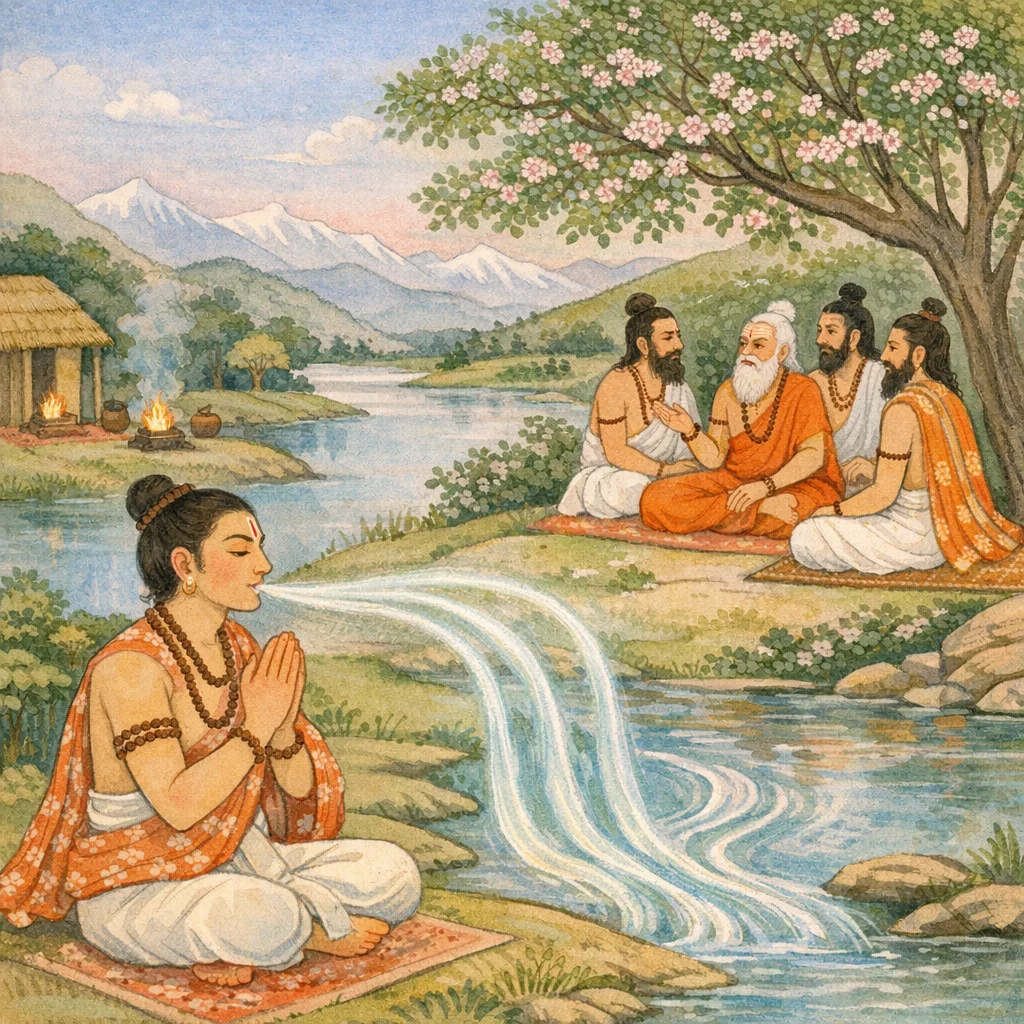
भस्म–रुद्राक्ष–शिवनाममाहात्म्य (The Greatness of Bhasma, Rudrākṣa, and the Name of Śiva)
Adhyāya 23 unfolds as a didactic dialogue: the ṛṣis ask Sūta, Vyāsa’s transmitter, to explain the “uttama” māhātmyas— the greatness of bhasma (vibhūti), the greatness of rudrākṣa, and the purifying power of Śiva’s Name. Sūta affirms the request as loka-hita (for the good of the world) and praises the sages as purified guardians of the lineage. The chapter teaches that the mouth which utters Śiva-nāma becomes a moving tīrtha; sin cannot cling to the devotee, as impurity does not cling to burning charcoal. Merit also spreads by proximity: one who beholds such a devotee gains the fruit of pilgrimage. It concludes by exalting the triad—Śiva-nāma, bhasma/vibhūti, and rudrākṣa—as equal to Triveṇī, making embodied Śaiva observance a continuous pilgrimage and an ongoing destruction of pāpa (pāpa-kṣaya).
Shlokas
Verse 1
ऋषय ऊचुः । सूत सूत महाभाग व्यासशिष्य नमोस्तु ते । तदेव व्यासतो ब्रूहि भस्ममाहात्म्यमुत्तमम्
The sages said: “O Sūta, O Sūta, most fortunate one—disciple of Vyāsa—salutations to you. Please tell us, just as you learned it from Vyāsa, the supreme glory of sacred ash (bhasma).”
Verse 2
तथा रुद्रा क्षमाहात्म्यं नाम माहात्म्यमुत्तमम् । त्रितयं ब्रूहि सुप्रीत्या ममानंदयचेतसम्
Likewise, O Rudra, speak with great affection the supreme account called the “Glory of Kṣamā (Forbearance)”. Tell me that triad of exalted teachings, and gladden my mind.
Verse 3
सूत उवाच । साधुपृष्टं भवद्भिश्च लोकानां हितकारकम् । भवंतो वै महाधन्याः पवित्राः कुलभूषणाः
Sūta said: “You have asked an excellent question—one that brings welfare to the worlds. Indeed, you are greatly blessed, pure, and an ornament to your noble line.”
Verse 4
येषां चैव शिवः साक्षाद्दैवतं परमं शुभम् । सदा शिवकथा लोके वल्लभा भवतां सदा
For those to whom Śiva Himself is directly the supreme, most auspicious Deity, may the sacred discourse of Śiva ever remain dear to them in this world—always and forever.
Verse 5
ते धन्याश्च कृतार्थाश्च सफलं देहधारणम् । उद्धृतञ्च कुलं तेषां ये शिवं समुपासते
Blessed indeed, and truly fulfilled, are those whose taking up a human body becomes fruitful; for they redeem their lineage as well—those who worship Lord Śiva with devoted reverence.
Verse 6
मुखे यस्य शिवनाम सदाशिवशिवेति च । पापानि न स्पृशंत्येव खदिरांगारंकयथा
In whose mouth the Name of Śiva ever abides—uttering “Sadāśiva, Śiva” —sins do not touch him at all, just as fire made from khadira-wood charcoal cannot be grasped (without being burned).
Verse 7
श्रीशिवाय नमस्तुभ्यं मुखं व्याहरते यदा । तन्मुखं पावनं तीर्थं सर्वपापविनाशनम्
Whenever the mouth utters, “Obeisance to Śrī Śiva,” that very mouth becomes a purifying tīrtha, destroying all sins.
Verse 8
तन्मुखञ्च तथा यो वै पश्यतिप्रीतिमान्नरः । तीर्थजन्यं फलं तस्य भवतीति सुनिश्चितम्
Whoever, with a heart filled with devotion, beholds that sacred Countenance—of Viśveśvara—certainly attains the merit born of pilgrimage; of this there is no doubt.
Verse 9
यत्र त्रयं सदा तिष्ठेदेतच्छुभतरं द्विजा । तस्य दर्शनमात्रेण वेणीस्नानफलंलभेत्
O twice-born ones, that place where the three are ever present is most auspicious; by the mere sight of it one gains the merit of bathing at the Veṇī, the sacred confluence.
Verse 10
शिवनामविभूतिश्च तथा रुद्रा क्ष एव च । एतत्त्रयं महापुण्यं त्रिवेणीसदृशं स्मृतम्
The Name of Śiva, sacred ash (vibhūti), and the rudrākṣa beads—this triad is supremely meritorious, remembered as comparable to the holy Triveṇī.
Verse 11
एतत्त्रयं शरीरे च यस्य तिष्ठति नित्यशः । तस्यैव दर्शनं लोके दुर्लभं पापहारकम्
He in whose body this triad—Śiva’s Name, vibhūti, and rudrākṣa—abides constantly: his very sight in this world is rare, and it destroys sins.
Verse 12
तद्दर्शनं यथा वेणी नोभयोरंतरं मनाक् । एवं योनविजानाति सपापिष्ठो न संशयः
Just as, when gazing upon a braided tress, one notices not even the slightest gap between its strands, so too the most sinful man—without any doubt—perceives only the yoni, the object of lust, and cannot discern any higher distinction in what he sees.
Verse 13
विभूतिर्यस्य नो भाले नांगे रुद्रा क्षधारणम् । नास्ये शिवमयी वाणी तं त्यजेदधमं यथा
One who bears no vibhūti (sacred ash) upon the forehead, who wears no Rudrākṣa beads upon the body, and in whose mouth there is no speech imbued with Śiva—such a person should be abandoned, as one abandons the base and ignoble.
Verse 14
शैवं नाम यथा गंगा विभूतिर्यमुना मता । रुद्रा क्षं विधिना प्रोक्ता सर्वपापाविनाशिनी
Just as the sacred Name of Śiva is like the Gaṅgā, so Vibhūti (holy ash) is regarded as the Yamunā; and Rudrākṣa, taught according to proper injunction, is the destroyer of all sins.
Verse 15
शरीरे च त्रयं यस्य तत्फलं चैकतः स्थितम् । एकतो वेणिकायाश्च स्नानजंतुफलं बुधैः
The wise declare that for one who bears the threefold Śaiva marks upon the body, their merit is gathered into a single, concentrated fruit; likewise, even the merit obtained from bathing and purificatory rites is said to be contained therein as one unified result.
Verse 16
तदेवं तुलितं पूर्वं ब्रह्मणाहितकारिणा । समानं चैव तज्जातं तस्माद्धार्यं सदा बुधैः
Thus it was formerly examined and weighed by Brahmā, the benefactor of the worlds, and it was found to be equal in merit and efficacy. Therefore, the wise should always uphold it and adopt it.
Verse 17
तद्दिनं हि समारभ्य ब्रह्मविष्ण्वादिभिः सरैः । धार्यते त्रितयं तच्च दर्शनात्पापहारकम्
From that very day onward, Brahmā, Viṣṇu, and the other gods wear and uphold this threefold Śaiva observance; and even the mere sight of it becomes a remover of sins.
Verse 18
ऋष्य ऊचुः । ईदृशं हि फलं प्रोक्तं नामादित्रितयोद्भवम् । तन्माहात्म्यं विशेषेण वक्तुमर्हसि सुव्रत
The sages said: “Indeed such a fruit has been proclaimed—arising from the triad that begins with the Divine Name. O you of noble vow, you should describe in particular the greatness of that practice.”
Verse 19
सूत उवाच । ऋषयो हि महाप्राज्ञाः सच्छैवा ज्ञानिनां वराः । तन्माहात्म्यं हि सद्भक्त्या शृणुतादरतो द्विजाः
Sūta said: “O sages, you are indeed greatly wise—true Śaivas and foremost among the knowers. Therefore, O twice-born ones, listen with reverence and sincere devotion to the glory of That: Lord Śiva and His sacred teaching.”
Verse 20
सुगूढमपि शास्त्रेषु पुराणेषु श्रुतिष्वपि । भवत्स्नेहान्मया विप्राः प्रकाशः क्रियतेऽधुना
Though this truth is very deeply concealed even within the Śāstras, the Purāṇas, and the Śrutis, O brāhmaṇa sages, out of affection for you I now make it clear and manifest.
Verse 21
कस्तत्त्रितयमाहात्म्यं संजानाति द्विजोत्तमाः । महेश्वरं विना सर्वं ब्रह्माण्डे सदसत्परम्
O best of the twice-born, who can truly comprehend the greatness of that triad? For in this entire cosmos, apart from Maheśvara, everything is only the supreme play of the real and the unreal—dependent, and not ultimate.
Verse 22
वच्म्यहं नाम माहात्म्यं यथाभक्ति समासतः । शृणुत प्रीतितो विप्राः सर्वपापहरं परम्
Now I shall speak, according to devotion and in brief, of the glory of the Divine Name. Listen with love, O Brāhmaṇa sages, to that supreme teaching which destroys all sins.
Verse 23
इति श्रीशिवमहापुराणे विद्येश्वरसंहितायां साध्यसाधनखंडेशिवनममाहात्म्यवर्णनोनामत्रयोविंशोऽध्यायः
Thus, in the holy Śiva Mahāpurāṇa—within the Vidyeśvara Saṃhitā, in the Sādhyasādhana-khaṇḍa—ends the twenty-third chapter, entitled “The Description of the Glory of the Name of Śiva.”
Verse 24
पापमूलानि दुःखानि विविधान्यपि शौनक । शिवनामैकनश्यानि नान्यनश्यानि सर्वथा
O Śaunaka, the many kinds of sufferings that spring from the root of sin are destroyed by the Name of Śiva alone; by no other means are they utterly destroyed.
Verse 25
स वैदिकः स पुण्यात्मा स धन्यस्स बुधो मतः । शिवनामजपासक्तो यो नित्यं भुवि मानव
That person alone is truly Vedic, virtuous, blessed, and deemed wise among men on earth—who is ever devoted, day after day, to the japa, the repetition of Śiva’s Name.
Verse 26
भवंति विविधा धर्मास्तेषां सद्यः फलोन्मुखाः । येषां भवति विश्वासः शिवनामजपे मुने
O sage, for those in whom firm faith arises in the repetition (japa) of Śiva’s Name, the many religious duties they undertake at once turn toward their fruit, quickly yielding their results.
Verse 27
पातकानि विनश्यंति यावंति शिवनामतः । भुवि तावंति पापानि क्रियंते न नरैर्मुने
O sage, as many sins as are destroyed through the Name of Śiva—so many sins are not even committed by human beings upon the earth.
Verse 28
ब्रह्महत्यादिपापानां राशीनप्रमितान्मुने । शिवनाम द्रुतं प्रोक्तं नाशयत्यखिलान्नरैः
O sage, even immeasurable heaps of sins—beginning with the sin of brahmin-slaying—are swiftly destroyed for human beings by the utterance of the name of Śiva.
Verse 29
शिवनामतरीं प्राप्य संसाराब्धिं तरंति ये । संसारमूलपापानि तानि नश्यंत्यसंशयम्
Having obtained the ferry of Śiva’s Name, those who embark upon it cross the ocean of saṃsāra; and the root-sins that generate worldly bondage are destroyed—without any doubt.
Verse 30
संसारमूलभूतानां पातकानां महामुने । शिवनामकुठारेण विनाशो जायते ध्रुवम्
O great sage, the sins that are the very root of worldly bondage are certainly destroyed by the axe of Śiva’s Name.
Verse 31
शिवनामामृतं पेयं पापदावानलार्दितैः । पापदावाग्नितप्तानां शांतिस्तेन विना न हि
For those afflicted by the forest-fire of sin, the nectar of Śiva’s Name should be drunk. For those scorched by that blaze of sin, there is truly no peace without it.
Verse 32
शिवेति नामपीयूषवर्षधारापरिप्लुताः । संसारदवमध्येपि न शोचंति कदाचन
Those who are drenched by the streaming rain of nectar that is the Name “Śiva” do not grieve at any time—even while standing in the midst of the wildfire of worldly existence.
Verse 33
शिवनाम्नि महद्भक्तिर्जाता येषां महात्मनाम् । तद्विधानां तु सहसा मुक्तिर्भवति सर्वथा
Those great-souled ones in whom profound devotion to the very Name of Śiva has arisen—such devotees, by that sacred observance, attain liberation swiftly and in every way.
Verse 34
अनेकजन्मभिर्येन तपस्तप्तं मुनीश्वर । शिवनाम्नि भवेद्भक्तिः सर्वपापापहारिणी
O lord among sages, only one who has performed austerities across many births attains devotion to the Name of Śiva—and that devotion to Śiva’s Name destroys all sins.
Verse 35
यस्या साधारणं शंभुनाम्नि भक्तिरखंडिता । तस्यैव मोक्षः सुलभो नान्यस्येति मतिर्मम
In my understanding, liberation is readily attainable only for that person whose steady, unbroken devotion is fixed upon the name of Śambhu; for none other is it so easily gained.
Verse 36
कृत्वाप्यनेकपापानि शिवनामजपादरः । सर्वपापविनिर्मुक्तो भवत्येव न संशयः
Even if one has committed many sins, a person who becomes devoted to the japa of Śiva’s Name is certainly freed from all sins—of this there is no doubt.
Verse 37
भवंति भस्मसाद्वृक्षा दवदग्धा यथा वने । तथा तावंति दग्धानि पापानि शिवनामतः
As trees in a forest, consumed by a raging wildfire, are reduced to ash, so too are one’s sins burned away—destroyed to their very root—by the mere power of Śiva’s Name.
Verse 38
यो नित्यं भस्मपूतांगः शिवनामजपादरः । संतरत्येव संसारं सघोरमपि शौनक
O Śaunaka, one who daily sanctifies the body with sacred ash (bhasma) and is devoted to the japa of Śiva’s Name surely crosses beyond saṃsāra—even when it appears most dreadful.
Verse 39
ब्रह्मस्वहरणं कृत्वा हत्वापि ब्राह्मणान्बहून् । न लिप्यते नरः पापैः शिवनामजपादरः
Even if a person has stolen a brahmin’s wealth and even if he has slain many brāhmaṇas, he is not tainted by sins—if he is devoted to the japa of Śiva’s Name.
Verse 40
विलोक्य वेदानखिलाञ्छिवनामजपः परम् । संसारतारणोपाय इति पूर्वैर्विनिश्चितः
Having examined all the Vedas in their entirety, the sages of old conclusively determined that the supreme practice is the japa of Śiva’s Name—indeed, the means by which one crosses over saṃsāra.
Verse 41
किं बहूक्त्या मुनिश्रेष्ठाः श्लोकेनैकेन वच्म्यहम् । शिवनाम्नो महिमानं सर्वपापापहारिणम्
What need is there, O best of sages, for many words? In a single verse I shall declare the glory of Shiva’s Name, which removes all sins.
Verse 42
पापानां हरणे शंभोर्नामः शक्तिर्हि पावनी । शक्नोति पातकं तावत्कर्तुं नापि नरः क्वचित्
To remove sins, the very Name of Śambhu has a truly purifying power. No person, anywhere, can commit a sin so great that it cannot be cleansed by that divine Name.
Verse 43
शिवनामप्रभावेण लेभे सद्गतिमुत्तमाम् । इन्द्र द्युम्ननृपः पूर्वं महापापः पुरामुने
O sage, by the power of Śiva’s Name, King Indradyumna—formerly burdened with great sin—attained the supreme sadgati, the highest auspicious state of liberation.
Verse 44
तथा काचिद्द्विजायोषा सौ मुने बहुपापिनी । शिवनामप्रभावेण लेभे सद्गतिमुत्तमाम्
So too, O sage, a certain Brahmin woman—though burdened with many sins—by the sheer power of Śiva’s Name attained the highest sadgati, the blessed destiny.
Verse 45
इत्युक्तं वो द्विजश्रेष्ठा नाममाहात्म्यमुत्तमम् । शृणुध्वं भस्ममाहात्म्यं सर्वपावनपावनम्
Thus, O best of the twice-born, I have declared to you the supreme greatness of the Divine Name. Now listen to the greatness of bhasma, the sacred ash—purifier even of all that purifies.
Frequently Asked Questions
Rather than a single mythic episode, the chapter presents a theological argument for a threefold Śaiva sādhanā—Śiva-nāma, bhasma, and rudrākṣa—asserting their world-benefiting efficacy and their capacity to neutralize pāpa through continual embodied practice.
The “rahasya” is the relocation of pilgrimage into daily life: the devotee’s speech (nāma) sacralizes the body (the mouth becomes tīrtha), while bhasma and rudrākṣa function as portable consecrations that render the practitioner a living confluence (Triveṇī-sadṛśa) of merit.
Śiva is foregrounded primarily as Sadāśiva through the performative potency of his name (e.g., “Sadāśiva, Śiva”), emphasizing the salvific presence of Śiva accessed via nāma rather than via a distinct iconographic avatāra-form in this excerpted portion.