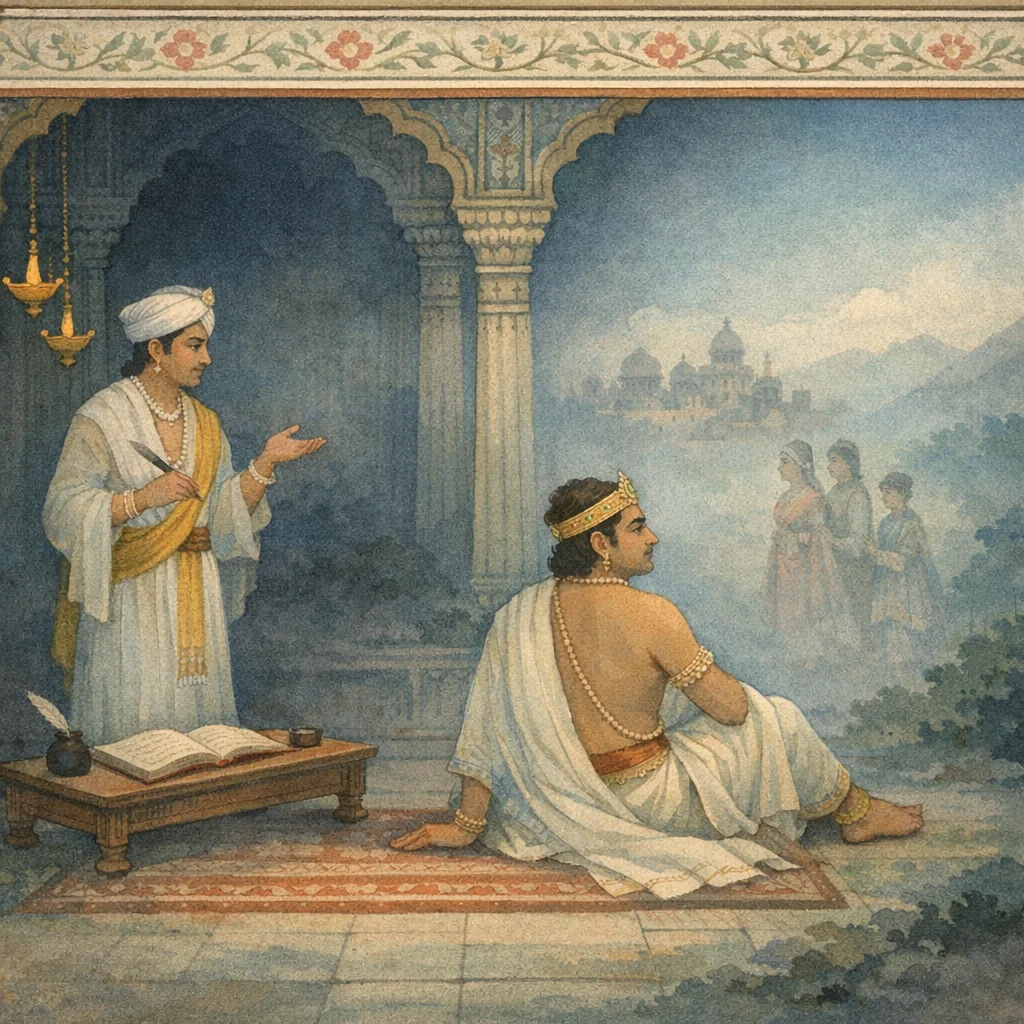
नरकलोकवर्णनम् (Narakaloka-varṇanam) — Description of the Hell-Realms
Framed as a didactic report within a sage-to-sage narration (Sanatkumāra speaking), this chapter describes the post-mortem adjudication of immoral beings. Citragupta, Yama’s juridical intelligence and keeper of karmic records, addresses wrongdoers—especially the powerful who fail in dharma: rulers who oppress subjects, thieves of others’ property, and violators of others’ spouses. It establishes the karmic principle that deeds must be re-experienced as their results; suffering is not arbitrary but self-authored through one’s own actions. With a forensic, corrective tone, it rejects external blame, shatters the delusion of temporary sovereignty, and shows how worldly supports (kingdom, family) collapse at death. Naraka is presented not merely as punishment but as a pedagogical extension of ṛta/dharma, making karmic causality immediately legible and compelling recognition, remorse, and the need for restraint and devotion as preventive sādhanā.
Shlokas
Verse 1
चित्रगुप्त उवाच । भो भो दुष्कृतकर्म्माणः पर द्रव्यापहारकाः । गर्विता रूपवीर्येण परदारावमर्द्दकाः
Citragupta said: “Ho! You who commit sinful deeds—robbers of others’ wealth! You who, swollen with pride in beauty and strength, violate the wives of others!”
Verse 2
यस्त्वयं क्रियते कर्म तदिदं भुज्यते पुनः । तत्किमात्मोपघातार्थं भवद्भिर्दुष्कृतं कृतम्
Whatever action is performed here, its result must surely be experienced again. Why, then, have you committed evil deeds—only to bring ruin upon your own self?
Verse 3
इदानीं किं प्रलप्यध्वे पीड्यमानास्स्वकर्मभिः । भुज्यंतां स्वानि कर्म्माणि नास्ति दोषो हि कस्यचित्
Why do you lament now, when you are being afflicted by your own deeds? Let each one experience the fruits of one’s own karma—indeed, no blame belongs to anyone else.
Verse 4
सनत्कुमार उवाच । एवं ते पृथिवीपालास्संप्राप्तास्तत्समीपतः । स्वकीयैः कर्म्मभिघौरैर्दुष्कर्म्मबलदर्पिणः
Sanatkumāra said: “Thus those rulers of the earth came near to him. Terrible through their own deeds, and puffed up by the strength born of wicked actions, they approached in arrogance.”
Verse 5
तानपि क्रोधसंयुक्तश्चित्रगुप्तो महाप्रभुः । संशिक्षयति धर्मज्ञो यमराजानुशिक्षया
Even those souls, the great lord Chitragupta—filled with stern wrath and skilled in dharma—disciplines and corrects, acting in accordance with the instruction and governance of King Yama.
Verse 6
चित्रगुप्त उवाच । भो भो नृपा दुराचाराः प्रजा विध्वंसकारिणः । अल्पकालस्य राज्यस्य कृते किं दुष्कृतं कृतम्
Citragupta said: “Alas, alas—O kings of wicked conduct, destroyers of your own subjects! For the sake of a short-lived reign, what sinful deeds have you committed?”
Verse 7
राज्यभोगेन मोहेन बलादन्यायतः प्रजाः । यद्दण्डिताः फलं तस्य भुज्यतामधुना नृपाः
O kings, the fruit of that deed must now be experienced: deluded by the enjoyments of sovereignty, you punished your subjects by force and unjustly.
Verse 8
इति श्रीशिवमहापुराणे पञ्चम्यामुमासंहितायां नरकलोकवर्णनं नामाष्टमोऽध्यायः
Thus, in the Śrī Śiva Mahāpurāṇa, in the Fifth Book—the Umāsaṃhitā—ends the Eighth Chapter, called “The Description of the Hell-Realms.”
Verse 9
पश्यामि तद्बलं नष्टं येन विध्वंसिताः प्रजाः । यमदूतैर्योज्यमाना अधुना कीदृशं भवेत्
I behold that very power has perished by which the creatures were being destroyed. Now, when Yama’s messengers seize and bind them, what will their condition become?
Verse 10
सनत्कुमार उवाच । एवं बहुविधैर्वाक्यैरुपलब्धा यमेन ते । स्वानि कर्माणि शोचंति तूष्णीं तिष्ठंति पार्थिवाः
Sanatkumāra said: Thus, reproved by Yama with many kinds of words, those earthly beings lament their own deeds and stand in silence.
Verse 11
इति कर्म्म समुद्दिश्य नृपाणां धर्म्मराड्यमः । तत्पापपंकशुद्ध्यर्थमिदं दूतान्ब्रवीति च
Having thus indicated the duty that constitutes righteous kingship for rulers, he then spoke these words to the messengers, intending the cleansing of that muddy mire of sin.
Verse 12
यमराज उवाच । भोभोश्चण्ड महाचंड गृहीत्वा नृपतीन्बलात् । नियमेन विशुद्यध्वं क्रमेण नरकाग्निषु
Yamarāja said: “Ho! Caṇḍa and Mahācaṇḍa—seize those kings by force. Then, according to the ordained rule, let them be purified step by step in the fires of hell.”
Verse 14
सनत्कुमार उवाच । ततश्शीघ्रं समादाय नृपान्संगृह्य पादयोः । भ्रामयित्वा तु वेगेन निक्षिप्योर्ध्वं प्रगृह्य च । सर्वप्रायेण महतातीव तप्ते शिलातले । आस्फालयंति तरसा वज्रेणेव महाद्रुमान्
Sanatkumāra said: Then, swiftly seizing the kings by their feet, they whirled them about with force, hurled them upward, and caught them again. For the most part, with great violence, they smashed them down upon a rock-surface heated intensely—striking with speed like a thunderbolt felling mighty trees.
Verse 15
ततस्सरक्तं श्रोत्रेण स्रवते जर्जरीकृतः । निस्संज्ञस्स सदा देही निश्चेष्टस्संप्रजायते
Then, with his body shattered and ruined, blood flows out through his ear; the embodied being becomes continually unconscious and is rendered completely motionless.
Verse 16
ततस्स वायुना स्पृष्टस्सतैरुज्जीवितः पुनः । ततः पापविशुद्ध्यर्थं क्षिपंति नरकार्णवे
Then, touched by the wind, he is revived again by hundreds (of attendants). After that, for the purification of sins, they cast him into the ocean of hell.
Verse 17
अष्टाविंशतिसंख्याभिः क्षित्यधस्सप्तकोटयः । सप्तमस्य तलस्यांते घोरे तमसि संस्थितः
Beneath the earth, at a depth measured as twenty‑eight and seven crores (of yojanas), at the far end of the seventh subterranean realm, he is situated in dreadful darkness.
Verse 18
घोराख्या प्रथमा कोटिः सुघोरा तदधः स्थिता । अतिघोरा महाघोरा घोररूपा च पंचमी
“The first division is called Ghorā. Beneath it is situated Sughorā. Then come Atighorā and Mahāghorā; and the fifth is called Ghorarūpā.”
Verse 19
षष्ठी तलातलाख्या च सप्तमी च भयानका । अष्टमी कालरात्रिश्च नवमी च भयोत्कटा
“The sixth (level) is called Talātalā; the seventh is dreadful. The eighth is known as Kālarātrī, and the ninth is exceedingly fearsome.”
Verse 20
दशमी तदधश्चण्डा महाचण्डा ततोऽप्यधः । चण्डकोलाहला चान्या प्रचण्डा चण्डनायिका
The tenth level is Daśamī. Below that is Caṇḍā; still lower is Mahācaṇḍā. Beneath that again is another called Caṇḍakolāhalā; and then come Pracaṇḍā and Caṇḍanāyikā.
Verse 21
पद्मा पद्मावती भीता भीमा भीषणनायिका । कराला विकराला च वज्राविंशतिमा स्मृता
She is remembered by the names Padmā, Padmāvatī, Bhītā, Bhīmā, Bhīṣaṇanāyikā, Karālā, Vikarālā, and Vajrā—thus she is counted as the twentieth in this enumeration of divine forms.
Verse 22
त्रिकोणा पञ्चकोणा च सुदीर्घा चाखिलार्तिदा । समा भीमबला भोग्रा दीप्तप्रायेति चान्तिमी
“(She is) Trikoṇā (the Three-angled Power), and Pañcakoṇā (the Five-angled Power); Sudīrghā (the Vast, far-reaching One), and Akhilārtidā (the Remover of all afflictions). She is Samā (the Even and Impartial One), Bhīmabalā (of formidable strength), Bhogrā (the Bestower of enjoyments), and lastly Dīptaprāyā (Radiant, blazing with splendor).”
Verse 23
इति ते नामतः प्रोक्ता घोरा नरककोटयः । अष्टाविंशतिरेवैताः पापानां यातनात्मिकाः
Thus, these dreadful multitudes of hells have been declared to you by name. Indeed, they are twenty-eight in number—realms whose very nature is torment, experienced as the consequence of sinful actions.
Verse 24
तासां क्रमेण विज्ञेयाः पंच पञ्चैव नायकाः । प्रत्येकं सर्वकोटीनां नामतस्संनिबोधत
Know, in due order, that within those groups there are five leaders—five for each. Now understand by name the leaders of every one of all the koṭis (multitudes).
Verse 25
रौरवः प्रथमस्तेषां रुवंते यत्र देहिनः । महारौरवपीडाभिर्महांतोऽपि रुदंति च
Among those hells, Raurava is the first—where embodied beings wail aloud. And when tormented by the pains of Mahāraurava, even the mighty weep.
Verse 26
ततश्शीतं तथा चोष्णं पंचाद्या नायकास्स्मृताः । सुघोरस्तु महातीक्ष्णस्तथा संजीवनः स्मृतः
Thereafter, ‘Śīta’ and ‘Uṣṇa’ are remembered among the first five leading powers; and ‘Sughora’, ‘Mahātīkṣṇa’, and likewise ‘Saṃjīvana’ are also remembered as principal leaders.
Verse 27
महातमो विलोमश्च विलोपश्चापि कंटक । तीव्रवेगः करालश्च विकरालः प्रकंपनः
“(They are called) Mahātamas, Viloma, Vilopa, and also Kaṇṭaka; (as well as) Tīvravega, Karāla, Vikarāla, and Prakaṃpana.”
Verse 28
महावक्रश्च कालश्च कालसूत्रः प्रगर्जनः । सूचीमुखस्सुनेतिश्च खादकस्सुप्रपीडनः
(They are named) Mahāvakra, Kāla, Kālasūtra, Pragarjana, Sūcīmukha, Suneti, Khādaka, and Suprapīḍana.
Verse 29
कुम्भीपाकसुपाकौ च क्रकचश्चातिदारुणः । अंगारराशिभवनं मेरुरसृक्प्रहितस्ततः
Then (he is hurled) into the hells called Kumbhīpāka and Supāka, and into the exceedingly dreadful Krakaca; thereafter (he is cast) into the abode that is a heap of burning embers, and into the mountain where torrents of blood are made to flow.
Verse 30
तीक्ष्णतुण्डश्च शकुनिर्महासंवर्तकः क्रतुः । तप्तजंतुः पंकलेपः प्रतिमांसस्त्रपूद्भवः
There was one named Sharp-beaked; another, the Bird; (another) the Great Agent of Dissolution; and Kratu. (Others were) Scorcher-of-creatures, Mud-smeared, Flesh-eater, and the one born of carrion—such were those dreadful beings spoken of in this account.
Verse 31
उच्छ्वासस्सुनिरुच्छ्वासो सुदीर्घः कूटशाल्मलिः । दुरिष्टस्सुमहावादः प्रवादस्सुप्रतापनः
He is the vital breath and the regulated out-breath; He is the supremely long-enduring One; He is the lofty, firm pillar, like the śālmali. He is the hard-to-overcome vision and ordinance; He is the great proclamation; He is the renowned declaration that powerfully burns away impurity.
Verse 32
ततो मेघो वृषः शाल्मस्सिंहव्याघ्रगजाननाः । श्वसूकराजमहिषघूककोकवृकाननाः
Then there appeared forms with faces like a cloud, a bull, and the śālmalī tree; with faces like lions, tigers, and elephants; and also with faces like dogs, boars, noble buffaloes, owls, jackals, and wolves.
Verse 33
ग्राहकुंभीननक्राख्या स्सर्पकूर्माख्यवायसाः । गृध्रोलूकहलोकाख्याः शार्दूलक्रथकर्कटाः
There were beings known as crocodiles, kumbhīra-creatures, and makaras; others were called serpents, tortoises, and crows. Likewise there were those named vultures, owls, and (certain) haloka-beings, as well as tigers, kratha-creatures, and crabs.
Verse 34
मंडूकाः पूतिवक्त्राश्च रक्ताक्षः पूतिमृत्तिकाः । कणधूम्रस्तथाग्निश्च कृमिगन्धिवपुस्तथा
“There are frog-like beings, those with foul mouths, red-eyed ones, and those smeared with stinking mud; there are also those who are smoke-dark, those who are fiery, and those whose bodies reek with the odor of worms.”
Verse 35
अग्नीध्रश्चाप्रतिष्ठश्च रुधिराभश्श्वभोजनः । लाला भेक्षांत्रभक्षौ च सर्वभक्षः सुदारुणः
“(There are beings known as) Agnīdhra and Apratiṣṭha; Rudhirābha (the blood-hued) and Śvabhojana (dog-eater); Lālā, Bhekṣāntrabhakṣa (devourer of frogs and entrails), and Sarvabhakṣa (eater of all). They are exceedingly fierce.”
Verse 36
कंटकस्सुविशालश्च विकटः कटपूतनः । अंबरीषः कटाहश्च कष्टा वैतरणी नदी
(There are) the thorn-filled region, the exceedingly vast one, the dreadful; Kaṭapūtana, Ambarīṣa, Kaṭāha; and the grievous river Vaitaraṇī.
Verse 37
सुतप्तलोहशयन एकपादः प्रपूरणः । असितालवनं घोरमस्थिभंगः सुपूरणः
He lay upon a bed of red-hot iron; standing on one foot, he persevered in severe austerity. He entered the dreadful Asitāla forest; even with bones breaking, he remained unwavering and fully intent on completing his penance.
Verse 38
विलातसोऽसुयंत्रोऽपि कूटपाशः प्रमर्दनः । महाचूर्ण्णो सुचूर्ण्णोऽपि तप्तलोहमयं तथा
“(The tormenting devices are) the ‘Vilātasa’; also the ‘Asuyantra’; the ‘Kūṭapāśa’, a deceptive noose that crushes; the ‘Mahācūrṇa’ and ‘Sucūrṇa’, the great and the fine pulverizers; and likewise a torture made of heated iron.”
Verse 39
पर्वतः क्षुरधारा च तथा यमलपर्वतः । मूत्रविष्ठाश्रुकूपश्च क्षारकूपश्च शीतलः
There is the Mountain, the Razor-edged Ridge, and the Twin Mountain; there are also wells of urine, excrement, and blood, and the caustic (alkaline) well, and the freezing region. (These are named as fearsome hellish tracts where the bound soul experiences the fruits of its deeds.)
Verse 40
मुसलोलूखलं यन्त्रं शिलाशकटलांगलम् । तालपत्रासिगहनं महाशकटमण्डपम्
There were contrivances like a pestle-and-mortar device, stone carts and ploughs; thickets dense with palm-leaf swords; and even a vast pavilion mounted upon a great cart.
Verse 41
संमोहमस्थिभंगश्च तप्तश्चलमयो गुडम् । बहुदुखं महाक्लेशः कश्मलं समलं मलात्
It brings delusion and even the breaking of bones; it burns and is unsteady—like jaggery melting in heat. It yields many sorrows and great affliction; it is sinful, stained, and born of impurity.
Verse 42
हालाहलो विरूपश्च स्वरूपश्च यमानुगः । एकपादस्त्रिपादश्च तीव्रश्चाचीवरं तमः
“Hālāhala; the Deformed and the Well-formed; the Follower of Yama; the One-footed and the Three-footed; the Fierce; and ‘Ācīvara,’ Darkness itself”—these too are spoken of as names and forms connected with Rudra’s dreadful, obscuring powers.
Verse 43
अष्टाविंशतिरित्येते क्रमशः पंचपंचकम् । कोटीनामानुपूर्व्येण पंच पंचैव नायकाः
Thus these are twenty-eight groups, arranged successively as sets of five. In the same order, for the Rudra-koṭis there are leaders—five for each set.
Verse 44
रौरवाय प्रबोध्यंते नरकाणां शतं स्मृतम् । चत्वारिंशच्छतं प्रोक्तं महानरकमण्डलम्
For the hell called Raurava, it is declared that a hundred hells are reckoned. And the great sphere of hell is said to consist of four hundred and forty divisions.
Verse 45
इति ते व्यास संप्रोक्ता नरकस्य स्थितिर्मया । प्रसंख्यानाच्च वैराग्यं शृणु पापगतिं च ताम्
Thus, O Vyāsa, I have explained to you the condition and nature of hell. Now listen—through a clear reckoning of these consequences arises vairāgya, dispassion; and hear also the very course and destiny of sin.
Frequently Asked Questions
The chapter presents a karmic-judicial scene: Citragupta, under Yamarāja’s authority, reprimands sinners—especially abusive rulers and transgressors—arguing that every act returns as experienced consequence (karma-phala), and that present torment arises from one’s own deeds rather than any external injustice.
Citragupta symbolizes moral memory and cosmic intelligibility: the universe is depicted as ethically readable, where intention and action are ‘recorded’ as causal imprints. Yamadūtas symbolize the inevitability of consequence, and Naraka functions as a pedagogic domain where the delusions of power, pleasure, and impunity are stripped away, revealing dharma as an impersonal law-like order.
No distinct iconographic manifestation (svarūpa) of Śiva or Umā is foregrounded in the sampled verses; instead, the chapter emphasizes Shaiva ethical theology indirectly—by showing how dharma and karma operate under divine governance (via Yama’s administration), reinforcing the necessity of disciplined living aligned with Śiva-oriented virtue.