Kāla-vañcana (Overcoming/Outwitting Time) and the Pañcabhūta Basis of the Body
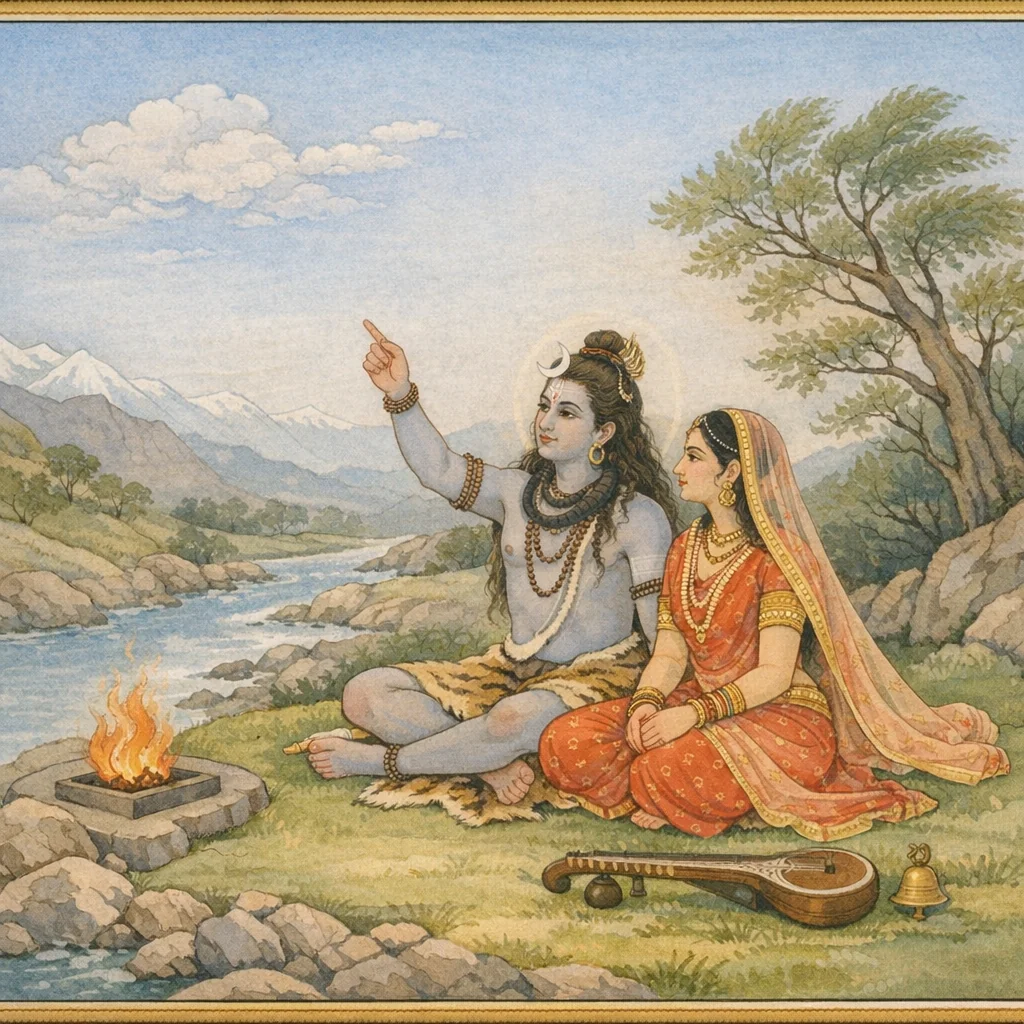
Adhyāya 26 unfolds as a direct dialogue between Umā and Śaṅkara on kāla-jñāna and “kāla-vañcana”: not a literal escape from cosmic law, but a yogic transcendence of time’s binding power. Umā asks how yogins grounded in tattva should face the ever-present imminence of kāla and mṛtyu. Śaṅkara replies for the welfare of all, beginning with elemental ontology: the body is pañcabhāutika (earth, water, fire, air, space), and ākāśa is taught as all-pervasive, the field into which things dissolve and from which they arise again, illuminating impermanence and continuity. The teaching links this analysis to steadiness (sthira-bhāva) and higher knowing (jñāna), upheld by tapas and mantra-bala. Resonant sound and instruments such as the ghaṇṭā and vīṇā serve as cues to nāda/ākāśa symbolism, hinting at an inner acoustics of practice. The chapter resolves the tension between time’s fearful sovereignty and the yogin’s freedom by locating “victory over time” in realized knowledge and non-identification with the perishable composite.
Shlokas
Verse 1
देव्युवाच । कथितं तु त्वया देव कालज्ञानं यथार्थतः । कालस्य वंचनं ब्रूहि यथा तत्त्वेन योगिनः
The Goddess said: “O Deva, you have indeed explained the true knowledge of Time just as it is. Now tell me—how do the yogins, established in Tattva, transcend and outstrip Time?”
Verse 2
कालस्तु सन्निकृष्टो हि वर्तते सर्वजंतुषु । यथा चास्य न मृत्युश्च वंचते कालमागतम्
Time indeed moves very near to all beings; and when one’s destined hour has arrived, even Death does not avert it or deceive it.
Verse 3
तथा कथय मे देव प्रीतिं कृत्वा ममोपरि । योगिनां च हिताय त्वं ब्रूहि सर्वसुखप्रद
Therefore, O Lord, out of affection for me, please tell me. For the welfare of yogins as well, speak that teaching which bestows all true happiness.
Verse 4
शंकर उवाच । शृणु देवि प्रवक्ष्यामि पृष्टोहं यत्त्वया शिवे । समासेन च सर्वेषां मानुषाणां हितार्थतः
Śaṅkara said: O Goddess, listen. O auspicious Śivā, I shall declare what you have asked of me—briefly, for the welfare of all human beings.
Verse 5
पृथिव्यापस्तथा तेजो वायुराकाशमेव च । एतेषां हि समायोगः शरीरं पांचभौतिकम्
Earth, water, fire, air, and also ether—indeed, the body is formed from the union of these; thus the embodied form is constituted of the five elements.
Verse 6
आकाशस्तु ततो व्यापी सर्वेषां सर्वगः स्थितः । आकाशे तु विलीयंते संभवंति पुनस्ततः
Thereafter, Ākāśa (space/ether) is the all-pervading principle, present everywhere and abiding in all. Into Ākāśa beings dissolve, and from that they arise again—according to the Lord’s cosmic order.
Verse 7
वियोगे तु सदा कस्य स्वं धाम प्रतिपेदिरे । तस्या स्थिरता चास्ति सन्निपातस्य सुंदरि
But in separation, who could ever remain steadily established in one’s own abode? O fair one, steadiness truly belongs to union (sannipāta), not to the state of parting.
Verse 8
ज्ञानिनोऽपि तथा तत्र तपोमंत्रबलादपि । ते सर्वे सुविजानंति सर्वमेतन्न संशयः
There, even the wise—by the power of their austerity and of mantra—come to know all of this with clear certainty; of this there is no doubt.
Verse 9
देव्युवाच । खं तेन यन्नश्यति घोररूपः कालः करालस्त्रिदिवैकनाथः । दग्धस्त्वया त्वं पुनरेव तुष्टः स्तोत्रै स्तुतः स्वां प्रकृतिं स लेभे
The Goddess said: “What is there that is not destroyed by dreadful, fearsome Time—sole Lord of the three worlds? Yet when he was burned by You, You became gracious again; praised with sacred hymns, he regained his own natural state.”
Verse 10
त्वया स चोक्तः कथया जनानामदृष्टरूपः प्रचरिष्यसीति । दृष्टस्त्वया तत्र महाप्रभावः प्रभोर्वरात्ते पुनरुत्थितश्च
You had declared to the people through your account, “He will move about in a form unseen.” Yet there you beheld that mighty one of great power; and by the Lord’s boon he rose again before you.
Verse 11
तदद्य भोः काल इहास्थि किंचिन्निहन्यते येन वदस्व तन्मे । त्वं योगिवर्यः प्रभुरात्मतंत्रः परोपकारात्ततनुर्महेश
“Tell me, O Kāla, what is it that is to be slain here today, and by what means it will be destroyed. You are the foremost of yogins—Mahādeva—self-governed and all-powerful; yet, for the sake of helping beings, you have assumed a manifest form.”
Verse 12
शंकर उवाच । न हन्यते देववरैस्तु दैत्यैस्सयक्षरक्षोरगमानुषैश्च । ये योगिनो ध्यानपरास्सदेहा भवंति ते घ्नंति सुखेन कालम्
Śaṅkara said: Yogins who are ever intent on meditation, even while dwelling in the body, are not slain by the best of the gods, nor by daityas, nor by yakṣas, rākṣasas, serpents, or human beings. They easily overcome Kāla—Time itself.
Verse 13
सनत्कुमार उवाच । एतच्छ्रुत्वा त्रिभुवनगुरोः प्राह गौरी विहस्य सत्यं त्वं मे वद कथमसौ हन्यते येन कालः । शम्भुस्तामाह सद्यो हि मकरवदने योगिनो ये क्षिपंति कालव्यालं सकलमनघास्तच्छृणुष्वैकचित्ता
Sanatkumāra said: Hearing the words of the Guru of the three worlds, Gaurī smiled and said, “Tell me truly—by what means is Kāla (Time/Death) slain?” Śambhu replied at once: “O sinless one, listen with a one-pointed mind; I shall tell how yogins swiftly cast the whole serpent of Kāla into the all-devouring, ‘makara-faced’ state.”
Verse 14
शङ्कर उवाच । पंचभूतात्मको देहस्सदायुक्तस्तु तद्गुणैः । उत्पाद्यते वरारोहे तद्विलीनो हि पार्थिवः
Śaṅkara said: “O fair-hipped one, the body is made of the five great elements and is ever joined to their qualities. It is produced from the earthly element and, indeed, in the end it dissolves back into that.”
Verse 15
आकाशाज्जायते वायुर्वायोस्तेजश्च जायते । तेजसोऽम्बु विनिर्द्दिष्टं तस्माद्धि पृथिवी भवेत्
From ether (ākāśa) arises air; from air arises fire. From fire, water is declared to arise; and from that water, indeed, earth comes into being.
Verse 16
पृथिव्यादीनि भूतानि गच्छंति क्रमशः परम् । धरा पंचगुणा प्रोक्ता ह्यापश्चैव चतुर्गुणाः
Beginning with earth, the gross elements proceed step by step toward the higher principle. Earth is declared to possess five qualities, and water indeed is said to possess four.
Verse 17
त्रिगुणं च तथा तेजो वायुर्द्विगुण एव च । शब्दैकगुणमाकाशं पृथिव्यादिषु कीर्तितम्
In this teaching on the elements beginning with earth, it is declared that fire bears three qualities, air bears two qualities, and ether bears a single quality—sound.
Verse 18
शब्दस्स्पर्शश्च रूपं च रसो गन्धश्च पंचमः । विजहाति गुणं स्वं स्वं तदा भूतं विपद्यते
Sound, touch, form, taste, and smell as the fifth—when each elemental principle abandons its own particular quality, then that element collapses and passes into dissolution. (Thus, by withdrawing from the guṇas, the manifested bhūtas resolve back, while Pati—Śiva—remains the transcendent ground.)
Verse 19
तदा गुणं विगृह्णाति प्रादुर्भूतं तदुच्यते । एवं जानीहि देवेशि पंचभूतानि तत्त्वतः
Then it assumes a distinct quality; that is what is called “manifest.” Thus, O Goddess, understand the five great elements in their true principles.
Verse 20
तस्माद्धि योगिना नित्यं स्वस्वकालेंऽशजा गुणाः । चिंतनीयाः प्रयत्नेन देवि कालजिगीषुणा
Therefore, O Devī, the yogin who seeks to conquer Time should, every day and with earnest effort, contemplate the qualities that arise from the respective portions of time (and seasons), understanding their influence.
Verse 22
शङ्कर उवाच । शृणु देवि प्रवक्ष्यामि योगिनां हितकाम्यया । परज्ञानप्रकथनं न देयं यस्य कस्यचित्
Shankara said: “Listen, O Goddess. Seeking the welfare of yogins, I shall explain this. But the teaching of the supreme knowledge must not be given indiscriminately to just anyone.”
Verse 23
श्रद्दधानाय दातव्यं भक्तियुक्ताय धीमते । अनास्तिकाय शुद्धाय धर्मनित्याय भामिनि
O fair one, it should be given to one who is full of faith, endowed with bhakti and discernment—free from atheistic denial, pure in conduct, and steadfast in dharma.
Verse 24
सुश्वासेन सुशय्यायां योगं युंजीत योगवित् । दीपं विनांधकारे तु प्रजाः सुप्तेषु धारयेत्
A knower of Yoga should engage in yogic discipline while resting upon a proper couch, gently regulating the breath. And in darkness, even without a lamp, he should sustain and protect living beings when they are asleep.
Verse 25
तर्जन्या पिहितौ कर्णौ पीडयित्वा मुहूर्त्तकम् । तस्मात्संश्रूयते शब्दस्तुदन्वह्निसमुद्भवः
Closing both ears with the index fingers and pressing them for a short while, one then distinctly hears a sound—like a piercing tone—arising as though from fire. This is taught as an inner yogic sign, drawing the mind inward toward Śiva.
Verse 26
इति श्रीशिवमहापुराणे पञ्चम्यामुमासंहितायां कालवंचनवर्णनं नाम षड्विंशोऽध्यायः
Thus, in the Śrī Śiva Mahāpurāṇa, in the Fifth Book—the Umā-saṃhitā—ends the twenty-sixth chapter, entitled “The Description of Outwitting Kāla (Time).”
Verse 27
यश्चोपलक्षयेन्नित्यैराकारं घटिकाद्वयम् । जित्वा मृत्युं तथा कामं स्वेच्छया पर्य्यटेदिह
Whoever, through constant practice, can perceive the subtle “form” of Time even for the span of two ghaṭikās, conquers death and desire; and, in this very world, moves about freely according to his own will.
Verse 28
सर्वज्ञस्सर्वदर्शी च सर्वसिद्धिमवाप्नुयात् । यथा नदति खेऽब्दो हि प्रावृडद्भिस्सुसंयतः
He becomes all-knowing and all-seeing, and attains every perfection. Just as a cloud, well-compacted with the waters of the rainy season, thunders in the sky, so does such a disciplined seeker manifest the power born of inner restraint.
Verse 29
तं श्रुत्वा मुच्यते योगी सद्यः संसारबन्धनात् । ततस्स योगिभिर्न्नित्यं सूक्ष्मात्सूक्ष्मतरो भवेत्
Hearing that (supreme teaching of Śiva), the yogin is immediately released from the bondage of worldly becoming (saṃsāra). Thereafter, among yogins, he ever becomes subtler than the subtlest—refined into the most inward state of realization.
Verse 30
एष ते कथितो देवि शब्दब्रह्मविधिक्रमः । पलालमिव धान्यार्थी त्यजेद्बन्धमशेषतः
O Goddess, thus has the method and progression for realizing Śabda-Brahman been explained to you. As one seeking grain casts away the chaff, so should one abandon every bond completely.
Verse 31
शब्दब्रह्मत्विदं प्राप्य ये केचिदन्यकांक्षिणः । घ्नंति ते मुष्टिनाकाशं कामयंते क्षुधां तृषाम्
Having attained this state of Śabda-Brahman, those who still crave something else are like people punching the empty sky with their fists—they end up desiring only hunger and thirst, an endless lack.
Verse 32
ज्ञात्वा परमिदं ब्रह्म सुखदं मुक्तिकारणम् । अवाह्यमक्षरं चैव सर्वोपाधिविवर्जितम्
Having realized this Supreme Brahman—bestowing true bliss and serving as the very cause of liberation—the wise know It as the ungraspable, imperishable Reality, wholly free from all limiting adjuncts.
Verse 33
मोहिताः कालपाशेन मृत्युपाशवशंगताः । शब्दब्रह्म न जानंति पापिनस्ते कुबुद्धयः
Deluded by the noose of Time and brought under the sway of Death’s snare, those sinful, misguided people do not recognize the Śabda-Brahman—the liberating divine Reality known through sacred sound, mantra and scripture.
Verse 34
तावद्भवंति संसारे यावद्धाम न विंदते । विदिते तु परे तत्त्वे मुच्यते जन्मबन्धनात्
So long as one does not realize the supreme Abode—Śiva’s own Dhāma—one continues to wander in saṃsāra. But when the highest Reality is truly known, one is freed from the bondage of repeated birth.
Verse 35
निद्रालस्यं महा विघ्नं जित्वा शत्रुं प्रयत्नतः । सुखासने स्थितो नित्यं शब्दब्रह्माभ्यसन्निति
Having overcome, through earnest effort, the enemy of sleep and lethargy—this great obstacle—one should ever remain seated in a comfortable posture and continuously practice contemplation on Śabda-Brahman, the Divine Reality realized through sacred sound.
Verse 36
शतवृद्धः पुमांल्लब्ध्वा यावदायुस्समभ्यसेत् । मृत्युञ्जयवपुस्तम्भ आरोग्यं वायुवर्द्धनम्
Even a man who has reached a hundred years of age, on obtaining this means, should continue it for as long as he lives. It grants the support and steadiness of the Mṛtyuñjaya form that conquers death, bestows health, and increases the vital life-breath (vāyu/prāṇa).
Verse 37
प्रत्ययो दृश्यते वृद्धे किं पुनस्तरुणे जने । न चोंकारो न मन्त्रोपि नैव बीजं न चाक्षरम्
If such firm conviction is seen even in an old man, how much more will it arise in a youthful person. For in this highest realization there is neither the syllable Oṁ, nor any mantra at all—neither seed-syllable (bīja) nor letter.
Verse 38
अनाहतमनुच्चार्य्यं शब्दब्रह्म शिवं परम् । ध्यायन्ते देवि सततं सुधिया यत्नतः प्रिये
O Devī, the wise, with steadfast effort, continually meditate on the Supreme Śiva—who is the unstruck inner sound (anāhata), the unuttered reality, and the Śabda-Brahman, Brahman as sacred Word.
Verse 39
तस्माच्छब्दा नव प्रोक्ताः प्राणविद्भिस्तु लक्षिताः । तान्प्रवक्ष्यामि यत्नेन नादसिद्धिमनुक्रमात्
Therefore, nine sounds (śabdas) have been declared and precisely characterized by the knowers of prāṇa. I shall explain them carefully, in proper sequence, as the means to attain perfection through nāda, the inner sound.
Verse 40
दुन्दुभिं ७ शंखशब्दं ८ तु नवमं मेघगर्जितम् ९
(There arose) as the seventh, the sound of the dundubhi kettle-drum; as the eighth, the sound of the conch (śaṅkha); and as the ninth, the thunderous roaring of the clouds.
Verse 41
नव शब्दान्परित्यज्य तुंकारं तु समभ्यसेत् । ध्यायन्नेवं सदा योगी पुण्यैः पापैर्न लिप्यते
Casting aside the other nine sounds, one should practice the single sound “tuṃ” alone. Meditating thus continually, the yogin is not tainted either by merit or by sin.
Verse 42
न शृणोति यदा शृण्वन्योगाभ्यासेन देविके । म्रियतेभ्यसमानस्तु योगी तिष्ठेद्दिवानिशम्
O Devī, when—through sustained practice of yoga—the yogin no longer hears even while sounds are present, then, becoming unlike those who are bound to death, that yogin should remain steadily absorbed day and night.
Verse 44
तस्मादुत्पद्यते शब्दो मृ त्सप्तभिर्दिनैः । स वै नवविधो देवि तं ब्रवीमि यथार्थतः । प्रथमं नदते घोषमात्मशुद्धिकरं परम् । सर्वव्याधिहरं नादं वश्याकर्षणमुत्तमम्
Therefore, O Goddess, within seven days a sound arises from that clay. That sound is indeed of nine kinds; I shall describe it to you truthfully. First it resounds as “ghoṣa”, a reverberant tone supremely purifying to the self; it is a nāda that removes all diseases and is excellent for drawing beings under beneficent influence and attraction.
Verse 45
द्वितीयं नादते कांस्यस्तम्भयेत्प्राणिनां गतिम् । विषभूतग्रहान्सर्वान्बध्नीयान्नात्र संशयः
Second: when a bronze bell is sounded, it arrests the movements of living beings; it binds and restrains all venomous influences—spirits (bhūtas) and every kind of seizure-causing graha—of this there is no doubt.
Verse 46
तृतीयं नादते शृंगमभिचारि नियोजयेत् । विद्विडुच्चाटने शत्रोर्मारणे च प्रयोजयेत्
One should employ the third, sound-producing horn for abhicāra—hostile rites such as driving away an adversary—and, against an enemy, even for mārana, destructive rites.
Verse 47
घंटानादं चतुर्थ तु वदते परमेश्वरः । आकर्षस्सर्वदेवानां किं पुनर्मानुषा भुवि
Next, the Supreme Lord, Parameśvara, speaks of the fourth sound—the ringing of a bell. It draws to itself even all the gods; how much more, then, does it attract human beings upon the earth.
Verse 48
यक्षगन्धर्वकन्याश्च तस्याकृष्टा ददंति हि । यथेप्सितां महासिद्धिं योगिने कामतोऽपि वा
Even the maidens of the Yakṣas and Gandharvas, drawn toward him, indeed bestow upon that yogin the great attainments (mahāsiddhi) he desires—according to his wish, even in matters of enjoyment.
Verse 49
वीणा तु पंचमो नादः श्रूयते योगिभिस्सदा । तस्मादुत्पद्यते देवि दूरादर्शनमेव हि
The fifth inner sound is heard as the tone of a vīṇā, ever perceived by yogins. From that sound, O Goddess, there truly arises the power of seeing at a distance.
Verse 50
ध्यायतो वंशनादं तु सर्वतत्त्वं प्रजायते । दुन्दुभिं ध्यायमानस्तु जरामृत्युविवर्जितः
By meditating upon the sound of the flute, the understanding of all tattvas arises. But one who meditates upon the sound of the drum becomes free from old age and death.
Verse 51
शंखशब्देन देवेशि कामरूपं प्रपद्यते । योगिनो मेघनादेन न विपत्संगमो भवेत्
O Goddess, by the sound of the conch one attains the power to assume any desired form; and by the deep, cloud-like resonance of sacred sound, a yogin is not afflicted through association with calamity.
Verse 52
यश्चैकमनसा नित्यं तुंकारं ब्रह्मरूपिणम् । किमसाध्यं न तस्यापि यथामति वरानने
O fair-faced one, whoever with single-pointed mind continually contemplates the syllable “tuṃ,” which is of the nature of Brahman—what, indeed, is unattainable for that person? According to one’s capacity, all becomes accomplishable.
Verse 53
सर्वज्ञस्सर्वदर्शी च कामरूपी व्रजत्यसौ । न विकारैः प्रयुज्येत शिव एव न संशयः
He is all-knowing and all-seeing; assuming any form at will, He moves everywhere. Yet He is never conditioned by modifications (vikāras). He alone is Śiva—of this there is no doubt.
Verse 54
एतत्ते परमेशानि शब्दब्रह्मस्वरूपकम् । नवधा सर्वमाख्यातं किं भूयः श्रोतुमिच्छसि
O Supreme Goddess, Parameśānī, this teaching—whose very nature is Śabda‑Brahman—has been fully explained to you in nine divisions. What more do you wish to hear?
Frequently Asked Questions
The chapter argues that while kāla is universally proximate to all beings and cannot be avoided at the level of embodied existence, the yogin ‘outwits’ time by shifting identity from the perishable pañcabhūta-composite to realized knowledge and steadiness grounded in tattva.
Ākāśa functions as the subtlest element marking pervasion and the field of dissolution/re-emergence; sound-signs (ghaṇṭā, vīṇā, etc.) cue the nāda–ākāśa relationship, suggesting inner resonance as a contemplative support for stabilizing awareness beyond temporal flux.
Rather than a distinct iconographic avatāra, the chapter foregrounds Śiva as Śaṅkara the teacher of tattva and yoga, and Devī as the philosophical interrogator (Umā) whose questioning frames the doctrine of time, embodiment, and liberation.