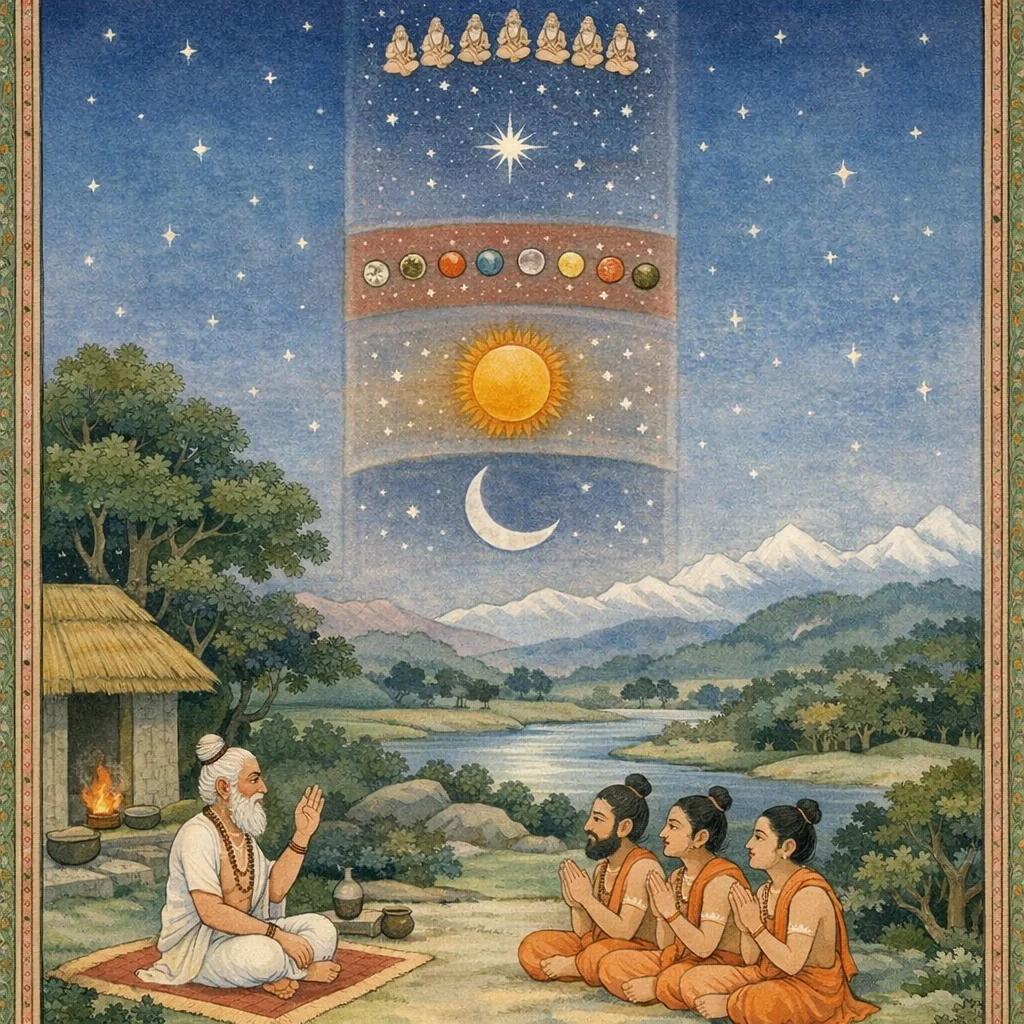
Lokapramāṇa–Grahamaṇḍala–Dhruvaloka-vyavasthā (Cosmic Measures and the Arrangement of the Heavenly Spheres)
Adhyāya 19 is a technical cosmographic teaching spoken by Sanatkumāra. Using measurable terms (yojana counts and spatial intervals), it defines the extent of the earthly realm by the reach of the Sun’s and Moon’s rays, then places the Sun and Moon in a graded vertical order above the earth. It next situates the planetary spheres (grahamaṇḍala) above the Moon and lists the visible planets in an ordered ascent. Beyond the planetary region it proceeds to the Saptarṣi-maṇḍala and to Dhruva (the polar pivot), portraying Dhruva as the axial support (meḍhībhūta) of the celestial wheel. Finally, it distinguishes the tri-loka (bhūr–bhuvaḥ–svaḥ) in relation to Dhruva and points toward higher worlds such as Maharloka and the primordial sages (Sanaka and others), mapping cosmology as a graded hierarchy of realms, beings, and spiritual stations.
Shlokas
Verse 1
सनत्कुमार उवाच । रविचन्द्रमसोर्यावन्मयूखा भासयंति हि । तावत्प्रमाणा पृथिवी भूलोकस्स तु गीयते
Sanatkumāra said: As far as the rays of the Sun and the Moon indeed illumine, so far extends the measure of the Earth; that region is sung of as Bhūloka (the earthly world).
Verse 2
भूमेर्योजनलक्षे तु संस्थितं रविमण्डलम् । योजनानां सहस्राणि सदैव परिसंख्यया
At a distance of one hundred thousand yojanas from the earth is stationed the orb of the Sun; its expanse is ever reckoned in thousands of yojanas.
Verse 3
शशिनस्तु प्रमाणाय जगतः परिचक्षते । रवेरूर्ध्वं शशी तस्थौ लक्षयोजनसंख्यया
They declare the Moon to be a standard for gauging the world’s order; and the Moon is said to stand above the Sun by a measure of one hundred thousand yojanas.
Verse 4
ग्रहाणां मण्डलं कृत्स्नं शशेरुपरि संस्थितम् । सनक्षत्रं सहस्राणि दशैव परितोपरि
Above the Moon is established the entire sphere of the planets; and, higher still all around, are the constellations—ten thousand in number.
Verse 5
बुधस्तस्मादथो काव्यस्तस्माद्भौमस्य मण्डलम् । बृहस्पतिस्तदूर्ध्वं तु तस्योपरि शनैश्चरः
Above Budha (Mercury) is Kāvya (Venus); above Venus lies the sphere of Bhauma (Mars). Above that is Bṛhaspati (Jupiter), and above Jupiter is Śanaiścara (Saturn)—thus the Purāṇa describes the ordered ascent of the planetary circles.
Verse 6
सप्तर्षिमण्डलं तस्माल्लक्षेणैकेन संस्थितम् । ऋषिभ्य तु सहस्राणां शतादूर्ध्वं ध्रुवः स्थितः
From that region, at a distance of one lakh (yojanas), lies the sphere of the Seven Sages (Saptarṣi). Above the sages, by one hundred thousand (yojanas), Dhruva stands fixed—steadfast as the cosmic pivot.
Verse 7
मेढीभूतस्स यस्तस्य ज्योतिश्चक्रस्य वै ध्रुवः । भूर्भुवःस्वरिति ज्ञेयं भुव ऊर्ध्वं ध्रुवादवाक्
That which has become the central post—the axis—of that wheel of light is indeed Dhruva, its fixed pivot. This is to be understood as the three worlds—Bhūr, Bhuvaḥ, and Svaḥ—where Bhuvaḥ is arranged both above and below about that pivot-point.
Verse 8
एकयोजनकोटिस्तु यत्र ते कल्पवासिनः । ध्रुवादूर्ध्वं महर्लोकस्सप्तैते ब्रह्मणस्सुताः
There, the expanse measures a crore of yojanas, and the beings who dwell there remain for the duration of a kalpa. Above Dhruva lies Maharloka; there dwell the seven sons of Brahmā.
Verse 9
सनकश्च सनन्दश्च तृतीयश्च सनातनः । कपिलश्चासुरिश्चैव वोढुः पंचशिखस्तथा
Sanaka and Sanandana; the third (Sanatkumāra) and Sanātana; Kapila and Āsuri as well; and Voḍhu, and likewise Pañcaśikha—these are the revered sages remembered in this teaching.
Verse 10
उपरिष्टात्ततश्शुक्रो द्विलक्षाभ्यंतरे स्थितः । द्विलक्षयोजनं तस्मादधः सोमसुतः स्मृतः
Above that, Śukra (Venus) is stationed within a span of two lakṣas; and two lakṣa yojanas below it is said to be Soma’s son, Budha (Mercury).
Verse 11
द्विलक्षयोजनं तस्मादूर्ध्वं भौमस्स्थितो मुने । द्विलक्षयोजनं तस्मादूर्ध्वं जीवः स्थितो गुरु
O sage, at a distance of two lakṣa yojanas above that stands Bhauma (Mars). Two lakṣa yojanas above that abides Jīva—the Guru (Jupiter), O venerable one.
Verse 12
द्विलक्षयोजनं जीवादूर्ध्वं सौरिर्व्यवस्थितः । एते सप्तग्रहाः प्रोक्तास्स्वस्वराशिव्यवस्थिता
Two lakṣa yojanas above Jīva, Sauri (Śani, Saturn) is stationed. These are declared to be the seven planets, each abiding in its own zodiacal division.
Verse 13
रुद्रलक्षैर्योजनतस्सप्तोर्ध्वमृषयः स्थिताः । विश्वलक्षैर्योजनतो ध्रुवस्थितिरुदाहृता
Above that, seven classes of Ṛṣis are said to abide at a height of a rudra-lakṣa of yojanas; and the station of Dhruva is declared to be at a viśva-lakṣa of yojanas (a million) above.
Verse 14
चतुर्गुणोत्तरे चार्द्धे जनलोकात्तपः स्मृतम् । वैराजा यत्र देवा वै स्थिता दाहविवर्जिताः
In the upper half, fourfold higher than Janaloka, the realm called Tapoloka is spoken of. There dwell the gods known as the Vairājas, established there and free from the burning affliction (the heat of worldly suffering).
Verse 15
षड्गुणेन तपोलोकात्सत्यलोको व्यवस्थितः । ब्रह्मलोकः स विज्ञेयो वसंत्यमलचेतसः
Beyond Tapoloka, by a sixfold excellence, Satyaloka is established. That very realm is to be known as Brahmaloka, where the pure-minded dwell.
Verse 16
सत्यधर्मरताश्चैव ज्ञानिनो ब्रह्मचारिणः । यद्गामिनोऽथ भूलोकान्निवसंति हि मानवाः
Indeed, in the region of Bhūloka dwell human beings who delight in truth and dharma—wise knowers, established in brahmacarya—whose lives move in accordance with that higher path and goal.
Verse 17
भुवर्लोके तु संसिद्धा मुनयो देवरूपिणः । स्वर्गलोके सुरादित्या मरुतो वसवोऽश्विनौ
In Bhuvar-loka dwell the perfected sages, radiant with a divine nature. In Svarga-loka abide the gods—the Ādityas, Maruts, Vasus, and the twin Aśvins.
Verse 18
विश्वेदेवास्तथा रुद्रास्साध्या नागाः खगादयः । नवग्रहास्ततस्तत्र ऋषयो वीतकल्मषाः
There, the Viśvedevas, the Rudras, the Sādhyas, the Nāgas, and the birds and other beings were present. The nine Grahas (celestial rulers/planets) were there as well, and the sages—freed from impurities—also stood assembled.
Verse 19
इति श्रीशिवमहापुराणे पञ्चम्यामुमासंहितायां लोकवर्णनंनामैकोनविंशोऽध्यायः
Thus, in the Śrī Śiva Mahāpurāṇa, in the Fifth Book—the Umāsaṃhitā—ends the nineteenth chapter called “Lokavarṇana (Description of the Worlds).”
Verse 20
दधिवृक्षफलं यद्वद्वृत्तिश्चोर्ध्वमधस्तथा । एतदंडकटाहेन सर्वतो वै समावृतम्
Just as the fruit of the dadhivṛkṣa is rounded, its curve rising above and sinking below, so too this world-system is, on every side, wholly enclosed by the cauldron-like shell of the cosmic egg.
Verse 21
दशगुणेन पयसा सर्वतस्तत्समावृतम् । वह्निना वायुना चापि नभसा तमसा तथा
That cosmic expanse was enveloped on all sides by water increased tenfold; and likewise it was covered by fire, by wind, by ether, and by darkness as well.
Verse 22
भूतादिनापि महता दिग्गुणोत्तरवेष्टितः । महांतं च समावृत्य प्रधानं पुरुषः स्थितः
Enveloped by the great principle beginning with the elements and also by the higher sheath of the directional qualities, the Puruṣa stands—covering even Mahat—and remains established upon Pradhāna (Primordial Nature).
Verse 23
अनंतस्य न तस्यास्ति संख्यापि परमात्मनः । तेनानंत इति ख्यातः प्रमाणं नास्ति वै यतः
For that Supreme Self (Paramātman) there is not even a number—no limit or count can be assigned. Therefore He is renowned as “Ananta” (the Infinite), for there exists no measure by which He can be delimited.
Verse 24
हेतुभूतस्समस्तस्य प्रकृतिस्सा परा मुने । अंडानां तु सहस्राणां सहस्राण्ययुतानि च
O sage, that Supreme Prakṛti is the causal ground of all. From her arise countless cosmic eggs—thousands upon thousands, and tens of thousands besides.
Verse 25
ईदृशानां प्रभूतानि तस्मादव्यक्तजन्मनः । दारुण्यग्निस्तिले तैलं पयस्सु च यथा घृतम्
Therefore, from That One whose origin is unmanifest, countless manifestations arise—just as fire lies hidden in wood, oil in sesame seeds, and ghee in milk.
Verse 26
तथासौ परमात्मा वै सर्वं व्याप्यात्मवेदनः । आदिबीजात्प्रसुवते ततस्तेभ्यः परेण्डजाः
Thus that Supreme Self—self-luminous Consciousness—pervades all. From the primordial seed He brings forth creation; and from those beings, in turn, arise the higher egg-born creatures.
Verse 27
तेभ्यः पुत्रास्तथान्येषां बीजान्यन्यानि वै ततः । महदादयो विशेषांतास्तद्भवंति सुरादयः
From them sons were born; and from others, thereafter, further seeds—causal principles—indeed arose. From that source emerge the evolutes beginning with Mahat and extending to the particularized elements, along with the gods and other beings.
Verse 28
बीजाद्वृक्षप्ररोहेण यथा नापचयस्तरोः । सूर्य्यकांतमणेः सूर्य्याद्यद्वद्वह्निः प्रजायते
Just as a tree is not diminished when a sprout arises from its seed, and just as fire is produced from the sūryakānta gem by the sun’s rays, so too the manifestation that proceeds from the Supreme Lord does not lessen Him in any way.
Verse 29
तद्वत्संजायते सृष्टिः शिवस्तत्रः न कामयेत् । शिवशक्तिसमायोगे देवाद्याः प्रभवंति हि
In that very manner creation comes into being; Śiva, by Himself, does not will it. For through the union of Śiva and Śakti the gods and all other beings truly arise.
Verse 30
तथा स्वकर्मणैकेन प्ररोहमुपयांति वै । ब्रह्मा विष्णुश्च रुद्राश्च स शिवः परिगीयते
Likewise, by His single inherent act, they truly rise to their respective functions—Brahmā, Viṣṇu, and the Rudras; and He is acclaimed as that very Śiva.
Verse 31
तस्मादुद्धरते सर्वं यस्मिंश्च लयमेष्यति । कर्ता क्रियाणां सर्वासां स शिवः परिगीयते
Therefore, He is the One from whom all this is brought forth and into whom it ultimately dissolves. As the doer behind every action, that Lord is celebrated as Śiva.
Verse 32
व्यास उवाच । सनत्कुमार सर्वज्ञ छिंधि मे संशयं महत् । सन्ति लोका हि ब्रह्मांडादुपरिष्टान्न वा मुने
Vyāsa said: “O Sanatkumāra, O all-knowing one—cut through my great doubt. O sage, do any worlds exist above the cosmic egg (brahmāṇḍa), or do they not?”
Verse 33
सनत्कुमार उवाच । ब्रह्मांडादुपरिष्टाच्च संति लोका मुनीश्वर । ताञ्छृणु त्वं विशेषेण वच्मि तेऽहं समागतः
Sanatkumāra said: “O lord among sages, above the cosmic egg (brahmāṇḍa) there are worlds. Listen to them in particular; I have come here to tell you of them.”
Verse 34
विधिलोकात्परो लोको वैकुंठ इति विश्रुतः । विराजते महादीप्त्या यत्र विष्णुः प्रतिष्ठितः
Beyond the world of Brahmā, the realm of cosmic ordinance, lies the world renowned as Vaikuṇṭha. It shines with immense splendor, and there Lord Viṣṇu is established upon His throne.
Verse 35
तस्योपरिष्टात्कौमारो लोको हि परमाद्भुतः । सेनानीः शंभुतनयो राजते यत्र सुप्रभः
Above that lies the Kaumāra realm, truly most wondrous. There shines the radiant Commander of the divine hosts—Śambhu’s son, Skanda/Kārttikeya.
Verse 36
ततः परमुमालोको महादिव्यो विरा जते । यत्र शक्तिर्विभात्येका त्रिदेवजननी शिवा
Thereafter shines the supreme realm of Umā, exceedingly divine—where the one Śakti alone is resplendent: Śivā, the auspicious Mother who gives rise to the three gods.
Verse 37
परात्परा हि प्रकृती रजस्सत्त्वतमोमयी । निर्गुणा च स्वयं देवी निर्विकारा शिवात्मिका
Prakṛti, the primordial Power, is indeed higher than the high, constituted of rajas, sattva, and tamas; yet that very Goddess, in her essential reality, is beyond the guṇas—changeless, and of the very nature of Śiva.
Verse 38
तस्योपरिष्टाद्विज्ञेयश्शिवलोकस्सनातनः । अविनाशी महादिव्यो महाशोभान्वितस्सदा
Above that, one should understand the eternal realm of Śiva, Śivaloka. It is imperishable, supremely divine, and forever endowed with great splendor.
Verse 39
विराजते परं ब्रह्म यत्र शंभुर्महेश्वरः । त्रिदेवजनकस्वामी सर्वेषां त्रिगुणात्परः
There shines the Supreme Brahman—Śambhu, the Great Lord—sovereign Father of the three gods, and for all beings transcending the three guṇas.
Verse 40
तत ऊर्ध्वं न लोकाश्च गोलोकस्तत्समीपतः । गोमातरस्सुशीलाख्यास्तत्र संति शिवप्रिया
Beyond that there are no further worlds; near it lies Goloka. There dwell the motherly cows, called Suśīlā, beloved of Lord Śiva.
Verse 41
तत्पालः कृष्णनामा हि राजते शंकराज्ञया । प्रतिष्ठितश्शिवेनैव शक्त्या स्वच्छन्दचारिणा
Its guardian, indeed named Kṛṣṇa, shines forth by Śaṅkara’s command—established by Śiva Himself through His sovereign Śakti that moves in perfect freedom.
Verse 42
शिवलोकोऽद्भुतो व्यास निराधारो मनोहरः । अतिनिर्वचनीयश्च नानावस्तुविराजितः
O Vyāsa, the realm of Śiva is wondrous—self-sustained, without any external support, and supremely enchanting. It is beyond full description in words, and it shines adorned with manifold divine realities.
Verse 43
शिवस्तु तदधिष्ठाता सर्वदेवशिरोमणिः । विष्णुब्रह्महरैस्सेव्यः परमात्मा निरञ्जनः
Indeed Śiva is the indwelling Lord and regulator of that; He is the crest-jewel of all the gods. He is worshipped even by Viṣṇu, Brahmā, and Hara (Rudra), for He is the Stainless Supreme Self, the Paramātman.
Verse 44
इति ते कथिता तात सर्वब्रह्मांडसंस्थितिः । तदूर्ध्वं लोकसंस्थानं किमन्यच्छ्रोतुमिच्छसि
Thus, dear child, I have explained to you the complete arrangement of all the brahmāṇḍas, the cosmic eggs. Now, concerning the disposition of the worlds above that—what else do you wish to hear?
Frequently Asked Questions
Rather than a narrative leelā, the chapter advances an authoritative cosmographic argument: the universe is intelligible as a vertically ordered system of spheres and lokas, quantified in yojanas and anchored by Dhruva as the stabilizing pivot of the celestial wheel.
Dhruva’s portrayal as meḍhībhūta (axle/pivot) functions symbolically as the principle of unwavering stability (dhruvatā): cosmic order depends on a fixed axis, mirroring the yogic ideal of a steady mind around which sensory and mental ‘orbits’ are regulated.
No specific Śiva-svarūpa or Gaurī-svarūpa is foregrounded in the sampled material; the chapter’s emphasis is cosmological architecture and hierarchy, serving as contextual knowledge that supports broader Shaiva theological and soteriological framing in the Umāsaṃhitā.