यक्षेश्वरावतारः (Yakṣeśvara-Avatāra) and the Nīlakaṇṭha Paradigm in the Churning of the Ocean
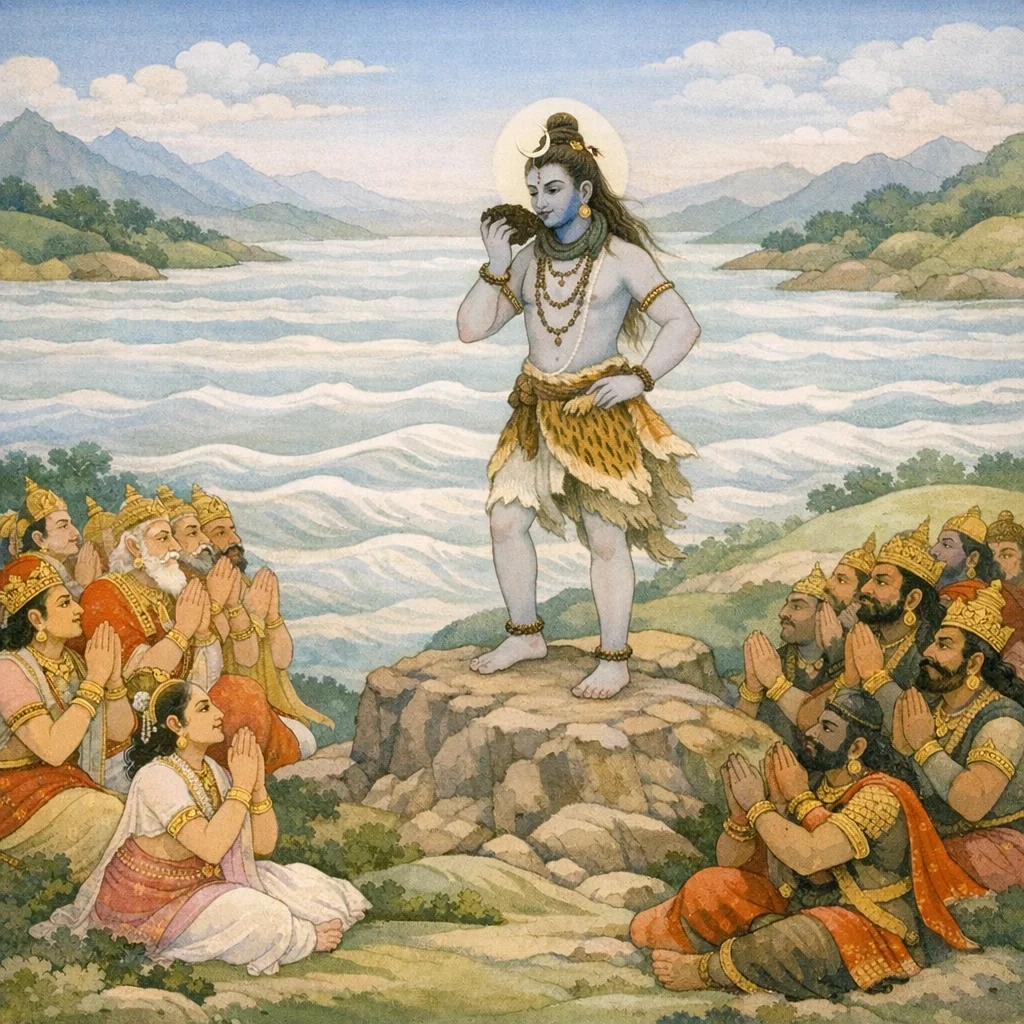
This Adhyāya, taught by Nandīśvara, recounts Śambhu’s Yakṣeśvara-related descent as a lesson to shatter arrogance (garva-haraṇa) and increase devotion among the virtuous (satāṃ bhakti-vivardhana). Set within the churning of the Milk Ocean (kṣīrodadhi) by devas and daityas for amṛta, it tells how, before nectar appears, a dreadful poison—like the fire of cosmic dissolution (kālānala)—arises and terrifies both hosts. In exemplary surrender (śaraṇāgati) they flee to Śaṅkara, praise him as the crest-jewel of all gods, and seek refuge. Śiva, the bhaktavatsala Lord, drinks the poison to save the worlds and holds it in his throat, revealing the Nīlakaṇṭha form as the sign of protective sacrifice and controlled power. With the poison’s danger neutralized by his grace, the churning continues, treasures emerge, and finally amṛta; the devas partake through Hari’s (Viṣṇu’s) strategy/compassion, sharpening the devas–asuras rivalry. Esoterically, the chapter encodes a Śaiva vision: crisis precedes immortality, surrender precedes order, and Śiva’s containment of viṣa models yogic mastery and divine compassion as the axis of liberation-oriented religion.
Shlokas
Verse 1
नन्दीश्वर उवाच । यक्षेश्वरावतारं च शृणु शंभोर्मुनीश्वर । गर्विणं गर्वहन्तारं सताम्भक्तिविवर्द्धनम्
Nandīśvara said: O lord among sages, listen to the account of Śambhu’s incarnation as Yakṣeśvara—He who humbles the arrogant, destroys pride itself, and increases the devotion of the virtuous.
Verse 2
पुरा देवाश्च दैत्याश्च पीयूषार्थम्महाबलाः । क्षीरोदधिं ममन्थुस्ते सुकृत स्वार्थ सन्धयः
In former times, the Devas and the Daityas—mighty in strength and intent on obtaining amṛta, the nectar of immortality—churned the Ocean of Milk, having formed an alliance for their own desired gain, supported by their accumulated merit.
Verse 3
मथ्यमानेऽमृते पूर्वं क्षीराब्धेस्सुरदानवैः । अग्नेः समुत्थितं तस्माद्विषं कालानलप्रभम्
When the Ocean of Milk was churned by the Devas and the Dānavas for the sake of amṛta, before the nectar arose, a poison first sprang forth from that churning—blazing like kālānala, the fire of Time’s final dissolution.
Verse 4
तं दृष्ट्वा निखिला देवा दैत्याश्च भयविह्वलाः । विद्रुत्य तरसा तात शंभोस्ते शरणं ययुः
Seeing Him, all the Devas and the Daityas, shaken with fear, fled swiftly; and, O dear one, they went for refuge to Śambhu (Lord Śiva).
Verse 5
दृष्ट्वा तं शंकरं सर्वे सर्वदेवशिखामणिम् । प्रणम्य तुष्टुवुर्भक्त्या साच्युता नतमस्तकाः
Seeing Śaṅkara—who is the crest-jewel among all the gods—they all bowed down, and with devotion began to praise Him, their heads lowered in reverent submission, free from any wavering or fall from righteousness.
Verse 6
ततः प्रसन्नो भगवाच्छङ्करो भक्तवत्सलः । पपौ विषं महाघोरं सुरासुरगणार्दनम्
Then the Blessed Lord Śaṅkara—ever tender toward His devotees—being pleased, drank that exceedingly dreadful poison which was tormenting the hosts of gods and demons.
Verse 7
पतिं तं विषमं कण्ठे निदधे विषमुल्बणम् । रेजेतेनाति स विभुर्नीलकण्ठो बभूव ह
That all-governing Lord (Pati) placed the dreadful, overpowering poison in His own throat. By that, the all-pervading One shone exceedingly, and thus He became renowned as Nīlakaṇṭha, the Blue-throated Lord.
Verse 8
ततः सुरा सुरगणा ममन्थुः पुनरेव तम् । विषदाहविनिर्मुक्ताः शिवानुग्रहतोऽखिलाः
Then the Devas and the hosts of gods churned it once more. By Lord Śiva’s grace, all were wholly freed from the burning torment of poison, and with renewed steadiness they resumed the churning.
Verse 9
तातो बहूनि रत्नानि निस्सृतानि ततो मुने । अमृतं च पदार्थं हि सुरदानवयोर्मुने
Then, O sage, many precious jewels emerged from it. And from that very churning, O muni, arose also Amṛta—the nectar of immortality—for the sake of both the Devas and the Dānavas.
Verse 10
तत्पपुः केवलन्देवा नासुराः कृपया हरेः । ततो बभूव सुमहद्रत्नं तेषां मिथोऽकदम्
By the compassion of Lord Hari, only the Devas drank it—not the Asuras. Thereupon a very great jewel came into being, and it became the cause of mutual conflict among them.
Verse 11
द्वन्द्वयुद्धम्बभूवाथ देवदानवयोर्मुने । तत्र राहुभयाच्चन्द्रो विदुद्राव तदर्दितः
O sage, then a fierce hand-to-hand combat arose between the gods and the Dānavas. In that turmoil, the Moon—terrified of Rāhu—fled away, distressed and harried by fear.
Verse 12
जगाम सदनं शंभोः शरणम्भय विह्वलः । सुप्रणम्य च तुष्टाव पाहिपाहीति संवदन्
Overwhelmed by fear, he went to the abode of Śambhu seeking refuge. Bowing down deeply, he praised Him, repeatedly crying, “Protect me, protect me!”
Verse 13
ततस्सतामभयदः शंकरो भक्तवत्सलः । दध्रे शिरसि चन्द्रं स विभुश्शरणमागतम्
Then Śaṅkara—giver of fearlessness to the righteous and ever tender to His devotees—placed upon His head the Moon that had come to Him for refuge; that all-pervading Lord granted it protection and honor.
Verse 14
अथागतस्तदा राहुस्तुष्टाव सुप्रणम्य तम् । शंकरं सकलाधीशं वाग्भिरिष्टाभिरादरात्
Then Rahu arrived and, bowing down deeply, praised Lord Śaṅkara—the sovereign of all—with chosen words offered in reverent devotion.
Verse 15
शंभुस्तन्मतमाज्ञाय तच्छिरांस्यच्युतेन ह । पुरा छिन्नानि वै केतुसंज्ञानि निदधे गले
Having understood that intention, Śambhu (Lord Śiva) caused Acyuta (Viṣṇu) to sever those heads; and those heads, thereafter known as “Ketu,” were long ago placed by Śiva upon His neck as an adornment.
Verse 16
इति श्रीशिवमहापुराणे तृतीयायां शतरुद्रसंहितायां यक्षेश्वरावतारवर्णनं नाम षोडशोध्यायः
Thus ends the Sixteenth Chapter, titled “The Description of the Yakṣēśvara Incarnation,” in the Third Book of the Śrī Śiva Mahāpurāṇa, within the Śatarudra Saṃhitā.
Verse 17
विष्णुप्रभृतयः सर्व्वे बभूवुश्चातिगर्विताः । बलानि चांकुरंतोन्तश्शिवमायाविमोहिताः
Vishnu and all the other gods became exceedingly proud; and, inwardly deluded by Shiva’s Māyā, they began to let their powers sprout and swell within them.
Verse 18
ततस्स शंकरो देवः सर्वाधीशोथ गर्वहा । यक्षो भूत्वा जगामाशु यत्र देवाः स्थिता मुने
Then Śaṅkara—the Deva, the Lord of all, the remover of pride—quickly went, O sage, to the place where the gods were standing, having assumed the form of a Yakṣa.
Verse 19
सर्वान्दृष्ट्वाच्युतमुखान्देवान्यक्षपतिस्स वै । महागर्वाढ्यमनसा महेशाः प्राह गर्वहा
Seeing all the gods headed by Acyuta (Viṣṇu), the lord of the Yakṣas (Kubera)—his mind swollen with great pride—spoke to Maheśa, the Destroyer of pride.
Verse 20
यक्षेश्वर उवाच । किमर्थं संस्थिता यूयमत्र सर्वे सुरा मिथः । किमु काष्ठाखिलम्ब्रूत कारणं मेनुपृच्छते
Yakṣeśvara said: “For what purpose are all you gods assembled here together? Tell me the true reason without concealment, for I am asking you.”
Verse 21
देवा ऊचुः । अभूदत्र महान्देव रणः परमदारुणः । असुरा नाशितास्सर्वेऽवशिष्टा विद्रुता गताः
The gods said: “O Great God, here a mighty battle took place—most dreadful indeed. All the asuras were destroyed; those who remained fled away in terror.”
Verse 22
वयं सर्वे महावीरा दैत्यघ्ना बलवत्तराः । अग्रेस्माकं कियन्तस्ते दैत्य क्षुद्रबलास्सदा
We are all great heroes—slayers of the Asuras, mightier in strength. Compared with us, what are you, O Asura, ever possessed of paltry power?
Verse 23
नन्दीश्वर उवाच । इति श्रुत्वा वचस्तेषां सुराणां गर्वगर्भितम् । गर्वहासौ महादेवो यक्षरूपो वचोऽब्रवीत्
Nandīśvara said: Hearing the gods’ words, swollen with pride, Mahādeva—smiling at their arrogance—spoke in the form of a Yakṣa.
Verse 24
यक्षेश्वर उवाच । हे सुरा निखिला यूयं मद्वचश्शृणुतादरात् । यथार्थं वच्मि नासत्यं सर्वगर्वापहारकम्
Yakṣeśvara said: “O all you Devas, listen with reverence to my words. I speak what is true, not falsehood—words that strip away every kind of pride.”
Verse 25
गर्व्वमेनं न कुरुत कर्त्ता हर्त्ताऽपरः प्रभुः । विस्मृताश्च महेशानं कथयध्वम्वृथाबलाः
Do not harbor this pride. The true Lord—other than you—is the real doer and withdrawer of all. Forgetting Mahēśāna, you speak as though you are mighty; your strength is in vain.
Verse 26
युष्माकञ्चेत्स हि मदो जानतां स्वबलम्महत् । मत्स्थापितं तृणमिदं छिन्त स्वास्त्रैश्च तैस्सुराः
If indeed this pride is yours—knowing your own strength to be great—then, O Devas, cut down this mere blade of grass that I have placed here, using those very weapons of yours.
Verse 27
नन्दीश्वर उवाच । इत्युक्त्वैकतृणन्तेषां निचिक्षेप पुरस्ततः । जह्रे सर्वमदं यक्षरूप ईशस्सतांगतिः
Nandīśvara said: “Having spoken thus, that Lord—refuge of the righteous—cast a single blade of grass before them. Assuming the form of a Yakṣa, Īśa then removed all their pride.”
Verse 28
अथ सर्वे सुरा विष्णुप्रमुखा वीरमानिनः । कृत्वा स्वपौरुषन्तत्र स्वायुधानि विचिक्षिपुः
Then all the gods—led by Viṣṇu, proud of their heroism—having displayed their own prowess there, cast down their weapons.
Verse 29
तत्रासन् विफलान्याशु तान्यस्त्राणि दिवौकसाम् । शिवप्रभावतस्तेषां मूढगर्वापहारिणः
There, the celestial beings’ weapons quickly became futile—by the sheer power of Śiva—stripping them of their deluded pride.
Verse 30
अथासीत्तु नभोवाणी देवविस्मयहारिणी । यक्षोऽयं शंकरो देवाः सर्वगर्वापहारकः
Then a voice resounded from the sky, dispelling the gods’ bewilderment: “O Devas, this ‘Yakṣa’ is none other than Śaṅkara (Śiva), the One who removes all pride.”
Verse 31
कर्ता हर्त्ता तथा भर्त्ताऽयमेव परमेश्वरः । एतद्बलेन वलिनो जीवाः सर्वेऽन्यथा न हि
He alone—the Supreme Lord (Parameśvara)—is the doer, the withdrawer, and the sustainer. By His power alone all embodied beings become capable; it cannot be otherwise.
Verse 32
अस्य मायाप्रभावाद्वै मोहिताः स्वप्रभुं शिवम् । मदतो बुबुधु नैवाद्यापि बोधतनुम्प्रभुम्
Truly, by the power of His Māyā they became deluded and did not recognize their own Lord, Śiva. Even to this day, intoxicated with ego and worldly fascination, they do not awaken to that Lord whose very body is pure Consciousness.
Verse 33
नन्दीश्वर उवाच । इति श्रुत्वा नभोवाणीं बुबुधुस्ते गतस्मयाः । यक्षेश्वरम्प्रणेमुश्च तुष्टुवुश्च तमीश्वरम्
Nandīśvara said: Having thus heard the celestial voice, they came to their senses, their pride dispelled. They bowed to the Lord of the Yakṣas and praised that sovereign Lord.
Verse 34
देवा ऊचुः । देवदेव महादेव सर्वगर्वापहारक । यक्षेश्वरमहालील माया तेत्यद्भुता प्रभो
The Devas said: “O God of gods, O Mahādeva, remover of all pride! O Lord, your wondrous play, appearing as the mighty Yakṣa—your māyā is truly astonishing.”
Verse 35
मोहिता माययाद्यापि तव यक्षस्वरूपिणः । सगर्वमभिभाषन्तस्त्वत्पुरो हि पृथङ्मयाः
Even now, deluded by Your māyā, those who have assumed the form of yakṣas speak before You with pride, imagining themselves separate—though in truth You alone pervade them and all that is.
Verse 36
इदानीं ज्ञानमायातन्तवैव कृपया प्रभो । कर्ता हर्ता च भर्ता च त्वमेवान्यो न शंकर
Now true understanding has arisen—only by Your grace, O Lord. You alone are the doer, the withdrawer, and the sustainer; there is none other but You, O Śaṅkara.
Verse 37
त्वमेव सर्वशक्तीनां सर्वेषां हि प्रवर्तकः । निवर्तकश्च सर्वेशः परमात्माव्ययोऽद्वयः
You alone are the impelling source of all powers, indeed the initiator of all. You also withdraw them; O Lord of all, You are the Supreme Self—imperishable and non-dual.
Verse 38
यक्षेश्वरस्वरूपेण सर्वेषां नो मदो हृतः । इतो मन्यामहे तत्तेनुग्रहो हि कृपालुना
Assuming the form of Yakṣeśvara, He has taken away the pride of all of us. From this we understand that it is truly the grace of the compassionate Lord upon us.
Verse 39
अथो स यक्षनाथोऽनुगृह्य वै सकलान् सुरान् । विबोध्य विविधैर्वाक्यैस्तत्रैवान्तरधीयत
Then the Lord of the Yakṣas, having graciously favored all the gods, awakened them with various words of counsel; and right there, He vanished from sight.
Verse 40
इत्थं स वर्णितः शम्भोरवतारः सुखावहः । यक्षेश्वराख्यस्सुखदस्सतान्तुष्टोऽभयंकरः
Thus has been described the auspicious incarnation of Śambhu, the bringer of well-being, the bestower of happiness. Known as Yakṣeśvara, He grants joy, is ever pleased with the virtuous, and bestows fearlessness.
Verse 41
इदमाख्यानममलं सर्वगर्वापहारकम् । सतां सुशान्तिदन्नित्यं भुक्तिमुक्तिप्रदं नृणाम्
This pure and sacred account removes all pride. It ever bestows deep peace upon the virtuous, and grants human beings both worldly fulfillment and final liberation (moksha).
Verse 42
य इदं शृणुयाद्भक्त्या श्रावयेद्वा सुधीः पुमान् । सर्वकामानवाप्नोति ततश्च लभते गतिम्
Any wise person who listens to this with devotion, or causes it to be recited for others, attains all desired aims; and thereafter gains the supreme course—liberation through Lord Śiva’s grace.
Frequently Asked Questions
The chapter recounts the Samudra Manthana sequence up to and including the emergence of the deadly poison and Śiva’s salvific act of drinking and containing it, establishing a theological argument that ultimate refuge and cosmic stabilization occur through Śiva’s grace when all beings—devas and daityas alike—are overwhelmed.
The poison (viṣa) signifies destructive excess—fear, karmic toxicity, and unassimilated power—while Śiva’s retention of it in the throat signifies controlled containment (dhāraṇa) rather than repression or discharge. Nīlakaṇṭha thus becomes a symbolic template for yogic mastery and compassionate sovereignty: the divine absorbs what would destroy the cosmos, transmuting crisis into the precondition for amṛta (immortality/gnosis).
Śiva is highlighted primarily as Śaṃkara/Śambhu in the Nīlakaṇṭha manifestation—defined by the blue throat as the enduring mark of his protective act. The opening also frames the account under a Yakṣeśvara-related avatāra motif, presenting Śiva’s descent as targeted toward garva-haraṇa (the subduing of pride) and the strengthening of bhakti among the righteous.