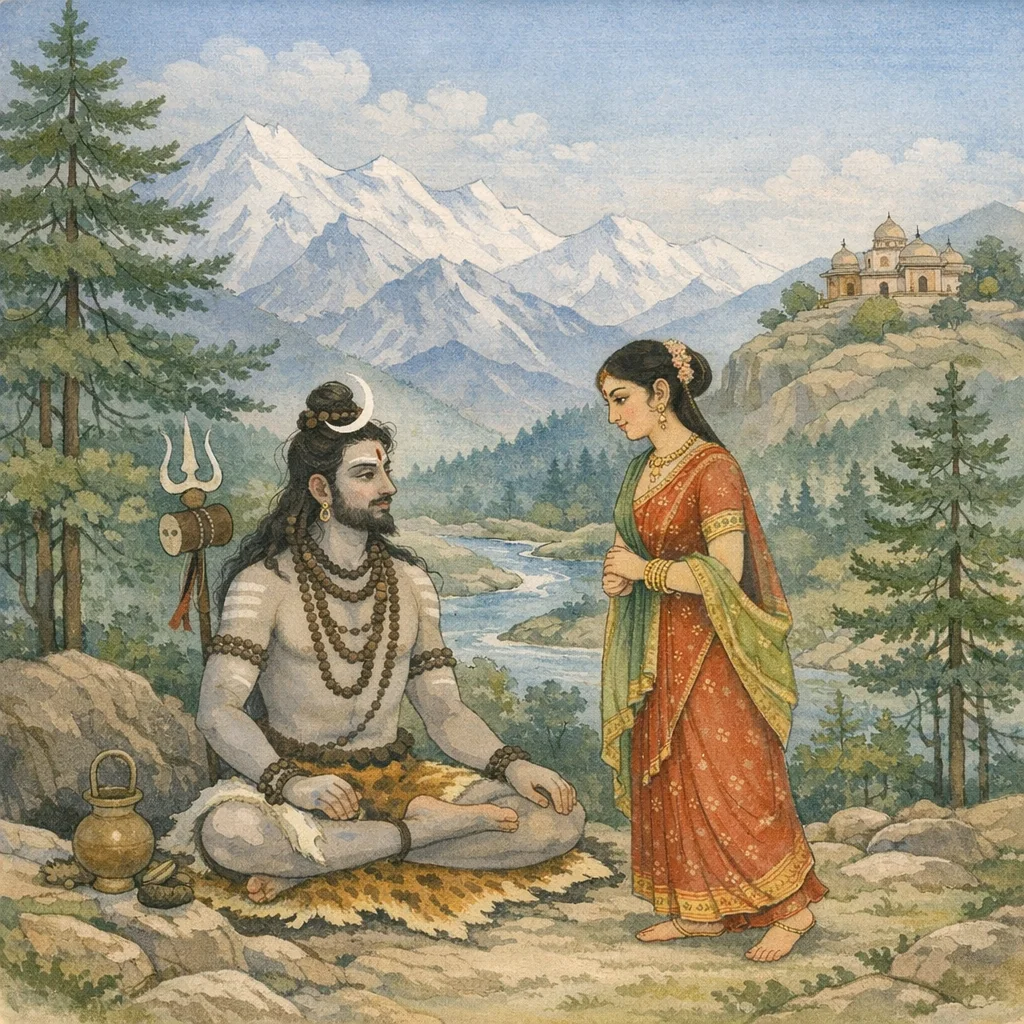
पार्वतीप्रार्थना—हिमवत्पार्श्वे भिक्षुरूपेण याचनम् | Pārvatī’s Request: Śiva to Seek Her in Beggar-Form at Himālaya’s Court
Adhyāya 29 continues the Nārada–Brahmā dialogue. Asked what happened next, Brahmā recounts the immediate aftermath of Pārvatī’s words to Śiva. Hara (Śiva), inwardly pleased, accepts her loving yet directive speech. Pārvatī hails him as her lord, recalls the cosmic episode of Dakṣa’s sacrifice and its forceful destruction, and links their present birth and mission to the devas’ distress caused by Tāraka. She petitions Śiva to compassionately accept her as wife, yet insists on a dharmic, publicly recognized procedure: she seeks leave to go to her father’s house and asks Śiva to come to Himavat’s side to formally request her hand, deliberately assuming the guise of a bhikṣu (mendicant) as a līlā. The chapter emphasizes dharmic legitimation, worldly fame (yaśas), and the harmonizing of ascetic identity with formal household marriage, preparing for the public acknowledgment of the divine union and its cosmic purpose.
Shlokas
Verse 1
नारद उवाच । ब्रह्मन् विधे महाभाग किं जातं तदनन्तरम् । तत्सर्वं श्रोतुमिच्छामि कथय त्वं शिवायशः
Nārada said: “O Brahman, O Vidhā the Creator, O greatly fortunate one—what happened after that? I wish to hear all of it. Please tell me, O Śivāyaśas, for it concerns the glory of Lord Śiva.”
Verse 2
ब्रह्मोवाच । देवर्षे श्रूयतां सम्यक्कथयामि कथां मुदा । तां महापापसंहर्त्रीं शिवभक्तिविवर्द्धिनीम्
Brahmā said: “O divine seer, listen attentively. With joy I shall narrate this sacred account—one that destroys even great sins and increases devotion to Lord Śiva.”
Verse 3
पार्वती वचनं श्रुत्वा हरस्स परमात्मनः । दृष्ट्वानन्दकरं रूपं जहर्षातीव च द्विज
O brāhmaṇa, hearing Pārvatī’s words, Hara—the Supreme Self—beheld her joy-bestowing form and was filled with great delight.
Verse 4
प्रत्युवाच महा साध्वी स्वोपकण्ठस्थितं विभुम् । अतीव सुखिता देवी प्रीत्युत्फुल्लानना शिवा
Then the great virtuous Goddess, exceedingly happy and with her face blossoming with love, replied to the all-pervading Lord who was resting close at her side.
Verse 5
पार्वत्युवाच । त्वं नाथो मम देवेश त्वया किं विस्मृतम्पुरा । दक्षयज्ञविनाशं हि यदर्थं कृतवान्हठात्
Pārvatī said: “O Devēśa, you are my Lord and protector. What has been forgotten by you from earlier times—namely, for what purpose you suddenly brought about the destruction of Dakṣa’s sacrifice?”
Verse 6
स त्वं साहं समुत्पन्ना मेनयां कार्य्यसिद्धये । देवानां देव देदेश तारकाप्ताऽसुखात्मनाम्
O Lord of the gods, O divine ruler: you and I have manifested through Menā for the fulfilment of the gods’ purpose—to remove the suffering that has befallen the devas because of Tāraka.
Verse 7
यदि प्रसन्नो देवेश करोषि च कृपां यदि । पतिर्भव ममेशान मम वाक्यं कुरु प्रभो
“O Lord of the gods, if You are pleased—if You would indeed show compassion—then, O Īśāna, become my husband. O Master, fulfill my request.”
Verse 8
पितुर्गेहे मया सम्यग्गम्यते त्वदनुजया । प्रसिद्धं क्रियतां तद्वै विशुद्धं परमं यशः
With your younger sister accompanying me, I am indeed going properly to my father’s house. Therefore, let that matter be publicly acknowledged, so that spotless and supreme honour may be established.
Verse 9
गन्तव्यं भवता नाथ हिमवत्पार्श्वतं प्रभो । याचस्व मां ततो भिक्षु भूत्वा लीलाविशारदः
O Lord, O Master—go to the side of Himavān, O Prabhu. Then, becoming a mendicant, skillful in divine play, approach and ask for me in marriage.
Verse 10
तथा त्वया प्रकर्तव्यं लोके ख्यापयता यशः । पितुर्मे सफलं सर्वं कुरुष्वैवं गृहा मम्
So too, act in such a way that your fame is proclaimed in the world. Thus make all my father’s aims bear fruit, and in this manner accept my hand in sacred marriage.
Verse 11
ऋषिभिर्बोधितः प्रीत्या स्वबन्धुपरिवारितः । करिष्यति न संदेहस्तव वाक्यं पिता मम
“My father—lovingly advised by the sages and surrounded by his own kinsmen—will surely carry out your word; of this there is no doubt.”
Verse 12
दक्षकन्या पुराहं वै पित्रा दत्ता यदा तव । यथोक्तविधिना तत्र विवाहो न कृतस्त्वया
Formerly, when I was Dakṣa’s daughter and my father gave me to you, you did not perform the marriage there according to the prescribed rites.
Verse 13
न ग्रहाः पूजितास्तेन दक्षेण जनकेन मे । ग्रहाणां विषयस्तेन सच्छिद्रोयं महानभूत्
“My father Dakṣa did not worship the Grahas (planetary deities). Because of that neglect, the influence of the Grahas became a great affliction—full of defects—upon this matter (and upon me).”
Verse 14
तस्माद्यथोक्तविधिना कर्तुमर्हसि मे प्रभो । विवाहं त्वं महादेव देवानां कार्य्यसिद्धये
Therefore, O my Lord, you ought to perform the marriage according to the prescribed rite. O Mahādeva, accomplish this wedding for the fulfillment of the gods’ purpose.
Verse 15
विवाहस्य यथा रीतिः कर्तव्या सा तथा धुवम् । जानातु हिमवान् सम्यक् कृतं पुत्र्या शुभं तपः
Let the wedding rites be performed exactly according to proper custom—surely so. Let Himavān clearly understand that his daughter has perfected her auspicious austerity (tapas).
Verse 16
ब्रह्मोवाच इत्येवं वचनं श्रुत्वा सुप्रसन्नस्सदाशिवः । प्रोवाच वचनं प्रीत्या गिरिजां प्रहसन्निव
Brahmā said: Having thus heard her words, Sadāśiva became exceedingly pleased; and with affection—almost smiling—He spoke to Girijā (Pārvatī).
Verse 17
शिव उवाच । शृणु देवि महेशानि परमं वचनं मम । यथोचितं सुमाङ्गल्यमविकारि तथा कुरु
Śiva said: “Listen, O Goddess, O Maheshānī, great queen of the Lord. Hear my supreme instruction: perform, in the proper manner, the auspicious rite that brings blessedness—steadfastly and without wavering.”
Verse 18
ब्रह्मादिकानि भूतानि त्वनित्यानि वरानने । दृष्टं यत्सर्वमेतच्च नश्वरं विद्धि भामिनि
O fair-faced one, even beings such as Brahmā and the rest are impermanent. Know, O radiant lady, that all this which is seen—everything without exception—is perishable.
Verse 19
एकोनेकत्वमापन्नो निर्गुणो हि गुणान्वितः । ज्योत्स्नया यो विभाति परज्योत्स्नान्वितोऽभवत्
He who is truly without attributes (nirguṇa) nevertheless becomes endowed with attributes (saguṇa) for the sake of revelation; though One, He assumes manifoldness. Like the moon that shines by reflected moonlight, He appears accompanied by a higher, transcendent Light.
Verse 20
स्वतन्त्रः परतन्त्रश्च त्वया देवि कृतो ह्यहम् । सर्वकर्त्री च प्रकृतिर्महामाया त्वमेव हि
O Goddess, by you I have been made both independent and dependent. You alone indeed are Prakṛti, the all-doing power, the great Māyā.
Verse 21
मायामयं कृतमिदं च जगत्समग्रं सर्वात्मना हि विधृतं परया स्वबुद्ध्या । सवार्त्मभिस्सुकृतिभिः परमात्मभावैस्संसिक्तमात्मनि गणः परिवेष्टितश्च
This entire universe is fashioned of Māyā, yet it is sustained by the Supreme as the inner Self of all, through His own supreme consciousness. And the host of beings—those of virtuous merit, whose awareness is steeped in the sense of the Supreme Self—remain encompassed and established within that very Self.
Verse 22
के ग्रहाः के ऋतुगणाः के वान्येपि त्वया ग्रहाः । किमुक्तं चाधुना देवि शिवार्थं वरवर्णिनि
“Which planets (grahas) are these, which groups of seasons, and what other influences have you taken into account? And now, O Goddess—O fair-limbed one—what has been declared for the sake of Śiva?”
Verse 23
गुणकार्य्यप्रभेदेनावाभ्यां प्रादुर्भवः कृतः । भक्तहेतोर्जगत्यस्मिन्भक्तवत्सलभावतः
By distinguishing the functions arising from the guṇas, we two have manifested in this world. This manifestation is for the sake of devotees (bhaktas), for in this universe our very nature is tender affection toward those who worship.
Verse 24
त्वं हि वै प्रकृतिस्सूक्ष्मा रजस्सत्त्वतमोमयी । व्यापारदक्षा सततं सगुणा निर्गुणापि च
You indeed are the subtle Prakṛti, constituted of rajas, sattva, and tamas. Ever skilled in bringing forth activity, you are both with attributes (saguṇā) and also beyond attributes (nirguṇā).
Verse 25
सर्वेषामिह भूतानामहमात्मा सुमध्यमे । निर्विकारी निरीहश्च भक्तेच्छोपात्तविग्रहः
O fair-waisted one, I am the very Self of all beings here. I am changeless and without need or dependence; yet, in response to the devotee’s longing, I assume a form that can be approached and worshipped.
Verse 26
हिमालयं न गच्छेयं जनकं तव शैलजे । ततस्त्वां भिक्षुको भूत्वा न याचेयं कथंचन
O Mountain-born one (Pārvatī), I shall not go to Himālaya to approach your father. Rather, even if I were to become a beggar, I would not ask you for anything at all.
Verse 27
महागुणैर्गरिष्ठोपि महात्मापि गिरीन्द्रजे । देहीतिवचनात्सद्यः पुरुषो याति लाघवम्
O daughter of the Lord of mountains, even a great-souled person—though weighty with many virtues—at once becomes diminished the moment he speaks the words, “Give (to me).”
Verse 28
इत्थं ज्ञात्वा तु कल्याणि किमस्माकं वदस्यथ । कार्य्यं त्वदाज्ञया भद्रे यथेच्छसि तथा कुरु
“O auspicious one, having understood it thus, what more can you say to us? O blessed lady, the matter is to be carried out according to your command—do exactly as you wish.”
Verse 29
ब्रह्मोवाच । तेनोक्तापि महादेवी सा साध्वी कमलेक्षणा । जगाद शंकरं भक्त्या सुप्रणम्य पुनः पुनः
Brahmā said: Though thus addressed, that great Goddess—virtuous and lotus-eyed—spoke to Śaṅkara with devotion, bowing down again and again in reverence.
Verse 30
पार्वत्युवाच । त्वमात्मा प्रकृतिश्चाहं नात्र कार्य्या विचारणा । स्वतन्त्रौ भक्तवशगौ निर्गुणौ सगुणावपि
Pārvatī said: “You are the supreme Self (Ātman), and I am Prakṛti, the primordial power. There is no need for deliberation about this. Though we are independent, we both come under the sway of devotees; and though beyond qualities (nirguṇa), we also manifest with qualities (saguṇa).”
Verse 31
प्रयत्नेन त्वया शम्भो कार्यं वाक्यं मम प्रभो । याचस्व मां हिमगिरेस्सौभाग्यं देहि शङ्कर
O Śambhu, my Lord—please fulfill my request with earnest effort. Go and ask for me from Himālaya; O Śaṅkara, grant me the blessed fortune of becoming your wedded consort.
Verse 32
कृपां कुरु महेशान तव भक्तास्मि नित्यशः । तव पत्नी सदा नाथ ह्यहं जन्मनि जन्मनि
O Maheśāna, show me grace. I am ever your devotee. O Lord, in every birth after birth, I am indeed always your wife.
Verse 33
त्वं ब्रह्म परमात्मा हि निर्गुणः प्रकृतेः परः । निर्विकारी निरीहश्च स्वतन्त्रः परमेश्वरः
You are truly Brahman—the Supreme Self (Paramātman); beyond the guṇas, transcending Prakṛti. Changeless and desireless, ever independent, You are the Supreme Lord, Parameśvara.
Verse 34
तथापि सगुणोपीह भक्तोद्धारपरायणः । विहारी स्वात्मनिरतो नानालीलाविशारदः
Yet even so, here he assumes a manifest (saguṇa) form, wholly intent on uplifting his devotees. He sports in divine play, abides in his own Self, and is expertly skilled in innumerable līlās.
Verse 35
सर्वथा त्वामहं जाने महादेव महेश्वर । किमुक्तेन च सर्वज्ञ बहुना हि दयां कुरु
In every way I know You to be Mahādeva, the Great Lord, Maheśvara. What is the use of saying more, O Omniscient One? Please, indeed, show compassion.
Verse 36
विस्तारय यशो लोके कृत्वा लीलां महाद्भुताम् । यत्सुगीय जना नाथांजसोत्तीर्णा भवाम्बुधेः
O Lord, expand Your fame in the world by performing a supremely wondrous divine play—by singing of which people, O Protector, swiftly cross over the ocean of worldly becoming.
Verse 37
ब्रह्मोवाच । इत्येवमुक्त्वा गिरिजा सुप्रणम्य पुनः पुनः । विरराम महेशानं नतस्कन्धा कृतांजलिः
Brahmā said: Having spoken thus, Girijā (Pārvatī) bowed again and again with reverence to Maheśāna (Lord Śiva). With shoulders bent in humility and palms joined in añjali, she fell silent and ceased speaking.
Verse 38
इत्येवमुक्तस्स तया महात्मा महेश्वरो लोकविडम्बनाय । तथेति मत्त्वा प्रहसन्बभूव मुदान्वितः कर्तुमनास्तदेव
Thus addressed by her, the great-souled Lord Maheśvara—wishing to enact a līlā for the instruction of the world—accepted it as “So be it.” Smiling, he was filled with joy and set his mind to do exactly that.
Verse 39
ततो ह्यन्तर्हितश्शम्भुर्बभूव सुप्रहर्षितः । कैलासं प्रययौ काल्या विरहाकृष्टमानसः
Then Śambhu (Lord Śiva) became invisible, filled with great joy. His mind, drawn by separation from Kālī (Pārvatī), departed for Kailāsa.
Verse 40
तत्र गत्वा महेशानो नन्द्यादिभ्यस्स ऊचिवान् । वृत्तान्तं सकलं तम्वै परमानन्दनिर्भरः
Having gone there, Lord Maheśāna spoke to Nandī and the others, recounting the entire account in full—He, the Supreme Lord, overflowing with the highest bliss.
Verse 41
तेऽपि श्रुत्वा गणास्सर्वे भैरवाद्याश्च सर्वशः । बभूवुस्सुखिनोत्यन्तं विदधुः परमोत्सवम्
Hearing that, all the Gaṇas as well—along with Bhairava and the others on every side—became exceedingly joyful, and they arranged a most splendid festival.
Verse 42
सुमंगलं तत्र द्विज बभूवातीव नारद । सर्वेषां दुःखनाशोभूद्रुद्रः प्रापापि संमुदम्
O Nārada, O noble brāhmaṇa, there arose there an exceedingly auspicious turn of events. The sorrows of all were destroyed, and Rudra too attained deep gladness.
Frequently Asked Questions
Pārvatī asks Śiva to go to Himavat’s residence and formally request her hand, even taking on a bhikṣu (mendicant) form as līlā; she also invokes the earlier Dakṣa-yajña destruction as contextual memory.
The narrative encodes the Śiva–Śakti union as grace-mediated and dharma-aligned: supreme divinity adopts humility (bhikṣu) to sanctify social order, showing that transcendence can validate, not negate, worldly rites.
Śiva is highlighted as Hara/Paramātman and as a potential bhikṣu-form (ascetic manifestation), while Pārvatī is shown as the directive Śakti who orchestrates the dharmic visibility of their union.