Viśveśvara-māhātmya and the Nirguṇa–Saguṇa Emergence of Śiva (Śakti–Puruṣa/Prakṛti Discourse)
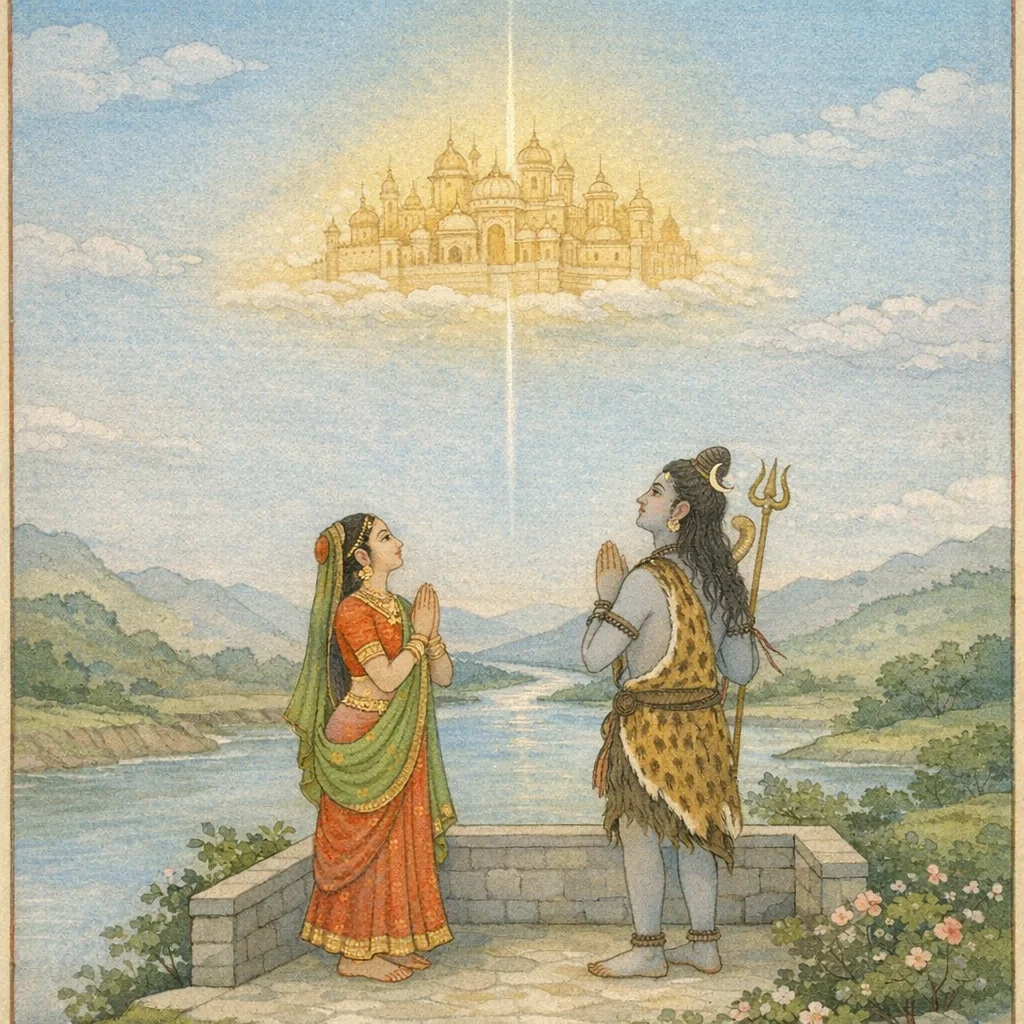
This chapter, spoken by Sūta to the assembled ṛṣis, proclaims Viśveśvara’s saving greatness as the destroyer of great sins (mahāpātaka) and grounds it in sacred ontology. The visible universe is described as a mere ‘vastumātraka’ appearance, resting on cidānanda—unchanging, eternal, and nirvikāra. From that Absolute arises a “second intention” (dvitīyecchā), by which the same Reality becomes saguṇa and is named “Śiva.” A polar manifestation is then taught: Śiva as the masculine principle and Śakti as the feminine power—an ordered duality rooted in the one cidānanda source. When Prakṛti and Puruṣa are uncertain how to proceed, an authoritative voice of the nirguṇa Paramātman declares that tapas is required for an excellent creation to emerge. Asked where austerity should be performed, a radiant sacred city/abode of concentrated tejas, fully furnished and measuring pañcakrośa, appears in the mid-space near Puruṣa. Thus the chapter unites metaphysical emanation, the problem of beginnings, and tapas as the ritual-ascetic catalyst of ordered manifestation, while presenting Viśveśvara as the theological key that dissolves sin and ignorance.
Shlokas
Verse 1
सूत उवाच । अतःपरं प्रवक्ष्यामि श्रूयतामृषिसत्तमाः । विश्वेश्वरस्य माहात्म्यं महापातकनाशनम्
Sūta said: “Next, O best of sages, listen. I shall now declare the sacred greatness of Viśveśvara (Lord Śiva as the Lord of the universe), a glory that destroys even the gravest sins.”
Verse 2
यदिदं दृश्यते किंचिज्जगत्यां वस्तुमात्रकम् । चिदानन्द स्वरूपं च निर्विकारं सनातनम्
Whatever is seen here in this world as mere “things” is, in truth, of the nature of Consciousness and Bliss—eternal and changeless.
Verse 3
तस्यैव कैवल्यरतेर्द्वितीयेच्छा ततोभवत् । स एव सगुणो जातश्शिव इत्यभिधीयते
For that very One who delights in absolute aloneness (kaivalya), a second intention then arose. From that, He Himself became manifest with attributes; and thus He is spoken of as “Śiva” in His saguṇa (qualified) mode.
Verse 4
स एव हि द्विधा जातः पुंस्त्रीरूपप्रभेदतः । यः पुमान्स शिवः ख्यातः स्त्रीशक्तिस्सा हि कथ्यते
He alone has become two, differentiated as the male and the female forms. The male is renowned as Śiva, and the female is indeed spoken of as His Śakti (power).
Verse 5
चिदानन्देस्वरूपाभ्यां पुरुषावपि निर्मितौ
From the two principles—pure Consciousness (cit) and Bliss (ānanda)—those two divine Persons as well were brought forth.
Verse 6
अदृष्टाभ्यां तदा ताभ्यां स्वभावान्मुनिसत्तमाः । तावदृष्ट्वा तदा तौ च स्वमातृपितरौ द्विजाः
O best of sages, then those two, moved by their own nature, looked on; and the two twice-born, seeing them, recognized them as their own mother and father.
Verse 7
महासंशयमापन्नौ प्रकृतिः पुरुषश्च तौ । तदा वाणी समुत्पन्ना निर्गुणात्परमात्मनः । तपश्चैव प्रकर्तव्यं ततस्सृष्टिरनुत्तमा
Prakṛti and Puruṣa, both fallen into great doubt, then heard a divine Voice arising from the Nirguṇa Supreme Self: “Austerity must indeed be undertaken; from that, the unsurpassed creation will come forth.”
Verse 8
प्रकृतिपुरुषाबूचतुः । तपसस्तु स्थलंनास्ति कुत्रावाभ्यां प्रभोऽधुना । स्थित्वा तपः प्रकर्तव्यं तव शासनतश्शिव
Prakṛti and Puruṣa said: “O Lord, at present there is no proper place for the two of us to perform tapas. Where should we remain and undertake austerity according to Your command, O Śiva?”
Verse 9
ततश्च तेजसस्सारं पंचक्रोशात्मकं शुभम् । सर्वोपकरणैर्युक्तं सुंदरं नगरं तथा
Then, from the very essence of divine radiance, there arose an auspicious and splendid city, extending for five krośas, furnished with every requisite and beautifully adorned.
Verse 10
निर्माय प्रेषितं तत्स्वं निर्गुणेन शिवेन च । अंतरिक्षे स्थितं तच्च पुरुषस्य समीपतः
Having fashioned it, the transcendent, attributeless (nirguṇa) Lord Śiva sent forth His own manifestation; and it remained poised in mid-air, close to that person.
Verse 11
तदधिष्ठाय हरिणा सृष्टिकामनया ततः । बहुकालं तपस्तप्तं तद्ध्यानमवलंब्य च
Thereafter, Hari (Viṣṇu), taking refuge in that sacred support (seat/abode) with the wish to bring forth creation, performed austerities (tapas) for a very long time, steadily relying upon meditation on That— the Supreme Lord Śiva.
Verse 12
श्रमेण जलधारश्च विविधाश्चाभवंस्तदा । ताभिर्व्याप्तं च तच्छून्यं नान्यत्किंचिददृश्यत
Then, through exertion, many kinds of streams of water arose. That empty expanse was pervaded by them, and nothing else whatsoever could be seen.
Verse 13
ततश्च विष्णुना दृष्टं किमेतद्दृश्यतेऽद्भुतम् । इत्याश्चर्यं तदा दृष्ट्वा शिरसः कम्पनं कृतम्
Then Viṣṇu looked on and thought, “What is this wondrous marvel that is being seen?” Beholding that astonishing sight, he shook his head in amazement.
Verse 14
ततश्च पतितः कर्णान्मणिश्च पुरतः प्रभो । तद्बभूव महत्तीर्थं नामतो मणिकर्णिका
Then, O Lord, the jewel fell from (Śiva’s) ear in front of all. From that event there arose a great sacred ford (tīrtha), renowned by the name Maṇikarṇikā.
Verse 15
जलौघे प्लाव्यमाना सा पंचक्रोशी यदाभवत । निर्गुणेन शिवेनाशु त्रिशूलेन धृता तदा
When the sacred Pañcakrośī region was being swept away by a torrent of waters, then Nirguṇa Śiva swiftly held it aloft upon His trident (triśūla), protecting it.
Verse 16
विष्णुस्तत्रैव सुष्वाप प्रकृत्या स्वस्त्रिया सह । तन्नाभिकमलाज्जातो ब्रह्मा शंकरशासनात्
There itself Viṣṇu lay in yogic repose, together with Prakṛti, his own consort. From the lotus of his navel, Brahmā was born—according to the ordinance of Śaṅkara, Lord Śiva.
Verse 17
शिवाज्ञां स समासाद्य सृष्टिचक्रेऽद्भुता तदा । चतुर्द्दशमिता लोका ब्रह्मांडे यत्र निर्मिताः
Having obtained the command of Lord Śiva, he then set in motion the wondrous work of creation. In that Brahmāṇḍa, the fourteen worlds were fashioned and established.
Verse 18
योजनानां च पंचाशत्कोटिसंख्याप्रमाणतः । ब्रह्मांडस्यैव विस्तारो मुनिभिः परिकीर्तितः
According to the measured count of fifty koṭis of yojanas, the sages have declared the extent of the very Brahmāṇḍa, the cosmic egg.
Verse 19
ब्रह्मांडे कर्मणा बद्धा प्राणिनो मां कथं पुनः । प्राप्स्यंतीति विचिन्त्यैतत्पंचक्रोशी विमोचिता
Reflecting, “How indeed will living beings—bound by karma within the Brahmāṇḍa—attain Me again?”, the Lord therefore revealed the liberating sacred region known as Pañcakrośī.
Verse 20
इयं च शुभदा लोके कर्म नाशकरी मता । मोक्षप्रकाशिका काशी ज्ञानदा मम सुप्रिया
“This Kāśī is auspicious in the world and is held to destroy the bonds of karma. Kāśī illumines the way of mokṣa, bestows true knowledge, and is exceedingly dear to Me.”
Verse 21
अविमुक्तं स्वयं लिंगं स्थापितं परमात्मना । न कदाचित्त्वया त्याज्यमिदं क्षेत्रं ममांशक
In Avimukta, the Supreme Self (Paramātman) Himself established this Liṅga. Therefore, O portion of Mine, you must never abandon this sacred kṣetra.
Verse 22
इति श्रीशिवमहापुराणे चतुर्थ्यां कोटिरुद्रसंहितायां विश्वेश्वरमाहात्म्ये काश्यां रुद्रागमनवर्णनंनाम द्वाविंशोऽध्यायः
Thus ends the twenty-second chapter, called “The Description of Rudra’s Arrival in Kāśī,” in the Viśveśvara Māhātmya of the Fourth (Koṭirudra Saṃhitā) of the Śrī Śiva Mahāpurāṇa.
Verse 23
ब्रह्मणश्च दिने सा हि न विनश्यति निश्चितम् । तदा शिवस्त्रिशूलेन दधाति मुनयश्च ताम्
Surely, during the daytime of Brahmā, it does not perish—this is certain. Then Śiva bears it upon His trident (triśūla), and the sages also uphold it.
Verse 24
पुनश्च ब्रह्मणा सृष्टौ कृतायां स्थाप्यते द्विजाः । कर्मणा कर्षणाच्चैव काशीति परिपठ्यते
And again, when Brahmā brings forth creation, the twice-born (dvija) are established there. And because, by its spiritual karmic power, it draws all beings, it is traditionally recited and known by the name “Kāśī.”
Verse 25
अविमुक्तेश्वरं लिंगं काश्यां तिष्ठति सर्वदा । मुक्तिदातृ च लोकानां महापातकिनामपि
The Liṅga known as Avimukteśvara ever abides in Kāśī; it bestows liberation upon beings—even upon those burdened with the gravest sins.
Verse 26
अन्यत्र प्राप्यते मुक्तिस्सारूप्यादिर्मुनीश्वराः । अत्रैव प्राप्यते जीवैः सायुज्या मुक्तिरुत्तमा
O foremost sages, elsewhere one may obtain liberation such as sārūpya and the like; but here itself living beings attain the supreme liberation—sāyujya, union with Lord Śiva.
Verse 27
येषां क्वापि गतिर्नास्ति तेषां वाराणसी पुरी । पंचक्रोशी महापुण्या हत्याकोटिविनाशनी
For those who find no refuge or spiritual way anywhere, the city of Vārāṇasī itself becomes their true sanctuary. The holy Pañcakrośī pilgrimage there is supremely meritorious, and by Śiva’s grace it destroys even crores of sins, grave as acts of killing.
Verse 28
अमरा मरणं सर्वे वांछतीह परे च के । भुक्तिमुक्तिप्रदा चैषा सर्वदा शंकरप्रिया
Even the deathless ones (the gods) all long for this “death” here—who then among others would not? For this holy place/power bestows both worldly enjoyment (bhukti) and liberation (mukti) always, and it is ever beloved of Śaṅkara.
Verse 29
ब्रह्मा च श्लाघते चामूं विष्णुस्सिद्धाश्च योगिनः । मुनयश्च तथैवान्ये त्रिलोकस्था जनाः सदा
Brahmā praises her, and so does Viṣṇu; the Siddhas and Yogins also praise her. The sages and likewise other beings dwelling throughout the three worlds continually extol her glory.
Verse 30
काश्याश्च महिमानं वै वक्तुं वर्षशतैरपि । शक्नोम्यहं न सर्वं हि यथाशक्ति ब्रुवे ततः
Truly, even if I were to speak for a hundred years, I would not be able to express the glory of Kāśī in its entirety. Therefore I shall describe it only to the extent of my capacity.
Verse 31
कैलासस्य पतिर्यो वै ह्यंतस्सत्त्वो बहिस्तमाः । कालाग्निर्नामतः ख्यातो निर्गुणो गुणवान्भवः । प्रणिपातैरनेकैश्च वचनं चेदमब्रवीत्
Then the Lord of Kailāsa—known by name as Kālāgni—who is inwardly pure (sattva) yet outwardly veiled in darkness, and who, though nirguṇa in essence, assumes guṇas for the sake of grace, offered many prostrations and spoke these words.
Verse 32
रुद्र उवाच । विश्वेश्वर महेशान त्वदीयोऽस्मि न संशयः । कृपां कुरु महादेव मयि त्वं साम्ब आत्मजे
Rudra said: “O Lord of the universe, O Maheśāna, I am truly Yours—there is no doubt. Show compassion to me, O Mahādeva; be gracious to me, O Śambhu, as Your own child.”
Verse 33
स्थातव्यं च सदात्रैव लोकानां हितकाम्यया । तारयस्व जगन्नाथ प्रार्थयामि जगत्पते
For the welfare of all beings, you should remain here always. O Lord of the universe, deliver the worlds—this is my prayer to you, O Master of all creation.
Verse 34
सूत उवाच । अविमुक्तेऽपि दान्तात्मा तं संप्रार्थ्य पुनः पुनः । नेत्राश्रूणि प्रमुच्यैव प्रीतः प्रोवाच शंकरम्
Sūta said: Even in Avimukta, that self-restrained man repeatedly implored him again and again; and shedding tears from his eyes, he—filled with devotion and joy—spoke to Śaṅkara (Lord Śiva).
Verse 35
अविमुक्त उवाच । देवदेव महादेव कालामयसुभेषज । त्वं त्रिलोकपतिस्सत्यं सेव्यो ब्रह्माच्युतादिभिः
Avimukta said: “O God of gods, O Mahādeva—O supreme medicine for the afflictions of Time (death and decay)! Truly, You are the Lord of the three worlds, and You are worthy to be worshipped even by Brahmā, Acyuta (Viṣṇu), and the other gods.”
Verse 36
काश्यां पुर्यां त्वया देव राजधानी प्रगृह्यताम् । मया ध्यानतया स्थेयमचिंत्य सुखहेतवे
O Deva, in the city of Kāśī, accept the royal seat as Your capital. As for me, I shall remain established in dhyāna (meditation), for the sake of bringing about inconceivable bliss.
Verse 37
मुक्तिदाता भवानेव कामदश्च न चापरः । तस्मात्त्वमुपकाराय तिष्ठोमासहितस्सदा
You alone are the bestower of mukti (liberation), and You alone grant all desired boons—there is none other. Therefore, for the welfare of devotees, remain always present, together with Umā.
Verse 38
जीवान्भवाब्धेरखिलांस्तारय त्वं सदाशिव । भक्तकार्य्यं कुरु हर प्रार्थयामि पुनःपुनः
O Sadāśiva, ferry all living beings across the ocean of worldly becoming. O Hara, fulfill the need of Your devotee—I beseech You again and again.
Verse 39
सूत उवाच । इत्येवं प्रार्थितस्तेन विश्वनाथेन शंकरः । लोकानामुपकारार्थं तस्थौ तत्रापि सर्वराट्
Sūta said: Thus entreated by Viśvanātha, Śaṅkara—the sovereign Lord of all—remained there as well, for the welfare and upliftment of the worlds.
Verse 40
यद्दिनं हि समारभ्य हरः काश्यामुपागतः । तदारभ्य च सा काशी सर्वश्रेष्ठतराभवत्
From the very day that Hara (Lord Śiva) came to Kāśī, from that moment onward that Kāśī became the most excellent of all holy places.
Frequently Asked Questions
It argues that the same absolute reality is nirguṇa cidānanda yet becomes saguṇa ‘Śiva’ through a secondary will (dvitīyecchā); then, as Prakṛti and Puruṣa face doubt about creation, a divine command mandates tapas, culminating in the manifestation of a luminous pañcakrośa domain as the operative setting for austerity and ordered emergence.
Cidānanda signifies consciousness-bliss as the invariant substrate; ‘dvitīyecchā’ encodes the transition from absolute to relational lordship; Śiva–Śakti indicates one reality’s self-differentiation into power and possessor-of-power; and the pañcakrośa tejas-city functions as a mapped sacred field where tapas becomes spatially ‘installable,’ implying that cosmology and sacred geography co-author ritual efficacy.
Rather than a named iconographic avatāra, the chapter highlights Śiva in two theological modes—nirguṇa Paramaśiva and saguṇa Śiva (Īśvara)—and the concomitant emergence of Śakti as the feminine power, establishing the foundational Śiva–Śakti framework that later supports specific forms and shrine-identities such as Viśveśvara.