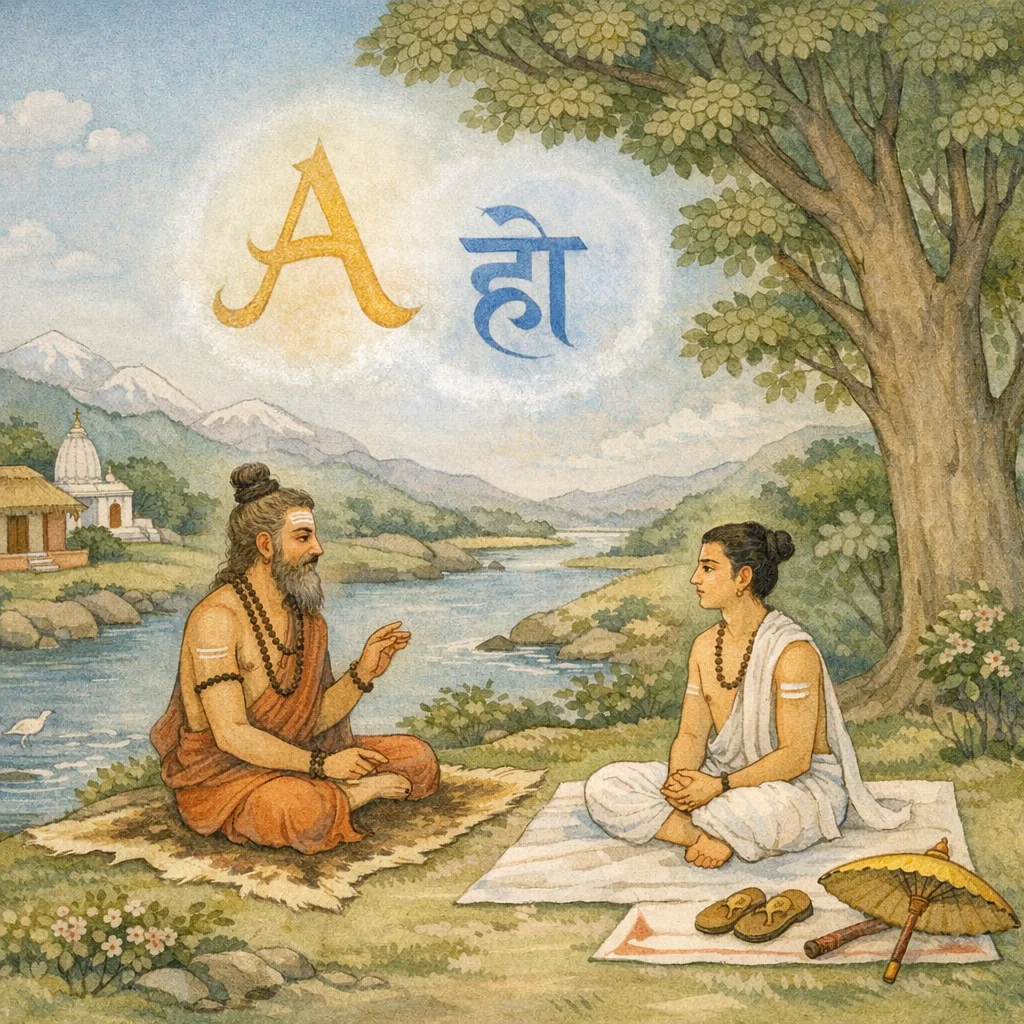
Śiva-Śakti Tattva, Varṇa-Rahasya, and Mahāvākya-Bhāvanā (Interpretive Discipline)
Adhyāya 19 gives a technical, instruction-focused teaching on Śiva–Śakti ontology and on disciplined contemplative interpretation (bhāvanā) of identity-statements akin to Upaniṣadic mahāvākyas. The sampled verses define the Supreme as Parameśvara, ensouled by Power, the referent of “aham” (I), and link phonemic principles to metaphysics: akāra is the supreme Śiva as illumination (prakāśa), while hakāra corresponds to the sky-like expanse and Śakti-nature. From their union arises ever-manifest bliss, and “Brahman” is clarified as the all-selfhood of Śiva–Śakti together. The text insists on correct syntactic and semantic alignment in contemplations such as “so’ham” and “sa tattvam asi,” warning that grammatical-gender mismatches and inverted meanings yield doctrinal incoherence. It also points to a guru-centered ritual setting (bestowal of an honorific name, umbrella, sandals), implying that metaphysical knowledge is transmitted within initiation etiquette. The sample closes with interpretive equivalences—“what is here is there”—affirming non-difference across loci when consciousness is recognized as one.
Shlokas
Verse 1
प्रज्ञानं ब्रह्मवाक्यार्थः पूर्वमेव प्रबोधितः । अहंपदस्यार्थभूतः शक्त्यात्मा परमेश्वरः
The meaning of the Brahma-utterance “prajñānaṃ brahma” has already been explained earlier. The Supreme Lord (Parameśvara)—whose very nature is Śakti—is the true import of the word “I” (ahaṃ).
Verse 2
अकारः सर्ववर्णाग्र्यः प्रकाशः परमः शिवः । हकारो व्योमरूपः स्याच्छक्त्यात्मा संप्रकीर्तितः
The syllable “A”—foremost among all sounds—is the supreme Light, Paramashiva Himself. The syllable “Ha” is said to be of the nature of space (vyoma) and is proclaimed as the very essence of Shakti.
Verse 3
शिवशक्त्योस्तु संयोगादानन्दः सततोदितः । ब्रह्मेति शिवशक्त्योस्तु सर्वात्मत्वमिति स्फुटम्
From the union of Śiva and Śakti, bliss ever arises unceasingly. And the term “Brahman” clearly denotes this truth: that Śiva and Śakti are the very Self of all.
Verse 4
पूर्वमेवोपदिष्टं तत्सोहमस्मीति भावयेत् । तत्त्वमित्यत्र तदिति सशब्दार्थः प्रबोधितः
One should contemplate exactly as previously instructed, “That—Śiva, the Supreme Lord—I am,” as an inner realization. In the statement “tattvam” (“That thou art”), the term “tat” (“That”) has been clearly explained along with its intended meaning.
Verse 5
अन्यथा सोऽहमित्यत्र विपरीतार्थभावना । अहंशब्दस्तु पुरुषस्तदिति स्यान्नपुंसकम् । एवमन्योन्यवैरुध्यादन्वयो नभवेत्तयोः
Otherwise, in the expression “so’ham” (“He am I”), the intended sense becomes inverted. The word “I” (aham) denotes a masculine person, whereas “that” (tad) is neuter. Thus, because of mutual incompatibility, no proper syntactic concord (anvaya) can be established between the two.
Verse 6
स्त्रीपुंरूपस्य जगतः कारणं चान्यथा भवेत् । स तत्त्वमसि इत्येवमुपदेशार्थभावना
If the cause of this universe—appearing in the forms of female and male—were other than That Supreme Reality, instruction would be futile. Therefore the contemplative purport of the teaching is expressed as: “Tat tvam asi—Thou art That (the Supreme Lord, Śiva).”
Verse 7
अयमात्मेति वाक्ये च पुंरूपं पदयुग्मकम् । ईशेन रक्षणीयत्वादीशावस्यमिदं जगत्
In the statement “This is the Self,” the pair of words appears in the masculine form. And since this universe is to be protected and governed by Īśa, therefore this entire world is pervaded by Īśa and belongs to Īśa.
Verse 8
प्रज्ञानात्मा यदेवेह तदमुत्रेति चिन्तयेत् । यः स एवेति विद्वद्भिस्सिद्धान्तिभिरिहोच्यते
One whose very Self is pure consciousness should contemplate thus: “Whatever is here, that indeed is there (beyond).” This is declared here by the learned exponents of Siddhānta as the truth that “he (the seeker) is verily That.”
Verse 9
उपरिस्थितवाक्ये च योऽमुत्र स इह स्थितः । इति पूर्ववदेवार्थः पुरुषो विदुषां मतः
In a sentence that speaks with reference to what is already established by the surrounding context, the one referred to as “there” is to be understood as the very same one “here.” Thus, as explained earlier, this is the intended meaning—such is the conclusion of the wise regarding the true Person (Puruṣa).
Verse 10
अन्यदेव तद्विदितादथो अविदितादपि । अस्मिन्वाक्ये फलस्यापि वैपरीत्यविभावना
He (Śiva), indeed, is other than what is known—and also other than what is unknown. In this very statement, even the ‘result’ promised by mere conceptual knowing is shown to be reversed—indicating that liberation is not produced by ordinary knowledge, but by direct realization of the Supreme Lord beyond all categories.
Verse 11
यथास्यात्तद्वदेवात्र वक्ष्यामि श्रूयतां मुने । अयथाविदिताछब्दो पूर्ववद्विदितादिति
O sage, listen. In this matter I shall speak exactly as it truly is. A word understood wrongly leads to error; but when understood rightly, it is as though it had been known from the beginning.
Verse 12
प्रवृत्तिस्स्यात्तद्विदितात्तथैवाविदितात्परम् । अन्यदेव हि संसिद्ध्यै न भवेदिति निश्चितम्
Right engagement (pravṛtti) arises from truly knowing That; and beyond the merely unknown stands the Supreme Reality. It is firmly concluded that for complete attainment (saṃsiddhi), no other deity can be the ultimate means.
Verse 13
एष त आत्मांतर्यामी योऽमृतश्च शिवस्स्वयम् । यश्चायम्पुरुषे शंभुर्यश्चादित्ये व्यवस्थितः
He indeed is your Inner Controller (Antaryāmin)—the deathless One, Śiva Himself. He is that Śambhu who abides within this person, and He is also the same Lord established in the Sun (Āditya).
Verse 14
स चाऽसौ सेति पार्थक्यं नैकं सर्वं स ईरितः । सोपाधिद्वयमस्यार्थ उपचारात्तथोच्यते
The distinction spoken of as “He and this” is not truly a second reality; the Lord alone is declared to be the All. Yet, since His meaning is taught in association with two limiting adjuncts (upādhis), this manner of description is employed only as a figurative instruction.
Verse 15
तं शम्भुनाथं श्रुतयो वदन्ति हि हिरण्मयम् । हिरण्य बाहव इति सर्वांगस्यो पलक्षलम्
The Vedas indeed proclaim Lord Śambhu to be “hiraṇmaya”—of golden, radiant splendour. The phrase “hiraṇya-bāhavaḥ” (golden-armed) is an indicative mark for His entire being, signifying the auspicious, all-pervading effulgence of all His limbs.
Verse 16
अन्यथा तत्पतित्वं तु न भवेदिति यत्नतः । य एषोन्तरिति शंभुश्छान्दोग्ये श्रूयते शिवः
Otherwise, His Lordship as the Supreme Pati would not be established. Therefore one should understand with due care that Śiva—Śambhu—who is heard of in the Chāndogya Upaniṣad as “He who is within,” is indeed that Supreme Lord.
Verse 17
हिरण्यश्मश्रुवांस्तद्वद्धिरण्यमयकेशवान् । नखमारभ्य केशाग्रा सर्वत्रापि हिरण्मयः
He had a golden beard, and likewise hair made of gold. From the nails up to the very tips of the hair, he was golden in every part—resplendent with a divine, auspicious radiance.
Verse 18
अहमस्मि परं ब्रह्म परापरपरात्परम् । इति वाक्यस्य तात्पर्यं वदामि श्रूयतामिदम्
“I am the Supreme Brahman—higher than both the transcendent and the immanent, indeed beyond even the beyond.” Now I shall state the intended purport of this declaration; listen to this.
Verse 19
इति श्रीशिवमहापुराणे षष्ठ्यां कैलाससंहितायां योगपट्टविधिवर्णनंनामैकोनविंशोऽध्यायः
Thus, in the Śrī Śiva Mahāpurāṇa, in the Sixth Book known as the Kailāsa-saṃhitā, ends the nineteenth chapter, entitled “The Description of the Procedure of the Yoga-strap (yogapaṭṭa).”
Verse 20
सर्वोत्कृष्टश्च सर्वात्मा परब्रह्म स ईरितः । परश्चाथापरश्चेति परात्परमिति त्रिधा
He is proclaimed as the Supreme Brahman—higher than all and the inner Self of all. That Supreme is described in a threefold way: as para (the Transcendent), as apara (the Immanent within manifestation), and as parātpara (the Transcendent beyond the transcendent).
Verse 21
रुद्रो ब्रह्मा च विष्णुश्च प्रोक्ताः श्रुत्यैव नान्यथा । तेभ्यश्च परमो देवः परशब्देन बोधितः
The Veda itself declares—without any other alternative—that Rudra, Brahmā, and Viṣṇu are thus spoken of. Yet the Supreme Deity, higher than them all, is indicated by the word “Para” (the Transcendent).
Verse 22
वेदशास्त्र गुरूणां च वाक्याभ्या सवशाच्छिशोः । पूर्णानन्दमयश्शंभुः प्रादुर्भूतो भवेद्धृदि
When a disciple becomes fully receptive—guided by the teachings of the Vedas and Śāstras and by the direct instruction of the Guru—Śambhu, who is of the very nature of perfect bliss, manifests within the heart.
Verse 23
सर्वभूतस्थितश्शम्भुस्स एवाहं न संशयः । तत्त्वजातस्य सर्वस्य प्राणोस्म्यहमहं शिवः
I am that Śambhu who abides within all beings—of this there is no doubt. Of the entire multitude of tattvas, I am the very life-breath (prāṇa); I am Śiva.
Verse 24
इत्युक्त्वा पुनरप्याह शिवस्तत्त्वत्रयस्य च । प्राणोस्मीत्यत्र पृथ्व्यादिगुणान्तग्रहणान्मुने
Having spoken thus, Śiva again explained the triad of realities. “I am Prāṇa, the life-breath,” he said; and in that statement, O sage, one should understand the concluding inclusion of the qualities beginning with earth—namely, the elemental and sensory attributes.
Verse 25
आत्मतत्त्वानि सर्वाणि गृहीतानीति भावय । पुनश्च सर्वग्रहणं विद्यातत्त्वशिवात्मनोः
Contemplate thus: “All the principles belonging to the Self have been comprehended.” And again, understand that total comprehension of reality is attained through the principle of Vidyā and through the very Self of Śiva.
Verse 26
तत्त्वयोश्चास्म्यहं प्राणास्सर्वस्स्सर्वात्मको ह्यहम् । जीवस्य चान्तर्यामित्वाज्जीवोऽहं तस्य सर्वदा
Among the principles (tattva) I am the vital breath (prāṇa); I am the All, for I am the Self abiding in all. And since I dwell as the inner Ruler (antaryāmin) of the individual soul, I am ever present within that jīva as its inmost reality.
Verse 27
यद्भूतं यच्च भव्यं यद्भविप्यत्सर्वमेव च । मन्मयत्वादहं सर्वः सर्वो वै रुद्र इत्यपि
Whatever has been, whatever is to be, and whatever will be—indeed all of it—because it is pervaded by Me, I am everything. Therefore it is also said: “All is Rudra.”
Verse 28
श्रुतिराह मुने सा हि साक्षाच्छिवमुखोद्गता । सर्वात्मा परमैरेभिर्गुणैर्नित्यसमन्वयात्
O sage, the Shruti (Veda) declares: it has truly issued directly from Shiva’s own mouth. Because He is the Self of all, He is eternally conjoined with the supreme qualities that uphold and illumine all.
Verse 29
स्वस्मात्परात्मविरहादद्वितीयोऽहमेव हि । सर्वं खल्विदं ब्रह्मेति वाक्यार्थः पूर्व्वमीरितः
Because there is no separation of the Supreme Self from one’s own Self, I alone am truly non-dual. Thus, the purport of the great statement—“Indeed, all this is Brahman”—has been declared earlier.
Verse 30
पूर्णोऽहं भावरूपत्वान्नित्यमुक्तोऽहमेव हि । पशवो मत्प्रसादेन मुक्ता मद्भावमाश्रिताः
“I am the Perfect One; by My very nature as pure Being-Consciousness, I am eternally free indeed. The bound souls (paśus), by My grace, become liberated and take refuge in My own state (My bhāva).”
Verse 31
योऽसौ सर्वात्मकश्शम्भुस्सोऽहं स शिवोऽस्म्यहम् । इति वै सर्ववाक्यार्थो वामदेव शिवोदितः
“That Śambhu who is the Self of all—He is I; I am that Śiva.” Thus indeed is the purport of all sacred statements, proclaimed by Śiva through Vāmadeva.
Verse 32
इतीशश्रुतिवाक्याभ्यामुपदिष्टार्थमादरात् । साक्षाच्छिवैक्यदं पुंसां शिशोगुरुरुपादिशेत्
Thus, with reverence, the teacher should instruct the child in the meaning taught by the Lord’s words and by the words of the Śruti—an instruction that directly grants human beings unity with Śiva.
Verse 33
आदाय शंखं साधारमस्त्रमन्त्रेण भस्मना । शोध्य तत्पुरतस्स्थाप्य चतुरस्रे समर्चिते
Taking the śaṅkha (conch), one should purify it with bhasma (sacred ash) by means of the Astra-mantra; then, placing it in front of the worship-seat within the duly worshipped square altar-space, one should proceed with the rite.
Verse 34
ओमित्यभ्यर्च्य गन्धाद्यैरस्त्रं वस्त्रोपशोभितम् । वासितं जलमापूर्य सम्पूज्योमिति मन्त्रतः
Worshipping the protective Astra with the utterance “Om,” and honoring it with fragrance and other offerings, adorning it with cloth, one should fill it with perfumed water and duly worship it again, in accordance with the mantra that begins with “Om.”
Verse 35
सप्तधैवाभिमंत्र्याथ प्रणवेन पुनश्च तम् । यस्त्वन्तरं किंचिदस्ति कुरुते त्यतिभीतिभाक्
Having consecrated it seven times, and again sanctified it with the Pranava (Oṁ), one should act without the least inner doubt; for whoever keeps even a small reservation within becomes a vessel of excessive fear.
Verse 36
इत्याह श्रुतिसत्तत्त्वं दृढात्मा गतभीर्भव । इत्याभाष्य स्वयं शिष्यं देवं ध्यायन्समर्चयेत्
Having thus taught the true essence established by the Vedas, the steadfast one said, “Be firm in spirit and free from fear.” Having spoken so, he should personally guide the disciple, meditate upon the Lord (Śiva), and worship Him with reverent offerings.
Verse 37
शिष्यासनं सम्प्रपूज्य षडुत्थापनमार्गतः । शिवासनं च संकल्प्य शिवमूर्तिं प्रकल्पयेत्
Having duly worshipped the disciple’s seat according to the sixfold method of raising (invocation and installation), one should then mentally resolve upon Śiva’s own seat and properly establish the sacred form (mūrti) of Śiva.
Verse 38
पञ्च ब्रह्माणि विन्यस्य शिरः पादावसानकम् । मुण्डवत्क्रकलाभेदैः प्रणवस्य कला अपि
Having performed nyāsa by placing the five Brahmas from the head down to the feet, and also the subtle divisions of the Pranava (Oṁ), distinguished in sections like the joints and segments of the body, one should contemplate the Lord pervading the entire form as the indwelling Śiva.
Verse 39
अष्टत्रिंशन्मंत्ररूपा श्शिष्यदेहेऽथ मस्तके । समावाह्य शिवं मुद्राः स्थापनीयाः प्रदर्शयेत्
Having invoked Śiva, the teacher should demonstrate and then establish the mudrās—formed as thirty-eight mantra-embodiments—upon the disciple’s body, and especially upon the head.
Verse 40
ततश्चाङ्गानि विन्यस्य सर्वज्ञानीत्यनुक्रमात् । कल्पयेदुपचारांश्च षोडशासनपूर्वकान्
Thereafter, having performed the nyāsa of the limbs in due sequence with the mantra beginning “Sarvajñānī…”, one should arrange the acts of worship—beginning with offering a seat—according to the sixteen traditional upacāras (services) for Lord Śiva.
Verse 41
पायसान्नञ्च नैवेद्यं समर्प्यो मग्निजायया । गण्डूषाचमनार्घ्यादि धूपदीपादिकं क्रमात्
Then, by the wife of the host, sweet rice (pāyasa) and other naivedya offerings should be duly presented; thereafter, in proper order, water for rinsing the mouth, water for ācamanīya sipping, the respectful arghya offering, and then incense, lamps, and the other items of worship should be offered step by step.
Verse 42
नामाष्टकेन सम्पूज्य ब्राह्मणैर्वेदपारगैः । जपेद्ब्रह्मविदाप्नोति भृगुर्वै वारुणिस्ततः
Having duly worshipped with the eight sacred Names, together with Brahmins who have mastered the Vedas, one should perform japa; thereby one attains the state of a knower of Brahman. Thereafter indeed Bhṛgu—Vāruṇi, the son of Varuṇa—attained it.
Verse 43
यो देवानामुपक्रम्यः यः परः स महेश्वरः । इत्यंतं तस्य पुरतः कह्लारादिविर्निताम्
“He who is foremost among the gods, who is the Supreme—He indeed is Maheśvara.” Thus, in his very presence, the utterance was concluded, expressed with lotus and other offerings.
Verse 44
आदाय मालामुत्थाय श्रीविरूपाक्ष निर्मिते । शास्त्रे पंचाशिके रूपे सिद्धिस्कन्धं जपेच्छनैः
Taking up the rosary and rising for worship, one should gently and steadily perform japa of the “Siddhi-skandha,” as taught in the scripture of fifty verses composed by the venerable Virūpākṣa.
Verse 45
ख्यातिः पूर्णोहमित्यंतं सानुकूलेन चेतसा । देशिकस्तस्य शिष्यस्य कण्ठदेशे समर्पयेत्
With a mind made receptive and harmonious, the Guru should confer upon that disciple—at the region of the throat—the inner realization that culminates in the awareness, “I am the Full (Pūrṇa).”
Verse 46
तिलकं वन्दनेनाथ सर्वाङ्गालेपनं पुनः । स्वसम्प्रदायानुगुणं कारयेच्च यथाविधि
Then, O Lord, after offering salutations, one should again apply the tilaka and anoint the whole body, performing it properly according to the rules and in a manner consistent with one’s own Shaiva tradition.
Verse 48
व्याख्यातत्वञ्च कर्म्मादिगुर्वासनपरिग्रहम् । अनुगृह्य गुरुस्तस्मै शिष्याय शिवरूपिणे
Having compassionately instructed him in the true purport, and having conferred the guru’s own discipline—beginning with the prescribed rites and observances—the Guru, out of grace, bestowed it upon that disciple, who was of the very form of Śiva.
Verse 49
शिवोहमस्मीति सदा समाधिस्थो भवेति तम् । सम्प्रोच्याथ स्वयं तस्मै नमस्कारं समाचरेत्
Having instructed him, “I am Śiva,” one should tell him to remain ever established in samādhi; and then, oneself, one should duly offer salutations (namaskāra) to him.
Verse 50
सम्प्रदायानुगुण्येन नमस्कुर्युस्तथापरे । शिष्यस्तदा समुत्थाय नमस्कुर्याद्गुरुन्तथा । गुरोरपि गुरुं तस्य शिष्यांश्च स्वगुरोरपि
In keeping with the custom of one’s own lineage (sampradāya), others too should offer salutations. Then the disciple, rising, should bow to the Guru; and he should also bow to the Guru’s Guru, and to the fellow disciples of his own Guru.
Verse 51
एवं कृतनमस्कारं शिष्यन्दद्याद्गुरुः स्वयम् । सुशीलं यतवाचं तं विनयावनतं स्थितम्
Thus, when the disciple has duly offered salutations, the Guru himself should instruct him—one of good conduct, restrained in speech, who stands humbly, bowed in reverence.
Verse 52
अद्यप्रभृति लोकानामनुग्रहपरो भव । परीक्ष्य वत्सरं शिष्यमंगीकुरु विधानतः
“From this day onward, be devoted to the welfare and uplift of people. After testing the disciple for a full year, accept him formally according to the prescribed rule.”
Verse 53
रागादिदोषान्संत्यज्य शिवध्यानपरो भव । सत्सम्प्रदायसंसिद्धैस्संगं कुरु न चेतरैः
Abandon the faults beginning with attachment (rāga) and become wholly devoted to meditation on Śiva. Keep company with those perfected in the true lineage (sat-sampradāya), and not with others.
Verse 54
अनभ्यर्च्य शिवं जातुमा भुंक्ष्वाप्राण संक्षयम् । गुरुभक्तिं समास्थाय सुखी भव सुखी भव
Never eat without first worshipping Lord Śiva—lest your very life-force be diminished. Abide in devotion to the Guru; then be happy—be happy.
Verse 55
इति क्रमाद्गुरुवरो दयालुर्ज्ञानसागरः । सानुकूलेन चित्तेन समं शिष्यं समाचरेत्
Thus, step by step, the excellent Guru—compassionate and an ocean of spiritual knowledge—should guide and train the disciple with a favorable, supportive mind, treating the disciple with evenness and fairness.
Verse 56
तव स्नेहान्मयायं वै वामदेव मुनीश्वर । योगपट्टप्रकारस्ते प्रोक्तो गुह्यतरोऽपि हि
O Vāmadeva, lord among sages—out of affection for you I have indeed explained this method of the yogapaṭṭa (the yogic support-belt/seat); for it is a teaching that is exceedingly secret.
Verse 57
इत्युक्त्वा षण्मुखस्तस्मै क्षौरस्नानविधिक्रमम् । वक्तुमारभत प्रीत्या यतीनां कृपया शुभम्
Having said thus, Ṣaṇmukha (Kārttikeya) joyfully began to explain to him—out of compassionate concern for ascetics—the auspicious procedure and sequence for shaving and ritual bathing.
Frequently Asked Questions
Rather than a narrative ‘leela,’ the chapter advances a theological-interpretive argument: identity-formulas such as “so’ham” and “sa tattvam asi” must be contemplated with correct meaning and syntactic coherence; otherwise, the intended teaching of Śiva-Śakti all-selfhood (sarvātmatva) collapses into contradiction.
The rahasya lies in mapping phoneme and metaphysics: akāra functions as a symbol of Śiva as prakāśa (self-luminous consciousness), while hakāra is linked to vyoma-like expanse and Śakti-nature; their inseparability explains bliss (ānanda) and the Purāṇic framing of ‘Brahman’ as the unified Śiva-Śakti reality.
The chapter highlights Śiva as Parameśvara characterized by prakāśa (illumination) and as the referent of ‘aham’ (I), together with Śakti as the inseparable power-principle; the emphasis is doctrinal (Śiva-Śakti tattva) rather than on a named iconographic form (e.g., a specific mūrti or avatāra).