Sarga 27
त्रिजटास्वप्नवर्णनम् (Trijata’s Dream-Omens and the Rakshasis’ Reversal)
सुन्दरकाण्ड
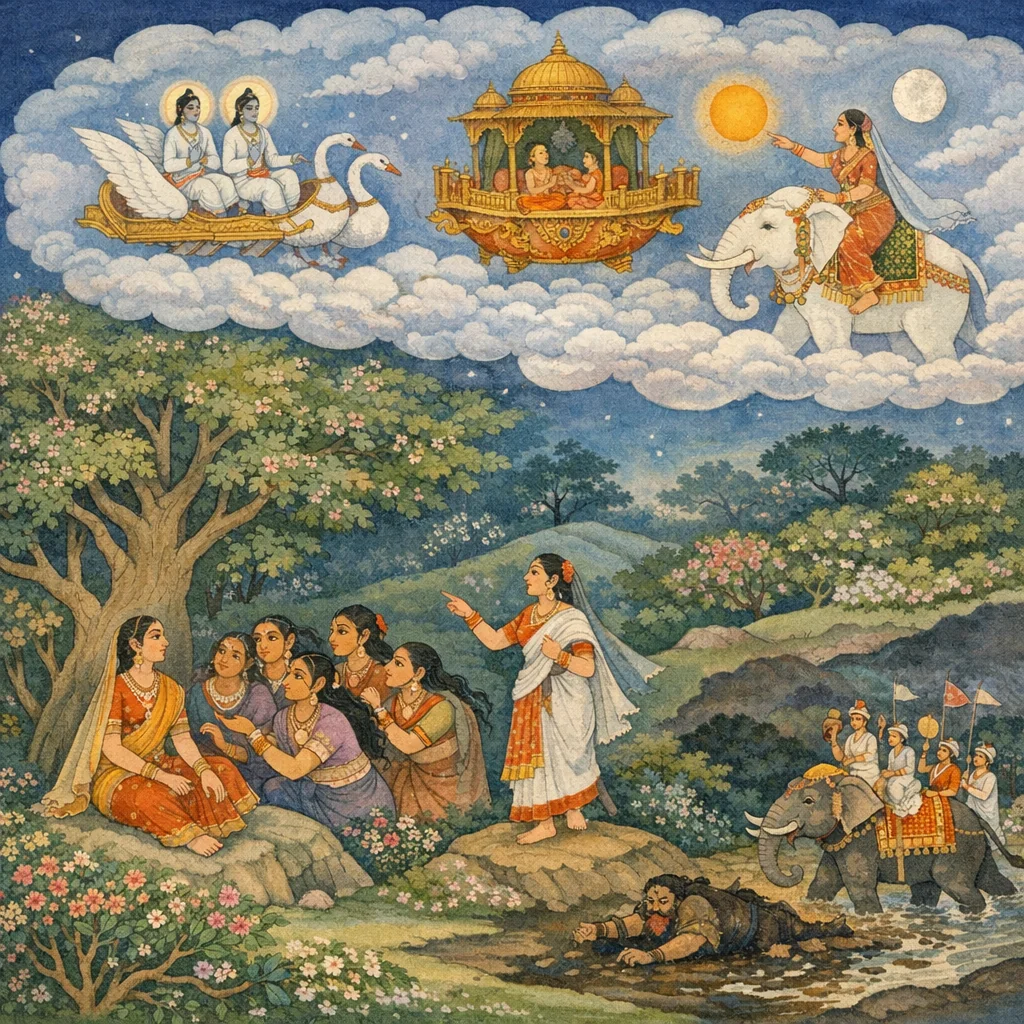
After Sītā’s firm rebuke, some enraged rākṣasīs go to report to Rāvaṇa, while others return to threaten her with immediate violence. At that moment the aged rākṣasī Trijaṭā intervenes and halts the escalation by recounting a dream—terrifying in form yet auspicious in meaning. In her vision, Rāma and Lakṣmaṇa appear radiant and clad in white, arriving in celestial conveyances: first an ivory palanquin drawn by swans, and then the Puṣpaka vimāna. Sītā is seen reunited with Rāma, raised upon a great elephant, and in cosmic play she touches the Moon and the Sun, signifying the restoration of right order. The dream then turns to ominous images of Rāvaṇa: smeared with oil, intoxicated, fallen from Puṣpaka, dragged southward—the direction of Yama—riding ignoble mounts (boar or donkey), and sinking into filth and darkness. The ill omen extends to Kumbhakarṇa and Rāvaṇa’s sons, while Vibhīṣaṇa alone is marked by white auspicious regalia and elevation on a four-tusked elephant amid celebratory sounds. Trijaṭā interprets these nimittas as the near fulfilment for Vaidehī, the demon-king’s destruction, and Rāma’s victory; she urges the rākṣasīs to abandon cruelty, seek pardon, and speak with conciliation. The chapter closes with embodied auspicious signs in Sītā—throbbing of eye and limbs, trembling of the thigh—and a bird repeating sweet notes as if prompting rejoicing. Thus the narrative turns from coercion to accountability under the approaching consequence of dharma.
Shlokas
Verse 1
इत्युक्तास्सीतया घोरं राक्षस्यः क्रोधमूर्छिताः।काश्चिज्जग्मुस्तदाख्यातुं रावणस्य तरस्विनः।।5.27.1।।
Thus addressed by Sītā, some of the terrifying rākṣasī-women—faint with rage—went to report it to swift-acting Rāvaṇa.
Verse 2
ततः सीतामुपागम्य राक्षस्यो घोरदर्शनाः।पुनः परुषमेकार्थमनर्थार्थमथाब्रुवन्।।5.27.2।।
Then the dreadful-looking rākṣasī women approached Sītā once more and spoke harshly, uttering a blunt, single-pointed threat that foretold grievous harm.
Verse 3
अद्येदानीं तवानार्ये सीते पापविनिश्चये।राक्षस्यो भक्षयिष्यन्ति मांसमेतद्यथासुखम्।।5.27.3।।
“O Sītā—ignoble one, fixed in sinful resolve—today, right now, these rākṣasī-women will devour this flesh of yours at their pleasure.”
Verse 4
सीतां ताभिरनार्याभिर्दृष्टवा सन्तर्जितां तदा।राक्षसी त्रिजटा वृद्धा शयाना वाक्यमब्रवीत्।।5.27.4।।
Then, seeing Sītā being threatened by those ignoble rākṣasī-women, the aged demoness Trijaṭā, lying there, spoke these words.
Verse 5
आत्मानं खादतानार्या न सीतां भक्षयिष्यथ।जनकस्य सुतामिष्टां स्नुषां दशरथस्य च।।5.27.5।।
Devour your own selves, O ignoble ones, if you must—but you shall not devour Sītā: Janaka’s beloved daughter and Daśaratha’s daughter-in-law.
Verse 6
स्वप्नो ह्यद्य मया दृष्टो दारुणो रोमहर्षणः।राक्षसानामभावाय भर्तुरस्या भवाय च।।5.27.6।।
Today I saw a dreadful, hair-raising dream—foretelling the destruction of the rākṣasas and the triumph of her husband.
Verse 7
एवमुक्तास्त्रिजटया राक्षस्यः क्रोधमूर्छिताः। सर्वा एवाब्रुवन्भीतास्त्रिजटां तामिदं वचः।।5.27.7।।
Thus addressed by Trijaṭā, the rākṣasī women—beside themselves with anger, yet afraid—together spoke these words to her.
Verse 8
कथयस्व त्वया दृष्टः स्वप्नोऽयं कीदृशो निशि।तासां श्रुत्वा तु वचनं राक्षसीनां मुखाच्युतम्।।5.27.8।।उवच वचनं काले त्रिजटा स्वप्नसंश्रितम्।
“Tell us—what kind of dream did you see at night?” Hearing the words that fell from the rākṣasīs’ mouths, Trijaṭā then spoke, at the proper time, words founded upon that dream.
Verse 9
गजदन्तमयीं दिव्यां शिबिकामन्तरिक्षगाम्।।5.27.9।।युक्तां हंससहस्रेण स्वयमास्थाय राघवः।शुक्लमाल्याम्बरधरो लक्ष्मणेन सहागतः।।5.27.10।।
Rāghava (Rāma) himself ascended a divine palanquin made of ivory, moving through the sky, yoked to a thousand swans; wearing white garlands and white garments, he arrived together with Lakṣmaṇa.
Verse 10
गजदन्तमयीं दिव्यां शिबिकामन्तरिक्षगाम्।।5.27.9।।युक्तां हंससहस्रेण स्वयमास्थाय राघवः।शुक्लमाल्याम्बरधरो लक्ष्मणेन सहागतः।।5.27.10।।
Rāghava himself, wearing a white garland and white garments, mounted a palanquin yoked to a thousand swans and arrived together with Lakṣmaṇa.
Verse 11
स्वप्ने चाद्य मया दृष्टा सीता शुक्लाम्बरावृता।सागरेण परिक्षिप्तं श्वेतं पर्वतमास्थिता।।5.27.11।।
And today, in a dream, I beheld Sītā clad in white, standing upon a white mountain encircled by the ocean.
Verse 12
रामेण सङ्गता सीता भास्करेण प्रभा यथा।राघवश्च मया दृष्टश्चतुर्दष्ट्रं महागजम्।।5.27.12।।आरूढ श्शैलसङ्काशं चचार सहलक्ष्मणः।
As radiance is united with the sun, so was Sītā united with Rāma. I also beheld Rāghava with Lakṣmaṇa, riding a vast, mountain-like elephant with four tusks, moving onward.
Verse 13
ततस्तौ नरशार्दूलौ दीप्यमानौ स्वतेजसा।।5.27.13।।शुक्लमाल्याम्बरधरौ जानकीं पर्युपस्थितौ।
Then those two tiger-like heroes among men, radiant with their own splendor and clad in white garlands and garments, drew near to Jānakī.
Verse 14
ततस्तस्य नगस्याग्रे ह्याकाशस्थस्य दन्तिनः।।5.27.14।।भर्त्रा परिगृहीतस्य जानकी स्कन्धमाश्रिता।
Then, before that mountain, Jānakī took her place upon the shoulder of an elephant poised in the sky, held and steadied by her husband.
Verse 15
भर्तुरङ्कात्समुत्पत्य ततः कमललोचना।।5.27.15।।चन्द्रसूर्यौ मया दृष्टा पाणिना परिमार्जती।
Then I beheld the lotus-eyed lady spring up from her husband’s lap and, with her hand, gently stroke the Moon and the Sun.
Verse 16
ततस्ताभ्यां कुमाराभ्यामास्थित: स गजोत्तमः।।5.27.16।।सीतया च विशालाक्ष्या लङ्काया उपरिस्थितः।
Then that finest of elephants, mounted by the two princes and by large-eyed Sītā, stood above Laṅkā.
Verse 17
पाण्डुरर्षभयुक्तेन रथेनाष्टयुजा स्वयम्।।5.27.17।।इहोपयातः काकुत्स्थ स्सीतया सह भार्यया।
Kākutstha himself arrived here with his wife Sītā, riding a chariot drawn by eight pale-white bulls.
Verse 18
लक्ष्मणेन सह भ्रात्रा सीतया सह वीर्यवान्।।5.27.18।।आरुह्य पुष्पकं दिव्यं विमानं सूर्यसन्निभम्।उत्तरां दिशमालोक्य जगाम पुरुषोत्तमः।।5.27.19।।
Valiant Rāma, the best of men, together with his brother Lakṣmaṇa and with Sītā, ascended the wondrous Puṣpaka—an aerial car resplendent like the Sun—and, looking toward the northern quarter, departed.
Verse 19
लक्ष्मणेन सह भ्रात्रा सीतया सह वीर्यवान्।।5.27.18।।आरुह्य पुष्पकं दिव्यं विमानं सूर्यसन्निभम्।उत्तरां दिशमालोक्य जगाम पुरुषोत्तमः।।5.27.19।।
Valiant Rāma, the best of men, together with his brother Lakṣmaṇa and with Sītā, ascended the wondrous Puṣpaka—an aerial car resplendent like the Sun—and, looking toward the northern quarter, departed.
Verse 20
एवं स्वप्ने मया दृष्टो रामो विष्णुपराक्रमः।लक्ष्मणेन सह भ्रात्रा सीतया सह राघवः।।5.27.20।।
Thus, in a dream, I beheld Rāghava Rāma—mighty in valor like Viṣṇu—together with his brother Lakṣmaṇa and with Sītā.
Verse 21
न हि रामो महातेजाश्शक्यो जेतुं सुरासुरैः।राक्षसैर्वापि चान्यैर्वा स्वर्गः पापजनैरिव।।5.27.21।।
For Rāma, blazing with great splendor, cannot be overcome—by gods and asuras alike, nor by rākṣasas or any others—just as heaven cannot be attained by the sinful.
Verse 22
रावणश्च मया दृष्टः क्षितौ तैलसमुक्षितः।रक्तवासाः पिबन्मत्तः करवीरकृतस्रजः।।5.27.22।।
“I saw Rāvaṇa lying on the ground, smeared with oil—clad in red, wearing a garland of karavīra-flowers, and drunken from drinking.”
Verse 23
विमानात्पुष्पकादद्य रावणः पतितो भुवि।कृष्यमाणः स्त्रिया दृष्टो मुण्डः कृष्णाम्बरः पुनः।।5.27.23।।
“Again, today I saw Rāvaṇa: fallen from the Puṣpaka aerial car onto the earth—shaven-headed, dressed in black, and being dragged by a woman.”
Verse 24
रथेन खरयुक्तेन रक्तमाल्यानुलेपनः।पिपंस्तैलं हसन्नृत्यन् भ्रान्तचित्ताकुलेन्द्रियः।।5.27.24।।
He rode upon a chariot yoked to donkeys, adorned with red garlands and anointed with unguents; drinking oil, laughing and dancing—his mind bewildered and his senses disordered.
Verse 25
गर्दभेन ययौ शीघ्रं दक्षिणां दिशमास्थितः।पुनरेव मया दृष्टो रावणो राक्षसेश्वरः।।5.27.25।।पतितोऽ वाक्चिरा रा भूमौ गर्दभाद्भयमोहितः।
He went swiftly toward the southern quarter upon a donkey. Again I saw Rāvaṇa, lord of the rākṣasas; then, deluded by fear of that donkey, he fell upon the ground with his head bowed.
Verse 26
सहसोत्थाय संभ्रान्तो भयार्तो मदविह्वलः।।5.27.26।।उन्मत्त इव दिग्वासा दुर्वाक्यं प्रलपन्बहु।दुर्गन्धं दुस्सहं घोरं तिमिरं नरकोपमम्।।5.27.27।।मलपङ्कं प्रविश्याशु मग्नस्तत्र स रावणः।
Rāvaṇa sprang up at once—bewildered, stricken with fear, and reeling with intoxication. Like a madman, naked, he babbled many vile words; then he rushed into a foul, unbearable, dreadful darkness like hell, entered a mire of filth, and there he sank down.
Verse 27
सहसोत्थाय संभ्रान्तो भयार्तो मदविह्वलः।।5.27.26।।उन्मत्त इव दिग्वासा दुर्वाक्यं प्रलपन्बहु।दुर्गन्धं दुस्सहं घोरं तिमिरं नरकोपमम्।।5.27.27।।मलपङ्कं प्रविश्याशु मग्नस्तत्र स रावणः।
Rāvaṇa sprang up at once—bewildered, stricken with fear, and reeling with intoxication. Like a madman, naked, he babbled many vile words; then he rushed into a foul, unbearable, dreadful darkness like hell, entered a mire of filth, and there he sank down.
Verse 28
कण्ठे बद्ध्वा दशग्रीवं प्रमदा रक्तवासिनी।।5.27.28।। काली कर्दमलिप्ताङ्गी दिशं याम्यां प्रकर्षति।
A woman—clad in red, dark in hue, her limbs smeared with mud—bound Daśagrīva by the neck and dragged him toward the southern quarter, the realm of Yama.
Verse 29
एवं तत्र मया दृष्टः कुम्भकर्णो निशाचरः।।5.27.29।।रावणस्य सुतास्सर्वे दृष्टास्तैलसमुक्षिताः।
In the same manner, there I saw Kumbhakarṇa, the night-roamer; and I saw all of Rāvaṇa’s sons as well, their bodies smeared with oil.
Verse 30
वराहेण दशग्रीवश्शिंशुमारेण चेन्द्रजित्।।5.27.30।।उष्ट्रेण कुम्भकर्णश्च प्रयाता दक्षिणां दिशम्।
Daśagrīva set forth mounted on a boar; Indrajit on a śiṁśumāra; and Kumbhakarṇa on a camel—departing toward the southern quarter.
Verse 31
एकस्तत्र मया दृष्टः श्वेतच्छत्रो विभीषणः।।5.27.31।।शुक्लमाल्याम्बरधरः शुक्लगन्धानुलेपनः।
There I saw Vibhīṣaṇa alone, beneath a white umbrella—wearing white garlands and garments, and anointed with white sandal-paste.
Verse 32
शङ्खदुन्धुभिनिर्घोषैर्नृत्तगीतैरलङ्कृतः।।5.27.32।।आरुह्य शैलसङ्काशं मेघस्तनितनिस्स्वनम्।चतुर्दन्तं गजं दिव्यमास्ते तत्र विभीषणः।।5.27.33।।चतुर्भिस्सचिवैः सार्थं वैहायसमुपस्थितः।
He was honored with the blare of conches and drums, and adorned with dance and song.
Verse 33
शङ्खदुन्धुभिनिर्घोषैर्नृत्तगीतैरलङ्कृतः।।5.27.32।।आरुह्य शैलसङ्काशं मेघस्तनितनिस्स्वनम्।चतुर्दन्तं गजं दिव्यमास्ते तत्र विभीषणः।।5.27.33।।चतुर्भिस्सचिवैः सार्थं वैहायसमुपस्थितः।
Mounting a divine four-tusked elephant—mountain-like and roaring like thunder-clouds—Vibhīṣaṇa, accompanied by four ministers, rose into the sky.
Verse 34
समाजश्च मया दृष्टो गीतवादित्रनिःस्वनः।।5.27.34।। पिबतां रक्तमाल्यानां रक्षसां रक्तवाससाम्।
I also saw a gathered crowd of rākṣasas, noisy with singing and instruments, drinking, wearing red garlands and red garments.
Verse 35
लङ्का चेयं पुरी रम्या सवाजिरथकुञ्जराः।।5.27.35।।सागरे पतिता दृष्टा भग्नगोपुरतोरणा।
This lovely city of Laṅkā—with its horses, chariots, and elephants—I saw fallen into the sea, its gatehouses and archways shattered.
Verse 36
लङ्का दृष्टा मया स्वप्ने रावणेनाभिरक्षिता।।5.27.36।। दग्धा रामस्य दूतेन वानरेण तरस्विना।
In my dream I saw Laṅkā—though guarded by Rāvaṇa—burned by a powerful vānara, the messenger of Rāma.
Verse 37
पीत्वा तैलं प्रनृत्ताश्च प्रहसन्त्यो महास्वनाः।।5.27.37।। लङ्कायां भस्मरूक्षायां सर्वा राक्षसस्त्रियः।
In Laṅkā, now dry and ashen, all the rākṣasa-women, having drunk oil, were dancing, laughing, and shouting loudly.
Verse 39
अपगच्छत नश्यध्वं सीतामाप्नोति राघवः।।5.27.39।।घातयेत्परमामर्षी युष्मान्सार्थं हि राक्षसैः।
Depart at once, or you will perish. Rāghava will regain Sītā, and in his utmost wrath he will destroy you together with the rākṣasas.
Verse 40
प्रियां बहुमतां भार्यां वनवासमनुव्रताम्।।5.27.40।।भर्त्सितां तर्जितां वापि नानुमंस्यति राघवः।
Rāghava will not tolerate it—whether she is abused or even threatened—his beloved, highly honored wife who followed him into forest-exile.
Verse 41
तदलं क्रूरवाक्यैश्च सान्त्वमेवाभिधीयताम्।।5.27.41।।अभियाचाम वैदेहीमेतद्धि मम रोचते।
Enough of cruel speech; let only conciliatory words be spoken. Let us beg Vaidehī for pardon—this is the course I approve.
Verse 42
यस्यामेवंविधः स्वप्नो दुःखितायां प्रदृश्यते।।5.27.42।।सा दुःखैर्विविधैर्मुक्ता प्रियं प्राप्नोत्यनुत्तमम्।
When a woman who is in sorrow sees a dream of this kind, she is freed from many kinds of grief and attains unsurpassed happiness.
Verse 43
भर्त्सितामपि याचध्वं राक्षस्यः किं विवक्षया।।5.27.43।।राघवाद्धि भयं घोरं राक्षसानामुपस्थितम्।
O rākṣasīs, even though you had threatened her, beg her now—what need is there for hesitation? For from Rāghava a dreadful fear has come upon the rākṣasas.
Verse 44
प्रणिपातप्रसन्ना हि मैथिली जनकात्मजा।।5.27.44।।अलमेषा परित्रातुं राक्षस्यो महतो भयात्।
For Maithilī, Janaka’s daughter, is gracious to one who bows down in humble submission; she is able, O rākṣasīs, to save you from great fear.
Verse 45
अपि चास्या विशालाक्ष्या न किंचिदुपलक्षये।।5.27.45।।विरूपमपि चाङ्गेषु सुसूक्ष्ममपि लक्षणम्।
And moreover, in this large-eyed lady I perceive not even the slightest inauspicious mark—no deformity or ill-sign, not even subtle, upon her limbs.
Verse 46
छायावैगुण्यमात्रं तु शङ्के दुःखमुपस्थितम्।।5.27.46।। अदुःखार्हामिमां देवीं वैहायसमुपस्थिताम्।
I think I see only a slight loss of luster—signaling that sorrow has come upon this noble lady who does not deserve to suffer, her complexion altered by distress.
Verse 47
अर्थसिद्धिं तु वैदेह्याः पश्याम्यहमुपस्थिताम्।।5.27.47।।राक्षसेन्द्रविनाशं च विजयं राघवस्य च।
I see the fulfilment of Vaidehī’s cause drawing near; and I also see the destruction of the lord of rākṣasas and the victory of Rāghava.
Verse 48
निमित्तभूतमेतत्तु श्रोतुमस्या महत्प्रियम्।।5.27.48।।दृश्यते च स्फुरच्चक्षुः पद्मपत्रमिवायतम्।
This has indeed become an omen that she will hear great glad tidings; and her eye—long like a lotus petal—is seen to throb.
Verse 49
ईषच्छ हृषितो वास्या दक्षिणाया ह्यदक्षिणः।।5.27.49।।अकस्मादेव वैदेह्या बाहुरेकः प्रकम्पते।
As if slightly gladdened, Vaidehī’s left arm—though she is a lady of auspicious fortune—suddenly began to tremble.
Verse 50
करेणुहस्तप्रतिम स्सव्यश्चोरुरनुत्तमः।।5.27.50।।वेपमानः सूचयति राघवं पुरतः स्थितम्।
Her excellent left thigh—like the trunk of a female elephant—trembled, as though pointing out that Rāghava (Rāma) was standing before her.
Verse 51
पक्षी च शाखानिलयं प्रविष्टःपुनः पुनश्चोत्तमसान्त्ववादी।सुस्वागतां वाचमुदीरयानः पुनःपुनश्चोदयतीव हृष्टः।।5.27.51।।
And a bird, entering again and again its leafy shelter among the branches, uttered excellent soothing notes—voicing words of welcome, as though joyfully urging her again and again to take heart.
Frequently Asked Questions
The rākṣasīs face a dharma-crisis: whether to execute coercive violence against a captive (Sītā) or restrain themselves. Trijaṭā’s intervention redirects them from cruelty to conciliation and seeking pardon, framing violence as self-destructive under approaching moral consequence.
Nimitta (omens) functions as ethical cognition: signs are meaningful when they prompt right action—restraint, accountability, and alignment with dharma. Even antagonists are urged to choose repentance over escalation when confronted with the inevitability of just outcomes.
Laṅkā and the sāgara (ocean) appear as key spatial markers; the southern direction (Yama-dik) operates as a cultural map of inauspicious destiny. Iconic objects—Puṣpaka vimāna, ivory palanquin, four-tusked elephant, conches and drums—encode royal legitimacy and its reversal.